

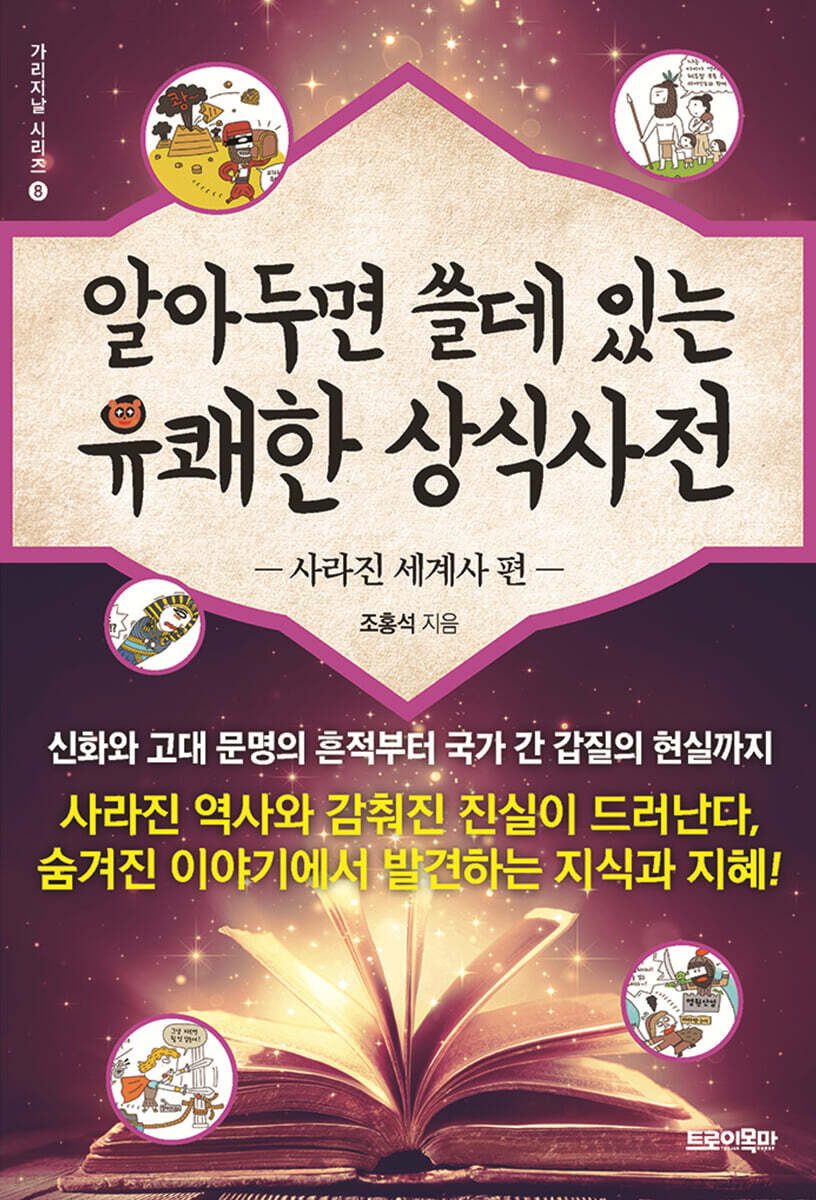
A Useful Dictionary of Entertaining Common Sense: Lost World History
 |
Description
Book Introduction
“A real story that has disappeared from human history is stirring. “A unique world history exploration in search of traces and secrets!” The eighth story in the Garijinal series, revealing surprising facts 99% don't know. Starting from the question, "Is the common sense I know really true?", the eighth book in the "Garigenal Series" (a common sense dictionary series that reveals in detail that the common sense that most people think of as "original" is actually "fake original," that is, garijinal, and explains the origin and history of original knowledge) compiled by digging through numerous books, various research materials, newspapers, and broadcasts has been published. The series' first volume, 'Daily Life', second volume, 'Science and Economy', third volume, 'Language and Art', fourth volume, 'Korean History', fifth volume, 'First and Best', sixth volume, 'Korean Language and Writing', and seventh volume, 'Unusual Domestic Travel', were loved by numerous readers as informative books that provided fun and knowledge. In this eighth volume, the 'Lost World History' has been published, which uncovers traces and secrets of human history that have disappeared and been hidden for various reasons. The 『Useful Dictionary of Common Sense』 series published so far is the result of the author's accumulated experience of reading and studying various media, including books, broadcasts, papers, and newspapers, in various fields for over 30 years, and his long-term efforts to convey difficult and fragmented knowledge in an easy, fun, and three-dimensional way. In this newly published book, the author presents various traces that prove that stories passed down orally as myths and tales are actually facts experienced by mankind, and digs into ancient civilizations that were much larger and more advanced than we expected, introduces not only the dark history of historical distortion that occurred in various countries during the Middle Ages, but also the tragedy of imperialist history that brutally exploited the American and African continents, and finally, tells an interesting story from a surprising and unique perspective about the shameless bullying behavior of powerful countries that continues to the present day. The book contains not only the story of the great flood, famous as the myth of 'Noah's Ark', but also the story of the great drought, in which many suns rose in the sky and all living things were drying up and dying, and an arrow was shot to bring down the suns to overcome the crisis, which is passed down orally in similar stories all over the world; the enormous traces of the Mesopotamian, Egyptian, Greek, and Indus civilizations, which are gradually being revealed as relics and ruins are gradually being discovered since the so-called recorded history began; the reality of the distortion of history during the Middle Ages that many countries want to hide; the sad history of the brutal exploitation of the American and African continents by the European countries that ushered in the era of imperialism and the fight and resistance against them; and the tyranny of great powers that continues to this day, such as in Iceland, England, France, Algeria, Greenland, and Denmark. Through this book, readers can learn about the fierce and splendid history of weak and neighboring countries, which they have not been aware of or indifferent to because they did not learn about it in world history classes, as well as the dark truths of history that so-called powerful countries like Europe, the United States, and China want to hide. Furthermore, by rediscovering various cultural and historical traces that have intertwined with the history of the Korean Peninsula from ancient civilizations to the present day, but were not well known because they were not taught in Korean history classes, we can look into the warp and weft of Korean and world history together. The author is evaluated by numerous readers as a Korean-style knowledge curator and the "Korean Bill Bryson" by questioning the so-called common sense that 99% of people believe without question, finding the source of knowledge and delivering a surprising story. Furthermore, believing that "all knowledge is interconnected, not isolated," we strive to provide readers with small insights that allow them to explore the three-dimensional connections between diverse knowledge sources, rather than simply providing fragmented knowledge. |
- You can preview some of the book's contents.
Preview
index
Entering
| Part 1 | In Search of Lost Stories from Before History
01 Memories of the Great Flood - Why did they go to the mountains?
02 Memories of the Great Drought - Why did the hero have to shoot the sun?
| Part 2 | Ancient Civilizations, In Search of Hidden Stories
01 The Secret of the Silla Gold Crown, Connected to Mesopotamian Civilization
02 The Origin of Cat Butlers: Egyptian Civilization
03 Greek civilization, loved only by Westerners
04 Ganges Civilization over Indus Civilization
| Part 3 | In Search of Stories Wanted to Be Hidden in the Middle Ages
01 Mulan, if you tell a lie too many times, does it become the truth?
02 We also abuse our power whenever we get the chance: The Vietnam and Champa Wars
03 The British Royal Family's Ancestor Swap Project
04 Another Crusade Story I Don't Want You to Know
| Part 4 | In Search of Sad Stories from the Age of Imperialism
01 Who was the first person to discover the American continent?
02 What is the truth behind the fall of the Aztec Empire?
03 Another country in America, Texas
04 Flame Queen Nzinga, a symbol of African resistance
| Part 5 | The Modern Age: A History of Abuse That Still Never Ends
01 Iceland's Independence: Turning Crisis into Opportunity
02 The long-standing feud between France and Algeria
In conclusion
References
| Part 1 | In Search of Lost Stories from Before History
01 Memories of the Great Flood - Why did they go to the mountains?
02 Memories of the Great Drought - Why did the hero have to shoot the sun?
| Part 2 | Ancient Civilizations, In Search of Hidden Stories
01 The Secret of the Silla Gold Crown, Connected to Mesopotamian Civilization
02 The Origin of Cat Butlers: Egyptian Civilization
03 Greek civilization, loved only by Westerners
04 Ganges Civilization over Indus Civilization
| Part 3 | In Search of Stories Wanted to Be Hidden in the Middle Ages
01 Mulan, if you tell a lie too many times, does it become the truth?
02 We also abuse our power whenever we get the chance: The Vietnam and Champa Wars
03 The British Royal Family's Ancestor Swap Project
04 Another Crusade Story I Don't Want You to Know
| Part 4 | In Search of Sad Stories from the Age of Imperialism
01 Who was the first person to discover the American continent?
02 What is the truth behind the fall of the Aztec Empire?
03 Another country in America, Texas
04 Flame Queen Nzinga, a symbol of African resistance
| Part 5 | The Modern Age: A History of Abuse That Still Never Ends
01 Iceland's Independence: Turning Crisis into Opportunity
02 The long-standing feud between France and Algeria
In conclusion
References
Detailed image

Into the book
Part 1 introduces the prehistoric world history that has not been recorded but has been revealed through recent scientific analysis.
Part 2 introduces ancient civilizations that are little known or newly discovered.
Discover the lesser-known stories of the Mesopotamian, Egyptian, Greek, and Indus civilizations, as well as their impact on our nation's history.
In Part 3, we will learn about the dark history of each country during the Middle Ages that they wanted to hide.
After exploring the long bloody battles and erasures between China and the northern nomads, and the two faces of Vietnam, which stood against China as the weak but was utterly cruel to the Cham, we introduce the story of the British royal family's genealogy swap and the many little-known stories of the Crusades during the Middle Ages.
Part 4 begins with the truth about the discovery of the American continent, exploring the lesser-known story of the European Age of Exploration that destroyed American and African civilizations, and the painful history between the United States and Mexico.
The final five parts explore the lesser-known and ongoing violence in Britain, Denmark, and France, through the independence struggles of Iceland and Algeria before and after World War II, and explore the brutal history of oppression that can be perpetrated at any opportunity, in any country, at any time.
--- From "Entering"
That is, if we look at the time of writing, the first written 'Story of the Atrahasis Flood' was included as an episode in the 'Epic of Gilgamesh', and later it is believed to have led to the story of Noah's Ark in the Bible.
The name Dilmun was later used to refer to the island of Bahrain, and it is thought to be the original word for the concept of the Garden of Eden.
Later, Muslims even considered the island of Sri Lanka to be the Garden of Eden.
Also, the story of Gilgamesh losing eternal life because of a snake is very similar to the story of Adam and Eve being driven out of the Garden of Eden.
In this way, in the Mesopotamian region, the story of the great flood, similar to Noah's Ark in the Bible, was already being told in various forms.
- pp22~23.
Part 1.
In search of lost stories from prehistoric times
--- From "Memories of the Great Flood - Why Did They Go to the Mountain?"
But what's most surprising is that the country with the most pyramids in the world is a completely unexpected one.
Huh? Not Egypt? That's right.
The country with the most pyramids is Sudan, a country south of Egypt.
Sudan, which appears as Nubia in the opera 'Aida', is a country that had a long history of exchange with Egypt. In the distant future, at the end of the New Kingdom, it went up the Nile River and conquered Egypt, establishing the 25th Dynasty (744 BC - 656 BC).
(Omitted) These Nubians were so impressed by the pyramids that they continued to build pyramids for over 1,000 years even after construction in Egypt had already stopped.
Initially, only royalty built them, but later nobles also started building them, and although they were smaller at 20 to 40 meters in height, they built more pyramids in number. It is said that five large-scale areas have been discovered to date.
However, most of the larger pyramids have their upper parts destroyed, which is said to be due to the atrocities of grave robbers just 200 years ago.
(Omitted) However, in the 1830s, Giuseppe Ferlini, an Italian doctor and grave robber, set off a bomb in his greed to steal the treasure, destroying the small pyramid entirely and the upper part of the large pyramid.
(Omitted) However, it is said that the artifacts that were excavated with great difficulty were not sold in Europe.
Europeans thought it was fake, as they believed such a magnificent artifact could not have come from Sudan, an unfamiliar African country.
--- 「Part 2.
Ancient Civilizations, In Search of Hidden Stories 02.
From "The Origin of Cat Butlers, Egyptian Civilization"
When we talk about ancient civilizations, we usually think of the 'Four Great Civilizations'.
I learned that in world history class when I was in school.
However, this is a policy that only applies to Korea, China, and Japan.
In the world of academia, Mesopotamia, Egypt, and the Indus Valley Civilization are considered the first major civilizations, and other civilizations are collectively called the "Cradle of Civilization" rather than specifically called the "Four Great Civilizations."
Because the concept of these four great ancient civilizations is an illusion created in 1900 by Liang Qichao (梁啓超, 1873-1929), a powerful politician and journalist in the Republic of China.
(Omitted) The Yellow River civilization theory proposed by Liang Qichao originated from his 1900 book, “Pacific Song of the Twentieth Century.” He emphasized that China, as an ancient civilization comparable to Egypt, Mesopotamia, and the Indus, could overcome this crisis and rise again by calling it the “four great ancient civilizations.”
However, it is ironic that the country that widely spread Liang Qichao's theory of the four great ancient civilizations was actually Japan.
At that time, when Japan, which had boarded the last train of imperialism, invaded each Asian country, it used the flashy name of the "Greater East Asia Co-Prosperity Sphere" to emphasize that the East was a civilization that would never be inferior to the West. This claim was accepted and included in Japan's world history textbooks, but it is still used only in East Asia, including our country, to this day.
So, from now on, it would be right to not use the expression 'four great ancient civilizations' that includes the Yellow River civilization, right?
--- 「Part 2.
Ancient Civilizations, In Search of Hidden Stories 04.
From "Ganges Civilization" rather than Indus Civilization
In 1517, more than 100 years before Martin Luther launched his religious reform movement, there was a significant increase in the number of peasants who followed the ideas of Jan Hus (1369–1415), who had already called for religious reform.
Jan Hus, a Catholic priest and president of Charles University in Prague, criticized Catholic corruption and incurred the wrath of Antipope John XXIII, leading to his eventual execution by burning at the stake.
(Omitted) However, when the Inquisition actually began, he was the one who caused Jan Hus to be burned at the stake by turning a blind eye, so the anger of his followers reached the sky, and as the momentum of the Bohemian believers spread further, in 1419, under the command of the one-eyed general Jan Žižka (1360-1424), the peasant army took control of Prague and strongly opposed it, such as by throwing the city council members out of the windows of Prague Castle and killing them.
When King Vaclav IV of Bohemia, who witnessed this incident with his own eyes, died from shock, the Pope and his brother Sigismund declared them heretics and declared a crusade in 1420.
However, the knights, who thought they would win easily, were defeated five times by the Wagenburg tactic of the peasant army led by the outstanding strategist Jan Žižka, who used wagons converted for battle.
(Omitted) The peasant army, having achieved such a dazzling victory, completely took control of the Bohemia region, established a provisional government, and advanced to the western Moravia region, but Jan Žižka died of an infectious disease.
His will was, "Make a drum out of my skin so that I can command the army even after I die."
(Omitted) Although many previous crusades had succeeded in eradicating heresy in Europe, the Knights Templar were defeated by an ill-armed and poorly trained peasant army, and this event is remembered as a symbol of the end of the Middle Ages along with the fall of the Eastern Roman Empire in 1453.
--- 「Part 3.
In search of a story to hide in the Middle Ages 04.
From "Another Crusade Story I Don't Want to Tell"
Before Cortés, Europeans who arrived in the Yucatán Peninsula were often taken captive by the Mayans, including a sailor named Gonzalo Guerrero (1470–1536).
In 1511, a ship was washed ashore on the coast of Yucatan after being caught in a storm and was captured by a tribe, who sacrificed five of them.
The remaining survivors somehow managed to escape and wandered until they reached the village of Chactemal. Unlike other tribes, the people there treated strangers as guests.
Later, when the other groups set out again, Gonzalo Guerrero decided to stay with the tribe and was noticed by the chief who noticed his strong physique. He married his daughter and the first mestizo children were born.
After his father-in-law passed away, he became the chief of the Chetumal tribe.
(syncopation)
Although the Cortes expedition overthrew the Aztec Empire and pacified the surrounding tribes who resisted in just two years, it took a long time for the Maya to take control of the Yucatan Peninsula as they resisted to the end.
This is said to be the reason why Gonzalo Guerrero gathered the scattered Maya people and encouraged them to fight to the death, saying, “Never trust white people!”
He knew the minds of imperialist Europeans all too well.
Finally, at the end of June 1536, after 17 years of struggle, a fierce battle was fought to completely subdue the Chetumal tribe, and Guerrero met his end alongside the Mayans at the age of 66.
It is said that the Spanish soldiers who confirmed his body after being shot by a matchlock gun at the time were surprised to see that he was wearing the same clothes as the Mayans and had tattoos all over his body.
Today, a statue of him stands in the city of Merida on the Yucatan Peninsula, honoring Guerrero for giving his life for the Maya people, and revering him not as Cortés but as the "Father of All Mestizaje" (Padre del Mestizaje).
(Omitted) But… , doesn't this story of assimilating into the natives and fighting against invaders from their homeland seem familiar? Yes, that's right.
They say that this person was the inspiration for the movie 'Avatar'.
--- 「Part 4.
In search of a sad story in the age of imperialism 02.
From "The Truth About the Fall of the Aztec Empire"
As a result, even recently, there have been frequent instances of harsh discrimination by the French police against Algerian immigrants and riots in response to this.
In particular, the '1961 Paris Massacre' is a case that clearly shows the dark side of France.
At the time, during the war of independence, some independence fighters infiltrated France and killed 11 Paris police officers and wounded 17 others, so the French police ordered a curfew for Algerians and Muslims only.
In response, Algerians living in France gathered in the streets of Paris to peacefully protest, but the police opened fire indiscriminately on them, killing over 300 people.
In particular, during this process, children holding their mothers' hands and babies in strollers were brutally thrown into the Seine River and killed, and some protesters were found dead with their hands and feet tied.
However, due to strict media control and the indifference of European countries at the time, this tragedy was not widely known.
Most recently, on June 27, 2023, the death of an Algerian boy shot by police sparked protests across France that lasted for over a month, including arson and looting.
Because the Korean media primarily focuses on American media reports, they often encounter racial discrimination against people of color in the United States, but they often do not know much about the reality of racial discrimination in other regions, such as Europe.
Part 2 introduces ancient civilizations that are little known or newly discovered.
Discover the lesser-known stories of the Mesopotamian, Egyptian, Greek, and Indus civilizations, as well as their impact on our nation's history.
In Part 3, we will learn about the dark history of each country during the Middle Ages that they wanted to hide.
After exploring the long bloody battles and erasures between China and the northern nomads, and the two faces of Vietnam, which stood against China as the weak but was utterly cruel to the Cham, we introduce the story of the British royal family's genealogy swap and the many little-known stories of the Crusades during the Middle Ages.
Part 4 begins with the truth about the discovery of the American continent, exploring the lesser-known story of the European Age of Exploration that destroyed American and African civilizations, and the painful history between the United States and Mexico.
The final five parts explore the lesser-known and ongoing violence in Britain, Denmark, and France, through the independence struggles of Iceland and Algeria before and after World War II, and explore the brutal history of oppression that can be perpetrated at any opportunity, in any country, at any time.
--- From "Entering"
That is, if we look at the time of writing, the first written 'Story of the Atrahasis Flood' was included as an episode in the 'Epic of Gilgamesh', and later it is believed to have led to the story of Noah's Ark in the Bible.
The name Dilmun was later used to refer to the island of Bahrain, and it is thought to be the original word for the concept of the Garden of Eden.
Later, Muslims even considered the island of Sri Lanka to be the Garden of Eden.
Also, the story of Gilgamesh losing eternal life because of a snake is very similar to the story of Adam and Eve being driven out of the Garden of Eden.
In this way, in the Mesopotamian region, the story of the great flood, similar to Noah's Ark in the Bible, was already being told in various forms.
- pp22~23.
Part 1.
In search of lost stories from prehistoric times
--- From "Memories of the Great Flood - Why Did They Go to the Mountain?"
But what's most surprising is that the country with the most pyramids in the world is a completely unexpected one.
Huh? Not Egypt? That's right.
The country with the most pyramids is Sudan, a country south of Egypt.
Sudan, which appears as Nubia in the opera 'Aida', is a country that had a long history of exchange with Egypt. In the distant future, at the end of the New Kingdom, it went up the Nile River and conquered Egypt, establishing the 25th Dynasty (744 BC - 656 BC).
(Omitted) These Nubians were so impressed by the pyramids that they continued to build pyramids for over 1,000 years even after construction in Egypt had already stopped.
Initially, only royalty built them, but later nobles also started building them, and although they were smaller at 20 to 40 meters in height, they built more pyramids in number. It is said that five large-scale areas have been discovered to date.
However, most of the larger pyramids have their upper parts destroyed, which is said to be due to the atrocities of grave robbers just 200 years ago.
(Omitted) However, in the 1830s, Giuseppe Ferlini, an Italian doctor and grave robber, set off a bomb in his greed to steal the treasure, destroying the small pyramid entirely and the upper part of the large pyramid.
(Omitted) However, it is said that the artifacts that were excavated with great difficulty were not sold in Europe.
Europeans thought it was fake, as they believed such a magnificent artifact could not have come from Sudan, an unfamiliar African country.
--- 「Part 2.
Ancient Civilizations, In Search of Hidden Stories 02.
From "The Origin of Cat Butlers, Egyptian Civilization"
When we talk about ancient civilizations, we usually think of the 'Four Great Civilizations'.
I learned that in world history class when I was in school.
However, this is a policy that only applies to Korea, China, and Japan.
In the world of academia, Mesopotamia, Egypt, and the Indus Valley Civilization are considered the first major civilizations, and other civilizations are collectively called the "Cradle of Civilization" rather than specifically called the "Four Great Civilizations."
Because the concept of these four great ancient civilizations is an illusion created in 1900 by Liang Qichao (梁啓超, 1873-1929), a powerful politician and journalist in the Republic of China.
(Omitted) The Yellow River civilization theory proposed by Liang Qichao originated from his 1900 book, “Pacific Song of the Twentieth Century.” He emphasized that China, as an ancient civilization comparable to Egypt, Mesopotamia, and the Indus, could overcome this crisis and rise again by calling it the “four great ancient civilizations.”
However, it is ironic that the country that widely spread Liang Qichao's theory of the four great ancient civilizations was actually Japan.
At that time, when Japan, which had boarded the last train of imperialism, invaded each Asian country, it used the flashy name of the "Greater East Asia Co-Prosperity Sphere" to emphasize that the East was a civilization that would never be inferior to the West. This claim was accepted and included in Japan's world history textbooks, but it is still used only in East Asia, including our country, to this day.
So, from now on, it would be right to not use the expression 'four great ancient civilizations' that includes the Yellow River civilization, right?
--- 「Part 2.
Ancient Civilizations, In Search of Hidden Stories 04.
From "Ganges Civilization" rather than Indus Civilization
In 1517, more than 100 years before Martin Luther launched his religious reform movement, there was a significant increase in the number of peasants who followed the ideas of Jan Hus (1369–1415), who had already called for religious reform.
Jan Hus, a Catholic priest and president of Charles University in Prague, criticized Catholic corruption and incurred the wrath of Antipope John XXIII, leading to his eventual execution by burning at the stake.
(Omitted) However, when the Inquisition actually began, he was the one who caused Jan Hus to be burned at the stake by turning a blind eye, so the anger of his followers reached the sky, and as the momentum of the Bohemian believers spread further, in 1419, under the command of the one-eyed general Jan Žižka (1360-1424), the peasant army took control of Prague and strongly opposed it, such as by throwing the city council members out of the windows of Prague Castle and killing them.
When King Vaclav IV of Bohemia, who witnessed this incident with his own eyes, died from shock, the Pope and his brother Sigismund declared them heretics and declared a crusade in 1420.
However, the knights, who thought they would win easily, were defeated five times by the Wagenburg tactic of the peasant army led by the outstanding strategist Jan Žižka, who used wagons converted for battle.
(Omitted) The peasant army, having achieved such a dazzling victory, completely took control of the Bohemia region, established a provisional government, and advanced to the western Moravia region, but Jan Žižka died of an infectious disease.
His will was, "Make a drum out of my skin so that I can command the army even after I die."
(Omitted) Although many previous crusades had succeeded in eradicating heresy in Europe, the Knights Templar were defeated by an ill-armed and poorly trained peasant army, and this event is remembered as a symbol of the end of the Middle Ages along with the fall of the Eastern Roman Empire in 1453.
--- 「Part 3.
In search of a story to hide in the Middle Ages 04.
From "Another Crusade Story I Don't Want to Tell"
Before Cortés, Europeans who arrived in the Yucatán Peninsula were often taken captive by the Mayans, including a sailor named Gonzalo Guerrero (1470–1536).
In 1511, a ship was washed ashore on the coast of Yucatan after being caught in a storm and was captured by a tribe, who sacrificed five of them.
The remaining survivors somehow managed to escape and wandered until they reached the village of Chactemal. Unlike other tribes, the people there treated strangers as guests.
Later, when the other groups set out again, Gonzalo Guerrero decided to stay with the tribe and was noticed by the chief who noticed his strong physique. He married his daughter and the first mestizo children were born.
After his father-in-law passed away, he became the chief of the Chetumal tribe.
(syncopation)
Although the Cortes expedition overthrew the Aztec Empire and pacified the surrounding tribes who resisted in just two years, it took a long time for the Maya to take control of the Yucatan Peninsula as they resisted to the end.
This is said to be the reason why Gonzalo Guerrero gathered the scattered Maya people and encouraged them to fight to the death, saying, “Never trust white people!”
He knew the minds of imperialist Europeans all too well.
Finally, at the end of June 1536, after 17 years of struggle, a fierce battle was fought to completely subdue the Chetumal tribe, and Guerrero met his end alongside the Mayans at the age of 66.
It is said that the Spanish soldiers who confirmed his body after being shot by a matchlock gun at the time were surprised to see that he was wearing the same clothes as the Mayans and had tattoos all over his body.
Today, a statue of him stands in the city of Merida on the Yucatan Peninsula, honoring Guerrero for giving his life for the Maya people, and revering him not as Cortés but as the "Father of All Mestizaje" (Padre del Mestizaje).
(Omitted) But… , doesn't this story of assimilating into the natives and fighting against invaders from their homeland seem familiar? Yes, that's right.
They say that this person was the inspiration for the movie 'Avatar'.
--- 「Part 4.
In search of a sad story in the age of imperialism 02.
From "The Truth About the Fall of the Aztec Empire"
As a result, even recently, there have been frequent instances of harsh discrimination by the French police against Algerian immigrants and riots in response to this.
In particular, the '1961 Paris Massacre' is a case that clearly shows the dark side of France.
At the time, during the war of independence, some independence fighters infiltrated France and killed 11 Paris police officers and wounded 17 others, so the French police ordered a curfew for Algerians and Muslims only.
In response, Algerians living in France gathered in the streets of Paris to peacefully protest, but the police opened fire indiscriminately on them, killing over 300 people.
In particular, during this process, children holding their mothers' hands and babies in strollers were brutally thrown into the Seine River and killed, and some protesters were found dead with their hands and feet tied.
However, due to strict media control and the indifference of European countries at the time, this tragedy was not widely known.
Most recently, on June 27, 2023, the death of an Algerian boy shot by police sparked protests across France that lasted for over a month, including arson and looting.
Because the Korean media primarily focuses on American media reports, they often encounter racial discrimination against people of color in the United States, but they often do not know much about the reality of racial discrimination in other regions, such as Europe.
--- 「Part 5.
Modern times, the history of bullying that still doesn't end 02.
From "The Long Bad Relations Between France and Algeria"
Modern times, the history of bullying that still doesn't end 02.
From "The Long Bad Relations Between France and Algeria"
Publisher's Review
From the memories of great floods and droughts passed down through oral tradition to the incredible ancient civilizations,
From the distorted realities of medieval history that should have been hidden to the reality of inter-state tyranny dating back to the era of imperialism, lost history and hidden truths are revealed!
√ A fun and informative dictionary of general knowledge that provides differentiated perspectives and three-dimensional information not found in textbooks.
This book, "The Useful Dictionary of Common Sense" ("The Lost World History"), is the eighth book in the series, following Volume 1: "Daily Life," Volume 2: "Science? Economy," Volume 3: "Language? Art," Volume 4: "Korean History," Volume 5: "The First? The Best," Volume 6: "Our Language? Our Writing," and Volume 7: "Unusual Domestic Travel."
The author, Hong-Seok Cho, has been sharing his unique content, which he has studied through numerous books, research materials, newspapers, and broadcasts, with approximately 40,000 people for over 10 years through the company intranet blog, emails to club members, colleagues, and customers, and columns in external media outlets.
The "Useful Dictionary of Common Sense" series, published in various formats including paperback, e-book, and audiobook, has been praised by numerous readers as being fun and informative.
The author, who has been called 'the walking Naver', 'Yuval Harari's younger brother, Mubal Harari', and 'the Bill Bryson of Korea', and has introduced 'original' common sense and knowledge across various fields such as history, people, geography, astronomy, food, clothing, shelter, sports, music, art, and language, tells interesting stories about the traces of history and people from all over the world that have disappeared and been hidden, with knowledge accumulated not only through books, papers, articles, and broadcasts, but also through his long life as a history enthusiast (geek).
√ A humanities history book that uncovers the historical traces and secrets of lost and hidden places around the world.
The eighth volume of the series, 'Lost World History', covers the historical traces surrounding the myths of the great flood and great drought, which are not often covered in other world history books but have been passed down orally as common content throughout the world, the increasingly astonishing truths about the civilizations of Mesopotamia, Egypt, Greece, and the Indus Valley, the distortion of history by countries trying to erase their dark history in the Middle Ages, the history of resistance by countries (civilizations) that suffered during the imperialist era, and the continued tyranny of powerful countries even in the modern era.
The historical traces of the great flood myth and the great drought myth that brought down the sun, which have been passed down orally with different contents on each continent (such as a giant ship, the survival of siblings, and a giant bird), the connection between the Mesopotamian civilization and the Silla gold crown, the ancient Egyptian civilization that is the origin of modern cat owners, the dark side of the ancient Greek civilization that is worshipped only by Westerners, the story of Mulan, a successful example of China's distortion of history, the reason why Vietnam and Goryeo in the Middle Ages shared a common destiny, Henry VIII of England who changed his religion and genealogy because of love, the European Vikings who discovered the American continent long before Columbus, the story of Malinche, a Mayan woman who led the downfall of the Aztec Empire in Mexico, the land of Texas that was originally Mexican but lost its nose after being tricked by the United States, Queen Nzinga who resisted Portuguese colonial rule and the slave trade, the story of Iceland that achieved independence during World War II by making good use of the international situation, the persistent ill-fated relationship between France and Algeria and the sad personal history of Zinedine Zidane, etc., buried historical traces and secret stories of each country that they want to hide and conceal. Let's meet up.
ㆍ Are the worldwide flood myths a memory of an event that actually occurred at the end of the Ice Age?
ㆍ The Assyrian Empire's attack on Scythia led to the creation of gold crowns in the Silla Dynasty!
ㆍ Is the origin of cat butlers all over the world none other than ancient Egypt?
The theory of the world's four great ancient civilizations is an illusion believed only in Korea, China, and Japan.
ㆍ What is the truth behind 'Mulan', a fantastic collaboration between China, the United States, and Japan?
The story of Henry VIII, who changed his royal genealogy and religion for love.
ㆍ The fall of the Aztec Empire began with one woman's desire for revenge!
There was a Spaniard who fought to the end to protect the lost Mayan civilization.
ㆍ Do you know about the Republic of Texas, another country within the United States?
The tangled and twisted relationship between Britain and Iceland, France and Algeria
ㆍ Which country is invading the African economy following imperialist Europe?
√ Easy, colloquial explanations, delightful illustrations, and a variety of images provide both fun and information.
In addition to its diverse storytelling, spanning from prehistoric times to the present day, another strength of this book is its unique depiction of dialogue, blending the author's wit with easy-to-understand colloquial language.
To make the book more approachable for readers, the author wrote in a comfortable, colloquial style, as if he were telling a story and talking to readers right there in the field.
In addition, the various photographic images that provide abundant information, the author's 'situation description dialogue', and illustrations in a cheerful and lively style are a unique point of differentiation of the 'Useful Common Sense Dictionary' series, which provides readers with visual information as well as small laughter and fun.
From the distorted realities of medieval history that should have been hidden to the reality of inter-state tyranny dating back to the era of imperialism, lost history and hidden truths are revealed!
√ A fun and informative dictionary of general knowledge that provides differentiated perspectives and three-dimensional information not found in textbooks.
This book, "The Useful Dictionary of Common Sense" ("The Lost World History"), is the eighth book in the series, following Volume 1: "Daily Life," Volume 2: "Science? Economy," Volume 3: "Language? Art," Volume 4: "Korean History," Volume 5: "The First? The Best," Volume 6: "Our Language? Our Writing," and Volume 7: "Unusual Domestic Travel."
The author, Hong-Seok Cho, has been sharing his unique content, which he has studied through numerous books, research materials, newspapers, and broadcasts, with approximately 40,000 people for over 10 years through the company intranet blog, emails to club members, colleagues, and customers, and columns in external media outlets.
The "Useful Dictionary of Common Sense" series, published in various formats including paperback, e-book, and audiobook, has been praised by numerous readers as being fun and informative.
The author, who has been called 'the walking Naver', 'Yuval Harari's younger brother, Mubal Harari', and 'the Bill Bryson of Korea', and has introduced 'original' common sense and knowledge across various fields such as history, people, geography, astronomy, food, clothing, shelter, sports, music, art, and language, tells interesting stories about the traces of history and people from all over the world that have disappeared and been hidden, with knowledge accumulated not only through books, papers, articles, and broadcasts, but also through his long life as a history enthusiast (geek).
√ A humanities history book that uncovers the historical traces and secrets of lost and hidden places around the world.
The eighth volume of the series, 'Lost World History', covers the historical traces surrounding the myths of the great flood and great drought, which are not often covered in other world history books but have been passed down orally as common content throughout the world, the increasingly astonishing truths about the civilizations of Mesopotamia, Egypt, Greece, and the Indus Valley, the distortion of history by countries trying to erase their dark history in the Middle Ages, the history of resistance by countries (civilizations) that suffered during the imperialist era, and the continued tyranny of powerful countries even in the modern era.
The historical traces of the great flood myth and the great drought myth that brought down the sun, which have been passed down orally with different contents on each continent (such as a giant ship, the survival of siblings, and a giant bird), the connection between the Mesopotamian civilization and the Silla gold crown, the ancient Egyptian civilization that is the origin of modern cat owners, the dark side of the ancient Greek civilization that is worshipped only by Westerners, the story of Mulan, a successful example of China's distortion of history, the reason why Vietnam and Goryeo in the Middle Ages shared a common destiny, Henry VIII of England who changed his religion and genealogy because of love, the European Vikings who discovered the American continent long before Columbus, the story of Malinche, a Mayan woman who led the downfall of the Aztec Empire in Mexico, the land of Texas that was originally Mexican but lost its nose after being tricked by the United States, Queen Nzinga who resisted Portuguese colonial rule and the slave trade, the story of Iceland that achieved independence during World War II by making good use of the international situation, the persistent ill-fated relationship between France and Algeria and the sad personal history of Zinedine Zidane, etc., buried historical traces and secret stories of each country that they want to hide and conceal. Let's meet up.
ㆍ Are the worldwide flood myths a memory of an event that actually occurred at the end of the Ice Age?
ㆍ The Assyrian Empire's attack on Scythia led to the creation of gold crowns in the Silla Dynasty!
ㆍ Is the origin of cat butlers all over the world none other than ancient Egypt?
The theory of the world's four great ancient civilizations is an illusion believed only in Korea, China, and Japan.
ㆍ What is the truth behind 'Mulan', a fantastic collaboration between China, the United States, and Japan?
The story of Henry VIII, who changed his royal genealogy and religion for love.
ㆍ The fall of the Aztec Empire began with one woman's desire for revenge!
There was a Spaniard who fought to the end to protect the lost Mayan civilization.
ㆍ Do you know about the Republic of Texas, another country within the United States?
The tangled and twisted relationship between Britain and Iceland, France and Algeria
ㆍ Which country is invading the African economy following imperialist Europe?
√ Easy, colloquial explanations, delightful illustrations, and a variety of images provide both fun and information.
In addition to its diverse storytelling, spanning from prehistoric times to the present day, another strength of this book is its unique depiction of dialogue, blending the author's wit with easy-to-understand colloquial language.
To make the book more approachable for readers, the author wrote in a comfortable, colloquial style, as if he were telling a story and talking to readers right there in the field.
In addition, the various photographic images that provide abundant information, the author's 'situation description dialogue', and illustrations in a cheerful and lively style are a unique point of differentiation of the 'Useful Common Sense Dictionary' series, which provides readers with visual information as well as small laughter and fun.
GOODS SPECIFICS
- Date of issue: July 10, 2024
- Page count, weight, size: 392 pages | 422g | 128*188*25mm
- ISBN13: 9791192959351
- ISBN10: 1192959353
You may also like
카테고리
korean


korean

![GQ KOREA Mark (Monthly): December [2025]](http://librairie.coreenne.fr/cdn/shop/files/8ef265dbbfbf186523ed75ba7319009d.jpg?v=1765340328&width=3840)


