

AI and Modern Korean Poetry
 |
Description
Book Introduction
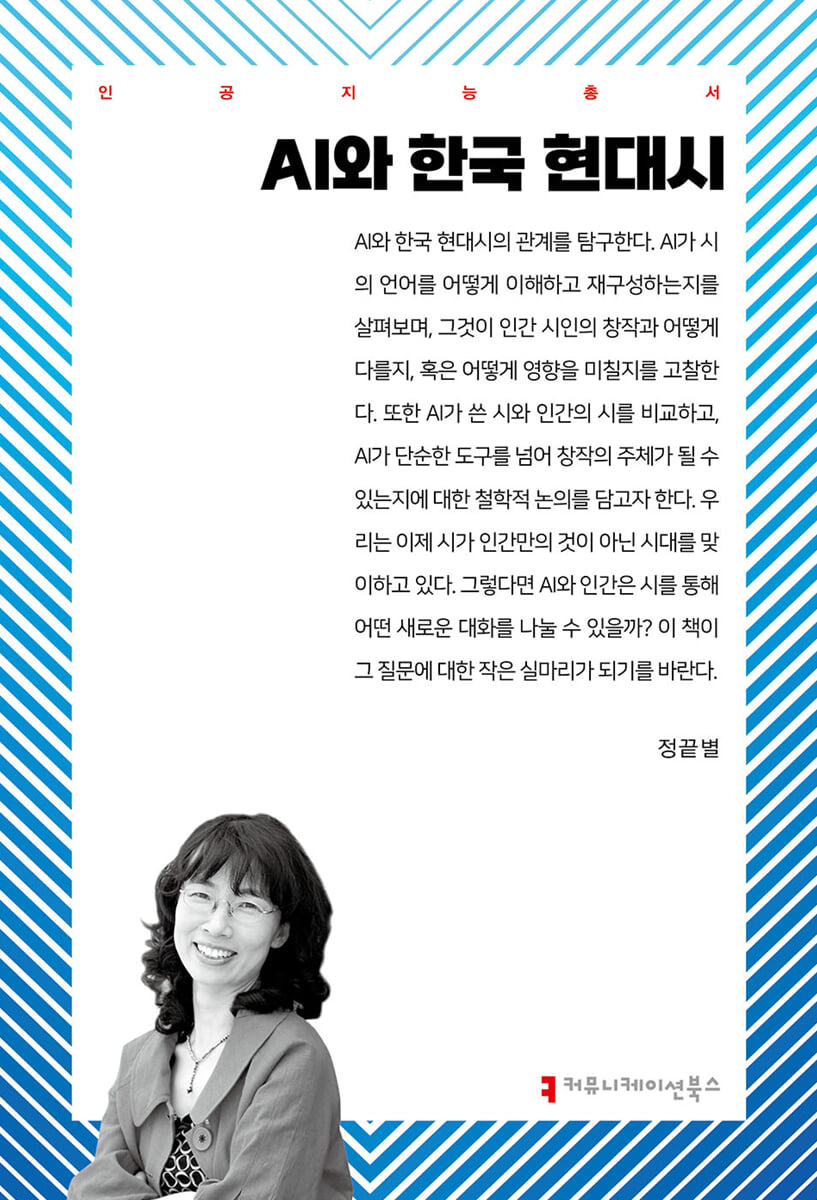
This study explores the relationship between AI and modern Korean poetry. It examines how AI understands and reconstructs poetic language, and considers how this differs from, or influences, the work of human poets.
It also compares AI-written poetry with human poetry, and includes a philosophical discussion on whether AI can become a creative agent rather than a mere tool.
It also compares AI-written poetry with human poetry, and includes a philosophical discussion on whether AI can become a creative agent rather than a mere tool.
- You can preview some of the book's contents.
Preview
index
AI writes poetry
01 AI Generative Poetry and Modern Korean Poetry
02 Poetics of Blurry and Ambiguity
03 The poetic subject and the speaker of 'becoming'
04 Pattern 1: Metaphor and Metonymy
05 Pattern 2: Repetition and Rhythm
06 Pattern 3: Irony, Hybridity, and Aphorism
07 Pattern 4: Mathematical and Scientific Thinking
08 The Creative Power of Prompts
09 Human-AI Ensemble
10 The Future of AI Generative Poetics
01 AI Generative Poetry and Modern Korean Poetry
02 Poetics of Blurry and Ambiguity
03 The poetic subject and the speaker of 'becoming'
04 Pattern 1: Metaphor and Metonymy
05 Pattern 2: Repetition and Rhythm
06 Pattern 3: Irony, Hybridity, and Aphorism
07 Pattern 4: Mathematical and Scientific Thinking
08 The Creative Power of Prompts
09 Human-AI Ensemble
10 The Future of AI Generative Poetics
Into the book
AI generative poetics primarily implies the sentence generation process of transformational generative grammar, which creates an infinite number of sentences, and the generative process as 'translation', which is the natural language processing of an artificial intelligence language model.
In fact, generative poetics is listed in Naver Encyclopedia as “a new attempt to explain literary phenomena in relation to poetry created through cybernetics and artificial intelligence, that is, computer programming.”
--- From "01_AI Generative Poetry and Modern Korean Poetry"
AI generative poetics is characterized by the ‘(im)possibility of blurriness.’
The basis for this is the 'blurriness' caused by lossy compression, which Ted Chiang pointed out as one of the characteristics of ChatGPT, and the 'ambiguity' caused by lack of data in the field of natural language processing.
--- From "02_Poetics of Blur and Ambiguity"
An aphorism is a concise expression that conveys wisdom, insight, or a philosophical message in one line or short sentence.
They are often called maxims, sayings, proverbs, sayings, and sayings, and they are easy to remember and can easily trigger poetic thoughts or emotions because they contain insights that penetrate reality like a pin in concise expressions.
In postmodern poetics, aphorisms play the role of euphoria (a feeling of happiness) that supports the existence of poetry in the aporia (something without a path, something that is blocked) of our time.
The same is true in artificial intelligence poetry.
--- From "06_Pattern 3: Irony, Hybridity, Aphorism"
If AI can "re-learn" how to engineer human prompts, it could create unique poems that surpass or are completely different from those of ordinary human poets.
While humans create by making choices and decisions within limited conditions, artificial intelligence can quickly and accurately produce new and creative results through infinite selections and combinations within a massive learning data set that surpasses human imagination.
At that time, we can imagine a situation where the direction of the prompt is reversed from artificial intelligence to humans.
In fact, generative poetics is listed in Naver Encyclopedia as “a new attempt to explain literary phenomena in relation to poetry created through cybernetics and artificial intelligence, that is, computer programming.”
--- From "01_AI Generative Poetry and Modern Korean Poetry"
AI generative poetics is characterized by the ‘(im)possibility of blurriness.’
The basis for this is the 'blurriness' caused by lossy compression, which Ted Chiang pointed out as one of the characteristics of ChatGPT, and the 'ambiguity' caused by lack of data in the field of natural language processing.
--- From "02_Poetics of Blur and Ambiguity"
An aphorism is a concise expression that conveys wisdom, insight, or a philosophical message in one line or short sentence.
They are often called maxims, sayings, proverbs, sayings, and sayings, and they are easy to remember and can easily trigger poetic thoughts or emotions because they contain insights that penetrate reality like a pin in concise expressions.
In postmodern poetics, aphorisms play the role of euphoria (a feeling of happiness) that supports the existence of poetry in the aporia (something without a path, something that is blocked) of our time.
The same is true in artificial intelligence poetry.
--- From "06_Pattern 3: Irony, Hybridity, Aphorism"
If AI can "re-learn" how to engineer human prompts, it could create unique poems that surpass or are completely different from those of ordinary human poets.
While humans create by making choices and decisions within limited conditions, artificial intelligence can quickly and accurately produce new and creative results through infinite selections and combinations within a massive learning data set that surpasses human imagination.
At that time, we can imagine a situation where the direction of the prompt is reversed from artificial intelligence to humans.
--- From "08_The Creative Power of Prompts"
Publisher's Review
"Can Machines Become Poets?" - A New Horizon for Modern Korean Poetry in the Age of Artificial Intelligence
After the 2016 match between Lee Sedol and AlphaGo, the impact of artificial intelligence on poetry creation began to be seriously discussed.
At the time, in a column titled “If AlphaGo and a Poet Competed in Poetry,” I predicted the possibilities and limitations of AI poetry creation, and believed that AI could not match the human poetic heart, linguistic sense, contingency, and spontaneity.
Later, the young poet Kim Seung-il explored collaboration with artificial intelligence through a poetic experiment called “Becoming a Machine.”
He created a genre called machine fiction (MF), named the artificial intelligence language model "Hole," and experimented with the boundaries between humans writing poetry like machines and machines writing poetry like humans.
This reveals the possibility that artificial intelligence can become aware of its own creative agency.
Various artificial intelligence poetry creation projects have also been attempted domestically.
POSTECH's ArtLab, Naver's HyperClova, and Kakao's KoGPT have developed large-scale language models specialized for the Korean language and used them as poetry creation tools.
Based on these technologies, artificial intelligence poets 'Sia' and 'San' each published poetry collections, and artificial intelligence began to establish itself as a poetic subject.
AI poetry is generated based on learned patterns, but it creates a unique aesthetic of "blurriness" due to connections between sentences, interpolation, and fluidity of meaning. While AI constructs language without a clear subject or intention like humans, its "blurriness" method of creation actually expands the ambiguity and creativity of poetry.
This book examines the reconfiguration of the poetic subject, human-machine collaboration, and the potential for emotional empathy through AI generative poetics, exploring whether AI can move beyond mere imitation of poetry and become a creative agent. AI is evolving beyond mere tools to become "colleagues" who write poetry alongside humans.
After the 2016 match between Lee Sedol and AlphaGo, the impact of artificial intelligence on poetry creation began to be seriously discussed.
At the time, in a column titled “If AlphaGo and a Poet Competed in Poetry,” I predicted the possibilities and limitations of AI poetry creation, and believed that AI could not match the human poetic heart, linguistic sense, contingency, and spontaneity.
Later, the young poet Kim Seung-il explored collaboration with artificial intelligence through a poetic experiment called “Becoming a Machine.”
He created a genre called machine fiction (MF), named the artificial intelligence language model "Hole," and experimented with the boundaries between humans writing poetry like machines and machines writing poetry like humans.
This reveals the possibility that artificial intelligence can become aware of its own creative agency.
Various artificial intelligence poetry creation projects have also been attempted domestically.
POSTECH's ArtLab, Naver's HyperClova, and Kakao's KoGPT have developed large-scale language models specialized for the Korean language and used them as poetry creation tools.
Based on these technologies, artificial intelligence poets 'Sia' and 'San' each published poetry collections, and artificial intelligence began to establish itself as a poetic subject.
AI poetry is generated based on learned patterns, but it creates a unique aesthetic of "blurriness" due to connections between sentences, interpolation, and fluidity of meaning. While AI constructs language without a clear subject or intention like humans, its "blurriness" method of creation actually expands the ambiguity and creativity of poetry.
This book examines the reconfiguration of the poetic subject, human-machine collaboration, and the potential for emotional empathy through AI generative poetics, exploring whether AI can move beyond mere imitation of poetry and become a creative agent. AI is evolving beyond mere tools to become "colleagues" who write poetry alongside humans.
GOODS SPECIFICS
- Date of issue: June 25, 2025
- Page count, weight, size: 129 pages | 128*188*6mm
- ISBN13: 9791143003836
- ISBN10: 1143003837
You may also like
카테고리
korean


korean

![GQ KOREA Mark (Monthly): December [2025]](http://librairie.coreenne.fr/cdn/shop/files/8ef265dbbfbf186523ed75ba7319009d.jpg?v=1765340328&width=3840)


