

How to Draft Legal Documents Using AI
 |
Description
Book Introduction
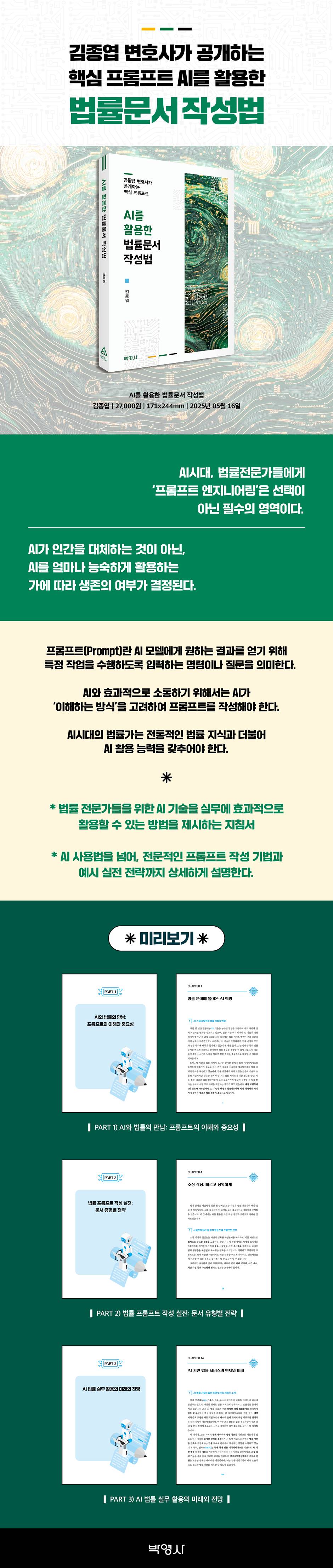
"Attorney Jongyeop Kim's Key Prompts: How to Draft Legal Documents Using AI" is designed to help legal professionals effectively utilize AI technology in their practice.
This book aims to provide practical assistance to all professionals working in the legal field, including lawyers, judicial scriveners, legal clerks, and law school students.
In particular, this guide goes beyond simple AI usage and covers in detail professional prompt writing techniques and practical strategies for drafting legal documents.
It provides concrete examples and prompts that can be immediately applied in practice, such as drafting petitions, responses, briefs, contracts, and effective legal documents using AI, preparing witness statements, analyzing judgments, and providing legal advice.
We aim to provide practical knowledge and techniques that can dramatically improve the efficiency of legal practitioners of all levels, from beginners to experts already familiar with AI.
This book aims to provide practical assistance to all professionals working in the legal field, including lawyers, judicial scriveners, legal clerks, and law school students.
In particular, this guide goes beyond simple AI usage and covers in detail professional prompt writing techniques and practical strategies for drafting legal documents.
It provides concrete examples and prompts that can be immediately applied in practice, such as drafting petitions, responses, briefs, contracts, and effective legal documents using AI, preparing witness statements, analyzing judgments, and providing legal advice.
We aim to provide practical knowledge and techniques that can dramatically improve the efficiency of legal practitioners of all levels, from beginners to experts already familiar with AI.
- You can preview some of the book's contents.
Preview
index
Preface i
PART 1: AI and Law Meet: Understanding and Importance of Prompts
CHAPTER 1: The AI Revolution in Law 2
CHAPTER 2: Effective Communication with AI: The Basics of Prompting 5
CHAPTER 3 15 Key Principles for Successful Prompting 9
PART 2: Practical Legal Prompt Writing: Strategies for Each Document Type
CHAPTER 4 Writing Your Brief: Quickly and Accurately 28
CHAPTER 5 WRITING RESPONSES AND PRESENTATIONS: A LOGICAL DEFENSE STRATEGY 44
CHAPTER 6 DRAFTING AND REVIEWING CONTRACTS: MINIMIZING RISK 61
CHAPTER 7 Writing a Certified Mail: Communicating Clearly 73
CHAPTER 8 WRITING LEGAL ADVICE AND OPINIONS: OPTIMIZING ADVICE 86
CHAPTER 9 Preparing Witness Statements: Securing Key Evidence 109
CHAPTER 10 Analyzing and Using Judgments: Developing Appeal/Review Strategies 131
CHAPTER 11 Criminal Procedure Documents: Complaints, Suspect Interrogations, Briefs, Reflection, Petitions 156
CHAPTER 12: Practical Tips and Tools for Leveraging AI 182
CHAPTER 13 Resolving Ethical Dilemmas: Precautions for Using AI 285
PART 3: The Future and Prospects of AI in Legal Practice
CHAPTER 14: The Present and Future of AI-Based Legal Services 294
CHAPTER 15 STRENGTHENING AI CAPABILITIES: Continuous Learning and Application 300
CHAPTER 16 APPENDIX: USEFUL TOOLS AND RESOURCES FOR USE OF AI 307
Epilogue 380
PART 1: AI and Law Meet: Understanding and Importance of Prompts
CHAPTER 1: The AI Revolution in Law 2
CHAPTER 2: Effective Communication with AI: The Basics of Prompting 5
CHAPTER 3 15 Key Principles for Successful Prompting 9
PART 2: Practical Legal Prompt Writing: Strategies for Each Document Type
CHAPTER 4 Writing Your Brief: Quickly and Accurately 28
CHAPTER 5 WRITING RESPONSES AND PRESENTATIONS: A LOGICAL DEFENSE STRATEGY 44
CHAPTER 6 DRAFTING AND REVIEWING CONTRACTS: MINIMIZING RISK 61
CHAPTER 7 Writing a Certified Mail: Communicating Clearly 73
CHAPTER 8 WRITING LEGAL ADVICE AND OPINIONS: OPTIMIZING ADVICE 86
CHAPTER 9 Preparing Witness Statements: Securing Key Evidence 109
CHAPTER 10 Analyzing and Using Judgments: Developing Appeal/Review Strategies 131
CHAPTER 11 Criminal Procedure Documents: Complaints, Suspect Interrogations, Briefs, Reflection, Petitions 156
CHAPTER 12: Practical Tips and Tools for Leveraging AI 182
CHAPTER 13 Resolving Ethical Dilemmas: Precautions for Using AI 285
PART 3: The Future and Prospects of AI in Legal Practice
CHAPTER 14: The Present and Future of AI-Based Legal Services 294
CHAPTER 15 STRENGTHENING AI CAPABILITIES: Continuous Learning and Application 300
CHAPTER 16 APPENDIX: USEFUL TOOLS AND RESOURCES FOR USE OF AI 307
Epilogue 380
Detailed image
Publisher's Review
"preface"
1. New Capabilities for Legal Professionals in the AI Era
The legal industry has long adhered to the traditional method of interpreting documents, case law, and statutes.
However, the rapid advancement of artificial intelligence technology is fundamentally changing the paradigm of the legal industry.
In particular, the emergence of large-scale language models (LLMs) such as ChatGPT and Claude is revolutionizing the everyday work of legal professionals, including drafting legal documents, analyzing case law, and identifying legal issues.
For legal professionals, the ability to effectively utilize AI, in addition to legal knowledge, is now a crucial competitive advantage. We are entering an era where AI will not replace human lawyers, but rather lawyers who skillfully utilize AI will replace those who lack it.
However, many legal professionals are still struggling with how to effectively apply AI in their practice.
In particular, creating high-quality legal documents using AI requires a strategic approach beyond simple questions—"prompt engineering."
2.
Purpose and target audience of this guide
"Attorney Jongyeop Kim's Key Prompts: How to Draft Legal Documents Using AI" is designed to help legal professionals effectively utilize AI technology in their practice.
This book aims to provide practical assistance to all professionals working in the legal field, including lawyers, judicial scriveners, legal clerks, and law school students.
Specifically, this guide goes beyond simple AI usage to cover professional prompt writing techniques and practical strategies for drafting legal documents.
We provide practical, practical examples and prompts for immediate application, including how to draft effective legal documents using AI, such as petitions, responses, briefs, contracts, witness statements, judgment analysis, and legal advice.
We aimed to provide practical knowledge and techniques that can dramatically improve the efficiency of legal practitioners of all levels, from beginners to experts already familiar with AI.
3. Expected Effects and Precautions of AI Utilization
Effectively utilizing AI in legal practice can yield a variety of benefits.
First of all, it can significantly reduce the time it takes to write documents, which greatly improves work efficiency.
Simple, repetitive, and mechanical tasks will be left to AI, freeing legal professionals to focus on more valuable tasks such as strategic judgment, creative legal interpretation, and client consultation.
Additionally, AI can quickly process and analyze vast amounts of legal information, helping to efficiently review relevant case law and laws.
Especially for novice lawyers, the structured document formats and legal logic provided by AI can serve as valuable reference materials for practical learning.
However, there are some caveats to using AI.
Above all, AI-generated content always requires expert review and revision. AI can sometimes generate incorrect information, known as "hallucinations," or fail to reflect the latest laws or precedents.
Moreover, legal judgment is ultimately the responsibility of legal professionals, so AI should be used only as an auxiliary tool.
Privacy is also an important issue.
When inputting content containing sensitive client information into AI, special care must be taken to ensure information security.
Especially when using public AI platforms, it is essential to anonymize or remove personally identifiable information.
This guide presents practical approaches to maximizing the benefits and minimizing the risks of AI. AI is merely a tool; how it is utilized depends on the capabilities of legal professionals.
I sincerely hope this book will be of practical help in effectively integrating AI into your legal practice. AI is advancing rapidly, and even after this book is published, AI with new capabilities will continue to emerge.
However, the basic principles and strategies for writing prompts covered here will remain valid even as AI technology advances.
We hope this book will serve as a useful compass on your journey to harnessing AI.
1. New Capabilities for Legal Professionals in the AI Era
The legal industry has long adhered to the traditional method of interpreting documents, case law, and statutes.
However, the rapid advancement of artificial intelligence technology is fundamentally changing the paradigm of the legal industry.
In particular, the emergence of large-scale language models (LLMs) such as ChatGPT and Claude is revolutionizing the everyday work of legal professionals, including drafting legal documents, analyzing case law, and identifying legal issues.
For legal professionals, the ability to effectively utilize AI, in addition to legal knowledge, is now a crucial competitive advantage. We are entering an era where AI will not replace human lawyers, but rather lawyers who skillfully utilize AI will replace those who lack it.
However, many legal professionals are still struggling with how to effectively apply AI in their practice.
In particular, creating high-quality legal documents using AI requires a strategic approach beyond simple questions—"prompt engineering."
2.
Purpose and target audience of this guide
"Attorney Jongyeop Kim's Key Prompts: How to Draft Legal Documents Using AI" is designed to help legal professionals effectively utilize AI technology in their practice.
This book aims to provide practical assistance to all professionals working in the legal field, including lawyers, judicial scriveners, legal clerks, and law school students.
Specifically, this guide goes beyond simple AI usage to cover professional prompt writing techniques and practical strategies for drafting legal documents.
We provide practical, practical examples and prompts for immediate application, including how to draft effective legal documents using AI, such as petitions, responses, briefs, contracts, witness statements, judgment analysis, and legal advice.
We aimed to provide practical knowledge and techniques that can dramatically improve the efficiency of legal practitioners of all levels, from beginners to experts already familiar with AI.
3. Expected Effects and Precautions of AI Utilization
Effectively utilizing AI in legal practice can yield a variety of benefits.
First of all, it can significantly reduce the time it takes to write documents, which greatly improves work efficiency.
Simple, repetitive, and mechanical tasks will be left to AI, freeing legal professionals to focus on more valuable tasks such as strategic judgment, creative legal interpretation, and client consultation.
Additionally, AI can quickly process and analyze vast amounts of legal information, helping to efficiently review relevant case law and laws.
Especially for novice lawyers, the structured document formats and legal logic provided by AI can serve as valuable reference materials for practical learning.
However, there are some caveats to using AI.
Above all, AI-generated content always requires expert review and revision. AI can sometimes generate incorrect information, known as "hallucinations," or fail to reflect the latest laws or precedents.
Moreover, legal judgment is ultimately the responsibility of legal professionals, so AI should be used only as an auxiliary tool.
Privacy is also an important issue.
When inputting content containing sensitive client information into AI, special care must be taken to ensure information security.
Especially when using public AI platforms, it is essential to anonymize or remove personally identifiable information.
This guide presents practical approaches to maximizing the benefits and minimizing the risks of AI. AI is merely a tool; how it is utilized depends on the capabilities of legal professionals.
I sincerely hope this book will be of practical help in effectively integrating AI into your legal practice. AI is advancing rapidly, and even after this book is published, AI with new capabilities will continue to emerge.
However, the basic principles and strategies for writing prompts covered here will remain valid even as AI technology advances.
We hope this book will serve as a useful compass on your journey to harnessing AI.
GOODS SPECIFICS
- Date of issue: May 16, 2025
- Page count, weight, size: 404 pages | 176*248*30mm
- ISBN13: 9791130349848
- ISBN10: 1130349845
You may also like
카테고리
korean


korean

![GQ KOREA Mark (Monthly): December [2025]](http://librairie.coreenne.fr/cdn/shop/files/8ef265dbbfbf186523ed75ba7319009d.jpg?v=1765340328&width=3840)


