

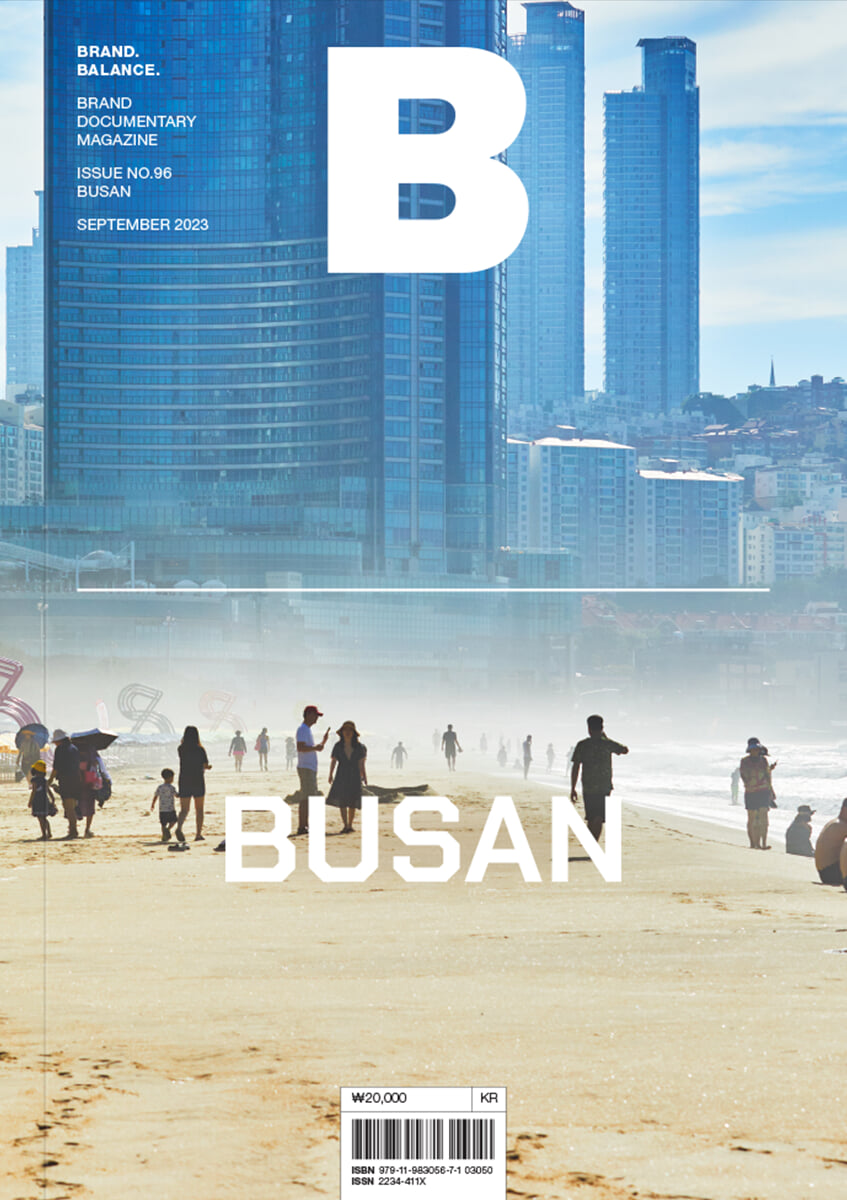
Magazine B: No. 96 Busan Korean Edition
 |
Description
Book Introduction
It is a brand documentary magazine that introduces one balanced brand per issue.
Anyone interested in the brand can easily see it, as it contains the brand's philosophy, hidden stories, emotions, and even culture in a sensuous manner.
Founded in November 2011, it has introduced over 90 brands to the world, covering fashion, lifestyle, tech, and urban areas.
(www.magazine-b.com)
Anyone interested in the brand can easily see it, as it contains the brand's philosophy, hidden stories, emotions, and even culture in a sensuous manner.
Founded in November 2011, it has introduced over 90 brands to the world, covering fashion, lifestyle, tech, and urban areas.
(www.magazine-b.com)
index
02 INTRO
08 EDITOR'S LETTER
12 BUSAN FOLKS
Five Busan natives, born and raised in Busan, share their thoughts on the energy and memories of their hometown.
18 INTERVIEW
Sammi Construction and Kitchen Bori CEO Park Ji-man have emphasized the importance of securing the aesthetic value of space through horizontal landmarks.
24 HOMEGROWN TALENT
Busan's confectionery, bakery, coffee, fish cake, and beer brands that embrace new knowledge with an open mind and encourage fair competition.
42 HISTORY OF LOCAL CUISINE
Old restaurants and local cuisine that offer a glimpse into the history of the Korean War and the division of North and South Korea.
50 INTERVIEW
Kim Ji-hoon, CEO of select shop Balansa, says Busan's street scene has been enriched by a combination of cultural influences from overseas and the inquisitive nature of each individual.
56 NEIGHBORHOOD
Four neighborhoods and the spaces that fill them offer a glimpse into Busan's dynamic side, where analogue and modern styles coexist.
72 AROUND TOWN
Young people who visited Busan for their own purposes share their impressions and unique charms of the city.
80 LEGEND MAKERS
Busan's steel bar, towel, and shoe manufacturing companies that fueled the manufacturing industry that laid the foundation for Busan's industrialization.
96 URBAN GETAWAYS
Activities to enjoy in Busan, a city that embraces mountains, sea, and city all at once
102 STAYCATION
Four hotels in Busan offer diverse experiences and content based on the region's natural environment and historical and cultural elements.
110 BORN AND RAISED
Ahn Bo-hyun, a representative actor of Busan, and Winter, a member of musician aespa, share their memories of Busan.
113 GREETINGS FROM BUSAN
"Made in Busan" products that capture the vibrant and active energy of Busan.
124 INTERVIEW
Kim Hye-joo, senior curator at the Singapore Art Museum, says a three-dimensional approach is needed to understand Busan, a city with a complex landscape influenced by diverse topography and seascapes.
130 ARTISTIC CITY
Galleries, art museums, and fairs that have enhanced Busan's artistic sensibility
148 YOUNG WAVE
Artists who have used the city of Busan as their studio to create their own unique artistic vision.
158 INTERVIEW
Yang Kyung-jun, founder and CEO of Crypton, says Busan is the perfect city for the birth of global creators who can digest foreign cultures in their own way.
164 THE AWAKENING GROUND
The "New Local" project creates new stories and values while preserving traces of the past.
182 CITY STORY
Two experts discuss Busan's development and the stories behind it, covering topics such as resorts, mixed-use spaces, architecture, and urban regeneration.
186 FROM SEOUL TO BUSAN
Seoul-born fashion and beauty brands that opened stores by designing unique brand experiences based on Busan's regional characteristics.
190 DIGEST
Busan in numbers and statistics
201 OUTRO
08 EDITOR'S LETTER
12 BUSAN FOLKS
Five Busan natives, born and raised in Busan, share their thoughts on the energy and memories of their hometown.
18 INTERVIEW
Sammi Construction and Kitchen Bori CEO Park Ji-man have emphasized the importance of securing the aesthetic value of space through horizontal landmarks.
24 HOMEGROWN TALENT
Busan's confectionery, bakery, coffee, fish cake, and beer brands that embrace new knowledge with an open mind and encourage fair competition.
42 HISTORY OF LOCAL CUISINE
Old restaurants and local cuisine that offer a glimpse into the history of the Korean War and the division of North and South Korea.
50 INTERVIEW
Kim Ji-hoon, CEO of select shop Balansa, says Busan's street scene has been enriched by a combination of cultural influences from overseas and the inquisitive nature of each individual.
56 NEIGHBORHOOD
Four neighborhoods and the spaces that fill them offer a glimpse into Busan's dynamic side, where analogue and modern styles coexist.
72 AROUND TOWN
Young people who visited Busan for their own purposes share their impressions and unique charms of the city.
80 LEGEND MAKERS
Busan's steel bar, towel, and shoe manufacturing companies that fueled the manufacturing industry that laid the foundation for Busan's industrialization.
96 URBAN GETAWAYS
Activities to enjoy in Busan, a city that embraces mountains, sea, and city all at once
102 STAYCATION
Four hotels in Busan offer diverse experiences and content based on the region's natural environment and historical and cultural elements.
110 BORN AND RAISED
Ahn Bo-hyun, a representative actor of Busan, and Winter, a member of musician aespa, share their memories of Busan.
113 GREETINGS FROM BUSAN
"Made in Busan" products that capture the vibrant and active energy of Busan.
124 INTERVIEW
Kim Hye-joo, senior curator at the Singapore Art Museum, says a three-dimensional approach is needed to understand Busan, a city with a complex landscape influenced by diverse topography and seascapes.
130 ARTISTIC CITY
Galleries, art museums, and fairs that have enhanced Busan's artistic sensibility
148 YOUNG WAVE
Artists who have used the city of Busan as their studio to create their own unique artistic vision.
158 INTERVIEW
Yang Kyung-jun, founder and CEO of Crypton, says Busan is the perfect city for the birth of global creators who can digest foreign cultures in their own way.
164 THE AWAKENING GROUND
The "New Local" project creates new stories and values while preserving traces of the past.
182 CITY STORY
Two experts discuss Busan's development and the stories behind it, covering topics such as resorts, mixed-use spaces, architecture, and urban regeneration.
186 FROM SEOUL TO BUSAN
Seoul-born fashion and beauty brands that opened stores by designing unique brand experiences based on Busan's regional characteristics.
190 DIGEST
Busan in numbers and statistics
201 OUTRO
Detailed image

Publisher's Review
This is the ninety-sixth magazine, “B.”
In 2018, when publishing the second edition of the South Korean capital, Seoul, we discussed which other cities in the country, other than Seoul, could be the subject of 〈B〉.
Many team members, including myself, thought of Busan, which is considered the second largest city, and Jeju Island, which boasts a beautiful natural environment.
And now, five years later, I have created “B” with Busan as the theme.
Of course, I was drawn to Jeju, a place known for relaxation and seclusion, but I was also more intrigued by the multi-layered aspects of Busan, which cannot be fully described with just words like "sea" and "tourism."
I visit Busan every year, and every time I stay there, I often say, "I want to live here," so there's definitely something magnetic about this port city, 400km from Seoul.
I was always captivated by the view of the dock outside the window as I took the train from Busan Station to my hotel in Haeundae by taxi.
When you see the huge container boxes and cranes occupying the dock, you feel like you've finally arrived in Busan. It's like passing through immigration.
Perhaps because of the unique scale of a port city, I always felt like Busan was a bigger city than Seoul.
Maybe it's an impression you can only experience in a second or third-tier city.
In a country's first city, the so-called administrative and economic capital, 'global standards' and 'statelessness' naturally emerge.
There is constant change in many aspects, including architecture, culture, and commercial districts, but there is a fate of first-tier cities that always returns to the average.
So, recently, I've heard from people who travel a lot to major cities overseas, "There's nothing special anymore.
Sometimes I hear people complaining, “It’s all in Seoul.”
Busan is a city that is somewhat exempt from such implicit equalization.
There are, of course, flagship stores of global brands, restaurants with modern service, and a hipster-style uniform, but they are not what defines the city of Busan.
In the gaps between the infrastructure that a large city should have, the unique culture of food, clothing, and shelter is revealed in its raw form, creating a local color.
The content of Busan that magazine <B> looked into in this issue also included people, objects, and businesses with a modern local character.
From barista Jeon Ju-yeon's 'Momos Coffee', which has gone from local to global, to 'Balansa', a fashion store more contemporary than any other Seoul-born brand, to 'Gents Bakery', which has the most Korean-style bakery look.
They are the protagonists of a reverse entry that created a local fandom and received love calls from Seoul.
In a city without a single headquarters of the country's top 100 companies, creativity that blossomed spontaneously actually operates with a business sense that is closer to instinct.
Although the number is small compared to the capital city of Seoul, I believe Busan's potential lies in these small business owners.
Just as many Busanites met by 〈B〉 find Busan's strength in individuals who grew up in Busan, a city far from Seoul and with an outward orientation.
Busan, a city constantly inhabited by outsiders, historical events like the Korean War's refugee movement, and geographic features that have led to a constant battle between internal and external forces, may be the perfect place for the birth of modern ideas.
Perhaps that's why I, who was born in Seoul, will always long for the port people and the city of Busan where they gather.
Editor-in-Chief Park Eun-seong
In 2018, when publishing the second edition of the South Korean capital, Seoul, we discussed which other cities in the country, other than Seoul, could be the subject of 〈B〉.
Many team members, including myself, thought of Busan, which is considered the second largest city, and Jeju Island, which boasts a beautiful natural environment.
And now, five years later, I have created “B” with Busan as the theme.
Of course, I was drawn to Jeju, a place known for relaxation and seclusion, but I was also more intrigued by the multi-layered aspects of Busan, which cannot be fully described with just words like "sea" and "tourism."
I visit Busan every year, and every time I stay there, I often say, "I want to live here," so there's definitely something magnetic about this port city, 400km from Seoul.
I was always captivated by the view of the dock outside the window as I took the train from Busan Station to my hotel in Haeundae by taxi.
When you see the huge container boxes and cranes occupying the dock, you feel like you've finally arrived in Busan. It's like passing through immigration.
Perhaps because of the unique scale of a port city, I always felt like Busan was a bigger city than Seoul.
Maybe it's an impression you can only experience in a second or third-tier city.
In a country's first city, the so-called administrative and economic capital, 'global standards' and 'statelessness' naturally emerge.
There is constant change in many aspects, including architecture, culture, and commercial districts, but there is a fate of first-tier cities that always returns to the average.
So, recently, I've heard from people who travel a lot to major cities overseas, "There's nothing special anymore.
Sometimes I hear people complaining, “It’s all in Seoul.”
Busan is a city that is somewhat exempt from such implicit equalization.
There are, of course, flagship stores of global brands, restaurants with modern service, and a hipster-style uniform, but they are not what defines the city of Busan.
In the gaps between the infrastructure that a large city should have, the unique culture of food, clothing, and shelter is revealed in its raw form, creating a local color.
The content of Busan that magazine <B> looked into in this issue also included people, objects, and businesses with a modern local character.
From barista Jeon Ju-yeon's 'Momos Coffee', which has gone from local to global, to 'Balansa', a fashion store more contemporary than any other Seoul-born brand, to 'Gents Bakery', which has the most Korean-style bakery look.
They are the protagonists of a reverse entry that created a local fandom and received love calls from Seoul.
In a city without a single headquarters of the country's top 100 companies, creativity that blossomed spontaneously actually operates with a business sense that is closer to instinct.
Although the number is small compared to the capital city of Seoul, I believe Busan's potential lies in these small business owners.
Just as many Busanites met by 〈B〉 find Busan's strength in individuals who grew up in Busan, a city far from Seoul and with an outward orientation.
Busan, a city constantly inhabited by outsiders, historical events like the Korean War's refugee movement, and geographic features that have led to a constant battle between internal and external forces, may be the perfect place for the birth of modern ideas.
Perhaps that's why I, who was born in Seoul, will always long for the port people and the city of Busan where they gather.
Editor-in-Chief Park Eun-seong
GOODS SPECIFICS
- Date of issue: September 15, 2023
- Page count, weight, size: 208 pages | 606g | 170*240*15mm
- ISBN13: 9791198305671
- ISBN10: 1198305673
You may also like
카테고리
korean


korean

![GQ KOREA Mark (Monthly): December [2025]](http://librairie.coreenne.fr/cdn/shop/files/8ef265dbbfbf186523ed75ba7319009d.jpg?v=1765340328&width=3840)


