

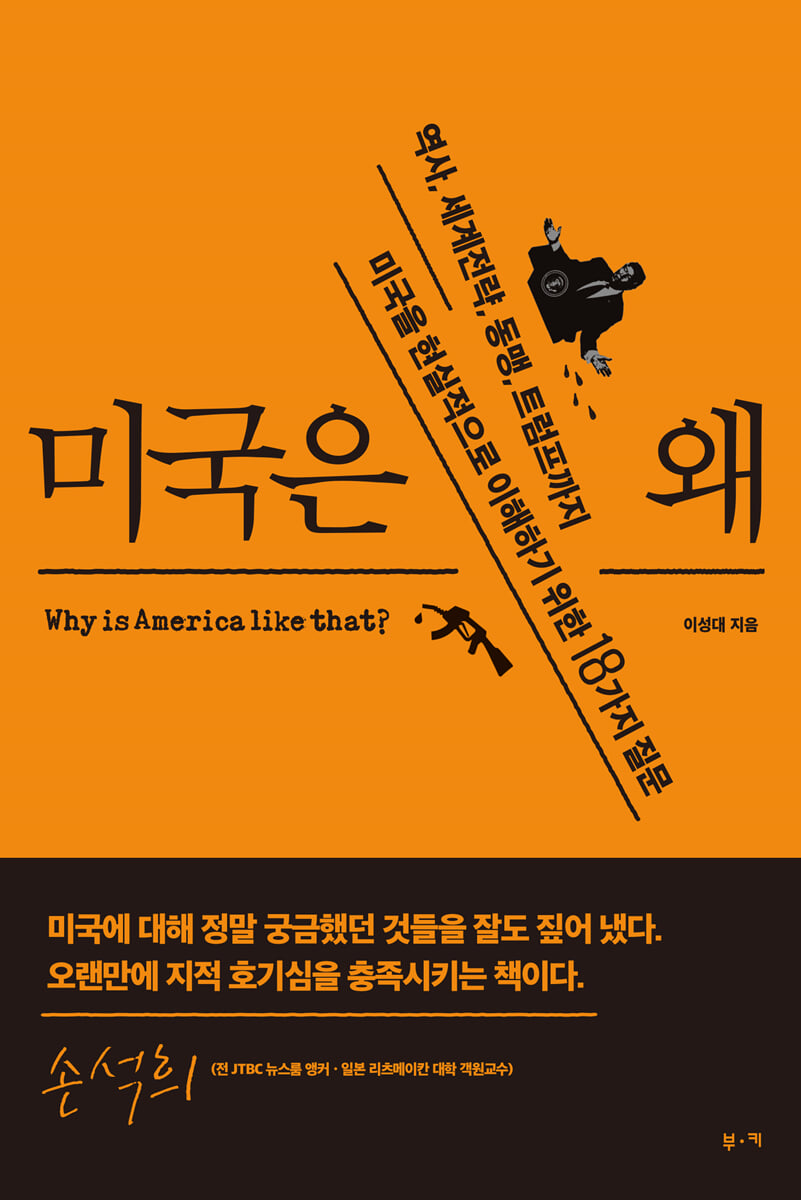
Why is America
 |
Description
Book Introduction
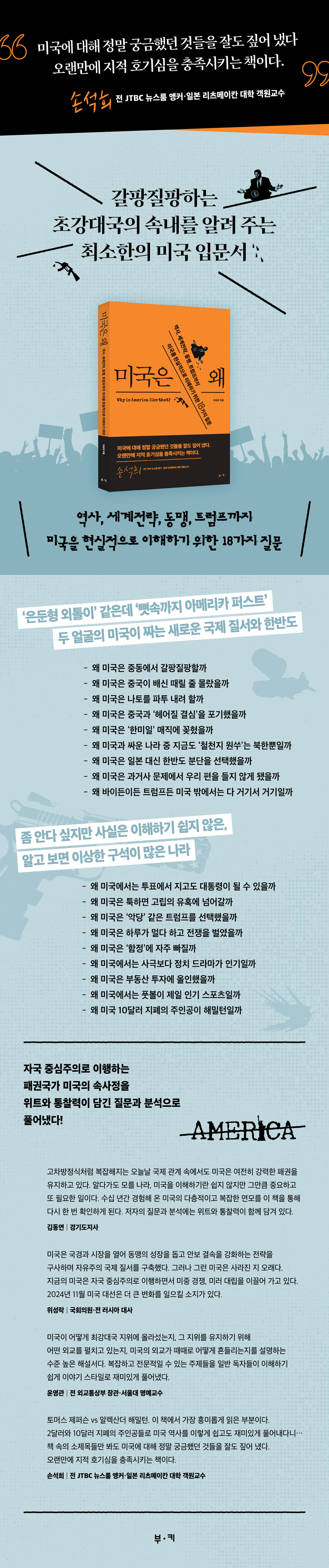
It reveals the inner workings of a superpower that is wavering.
A minimal introduction to the United States!
The United States, a superpower that influences the world order.
The United States is South Korea's closest ally, but it is not easy to understand its choices and actions in the context of the Northeast Asian order or international diplomacy.
This book is a basic guide to understanding America's intentions and diplomatic strategies from a Korean perspective.
How did the United States rise to the ranks of the "celestial powers"? How did the United States choose a divine move at every crucial moment? Why does the United States favor Japan? Why does the United States wage war so often? The author, who has covered international diplomacy and security for JTBC for over 20 years, starts with these questions and explains, in an easy-to-understand manner with a journalism sense, the process by which the United States, a new nation with a short history of less than 250 years, secured the status of a superpower that commands the world, and the United States' strategy for the current international order.
The author addresses questions that anyone would have wondered about at least once, covering a wide range of topics, including American politics, history, culture, institutions, and international relations, in a light-hearted style.
In the near future, by watching to see who will be elected in the US presidential election this coming November, you can understand the unique American electoral system and the consciousness of the American people who are crazy about Trump. In the more distant future, you can learn about the unique values of the United States from various angles, such as the process of expanding fertile territory after independence, the reason for the constant wars around the world after World War II, and the frontier spirit.
A minimal introduction to the United States!
The United States, a superpower that influences the world order.
The United States is South Korea's closest ally, but it is not easy to understand its choices and actions in the context of the Northeast Asian order or international diplomacy.
This book is a basic guide to understanding America's intentions and diplomatic strategies from a Korean perspective.
How did the United States rise to the ranks of the "celestial powers"? How did the United States choose a divine move at every crucial moment? Why does the United States favor Japan? Why does the United States wage war so often? The author, who has covered international diplomacy and security for JTBC for over 20 years, starts with these questions and explains, in an easy-to-understand manner with a journalism sense, the process by which the United States, a new nation with a short history of less than 250 years, secured the status of a superpower that commands the world, and the United States' strategy for the current international order.
The author addresses questions that anyone would have wondered about at least once, covering a wide range of topics, including American politics, history, culture, institutions, and international relations, in a light-hearted style.
In the near future, by watching to see who will be elected in the US presidential election this coming November, you can understand the unique American electoral system and the consciousness of the American people who are crazy about Trump. In the more distant future, you can learn about the unique values of the United States from various angles, such as the process of expanding fertile territory after independence, the reason for the constant wars around the world after World War II, and the frontier spirit.
index
Recommendation
preface
Part 1: A Godsend Every Time! … The Birth of America
01 Why are political dramas more popular than historical dramas in the United States?
02 Why did the US go all-in on real estate investment?
03 Why is football the most popular sport in the United States?
04 Why is Hamilton featured on the US $10 bill?
Part 2: A Strange Superpower Upon Exploration… The United States, Out of Touch with International Standards
05 Why can someone become president in the United States even if they lose the election?
06 Why did America choose Trump?
07 Why are Biden and Trump doing similar things outside the US?
08 Why did the United States go to war so often?
Part 3: He who would wear the crown must bear its weight… America in limbo
09 Why does the United States so easily succumb to the temptation of isolation?
10 Why America So Often Falls into a 'Trap'
11 Why is the US so hesitant in the Middle East?
12 Why Didn't America Know China Would Betray It?
Part 4 · Will the Panjagi succeed? Does America have a plan?
13 Why Did the US Give Up on Breaking Up with China?
14 Why the US Wants to Dismantle NATO
15 Why is the US so hooked on the "US-Korea-Japan" magic?
Part 5: An alliance that seems like an alliance, but isn't… What does Korea mean to the United States?
16 Why is North Korea the only country that fought against the United States and is still its sworn enemy?
17 Why Did the United States Choose Division of the Korean Peninsula Over Japan?
18 Why won't the US take our side on historical issues?
preface
Part 1: A Godsend Every Time! … The Birth of America
01 Why are political dramas more popular than historical dramas in the United States?
02 Why did the US go all-in on real estate investment?
03 Why is football the most popular sport in the United States?
04 Why is Hamilton featured on the US $10 bill?
Part 2: A Strange Superpower Upon Exploration… The United States, Out of Touch with International Standards
05 Why can someone become president in the United States even if they lose the election?
06 Why did America choose Trump?
07 Why are Biden and Trump doing similar things outside the US?
08 Why did the United States go to war so often?
Part 3: He who would wear the crown must bear its weight… America in limbo
09 Why does the United States so easily succumb to the temptation of isolation?
10 Why America So Often Falls into a 'Trap'
11 Why is the US so hesitant in the Middle East?
12 Why Didn't America Know China Would Betray It?
Part 4 · Will the Panjagi succeed? Does America have a plan?
13 Why Did the US Give Up on Breaking Up with China?
14 Why the US Wants to Dismantle NATO
15 Why is the US so hooked on the "US-Korea-Japan" magic?
Part 5: An alliance that seems like an alliance, but isn't… What does Korea mean to the United States?
16 Why is North Korea the only country that fought against the United States and is still its sworn enemy?
17 Why Did the United States Choose Division of the Korean Peninsula Over Japan?
18 Why won't the US take our side on historical issues?
Detailed image
Into the book
Until the late 1700s, it was unthinkable for rulers to have term limits.
It is no wonder that George III in the musical wonders, “Do you plan to keep changing leaders?”
Was it only the British king who did this?
At the time, most Americans would have thought that Washington would reign as a king called 'President.'
But Washington proved that the very essence of the presidency is to clearly define the limits of elected power by limiting the term of office itself.
--- p.28
In particular, when asked about the appropriate level of government intervention through election surveys in the United States, the American public's perception is much closer to the conservatives, with a 35 to 65 split between progressives and conservatives.
However, macroeconomic policy is more progressive, with a 60-40 split between progressive and conservative, education policy is 70-30, and environmental policy is 75-25.
Ultimately, the average American can be said to be conservative on an abstract level and progressive on a concrete policy level.
The Republican and Democratic parties have been attacking each point based on this.
--- p.35
For Koreans, the word 'border' conjures up images of separation.
Because of the division of North and South Korea, it is impossible to even approach, let alone cross the border.
For Americans, on the other hand, borders mean the opposite.
Throughout American history, borders have been largely open spaces rather than closed boundaries.
After settling in the New World, as the land continued to expand, the border became not the end of the country but a new starting point, and not the periphery but the center of dynamism.
--- p.60
If it weren't for Hamilton, America might have remained an agricultural nation rather than the capitalist power it is today.
At best, it would be comparable to an advanced agricultural country, such as Denmark, which has a large land area.
Even in the early days of the nation's founding, there were two opposing camps over the future development path of the new nation of the United States.
There are two groups: those who advocate industrial modernization and those who aim for an agricultural society based on slavery.
--- p.74
After the Civil War, the American economy grew by leaps and bounds at a rate that "astounded statistics."
From 1865 to 1895, the United States achieved an economic growth rate unprecedented not only in American history but also in the history of global capitalism.
From 1961 to 1981, when our country achieved the 'Miracle on the Han River,' the average annual economic growth rate for 20 years was approximately 10 percent.
Germany's 'Miracle on the Rhine' also peaked at 8 percent growth in the 1950s.
However, during the 30 years immediately following the Civil War, the U.S. economic growth rate averaged a whopping 15 percent per year, an unprecedented record in world history.
--- p.78
There have been five instances of a candidate winning the national popular vote but losing in the Electoral College, including the 2000 election.
Andrew Jackson in 1824, Samuel Tilden in 1876, and Stephen Grover Cleveland in 1888 were all caught up in this institutional contradiction.
The most recent unfortunate protagonist is Hillary Clinton in the 2016 presidential election.
Hillary Clinton received about 3 million more votes than Trump, but lost by a whopping 74 electoral votes.
--- p.94
In fact, according to an analysis of 2020 exit polls by The Washington Post and Edison Research, Biden led Trump 55-57 percent to 42-44 percent among households with incomes under $100,000, but Trump won 54 percent to Biden's 42 percent among households with incomes over $100,000.
Trump is no longer just a hero for low-income whites; he has also completely absorbed the middle-class and wealthy, the traditional mainstream Republican supporters.
It is a political power that is close to a miracle.
--- p.105
So when Biden defeated Trump and reclaimed the White House in November 2020, the international community was relieved.
It was so moving when he said at the inauguration that “America is back.”
They thought that this would bridge the gap in alliances created during the Trump era, relieve some of the anxiety, and return to the previous international order.
However, while Biden reversed many of his predecessor's policies, he left the "America First" foreign policy fundamentals largely untouched.
--- p.126
In fact, a 2016 Pew Research Center poll found that 57 percent of Americans said the U.S. government should focus on domestic issues and leave other countries to solve their own problems.
Fifteen years ago, only 30 percent of Americans thought this way.
Only 27 percent of respondents said the United States needed to play a greater role in solving international issues.
Americans living in the 2000s do not want an America that is "broad-minded," but rather an America that "treats its own citizens well."
--- p.131
But somehow, the times of peace when America has stopped fighting wars like now feel strange.
Because the United States has been at war for about a quarter of its entire history.
If we narrow it down to half the period since World War II, and then narrow it down to the 21st century, we've been at war almost every day.
In fact, since this was a country where war was a daily occurrence, it is impossible to know whether this is an interwar period leading up to another war or a permanent period of truce.
--- p.135
As the era of war ended, America found itself mired in a full-blown war.
Since the end of World War II on September 2, 1945, the period of war has lasted for 78 years, reaching a whopping 57%, or 44 years (Korean War 1950-1953, Vietnam War 1955-1975, Gulf War 1990-1991, Afghanistan War 2001-2021).
It's like fighting a war once every two years.
The end of World War II brought with it the irony of America's war becoming more intense.
--- p.141
Ultimately, as the historical mission to spread American values deepened, the frequency of wars increased, which in turn resulted in the loss of life and freedom for humankind around the world.
It makes no sense to suppress freedom in a war to protect freedom and human rights, as if you love your children too much and beat and abuse them.
--- p.149
In reality, the United States is closer to an empire.
For over half a century, we have sent American troops to every corner of the globe, making the American liberal order the international standard.
Among the permanent members of the UN Security Council, the United States is the only one that uses the name of its administrative organization dealing with other countries as State Department rather than Diplomacy or Foreign Affairs.
--- p.154
If you only know the 'Thucydides Trap', you could literally fall into a trap when predicting the US-China hegemony struggle.
There is a similar but different trap that exists like an Iranian twin: the Kindleberger Trap.
In short, the view is that if a rapidly rising emerging power has no will to assume the position of a hegemon while the existing hegemon's capabilities are insufficient, the international system will become unstable.
--- p.179
Why do totalitarian regimes fall into the American trap?
As Kennan had already observed about the nature of the Soviet Union, the nature of a totalitarian state is such that it judges American politics and culture through the lens of its own distorted ideology.
In other words, there is an analysis that this is due to the tendency to perceive the diversity, social progress, and political polarization of the liberal system as decline rather than regeneration.
--- p.181
From then on, it was a series of events.
The United States supported Hussein of Iraq to check Iran, which led to the Iran-Iraq War. When Hussein, exhausted from the eight-year war, invaded Kuwait with the intention of fighting a war of attrition, the United States started the Gulf War.
The Gulf War gave birth to Osama bin Laden in Saudi Arabia, which led to the 9/11 attacks, and 9/11 in turn led to the US wars in Iraq and Afghanistan.
This in turn gave birth to the Islamic State (IS), which in turn led the United States to become involved in the Syrian civil war.
--- p.188
America's feelings toward China may be one of insult.
China, which we trusted, is now constantly challenging the international order created by the United States, tarnishing America's reputation.
The United States, which has been pushing China to survive to this extent, must feel betrayed.
Even if the United States is the "most powerful hegemon in human history," if it is tarnished, it will be difficult to maintain a stable international order.
If Oya says that someone made a mistake, then the person who made a mistake has to come forward even if he or she did not make a mistake.
Whether China really made a mistake or not is not a big variable.
That stage has already been passed.
--- p.198
Then, as the war on terrorism in the Middle East reached a standstill, the Obama administration turned its attention to China in earnest.
The change in policy toward China is generally considered to have begun around 2011, in the middle of the first term of the Obama administration.
In October of that year, then-Secretary of State Hillary Clinton contributed an article titled “America’s Pacific Century” to the foreign affairs magazine Foreign Policy.
“Over the past decade, America’s foreign policy has shifted from addressing the post-Cold War peace dividend to fulfilling our commitments in Iraq and Afghanistan,” Hillary said. “Now that those wars are over, we must accelerate our efforts to pivot to a new international reality.”
The so-called 'return to Asia' strategy was announced.
--- p.208
Sullivan, while pursuing derisking, set three conditions: diversifying the supply chain for core technologies such as semiconductors, limiting the transfer of advanced military and security technologies to China, and prioritizing the development of American industries.
The areas covered here are exempt from derisking.
However, if we start to consider the specific applicability, the list of exceptions is bound to grow.
Because of this, it feels like a divorce deferral memorandum of understanding that says, “We won’t break up as long as certain conditions are met.”
--- p.223
Jin Changrong, vice-dean of the School of International Relations at Renmin University of China, diagnosed that the Soviet Union, Germany, and Japan, which challenged American hegemony, all fell short of 70 percent of the US GDP and dropped out of the systemic competition.
However, China has already surpassed 70 percent of the U.S. GDP and is projected to catch up by 2025.
China is confident that it is taking a different path from the Soviet Union, Germany, and Japan.
China's goal is to become a prosperous, powerful, modern socialist nation by 2049, the 100th anniversary of the founding of the People's Republic of China, and to become a global hegemon that can rival the United States.
This is the Chinese dream.
--- p.226
Biden, perhaps feeling regretful that he was not able to participate in the actual "historic reconciliation" between Seoul and Tokyo, invited the leaders of South Korea and Japan to Camp David, the U.S. presidential retreat, on August 18 of that year.
While we're at it, we've set the stage for transforming the security cooperation structure, currently divided into the ROK-US alliance and the US-Japan alliance, with the US in the middle, into a single ROK-US-Japan triangular cooperation body.
Biden, smiling brightly while walking with the leaders of South Korea and Japan without a tie in the middle of the street, may have been mumbling to himself, "South Korea, America, Japan, South Korea, America, Japan~"
Because if we do well, a long-standing problem of 70 years may be resolved.
--- p.247
Expanding the alliance network could integrate U.S. military assets, achieving economies of scale and reducing the burden on the U.S. defense budget.
Moreover, it will give Japan more discretion and relatively lessen the strategic burden on the United States.
Furthermore, the trilateral structure between South Korea, the US, and Japan in Northeast Asia could expand to the South China Sea, West Asia, and even Europe.
This would allow the United States to build a new global security network.
Ultimately, the hub-and-spoke system that was cutting edge during the Cold War has become an old fashion that no longer fits and is out of style.
So, what was designed was the so-called grid-type security framework.
--- p.254
North American relations are like planets orbiting on different cycles.
Since they each orbit in an elliptical orbit of different sizes, the chance of them meeting is extremely rare.
It was much more difficult for North America to sit down seriously with the Cowherd and the Weaver Girl than for a man from Mars and a woman from Venus to meet.
When the United States is friendly, North Korea closes its heart, and conversely, when North Korea is ready to open its heart, the United States is not interested.
This cycle occurs roughly once every 20 years since the end of the Cold War.
The most recent was the aforementioned 2018-2019 North Korea-US summit, and the one immediately preceding it dates back to the early 2000s.
--- p.269
Why is America so friendly to Japan?
Japan, the aggressor who started the world war, attacked Hawaii, saying that it would fight the United States.
Because of this, the world was hit by the atomic bomb for the first time.
Yet, the fact that it has been able to become America's 'BFF' for nearly 80 years cannot be explained without geopolitics.
--- p.280
The rest is as we know.
As the Soviet Union advanced rapidly into the Korean Peninsula, the United States, startled, unfolded a National Geographic wall map and hastily drew a line down the center of the Korean Peninsula.
Truman approved it on August 13, 1945.
The Korean Peninsula was divided two days before Japan declared unconditional surrender.
Japan's 'gaslighting' strategy of inducing the United States and the Soviet Union to divide and occupy the Korean Peninsula worked.
--- p.288
The compensation solution for victims of forced mobilization by Japan, announced by the South Korean government on March 6, 2023, resembles the 2015 comfort women agreement in many ways.
It's like a solution for eight-year-old brothers.
What's interesting is that the comfort women agreement came out in the third year of Obama's second term, and the solution to compensation for forced mobilization also came out in the third year of the Biden administration.
The issue of historical disputes, the biggest point of contention in Korea-Japan relations, was ironically resolved a year before the next presidential election in the United States.
In other words, it can be said that South Korea-Japan relations have "suddenly" improved at a time when both the Obama and Biden administrations need diplomatic achievements for the next election.
--- p.292
A marital dispute is not a public domain where the ‘perpetrator-victim/responsibility-compensation’ is clearly distinguished.
It is a private area where one can apologize and forgive, even if one is not at fault, for the sake of peace and well-being in the family.
The U.S. government's comparison of the sharp and sensitive historical issue between Korea and Japan to a marital dispute and its self-described "divorce counselor" clearly demonstrates how it has approached the issue.
In other words, the Obama administration at the time admitted that it was focusing on the comfort women 'agreement' rather than the 'comfort women' agreement.
From this point on, the United States showed more interest in resolving the historical conflict between Korea and Japan quickly rather than properly.
Because when a couple fights, it is more important to quickly reconcile than to figure out who is at fault.
Ultimately, the United States abandoned its role as a criminal court and defined itself as a family court that mediates marital disputes.
--- p.296
It was the Abe administration that helped ease America's worries.
Abe first visited India in 2007, during his first term as prime minister, and put forward the idea of a "free and open Indo-Pacific."
For the Indian and Pacific Oceans to be freely connected, the South China Sea between them must be opened, which is like China's front yard where it is gradually expanding its influence.
For this reason, the Indo-Pacific concept has emerged as a plausible concept for blocking China's maritime advances.
From the American perspective, there could not have been a more plausible justification.
In short, it was a 'eureka' moment that made me slap my knee.
It is no wonder that George III in the musical wonders, “Do you plan to keep changing leaders?”
Was it only the British king who did this?
At the time, most Americans would have thought that Washington would reign as a king called 'President.'
But Washington proved that the very essence of the presidency is to clearly define the limits of elected power by limiting the term of office itself.
--- p.28
In particular, when asked about the appropriate level of government intervention through election surveys in the United States, the American public's perception is much closer to the conservatives, with a 35 to 65 split between progressives and conservatives.
However, macroeconomic policy is more progressive, with a 60-40 split between progressive and conservative, education policy is 70-30, and environmental policy is 75-25.
Ultimately, the average American can be said to be conservative on an abstract level and progressive on a concrete policy level.
The Republican and Democratic parties have been attacking each point based on this.
--- p.35
For Koreans, the word 'border' conjures up images of separation.
Because of the division of North and South Korea, it is impossible to even approach, let alone cross the border.
For Americans, on the other hand, borders mean the opposite.
Throughout American history, borders have been largely open spaces rather than closed boundaries.
After settling in the New World, as the land continued to expand, the border became not the end of the country but a new starting point, and not the periphery but the center of dynamism.
--- p.60
If it weren't for Hamilton, America might have remained an agricultural nation rather than the capitalist power it is today.
At best, it would be comparable to an advanced agricultural country, such as Denmark, which has a large land area.
Even in the early days of the nation's founding, there were two opposing camps over the future development path of the new nation of the United States.
There are two groups: those who advocate industrial modernization and those who aim for an agricultural society based on slavery.
--- p.74
After the Civil War, the American economy grew by leaps and bounds at a rate that "astounded statistics."
From 1865 to 1895, the United States achieved an economic growth rate unprecedented not only in American history but also in the history of global capitalism.
From 1961 to 1981, when our country achieved the 'Miracle on the Han River,' the average annual economic growth rate for 20 years was approximately 10 percent.
Germany's 'Miracle on the Rhine' also peaked at 8 percent growth in the 1950s.
However, during the 30 years immediately following the Civil War, the U.S. economic growth rate averaged a whopping 15 percent per year, an unprecedented record in world history.
--- p.78
There have been five instances of a candidate winning the national popular vote but losing in the Electoral College, including the 2000 election.
Andrew Jackson in 1824, Samuel Tilden in 1876, and Stephen Grover Cleveland in 1888 were all caught up in this institutional contradiction.
The most recent unfortunate protagonist is Hillary Clinton in the 2016 presidential election.
Hillary Clinton received about 3 million more votes than Trump, but lost by a whopping 74 electoral votes.
--- p.94
In fact, according to an analysis of 2020 exit polls by The Washington Post and Edison Research, Biden led Trump 55-57 percent to 42-44 percent among households with incomes under $100,000, but Trump won 54 percent to Biden's 42 percent among households with incomes over $100,000.
Trump is no longer just a hero for low-income whites; he has also completely absorbed the middle-class and wealthy, the traditional mainstream Republican supporters.
It is a political power that is close to a miracle.
--- p.105
So when Biden defeated Trump and reclaimed the White House in November 2020, the international community was relieved.
It was so moving when he said at the inauguration that “America is back.”
They thought that this would bridge the gap in alliances created during the Trump era, relieve some of the anxiety, and return to the previous international order.
However, while Biden reversed many of his predecessor's policies, he left the "America First" foreign policy fundamentals largely untouched.
--- p.126
In fact, a 2016 Pew Research Center poll found that 57 percent of Americans said the U.S. government should focus on domestic issues and leave other countries to solve their own problems.
Fifteen years ago, only 30 percent of Americans thought this way.
Only 27 percent of respondents said the United States needed to play a greater role in solving international issues.
Americans living in the 2000s do not want an America that is "broad-minded," but rather an America that "treats its own citizens well."
--- p.131
But somehow, the times of peace when America has stopped fighting wars like now feel strange.
Because the United States has been at war for about a quarter of its entire history.
If we narrow it down to half the period since World War II, and then narrow it down to the 21st century, we've been at war almost every day.
In fact, since this was a country where war was a daily occurrence, it is impossible to know whether this is an interwar period leading up to another war or a permanent period of truce.
--- p.135
As the era of war ended, America found itself mired in a full-blown war.
Since the end of World War II on September 2, 1945, the period of war has lasted for 78 years, reaching a whopping 57%, or 44 years (Korean War 1950-1953, Vietnam War 1955-1975, Gulf War 1990-1991, Afghanistan War 2001-2021).
It's like fighting a war once every two years.
The end of World War II brought with it the irony of America's war becoming more intense.
--- p.141
Ultimately, as the historical mission to spread American values deepened, the frequency of wars increased, which in turn resulted in the loss of life and freedom for humankind around the world.
It makes no sense to suppress freedom in a war to protect freedom and human rights, as if you love your children too much and beat and abuse them.
--- p.149
In reality, the United States is closer to an empire.
For over half a century, we have sent American troops to every corner of the globe, making the American liberal order the international standard.
Among the permanent members of the UN Security Council, the United States is the only one that uses the name of its administrative organization dealing with other countries as State Department rather than Diplomacy or Foreign Affairs.
--- p.154
If you only know the 'Thucydides Trap', you could literally fall into a trap when predicting the US-China hegemony struggle.
There is a similar but different trap that exists like an Iranian twin: the Kindleberger Trap.
In short, the view is that if a rapidly rising emerging power has no will to assume the position of a hegemon while the existing hegemon's capabilities are insufficient, the international system will become unstable.
--- p.179
Why do totalitarian regimes fall into the American trap?
As Kennan had already observed about the nature of the Soviet Union, the nature of a totalitarian state is such that it judges American politics and culture through the lens of its own distorted ideology.
In other words, there is an analysis that this is due to the tendency to perceive the diversity, social progress, and political polarization of the liberal system as decline rather than regeneration.
--- p.181
From then on, it was a series of events.
The United States supported Hussein of Iraq to check Iran, which led to the Iran-Iraq War. When Hussein, exhausted from the eight-year war, invaded Kuwait with the intention of fighting a war of attrition, the United States started the Gulf War.
The Gulf War gave birth to Osama bin Laden in Saudi Arabia, which led to the 9/11 attacks, and 9/11 in turn led to the US wars in Iraq and Afghanistan.
This in turn gave birth to the Islamic State (IS), which in turn led the United States to become involved in the Syrian civil war.
--- p.188
America's feelings toward China may be one of insult.
China, which we trusted, is now constantly challenging the international order created by the United States, tarnishing America's reputation.
The United States, which has been pushing China to survive to this extent, must feel betrayed.
Even if the United States is the "most powerful hegemon in human history," if it is tarnished, it will be difficult to maintain a stable international order.
If Oya says that someone made a mistake, then the person who made a mistake has to come forward even if he or she did not make a mistake.
Whether China really made a mistake or not is not a big variable.
That stage has already been passed.
--- p.198
Then, as the war on terrorism in the Middle East reached a standstill, the Obama administration turned its attention to China in earnest.
The change in policy toward China is generally considered to have begun around 2011, in the middle of the first term of the Obama administration.
In October of that year, then-Secretary of State Hillary Clinton contributed an article titled “America’s Pacific Century” to the foreign affairs magazine Foreign Policy.
“Over the past decade, America’s foreign policy has shifted from addressing the post-Cold War peace dividend to fulfilling our commitments in Iraq and Afghanistan,” Hillary said. “Now that those wars are over, we must accelerate our efforts to pivot to a new international reality.”
The so-called 'return to Asia' strategy was announced.
--- p.208
Sullivan, while pursuing derisking, set three conditions: diversifying the supply chain for core technologies such as semiconductors, limiting the transfer of advanced military and security technologies to China, and prioritizing the development of American industries.
The areas covered here are exempt from derisking.
However, if we start to consider the specific applicability, the list of exceptions is bound to grow.
Because of this, it feels like a divorce deferral memorandum of understanding that says, “We won’t break up as long as certain conditions are met.”
--- p.223
Jin Changrong, vice-dean of the School of International Relations at Renmin University of China, diagnosed that the Soviet Union, Germany, and Japan, which challenged American hegemony, all fell short of 70 percent of the US GDP and dropped out of the systemic competition.
However, China has already surpassed 70 percent of the U.S. GDP and is projected to catch up by 2025.
China is confident that it is taking a different path from the Soviet Union, Germany, and Japan.
China's goal is to become a prosperous, powerful, modern socialist nation by 2049, the 100th anniversary of the founding of the People's Republic of China, and to become a global hegemon that can rival the United States.
This is the Chinese dream.
--- p.226
Biden, perhaps feeling regretful that he was not able to participate in the actual "historic reconciliation" between Seoul and Tokyo, invited the leaders of South Korea and Japan to Camp David, the U.S. presidential retreat, on August 18 of that year.
While we're at it, we've set the stage for transforming the security cooperation structure, currently divided into the ROK-US alliance and the US-Japan alliance, with the US in the middle, into a single ROK-US-Japan triangular cooperation body.
Biden, smiling brightly while walking with the leaders of South Korea and Japan without a tie in the middle of the street, may have been mumbling to himself, "South Korea, America, Japan, South Korea, America, Japan~"
Because if we do well, a long-standing problem of 70 years may be resolved.
--- p.247
Expanding the alliance network could integrate U.S. military assets, achieving economies of scale and reducing the burden on the U.S. defense budget.
Moreover, it will give Japan more discretion and relatively lessen the strategic burden on the United States.
Furthermore, the trilateral structure between South Korea, the US, and Japan in Northeast Asia could expand to the South China Sea, West Asia, and even Europe.
This would allow the United States to build a new global security network.
Ultimately, the hub-and-spoke system that was cutting edge during the Cold War has become an old fashion that no longer fits and is out of style.
So, what was designed was the so-called grid-type security framework.
--- p.254
North American relations are like planets orbiting on different cycles.
Since they each orbit in an elliptical orbit of different sizes, the chance of them meeting is extremely rare.
It was much more difficult for North America to sit down seriously with the Cowherd and the Weaver Girl than for a man from Mars and a woman from Venus to meet.
When the United States is friendly, North Korea closes its heart, and conversely, when North Korea is ready to open its heart, the United States is not interested.
This cycle occurs roughly once every 20 years since the end of the Cold War.
The most recent was the aforementioned 2018-2019 North Korea-US summit, and the one immediately preceding it dates back to the early 2000s.
--- p.269
Why is America so friendly to Japan?
Japan, the aggressor who started the world war, attacked Hawaii, saying that it would fight the United States.
Because of this, the world was hit by the atomic bomb for the first time.
Yet, the fact that it has been able to become America's 'BFF' for nearly 80 years cannot be explained without geopolitics.
--- p.280
The rest is as we know.
As the Soviet Union advanced rapidly into the Korean Peninsula, the United States, startled, unfolded a National Geographic wall map and hastily drew a line down the center of the Korean Peninsula.
Truman approved it on August 13, 1945.
The Korean Peninsula was divided two days before Japan declared unconditional surrender.
Japan's 'gaslighting' strategy of inducing the United States and the Soviet Union to divide and occupy the Korean Peninsula worked.
--- p.288
The compensation solution for victims of forced mobilization by Japan, announced by the South Korean government on March 6, 2023, resembles the 2015 comfort women agreement in many ways.
It's like a solution for eight-year-old brothers.
What's interesting is that the comfort women agreement came out in the third year of Obama's second term, and the solution to compensation for forced mobilization also came out in the third year of the Biden administration.
The issue of historical disputes, the biggest point of contention in Korea-Japan relations, was ironically resolved a year before the next presidential election in the United States.
In other words, it can be said that South Korea-Japan relations have "suddenly" improved at a time when both the Obama and Biden administrations need diplomatic achievements for the next election.
--- p.292
A marital dispute is not a public domain where the ‘perpetrator-victim/responsibility-compensation’ is clearly distinguished.
It is a private area where one can apologize and forgive, even if one is not at fault, for the sake of peace and well-being in the family.
The U.S. government's comparison of the sharp and sensitive historical issue between Korea and Japan to a marital dispute and its self-described "divorce counselor" clearly demonstrates how it has approached the issue.
In other words, the Obama administration at the time admitted that it was focusing on the comfort women 'agreement' rather than the 'comfort women' agreement.
From this point on, the United States showed more interest in resolving the historical conflict between Korea and Japan quickly rather than properly.
Because when a couple fights, it is more important to quickly reconcile than to figure out who is at fault.
Ultimately, the United States abandoned its role as a criminal court and defined itself as a family court that mediates marital disputes.
--- p.296
It was the Abe administration that helped ease America's worries.
Abe first visited India in 2007, during his first term as prime minister, and put forward the idea of a "free and open Indo-Pacific."
For the Indian and Pacific Oceans to be freely connected, the South China Sea between them must be opened, which is like China's front yard where it is gradually expanding its influence.
For this reason, the Indo-Pacific concept has emerged as a plausible concept for blocking China's maritime advances.
From the American perspective, there could not have been a more plausible justification.
In short, it was a 'eureka' moment that made me slap my knee.
--- p.300
Publisher's Review
Penetrating the core of the swirling Korea-US relationship
A frontline report and a minimal introduction to America.
Written by a journalist with 20 years of experience, including serving as the head of the International Diplomacy and Security Department at JTBC, "Why America" delves into the essence of America and the reality of the new international order it is creating through 18 questions that Korean readers are most likely to be curious about.
From historical and political culture issues that reveal the DNA that formed the United States, such as ‘Why did the United States go all-in on real estate investment?’ and ‘Why can you become president in the United States even if you lose the election?’ to ‘Why didn’t the United States know that China would betray them?’, ‘Why are Biden and Trump all the same outside the United States?’, ‘Why is North Korea the only country that fought the United States and is still our sworn enemy?’, ‘Why doesn’t the United States take our side on historical issues?’, and ‘Why is the United States so caught up in the ‘Korea-US-Japan’ magic?’, we examine the rapidly changing international situation in the 21st century and the sobering face of the United States’ ‘America First’ strategy.
This is the essential introductory book on the United States in this period leading up to the US presidential election, and it is a frontline report from a working journalist to provide a sober understanding of the situation surrounding the Korean Peninsula.
History, world strategy, and even Trump
18 Questions to Understand America Realistically
'They're like besties, but they're not besties...'
If Japan is our "closest yet most distant country," what kind of country is the United States? It seems like a "best friend," having fought alongside us in wars, provided aid in times of need, and maintained a close political and diplomatic partnership.
But when you look at the way they shift the cost of stationing U.S. troops in Korea to their allies, constantly pressure them to join the containment strategy against China, and increasingly blatantly side with Japan on the thorny issue of Korea-Japan history, they seem like cold-hearted business partners who only care about their own interests, unfolding a profit and loss statement.
In short, it is a country that is 'like a bestie but not a bestie'.
This book, written by a journalist with 20 years of experience, including serving as the head of the International Diplomacy and Security Department at JTBC, begins with the same curiosity we have about the United States.
There are many books about the United States, the world's most powerful nation, which is like a giant elephant so big that it is difficult to tell whether you are touching a leg or a nose.
However, these books often delve into only a few aspects of the United States or are analyses at the level of foreign affairs and security experts, making it difficult for general readers to delve into pressing issues, such as America's global strategy and America's true intentions toward the Korean Peninsula.
Just because the author's analysis and observations originate from readers' curiosity, they are by no means 'Korea-centric'.
"Why America" combines the major historical and political systems that shaped today's America, the traits engraved in its DNA during its rise to become the world's most powerful nation, and the nature of international relations with the outside world, to provide a simple and concise explanation of America's actions and intentions.
From our perspective, we may wonder, "Why on earth does America act like that?" But internally, there are compelling reasons for this and a path dependency built up over history.
In that sense, this book is a thoroughly practical, "minimal introduction to the United States" for Korean readers to understand the United States, and it is also a "front-line report" that delves into the new international order and Korean Peninsula policy being crafted by the United States.
America, the genius of real estate investment?
The DNA of a Superpower: 18 Questions
This book is divided into five parts, and the author poses 18 questions, three to four in each part, to guide the reader through the surface and depth of the United States.
It may seem like a difficult and complex book on international relations and social sciences that deals with current issues, but that is not the case.
The book's greatest virtue is that, as befitting a working journalist, it seems to read the reader's mind, grasping the core and explaining it appropriately with clear metaphors.
For example, Chapter 2, "Why Did the U.S. Go All-In on Real Estate Investment," uses the concept of real estate investment to help readers quickly understand everything from the U.S.'s territorial expansion process to its policy of containment against the Soviet Union during the Cold War.
The author summarizes that the vast territory and resources of the North American continent played a significant role in the United States' rise to global hegemony today, and that two major real estate investments made by the United States were crucial.
At the time of the Declaration of Independence in 1776, the United States, whose territory was limited to a part of the Atlantic coast of the northeastern part of the North American continent, purchased Louisiana from France in 1803, a vast land encompassing present-day Louisiana, Arkansas, Oklahoma, Missouri, Kansas, Nebraska, Minnesota bordering Canada, and Montana connected to the Rocky Mountains in the west.
It is similar in area to Spain, Italy, France, the United Kingdom, and Germany combined.
Jefferson purchased this vast territory for a mere $15 million.
Converted to our current currency, it is said that they paid only 0.7 won per person.
For just $15 million, he doubled the size of the United States at the time and acquired land equivalent to all of Western Europe.
No one, whether Indian, French, or Spanish, has ever succeeded in real estate investing like this in North America.
-Page 40
With the expansion of the West and the Louisiana Purchase, the United States completed a vast continental nation stretching 4,828 kilometers to the Pacific coast on the other side of the continent in just 70 years after independence.
This experience of territorial expansion was also reflected in foreign policy during the Cold War with the Soviet Union.
After completing its territorial expansion in North America, the only thing left for the United States was to block the advance of its powerful enemy, the Soviet Union.
The United States, fully aware of the strategic value of its investment in Louisiana, employed a strategy of preempting the major global chokepoints through which the Soviet Union could emerge.
The region was brought under the US sphere of influence by providing large-scale aid through the Marshall Plan.
In other words, if the Louisiana Purchase was a 'direct investment' in real estate, the Soviet blockade strategy was an 'indirect investment' that secured a portion of shares in prime real estate, similar to 'real estate REIT investment.'
A lucid and engaging account that encapsulates international geography during the Cold War.
Ultimately, the United States rose to its current hegemony by hitting the jackpot in two real estate investments.
Once, he secured a lifelong livelihood through the Louisiana Purchase, and another time, he successfully ended the Cold War by blockading the Soviet Union and established a US-led international order.
Therefore, Spykman's diagnosis, made during World War II, is still valid today.
“History has been kind to America, geography has been a boon to us, and opportunities have been well-utilized.
As a result, the United States today has become the most important political entity in the New World.
-Page 53
Chapters such as 'Why are political dramas more popular than historical dramas in the US?', 'Why is football the most popular sport in the US?', 'Why can someone become president in the US even if they lose the election?', and 'Why does the US go to war so often?' are questions in themselves that examine the history of the US and the temperament, culture, and political and social systems engraved in the DNA of Americans.
After examining the history and culture of the United States and dissecting its internal dynamics, the author moves on to the most pressing issues readers are curious about: the essence of US-ROK relations and the changing political landscape surrounding the Korean Peninsula.
The first half of the 18 questions, which covered American history, culture, and politics, served as a warm-up and build-up to delve deeper into the topic.
Now, let's look at the contents of the most important parts of the book, Part 4, "Will the plan succeed?" and Part 5, "It seems like an alliance, but it's not an alliance."
Why won't the US take our side on historical issues?
Divorce judges in the US who choose practicality over justice
Many Koreans are surprised and perplexed by the change in the U.S. attitude toward Japan on historical issues.
Until the early 2010s, the United States approached the issue of Korea-Japan history through the lens of human rights issues and American-style liberal democratic values.
So, he also publicly supported Korea's position on the comfort women issue.
But as we moved into the mid-2010s, the American mainstream began to change.
Finally, in late February 2015, Wendy Sherman, the US Under Secretary of State for Political Affairs, effectively defended Japan's obsession with erasing its past, saying, "(South Korea's) nationalist sentiment can be exploited and paralyze regional cooperation."
Ultimately, the United States abandoned its role as a criminal court and defined itself as a family court that mediates marital disputes.
Because of this, the issue of compensation for Japan's shameless war crime of 'forced sexual slavery' has lost its importance and interest to the level of a fight at the level of 'cutting water with a knife' that is not even grounds for divorce.
(...) The United States, which had been on Korea's side and pointing out Japan at a 2 to 1 ratio, has now tilted toward Japan, and now our country is being pushed back at a 1 to 2 ratio.
The comfort women agreement of eight years ago was an extension of that.
-Page 297
Of course, this was not a simple change of heart.
The Obama administration's foreign policy changed in response to the need to seriously check China's rapid rise.
Until the threat from China was not seriously felt, it was sufficient to have alliances with individual countries such as South Korea, the US, and the US-Japan centered around the US axis, so it did not matter if South Korea-Japan relations were not necessarily close.
However, to block China's expansion into the South China Sea and the Indo-Pacific, individual alliances with key countries were not enough; a more elaborate net was needed.
The United States has devised a strategy to further pressure and contain China by establishing various small-group security systems at the regional level and having them intersect with each other.
The US strategy of containing China, which involves forming regional subgroups such as the Quad (including the US, India, Japan, and Australia), the US-Japan-Philippines trilateral meeting, and the US-ROK-Japan trilateral alliance, and forming a tightly interlocked "grid structure" with these subgroups overlapping each other, is beginning to take shape.
With China's rapid rise, the United States has begun to comprehensively reexamine its threat checklist.
As a result, it was reconfirmed that the Asian Mediterranean, or the current South China Sea, is a key region and choke point.
The United States has since put China at the top of its checklist.
In fact, this area has emerged as a key area of maritime conflict between the US and China since the 2010s.
(...) Ultimately, the 'Pivot to Asia' led to a realignment of Asian strategy, which gave birth to the concept of the Indo-Pacific, which in turn gave birth to the Quad, so all of this points to one place.
It's China.
And to further solidify this strategy, a trilateral bloc among South Korea, the US, and Japan is essential.
-Page 250
The keynote changes of the Obama administration were not only carried over to the Trump and Biden administrations, but also became increasingly concrete.
Trump's demand for a partial withdrawal of US troops from South Korea and for South Korea to shoulder the burden of military costs was only part of this major strategic shift.
Only Korea, unaware of this trend, was caught up in a naive optimism, thinking, "That's because Trump is a businessman. Things will change when the Democratic Party takes power."
The keyword is 'America First'
Obama, Trump, and Biden are the same for Korea's perspective.
Ultimately, America's recent appearance, which has seemed unfamiliar to us, is the result of its cool-headed international strategy to strongly contain China and maintain its status as the world's most powerful nation.
A term that best describes this is 'America First'.
America First is the foundation of international politics and diplomatic security, a policy that the United States, which has sometimes faced setbacks since its founding and sometimes wandered between isolation and advancement, has ultimately established itself as a superpower and is now redrawing its global strategy to maintain that status.
Whether we're aware of it or not, a massive restructuring of all previously established alliances to prioritize American interests has been underway for the past decade or so.
Trump advocated the "ABO (Anything But Obama)" policy of "anything but Obama," but he refined Obama's "pivot to Asia" into the "Indo-Pacific strategy."
(...)
Biden went further.
Despite shouting “ABT (Anything But Trump),” which means “anything but Trump,” he inherited Trump’s Indo-Pacific strategy and created an organization called QUAD (Quadrilateral Security Dialogue) (a four-party security dialogue between the United States, India, Japan, and Australia).
Moreover, the NSS defined China as the “only competitor.”
In fact, it can be seen as a formalization of the concept of the main enemy.
-Page 219
Among the 18 questions in "Why America?", the author's main questions regarding the changing situation around the Korean Peninsula are as follows:
"Why didn't the US know China would betray them?", "Why are Biden and Trump the same outside the US?", "Why is North Korea the only country that has fought the US and is still its sworn enemy?", "Why won't the US side with us on historical issues?", "Why is the US so caught up in the 'US-ROK-Japan' magic?"...
This is a question that puzzles all Koreans, and one that inevitably has a profound impact on our national interests and peace on the Korean Peninsula. As you read along with the author's clear explanations, you'll realize that all these questions converge on a single point.
The Cold War ended and a unipolar system seemed to be taking shape, but with the rapid rise of China, which was pursuing its Chinese dream, the United States was forced to once again enter the 21st century and embark on a new global strategy.
If we had our own situation, America had its own circumstances.
The Korean Peninsula is once again engulfed in turmoil.
To navigate this rapid current, we need to take a sober look at the United States, which is completely rewriting the international system under the banner of "America First."
The flow of change is too rapid and merciless to allow for complacency.
This year is also the year of the US presidential election, which will have a significant impact on Korea-US relations and the international situation.
Perhaps it is time to seriously heed the author's advice to properly understand the United States and safeguard Korea's national interests and self-interests in the face of the harsh international order.
A frontline report and a minimal introduction to America.
Written by a journalist with 20 years of experience, including serving as the head of the International Diplomacy and Security Department at JTBC, "Why America" delves into the essence of America and the reality of the new international order it is creating through 18 questions that Korean readers are most likely to be curious about.
From historical and political culture issues that reveal the DNA that formed the United States, such as ‘Why did the United States go all-in on real estate investment?’ and ‘Why can you become president in the United States even if you lose the election?’ to ‘Why didn’t the United States know that China would betray them?’, ‘Why are Biden and Trump all the same outside the United States?’, ‘Why is North Korea the only country that fought the United States and is still our sworn enemy?’, ‘Why doesn’t the United States take our side on historical issues?’, and ‘Why is the United States so caught up in the ‘Korea-US-Japan’ magic?’, we examine the rapidly changing international situation in the 21st century and the sobering face of the United States’ ‘America First’ strategy.
This is the essential introductory book on the United States in this period leading up to the US presidential election, and it is a frontline report from a working journalist to provide a sober understanding of the situation surrounding the Korean Peninsula.
History, world strategy, and even Trump
18 Questions to Understand America Realistically
'They're like besties, but they're not besties...'
If Japan is our "closest yet most distant country," what kind of country is the United States? It seems like a "best friend," having fought alongside us in wars, provided aid in times of need, and maintained a close political and diplomatic partnership.
But when you look at the way they shift the cost of stationing U.S. troops in Korea to their allies, constantly pressure them to join the containment strategy against China, and increasingly blatantly side with Japan on the thorny issue of Korea-Japan history, they seem like cold-hearted business partners who only care about their own interests, unfolding a profit and loss statement.
In short, it is a country that is 'like a bestie but not a bestie'.
This book, written by a journalist with 20 years of experience, including serving as the head of the International Diplomacy and Security Department at JTBC, begins with the same curiosity we have about the United States.
There are many books about the United States, the world's most powerful nation, which is like a giant elephant so big that it is difficult to tell whether you are touching a leg or a nose.
However, these books often delve into only a few aspects of the United States or are analyses at the level of foreign affairs and security experts, making it difficult for general readers to delve into pressing issues, such as America's global strategy and America's true intentions toward the Korean Peninsula.
Just because the author's analysis and observations originate from readers' curiosity, they are by no means 'Korea-centric'.
"Why America" combines the major historical and political systems that shaped today's America, the traits engraved in its DNA during its rise to become the world's most powerful nation, and the nature of international relations with the outside world, to provide a simple and concise explanation of America's actions and intentions.
From our perspective, we may wonder, "Why on earth does America act like that?" But internally, there are compelling reasons for this and a path dependency built up over history.
In that sense, this book is a thoroughly practical, "minimal introduction to the United States" for Korean readers to understand the United States, and it is also a "front-line report" that delves into the new international order and Korean Peninsula policy being crafted by the United States.
America, the genius of real estate investment?
The DNA of a Superpower: 18 Questions
This book is divided into five parts, and the author poses 18 questions, three to four in each part, to guide the reader through the surface and depth of the United States.
It may seem like a difficult and complex book on international relations and social sciences that deals with current issues, but that is not the case.
The book's greatest virtue is that, as befitting a working journalist, it seems to read the reader's mind, grasping the core and explaining it appropriately with clear metaphors.
For example, Chapter 2, "Why Did the U.S. Go All-In on Real Estate Investment," uses the concept of real estate investment to help readers quickly understand everything from the U.S.'s territorial expansion process to its policy of containment against the Soviet Union during the Cold War.
The author summarizes that the vast territory and resources of the North American continent played a significant role in the United States' rise to global hegemony today, and that two major real estate investments made by the United States were crucial.
At the time of the Declaration of Independence in 1776, the United States, whose territory was limited to a part of the Atlantic coast of the northeastern part of the North American continent, purchased Louisiana from France in 1803, a vast land encompassing present-day Louisiana, Arkansas, Oklahoma, Missouri, Kansas, Nebraska, Minnesota bordering Canada, and Montana connected to the Rocky Mountains in the west.
It is similar in area to Spain, Italy, France, the United Kingdom, and Germany combined.
Jefferson purchased this vast territory for a mere $15 million.
Converted to our current currency, it is said that they paid only 0.7 won per person.
For just $15 million, he doubled the size of the United States at the time and acquired land equivalent to all of Western Europe.
No one, whether Indian, French, or Spanish, has ever succeeded in real estate investing like this in North America.
-Page 40
With the expansion of the West and the Louisiana Purchase, the United States completed a vast continental nation stretching 4,828 kilometers to the Pacific coast on the other side of the continent in just 70 years after independence.
This experience of territorial expansion was also reflected in foreign policy during the Cold War with the Soviet Union.
After completing its territorial expansion in North America, the only thing left for the United States was to block the advance of its powerful enemy, the Soviet Union.
The United States, fully aware of the strategic value of its investment in Louisiana, employed a strategy of preempting the major global chokepoints through which the Soviet Union could emerge.
The region was brought under the US sphere of influence by providing large-scale aid through the Marshall Plan.
In other words, if the Louisiana Purchase was a 'direct investment' in real estate, the Soviet blockade strategy was an 'indirect investment' that secured a portion of shares in prime real estate, similar to 'real estate REIT investment.'
A lucid and engaging account that encapsulates international geography during the Cold War.
Ultimately, the United States rose to its current hegemony by hitting the jackpot in two real estate investments.
Once, he secured a lifelong livelihood through the Louisiana Purchase, and another time, he successfully ended the Cold War by blockading the Soviet Union and established a US-led international order.
Therefore, Spykman's diagnosis, made during World War II, is still valid today.
“History has been kind to America, geography has been a boon to us, and opportunities have been well-utilized.
As a result, the United States today has become the most important political entity in the New World.
-Page 53
Chapters such as 'Why are political dramas more popular than historical dramas in the US?', 'Why is football the most popular sport in the US?', 'Why can someone become president in the US even if they lose the election?', and 'Why does the US go to war so often?' are questions in themselves that examine the history of the US and the temperament, culture, and political and social systems engraved in the DNA of Americans.
After examining the history and culture of the United States and dissecting its internal dynamics, the author moves on to the most pressing issues readers are curious about: the essence of US-ROK relations and the changing political landscape surrounding the Korean Peninsula.
The first half of the 18 questions, which covered American history, culture, and politics, served as a warm-up and build-up to delve deeper into the topic.
Now, let's look at the contents of the most important parts of the book, Part 4, "Will the plan succeed?" and Part 5, "It seems like an alliance, but it's not an alliance."
Why won't the US take our side on historical issues?
Divorce judges in the US who choose practicality over justice
Many Koreans are surprised and perplexed by the change in the U.S. attitude toward Japan on historical issues.
Until the early 2010s, the United States approached the issue of Korea-Japan history through the lens of human rights issues and American-style liberal democratic values.
So, he also publicly supported Korea's position on the comfort women issue.
But as we moved into the mid-2010s, the American mainstream began to change.
Finally, in late February 2015, Wendy Sherman, the US Under Secretary of State for Political Affairs, effectively defended Japan's obsession with erasing its past, saying, "(South Korea's) nationalist sentiment can be exploited and paralyze regional cooperation."
Ultimately, the United States abandoned its role as a criminal court and defined itself as a family court that mediates marital disputes.
Because of this, the issue of compensation for Japan's shameless war crime of 'forced sexual slavery' has lost its importance and interest to the level of a fight at the level of 'cutting water with a knife' that is not even grounds for divorce.
(...) The United States, which had been on Korea's side and pointing out Japan at a 2 to 1 ratio, has now tilted toward Japan, and now our country is being pushed back at a 1 to 2 ratio.
The comfort women agreement of eight years ago was an extension of that.
-Page 297
Of course, this was not a simple change of heart.
The Obama administration's foreign policy changed in response to the need to seriously check China's rapid rise.
Until the threat from China was not seriously felt, it was sufficient to have alliances with individual countries such as South Korea, the US, and the US-Japan centered around the US axis, so it did not matter if South Korea-Japan relations were not necessarily close.
However, to block China's expansion into the South China Sea and the Indo-Pacific, individual alliances with key countries were not enough; a more elaborate net was needed.
The United States has devised a strategy to further pressure and contain China by establishing various small-group security systems at the regional level and having them intersect with each other.
The US strategy of containing China, which involves forming regional subgroups such as the Quad (including the US, India, Japan, and Australia), the US-Japan-Philippines trilateral meeting, and the US-ROK-Japan trilateral alliance, and forming a tightly interlocked "grid structure" with these subgroups overlapping each other, is beginning to take shape.
With China's rapid rise, the United States has begun to comprehensively reexamine its threat checklist.
As a result, it was reconfirmed that the Asian Mediterranean, or the current South China Sea, is a key region and choke point.
The United States has since put China at the top of its checklist.
In fact, this area has emerged as a key area of maritime conflict between the US and China since the 2010s.
(...) Ultimately, the 'Pivot to Asia' led to a realignment of Asian strategy, which gave birth to the concept of the Indo-Pacific, which in turn gave birth to the Quad, so all of this points to one place.
It's China.
And to further solidify this strategy, a trilateral bloc among South Korea, the US, and Japan is essential.
-Page 250
The keynote changes of the Obama administration were not only carried over to the Trump and Biden administrations, but also became increasingly concrete.
Trump's demand for a partial withdrawal of US troops from South Korea and for South Korea to shoulder the burden of military costs was only part of this major strategic shift.
Only Korea, unaware of this trend, was caught up in a naive optimism, thinking, "That's because Trump is a businessman. Things will change when the Democratic Party takes power."
The keyword is 'America First'
Obama, Trump, and Biden are the same for Korea's perspective.
Ultimately, America's recent appearance, which has seemed unfamiliar to us, is the result of its cool-headed international strategy to strongly contain China and maintain its status as the world's most powerful nation.
A term that best describes this is 'America First'.
America First is the foundation of international politics and diplomatic security, a policy that the United States, which has sometimes faced setbacks since its founding and sometimes wandered between isolation and advancement, has ultimately established itself as a superpower and is now redrawing its global strategy to maintain that status.
Whether we're aware of it or not, a massive restructuring of all previously established alliances to prioritize American interests has been underway for the past decade or so.
Trump advocated the "ABO (Anything But Obama)" policy of "anything but Obama," but he refined Obama's "pivot to Asia" into the "Indo-Pacific strategy."
(...)
Biden went further.
Despite shouting “ABT (Anything But Trump),” which means “anything but Trump,” he inherited Trump’s Indo-Pacific strategy and created an organization called QUAD (Quadrilateral Security Dialogue) (a four-party security dialogue between the United States, India, Japan, and Australia).
Moreover, the NSS defined China as the “only competitor.”
In fact, it can be seen as a formalization of the concept of the main enemy.
-Page 219
Among the 18 questions in "Why America?", the author's main questions regarding the changing situation around the Korean Peninsula are as follows:
"Why didn't the US know China would betray them?", "Why are Biden and Trump the same outside the US?", "Why is North Korea the only country that has fought the US and is still its sworn enemy?", "Why won't the US side with us on historical issues?", "Why is the US so caught up in the 'US-ROK-Japan' magic?"...
This is a question that puzzles all Koreans, and one that inevitably has a profound impact on our national interests and peace on the Korean Peninsula. As you read along with the author's clear explanations, you'll realize that all these questions converge on a single point.
The Cold War ended and a unipolar system seemed to be taking shape, but with the rapid rise of China, which was pursuing its Chinese dream, the United States was forced to once again enter the 21st century and embark on a new global strategy.
If we had our own situation, America had its own circumstances.
The Korean Peninsula is once again engulfed in turmoil.
To navigate this rapid current, we need to take a sober look at the United States, which is completely rewriting the international system under the banner of "America First."
The flow of change is too rapid and merciless to allow for complacency.
This year is also the year of the US presidential election, which will have a significant impact on Korea-US relations and the international situation.
Perhaps it is time to seriously heed the author's advice to properly understand the United States and safeguard Korea's national interests and self-interests in the face of the harsh international order.
GOODS SPECIFICS
- Date of issue: June 17, 2024
- Page count, weight, size: 312 pages | 406g | 140*210*15mm
- ISBN13: 9791193528174
- ISBN10: 1193528178
You may also like
카테고리
korean


korean

![GQ KOREA Mark (Monthly): December [2025]](http://librairie.coreenne.fr/cdn/shop/files/8ef265dbbfbf186523ed75ba7319009d.jpg?v=1765340328&width=3840)


