

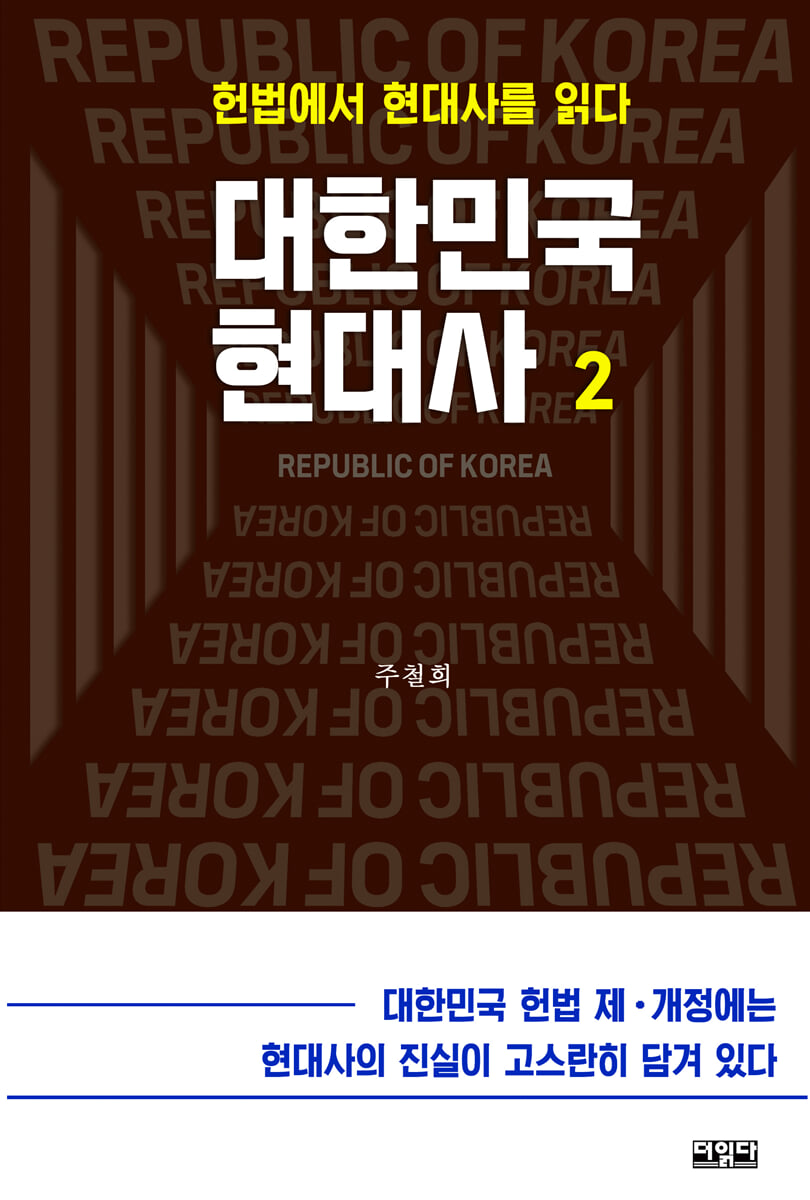
Modern History of the Republic of Korea 2
 |
Description
Book Introduction
The keywords of 『Modern History of the Republic of Korea: Reading Modern History from the Constitution』 are constitution, democracy (democratic republic), and history (modern history).
The field I study is history.
This book contains the modern history of the Republic of Korea, starting with the enactment of the Constitution on July 17, 1948, and continuing through the 9th amendment to the Constitution, which led to the current Constitution of the 6th Republic.
The modern history of the Republic of Korea is another word for democracy.
I tried to write in a way that makes it easy to read the modern history of the Republic of Korea and democracy revealed in the Constitution.
Article 1 of the Constitution, "The Republic of Korea shall be a democratic republic," and "The sovereignty of the Republic of Korea shall reside in the people, and all state authority shall emanate from the people." This book was written not only to understand and recognize the text of the Constitution, but also to explore the attitude and role that citizens should have as sovereign citizens, as well as the direction in which the Republic of Korea should move forward.
The field I study is history.
This book contains the modern history of the Republic of Korea, starting with the enactment of the Constitution on July 17, 1948, and continuing through the 9th amendment to the Constitution, which led to the current Constitution of the 6th Republic.
The modern history of the Republic of Korea is another word for democracy.
I tried to write in a way that makes it easy to read the modern history of the Republic of Korea and democracy revealed in the Constitution.
Article 1 of the Constitution, "The Republic of Korea shall be a democratic republic," and "The sovereignty of the Republic of Korea shall reside in the people, and all state authority shall emanate from the people." This book was written not only to understand and recognize the text of the Constitution, but also to explore the attitude and role that citizens should have as sovereign citizens, as well as the direction in which the Republic of Korea should move forward.
- You can preview some of the book's contents.
Preview
index
Part 4: The Fourth Republic, the Yushin Era
Chapter 1: Background of the October Yushin Proclamation
1.
The 40s Rider Theory and the Two Kims Era _13
2.
7th Presidential Election, General System _25
3.
October Yushin Declaration, Permanent Rule _35
4.
Inter-Korean Dialogue and the July 4th Joint Statement _43
Chapter 2: The Yushin Constitution for Lifelong Rule 55
1.
Peaceful Unification of the Fatherland and the Basic Order of Liberal Democracy _57
2.
Imperial President and the Weakening of Citizens' Fundamental Rights _60
3.
The One and Only Commissioned Body for the President _62
4.
Yushin Constitution, Permanent Rule National Referendum _66
5.
National Conference for Unification as a Flagship of the Yushin Regime _70
Chapter 3: Park Chung-hee Walks Toward the End (75)
1.
Jeon Tae-il, "Don't Let My Death Be in Vain" _75
2.
Gwangju Complex Civil Rights Movement _81
3.
Kim Dae-jung Kidnapping Case _84
4.
Emergency Measures and the Wave of Public Opinion _91
5.
Emergency Measure No. 1, Jang Jun-ha _97
6.
The Mincheonghakryeon Incident and the People's Revolutionary Party Reconstruction Committee _112
7.
Dong-A, the Struggle for Free Press _123
Sintering Yushin system 138
Part 5: The Fifth Republic: Chun Doo-hwan and the New Military Government
Chapter 1: The Fall of the Yushin Regime 152
1.
The YH Incident of the "Female Worker" and "Gongsoon-i" _152
2. YS's Expulsion and the Busan-Masan Democratic Struggle _159
3.
The Busan-Masan Democratic Struggle and Kim Jae-gyu _179
Chapter 2: Shooting the Heart of a Beast 184
1.
Gunshots in Gungjeong-dong _184
2.
People at the October 26th Dinner _188
3.
Three Gunshots Signaling the End _193
4.
When and with whom was the uprising conspired? _198
5.
Is Kim Jae-gyu a "Chief Instigator" or a "Doctor"? _201
Chapter 3: The Emergence of the New Military Government 217
1.
The military's private organization, Hanahoe _218
2.
Spring in Seoul, Operation "Birthday Party" _220
3.
May 17th Martial Law Expansion Measures _232
Chapter 4: The Gwangju Democratization Movement 240
1.
Special Forces Airborne Unit Deployment _242
2.
The Eternal Name of the Gwangju Democratization Movement: "Women" _251
3.
'Absolute Community': Gwangju and Democracy _265
4.
National Security Emergency Committee _281
Chapter 5, Constitution of the Fifth Republic, 286
1.
The preamble to the Constitution has been changed _286
2.
Restoration of Popular Sovereignty _289
3.
Fundamental Rights Reemphasized _292
4.
The Power Structure of the Fifth Republic _293
5.
Economic Order _297
6.
The Era of Chun Doo-hwan by Chun Doo-hwan _299
The Fifth Republic, the "Winter Republic" 302
Part 6, 6th Republic of Korea, present
Chapter 1: The June 1987 Democracy Movement 316
1.
Chun Doo-hwan's '3S' Policy _316
2.
The Return of the Constitutional Amendment _319
3.
Park Jong-cheol's Torture and Death _323
4.
April 13 Constitutional Declaration _330
5.
June Democracy Movement _334
6.
The Birth of Numerous Martyrs _344
Chapter 2: The Achievement of Direct Election Constitutional Amendment 353
1.
June 29 Declaration _353
2.
Constitutional Special Committee and Eight-Person Political Meeting _357
Chapter 3, Constitution of the Sixth Republic, 362
1.
Constitution (Preamble) _363
2.
Article 4 of the Constitution: "Unification" _371
3.
Political Neutrality of the Military _393
4.
Minimum Wage System _396
5.
The Power Structure of the Sixth Republic _401
6.
Constitutional Court _404
Chapter 4: The Sixth Republic, Currently in Progress 420
1.
The Two Kims: Kim Young-sam and Kim Dae-jung _422
2.
Three-Party Merger: Roh Tae-woo, Kim Young-sam, and Kim Jong-pil _425
When will the 7th Republic of Korea be 431?
·In conclusion
: Remembering and Recording Democracy 443
Chapter 1: Background of the October Yushin Proclamation
1.
The 40s Rider Theory and the Two Kims Era _13
2.
7th Presidential Election, General System _25
3.
October Yushin Declaration, Permanent Rule _35
4.
Inter-Korean Dialogue and the July 4th Joint Statement _43
Chapter 2: The Yushin Constitution for Lifelong Rule 55
1.
Peaceful Unification of the Fatherland and the Basic Order of Liberal Democracy _57
2.
Imperial President and the Weakening of Citizens' Fundamental Rights _60
3.
The One and Only Commissioned Body for the President _62
4.
Yushin Constitution, Permanent Rule National Referendum _66
5.
National Conference for Unification as a Flagship of the Yushin Regime _70
Chapter 3: Park Chung-hee Walks Toward the End (75)
1.
Jeon Tae-il, "Don't Let My Death Be in Vain" _75
2.
Gwangju Complex Civil Rights Movement _81
3.
Kim Dae-jung Kidnapping Case _84
4.
Emergency Measures and the Wave of Public Opinion _91
5.
Emergency Measure No. 1, Jang Jun-ha _97
6.
The Mincheonghakryeon Incident and the People's Revolutionary Party Reconstruction Committee _112
7.
Dong-A, the Struggle for Free Press _123
Sintering Yushin system 138
Part 5: The Fifth Republic: Chun Doo-hwan and the New Military Government
Chapter 1: The Fall of the Yushin Regime 152
1.
The YH Incident of the "Female Worker" and "Gongsoon-i" _152
2. YS's Expulsion and the Busan-Masan Democratic Struggle _159
3.
The Busan-Masan Democratic Struggle and Kim Jae-gyu _179
Chapter 2: Shooting the Heart of a Beast 184
1.
Gunshots in Gungjeong-dong _184
2.
People at the October 26th Dinner _188
3.
Three Gunshots Signaling the End _193
4.
When and with whom was the uprising conspired? _198
5.
Is Kim Jae-gyu a "Chief Instigator" or a "Doctor"? _201
Chapter 3: The Emergence of the New Military Government 217
1.
The military's private organization, Hanahoe _218
2.
Spring in Seoul, Operation "Birthday Party" _220
3.
May 17th Martial Law Expansion Measures _232
Chapter 4: The Gwangju Democratization Movement 240
1.
Special Forces Airborne Unit Deployment _242
2.
The Eternal Name of the Gwangju Democratization Movement: "Women" _251
3.
'Absolute Community': Gwangju and Democracy _265
4.
National Security Emergency Committee _281
Chapter 5, Constitution of the Fifth Republic, 286
1.
The preamble to the Constitution has been changed _286
2.
Restoration of Popular Sovereignty _289
3.
Fundamental Rights Reemphasized _292
4.
The Power Structure of the Fifth Republic _293
5.
Economic Order _297
6.
The Era of Chun Doo-hwan by Chun Doo-hwan _299
The Fifth Republic, the "Winter Republic" 302
Part 6, 6th Republic of Korea, present
Chapter 1: The June 1987 Democracy Movement 316
1.
Chun Doo-hwan's '3S' Policy _316
2.
The Return of the Constitutional Amendment _319
3.
Park Jong-cheol's Torture and Death _323
4.
April 13 Constitutional Declaration _330
5.
June Democracy Movement _334
6.
The Birth of Numerous Martyrs _344
Chapter 2: The Achievement of Direct Election Constitutional Amendment 353
1.
June 29 Declaration _353
2.
Constitutional Special Committee and Eight-Person Political Meeting _357
Chapter 3, Constitution of the Sixth Republic, 362
1.
Constitution (Preamble) _363
2.
Article 4 of the Constitution: "Unification" _371
3.
Political Neutrality of the Military _393
4.
Minimum Wage System _396
5.
The Power Structure of the Sixth Republic _401
6.
Constitutional Court _404
Chapter 4: The Sixth Republic, Currently in Progress 420
1.
The Two Kims: Kim Young-sam and Kim Dae-jung _422
2.
Three-Party Merger: Roh Tae-woo, Kim Young-sam, and Kim Jong-pil _425
When will the 7th Republic of Korea be 431?
·In conclusion
: Remembering and Recording Democracy 443
Into the book
〈The history of the Republic of Korea is contained in the process of establishing and amending the Constitution.
The democracy of the Republic of Korea is fully embedded in it.
The Constitution of the Republic of Korea, modern history, and democracy have not been smooth sailing.
There were too many people in power who manipulated the constitution as they pleased.
The people stood up to them and thus protected democracy.
The only cases of punishing those who disrupted the constitutional order through the confidence that a successful coup cannot be punished and his followers are the new military junta including Chun Doo-hwan.
This is a history that must be settled even now.
The turbulent history of the past tells us many stories about the democracy of the Republic of Korea that will come in the future.
Democracy is the highest value of the Republic of Korea.
Many young people and students shed blood to protect and preserve that value.
Democracy is never something that just happens.
There were countless struggles and deaths.
Through that struggle and death, democracy in the Republic of Korea breathes passionately and passionately right next to us today.
Remember and record them.
In the 5th and 6th presidential elections, opposition candidate Yun Bo-seon was well-known to the public, but he was widely perceived as an older, old-fashioned politician.
However, the 7th opposition candidate, Kim Dae-jung, overwhelmed Park Chung-hee in every way.
First, Kim Dae-jung presented a clear pledge on how he would run the country.
A constitutional amendment was proposed by the people to ban a third consecutive term.
The realization of a mass economy received tremendous support from the people.
A popular economy includes expanded welfare, fair distribution of the fruits of economic growth, employee ownership, agricultural reform, and increased taxation of the wealthy.
Second, his speech, which was both extensive and powerful, was unparalleled.
Kim Dae-jung's appeal was in simple language that the people could easily understand.
With this confidence, Kim Dae-jung proposed to Park Chung-hee a public debate on TV and radio.
Third, and above all, Kim Dae-jung was younger than Park Chung-hee.
What Kim Dae-jung lacked compared to Park Chung-hee was the ability to mobilize government power.
--- p.138
On October 17, 1972, Park Chung-hee once again destroyed the constitutional order by declaring the ‘October Yushin.’
With the Yushin Constitution, the presidential election was moved to the gymnasium (National Conference for Unification).
In the 8th and 9th presidential elections held in the gymnasium, Park Chung-hee ran unopposed and was elected with 99.96% of the votes.
The National Assembly was formed by members recommended by the President.
It accounted for a whopping one-third of the total number of National Assembly members.
It was an absolute power in which the executive, judicial, and legislative branches were controlled by one president.
The youth and students' desire for democracy has grown stronger and more organized.
Park Chung-hee abused his emergency decrees, and the National Security Act and the Anti-Communism Act were used as they pleased.
The Yushin regime was anti-democratic, anti-human rights, anti-labor, and anti-unification.
However, the Yushin regime of, by, and for Park Chung-hee has come to an end.
By the hands of one's own subordinates.
--- p.143
With the start of the new semester in 1980, university students' enthusiasm for democracy was high.
Entering May, the university student protests shifted from demanding democratization on campus to political issues such as "Lift martial law" and "Chun Doo-hwan step down."
As the military's influence was increasingly being diminished by the democratization movement, Chun Doo-hwan and the new military regime could not just sit back and watch.
So, the special measure that was created was the ‘Current Situation Management Plan.’
The main point is, first of all, to neutralize the legitimate National Assembly.
Second, the intensity of martial law will be increased to the highest level to maximize the military's control.
Third, establish an organization that can carry out actual governance.
The first and second of the new military government's 'state of emergency management plan' are to achieve their goals through the nationwide expansion of martial law on May 17.
And finally, we set about establishing a practical governing body.
--- p.281
On November 23, 1988, Chun Doo-hwan stood before reporters in an alley in Yeonhui-dong.
It is also known as 'alley statement'.
He apologized for the mistakes and corruption during his term and issued an apology.
His apology stated, “At the time, I was entrusted with the responsibility of state affairs without any preparation or experience in a state of national emergency.”
This apology stands in stark contrast to the confidence expressed in 1980 when he came to the forefront of politics, saying, “Korea clearly needs military leadership and control.”
In 1979 and 1980, no one asked Chun Doo-hwan to take responsibility for state affairs.
Although he was not prepared or experienced enough to run a country, he was blinded by power and usurped it.
The moment of glory was short-lived.
--- p.304
The Constitution of the 6th Republic consists of a preamble, 10 chapters and 130 articles in the main text, and 6 supplementary provisions.
Looking at the composition of the Constitution, in the Fifth Republic, Chapter 3 was the ‘Government’ and Chapter 4 was the ‘National Assembly.’
In the 6th Republic, Chapter 3 was changed to ‘National Assembly’ and Chapter 4 to ‘Government.’
It means that we will respect the National Assembly, which is the representative body of the people.
Although it is called the National Assembly or Parliament, Article 40 of the current Constitution clearly states that “the legislative power belongs to the National Assembly.”
It would be more correct to express and specify it as the National Assembly rather than the Parliament.
The statement that legislative power belongs to the National Assembly implies that executive power belongs to the government and judicial power belongs to the courts.
It is the separation of powers.
--- p.362
The unification plan of the Korean community proposed the 'South-North Korea Union Korea Commonwealth' as a transitional unification system.
Unlike confederation or federation, the North-South union is a transitional and special form of union that aims for unification.
That is, the goal is to realize openness and exchange and cooperation between the South and the North within the South-North union in the form of a two-system union within one nation, and to lay the foundation for homogenization and integration of the national society.
This is a plan to achieve gradual and step-by-step unification by securing national homogeneity as a prerequisite for unification.
--- p.376
'Betrayal of the people's trust' cannot be interpreted legally, but rather, public sentiment must be used as a key indicator.
The Constitutional Court, with its weak democratic legitimacy, cannot ignore the political demands expressed by the people, the sovereign of the country.
This is because the Constitution itself is a fundamental right of the people and a product of political heritage.
Therefore, the Constitutional Court's decision on impeachment based on "severity" was a result of the political demands of the sovereign people.
--- p.433
The Constitution and democracy of the Republic of Korea have not been smooth sailing.
It is filled with countless stories and twists and turns, and is called the history of the Republic of Korea.
The history of the Republic of Korea has been marked by countless struggles and deaths.
Through that struggle and death, democracy in the Republic of Korea breathes passionately and passionately right next to us today.
Remember and record them.
The democracy of the Republic of Korea is fully embedded in it.
The Constitution of the Republic of Korea, modern history, and democracy have not been smooth sailing.
There were too many people in power who manipulated the constitution as they pleased.
The people stood up to them and thus protected democracy.
The only cases of punishing those who disrupted the constitutional order through the confidence that a successful coup cannot be punished and his followers are the new military junta including Chun Doo-hwan.
This is a history that must be settled even now.
The turbulent history of the past tells us many stories about the democracy of the Republic of Korea that will come in the future.
Democracy is the highest value of the Republic of Korea.
Many young people and students shed blood to protect and preserve that value.
Democracy is never something that just happens.
There were countless struggles and deaths.
Through that struggle and death, democracy in the Republic of Korea breathes passionately and passionately right next to us today.
Remember and record them.
In the 5th and 6th presidential elections, opposition candidate Yun Bo-seon was well-known to the public, but he was widely perceived as an older, old-fashioned politician.
However, the 7th opposition candidate, Kim Dae-jung, overwhelmed Park Chung-hee in every way.
First, Kim Dae-jung presented a clear pledge on how he would run the country.
A constitutional amendment was proposed by the people to ban a third consecutive term.
The realization of a mass economy received tremendous support from the people.
A popular economy includes expanded welfare, fair distribution of the fruits of economic growth, employee ownership, agricultural reform, and increased taxation of the wealthy.
Second, his speech, which was both extensive and powerful, was unparalleled.
Kim Dae-jung's appeal was in simple language that the people could easily understand.
With this confidence, Kim Dae-jung proposed to Park Chung-hee a public debate on TV and radio.
Third, and above all, Kim Dae-jung was younger than Park Chung-hee.
What Kim Dae-jung lacked compared to Park Chung-hee was the ability to mobilize government power.
--- p.138
On October 17, 1972, Park Chung-hee once again destroyed the constitutional order by declaring the ‘October Yushin.’
With the Yushin Constitution, the presidential election was moved to the gymnasium (National Conference for Unification).
In the 8th and 9th presidential elections held in the gymnasium, Park Chung-hee ran unopposed and was elected with 99.96% of the votes.
The National Assembly was formed by members recommended by the President.
It accounted for a whopping one-third of the total number of National Assembly members.
It was an absolute power in which the executive, judicial, and legislative branches were controlled by one president.
The youth and students' desire for democracy has grown stronger and more organized.
Park Chung-hee abused his emergency decrees, and the National Security Act and the Anti-Communism Act were used as they pleased.
The Yushin regime was anti-democratic, anti-human rights, anti-labor, and anti-unification.
However, the Yushin regime of, by, and for Park Chung-hee has come to an end.
By the hands of one's own subordinates.
--- p.143
With the start of the new semester in 1980, university students' enthusiasm for democracy was high.
Entering May, the university student protests shifted from demanding democratization on campus to political issues such as "Lift martial law" and "Chun Doo-hwan step down."
As the military's influence was increasingly being diminished by the democratization movement, Chun Doo-hwan and the new military regime could not just sit back and watch.
So, the special measure that was created was the ‘Current Situation Management Plan.’
The main point is, first of all, to neutralize the legitimate National Assembly.
Second, the intensity of martial law will be increased to the highest level to maximize the military's control.
Third, establish an organization that can carry out actual governance.
The first and second of the new military government's 'state of emergency management plan' are to achieve their goals through the nationwide expansion of martial law on May 17.
And finally, we set about establishing a practical governing body.
--- p.281
On November 23, 1988, Chun Doo-hwan stood before reporters in an alley in Yeonhui-dong.
It is also known as 'alley statement'.
He apologized for the mistakes and corruption during his term and issued an apology.
His apology stated, “At the time, I was entrusted with the responsibility of state affairs without any preparation or experience in a state of national emergency.”
This apology stands in stark contrast to the confidence expressed in 1980 when he came to the forefront of politics, saying, “Korea clearly needs military leadership and control.”
In 1979 and 1980, no one asked Chun Doo-hwan to take responsibility for state affairs.
Although he was not prepared or experienced enough to run a country, he was blinded by power and usurped it.
The moment of glory was short-lived.
--- p.304
The Constitution of the 6th Republic consists of a preamble, 10 chapters and 130 articles in the main text, and 6 supplementary provisions.
Looking at the composition of the Constitution, in the Fifth Republic, Chapter 3 was the ‘Government’ and Chapter 4 was the ‘National Assembly.’
In the 6th Republic, Chapter 3 was changed to ‘National Assembly’ and Chapter 4 to ‘Government.’
It means that we will respect the National Assembly, which is the representative body of the people.
Although it is called the National Assembly or Parliament, Article 40 of the current Constitution clearly states that “the legislative power belongs to the National Assembly.”
It would be more correct to express and specify it as the National Assembly rather than the Parliament.
The statement that legislative power belongs to the National Assembly implies that executive power belongs to the government and judicial power belongs to the courts.
It is the separation of powers.
--- p.362
The unification plan of the Korean community proposed the 'South-North Korea Union Korea Commonwealth' as a transitional unification system.
Unlike confederation or federation, the North-South union is a transitional and special form of union that aims for unification.
That is, the goal is to realize openness and exchange and cooperation between the South and the North within the South-North union in the form of a two-system union within one nation, and to lay the foundation for homogenization and integration of the national society.
This is a plan to achieve gradual and step-by-step unification by securing national homogeneity as a prerequisite for unification.
--- p.376
'Betrayal of the people's trust' cannot be interpreted legally, but rather, public sentiment must be used as a key indicator.
The Constitutional Court, with its weak democratic legitimacy, cannot ignore the political demands expressed by the people, the sovereign of the country.
This is because the Constitution itself is a fundamental right of the people and a product of political heritage.
Therefore, the Constitutional Court's decision on impeachment based on "severity" was a result of the political demands of the sovereign people.
--- p.433
The Constitution and democracy of the Republic of Korea have not been smooth sailing.
It is filled with countless stories and twists and turns, and is called the history of the Republic of Korea.
The history of the Republic of Korea has been marked by countless struggles and deaths.
Through that struggle and death, democracy in the Republic of Korea breathes passionately and passionately right next to us today.
Remember and record them.
--- p.461
Publisher's Review
The truth about modern history in the Constitution: We were so unaware.
The Constitution of the Republic of Korea has been amended nine times since its enactment on July 17, 1948, and the current Constitution is the Constitution of the 6th Republic.
The Constitution is the basic law of the Republic of Korea that contains the fundamental character and political ideals and values of the nation and governs the rights and duties of the people.
Despite the constitution stating that "the Republic of Korea is a democratic republic" and that "the sovereignty of the Republic of Korea resides in the people, and all state authority emanates from the people," there have been few cases of revisions in accordance with the will of the sovereign people during the nine revisions.
The constitutional spirit of democracy and popular sovereignty was thoroughly ignored by those in power.
It is a violation of modern Korean history.
A must-read on modern Korean history, with extensive material.
Based on the belief that the Constitution of the Republic of Korea should be close to the people and for the people as sovereign, the author undertook the arduous task of uncovering the hidden truths of the Republic of Korea, one by one, through hundreds of papers and historical materials.
The modern history of the Republic of Korea and the constitutional amendment follow the same path.
This book sheds new light on a series of facts contained in the process of constitutional enactment and revision from a historical perspective, thereby revealing that the Constitution of the Republic of Korea is directed toward the people.
There is no shortage of must-reads for those of us living today.
The Constitution of the Republic of Korea has been amended nine times since its enactment on July 17, 1948, and the current Constitution is the Constitution of the 6th Republic.
The Constitution is the basic law of the Republic of Korea that contains the fundamental character and political ideals and values of the nation and governs the rights and duties of the people.
Despite the constitution stating that "the Republic of Korea is a democratic republic" and that "the sovereignty of the Republic of Korea resides in the people, and all state authority emanates from the people," there have been few cases of revisions in accordance with the will of the sovereign people during the nine revisions.
The constitutional spirit of democracy and popular sovereignty was thoroughly ignored by those in power.
It is a violation of modern Korean history.
A must-read on modern Korean history, with extensive material.
Based on the belief that the Constitution of the Republic of Korea should be close to the people and for the people as sovereign, the author undertook the arduous task of uncovering the hidden truths of the Republic of Korea, one by one, through hundreds of papers and historical materials.
The modern history of the Republic of Korea and the constitutional amendment follow the same path.
This book sheds new light on a series of facts contained in the process of constitutional enactment and revision from a historical perspective, thereby revealing that the Constitution of the Republic of Korea is directed toward the people.
There is no shortage of must-reads for those of us living today.
GOODS SPECIFICS
- Date of issue: May 25, 2024
- Page count, weight, size: 462 pages | 152*225*30mm
- ISBN13: 9791198762214
- ISBN10: 1198762217
You may also like
카테고리
korean


korean

![GQ KOREA Mark (Monthly): December [2025]](http://librairie.coreenne.fr/cdn/shop/files/8ef265dbbfbf186523ed75ba7319009d.jpg?v=1765340328&width=3840)


