

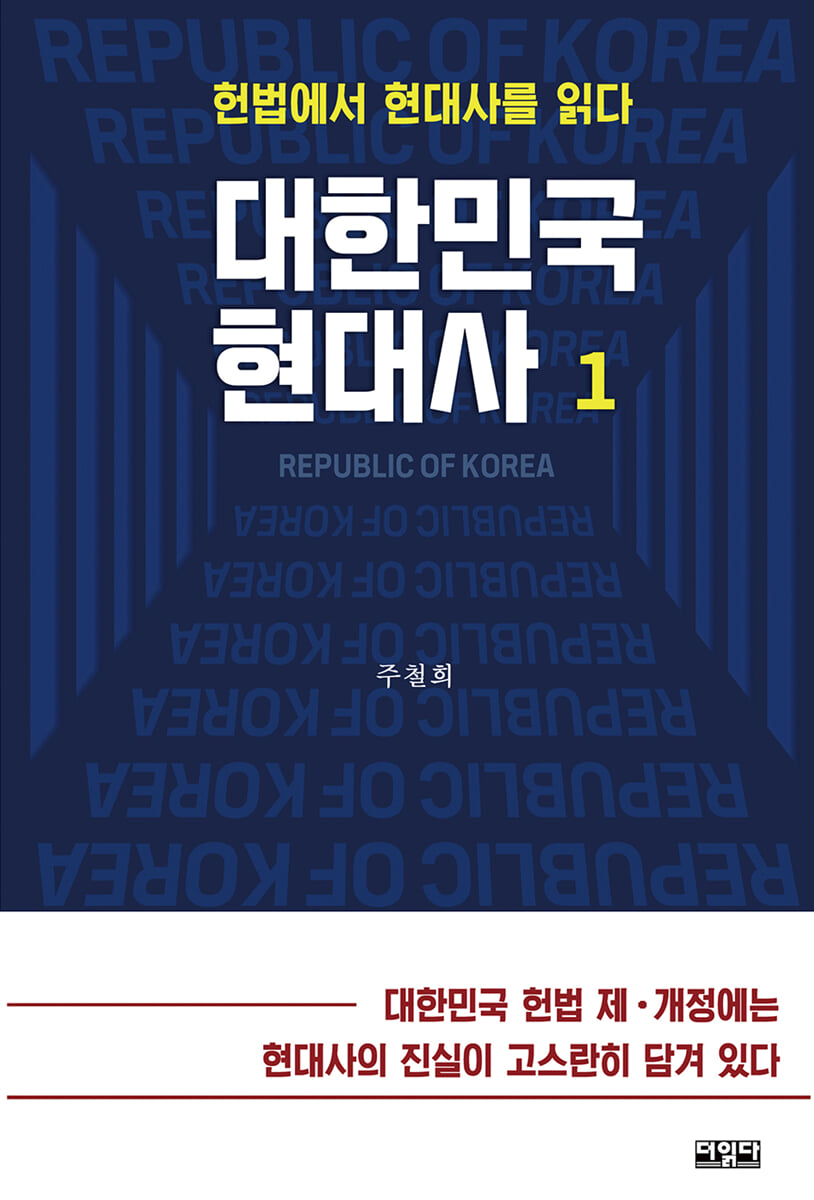
Modern History of the Republic of Korea 1
 |
Description
Book Introduction
This book contains the modern history of the Republic of Korea, starting with the enactment of the Constitution on July 17, 1948, and continuing through the 9th amendment to the Constitution, which led to the current Constitution of the 6th Republic.
In other words, the constitutional amendment was not just a legal issue, but it was started with the understanding and recognition of the modern history of the Republic of Korea itself.
And I thought deeply about why we are amending the Constitution.
The reason for the constitutional amendment was to reflect the changing values and political situation of the time and to prepare for a new future.
Therefore, the constitutional amendment was history.
This book records the historical facts contained in the process of establishing and revising the Constitution.
In other words, the constitutional amendment was not just a legal issue, but it was started with the understanding and recognition of the modern history of the Republic of Korea itself.
And I thought deeply about why we are amending the Constitution.
The reason for the constitutional amendment was to reflect the changing values and political situation of the time and to prepare for a new future.
Therefore, the constitutional amendment was history.
This book records the historical facts contained in the process of establishing and revising the Constitution.
- You can preview some of the book's contents.
Preview
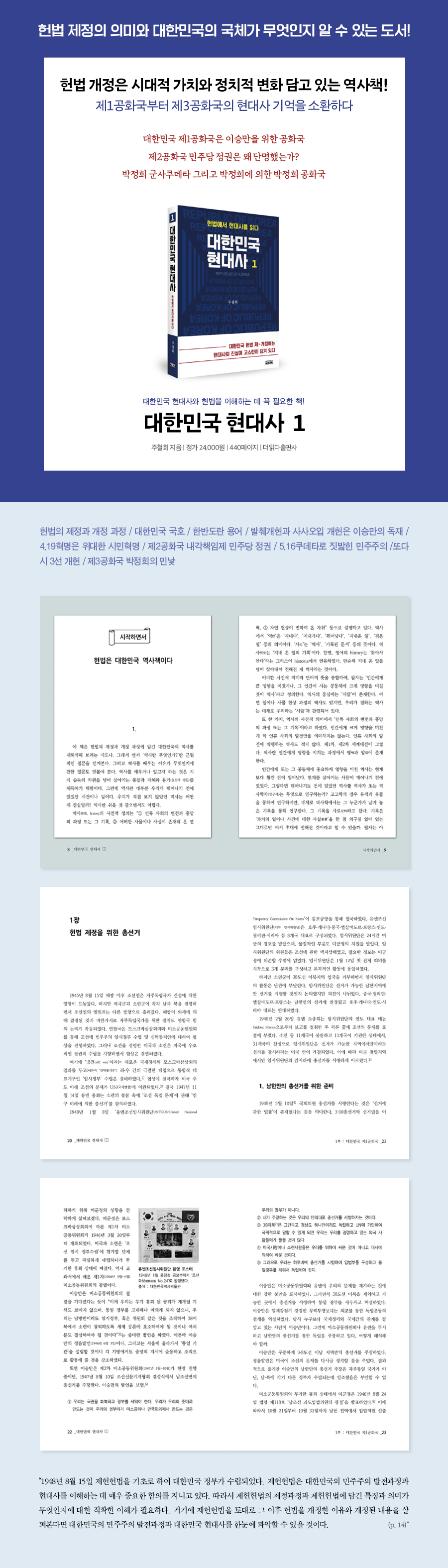
index
To begin with: The Constitution is the history book of the Republic of Korea _8
Part 1 The First Republic of Korea
Chapter 1 General Election for the Constitution _20
1.
Preparations for South Korea's General Election _21
2.
People of the Constitutional Assembly _30
Chapter 2: The National Assembly, Enacting the Constitution _38
1.
National Assembly Opening Ceremony _38
2.
Preamble to the Constitution _42
3.
National Title, 'Republic of Korea' _44
4.
March 1st Movement and the March 1st Revolution _52
5.
The Republic of Korea's National Structure and Politics, "Democratic Republic" _64
6.
'People' and 'National' _75
7.
Territory of the Republic of Korea _80
8.
Presidential and Cabinet Systems, and President Syngman Rhee _87
9.
Etymology of President _93
10.
Separation of Politics and Religion in the Constitution _97
11.
Economic System, 'Social and Economic Democracy' _101
Chapter 3: The Birth of the National Security Act _108
1.
The first martial law declared in South Korea _108
2.
Enactment of the National Security Act _114
3.
Temporary Postal Service Control Act _122
Chapter 4: Why Change the Constitution _125
1.
Constitutional Amendment, Failed _125
2.
Excerpt from the Constitutional Amendment (1st Amendment), the Crisis of Democracy _129
3.
The 'SaSaOip' Constitutional Amendment (Second Amendment) _135
4.
Abolition of the Prime Minister System _147
Chapter 5: Progressive Party's Cho Bong-am, Judicial Murder _149
1.
Who is Jo Bong-am? _149
2.
Progressive Party's Cho Bong-am faces charges under the National Security Act _159
Is the First Republic a Monarchy? _167
Part 2: Second Republic Democratic Party Government
Chapter 1: The Prelude to the Second Republic _182
1.
March 15th Election Fraud _182
2.
High School Students, Visionaries of Their Times _189
3.
Citizens' Revolution, April 19 Revolution _194
4.
The Ultimate Dictator Who Came Laughing and Left Crying _208
5.
The Scars of the April Revolution _211
Chapter 2: Who is Syngman Rhee, the "Father of the Nation"? _213
1.
“The burden is the nation” _213
2.
First wife Park Seung-seon and son _216
3.
Family Registers Usurped by Power _222
Chapter 3: The First Cabinet System in Constitutional History _229
1.
The Third Constitutional Amendment: Process and Key Issues _230
2.
3rd Constitutional Amendment, Key Points _234
3.
Ignorance of the Cabinet System _240
4.
New political party provision: Central party in Seoul _245
5.
Judicial Democratization: The Supreme Court Chief Justice and Justice Election System _248
6.
Constitutionalization of the National Election Commission _251
7.
The Fourth Constitutional Amendment Embodied in Revolutionary Spirit _252
Chapter 4: Did the Second Republic Fail? _256
1.
Conflict and Division Between the Old and New Factions of the Democratic Party _256
2.
'Economy First' and the Five-Year Economic Development Plan _263
3.
The Civil Revolution and the Short-lived Second Republic _269
The Legacy of the Second Republic of Korea _274
Part 3: The Third Republic: The Era of Park Chung-hee
Chapter 1: The Second Republic Isn't Over _282
1.
At dawn on May 16th, soldiers moved _282
2.
When did the military rebellion begin? _295
3.
Military Academy Cadets' "Support Coup" March _302
4.
The US Position on the Military Rebellion _307
5.
Launch of the Supreme Council for National Reconstruction _323
Chapter 2: The Birth of a Military Dictatorship Republic _337
1.
Special: Based on the April 19 Uprising and the May 16 Revolution _339
2.
Major Constitutional Amendments of the Third Republic _341
3.
The first person to receive a medal after the establishment of the government _349
Chapter 3: The Fifth Presidential Election _354
1.
Civilian Absence and Military Government Extension _355
2.
So that there will never again be an unfortunate soldier in this country _361
3.
Park Chung-hee's Ideological Debate _366
4.
The Rise of Ruinous Regionalism _375
Chapter 4: The True Face of the Third Republic _381
1.
Let's go, come north, meet south, Panmunjom _381
2.
Korea-Japan Summit, Kim Jong-pil-Ohira Memo _386
3.
People's Revolutionary Party Incident _396
4.
Samsung Saccharin Smuggling Case _402
Chapter 5: Park Chung-hee, Another Third-Term Constitutional Amendment _419
1.
How far does the desire for power go? _419
2.
The Third Amendment (6th Amendment) and Election Fraud _423
Park Chung-hee, following Syngman Rhee's path _429
Part 1 The First Republic of Korea
Chapter 1 General Election for the Constitution _20
1.
Preparations for South Korea's General Election _21
2.
People of the Constitutional Assembly _30
Chapter 2: The National Assembly, Enacting the Constitution _38
1.
National Assembly Opening Ceremony _38
2.
Preamble to the Constitution _42
3.
National Title, 'Republic of Korea' _44
4.
March 1st Movement and the March 1st Revolution _52
5.
The Republic of Korea's National Structure and Politics, "Democratic Republic" _64
6.
'People' and 'National' _75
7.
Territory of the Republic of Korea _80
8.
Presidential and Cabinet Systems, and President Syngman Rhee _87
9.
Etymology of President _93
10.
Separation of Politics and Religion in the Constitution _97
11.
Economic System, 'Social and Economic Democracy' _101
Chapter 3: The Birth of the National Security Act _108
1.
The first martial law declared in South Korea _108
2.
Enactment of the National Security Act _114
3.
Temporary Postal Service Control Act _122
Chapter 4: Why Change the Constitution _125
1.
Constitutional Amendment, Failed _125
2.
Excerpt from the Constitutional Amendment (1st Amendment), the Crisis of Democracy _129
3.
The 'SaSaOip' Constitutional Amendment (Second Amendment) _135
4.
Abolition of the Prime Minister System _147
Chapter 5: Progressive Party's Cho Bong-am, Judicial Murder _149
1.
Who is Jo Bong-am? _149
2.
Progressive Party's Cho Bong-am faces charges under the National Security Act _159
Is the First Republic a Monarchy? _167
Part 2: Second Republic Democratic Party Government
Chapter 1: The Prelude to the Second Republic _182
1.
March 15th Election Fraud _182
2.
High School Students, Visionaries of Their Times _189
3.
Citizens' Revolution, April 19 Revolution _194
4.
The Ultimate Dictator Who Came Laughing and Left Crying _208
5.
The Scars of the April Revolution _211
Chapter 2: Who is Syngman Rhee, the "Father of the Nation"? _213
1.
“The burden is the nation” _213
2.
First wife Park Seung-seon and son _216
3.
Family Registers Usurped by Power _222
Chapter 3: The First Cabinet System in Constitutional History _229
1.
The Third Constitutional Amendment: Process and Key Issues _230
2.
3rd Constitutional Amendment, Key Points _234
3.
Ignorance of the Cabinet System _240
4.
New political party provision: Central party in Seoul _245
5.
Judicial Democratization: The Supreme Court Chief Justice and Justice Election System _248
6.
Constitutionalization of the National Election Commission _251
7.
The Fourth Constitutional Amendment Embodied in Revolutionary Spirit _252
Chapter 4: Did the Second Republic Fail? _256
1.
Conflict and Division Between the Old and New Factions of the Democratic Party _256
2.
'Economy First' and the Five-Year Economic Development Plan _263
3.
The Civil Revolution and the Short-lived Second Republic _269
The Legacy of the Second Republic of Korea _274
Part 3: The Third Republic: The Era of Park Chung-hee
Chapter 1: The Second Republic Isn't Over _282
1.
At dawn on May 16th, soldiers moved _282
2.
When did the military rebellion begin? _295
3.
Military Academy Cadets' "Support Coup" March _302
4.
The US Position on the Military Rebellion _307
5.
Launch of the Supreme Council for National Reconstruction _323
Chapter 2: The Birth of a Military Dictatorship Republic _337
1.
Special: Based on the April 19 Uprising and the May 16 Revolution _339
2.
Major Constitutional Amendments of the Third Republic _341
3.
The first person to receive a medal after the establishment of the government _349
Chapter 3: The Fifth Presidential Election _354
1.
Civilian Absence and Military Government Extension _355
2.
So that there will never again be an unfortunate soldier in this country _361
3.
Park Chung-hee's Ideological Debate _366
4.
The Rise of Ruinous Regionalism _375
Chapter 4: The True Face of the Third Republic _381
1.
Let's go, come north, meet south, Panmunjom _381
2.
Korea-Japan Summit, Kim Jong-pil-Ohira Memo _386
3.
People's Revolutionary Party Incident _396
4.
Samsung Saccharin Smuggling Case _402
Chapter 5: Park Chung-hee, Another Third-Term Constitutional Amendment _419
1.
How far does the desire for power go? _419
2.
The Third Amendment (6th Amendment) and Election Fraud _423
Park Chung-hee, following Syngman Rhee's path _429
Detailed image
Into the book
The government of the Republic of Korea was established on August 15, 1948, based on the Constitution.
The Constitution has very important implications for understanding the development of democracy and modern history in the Republic of Korea.
Therefore, it is necessary to have a precise understanding of the process of establishing the Constitution and the characteristics and meaning contained in the Constitution.
If we examine the reasons for and the revised contents of subsequent constitutions based on the Constitution, we will be able to grasp the development of democracy in the Republic of Korea and the modern history of the Republic of Korea at a glance.
--- p.14
In the Yu Jin-oh constitutional draft, the national name was written as ‘Joseon’ and the people were referred to as ‘people.’
There was a heated debate regarding the national name in the Constitutional Drafting Committee on June 8th.
Finally, a vote was held.
As a result, the Republic of Korea received 17 votes, the Republic of Koryo received 7 votes, the Republic of Joseon received 2 votes, and Korea received 1 vote, so 'Republic of Korea' was decided as the national name.
Among the members of the Constitutional Drafting Committee, the group that urged the people, including Lee Cheong-cheon, supported the 'Republic of Korea' favored by Syngman Rhee, while the Korean Democratic Party supported the 'Republic of Goryeo'.
The main reason given by those who insisted on using the name of the country as the Republic of Korea was that “in order to receive compensation from Japan, the claim can only be made under the former name of the country, the Republic of Korea.”
--- p.48
The Constitution focused on political democracy, including guaranteeing the people's basic rights.
Among the subsequent laws enacted after the establishment of the Republic of Korea government, the one that most closely impacted the basic rights of the people was undoubtedly the 'National Security Act'.
Until the establishment of the Republic of Korea government and the Yeosu-Suncheon Uprising, the influence of leftist forces was considerable throughout society.
The government enacted the National Security Act as a legal mechanism to comprehensively suppress and destroy the remaining leftist forces following the Yeosu-Suncheon Uprising.
Thus, the National Security Act was enacted and promulgated as Law No. 10 on December 1, 1948.
And even as of 2023, its power remains immense.
--- p.114
The core of Article 1 of the Constitution, ‘The Republic of Korea is a democratic republic,’ is a republic.
In a democratic country that adopted a republican system, Syngman Rhee longed to become an eternal monarch.
How contradictory.
The Constitution was enacted to prevent arbitrary exercise of power by those in power.
The core of legislative democracy is the principle of government in which state power is exercised according to the constitution established by the sovereign people.
As a monarch with a completely different ruling ideology from the Democratic Republic of Korea, Syngman Rhee ruled for 12 years.
The end of that rule was in the hands of the people.
The Constitution and constitutional order of the Republic of Korea danced around at the whim of those in power.
It was not a normal country.
History must condemn the person who made the Republic of Korea's national system abnormal.
But he could not be convicted.
We have failed to liquidate the wrong history.
So, a person of power like Syngman Rhee emerged again.
The First Republic was a time when the ruling structure of Syngman Rhee, by Syngman Rhee, and for Syngman Rhee dominated to the point where it was embarrassing to declare a “democratic republic.”
--- p.170
The April 19 Revolution began with the blood of high school students.
The student protests began on April 18th and culminated in a declaration by the faculty on April 25th. However, we must never forget that it was the practice and action of teenagers for democracy that brought us to where we are today.
--- p.238
The April 19 Revolution expanded political freedom and gave birth to the Second Republic, a parliamentary cabinet system faithful to parliamentary democracy.
The Second Republic maintained a normal constitutional system for less than a year.
In that respect, it is not easy to evaluate the Second Republic.
However, the Constitution of the Second Republic is something to think about in the Republic of Korea today.
The legal reservation clauses in several individual rights provisions were removed, and a new provision was added stating that even when restricted by law, the essential content of freedoms and rights cannot be violated.
After experiencing a one-man, one-party dictatorship, a multi-party system and a cabinet responsibility system through a bicameral National Assembly were implemented.
It established regulations to protect political parties so that they could carry out normal political activities, and stipulated the political neutrality of public officials.
To democratize the judiciary, the election system for the Chief Justice and Justices of the Supreme Court was introduced, and the duties and composition of the Constitutional Court were specified to control unconstitutional situations.
To ensure fair election management, the Central Election Committee was elevated to a constitutional body.
--- p.275
The students' unification movement, which sang, "Let's go, to the North! Come, to the South! Let's meet at Panmunjom!" and "Whose land is this that we can't go back and forth?", did not last long.
On May 16, 1961, Park Chung-hee's military coup broke out.
Under the military government that adopted anti-communism as its national policy, the unification movement was relegated to the exclusive domain of the military government.
Any discussion of unification other than by Park Chung-hee was perceived as anti-state and anti-system activity and was immediately punished.
Against this backdrop, the fabricated incident was the People's Revolutionary Party incident in August 1964.
--- p.386
From Park Chung-hee's May 16 coup to the eight years of the Third Republic he led, there was no democratic republic.
Park Chung-hee followed the same path to ruin that Syngman Rhee had taken.
In October 1969, a constitutional amendment was made to allow Park Chung-hee to run for a third term.
And in the 7th presidential election in April 1971, Park Chung-hee said, “I will never again ask the people for their votes.”
Park Chung-hee, who was elected president, did not beg for votes from the people as he had said.
Other measures were taken to ensure permanent rule.
It was a trampling on the ‘democratic republic’ and a destruction of the constitutional order.
The Constitution has very important implications for understanding the development of democracy and modern history in the Republic of Korea.
Therefore, it is necessary to have a precise understanding of the process of establishing the Constitution and the characteristics and meaning contained in the Constitution.
If we examine the reasons for and the revised contents of subsequent constitutions based on the Constitution, we will be able to grasp the development of democracy in the Republic of Korea and the modern history of the Republic of Korea at a glance.
--- p.14
In the Yu Jin-oh constitutional draft, the national name was written as ‘Joseon’ and the people were referred to as ‘people.’
There was a heated debate regarding the national name in the Constitutional Drafting Committee on June 8th.
Finally, a vote was held.
As a result, the Republic of Korea received 17 votes, the Republic of Koryo received 7 votes, the Republic of Joseon received 2 votes, and Korea received 1 vote, so 'Republic of Korea' was decided as the national name.
Among the members of the Constitutional Drafting Committee, the group that urged the people, including Lee Cheong-cheon, supported the 'Republic of Korea' favored by Syngman Rhee, while the Korean Democratic Party supported the 'Republic of Goryeo'.
The main reason given by those who insisted on using the name of the country as the Republic of Korea was that “in order to receive compensation from Japan, the claim can only be made under the former name of the country, the Republic of Korea.”
--- p.48
The Constitution focused on political democracy, including guaranteeing the people's basic rights.
Among the subsequent laws enacted after the establishment of the Republic of Korea government, the one that most closely impacted the basic rights of the people was undoubtedly the 'National Security Act'.
Until the establishment of the Republic of Korea government and the Yeosu-Suncheon Uprising, the influence of leftist forces was considerable throughout society.
The government enacted the National Security Act as a legal mechanism to comprehensively suppress and destroy the remaining leftist forces following the Yeosu-Suncheon Uprising.
Thus, the National Security Act was enacted and promulgated as Law No. 10 on December 1, 1948.
And even as of 2023, its power remains immense.
--- p.114
The core of Article 1 of the Constitution, ‘The Republic of Korea is a democratic republic,’ is a republic.
In a democratic country that adopted a republican system, Syngman Rhee longed to become an eternal monarch.
How contradictory.
The Constitution was enacted to prevent arbitrary exercise of power by those in power.
The core of legislative democracy is the principle of government in which state power is exercised according to the constitution established by the sovereign people.
As a monarch with a completely different ruling ideology from the Democratic Republic of Korea, Syngman Rhee ruled for 12 years.
The end of that rule was in the hands of the people.
The Constitution and constitutional order of the Republic of Korea danced around at the whim of those in power.
It was not a normal country.
History must condemn the person who made the Republic of Korea's national system abnormal.
But he could not be convicted.
We have failed to liquidate the wrong history.
So, a person of power like Syngman Rhee emerged again.
The First Republic was a time when the ruling structure of Syngman Rhee, by Syngman Rhee, and for Syngman Rhee dominated to the point where it was embarrassing to declare a “democratic republic.”
--- p.170
The April 19 Revolution began with the blood of high school students.
The student protests began on April 18th and culminated in a declaration by the faculty on April 25th. However, we must never forget that it was the practice and action of teenagers for democracy that brought us to where we are today.
--- p.238
The April 19 Revolution expanded political freedom and gave birth to the Second Republic, a parliamentary cabinet system faithful to parliamentary democracy.
The Second Republic maintained a normal constitutional system for less than a year.
In that respect, it is not easy to evaluate the Second Republic.
However, the Constitution of the Second Republic is something to think about in the Republic of Korea today.
The legal reservation clauses in several individual rights provisions were removed, and a new provision was added stating that even when restricted by law, the essential content of freedoms and rights cannot be violated.
After experiencing a one-man, one-party dictatorship, a multi-party system and a cabinet responsibility system through a bicameral National Assembly were implemented.
It established regulations to protect political parties so that they could carry out normal political activities, and stipulated the political neutrality of public officials.
To democratize the judiciary, the election system for the Chief Justice and Justices of the Supreme Court was introduced, and the duties and composition of the Constitutional Court were specified to control unconstitutional situations.
To ensure fair election management, the Central Election Committee was elevated to a constitutional body.
--- p.275
The students' unification movement, which sang, "Let's go, to the North! Come, to the South! Let's meet at Panmunjom!" and "Whose land is this that we can't go back and forth?", did not last long.
On May 16, 1961, Park Chung-hee's military coup broke out.
Under the military government that adopted anti-communism as its national policy, the unification movement was relegated to the exclusive domain of the military government.
Any discussion of unification other than by Park Chung-hee was perceived as anti-state and anti-system activity and was immediately punished.
Against this backdrop, the fabricated incident was the People's Revolutionary Party incident in August 1964.
--- p.386
From Park Chung-hee's May 16 coup to the eight years of the Third Republic he led, there was no democratic republic.
Park Chung-hee followed the same path to ruin that Syngman Rhee had taken.
In October 1969, a constitutional amendment was made to allow Park Chung-hee to run for a third term.
And in the 7th presidential election in April 1971, Park Chung-hee said, “I will never again ask the people for their votes.”
Park Chung-hee, who was elected president, did not beg for votes from the people as he had said.
Other measures were taken to ensure permanent rule.
It was a trampling on the ‘democratic republic’ and a destruction of the constitutional order.
--- p.432
Publisher's Review
The truth about modern history in the Constitution: We were so unaware.
The Constitution of the Republic of Korea has been amended nine times since its enactment on July 17, 1948, and the current Constitution is the Constitution of the 6th Republic.
The Constitution is the basic law of the Republic of Korea that contains the fundamental character and political ideals and values of the nation and governs the rights and duties of the people.
Despite the constitution stating that "the Republic of Korea is a democratic republic" and that "the sovereignty of the Republic of Korea resides in the people, and all state authority emanates from the people," there have been few cases of revisions in accordance with the will of the sovereign people during the nine revisions.
The constitutional spirit of democracy and popular sovereignty was thoroughly ignored by those in power.
It is a violation of modern Korean history.
A fresh look at the Constitution of the Republic of Korea from a historical perspective
Based on the belief that the Constitution of the Republic of Korea should be close to the people and for the people as sovereign, the author undertook the arduous task of uncovering the hidden truths of the Republic of Korea, one by one, through hundreds of papers and historical materials.
The modern history of the Republic of Korea and the constitutional amendment follow the same path.
This book sheds new light on a series of facts contained in the process of constitutional enactment and revision from a historical perspective, thereby revealing that the Constitution of the Republic of Korea is directed toward the people.
The Constitution of the Republic of Korea has been amended nine times since its enactment on July 17, 1948, and the current Constitution is the Constitution of the 6th Republic.
The Constitution is the basic law of the Republic of Korea that contains the fundamental character and political ideals and values of the nation and governs the rights and duties of the people.
Despite the constitution stating that "the Republic of Korea is a democratic republic" and that "the sovereignty of the Republic of Korea resides in the people, and all state authority emanates from the people," there have been few cases of revisions in accordance with the will of the sovereign people during the nine revisions.
The constitutional spirit of democracy and popular sovereignty was thoroughly ignored by those in power.
It is a violation of modern Korean history.
A fresh look at the Constitution of the Republic of Korea from a historical perspective
Based on the belief that the Constitution of the Republic of Korea should be close to the people and for the people as sovereign, the author undertook the arduous task of uncovering the hidden truths of the Republic of Korea, one by one, through hundreds of papers and historical materials.
The modern history of the Republic of Korea and the constitutional amendment follow the same path.
This book sheds new light on a series of facts contained in the process of constitutional enactment and revision from a historical perspective, thereby revealing that the Constitution of the Republic of Korea is directed toward the people.
GOODS SPECIFICS
- Date of issue: May 15, 2024
- Page count, weight, size: 440 pages | 152*225*30mm
- ISBN13: 9791198762207
- ISBN10: 1198762209
You may also like
카테고리
korean


korean

![GQ KOREA Mark (Monthly): December [2025]](http://librairie.coreenne.fr/cdn/shop/files/8ef265dbbfbf186523ed75ba7319009d.jpg?v=1765340328&width=3840)


