

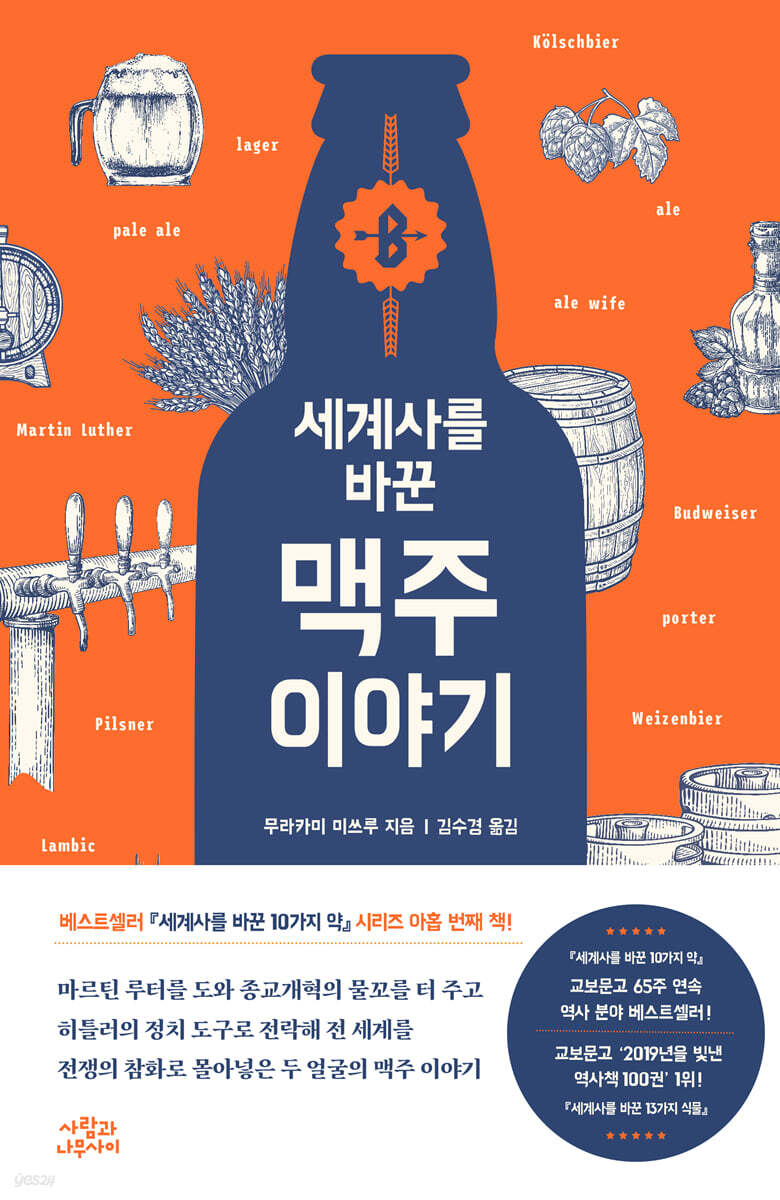
The story of beer that changed world history
 |
Description
Book Introduction
Helped Martin Luther lead the Reformation to success
It was turned into a tool of Hitler and the Nazis' political uprising, shaking up world history.
A Tale of Two Faces of Beer
Beer, which captivates people with its sweet and bitter taste and refreshing foam, changed the course of European religious history and world history.
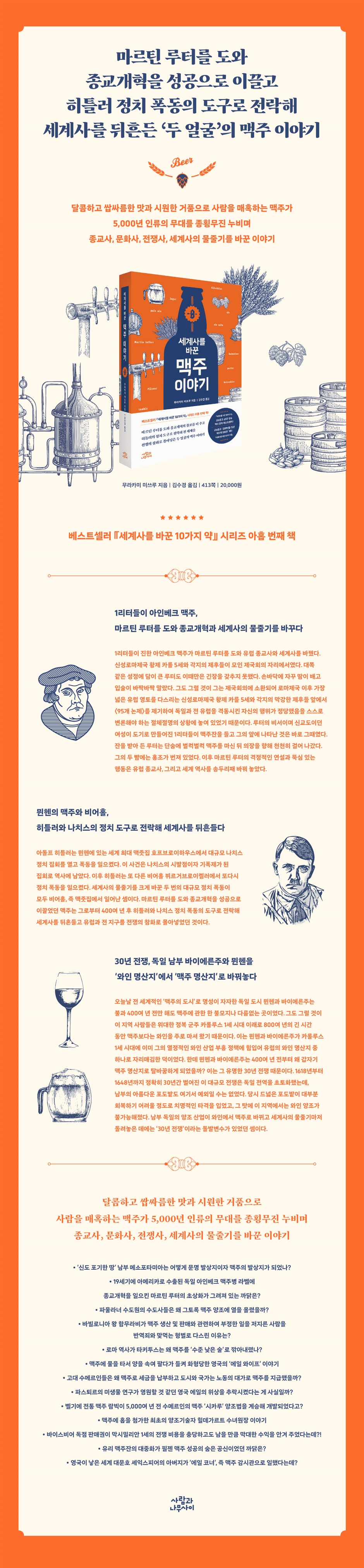
In April 1521, Luther's religious reform, which had been launched out of anger at the Roman Catholic Church's sale of indulgences, was in dire straits.
As a wave of opposition to the sale of indulgences swept across Germany, Holy Roman Emperor Charles V, realizing the gravity of the situation, summoned Luther to the Imperial Diet.
Even Luther, who had a bold personality and was very courageous, could not hide his nervousness.
My palms were sweaty and my lips were dry.
This is because the Holy Roman Emperor Charles V, who ruled over the largest European territory since the Roman Empire, and powerful princes from various regions gathered at the Imperial Diet to question him.
It was then that Luther's secretary appeared holding a one-liter Einbeck beer mug made of ceramic.
Luther accepted the glass, drank the beer in one gulp, and then walked towards the chairman.
A flush of intoxication spread across his cheeks.
Afterwards, Luther's passionate speeches and determined actions, which he regained under the influence of alcohol, added fuel to the flames of the burgeoning Reformation and changed the history of European religion and world history.
400 years later, a momentous event that would change the course of German, European, and world history occurred at the Hofbräuhaus, a beer hall in Munich.
The political uprising that Hitler and his followers initiated here later became the starting point and fuse for the Nazis, and it also became the trigger for their domination of Germany and the start of World War II.
It was turned into a tool of Hitler and the Nazis' political uprising, shaking up world history.
A Tale of Two Faces of Beer
Beer, which captivates people with its sweet and bitter taste and refreshing foam, changed the course of European religious history and world history.
In April 1521, Luther's religious reform, which had been launched out of anger at the Roman Catholic Church's sale of indulgences, was in dire straits.
As a wave of opposition to the sale of indulgences swept across Germany, Holy Roman Emperor Charles V, realizing the gravity of the situation, summoned Luther to the Imperial Diet.
Even Luther, who had a bold personality and was very courageous, could not hide his nervousness.
My palms were sweaty and my lips were dry.
This is because the Holy Roman Emperor Charles V, who ruled over the largest European territory since the Roman Empire, and powerful princes from various regions gathered at the Imperial Diet to question him.
It was then that Luther's secretary appeared holding a one-liter Einbeck beer mug made of ceramic.
Luther accepted the glass, drank the beer in one gulp, and then walked towards the chairman.
A flush of intoxication spread across his cheeks.
Afterwards, Luther's passionate speeches and determined actions, which he regained under the influence of alcohol, added fuel to the flames of the burgeoning Reformation and changed the history of European religion and world history.
400 years later, a momentous event that would change the course of German, European, and world history occurred at the Hofbräuhaus, a beer hall in Munich.
The political uprising that Hitler and his followers initiated here later became the starting point and fuse for the Nazis, and it also became the trigger for their domination of Germany and the start of World War II.
- You can preview some of the book's contents.
Preview
index
Introduction_ The story of beer with two faces: the good Dr. Jekyll who helped Martin Luther change the course of the Reformation, and the evil Mr. Hyde who became the fuse for the Nazi political uprising and shook world history.
① World History of BEER
The story of beer that led to the success of Martin Luther's religious reformation
Why is the portrait of Martin Luther, the founder of the Protestant Reformation, featured on the labels of German Einbeck beer bottles exported to America in the 19th century? | Emperor Charles V, who ruled over the largest territory in European history since the fall of the Roman Empire, lost his battle with Luther, a Catholic priest. | Why were the monks of the Paulaner Abbey so passionate about brewing beer?
② World History of BEER
The Hidden Reason Why the Bavarian Monarchs Restricted and Controlled Beer Ingredients in the Name of the "Purity Law"
Why did Babylonian King Hammurabi punish those who committed illegal acts related to beer production and sales with a punishment equivalent to treason? | Is it true that the father of Shakespeare, one of the world's greatest writers from England, worked as an 'ale corner', or beer inspector? | Is the secret to Southern Germany's Munich beer's victory over the traditional powerhouse Northern Germany's beer thanks to the 'Beer Purity Law'?
③ World History of BEER
Why did Hitler frequently use beer halls as political rallies and riots?
What decisive event led to the collapse of the wine industry in southern Germany, which had flourished until the early 17th century, and the development of the beer industry? | Two historical figures who made Hofbräuhaus famous: Wilhelm V and Adolf Hitler | Why did the Nazis choose the Hofbräuhaus' grand ballroom as a meeting place? | Why are the tastes of North and South German beers so starkly different? | The horse race celebrating the wedding of Prince Ludwig of Bavaria and Princess Therese of Saxony, which became the origin of the world-famous Oktoberfest festival | Why was 'Märzenbier' established as the beer of Oktoberfest and not another beer?
④ World History of BEER
Southern Mesopotamia, the birthplace of beer and the "land where even the gods abandoned it."
How did southern Mesopotamia, the "land abandoned even by the gods," become the cradle of civilization and the birthplace of beer? | Why is it difficult to clearly conclude that "the Sumerians invented beer around 3500-3000 BC"? | Did ancient Sumerians pay taxes in beer, and cities and states paid beer in exchange for labor?
⑤ World History of BEER
The story of the ale wife who was caught adding water to her beer and burned at the stake.
Why did the Roman historian Tacitus disparage beer as a "low-quality drink"? | The story of the ale wife who was burned at the stake after being caught watering down sheep | Why did medieval English lords and bishops spread false rumors that hops were poisonous? | As beer glasses changed from ceramic to glass, the color of beer became the most important competitive factor.
⑥ World History of BEER
Porter, the drink of Londoners that became a powerful brand that dominated 18th-century England.
How did Porter, the beer that dominated the 18th century, come into being? | Porter, the driving force that transformed British beer brewing from a traditional handcrafted process to a fully mechanized industry | Guinness, which toppled the stronghold of London Porter, the 18th-century powerhouse, with its groundbreaking new product, Stout Porter | Imperial Stout, the beer loved and enjoyed by Catherine II
⑦ World History of BEER
Pasteur's microbiological research dealt a fatal blow to British ale.
Pasteur's microbiological research brought down the seemingly eternal status of British ale | The Kamla movement ushered in the global era of regional beer
⑧ World History of BEER
Why Medieval Monasteries Became Enthusiastic About Brewing Beer
The surprising reason the Orval Abbey brewery isn't operating at full capacity? | Why did medieval monasteries start brewing beer? | Charlemagne, who transformed beer from a low-grade drink into the pride of the Germanic people. | Was Abbess Hildegard the First Brewer to Add Hops to Beer?
⑨ World History of BEER
Why the brewing rights granted to monastic breweries were perceived as an all-powerful certificate containing all rights
Weihenstephan, a mecca for brewers worldwide | Why the "Monastery Plan" preserved at the Abbey of St. Gall is recognized as a treasure worthy of being called a cultural heritage of humanity.
⑩ World History of BEER
Was the popularization of glass beer glasses the unsung hero behind Pilsner's success?
Sedlmayr II and Anton Dreher, founders of a world-leading beer company and hailed as the "fathers of lager," were industrial spies who stole British wort? | Why the popularization of glass beer mugs was the unsung hero behind the success of Pilsen beer? | Is Budejovice beer, beloved by King Ferdinand I of Bohemia, the origin of the best-selling beer, Budweiser? | The fatal mistake of microbiologist Hansen that led to the decline of the yeast Carlsbergensis | Why shortening the shelf life of lager beer was a crucial topic for brewers in the 1950s and 1960s?
⑪ World History of BEER
Lager, a simple country beer that has become a world-renowned beer today
Altbier, a sophisticated top-fermented beer that enjoys a firm position today | The historical reason why Kölschbier, a type of top-fermented beer along with Altbier, had to insist on being called "Kölsch" instead of "Alt" dates back to the Hanseatic League. | How did wheat beer become the representative beer of Bavaria, Germany? | The popularization of clear glasses gave wings to the sales of wheat beer, also known as "white beer." | The exclusive distribution rights for Weissbier, which brought in enormous profits that more than covered Maximilian I's war expenses. | Why does Berliner Weisse taste sour?
⑫ World History of BEER
Why Everyone Considers Belgium the "Beer Prince" of Europe
If Europe had a "prince of beers," it would be Belgian. Why? | A comprehensive guide to five leading Belgian ales | A journey through Belgian beer
⑬ World History of BEER
Lambic, a traditional Belgian beer that inherited the Sumerian beer "Sikaru" brewing method from 5,000 years ago
Belgian Lambic, a traditional beer, was developed over 5,000 years ago, inheriting the Sumerian brewing method of "Sikaru"? | The Desperate Reason Belgian Lambic Brewers Tenaciously Continue the Family Business | Gueuse and Fruit Lambic, the "Champagne of Beer"
⑭ World History of BEER
The 21st-century global beer market, tumultuous like a roller coaster
The global beer market, swept up in the turbulent waves of globalization that began in earnest in the late 20th century | Is beer no longer a lucrative business? | The acquisition of Anheuser-Busch, the largest U.S. brewer, by Belgian brewer InBev, which shook the global beer market | The rankings of economic powerhouses and beer powerhouses are increasingly aligning?! | The key commonality between Anheuser-Busch InBev and SABMiller: 'stateless emerging powers.'
Beer Mini Dictionary
References
① World History of BEER
The story of beer that led to the success of Martin Luther's religious reformation
Why is the portrait of Martin Luther, the founder of the Protestant Reformation, featured on the labels of German Einbeck beer bottles exported to America in the 19th century? | Emperor Charles V, who ruled over the largest territory in European history since the fall of the Roman Empire, lost his battle with Luther, a Catholic priest. | Why were the monks of the Paulaner Abbey so passionate about brewing beer?
② World History of BEER
The Hidden Reason Why the Bavarian Monarchs Restricted and Controlled Beer Ingredients in the Name of the "Purity Law"
Why did Babylonian King Hammurabi punish those who committed illegal acts related to beer production and sales with a punishment equivalent to treason? | Is it true that the father of Shakespeare, one of the world's greatest writers from England, worked as an 'ale corner', or beer inspector? | Is the secret to Southern Germany's Munich beer's victory over the traditional powerhouse Northern Germany's beer thanks to the 'Beer Purity Law'?
③ World History of BEER
Why did Hitler frequently use beer halls as political rallies and riots?
What decisive event led to the collapse of the wine industry in southern Germany, which had flourished until the early 17th century, and the development of the beer industry? | Two historical figures who made Hofbräuhaus famous: Wilhelm V and Adolf Hitler | Why did the Nazis choose the Hofbräuhaus' grand ballroom as a meeting place? | Why are the tastes of North and South German beers so starkly different? | The horse race celebrating the wedding of Prince Ludwig of Bavaria and Princess Therese of Saxony, which became the origin of the world-famous Oktoberfest festival | Why was 'Märzenbier' established as the beer of Oktoberfest and not another beer?
④ World History of BEER
Southern Mesopotamia, the birthplace of beer and the "land where even the gods abandoned it."
How did southern Mesopotamia, the "land abandoned even by the gods," become the cradle of civilization and the birthplace of beer? | Why is it difficult to clearly conclude that "the Sumerians invented beer around 3500-3000 BC"? | Did ancient Sumerians pay taxes in beer, and cities and states paid beer in exchange for labor?
⑤ World History of BEER
The story of the ale wife who was caught adding water to her beer and burned at the stake.
Why did the Roman historian Tacitus disparage beer as a "low-quality drink"? | The story of the ale wife who was burned at the stake after being caught watering down sheep | Why did medieval English lords and bishops spread false rumors that hops were poisonous? | As beer glasses changed from ceramic to glass, the color of beer became the most important competitive factor.
⑥ World History of BEER
Porter, the drink of Londoners that became a powerful brand that dominated 18th-century England.
How did Porter, the beer that dominated the 18th century, come into being? | Porter, the driving force that transformed British beer brewing from a traditional handcrafted process to a fully mechanized industry | Guinness, which toppled the stronghold of London Porter, the 18th-century powerhouse, with its groundbreaking new product, Stout Porter | Imperial Stout, the beer loved and enjoyed by Catherine II
⑦ World History of BEER
Pasteur's microbiological research dealt a fatal blow to British ale.
Pasteur's microbiological research brought down the seemingly eternal status of British ale | The Kamla movement ushered in the global era of regional beer
⑧ World History of BEER
Why Medieval Monasteries Became Enthusiastic About Brewing Beer
The surprising reason the Orval Abbey brewery isn't operating at full capacity? | Why did medieval monasteries start brewing beer? | Charlemagne, who transformed beer from a low-grade drink into the pride of the Germanic people. | Was Abbess Hildegard the First Brewer to Add Hops to Beer?
⑨ World History of BEER
Why the brewing rights granted to monastic breweries were perceived as an all-powerful certificate containing all rights
Weihenstephan, a mecca for brewers worldwide | Why the "Monastery Plan" preserved at the Abbey of St. Gall is recognized as a treasure worthy of being called a cultural heritage of humanity.
⑩ World History of BEER
Was the popularization of glass beer glasses the unsung hero behind Pilsner's success?
Sedlmayr II and Anton Dreher, founders of a world-leading beer company and hailed as the "fathers of lager," were industrial spies who stole British wort? | Why the popularization of glass beer mugs was the unsung hero behind the success of Pilsen beer? | Is Budejovice beer, beloved by King Ferdinand I of Bohemia, the origin of the best-selling beer, Budweiser? | The fatal mistake of microbiologist Hansen that led to the decline of the yeast Carlsbergensis | Why shortening the shelf life of lager beer was a crucial topic for brewers in the 1950s and 1960s?
⑪ World History of BEER
Lager, a simple country beer that has become a world-renowned beer today
Altbier, a sophisticated top-fermented beer that enjoys a firm position today | The historical reason why Kölschbier, a type of top-fermented beer along with Altbier, had to insist on being called "Kölsch" instead of "Alt" dates back to the Hanseatic League. | How did wheat beer become the representative beer of Bavaria, Germany? | The popularization of clear glasses gave wings to the sales of wheat beer, also known as "white beer." | The exclusive distribution rights for Weissbier, which brought in enormous profits that more than covered Maximilian I's war expenses. | Why does Berliner Weisse taste sour?
⑫ World History of BEER
Why Everyone Considers Belgium the "Beer Prince" of Europe
If Europe had a "prince of beers," it would be Belgian. Why? | A comprehensive guide to five leading Belgian ales | A journey through Belgian beer
⑬ World History of BEER
Lambic, a traditional Belgian beer that inherited the Sumerian beer "Sikaru" brewing method from 5,000 years ago
Belgian Lambic, a traditional beer, was developed over 5,000 years ago, inheriting the Sumerian brewing method of "Sikaru"? | The Desperate Reason Belgian Lambic Brewers Tenaciously Continue the Family Business | Gueuse and Fruit Lambic, the "Champagne of Beer"
⑭ World History of BEER
The 21st-century global beer market, tumultuous like a roller coaster
The global beer market, swept up in the turbulent waves of globalization that began in earnest in the late 20th century | Is beer no longer a lucrative business? | The acquisition of Anheuser-Busch, the largest U.S. brewer, by Belgian brewer InBev, which shook the global beer market | The rankings of economic powerhouses and beer powerhouses are increasingly aligning?! | The key commonality between Anheuser-Busch InBev and SABMiller: 'stateless emerging powers.'
Beer Mini Dictionary
References
Detailed image
Into the book
Martin Luther wrote the famous 95 Theses.
After that, the 'topic' spread quickly throughout Germany like ink on wet paper.
It was thanks to the Gutenberg printing press, which had already reached the practical stage by that time.
The effect was amazing.
As if thoroughly prepared, a wave of opposition to the sale of indulgences swirled throughout Germany.
Realizing the gravity of the situation, Holy Roman Emperor Charles V (reigned 1519–1556) summoned Martin Luther to the Imperial Diet.
It was to demand the withdrawal of the 95 Theses he had put forward.
This is the famous 'Martin Luther Trial' at the Diet of Worms (Reichstag zu Worms).
This happened on April 17, 1521.
The Imperial Council was held.
Holy Roman Emperor Charles V and the princes who had gathered from various places began to take their seats one by one.
Even Luther, who had a bold personality and was very courageous, could not hide his nervousness at this time.
My palms kept sweating and my lips were parched.
It was then that Luther's secretary, a Protestant woman, appeared before him holding a one-liter ceramic beer mug.
Luther accepted the glass, drank the beer in one gulp, and then slowly walked towards the chairman.
A blush spread across his cheeks.
From then on, Martin Luther's passionate speeches and courageous actions completely changed the history of European religion and world history.
--- p.23~24, from “Why is the portrait of Martin Luther, who initiated the Reformation, drawn on the labels of German Einbeck beer bottles exported to America in the 19th century?”
Interestingly, however, the same testing method has been in place in the UK for a long time.
But somehow, the result of the judgment was the exact opposite.
In England, if the bench clung to the leather trousers, they were considered a failure.
Why? In this case, it was determined that the beer had not yet fully fermented, leaving behind useless sugars.
In any case, both cases lack sufficient evidence from a technical standpoint.
So, which of the two scenarios is more plausible by today's standards? The British one.
In contemporary England, there were beer watchmen appointed by the lords.
The title of the beer inspector was 'Ale Conner'.
Ale corners have a long history, having been active in London since the 11th century.
Their main job was to visit breweries and inspect the quality of beer.
One of those various testing methods was the 'leather pants test' mentioned earlier.
The Ale Corner was also given the power to prosecute brewers suspected of misconduct and bring them to trial.
An interesting fact is that John Shakespeare, the father of the great English writer William Shakespeare, was an ale cornerer.
--- p.48, from “Is it true that the father of Shakespeare, the world’s greatest writer born in England, worked as an ‘ale corner’, or beer inspector?”
In the city within the walls, or rather, the Ringstrasse, a market was built in the center, and a town hall and a church were built.
The market, the city hall, and the church were like a set that made up a city surrounded by walls.
There is a square in front of the city hall.
At that time, the square served as a space for communication to convey useful information to citizens.
The church took on the role of healing the wounded hearts of the citizens.
The body responsible for the city's administration was a council composed of representatives elected by the citizens.
There was a restaurant in the basement of the city hall, which was used as a space for exchange between members of the council and to provide them with food.
The restaurant had an attached brewery, and beer brewed there was served to the members during their meals and meetings.
In this way, the underground restaurant also served as a meeting place.
After the city hall was opened to the public for free use, the basement dining hall was transformed into a beer hall and restaurant, becoming a place for citizens to interact.
Now that the beer halls of European cities had become regional gathering places, it was only natural that the Nazis would choose the grand ballroom of Munich's Hofbräuhaus as their meeting place.
--- p.68~69, from “Why Did the Nazis Choose the Great Hall of the Hofbräuhaus as Their Meeting Place?”
The incidence of puerperal fever in Ward 1 fell to a level similar to that in Ward 2.
This is the situation after 1847.
This was entirely thanks to Semmelweis's thorough hand washing and disinfection.
Going a step further, in 1848 the scope of sterilization was expanded to include medical equipment, and the deaths of mothers from puerperal fever almost disappeared.
Semmelweis's paper revealed that doctors' hands had been a medium for transmitting puerperal fever.
And he appealed to the need for disinfection with chlorine water to prevent puerperal fever.
However, the medical council strongly criticized him, saying, “How can you treat a doctor like a murderer!” and expelled him from the medical council.
In the end, Semmelweis suffered the humiliating and miserable fate of being forcibly admitted to a mental hospital.
And there, he died of an infection caused by wounds sustained during the brutal abuse.
He was an unfortunate genius who saved humanity while being toyed with by a cruel fate.
--- p.102~103, from “Semmelweis was expelled from the medical community for revealing that doctors’ hands had been a medium for transmitting puerperal fever.”
The Babylonians brewed twenty kinds of beer.
To be more specific, there are beers made from eight types of barley, beers made from eight types of emmer wheat, and four types of beers made by mixing two types of ingredients.
At that time, Babylonia used a type of medicinal herb called cinnamon (a perennial herb of the Lamiaceae family - translator's note) instead of hops.
In Babylonia, like the Sumerians, every citizen was given a fixed amount of beer.
And, as in Sumer, there were differences in rations according to class and status.
Specifically, workers were given 2 liters of strong beer per day, middle-class officials were given 3 liters of strong beer, and upper-class officials were given 5 liters of strong beer.
One interesting thing is that in Babylonia, brewers were exempt from military service on par with high-ranking priests.
The laws created by Hammurabi, the most famous of the Babylonian kings, are very famous (the first legal code in human history is the Code of Ur-Nammu of the 3rd Dynasty of Ur in Sumer).
The law regarding beer is engraved on a cylindrical stone pillar made of 2.5 meters high greenstone.
This allows us to guess that beer was an important source of national finance at the time.
--- p.103~104, from “Ancient Sumerians paid taxes with beer, and cities and countries paid beer as compensation for labor?”
Ale houses of the time often sold beers laced with something strange and unidentifiable.
Moreover, cases of sheep being cheated were common, and drunken customers often had their wallets stolen or lost.
As mentioned above, the ale wives of the time were idols to men, so if their dishonest and shameless acts were ever discovered, they became the target of tremendous anger.
The greater the expectations, the greater the disappointment, and that disappointment often turns into anger.
There actually was a case like this.
This is a case of a man being caught cheating a sheep by diluting his beer with water, and the ale wife was burned at the stake for this.
The following is a poem and song of repentance that he is said to have recited before being burned at the stake.
My beer glass is a mess.
I made it.
Many people were completely fooled.
I sold people watered-down ale.
It was after this incident that the ale wife gradually disappeared and the man began to appear as an ale expert.
--- p.120, from “The Story of the Ale Wife, who was caught and burned at the stake for tricking sheep by adding water to beer”
Who was this young gentleman who committed such a brazen and shameless act of espionage? Gabriel Sedlmayer II.
Why on earth did he commit such a crime? It was a consequence of his father, Gabriel Sedlmayr I, sending him to England to study, broadening his knowledge and acquiring skills in brewing.
It was in the 1830s.
At that time, the British economy was experiencing tremendous growth with the advent and commercialization of steam locomotives.
In this situation, breweries near Burton and Glasgow were becoming prime targets for Munich brewers seeking to steal their unique technology.
That's why British brewers were very wary of the Germans.
To be precise, at that time, King Jedmeler II did not infiltrate there alone.
He plotted the operation with his friend Anton Dreher from Vienna and succeeded in secretly collecting and smuggling samples out.
Gabriel Sedlmayer II sent a letter to his father, in which he wrote:
“Father, I will hurry and take a small bottle of the secretly collected wort sample.” There are two reasons for quoting here a rather lengthy anecdote about Sedlmayr II’s beer-stealing.
Surprisingly, the two men featured in the above quote, Gabriel Sedlmayr II and his predecessor Anton Dreher, are the ones who built some of the world's leading beer manufacturers today, and are not exaggerated in their honorable title of "Father of Lager Beer."
After that, the 'topic' spread quickly throughout Germany like ink on wet paper.
It was thanks to the Gutenberg printing press, which had already reached the practical stage by that time.
The effect was amazing.
As if thoroughly prepared, a wave of opposition to the sale of indulgences swirled throughout Germany.
Realizing the gravity of the situation, Holy Roman Emperor Charles V (reigned 1519–1556) summoned Martin Luther to the Imperial Diet.
It was to demand the withdrawal of the 95 Theses he had put forward.
This is the famous 'Martin Luther Trial' at the Diet of Worms (Reichstag zu Worms).
This happened on April 17, 1521.
The Imperial Council was held.
Holy Roman Emperor Charles V and the princes who had gathered from various places began to take their seats one by one.
Even Luther, who had a bold personality and was very courageous, could not hide his nervousness at this time.
My palms kept sweating and my lips were parched.
It was then that Luther's secretary, a Protestant woman, appeared before him holding a one-liter ceramic beer mug.
Luther accepted the glass, drank the beer in one gulp, and then slowly walked towards the chairman.
A blush spread across his cheeks.
From then on, Martin Luther's passionate speeches and courageous actions completely changed the history of European religion and world history.
--- p.23~24, from “Why is the portrait of Martin Luther, who initiated the Reformation, drawn on the labels of German Einbeck beer bottles exported to America in the 19th century?”
Interestingly, however, the same testing method has been in place in the UK for a long time.
But somehow, the result of the judgment was the exact opposite.
In England, if the bench clung to the leather trousers, they were considered a failure.
Why? In this case, it was determined that the beer had not yet fully fermented, leaving behind useless sugars.
In any case, both cases lack sufficient evidence from a technical standpoint.
So, which of the two scenarios is more plausible by today's standards? The British one.
In contemporary England, there were beer watchmen appointed by the lords.
The title of the beer inspector was 'Ale Conner'.
Ale corners have a long history, having been active in London since the 11th century.
Their main job was to visit breweries and inspect the quality of beer.
One of those various testing methods was the 'leather pants test' mentioned earlier.
The Ale Corner was also given the power to prosecute brewers suspected of misconduct and bring them to trial.
An interesting fact is that John Shakespeare, the father of the great English writer William Shakespeare, was an ale cornerer.
--- p.48, from “Is it true that the father of Shakespeare, the world’s greatest writer born in England, worked as an ‘ale corner’, or beer inspector?”
In the city within the walls, or rather, the Ringstrasse, a market was built in the center, and a town hall and a church were built.
The market, the city hall, and the church were like a set that made up a city surrounded by walls.
There is a square in front of the city hall.
At that time, the square served as a space for communication to convey useful information to citizens.
The church took on the role of healing the wounded hearts of the citizens.
The body responsible for the city's administration was a council composed of representatives elected by the citizens.
There was a restaurant in the basement of the city hall, which was used as a space for exchange between members of the council and to provide them with food.
The restaurant had an attached brewery, and beer brewed there was served to the members during their meals and meetings.
In this way, the underground restaurant also served as a meeting place.
After the city hall was opened to the public for free use, the basement dining hall was transformed into a beer hall and restaurant, becoming a place for citizens to interact.
Now that the beer halls of European cities had become regional gathering places, it was only natural that the Nazis would choose the grand ballroom of Munich's Hofbräuhaus as their meeting place.
--- p.68~69, from “Why Did the Nazis Choose the Great Hall of the Hofbräuhaus as Their Meeting Place?”
The incidence of puerperal fever in Ward 1 fell to a level similar to that in Ward 2.
This is the situation after 1847.
This was entirely thanks to Semmelweis's thorough hand washing and disinfection.
Going a step further, in 1848 the scope of sterilization was expanded to include medical equipment, and the deaths of mothers from puerperal fever almost disappeared.
Semmelweis's paper revealed that doctors' hands had been a medium for transmitting puerperal fever.
And he appealed to the need for disinfection with chlorine water to prevent puerperal fever.
However, the medical council strongly criticized him, saying, “How can you treat a doctor like a murderer!” and expelled him from the medical council.
In the end, Semmelweis suffered the humiliating and miserable fate of being forcibly admitted to a mental hospital.
And there, he died of an infection caused by wounds sustained during the brutal abuse.
He was an unfortunate genius who saved humanity while being toyed with by a cruel fate.
--- p.102~103, from “Semmelweis was expelled from the medical community for revealing that doctors’ hands had been a medium for transmitting puerperal fever.”
The Babylonians brewed twenty kinds of beer.
To be more specific, there are beers made from eight types of barley, beers made from eight types of emmer wheat, and four types of beers made by mixing two types of ingredients.
At that time, Babylonia used a type of medicinal herb called cinnamon (a perennial herb of the Lamiaceae family - translator's note) instead of hops.
In Babylonia, like the Sumerians, every citizen was given a fixed amount of beer.
And, as in Sumer, there were differences in rations according to class and status.
Specifically, workers were given 2 liters of strong beer per day, middle-class officials were given 3 liters of strong beer, and upper-class officials were given 5 liters of strong beer.
One interesting thing is that in Babylonia, brewers were exempt from military service on par with high-ranking priests.
The laws created by Hammurabi, the most famous of the Babylonian kings, are very famous (the first legal code in human history is the Code of Ur-Nammu of the 3rd Dynasty of Ur in Sumer).
The law regarding beer is engraved on a cylindrical stone pillar made of 2.5 meters high greenstone.
This allows us to guess that beer was an important source of national finance at the time.
--- p.103~104, from “Ancient Sumerians paid taxes with beer, and cities and countries paid beer as compensation for labor?”
Ale houses of the time often sold beers laced with something strange and unidentifiable.
Moreover, cases of sheep being cheated were common, and drunken customers often had their wallets stolen or lost.
As mentioned above, the ale wives of the time were idols to men, so if their dishonest and shameless acts were ever discovered, they became the target of tremendous anger.
The greater the expectations, the greater the disappointment, and that disappointment often turns into anger.
There actually was a case like this.
This is a case of a man being caught cheating a sheep by diluting his beer with water, and the ale wife was burned at the stake for this.
The following is a poem and song of repentance that he is said to have recited before being burned at the stake.
My beer glass is a mess.
I made it.
Many people were completely fooled.
I sold people watered-down ale.
It was after this incident that the ale wife gradually disappeared and the man began to appear as an ale expert.
--- p.120, from “The Story of the Ale Wife, who was caught and burned at the stake for tricking sheep by adding water to beer”
Who was this young gentleman who committed such a brazen and shameless act of espionage? Gabriel Sedlmayer II.
Why on earth did he commit such a crime? It was a consequence of his father, Gabriel Sedlmayr I, sending him to England to study, broadening his knowledge and acquiring skills in brewing.
It was in the 1830s.
At that time, the British economy was experiencing tremendous growth with the advent and commercialization of steam locomotives.
In this situation, breweries near Burton and Glasgow were becoming prime targets for Munich brewers seeking to steal their unique technology.
That's why British brewers were very wary of the Germans.
To be precise, at that time, King Jedmeler II did not infiltrate there alone.
He plotted the operation with his friend Anton Dreher from Vienna and succeeded in secretly collecting and smuggling samples out.
Gabriel Sedlmayer II sent a letter to his father, in which he wrote:
“Father, I will hurry and take a small bottle of the secretly collected wort sample.” There are two reasons for quoting here a rather lengthy anecdote about Sedlmayr II’s beer-stealing.
Surprisingly, the two men featured in the above quote, Gabriel Sedlmayr II and his predecessor Anton Dreher, are the ones who built some of the world's leading beer manufacturers today, and are not exaggerated in their honorable title of "Father of Lager Beer."
--- p.212~213, from “Were Sedlmayr II and Anton Dreher, founders of a world-leading beer manufacturer and praised as the ‘father of lager beer’, industrial spies who stole British wort?”
Publisher's Review
▣ 1 liter of strong Einbeck beer helped Martin Luther start the Reformation.
Leading to success and changing European religious history and world history
Martin Luther, a priest and theologian, felt deep anger.
This is because the Roman Catholic Church of the time, which had already committed countless acts of corruption, ended up selling “indulgences,” certificates that promised forgiveness for people’s sins against God in exchange for money.
Why did the Roman Catholic Church commit such a heinous crime? The church's vested interests claimed to be rebuilding St. Peter's Basilica, but their true intentions were different.
It was to repay an astronomical amount of debt owed by the Archbishop of Mainz to the wealthy Fugger family of Augsburg.
Luther, who raised the banner of reform against the corrupt Catholic Church, wrote the famous “95 Theses” and posted them on the main door of the University Church in Wittenberg.
After that, the “thesis” spread throughout Germany faster than the wind.
The role of the Gutenberg printing press, which was already in the practical stage at the time and too exquisite to be dismissed as a coincidence, was very important here.
The effect was surprisingly great.
Across Germany, a wave of resistance against the sale of indulgences swept through, as if many people had known about it and prepared for it in advance.
When the situation became like this, Holy Roman Emperor Charles V recognized the seriousness of the situation and summoned Luther, who had ignited the fuse of the Reformation, to the Imperial Diet.
This was the famous 'Martin Luther Trial Incident' at the Imperial Diet of Worms, which was held to demand the retraction of Luther's '95 Theses'.
It was April 17, 1521.
Originally, Luther was a man with more courage and guts than anyone else.
Even he couldn't hide his tension and anxiety at this time.
My palms kept sweating and my lips were parched.
This was understandable, as he was summoned to an imperial diet and had to defend, without any help from anyone, the legitimacy of his actions, which had stirred up Germany and all of Europe by proposing the Ninety-Five Theses, before the Holy Roman Emperor Charles V, who ruled over the largest territory since the Roman Empire, and powerful princes from various regions.
It was then that Luther's secretary, a Protestant, appeared before him, holding a one-liter ceramic mug filled with strong Einbeck beer.
Luther carefully took the glass with both hands, drank the beer without leaving a single drop behind, and then slowly walked towards the emperor and the princes who were glaring at him fiercely like wild beasts.
His cheeks were flushed with intoxication.
Martin Luther's passionate speeches and determined actions, which he regained later under the influence of alcohol, added fuel to the already lit flames of the Reformation, ultimately significantly changing the course of European religious history and world history.
▣ Beer and beer halls have become political tools for Hitler and Nietzsche.
Plunging the world into the devastation of war and changing the course of world history
The stage is again Germany.
However, there is a difference in timing; it is the situation in the early 19th century, about 400 years after Martin Luther's religious reformation.
At that time, in Germany, just as Luther had successfully led the Reformation with the help of beer 400 years earlier and changed the course of religious and world history, a person appeared who used beer and beer halls as tools to shake up world history and drastically change the course of the world.
That is Adolf Hitler, the greatest dictator and evil man, and his political force, the Nazis.
Adolf Hitler held a large political rally and riot at the Hofbräuhaus, a famous beer hall in Munich, a southern German city that was then renowned as the city of beer.
This incident further catapulted the Hofbräuhaus, already renowned as the world's largest beer hall, into fame, and marked a turning point in history as the rally that sparked and triggered the Nazis.
Afterwards, Hitler started a series of Munich riots, which, strangely enough, took place mostly in 'beer houses', such as another beer hall, the Bürgerbräukeller.
Can we simply chalk this up to coincidence, when several large-scale political uprisings that profoundly changed the course of world history almost invariably took place in beer halls?
There is a sufficiently convincing historical background and reason for this.
However, to properly understand the context, we must briefly go back to the era of Franz Joseph I, the last Emperor of the Holy Roman Empire and the third Emperor of the Austrian Empire.
Emperor Joseph I demolished the city walls, which had been rendered useless after fierce and tiresome battles with the Ottoman Turks, and embarked on a large-scale project to completely redevelop the entire city center of Vienna.
And the project was so successful that Emperor Joseph ordered it to be expanded to other cities within the empire.
In the process, a huge beer hall and restaurant with a brewery was built in the basement of the newly built city hall. Through this process, the large beer halls that were born in each city were often used as public gathering places in the area.
And it was only natural that these beer halls would become venues for political rallies and riots by Hitler and the Nazis.
This is the true face of the Munich beer halls, which were actively used as tools and stages for the cunning political uprising of Adolf Hitler and the Nazis, the far-right fascist party of Germany, and which shook all of Europe and the world and changed the course of world history in a dark direction.
▣ A beer that captivates people with its sweet and bitter taste and cool foam.
For 5,000 years, he has roamed the world of mankind.
A story that changed the course of religious history, cultural history, war history, and world history.
Kyobo Bookstore's bestseller in the history category for 65 consecutive weeks (『10 Medicines That Changed World History』), No. 1 in Kyobo Bookstore's '100 History Books that Shined in 2019' (『13 Plants That Changed World History』), 2021 Education Office Student Education and Culture Center Recommended Book (『37 Stories of Fish That Changed World History』), Happy Morning Reading Recommended Book (『10 Medicines That Changed World History』『13 Plants That Changed World History』『37 Stories of Fish That Changed World History』『10 Infectious Diseases That Changed World History』『Stories of Chemistry That Changed World History - From the Birth of the Universe to the Industrial Revolution』), School Library Journal Recommended Book (『13 Plants That Changed World History』『37 Stories of Fish That Changed World History』), Book Morning Book for Kyobo Bookstore CEO (『13 Plants That Changed World History』『37 Stories of Fish That Changed World History』『10 Infectious Diseases That Changed World History』『Stories of Coffee That Changed World History』『 A series that has 'changed world history' and has been consistently sold as a bestseller and steady seller in major online and offline bookstores, including 'Chemistry Story - From the Birth of the Universe to the Industrial Revolution', and has been recognized for its content and value.
The ninth book in this series has been published by People and Trees Publishing.
“The Story of Beer That Changed World History” is that book.
In addition to the story of beer that helped Martin Luther succeed in the Reformation and the story of beer that shook world history by being reduced to a political tool of Adolf Hitler and the Nazis mentioned above, this book also covers the reason why southern Mesopotamia, the 'land where even the gods abandoned', became the cradle of civilization and the birthplace of beer, the reason why it is difficult to clearly conclude that 'the Sumerians invented beer around 3500 to 3000 BC', the reason why the Babylonian king Hammurabi punished those who committed irregularities in the production and sale of beer with a punishment equivalent to treason, the reason why the Roman historian Tacitus disparaged beer as a 'low-quality drink', the reason why a portrait of Martin Luther, who initiated the Reformation, was drawn on the label of a German Einbeck beer bottle exported to America in the 19th century, the story of the Ale Wife who was burned at the stake after being caught deceiving sheep by diluting beer with water, and the story of the monks of the Paulaner Monastery who were particularly passionate about brewing beer. From the story of Pasteur's microbiological research that brought down the seemingly eternal status of British ale, to the story of how beer color became the most important competitive factor when beer glasses changed from ceramic to glass, completely changing the paradigm of the beer industry, this book is full of bizarre and exciting stories surrounding the sweet and bitter alcoholic beverage beer.
Leading to success and changing European religious history and world history
Martin Luther, a priest and theologian, felt deep anger.
This is because the Roman Catholic Church of the time, which had already committed countless acts of corruption, ended up selling “indulgences,” certificates that promised forgiveness for people’s sins against God in exchange for money.
Why did the Roman Catholic Church commit such a heinous crime? The church's vested interests claimed to be rebuilding St. Peter's Basilica, but their true intentions were different.
It was to repay an astronomical amount of debt owed by the Archbishop of Mainz to the wealthy Fugger family of Augsburg.
Luther, who raised the banner of reform against the corrupt Catholic Church, wrote the famous “95 Theses” and posted them on the main door of the University Church in Wittenberg.
After that, the “thesis” spread throughout Germany faster than the wind.
The role of the Gutenberg printing press, which was already in the practical stage at the time and too exquisite to be dismissed as a coincidence, was very important here.
The effect was surprisingly great.
Across Germany, a wave of resistance against the sale of indulgences swept through, as if many people had known about it and prepared for it in advance.
When the situation became like this, Holy Roman Emperor Charles V recognized the seriousness of the situation and summoned Luther, who had ignited the fuse of the Reformation, to the Imperial Diet.
This was the famous 'Martin Luther Trial Incident' at the Imperial Diet of Worms, which was held to demand the retraction of Luther's '95 Theses'.
It was April 17, 1521.
Originally, Luther was a man with more courage and guts than anyone else.
Even he couldn't hide his tension and anxiety at this time.
My palms kept sweating and my lips were parched.
This was understandable, as he was summoned to an imperial diet and had to defend, without any help from anyone, the legitimacy of his actions, which had stirred up Germany and all of Europe by proposing the Ninety-Five Theses, before the Holy Roman Emperor Charles V, who ruled over the largest territory since the Roman Empire, and powerful princes from various regions.
It was then that Luther's secretary, a Protestant, appeared before him, holding a one-liter ceramic mug filled with strong Einbeck beer.
Luther carefully took the glass with both hands, drank the beer without leaving a single drop behind, and then slowly walked towards the emperor and the princes who were glaring at him fiercely like wild beasts.
His cheeks were flushed with intoxication.
Martin Luther's passionate speeches and determined actions, which he regained later under the influence of alcohol, added fuel to the already lit flames of the Reformation, ultimately significantly changing the course of European religious history and world history.
▣ Beer and beer halls have become political tools for Hitler and Nietzsche.
Plunging the world into the devastation of war and changing the course of world history
The stage is again Germany.
However, there is a difference in timing; it is the situation in the early 19th century, about 400 years after Martin Luther's religious reformation.
At that time, in Germany, just as Luther had successfully led the Reformation with the help of beer 400 years earlier and changed the course of religious and world history, a person appeared who used beer and beer halls as tools to shake up world history and drastically change the course of the world.
That is Adolf Hitler, the greatest dictator and evil man, and his political force, the Nazis.
Adolf Hitler held a large political rally and riot at the Hofbräuhaus, a famous beer hall in Munich, a southern German city that was then renowned as the city of beer.
This incident further catapulted the Hofbräuhaus, already renowned as the world's largest beer hall, into fame, and marked a turning point in history as the rally that sparked and triggered the Nazis.
Afterwards, Hitler started a series of Munich riots, which, strangely enough, took place mostly in 'beer houses', such as another beer hall, the Bürgerbräukeller.
Can we simply chalk this up to coincidence, when several large-scale political uprisings that profoundly changed the course of world history almost invariably took place in beer halls?
There is a sufficiently convincing historical background and reason for this.
However, to properly understand the context, we must briefly go back to the era of Franz Joseph I, the last Emperor of the Holy Roman Empire and the third Emperor of the Austrian Empire.
Emperor Joseph I demolished the city walls, which had been rendered useless after fierce and tiresome battles with the Ottoman Turks, and embarked on a large-scale project to completely redevelop the entire city center of Vienna.
And the project was so successful that Emperor Joseph ordered it to be expanded to other cities within the empire.
In the process, a huge beer hall and restaurant with a brewery was built in the basement of the newly built city hall. Through this process, the large beer halls that were born in each city were often used as public gathering places in the area.
And it was only natural that these beer halls would become venues for political rallies and riots by Hitler and the Nazis.
This is the true face of the Munich beer halls, which were actively used as tools and stages for the cunning political uprising of Adolf Hitler and the Nazis, the far-right fascist party of Germany, and which shook all of Europe and the world and changed the course of world history in a dark direction.
▣ A beer that captivates people with its sweet and bitter taste and cool foam.
For 5,000 years, he has roamed the world of mankind.
A story that changed the course of religious history, cultural history, war history, and world history.
Kyobo Bookstore's bestseller in the history category for 65 consecutive weeks (『10 Medicines That Changed World History』), No. 1 in Kyobo Bookstore's '100 History Books that Shined in 2019' (『13 Plants That Changed World History』), 2021 Education Office Student Education and Culture Center Recommended Book (『37 Stories of Fish That Changed World History』), Happy Morning Reading Recommended Book (『10 Medicines That Changed World History』『13 Plants That Changed World History』『37 Stories of Fish That Changed World History』『10 Infectious Diseases That Changed World History』『Stories of Chemistry That Changed World History - From the Birth of the Universe to the Industrial Revolution』), School Library Journal Recommended Book (『13 Plants That Changed World History』『37 Stories of Fish That Changed World History』), Book Morning Book for Kyobo Bookstore CEO (『13 Plants That Changed World History』『37 Stories of Fish That Changed World History』『10 Infectious Diseases That Changed World History』『Stories of Coffee That Changed World History』『 A series that has 'changed world history' and has been consistently sold as a bestseller and steady seller in major online and offline bookstores, including 'Chemistry Story - From the Birth of the Universe to the Industrial Revolution', and has been recognized for its content and value.
The ninth book in this series has been published by People and Trees Publishing.
“The Story of Beer That Changed World History” is that book.
In addition to the story of beer that helped Martin Luther succeed in the Reformation and the story of beer that shook world history by being reduced to a political tool of Adolf Hitler and the Nazis mentioned above, this book also covers the reason why southern Mesopotamia, the 'land where even the gods abandoned', became the cradle of civilization and the birthplace of beer, the reason why it is difficult to clearly conclude that 'the Sumerians invented beer around 3500 to 3000 BC', the reason why the Babylonian king Hammurabi punished those who committed irregularities in the production and sale of beer with a punishment equivalent to treason, the reason why the Roman historian Tacitus disparaged beer as a 'low-quality drink', the reason why a portrait of Martin Luther, who initiated the Reformation, was drawn on the label of a German Einbeck beer bottle exported to America in the 19th century, the story of the Ale Wife who was burned at the stake after being caught deceiving sheep by diluting beer with water, and the story of the monks of the Paulaner Monastery who were particularly passionate about brewing beer. From the story of Pasteur's microbiological research that brought down the seemingly eternal status of British ale, to the story of how beer color became the most important competitive factor when beer glasses changed from ceramic to glass, completely changing the paradigm of the beer industry, this book is full of bizarre and exciting stories surrounding the sweet and bitter alcoholic beverage beer.
GOODS SPECIFICS
- Date of issue: April 15, 2024
- Page count, weight, size: 413 pages | 608g | 140*215*28mm
- ISBN13: 9791188635931
- ISBN10: 118863593X
You may also like
카테고리
korean


korean

![GQ KOREA Mark (Monthly): December [2025]](http://librairie.coreenne.fr/cdn/shop/files/8ef265dbbfbf186523ed75ba7319009d.jpg?v=1765340328&width=3840)


