

Python programming
 |
Description
Book Introduction
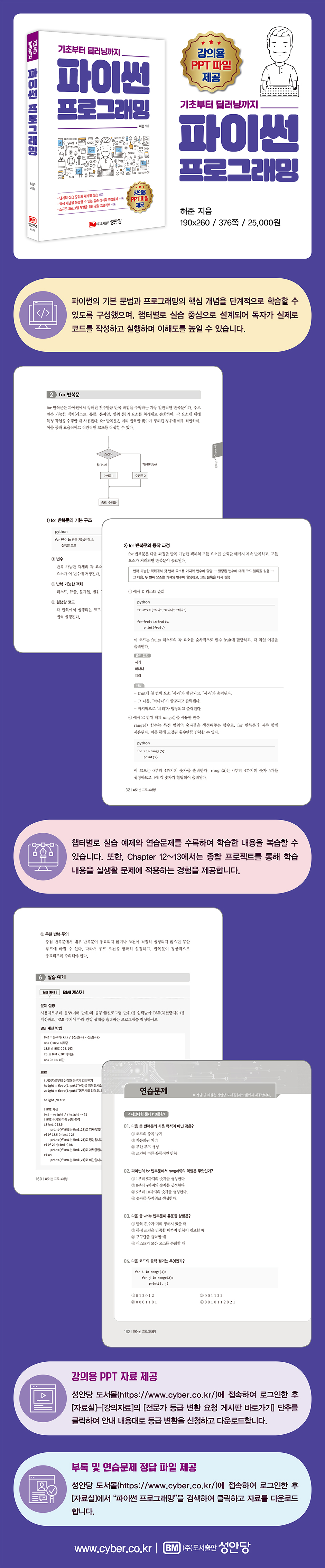
It is structured so that you can learn the basic concepts of programming step by step, starting with basic Python grammar and data types, and then moving on to core concepts of programming such as loops, functions, and file input/output.
Each chapter is designed to be hands-on, allowing readers to actually write and run code to deepen their understanding.
The latter part of the book provides experience applying what you have learned to real-life problems through a comprehensive project.
Through a variety of projects, including text analysis, simple game development, and data visualization, readers will experience the joy and sense of accomplishment that comes with programming.
Each chapter is designed to be hands-on, allowing readers to actually write and run code to deepen their understanding.
The latter part of the book provides experience applying what you have learned to real-life problems through a comprehensive project.
Through a variety of projects, including text analysis, simple game development, and data visualization, readers will experience the joy and sense of accomplishment that comes with programming.
- You can preview some of the book's contents.
Preview
index
Part 1.
Introduction and Installation of Python
1.
What is Python?
2.
History and Features of Python
3.
Select Python version
4.
How to install Python (Python IDLE, Colab, Anaconda, Spyder)
5.
Setting up a Python development environment (Python IDLE, Colab, Anaconda, Spyder)
Part 2.
Python basic grammar
1.
Variables and data types
2.
Numeric types (int, float, complex)
3.
Practical example
Part 3.
Operators and expressions
1.
Arithmetic operators
2.
Comparison operators
3.
Logical operators
4.
Assignment operator
5.
Operator precedence
6.
Practical example
Part 4.
Conditional statements
1.
Concept of conditional statements
2.
if, elif, else structure
3.
Nested conditional statements
4.
Conditional expression
5.
Practical example
Part 5.
loop
1.
The concept of loops
2.
for loop
3.
while loop
4.
Iteration control keywords (break, continue, pass)
5.
Nested loops
6.
Practical example
Part 6.
function
1.
Defining and calling functions
2.
Parameters and arguments
3.
Default and keyword arguments
4.
Return value and return
5.
Variable arguments
6.
Practical example
Part 7.
List and Purple
1.
Creating and using lists
2.
List indexing and slicing
3.
List methods
4.
Creating and using tuples
5.
Differences between lists and tuples
6.
Practical example
Part 8.
Dictionaries and sets
1.
The concept and use of dictionaries
2.
Dictionary methods
3.
The concept and use of sets
4.
Set operations (union, intersection, difference)
5.
Practical example
Part 9.
File input/output
1.
Basic concepts of file input/output
2.
Reading text files (open, read, readline)
3.
Write a text file (write, writelines)
4.
File mode (r, w, a, b)
5.
Closing files and handling exceptions
6.
Advanced Exception Handling: File Locking and Multithreaded Environments
7.
Practical example
Part 10.
Modules and Packages
1.
Module Concept and Usage
2.
Using standard library modules (math, random, datetime, etc.)
3.
Writing a Custom Module
4.
Concept and usage of packages
5.
Installing external packages using pip
6.
Practical example
Part 11.
Exception handling
1.
The Importance of Exception Handling
2.
try, except, finally blocks
3.
Handling multiple exceptions
4.
Custom exceptions
5.
Raise an exception
6.
Practical example
Part 12.
Comprehensive Project I
1.
Comprehensive Project Overview
2.
Project 1 - Creating a Text-Based Game (Number Guessing Game)
3.
Project 2 - Creating a Calculator Program
4.
Challenges for Further Learning - Shopping on the Danawa Site
Part 13.
Comprehensive Project II
1.
Challenge Project - Map the route to your destination (navigation)
2.
Deep Learning Practice: Handwritten Character Recognition Project
Introduction and Installation of Python
1.
What is Python?
2.
History and Features of Python
3.
Select Python version
4.
How to install Python (Python IDLE, Colab, Anaconda, Spyder)
5.
Setting up a Python development environment (Python IDLE, Colab, Anaconda, Spyder)
Part 2.
Python basic grammar
1.
Variables and data types
2.
Numeric types (int, float, complex)
3.
Practical example
Part 3.
Operators and expressions
1.
Arithmetic operators
2.
Comparison operators
3.
Logical operators
4.
Assignment operator
5.
Operator precedence
6.
Practical example
Part 4.
Conditional statements
1.
Concept of conditional statements
2.
if, elif, else structure
3.
Nested conditional statements
4.
Conditional expression
5.
Practical example
Part 5.
loop
1.
The concept of loops
2.
for loop
3.
while loop
4.
Iteration control keywords (break, continue, pass)
5.
Nested loops
6.
Practical example
Part 6.
function
1.
Defining and calling functions
2.
Parameters and arguments
3.
Default and keyword arguments
4.
Return value and return
5.
Variable arguments
6.
Practical example
Part 7.
List and Purple
1.
Creating and using lists
2.
List indexing and slicing
3.
List methods
4.
Creating and using tuples
5.
Differences between lists and tuples
6.
Practical example
Part 8.
Dictionaries and sets
1.
The concept and use of dictionaries
2.
Dictionary methods
3.
The concept and use of sets
4.
Set operations (union, intersection, difference)
5.
Practical example
Part 9.
File input/output
1.
Basic concepts of file input/output
2.
Reading text files (open, read, readline)
3.
Write a text file (write, writelines)
4.
File mode (r, w, a, b)
5.
Closing files and handling exceptions
6.
Advanced Exception Handling: File Locking and Multithreaded Environments
7.
Practical example
Part 10.
Modules and Packages
1.
Module Concept and Usage
2.
Using standard library modules (math, random, datetime, etc.)
3.
Writing a Custom Module
4.
Concept and usage of packages
5.
Installing external packages using pip
6.
Practical example
Part 11.
Exception handling
1.
The Importance of Exception Handling
2.
try, except, finally blocks
3.
Handling multiple exceptions
4.
Custom exceptions
5.
Raise an exception
6.
Practical example
Part 12.
Comprehensive Project I
1.
Comprehensive Project Overview
2.
Project 1 - Creating a Text-Based Game (Number Guessing Game)
3.
Project 2 - Creating a Calculator Program
4.
Challenges for Further Learning - Shopping on the Danawa Site
Part 13.
Comprehensive Project II
1.
Challenge Project - Map the route to your destination (navigation)
2.
Deep Learning Practice: Handwritten Character Recognition Project
Detailed image
Publisher's Review
1.
Systematic learning from basic to advanced level
Starting with the basics of Python grammar and data types, it is structured so that you can learn core programming concepts such as loops, functions, and file input/output in a step-by-step manner.
Each chapter is designed to be hands-on, allowing readers to actually write and run code to deepen their understanding.
2.
Practical project-based learning
The latter part of the book provides experience applying what you've learned to real-life problems through comprehensive projects.
Through a variety of projects, including text analysis, simple game development, and data visualization, readers will experience the joy and fulfillment of programming.
3.
Suitable for use in various learning environments
The book guides you through using various development environments, including Python IDLE, Google Colab, Anaconda, and Spyder.
This allows readers to continue learning in the environment that best suits them.
4.
Beginner-friendly approach
We've tried to explain all concepts clearly and easily, and added real-life examples where necessary, to help readers who are new to programming understand them.
For example, we start with simple data analysis tasks instead of complex algorithms, allowing readers to learn at their own pace.
5.
Providing learning materials
Explanations and answers to practice problems by part, as well as various project ideas of varying difficulty levels that you can practice with while learning Python for the first time, are provided in the [Data Room] of Seongandang Bookstore (https://www.cyber.co.kr/).
6.
Lecture materials provided
For those who are teaching in the field, PowerPoint lecture materials summarizing the entire content are provided in [Data Room]-[Lecture Materials] of Seongandang Book Mall (https://www.cyber.co.kr/).
Systematic learning from basic to advanced level
Starting with the basics of Python grammar and data types, it is structured so that you can learn core programming concepts such as loops, functions, and file input/output in a step-by-step manner.
Each chapter is designed to be hands-on, allowing readers to actually write and run code to deepen their understanding.
2.
Practical project-based learning
The latter part of the book provides experience applying what you've learned to real-life problems through comprehensive projects.
Through a variety of projects, including text analysis, simple game development, and data visualization, readers will experience the joy and fulfillment of programming.
3.
Suitable for use in various learning environments
The book guides you through using various development environments, including Python IDLE, Google Colab, Anaconda, and Spyder.
This allows readers to continue learning in the environment that best suits them.
4.
Beginner-friendly approach
We've tried to explain all concepts clearly and easily, and added real-life examples where necessary, to help readers who are new to programming understand them.
For example, we start with simple data analysis tasks instead of complex algorithms, allowing readers to learn at their own pace.
5.
Providing learning materials
Explanations and answers to practice problems by part, as well as various project ideas of varying difficulty levels that you can practice with while learning Python for the first time, are provided in the [Data Room] of Seongandang Bookstore (https://www.cyber.co.kr/).
6.
Lecture materials provided
For those who are teaching in the field, PowerPoint lecture materials summarizing the entire content are provided in [Data Room]-[Lecture Materials] of Seongandang Book Mall (https://www.cyber.co.kr/).
GOODS SPECIFICS
- Date of issue: March 12, 2025
- Page count, weight, size: 376 pages | 190*260*30mm
- ISBN13: 9788931575767
- ISBN10: 8931575769
You may also like
카테고리
korean


korean

![GQ KOREA Mark (Monthly): December [2025]](http://librairie.coreenne.fr/cdn/shop/files/8ef265dbbfbf186523ed75ba7319009d.jpg?v=1765340328&width=3840)


