

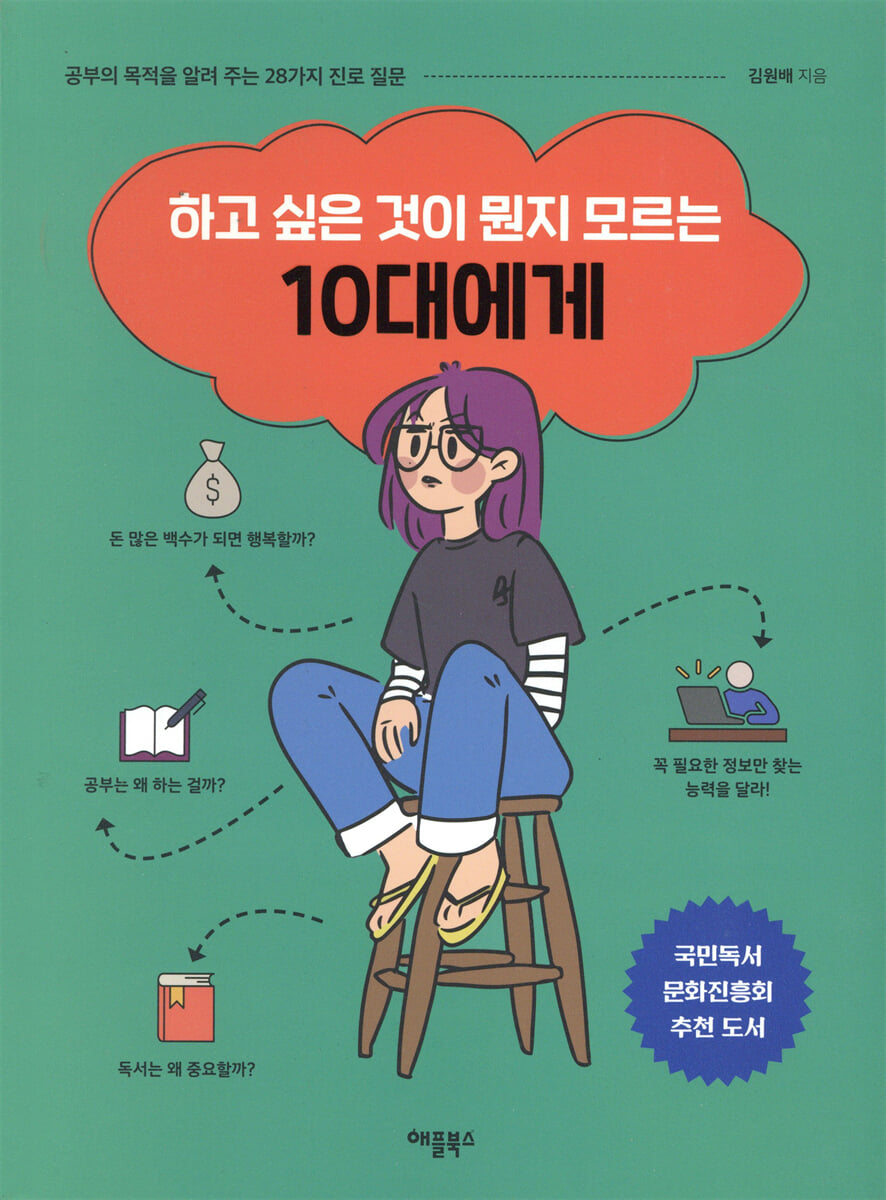
For teenagers who don't know what they want to do
 |
Description
Book Introduction
Answering key career questions that develop your thinking skills
Meet my future self. Books recommended by the National Reading Culture Promotion Association! The Fourth Industrial Revolution is changing the world with AI, robots, big data, and the Internet of Things. With the COVID-19 pandemic added to the mix, it is true that the future society predicted by scientists is approaching us sooner than expected. However, changes in school education are still slow, and career education, which must keep pace with the rapidly changing future society, is also at a standstill. Rather than spending your school years aimlessly, your future will be different if you understand your aptitude and design a strategic roadmap to prepare for future society, not to mention studying. But how many students actually prepare for a future shaped by AI and artificial intelligence when choosing their career paths? Many students enter high school and college without having the opportunity to contemplate their dreams. They even choose careers based on their parents' wishes without considering their career paths, ultimately experiencing countless trials and errors. However, it is true that it is vague as to where and how to start planning one's career path and how to choose the school of one's choice to attend. "For Teenagers Who Don't Know What They Want to Do" breaks down that vagueness and provides methods for students to create more realistic goals and design a career roadmap, along with activity sheets that allow students to check and think about their own paths. |
- You can preview some of the book's contents.
Preview
index
prolog
Dear teenagers who don't know what they want to do
Chapter 1: Let's go on a journey to the future
1.
What does my future look like if I draw it in advance?
2.
How should we accept technological advancements?
3.
What kind of talent will I become?
4.
How do I brand myself attractively?
Chapter 2: Strengthening the internal energy
1.
What is the best way to develop skills?
2.
Why do creativity and reading always go together?
3.
Is there a way to find only the information I need?
4.
Why is character important?
5.
Why are relationships, empathy, and communication important?
Chapter 3: Designing Habits and Learning Methods
1.
What are some good habits that lead to success?
2.
Don't waste class time!
3.
Doing it yourself gives you the best results!
4.
Let us realize that time is a very precious gift!
5.
Want to find your own way of writing?
Chapter 4: Career Design
1.
Who is my career model?
2.
Every profession has its own set of ethics!
3.
Should I try my hand at creating a business?
4.
There are jobs that will exist in the future!
Chapter 5: Self-Design
1.
What do I like best and am I good at?
2.
What is the best way to connect dreams and reality?
3.
What do I consider most important?
4.
Even the smallest things require a challenge!
5.
How about connecting what you're good at with what you like?
Chapter 6: Strategy Design
1.
What should I do to make today different from yesterday?
2.
What are the most important barriers you must overcome to get the job you want?
3.
What is the best way to communicate with my dreams?
4.
To achieve your dreams, you need to have a strategy!
5.
The most important thing to achieve your dreams is communication with yourself.
Career-related site information
Job Support Centers by City/Province
City/Provincial Office of Education Career and Academic Advancement Information Center
Guide to Useful Career Information Resources
Dear teenagers who don't know what they want to do
Chapter 1: Let's go on a journey to the future
1.
What does my future look like if I draw it in advance?
2.
How should we accept technological advancements?
3.
What kind of talent will I become?
4.
How do I brand myself attractively?
Chapter 2: Strengthening the internal energy
1.
What is the best way to develop skills?
2.
Why do creativity and reading always go together?
3.
Is there a way to find only the information I need?
4.
Why is character important?
5.
Why are relationships, empathy, and communication important?
Chapter 3: Designing Habits and Learning Methods
1.
What are some good habits that lead to success?
2.
Don't waste class time!
3.
Doing it yourself gives you the best results!
4.
Let us realize that time is a very precious gift!
5.
Want to find your own way of writing?
Chapter 4: Career Design
1.
Who is my career model?
2.
Every profession has its own set of ethics!
3.
Should I try my hand at creating a business?
4.
There are jobs that will exist in the future!
Chapter 5: Self-Design
1.
What do I like best and am I good at?
2.
What is the best way to connect dreams and reality?
3.
What do I consider most important?
4.
Even the smallest things require a challenge!
5.
How about connecting what you're good at with what you like?
Chapter 6: Strategy Design
1.
What should I do to make today different from yesterday?
2.
What are the most important barriers you must overcome to get the job you want?
3.
What is the best way to communicate with my dreams?
4.
To achieve your dreams, you need to have a strategy!
5.
The most important thing to achieve your dreams is communication with yourself.
Career-related site information
Job Support Centers by City/Province
City/Provincial Office of Education Career and Academic Advancement Information Center
Guide to Useful Career Information Resources
Detailed image
.jpg)
Into the book
“What do young people really need?”
This question is what started the writing.
I have been meeting children as a career guidance counselor at schools for 10 years.
We run career and vocational classes, creative career activities, free semester career exploration, and career counseling, and we constantly think about how career education should change.
As the world changes, career education in schools also needs to change.
This book is not simply for career exploration, but is designed to help you create your own future through 'reading,' 'writing,' and 'thinking.'
In this pandemic era, where field experience is difficult, we've also included an activity guide that draws on numerous counseling experiences to help you explore, plan, and think about your career path on your own.
--- From the author's note
Future society will be complex and diverse.
Therefore, we need talents who can solve convergent problems.
There is no one in this world who can do everything well.
Einstein said, “Everyone is a genius.
But if you judge a fish by its ability to climb a tree, it will live its whole life believing it is stupid.”
Fish are good at swimming, and monkeys are good at climbing trees.
The animal that is good at running is the cheetah.
As such, each animal has something it is good at.
Same goes for us.
Everyone has things they are good at and things they find difficult.
Young people preparing for the future must find out what they are good at and strive to become more outstanding than others in that field.
--- From "What kind of talent will I become?"
Are you an attractive person? Is your brand attractive? How can you create your own attractive brand? Let's create an attractive brand that connects with myself.
Above all, a brand must have authenticity that comes from within.
So, you can't force yourself to be attractive.
What increases the value of your brand as you go through life is your true charm.
--- From "How can I brand myself attractively?"
A leader's qualities, or disposition, are very important in leading an organization.
In modern society, leaders must motivate and foster strong teamwork among team members so that they can be creative and develop their capabilities.
Above all, future leaders must be humble, and they must learn this humility from their school days.
Humility does not mean lowering yourself unconditionally, but rather thinking of others more than yourself.
It is impossible for a person who is not humble to lead and encourage others.
Only by being humble can we listen to and accept the opinions of our employees.
--- From "Why is personality important?"
Michael Jordan is the greatest basketball player in NBA history, so much so that he is called the 'Emperor of Basketball.'
He joined the Chicago Bulls in 1984 and played 15 seasons in professional basketball, leading the team to six championships.
Michael Jordan announced his retirement before the start of the 1993-1994 professional basketball season and began a new life as a baseball player in the minor leagues of professional baseball.
However, he, who was the emperor of basketball, was unable to properly demonstrate his skills in professional baseball, and returned to the Chicago Bulls basketball team in March 1995, leading them to three consecutive championships.
“I’ve missed over 9,000 shots since I started playing basketball.
I lost close to 300 games.
I missed the game-winning shot that decided the game 26 times.
I failed and failed again.
That's why I was successful.”
Michael Jordan had a natural talent as a basketball player, but he was never satisfied with his position and worked tirelessly to become the emperor of basketball.
Even basketball emperor Michael Jordan didn't have any special talent in baseball, but his strength was his basketball skills.
This question is what started the writing.
I have been meeting children as a career guidance counselor at schools for 10 years.
We run career and vocational classes, creative career activities, free semester career exploration, and career counseling, and we constantly think about how career education should change.
As the world changes, career education in schools also needs to change.
This book is not simply for career exploration, but is designed to help you create your own future through 'reading,' 'writing,' and 'thinking.'
In this pandemic era, where field experience is difficult, we've also included an activity guide that draws on numerous counseling experiences to help you explore, plan, and think about your career path on your own.
--- From the author's note
Future society will be complex and diverse.
Therefore, we need talents who can solve convergent problems.
There is no one in this world who can do everything well.
Einstein said, “Everyone is a genius.
But if you judge a fish by its ability to climb a tree, it will live its whole life believing it is stupid.”
Fish are good at swimming, and monkeys are good at climbing trees.
The animal that is good at running is the cheetah.
As such, each animal has something it is good at.
Same goes for us.
Everyone has things they are good at and things they find difficult.
Young people preparing for the future must find out what they are good at and strive to become more outstanding than others in that field.
--- From "What kind of talent will I become?"
Are you an attractive person? Is your brand attractive? How can you create your own attractive brand? Let's create an attractive brand that connects with myself.
Above all, a brand must have authenticity that comes from within.
So, you can't force yourself to be attractive.
What increases the value of your brand as you go through life is your true charm.
--- From "How can I brand myself attractively?"
A leader's qualities, or disposition, are very important in leading an organization.
In modern society, leaders must motivate and foster strong teamwork among team members so that they can be creative and develop their capabilities.
Above all, future leaders must be humble, and they must learn this humility from their school days.
Humility does not mean lowering yourself unconditionally, but rather thinking of others more than yourself.
It is impossible for a person who is not humble to lead and encourage others.
Only by being humble can we listen to and accept the opinions of our employees.
--- From "Why is personality important?"
Michael Jordan is the greatest basketball player in NBA history, so much so that he is called the 'Emperor of Basketball.'
He joined the Chicago Bulls in 1984 and played 15 seasons in professional basketball, leading the team to six championships.
Michael Jordan announced his retirement before the start of the 1993-1994 professional basketball season and began a new life as a baseball player in the minor leagues of professional baseball.
However, he, who was the emperor of basketball, was unable to properly demonstrate his skills in professional baseball, and returned to the Chicago Bulls basketball team in March 1995, leading them to three consecutive championships.
“I’ve missed over 9,000 shots since I started playing basketball.
I lost close to 300 games.
I missed the game-winning shot that decided the game 26 times.
I failed and failed again.
That's why I was successful.”
Michael Jordan had a natural talent as a basketball player, but he was never satisfied with his position and worked tirelessly to become the emperor of basketball.
Even basketball emperor Michael Jordan didn't have any special talent in baseball, but his strength was his basketball skills.
--- From "What do I like best and am good at?"
Publisher's Review
“As the world changes, career education in schools also needs to change.
As you seek answers to your questions, you will see the purpose of your studies.”
Living in a pandemic era where field experience is difficult
For teenagers who want to know what they want to do
This book guides students concerned about their studies and career paths in a rapidly changing world to proactively design their own career paths, develop their learning abilities, and discover a stronger version of themselves in the future.
Drawing on over ten years of experience as a career guidance counselor in schools, the author offers guidance on the best ways to connect school learning with career development.
The book begins with the question of what kind of talent will be needed in a future world that will be completely different from the present due to cutting-edge science and technology such as AI and big data. It then helps young people develop their own capabilities, develop their own study habits, and connect these habits to their career goals to explore careers and design their career outlook.
It doesn't stop there, but also offers tips on how to identify your own inclinations and make decisions about choosing a career, school, and major.
When you worry about your career path, your mind changes several times a day and it becomes difficult to stay focused.
Many people want to pursue their dreams, but they don't know what they are good at and don't even know how to connect their talents to their dreams.
If you do that, you might not even know what your dream is and you might feel incompetent.
If a mentor or career manager helps you in such a situation, these worries will fly away in an instant.
In that sense, this book can be said to be a career mentor and a career manager.
The book includes activity sheets created by the author based on his extensive career counseling experience. As you fill out each one, you will be able to experience and plan your own career path.
Going one step further, this book will serve as a wise guide for teenagers who don't know what they want to do, helping them find their dreams, cultivate their academic skills, explore careers, and make career decisions.
As you seek answers to your questions, you will see the purpose of your studies.”
Living in a pandemic era where field experience is difficult
For teenagers who want to know what they want to do
This book guides students concerned about their studies and career paths in a rapidly changing world to proactively design their own career paths, develop their learning abilities, and discover a stronger version of themselves in the future.
Drawing on over ten years of experience as a career guidance counselor in schools, the author offers guidance on the best ways to connect school learning with career development.
The book begins with the question of what kind of talent will be needed in a future world that will be completely different from the present due to cutting-edge science and technology such as AI and big data. It then helps young people develop their own capabilities, develop their own study habits, and connect these habits to their career goals to explore careers and design their career outlook.
It doesn't stop there, but also offers tips on how to identify your own inclinations and make decisions about choosing a career, school, and major.
When you worry about your career path, your mind changes several times a day and it becomes difficult to stay focused.
Many people want to pursue their dreams, but they don't know what they are good at and don't even know how to connect their talents to their dreams.
If you do that, you might not even know what your dream is and you might feel incompetent.
If a mentor or career manager helps you in such a situation, these worries will fly away in an instant.
In that sense, this book can be said to be a career mentor and a career manager.
The book includes activity sheets created by the author based on his extensive career counseling experience. As you fill out each one, you will be able to experience and plan your own career path.
Going one step further, this book will serve as a wise guide for teenagers who don't know what they want to do, helping them find their dreams, cultivate their academic skills, explore careers, and make career decisions.
GOODS SPECIFICS
- Date of issue: August 5, 2021
- Page count, weight, size: 216 pages | 480g | 174*235*13mm
- ISBN13: 9791190147699
- ISBN10: 1190147696
You may also like
카테고리
korean


korean

![GQ KOREA Mark (Monthly): December [2025]](http://librairie.coreenne.fr/cdn/shop/files/8ef265dbbfbf186523ed75ba7319009d.jpg?v=1765340328&width=3840)


