

Stories of modern history told by Kim Gu, Jeon Tae-il, and Park Jong-cheol
 |
Description
Book Introduction
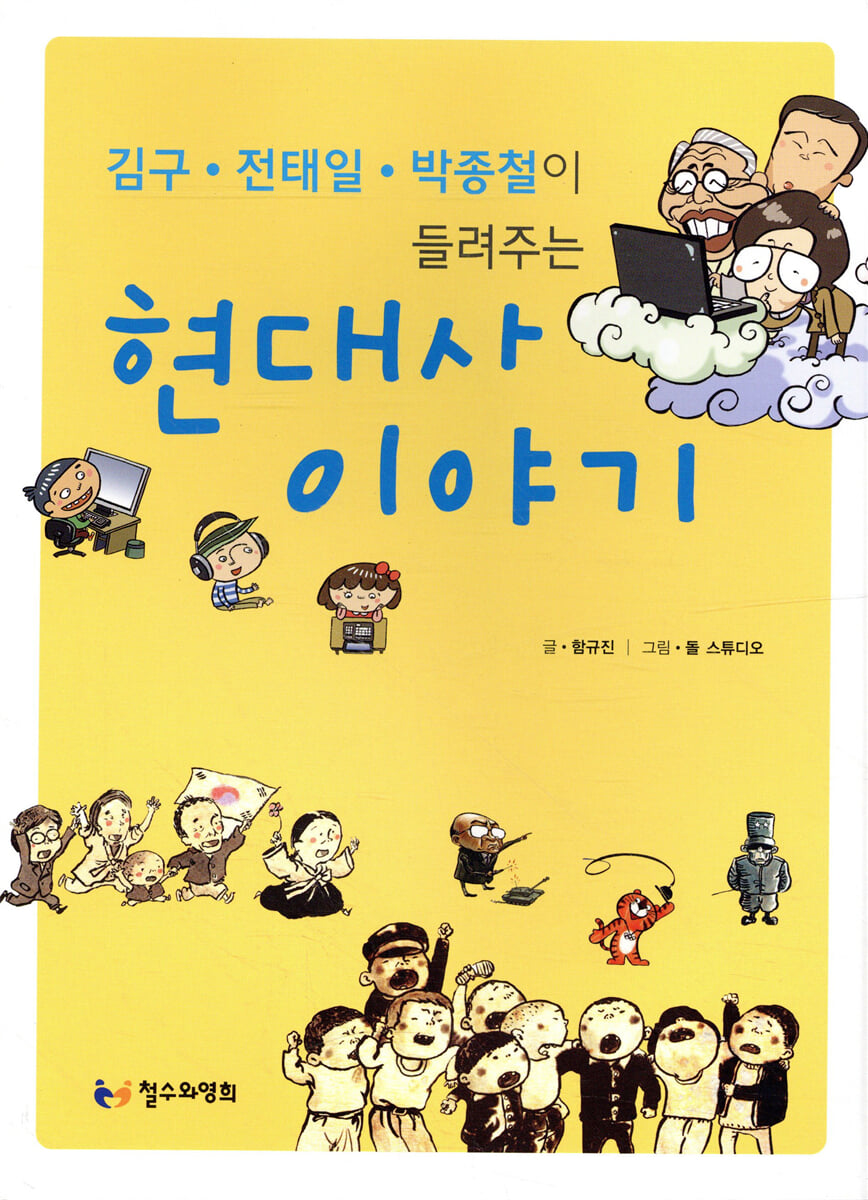
This is a history textbook that consists of the martyrs Kim Gu, Jeon Tae-il, and Park Jong-cheol, whose lives were modern history, teaching about Korea's modern history to the teenage children Yeokdol, Cheolsu, and Yeonghee from heaven.
Grandfather Baekbeom Kim Gu explains the liberation, division, and establishment of the Republic of Korea; older brother Jeon Tae-il explains Park Chung-hee's dictatorship, economic growth, and the lives of marginalized citizens; and older brother Park Jong-cheol explains the April 19 Revolution, the May 18 Gwangju Democratization Movement, and the June Democracy Movement since the 1950s.
It explains issues of modern history, such as why our country was divided, why the Korean War broke out, and why people shed blood for democracy, using abundant examples at a level children can understand.
Grandfather Baekbeom Kim Gu explains the liberation, division, and establishment of the Republic of Korea; older brother Jeon Tae-il explains Park Chung-hee's dictatorship, economic growth, and the lives of marginalized citizens; and older brother Park Jong-cheol explains the April 19 Revolution, the May 18 Gwangju Democratization Movement, and the June Democracy Movement since the 1950s.
It explains issues of modern history, such as why our country was divided, why the Korean War broke out, and why people shed blood for democracy, using abundant examples at a level children can understand.
- You can preview some of the book's contents.
Preview
index
preface
Why on earth do we learn history?
History lectures by three great men
Grandfather Baekbeom Appears in Messenger │ Learn Fun Modern History Through Email
How was the Republic of Korea founded?
A nation founded by our people │ We have become a nation without a 'nation' │ Two misunderstandings │ The military administration of the United States and the Soviet Union that was different from our will │ The trusteeship decided at the 'Moscow Tripartite Conference' │ Those who tried to continue the division of North and South Korea │ The election held only in South Korea under UN supervision │ Why should we achieve unification?
Why did the war happen?
A Continuum of Chaos and Violence │ The Shadow of Hatred and Distrust Covering the Korean Peninsula │ North Korea's Surprise Attack on South Korea │ The Entry of U.S. and UN Forces │ 3 Million Precious Lives Lost in the War │ The Korean War Deepens the Fury of Hatred
What is democracy?
Food scraps discarded by American soldiers, budaejjigae │ President Syngman Rhee wielding dictatorial power │ Democracy and dictatorship │ Democracy and elections │ March 15 rigged election │ April 19 Revolution │ Democracy grows on blood?
How did you develop your economy?
The change in government structure to a cabinet system │ Park Chung-hee's May 16 military coup │ Anti-communism and economic development │ Manpower exports and the Miracle on the Han River │ Jeon Tae-il's death │ Democracy and economic development │ Park Chung-hee's 18 years in power │ Was Park Chung-hee a hero?
What happened before the Olympics?
Chun Doo-hwan's coup d'état │ Gwangju Democratization Movement │ Cheol-su's father's prejudice │ Chun Doo-hwan's faction nurtured by Park Chung-hee │ 'Ubiquitous Telecom' and the 'Doo-hwan series' │ June Democratic Uprising │ Surrender of the Fifth Republic
What kind of Republic of Korea should we create?
History after the 1988 Seoul Olympics │ Simultaneous admission of North and South Korea to the UN │ Inter-Korean Summit │ Our Democracy, 2% Short of Time │ 'IMF Crisis' │ A More Peaceful World, a Freer Nation, a More Equal Society
Why on earth do we learn history?
History lectures by three great men
Grandfather Baekbeom Appears in Messenger │ Learn Fun Modern History Through Email
How was the Republic of Korea founded?
A nation founded by our people │ We have become a nation without a 'nation' │ Two misunderstandings │ The military administration of the United States and the Soviet Union that was different from our will │ The trusteeship decided at the 'Moscow Tripartite Conference' │ Those who tried to continue the division of North and South Korea │ The election held only in South Korea under UN supervision │ Why should we achieve unification?
Why did the war happen?
A Continuum of Chaos and Violence │ The Shadow of Hatred and Distrust Covering the Korean Peninsula │ North Korea's Surprise Attack on South Korea │ The Entry of U.S. and UN Forces │ 3 Million Precious Lives Lost in the War │ The Korean War Deepens the Fury of Hatred
What is democracy?
Food scraps discarded by American soldiers, budaejjigae │ President Syngman Rhee wielding dictatorial power │ Democracy and dictatorship │ Democracy and elections │ March 15 rigged election │ April 19 Revolution │ Democracy grows on blood?
How did you develop your economy?
The change in government structure to a cabinet system │ Park Chung-hee's May 16 military coup │ Anti-communism and economic development │ Manpower exports and the Miracle on the Han River │ Jeon Tae-il's death │ Democracy and economic development │ Park Chung-hee's 18 years in power │ Was Park Chung-hee a hero?
What happened before the Olympics?
Chun Doo-hwan's coup d'état │ Gwangju Democratization Movement │ Cheol-su's father's prejudice │ Chun Doo-hwan's faction nurtured by Park Chung-hee │ 'Ubiquitous Telecom' and the 'Doo-hwan series' │ June Democratic Uprising │ Surrender of the Fifth Republic
What kind of Republic of Korea should we create?
History after the 1988 Seoul Olympics │ Simultaneous admission of North and South Korea to the UN │ Inter-Korean Summit │ Our Democracy, 2% Short of Time │ 'IMF Crisis' │ A More Peaceful World, a Freer Nation, a More Equal Society
Into the book
From the late 1960s to the 1970s, the country achieved remarkable economic growth, with an average annual economic growth rate of 10 percent, enabling it to rise from the lowest developing country to the ranks of a middle-income country.
Foreigners who remembered the ashes of Korea immediately after the Korean War were amazed and called it the “Miracle on the Han River.”
So, given its rapid economic growth, was the Park Chung-hee regime truly a successful one? Were the many sacrifices it undertook—the military coup, the humiliating diplomacy, the dispatch of mercenaries—an inevitable sacrifice? --- p.120
Even on April 19, it was the police, not the military, who shot at the protesters.
But this time, the South Korean military indiscriminately attacked the South Korean people as if they were destroying the enemy.
Gwangju, the city of light, was instantly drenched in blood and turned into a battlefield.
Chun Doo-hwan set an example for the entire nation by brutally massacring the citizens of Gwangju.
The point was that if anyone protested, they would not be spared.
The reckless threats must have worked, as the protests died down, and Chun Doo-hwan amended the constitution to establish the Fifth Republic, becoming president through a "sham election" that did not properly reflect the will of the people and in which the ruling party was almost certain to win.
Foreigners who remembered the ashes of Korea immediately after the Korean War were amazed and called it the “Miracle on the Han River.”
So, given its rapid economic growth, was the Park Chung-hee regime truly a successful one? Were the many sacrifices it undertook—the military coup, the humiliating diplomacy, the dispatch of mercenaries—an inevitable sacrifice? --- p.120
Even on April 19, it was the police, not the military, who shot at the protesters.
But this time, the South Korean military indiscriminately attacked the South Korean people as if they were destroying the enemy.
Gwangju, the city of light, was instantly drenched in blood and turned into a battlefield.
Chun Doo-hwan set an example for the entire nation by brutally massacring the citizens of Gwangju.
The point was that if anyone protested, they would not be spared.
The reckless threats must have worked, as the protests died down, and Chun Doo-hwan amended the constitution to establish the Fifth Republic, becoming president through a "sham election" that did not properly reflect the will of the people and in which the ruling party was almost certain to win.
--- p.144
Publisher's Review
Grandfather Kim Gu, Jeon Tae-il, and Park Jong-cheol
Stories of our country's modern history told through chat and email!!!
〈Baekbeom〉: As Taeil said before, let’s first think about what a ‘well-off country’ is.
If only some of the people live in luxury, while the majority live in misery, but the average shows that the entire country is quite well off, is that truly a 'well-off country'?
〈Reverse Stone〉: No.
We need to live well overall.
Taeil: That's right.
And instead of struggling to become rich on your own, you should also take care of your neighbors in difficult circumstances, care for the destroyed nature, and have a warm and generous heart to truly live well.
A country with so many well-off people would be the 'beautiful country' that Baekbeom dreamed of.
- From p183~184
This book is composed of grandfather Kim Gu, Taeil, and older brothers Jongcheol, whose lives were modern history, easily explaining the issues of modern history that their grandfather, grandmother, father, and mother lived through through conversations and discussions via chat and email to the teenage children Yeokdol, Cheolsu, and Yeonghee in heaven.
Grandfather Baekbeom Kim Gu explains the liberation, division, and establishment of the Republic of Korea; older brother Jeon Tae-il explains Park Chung-hee's dictatorship, economic growth, and the lives of marginalized citizens; and older brother Park Jong-cheol explains events from the 1950s, including the April 19 Revolution, the May 18 Gwangju Democratization Movement, and the June Democracy Movement, in an easy-to-understand manner.
A fun modern history story tailored to children's eye level!!!
It explains the issues of modern history, such as why our country was divided, why the Korean War broke out, why unification is necessary, why people shed blood for democracy, and the direction our country should take, without being vague, but through abundant examples at a level children can understand.
I hope that through this book, our children will develop a deep interest in modern history and a correct perspective.
Stories of our country's modern history told through chat and email!!!
〈Baekbeom〉: As Taeil said before, let’s first think about what a ‘well-off country’ is.
If only some of the people live in luxury, while the majority live in misery, but the average shows that the entire country is quite well off, is that truly a 'well-off country'?
〈Reverse Stone〉: No.
We need to live well overall.
Taeil: That's right.
And instead of struggling to become rich on your own, you should also take care of your neighbors in difficult circumstances, care for the destroyed nature, and have a warm and generous heart to truly live well.
A country with so many well-off people would be the 'beautiful country' that Baekbeom dreamed of.
- From p183~184
This book is composed of grandfather Kim Gu, Taeil, and older brothers Jongcheol, whose lives were modern history, easily explaining the issues of modern history that their grandfather, grandmother, father, and mother lived through through conversations and discussions via chat and email to the teenage children Yeokdol, Cheolsu, and Yeonghee in heaven.
Grandfather Baekbeom Kim Gu explains the liberation, division, and establishment of the Republic of Korea; older brother Jeon Tae-il explains Park Chung-hee's dictatorship, economic growth, and the lives of marginalized citizens; and older brother Park Jong-cheol explains events from the 1950s, including the April 19 Revolution, the May 18 Gwangju Democratization Movement, and the June Democracy Movement, in an easy-to-understand manner.
A fun modern history story tailored to children's eye level!!!
It explains the issues of modern history, such as why our country was divided, why the Korean War broke out, why unification is necessary, why people shed blood for democracy, and the direction our country should take, without being vague, but through abundant examples at a level children can understand.
I hope that through this book, our children will develop a deep interest in modern history and a correct perspective.
GOODS SPECIFICS
- Date of issue: August 30, 2010
- Page count, weight, size: 192 pages | 398g | 163*225*20mm
- ISBN13: 9788993463101
- ISBN10: 8993463107
You may also like
카테고리
korean


korean

![GQ KOREA Mark (Monthly): December [2025]](http://librairie.coreenne.fr/cdn/shop/files/8ef265dbbfbf186523ed75ba7319009d.jpg?v=1765340328&width=3840)


