

Why, what do you mean by that?
 |
Description
Book Introduction
★ Included in middle school Korean language textbooks ★ Selected as a book in the liberal arts category by Sejong Books
★ National Korean Language Teachers Association Mulkkobang Recommended Books ★ Booktase Recommended Books
★ Gwangyang City Library Book of the Year ★ Jeju Udang Library Book of the Year
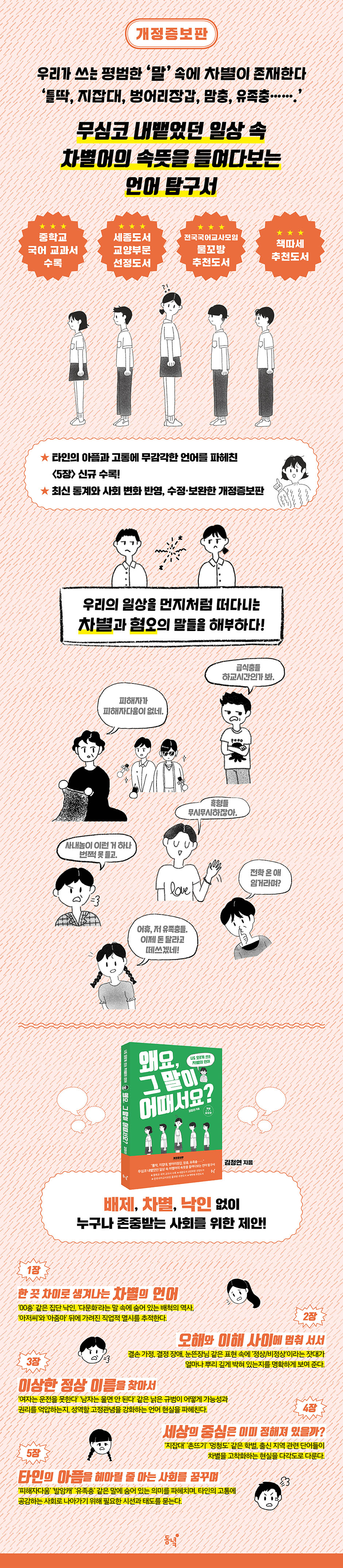
《Why, What's Wrong with That?》 Revised and Expanded Edition Published!
"Why, What's Wrong with That?", which has been responsible for the language life of Korean youth, has returned with a revised and expanded edition after six years of publication.
This book delves into how expressions like 'ttakttak, mittens, jjibdae, heukhyung, luxury body' that we use thoughtlessly in our daily lives can lead to hatred and discrimination, and opens up a new perspective on language for young people.
It was evaluated as having raised the level of language sensitivity of young people by not simply pointing out 'words that should not be used', but also showing the social context in which those words were created and the hatred and discrimination that those words created.
Since then, it has been included in middle school Korean language textbooks and has been selected as a recommended book by various organizations, providing clear guidelines for the language life of young people.
Since the publication of the first edition, our society has experienced changes both large and small, including an unprecedented infectious disease, a series of social disasters, and deepening inequality.
In the process, insensitive and flat language directed at victims and the vulnerable, as well as expressions that reinforce stereotypes, have reappeared.
This revised and expanded edition actively reflects these social changes, revising and supplementing existing content and adding Chapter 5 (Dreaming of a Society That Understands the Pain of Others), which addresses the newly emerging language of discrimination and hatred.
Chapter 5 examines carefully who the words that trap victims of incidents in the shackles of prejudice, trivialize the pain of those suffering from illness or accidents, or view them through a distorted lens, are directed at, and what impact they can have.
"Why, What's Wrong with That?" helps us discover the discriminatory elements hidden in the words we actually use, and guides us to lead a new language life that respects others through this small but important realization.
★ National Korean Language Teachers Association Mulkkobang Recommended Books ★ Booktase Recommended Books
★ Gwangyang City Library Book of the Year ★ Jeju Udang Library Book of the Year
《Why, What's Wrong with That?》 Revised and Expanded Edition Published!
"Why, What's Wrong with That?", which has been responsible for the language life of Korean youth, has returned with a revised and expanded edition after six years of publication.
This book delves into how expressions like 'ttakttak, mittens, jjibdae, heukhyung, luxury body' that we use thoughtlessly in our daily lives can lead to hatred and discrimination, and opens up a new perspective on language for young people.
It was evaluated as having raised the level of language sensitivity of young people by not simply pointing out 'words that should not be used', but also showing the social context in which those words were created and the hatred and discrimination that those words created.
Since then, it has been included in middle school Korean language textbooks and has been selected as a recommended book by various organizations, providing clear guidelines for the language life of young people.
Since the publication of the first edition, our society has experienced changes both large and small, including an unprecedented infectious disease, a series of social disasters, and deepening inequality.
In the process, insensitive and flat language directed at victims and the vulnerable, as well as expressions that reinforce stereotypes, have reappeared.
This revised and expanded edition actively reflects these social changes, revising and supplementing existing content and adding Chapter 5 (Dreaming of a Society That Understands the Pain of Others), which addresses the newly emerging language of discrimination and hatred.
Chapter 5 examines carefully who the words that trap victims of incidents in the shackles of prejudice, trivialize the pain of those suffering from illness or accidents, or view them through a distorted lens, are directed at, and what impact they can have.
"Why, What's Wrong with That?" helps us discover the discriminatory elements hidden in the words we actually use, and guides us to lead a new language life that respects others through this small but important realization.
- You can preview some of the book's contents.
Preview
index
Introduction_ Why is that familiar word a problem?
Chapter 1: The Language of Discrimination Created by a Minor Difference
I guess it's time for the ㅇㅇㅇs to get off school
There, come out
I'm annoyed by you guys
I was startled when ㅇㅇ suddenly appeared.
Yeah, order here
Words like these hurt! Words that compare people to "bugs."
Chapter 2: Standing Between Misunderstanding and Understanding
ㅇㅇ ㅇㅇ I prepared this to help my friends
The weather is getting colder, ㅇㅇㅇㅇㅇ
These guys are scary
That's just a policy
These words hurt! They degrade people with disabilities and their race.
Chapter 3: Finding the Strange Normal Name
ㅇㅇㅇ can't even pick up something like this
Yeah, so you have to be careful with your actions.
She's also pretty
Yeah, I'll drive at home.
This is something that ㅇㅇ should do
Words like this hurt! Words that are full of gender bias.
Chapter 4: Is the center of the world already determined?
The kid who transferred said, "ㅇㅇ"
If you're going to ㅇㅇㅇ, you should take a year off
ㅇㅇㅇ There's a lot to say on this topic
Yeah, yeah, yeah
Born in ㅇㅇㅇ and joined a large company
These words hurt! Prejudiced remarks about academic background and living conditions.
Chapter 5
Dreaming of a society that understands the pain of others
Yeah, yeah, did you see the news?
I'm going to get cancer because of these guys!
There is no victim ㅇㅇㅇㅇㅇ
Oh my.
Those guys.
Now he's going to start demanding money!
These words hurt! Expressions that can cause secondary damage.
Outgoing writing_ May everyone live a life where they are respected without exclusion, discrimination, or stigmatization.
Chapter 1: The Language of Discrimination Created by a Minor Difference
I guess it's time for the ㅇㅇㅇs to get off school
There, come out
I'm annoyed by you guys
I was startled when ㅇㅇ suddenly appeared.
Yeah, order here
Words like these hurt! Words that compare people to "bugs."
Chapter 2: Standing Between Misunderstanding and Understanding
ㅇㅇ ㅇㅇ I prepared this to help my friends
The weather is getting colder, ㅇㅇㅇㅇㅇ
These guys are scary
That's just a policy
These words hurt! They degrade people with disabilities and their race.
Chapter 3: Finding the Strange Normal Name
ㅇㅇㅇ can't even pick up something like this
Yeah, so you have to be careful with your actions.
She's also pretty
Yeah, I'll drive at home.
This is something that ㅇㅇ should do
Words like this hurt! Words that are full of gender bias.
Chapter 4: Is the center of the world already determined?
The kid who transferred said, "ㅇㅇ"
If you're going to ㅇㅇㅇ, you should take a year off
ㅇㅇㅇ There's a lot to say on this topic
Yeah, yeah, yeah
Born in ㅇㅇㅇ and joined a large company
These words hurt! Prejudiced remarks about academic background and living conditions.
Chapter 5
Dreaming of a society that understands the pain of others
Yeah, yeah, did you see the news?
I'm going to get cancer because of these guys!
There is no victim ㅇㅇㅇㅇㅇ
Oh my.
Those guys.
Now he's going to start demanding money!
These words hurt! Expressions that can cause secondary damage.
Outgoing writing_ May everyone live a life where they are respected without exclusion, discrimination, or stigmatization.
Detailed image
Into the book
“Children don’t complain as long as you feed them well.”
Have you ever heard this saying? It's something adults often say to children.
At first glance, you might think, 'Well, I guess so.' and just pass it over.
But if you think about it carefully, it seems to contain the perspective that “children are so simple and immature that all their complaints will be resolved if only the food problem is solved.”
From this perspective, 'food bugs' are 'simple, immature bugs that only care about what they eat.'
--- p.18
The term 'broken family' is based on the view that a family consisting of three or more people - a father, mother, and children - is 'normal'.
Since this type of family is considered normal, families that are slightly different from it are seen as abnormal and somehow incomplete.
--- p.54
The term 'lame policy' is often used in media such as newspapers and broadcasting as an idiomatic expression meaning 'unbalanced policy', 'incomplete policy', or 'abnormal policy'.
Those who use this expression probably mean 'imbalanced', 'incomplete', or 'abnormal'.
But let's think about it carefully.
What criteria can be used to say that someone with a limp is imperfect and abnormal? Is there any basis for saying someone without a limp is normal?
--- p.71
There are also attempts to change the expressions we commonly use from a gender equality perspective.
A representative example is the phenomenon of changing the name of ‘stroller’ to ‘baby carriage’.
The word ‘baby carriage’ only contains the character ‘mother’ (母).
There was criticism that it is not suitable for the era of equal parenting because it does not mean that fathers cannot push strollers.
In that sense, many people are calling it a 'baby carriage' centered around the child.
--- p.90
If the name of the incident is combined with the victim's name and the name of the region, it can become a 'stigma', as negative perceptions of a specific region become established as stereotypes.
'We need to filter out people from that criminal city!' 'The area is full of crime.' That's what it's like.
--- p.148
Expressions related to victimhood often appear these days not only in sexual crime cases but also in other cases.
To the parents who lost their children in the Sewol Ferry disaster, statements like, “The bereaved family is eating?” “Huh? They’re laughing?” “They must have the presence of mind to put on makeup and come out,” can be seen as expressions that come from the absurd prejudice that “if you’re a victim (parent), you have to stop your daily life and live in sorrow and fear as if you’re dead.”
Have you ever heard this saying? It's something adults often say to children.
At first glance, you might think, 'Well, I guess so.' and just pass it over.
But if you think about it carefully, it seems to contain the perspective that “children are so simple and immature that all their complaints will be resolved if only the food problem is solved.”
From this perspective, 'food bugs' are 'simple, immature bugs that only care about what they eat.'
--- p.18
The term 'broken family' is based on the view that a family consisting of three or more people - a father, mother, and children - is 'normal'.
Since this type of family is considered normal, families that are slightly different from it are seen as abnormal and somehow incomplete.
--- p.54
The term 'lame policy' is often used in media such as newspapers and broadcasting as an idiomatic expression meaning 'unbalanced policy', 'incomplete policy', or 'abnormal policy'.
Those who use this expression probably mean 'imbalanced', 'incomplete', or 'abnormal'.
But let's think about it carefully.
What criteria can be used to say that someone with a limp is imperfect and abnormal? Is there any basis for saying someone without a limp is normal?
--- p.71
There are also attempts to change the expressions we commonly use from a gender equality perspective.
A representative example is the phenomenon of changing the name of ‘stroller’ to ‘baby carriage’.
The word ‘baby carriage’ only contains the character ‘mother’ (母).
There was criticism that it is not suitable for the era of equal parenting because it does not mean that fathers cannot push strollers.
In that sense, many people are calling it a 'baby carriage' centered around the child.
--- p.90
If the name of the incident is combined with the victim's name and the name of the region, it can become a 'stigma', as negative perceptions of a specific region become established as stereotypes.
'We need to filter out people from that criminal city!' 'The area is full of crime.' That's what it's like.
--- p.148
Expressions related to victimhood often appear these days not only in sexual crime cases but also in other cases.
To the parents who lost their children in the Sewol Ferry disaster, statements like, “The bereaved family is eating?” “Huh? They’re laughing?” “They must have the presence of mind to put on makeup and come out,” can be seen as expressions that come from the absurd prejudice that “if you’re a victim (parent), you have to stop your daily life and live in sorrow and fear as if you’re dead.”
--- p.160
Publisher's Review
《Why, What's Wrong with That?》 Revised and Expanded Edition Published!
"Why, What's Wrong with That?", which has been responsible for the language life of Korean youth, has returned after six years with a deeper perspective.
"Why, What's Wrong with That?" is a book that points out expressions that teenagers use in their daily lives without thinking, such as "ttakttak," "mute gloves," "jijabdae," "heukhyung," and "luxury body," and informs us that "those words" are not just jokes or idioms, but can be painful discrimination and hatred to some people.
Immediately after its publication, it was selected as a recommended book by numerous organizations, was included in middle school Korean language textbooks, and was mentioned as a must-read for teenagers in various media and gatherings, popularizing the concept of "language sensitivity."
This revised and expanded edition faithfully reflects the social environment that has changed since the first edition.
We meticulously track the distorted language directed at victims and the vulnerable amid recent events and incidents, including the COVID-19 pandemic, social disasters, and deepening inequality.
A newly added fifth chapter focuses on how insensitive remarks directed at victims of illness, accidents, or disasters create further wounds.
By carefully refining and supplementing existing content, while analyzing newly emerging language of discrimination and hatred, it raises a more persuasive awareness of the issues for readers living today.
Tracking the "dust discrimination" scattered throughout everyday life
Small, seemingly trivial discriminations float around in our daily lives.
This is called a 'microaggression', a combination of the words 'micro' and 'aggression', and literally means a subtle but aggressive discrimination.
In Korean, we call it 'dust discrimination'.
Just like fine dust scattered in the air but harmful to the human body, discriminatory words embedded in everyday language may seem insignificant on the surface, but they actually leave deep scars.
This book identifies discriminatory expressions we use without thinking, one by one, and traces their origins and context.
And he persistently asks when words used as jokes became symbols of discrimination and hatred, and why they do not change easily.
“I didn’t want to simply say, ‘Don’t use that expression!’ through the book.
By examining the meaning of the expression, its background, and the various contexts in which it is used, I wanted to talk with readers about how we are surrounded by stereotypes and prejudices, and how we arbitrarily create standards in the name of "us" and then build walls against those who deviate from those standards.
With that in mind, I persistently pursued the meaning, background, and influence of expressions. “ _From the ‘Introduction’
No slanted respect or courtesy!
Language sensitivity training that does not belittle anyone and does not hurt anyone.
Chapter 1, “The Language of Discrimination Created by a Minor Difference,” deals with language that stems from stereotypes such as age and occupation.
It traces the collective stigma of "00-chung," the history of exclusion hidden in the term "multicultural," and the professional contempt hidden behind "ajussi" and "ajumma."
Chapter 2, ‘Standing Between Misunderstanding and Understanding,’ illuminates the perspective of a society that cannot distinguish between ‘wrong’ and ‘difference.’
Expressions like broken homes, decision-making difficulties, and blind people clearly show how deeply rooted the standards of “normal/abnormal” are.
Chapter 3, "In Search of Strange Normal Names," focuses on stereotypes based on gender and age.
It explores how outdated norms like "women can't drive" and "men shouldn't cry" suppress possibilities and rights, and the linguistic realities that reinforce gender role stereotypes.
Chapter 4, "Is the Center of the World Already Determined?" illuminates a social landscape where a person's worth is judged by their "origin"—such as academic background, region, and housing price.
It deals with the reality that words like 'jijabdae', 'country bumpkin', and 'idiot' are perpetuating discrimination from various angles.
Chapter 5, "Dreaming of a Society That Understands the Pain of Others," newly added to this revised and expanded edition, focuses on language that confines victims of incidents within the framework of prejudice, and expressions that trivialize or distort the suffering of victims of illness or accidents.
By delving into the hidden meanings behind words like “victimhood,” “carcinogen,” and “survivor,” we ask about the perspectives and attitudes needed to move toward a society that empathizes with the suffering of others.
The book's subject matter could easily be considered heavy, but Kim Ga-ji's four-panel daily life cartoon adds liveliness and wit to the book.
Thanks to this, readers can more vividly perceive the contents of this book and read it with empathy.
Learning respect through sensitivity
As you read the book, questions like, "Isn't this just a joke?" and "How can I live when I'm so tired of worrying about things like this?" naturally arise.
The author also acknowledges such fatigue.
But it is precisely this ‘sensitivity’ that is the starting point of language sensitivity.
Respect and consideration begin the moment you stop and think, 'How will my words sound to the other person?'
"Why, What's Wrong with That?" suggests that before we shout against discrimination, we should first look back at our language habits.
Even if it's a little uncomfortable, through that process we can renew our perspective on others and society.
As such, discovering discriminatory words is not simply a matter of picking out 'bad words'.
It is a process of establishing a new language of respect and equality.
Especially in today's digital environment where verbal abuse spreads rapidly, "Why, What's Wrong with That?" prompts both youth and adult readers to reflect on the social responsibility of language.
In a reality where trivial remarks and trivial jokes build walls of discrimination, this book makes us fundamentally rethink our attitude toward words and writing.
The first step toward a language of respect begins right here.
"Why, What's Wrong with That?", which has been responsible for the language life of Korean youth, has returned after six years with a deeper perspective.
"Why, What's Wrong with That?" is a book that points out expressions that teenagers use in their daily lives without thinking, such as "ttakttak," "mute gloves," "jijabdae," "heukhyung," and "luxury body," and informs us that "those words" are not just jokes or idioms, but can be painful discrimination and hatred to some people.
Immediately after its publication, it was selected as a recommended book by numerous organizations, was included in middle school Korean language textbooks, and was mentioned as a must-read for teenagers in various media and gatherings, popularizing the concept of "language sensitivity."
This revised and expanded edition faithfully reflects the social environment that has changed since the first edition.
We meticulously track the distorted language directed at victims and the vulnerable amid recent events and incidents, including the COVID-19 pandemic, social disasters, and deepening inequality.
A newly added fifth chapter focuses on how insensitive remarks directed at victims of illness, accidents, or disasters create further wounds.
By carefully refining and supplementing existing content, while analyzing newly emerging language of discrimination and hatred, it raises a more persuasive awareness of the issues for readers living today.
Tracking the "dust discrimination" scattered throughout everyday life
Small, seemingly trivial discriminations float around in our daily lives.
This is called a 'microaggression', a combination of the words 'micro' and 'aggression', and literally means a subtle but aggressive discrimination.
In Korean, we call it 'dust discrimination'.
Just like fine dust scattered in the air but harmful to the human body, discriminatory words embedded in everyday language may seem insignificant on the surface, but they actually leave deep scars.
This book identifies discriminatory expressions we use without thinking, one by one, and traces their origins and context.
And he persistently asks when words used as jokes became symbols of discrimination and hatred, and why they do not change easily.
“I didn’t want to simply say, ‘Don’t use that expression!’ through the book.
By examining the meaning of the expression, its background, and the various contexts in which it is used, I wanted to talk with readers about how we are surrounded by stereotypes and prejudices, and how we arbitrarily create standards in the name of "us" and then build walls against those who deviate from those standards.
With that in mind, I persistently pursued the meaning, background, and influence of expressions. “ _From the ‘Introduction’
No slanted respect or courtesy!
Language sensitivity training that does not belittle anyone and does not hurt anyone.
Chapter 1, “The Language of Discrimination Created by a Minor Difference,” deals with language that stems from stereotypes such as age and occupation.
It traces the collective stigma of "00-chung," the history of exclusion hidden in the term "multicultural," and the professional contempt hidden behind "ajussi" and "ajumma."
Chapter 2, ‘Standing Between Misunderstanding and Understanding,’ illuminates the perspective of a society that cannot distinguish between ‘wrong’ and ‘difference.’
Expressions like broken homes, decision-making difficulties, and blind people clearly show how deeply rooted the standards of “normal/abnormal” are.
Chapter 3, "In Search of Strange Normal Names," focuses on stereotypes based on gender and age.
It explores how outdated norms like "women can't drive" and "men shouldn't cry" suppress possibilities and rights, and the linguistic realities that reinforce gender role stereotypes.
Chapter 4, "Is the Center of the World Already Determined?" illuminates a social landscape where a person's worth is judged by their "origin"—such as academic background, region, and housing price.
It deals with the reality that words like 'jijabdae', 'country bumpkin', and 'idiot' are perpetuating discrimination from various angles.
Chapter 5, "Dreaming of a Society That Understands the Pain of Others," newly added to this revised and expanded edition, focuses on language that confines victims of incidents within the framework of prejudice, and expressions that trivialize or distort the suffering of victims of illness or accidents.
By delving into the hidden meanings behind words like “victimhood,” “carcinogen,” and “survivor,” we ask about the perspectives and attitudes needed to move toward a society that empathizes with the suffering of others.
The book's subject matter could easily be considered heavy, but Kim Ga-ji's four-panel daily life cartoon adds liveliness and wit to the book.
Thanks to this, readers can more vividly perceive the contents of this book and read it with empathy.
Learning respect through sensitivity
As you read the book, questions like, "Isn't this just a joke?" and "How can I live when I'm so tired of worrying about things like this?" naturally arise.
The author also acknowledges such fatigue.
But it is precisely this ‘sensitivity’ that is the starting point of language sensitivity.
Respect and consideration begin the moment you stop and think, 'How will my words sound to the other person?'
"Why, What's Wrong with That?" suggests that before we shout against discrimination, we should first look back at our language habits.
Even if it's a little uncomfortable, through that process we can renew our perspective on others and society.
As such, discovering discriminatory words is not simply a matter of picking out 'bad words'.
It is a process of establishing a new language of respect and equality.
Especially in today's digital environment where verbal abuse spreads rapidly, "Why, What's Wrong with That?" prompts both youth and adult readers to reflect on the social responsibility of language.
In a reality where trivial remarks and trivial jokes build walls of discrimination, this book makes us fundamentally rethink our attitude toward words and writing.
The first step toward a language of respect begins right here.
GOODS SPECIFICS
- Date of issue: September 12, 2025
- Page count, weight, size: 176 pages | 204g | 128*188*10mm
- ISBN13: 9788972971733
- ISBN10: 8972971731
You may also like
카테고리
korean


korean

![GQ KOREA Mark (Monthly): December [2025]](http://librairie.coreenne.fr/cdn/shop/files/8ef265dbbfbf186523ed75ba7319009d.jpg?v=1765340328&width=3840)


