

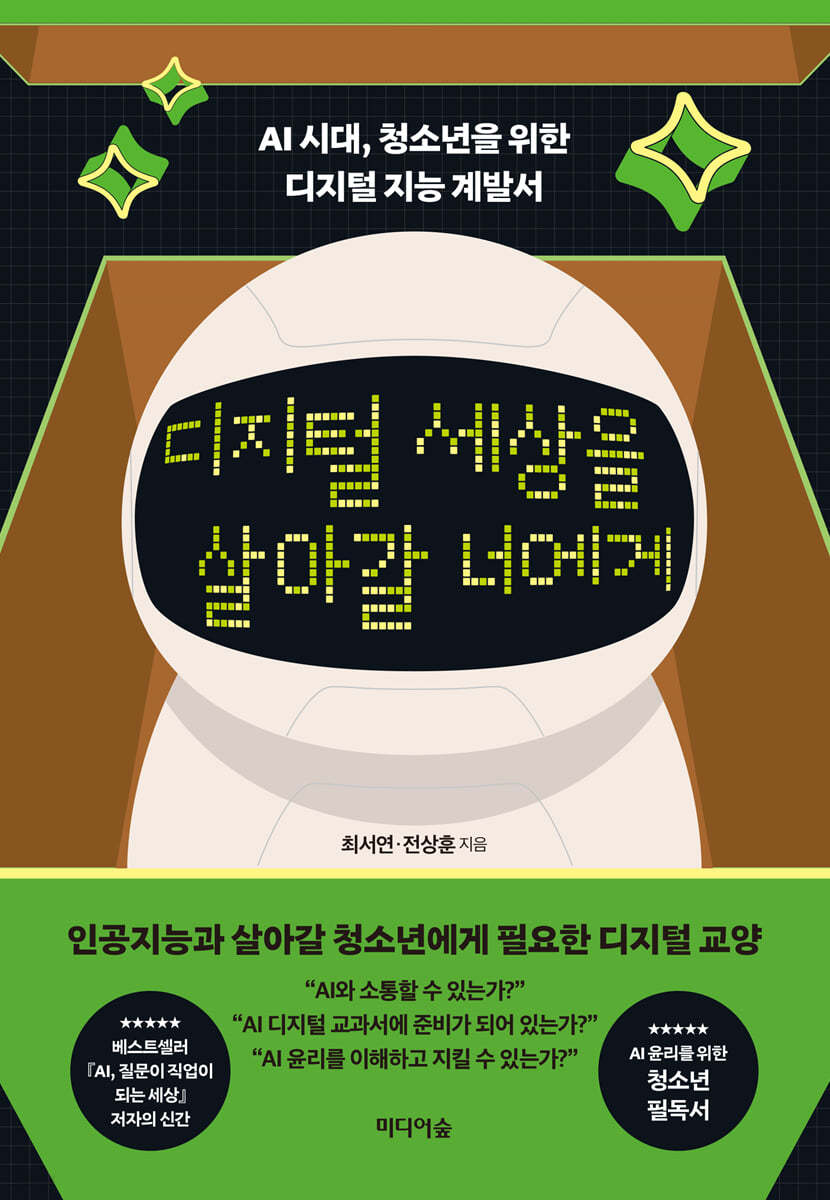
To you who will live in the digital world
 |
Description
Book Introduction
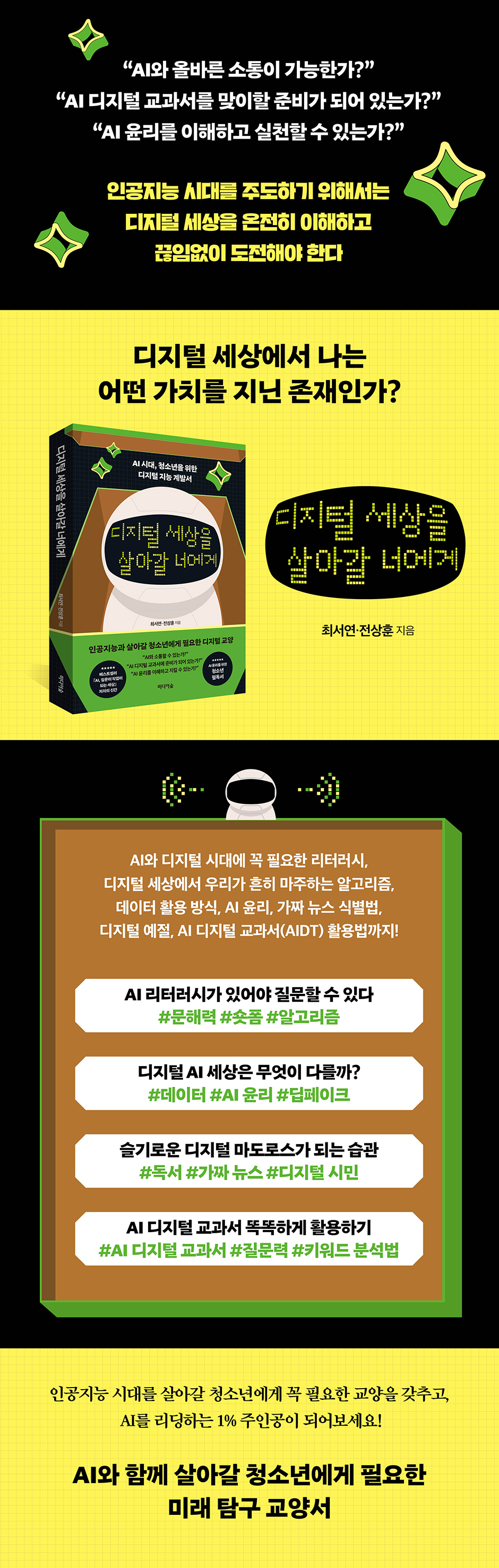
“Can we communicate with AI?”
“Are you ready for AI-powered digital textbooks?”
“Can you understand and adhere to AI ethics?”
A future exploration textbook for youth preparing for the digital AI era.
This book begins with the question, "What is my value in an AI-driven digital world?"
In a digital world where the real and the fake coexist, how can we protect ourselves and find our precious existence? Surrounded by a vast amount of information and cutting-edge technology, the questions of who we are and what we live for are becoming increasingly crucial.
In particular, as AI technology rapidly evolves and permeates every aspect of our daily lives, our youth must learn how to maintain their own identities and protect their precious values in this new world where they coexist with AI.
However, in the midst of rapid change, it is becoming increasingly difficult to find one's true self and live while recognizing the value of one's existence.
AI technology, which has become deeply embedded in our daily lives, presents a particularly significant challenge for young people. In this era where we must grow alongside AI, what skills must we cultivate to avoid losing our sense of self? In this rapidly changing world, finding our true selves and maintaining our unique values is becoming increasingly difficult, yet at the same time, it's more urgent than ever.
The first chapter of this book delves into the characteristics of AI and the digital world, covering topics such as AI and digital, the relationship between AI and data, deepfakes, and AI ethics.
We cover why data is a key resource for AI, why AI ethics are important, and the impact of deepfakes on individuals and society.
All of these elements surround us in today's digital environment.
The second chapter explains the concept of 'literacy', which is essential in the AI and digital world.
Literacy consists of media literacy, digital literacy, the ability to analyze data, and the ability to understand AI, each of which is essential for living a smart life in the digital world.
This allows us to understand how algorithms work and to question and judge more actively.
The third chapter introduces how to become a wise 'sailor' in the digital world.
It emphasizes the importance of reading texts in the digital world, how to identify fake news, and the importance of etiquette and responsibility in digital spaces, helping young people act responsibly as digital citizens.
Finally, the fourth chapter introduces the use of AI Digital Textbooks (AIDT), which will begin in 2025, mentioning their features, pros and cons and suggesting specific methods for effective learning.
Develop creative thinking skills in the digital world through keyword analysis and questioning exercises.
To all of you who wish to move forward confidently in the digital world without losing your value, let's take the first step together.
“Are you ready for AI-powered digital textbooks?”
“Can you understand and adhere to AI ethics?”
A future exploration textbook for youth preparing for the digital AI era.
This book begins with the question, "What is my value in an AI-driven digital world?"
In a digital world where the real and the fake coexist, how can we protect ourselves and find our precious existence? Surrounded by a vast amount of information and cutting-edge technology, the questions of who we are and what we live for are becoming increasingly crucial.
In particular, as AI technology rapidly evolves and permeates every aspect of our daily lives, our youth must learn how to maintain their own identities and protect their precious values in this new world where they coexist with AI.
However, in the midst of rapid change, it is becoming increasingly difficult to find one's true self and live while recognizing the value of one's existence.
AI technology, which has become deeply embedded in our daily lives, presents a particularly significant challenge for young people. In this era where we must grow alongside AI, what skills must we cultivate to avoid losing our sense of self? In this rapidly changing world, finding our true selves and maintaining our unique values is becoming increasingly difficult, yet at the same time, it's more urgent than ever.
The first chapter of this book delves into the characteristics of AI and the digital world, covering topics such as AI and digital, the relationship between AI and data, deepfakes, and AI ethics.
We cover why data is a key resource for AI, why AI ethics are important, and the impact of deepfakes on individuals and society.
All of these elements surround us in today's digital environment.
The second chapter explains the concept of 'literacy', which is essential in the AI and digital world.
Literacy consists of media literacy, digital literacy, the ability to analyze data, and the ability to understand AI, each of which is essential for living a smart life in the digital world.
This allows us to understand how algorithms work and to question and judge more actively.
The third chapter introduces how to become a wise 'sailor' in the digital world.
It emphasizes the importance of reading texts in the digital world, how to identify fake news, and the importance of etiquette and responsibility in digital spaces, helping young people act responsibly as digital citizens.
Finally, the fourth chapter introduces the use of AI Digital Textbooks (AIDT), which will begin in 2025, mentioning their features, pros and cons and suggesting specific methods for effective learning.
Develop creative thinking skills in the digital world through keyword analysis and questioning exercises.
To all of you who wish to move forward confidently in the digital world without losing your value, let's take the first step together.
- You can preview some of the book's contents.
Preview
index
Prologue: Who Am I in the AI Era?
Part 1. What will be different in an AI-driven digital world?
1.
Everything leaves a trace.
2. AI thinks digitally.
3.
AI that feeds on data
4. AI knows me better than I know myself?
5. AI ethics are a true competitive advantage.
Part 2. You Need AI Literacy to Ask Questions
1.
Literacy in the Digital World
2.
From short form back to text
3. Understanding MDDAI Literacy
4.
Where will the algorithm lead me?
Part 3.
Habits that protect me in the digital world
1.
A Personal Reading Life: Text is Hip
- 10 Ways to Get to Know Plus Box Books
2.
Developing the ability to identify fake information
3.
Etiquette and Responsibility in the Digital Space
4.
Digital Detox for Me
Part 4. Smartly Using AI Digital Textbooks
1. Everything About AI Digital Textbooks
2. The Duality of AI Digital Textbooks: Moments of Change and Choice
3.
Keyword Analysis for Efficient Learning
4.
The power of questioning is becoming increasingly important
5. AI is not omnipotent.
- The roles of teachers, parents, and students following the introduction of Plus Box AI digital textbooks.
Epilogue: In the Age of AI, Will We Be Pioneers?
References
Part 1. What will be different in an AI-driven digital world?
1.
Everything leaves a trace.
2. AI thinks digitally.
3.
AI that feeds on data
4. AI knows me better than I know myself?
5. AI ethics are a true competitive advantage.
Part 2. You Need AI Literacy to Ask Questions
1.
Literacy in the Digital World
2.
From short form back to text
3. Understanding MDDAI Literacy
4.
Where will the algorithm lead me?
Part 3.
Habits that protect me in the digital world
1.
A Personal Reading Life: Text is Hip
- 10 Ways to Get to Know Plus Box Books
2.
Developing the ability to identify fake information
3.
Etiquette and Responsibility in the Digital Space
4.
Digital Detox for Me
Part 4. Smartly Using AI Digital Textbooks
1. Everything About AI Digital Textbooks
2. The Duality of AI Digital Textbooks: Moments of Change and Choice
3.
Keyword Analysis for Efficient Learning
4.
The power of questioning is becoming increasingly important
5. AI is not omnipotent.
- The roles of teachers, parents, and students following the introduction of Plus Box AI digital textbooks.
Epilogue: In the Age of AI, Will We Be Pioneers?
References
Detailed image
Into the book
Students already struggle to control themselves with online games and social media, and they worry that allowing them to access digital devices at school will only further immerse them in the digital world and make self-control more difficult.
Not only will this lead to a decline in literacy, it will also make it more difficult to create an environment that fosters critical thinking skills, which are becoming increasingly important in the AI era.
--- From the text
In this life, there are things that we pass by without even realizing it.
It is a 'trace'.
In the digital space, those footprints are left behind and stored intact.
Whether I'm using social media, riding the bus, or watching a movie, my daily life is being recorded in a digital space through digital devices connected to the Internet.
We call those traces 'data'.
--- From the text
A report published in July 2024, "AI Models Trained Repeatedly on Generated Data Collapse," highlights that models trained solely on AI-generated data suffer a significant performance degradation.
According to the report, this process leads to a growing number of low-quality data and errors, ultimately significantly compromising the reliability of AI systems.
--- From the text
AI ethics are important not only for AI developers and companies, but also for users who utilize and deploy AI.
In the summer of 2024, one of the biggest AI ethics issues in Korean society was the inappropriate deepfake video incident distributed via the Telegram messenger app.
This is an example of a celebrity's face being synthesized onto another person's body or a non-existent face being created and used maliciously.
Deepfake technology can be used to create entertaining videos and works of art, but when used maliciously, it can cause serious problems.
--- From the text
Illegal distribution of personal information carries the risk of infringing on personal freedom or being misused to monitor and control behavior.
This remains a particularly significant challenge for young people living in an AI-driven digital world, requiring critical thinking skills to clearly discern the dangers hidden behind AI's seemingly plausible information.
Addressing these challenges requires recognizing the importance of privacy and fostering critical thinking.
--- From the text
Young people feel secure and special by using language that adults find difficult to understand and sharing their own culture.
But what we must never forget is that there is a separate, official language used in society.
The language used in the specific community I belong to and the language required in social life are clearly different.
We need to recognize the difference and use appropriate language for the situation.
--- From the text
Media literacy refers to the ability to understand content provided through various media and to critically analyze and determine whether the information is true or false.
Because not all media information we encounter today is factual or informative, it's crucial to determine for yourself whether the information is trustworthy or manipulated or distorted.
--- From the text
Nomophobia is not just a discomfort; it can cause a variety of problems, including decreased academic achievement, decreased social skills, sleep disturbances, and even affect relationships with friends.
It is very important to control the amount of time you spend using your smartphone and find activities you can enjoy without it.
--- From the text
AI digital textbooks provide parents with a more detailed view of their children's learning.
Even for parents, it's difficult to accurately assess their children's learning abilities. However, if AI digital textbooks can analyze and instantly monitor their child's learning progress in real time, they can more quickly understand their child's learning process and provide optimized support based on their performance.
--- From the text
The Big Picture Creativity Training method is a great help in developing the most important questioning skills in AI digital textbooks.
This training method uses keyword analysis associative techniques to ask a series of questions.
First, we envision the big picture of the entire topic, extract questions based on that into keywords, and then expand our thinking by finding information related to those keywords.
It is a training that broadens the scope of thinking by asking questions again at each stage and obtaining additional information.
Not only will this lead to a decline in literacy, it will also make it more difficult to create an environment that fosters critical thinking skills, which are becoming increasingly important in the AI era.
--- From the text
In this life, there are things that we pass by without even realizing it.
It is a 'trace'.
In the digital space, those footprints are left behind and stored intact.
Whether I'm using social media, riding the bus, or watching a movie, my daily life is being recorded in a digital space through digital devices connected to the Internet.
We call those traces 'data'.
--- From the text
A report published in July 2024, "AI Models Trained Repeatedly on Generated Data Collapse," highlights that models trained solely on AI-generated data suffer a significant performance degradation.
According to the report, this process leads to a growing number of low-quality data and errors, ultimately significantly compromising the reliability of AI systems.
--- From the text
AI ethics are important not only for AI developers and companies, but also for users who utilize and deploy AI.
In the summer of 2024, one of the biggest AI ethics issues in Korean society was the inappropriate deepfake video incident distributed via the Telegram messenger app.
This is an example of a celebrity's face being synthesized onto another person's body or a non-existent face being created and used maliciously.
Deepfake technology can be used to create entertaining videos and works of art, but when used maliciously, it can cause serious problems.
--- From the text
Illegal distribution of personal information carries the risk of infringing on personal freedom or being misused to monitor and control behavior.
This remains a particularly significant challenge for young people living in an AI-driven digital world, requiring critical thinking skills to clearly discern the dangers hidden behind AI's seemingly plausible information.
Addressing these challenges requires recognizing the importance of privacy and fostering critical thinking.
--- From the text
Young people feel secure and special by using language that adults find difficult to understand and sharing their own culture.
But what we must never forget is that there is a separate, official language used in society.
The language used in the specific community I belong to and the language required in social life are clearly different.
We need to recognize the difference and use appropriate language for the situation.
--- From the text
Media literacy refers to the ability to understand content provided through various media and to critically analyze and determine whether the information is true or false.
Because not all media information we encounter today is factual or informative, it's crucial to determine for yourself whether the information is trustworthy or manipulated or distorted.
--- From the text
Nomophobia is not just a discomfort; it can cause a variety of problems, including decreased academic achievement, decreased social skills, sleep disturbances, and even affect relationships with friends.
It is very important to control the amount of time you spend using your smartphone and find activities you can enjoy without it.
--- From the text
AI digital textbooks provide parents with a more detailed view of their children's learning.
Even for parents, it's difficult to accurately assess their children's learning abilities. However, if AI digital textbooks can analyze and instantly monitor their child's learning progress in real time, they can more quickly understand their child's learning process and provide optimized support based on their performance.
--- From the text
The Big Picture Creativity Training method is a great help in developing the most important questioning skills in AI digital textbooks.
This training method uses keyword analysis associative techniques to ask a series of questions.
First, we envision the big picture of the entire topic, extract questions based on that into keywords, and then expand our thinking by finding information related to those keywords.
It is a training that broadens the scope of thinking by asking questions again at each stage and obtaining additional information.
--- From the text
Publisher's Review
The First Step to Preparing for the AI Future
“What is my role and what is the value of my existence?”
Where are we headed in this rapidly changing technological landscape? With this book, we aim to guide young people to define themselves amidst the deluge of AI and data, forge their own path, and confidently move into the future.
No matter how much the world changes, my will to find my own unique value will not change.
"In the AI era, what is my role and what is my value?" is a question that young people, who will live in the age of artificial intelligence, must find the answer to.
"To You Who Will Live in the Digital World" accompanies the youth who harbor these questions on their journey to find the answers.
“You need to have MDDAI literacy to be able to ask questions,
“Those who can ask questions lead AI.”
A Guide to Digital Literacy and AI Digital Textbooks for Youth
In today's AI-driven digital age, digital literacy and AI comprehension are no longer optional, but essential capabilities.
This book will help you develop both of these skills.
It provides easy-to-understand explanations of key topics young people will face in the digital society, including algorithms, data utilization, and AI ethics.
We also support young people to grow into responsible and proactive digital citizens by teaching them how to identify fake information, digital etiquette, and how to use AI Digital Textbooks (AIDT).
This book is not just a simple AI technology manual.
We guide young people to confidently find their own path in the digital age and utilize AI as a tool to advance into a wider world. In the age of AI, ask yourself these questions.
"Who am I?", "What is my value in the digital world?" The process of finding answers to these questions will lead you to a wider world.
“What is my role and what is the value of my existence?”
Where are we headed in this rapidly changing technological landscape? With this book, we aim to guide young people to define themselves amidst the deluge of AI and data, forge their own path, and confidently move into the future.
No matter how much the world changes, my will to find my own unique value will not change.
"In the AI era, what is my role and what is my value?" is a question that young people, who will live in the age of artificial intelligence, must find the answer to.
"To You Who Will Live in the Digital World" accompanies the youth who harbor these questions on their journey to find the answers.
“You need to have MDDAI literacy to be able to ask questions,
“Those who can ask questions lead AI.”
A Guide to Digital Literacy and AI Digital Textbooks for Youth
In today's AI-driven digital age, digital literacy and AI comprehension are no longer optional, but essential capabilities.
This book will help you develop both of these skills.
It provides easy-to-understand explanations of key topics young people will face in the digital society, including algorithms, data utilization, and AI ethics.
We also support young people to grow into responsible and proactive digital citizens by teaching them how to identify fake information, digital etiquette, and how to use AI Digital Textbooks (AIDT).
This book is not just a simple AI technology manual.
We guide young people to confidently find their own path in the digital age and utilize AI as a tool to advance into a wider world. In the age of AI, ask yourself these questions.
"Who am I?", "What is my value in the digital world?" The process of finding answers to these questions will lead you to a wider world.
GOODS SPECIFICS
- Date of issue: January 20, 2025
- Page count, weight, size: 240 pages | 147*212*20mm
- ISBN13: 9791158742454
- ISBN10: 1158742452
You may also like
카테고리
korean


korean

![GQ KOREA Mark (Monthly): December [2025]](http://librairie.coreenne.fr/cdn/shop/files/8ef265dbbfbf186523ed75ba7319009d.jpg?v=1765340328&width=3840)


