

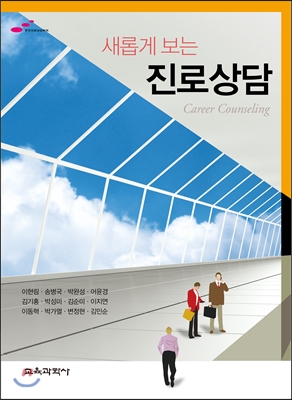
A new perspective on career counseling
 |
Description
Book Introduction
This book was published to help provide successful career counseling so that students can grow into the talents required in a knowledge-based society and become better members of society.
This book contains information on how to provide counseling and education necessary for career guidance.
It systematically presents basic concepts and theories to broaden knowledge and understanding of career counseling, and even provides specific suggestions for how to utilize them in counseling.
It also provides detailed information on how to effectively guide clients in various counseling fields.
This book contains information on how to provide counseling and education necessary for career guidance.
It systematically presents basic concepts and theories to broaden knowledge and understanding of career counseling, and even provides specific suggestions for how to utilize them in counseling.
It also provides detailed information on how to effectively guide clients in various counseling fields.
index
preface
CHAPTER 01: The Basics of Career Counseling - Professor Emeritus Lee Hyeon-rim, Yeungnam University
1.
Career counseling
1) Career path 2) Career development 3) Career awareness maturity 4) Career guidance
5) Career guidance 6) Career counseling
2.
History of career counseling
1) Initial career guidance 2) Systematic career guidance 3) Transition from a career model to a career model
4) The Beginning of Career Education 5) The Rise of Career Counseling
3.
Goals and Necessity of Career Counseling
1) Goals of career counseling 2) Necessity and principles of career counseling
4.
Factors influencing career choice
1) Physical factors 2) Psychological and emotional factors
3) Environmental factors 4) Chance factors
5.
Current issues and directions of career counseling
1) Understanding social change 2) Direction of career counseling
3) Direction of career counseling for adaptation to future society
Think about it
References
CHAPTER 02 Career Choice Theory - Professor Emeritus Lee Hyeon-rim, Yeungnam University
1.
Trait-based career counseling
1) Diagnosis 2) Process 3) Results 4) Counseling Techniques 5) Counseling Principles
6) Interpretation of the test 7) Job information 8) Evaluation
2.
Human-centered career counseling
1) Diagnosis 2) Purpose 3) Process 4) Counseling Techniques 5) Use of Tests
6) Use of job information
3.
Psychoanalytic career counseling
1) Diagnosis 2) Purpose 3) Process 4) Counseling Techniques 5) Use of Tests
6) Use of job information 7) Evaluation
4.
Behavioral Career Counseling
1) Diagnosis 2) Purpose 3) Process 4) Counseling Techniques 5) Use of Tests
6) Use of job information
5.
Roe's need theory
1) Parent-child interaction 2) Occupational classification
3) Relationship between parent-child interaction and occupation 4) Evaluation
6.
Holland's personality theory
1) Theory assumptions and personality types 2) Occupational environment and career choice 3) Evaluation
Think about it
References
CHAPTER 03 Career Development Theory - Professor Song Byeong-guk, Soonchunhyang University
1.
Ginzberg's career development theory
1) Fantasy phase 2) Tentative phase
3) Realistic phase
2.
Super's Life Career Development Theory
1) Vocational self-concept 2) Life career development stage
3) Life roles 4) Application to career counseling
3.
Gottfredson's limited-compromise theory
1) Stages of the Restriction-Compromise Theory 2) Application of the Restriction-Compromise Theory
Think about it
References
CHAPTER 04 Career Decision-Making Theory - Professor Park Wan-seong, Samyuk University
1.
Career Decision-Making Theory
1) Gelatt's decision-making theory 2) Katz's theory 3) Tiedeman and O'Hara's decision-making theory
4) Janis and Mann's conflict model 5) Mitchell's choice model 6) Harren's decision-making theory
2.
How to make rational career decisions
1) What is decision making? 2) Types of decision making
3) Decision-making style test items 4) Developing rational decision-making skills
Think about it
References
CHAPTER 05: Current Theories on Career Choice and Development - Professor Song Byeong-guk, Soonchunhyang University
1.
Krumboltz's social learning theory
1) Career decision factors 2) Interaction results of career decision factors 3) Application to career counseling
2.
Social Cognitive Career Theory
1) Cognitive factors in career development 2) Environmental factors and career barriers
3) Career behavior model of social cognitive career theory 4) Application to career counseling
3.
Constructivist career development theory
1) Basic assumptions of career constructivism theory 2) Key concepts of career constructivism theory
3) Application to career counseling
Think about it
References
CHAPTER 06 Career Counseling Process and Techniques - Eo Yoon-kyung, Associate Professor, Kongju National University
1.
Setting the stage for career counseling
1) Client diagnosis 2) Counseling structure and counseling goal setting
3) Establishment of counseling strategy and treatment 4) Conclusion of counseling
2.
Role and Competencies of Career Counselor
3.
Career Counseling Strategies by Client Type
Think about it
References
CHAPTER 07 Career Adaptation and Career Transition in Career Counseling - Kim Ki-hong, Senior Research Fellow, Korea Research Institute for Vocational Education and Training
1.
career adaptation
1) The concept of job adaptation
2.
Theory of Career Adaptation
1) Dawis and Lofquist's vocational adaptation 2) Hershenson's vocational adaptation
3.
career change
1) The concept of career change 2) Types and factors of career change 3) Theories on career change
4.
Conclusion and Implications
1) Job adaptation 2) Career change
Think about it
References
CHAPTER 08: Using Psychological Testing for Career Counseling - Professor Park Seong-mi, Dongseo University
1.
The developmental relationship between counseling and psychological testing
2.
Benefits of Using Psychological Testing in Career Counseling
1) Providing information to clients 2) Facilitating clients' self-exploration
3) Evaluation of the counseling process or results
3.
The use of psychological testing as an effective means of career counseling
1) Principles of using psychological tests 2) Components of using psychological tests
3) Career counseling using psychological tests
4.
Types of psychological tests according to career counseling type
1) Psychological tests for career selection 2) Evaluations to promote career development
Think about it
References
CHAPTER 09 Career Information Activities - Kim Soon-mi, Research Professor, Daegu Catholic University
1.
Understanding career information
1) The meaning of career information 2) Types of career information 3) Career information center
2.
Career information management process
1) Collection of career information 2) Analysis of career information 3) Processing and systematization of career information
4) Method of providing career information 5) Accumulation of career information 6) Evaluation of career information
3.
Use of career information
1) Korean Standard Occupational Classification 2) Korean Standard Industrial Classification 3) Korean Dictionary of Occupations
4) Korea Job Outlook 5) Foreign Cases
4.
Job Outlook
Think about it
References
CHAPTER 10 Women-Specific Career Counseling - Lee Ji-yeon, Senior Research Fellow, Korea Research Institute for Vocational Education and Training
1.
The Need for Women-Specific Career Counseling
1) Career counseling as a practical way to escape the M-shaped curve
2) Career counseling to support women's will to activate their careers
3) Career counseling as a deliberate, planned, and systematic response to career obstacles for women 269
2.
Women's career development and career obstacles
1) Characteristics of women 2) Characteristics of women's career development
3) Factors hindering women's careers 4) Coping with women's career obstacles
3.
Women-specific career counseling
1) Formation and structuring of the female client-counselor relationship 2) Classification of female client characteristics
3) Analysis of career obstacles in female clients 4) Setting counseling goals
5) Operation of counseling intervention program to overcome career obstacles 6) Evaluation and termination
7) Harvest Map 8) Feedback
4.
summation
Think about it
References
CHAPTER 11 Multicultural Career Counseling - Professor Lee Dong-hyeok, Konkuk University
1.
Multicultural Career Counseling
2.
Skills Required for Multicultural Career Counselor
3.
Career counseling for multicultural clients
1) Career counseling for North Korean defectors 2) Career counseling for immigrants
3) Career counseling for international students 4) Career counseling for people with disabilities
5) Career counseling for sexual minorities 6) Career counseling for economically vulnerable groups
Think about it
References
CHAPTER 12 Career Counseling for At-Risk Youth - Park Ga-yeol, Research Fellow, Korea Employment Information Service
1.
introduction
2.
The concept and current status of at-risk youth
1) The concept of at-risk youth 2) Current status of at-risk youth
3.
Policies and systems for career development of at-risk youth
1) Overseas 2) Domestic
4.
Case Study of Program Development for Career Counseling for At-Risk Youth: To the Job Program
1) Theoretical background 2) Main components 3) Operational plan
5.
Conclusion and Suggestions
Think about it
References
CHAPTER 13 Cyber Career Counseling - Byun Jeong-hyeon, Senior Researcher, Korea Employment Information Service
1.
Understanding Cyber Career Counseling
1) The concept and emergence of cyber career counseling 2) Characteristics of cyber career counseling
2.
Resources and Types of Cyber Career Counseling
1) Cyber career counseling resources 2) Types of cyber career counseling
3.
Cyber career counseling techniques
1) Expression techniques for cyber career counseling 2) Techniques for conducting cyber career counseling
4.
Contents and examples of cyber career counseling
1) Main contents of cyber career counseling 2) Cyber career counseling cases
Think about it
References
CHAPTER 14: The Reality of Career Group Counseling - Kim Min-sun, Visiting Professor, Changwon National University
1.
Understanding Group Career Counseling
1) Meaning and characteristics of career group counseling 2) Purpose of career group counseling
3) The necessity and effectiveness of career group counseling 4) Qualifications of career group counselors
2.
Career group counseling plan
1) Things to keep in mind about career group counseling 2) Preparation for career group counseling
3.
The process of career group counseling
1) Preliminary group counseling stage (Encounter) 2) Exploration stage
3) Working stage 4) Conclusion stage
4.
The reality of career group counseling
1) Group career counseling for elementary school students 2) Group career counseling for middle school students
3) High school student career group counseling 4) College student career group counseling
Think about it
References
Search
CHAPTER 01: The Basics of Career Counseling - Professor Emeritus Lee Hyeon-rim, Yeungnam University
1.
Career counseling
1) Career path 2) Career development 3) Career awareness maturity 4) Career guidance
5) Career guidance 6) Career counseling
2.
History of career counseling
1) Initial career guidance 2) Systematic career guidance 3) Transition from a career model to a career model
4) The Beginning of Career Education 5) The Rise of Career Counseling
3.
Goals and Necessity of Career Counseling
1) Goals of career counseling 2) Necessity and principles of career counseling
4.
Factors influencing career choice
1) Physical factors 2) Psychological and emotional factors
3) Environmental factors 4) Chance factors
5.
Current issues and directions of career counseling
1) Understanding social change 2) Direction of career counseling
3) Direction of career counseling for adaptation to future society
Think about it
References
CHAPTER 02 Career Choice Theory - Professor Emeritus Lee Hyeon-rim, Yeungnam University
1.
Trait-based career counseling
1) Diagnosis 2) Process 3) Results 4) Counseling Techniques 5) Counseling Principles
6) Interpretation of the test 7) Job information 8) Evaluation
2.
Human-centered career counseling
1) Diagnosis 2) Purpose 3) Process 4) Counseling Techniques 5) Use of Tests
6) Use of job information
3.
Psychoanalytic career counseling
1) Diagnosis 2) Purpose 3) Process 4) Counseling Techniques 5) Use of Tests
6) Use of job information 7) Evaluation
4.
Behavioral Career Counseling
1) Diagnosis 2) Purpose 3) Process 4) Counseling Techniques 5) Use of Tests
6) Use of job information
5.
Roe's need theory
1) Parent-child interaction 2) Occupational classification
3) Relationship between parent-child interaction and occupation 4) Evaluation
6.
Holland's personality theory
1) Theory assumptions and personality types 2) Occupational environment and career choice 3) Evaluation
Think about it
References
CHAPTER 03 Career Development Theory - Professor Song Byeong-guk, Soonchunhyang University
1.
Ginzberg's career development theory
1) Fantasy phase 2) Tentative phase
3) Realistic phase
2.
Super's Life Career Development Theory
1) Vocational self-concept 2) Life career development stage
3) Life roles 4) Application to career counseling
3.
Gottfredson's limited-compromise theory
1) Stages of the Restriction-Compromise Theory 2) Application of the Restriction-Compromise Theory
Think about it
References
CHAPTER 04 Career Decision-Making Theory - Professor Park Wan-seong, Samyuk University
1.
Career Decision-Making Theory
1) Gelatt's decision-making theory 2) Katz's theory 3) Tiedeman and O'Hara's decision-making theory
4) Janis and Mann's conflict model 5) Mitchell's choice model 6) Harren's decision-making theory
2.
How to make rational career decisions
1) What is decision making? 2) Types of decision making
3) Decision-making style test items 4) Developing rational decision-making skills
Think about it
References
CHAPTER 05: Current Theories on Career Choice and Development - Professor Song Byeong-guk, Soonchunhyang University
1.
Krumboltz's social learning theory
1) Career decision factors 2) Interaction results of career decision factors 3) Application to career counseling
2.
Social Cognitive Career Theory
1) Cognitive factors in career development 2) Environmental factors and career barriers
3) Career behavior model of social cognitive career theory 4) Application to career counseling
3.
Constructivist career development theory
1) Basic assumptions of career constructivism theory 2) Key concepts of career constructivism theory
3) Application to career counseling
Think about it
References
CHAPTER 06 Career Counseling Process and Techniques - Eo Yoon-kyung, Associate Professor, Kongju National University
1.
Setting the stage for career counseling
1) Client diagnosis 2) Counseling structure and counseling goal setting
3) Establishment of counseling strategy and treatment 4) Conclusion of counseling
2.
Role and Competencies of Career Counselor
3.
Career Counseling Strategies by Client Type
Think about it
References
CHAPTER 07 Career Adaptation and Career Transition in Career Counseling - Kim Ki-hong, Senior Research Fellow, Korea Research Institute for Vocational Education and Training
1.
career adaptation
1) The concept of job adaptation
2.
Theory of Career Adaptation
1) Dawis and Lofquist's vocational adaptation 2) Hershenson's vocational adaptation
3.
career change
1) The concept of career change 2) Types and factors of career change 3) Theories on career change
4.
Conclusion and Implications
1) Job adaptation 2) Career change
Think about it
References
CHAPTER 08: Using Psychological Testing for Career Counseling - Professor Park Seong-mi, Dongseo University
1.
The developmental relationship between counseling and psychological testing
2.
Benefits of Using Psychological Testing in Career Counseling
1) Providing information to clients 2) Facilitating clients' self-exploration
3) Evaluation of the counseling process or results
3.
The use of psychological testing as an effective means of career counseling
1) Principles of using psychological tests 2) Components of using psychological tests
3) Career counseling using psychological tests
4.
Types of psychological tests according to career counseling type
1) Psychological tests for career selection 2) Evaluations to promote career development
Think about it
References
CHAPTER 09 Career Information Activities - Kim Soon-mi, Research Professor, Daegu Catholic University
1.
Understanding career information
1) The meaning of career information 2) Types of career information 3) Career information center
2.
Career information management process
1) Collection of career information 2) Analysis of career information 3) Processing and systematization of career information
4) Method of providing career information 5) Accumulation of career information 6) Evaluation of career information
3.
Use of career information
1) Korean Standard Occupational Classification 2) Korean Standard Industrial Classification 3) Korean Dictionary of Occupations
4) Korea Job Outlook 5) Foreign Cases
4.
Job Outlook
Think about it
References
CHAPTER 10 Women-Specific Career Counseling - Lee Ji-yeon, Senior Research Fellow, Korea Research Institute for Vocational Education and Training
1.
The Need for Women-Specific Career Counseling
1) Career counseling as a practical way to escape the M-shaped curve
2) Career counseling to support women's will to activate their careers
3) Career counseling as a deliberate, planned, and systematic response to career obstacles for women 269
2.
Women's career development and career obstacles
1) Characteristics of women 2) Characteristics of women's career development
3) Factors hindering women's careers 4) Coping with women's career obstacles
3.
Women-specific career counseling
1) Formation and structuring of the female client-counselor relationship 2) Classification of female client characteristics
3) Analysis of career obstacles in female clients 4) Setting counseling goals
5) Operation of counseling intervention program to overcome career obstacles 6) Evaluation and termination
7) Harvest Map 8) Feedback
4.
summation
Think about it
References
CHAPTER 11 Multicultural Career Counseling - Professor Lee Dong-hyeok, Konkuk University
1.
Multicultural Career Counseling
2.
Skills Required for Multicultural Career Counselor
3.
Career counseling for multicultural clients
1) Career counseling for North Korean defectors 2) Career counseling for immigrants
3) Career counseling for international students 4) Career counseling for people with disabilities
5) Career counseling for sexual minorities 6) Career counseling for economically vulnerable groups
Think about it
References
CHAPTER 12 Career Counseling for At-Risk Youth - Park Ga-yeol, Research Fellow, Korea Employment Information Service
1.
introduction
2.
The concept and current status of at-risk youth
1) The concept of at-risk youth 2) Current status of at-risk youth
3.
Policies and systems for career development of at-risk youth
1) Overseas 2) Domestic
4.
Case Study of Program Development for Career Counseling for At-Risk Youth: To the Job Program
1) Theoretical background 2) Main components 3) Operational plan
5.
Conclusion and Suggestions
Think about it
References
CHAPTER 13 Cyber Career Counseling - Byun Jeong-hyeon, Senior Researcher, Korea Employment Information Service
1.
Understanding Cyber Career Counseling
1) The concept and emergence of cyber career counseling 2) Characteristics of cyber career counseling
2.
Resources and Types of Cyber Career Counseling
1) Cyber career counseling resources 2) Types of cyber career counseling
3.
Cyber career counseling techniques
1) Expression techniques for cyber career counseling 2) Techniques for conducting cyber career counseling
4.
Contents and examples of cyber career counseling
1) Main contents of cyber career counseling 2) Cyber career counseling cases
Think about it
References
CHAPTER 14: The Reality of Career Group Counseling - Kim Min-sun, Visiting Professor, Changwon National University
1.
Understanding Group Career Counseling
1) Meaning and characteristics of career group counseling 2) Purpose of career group counseling
3) The necessity and effectiveness of career group counseling 4) Qualifications of career group counselors
2.
Career group counseling plan
1) Things to keep in mind about career group counseling 2) Preparation for career group counseling
3.
The process of career group counseling
1) Preliminary group counseling stage (Encounter) 2) Exploration stage
3) Working stage 4) Conclusion stage
4.
The reality of career group counseling
1) Group career counseling for elementary school students 2) Group career counseling for middle school students
3) High school student career group counseling 4) College student career group counseling
Think about it
References
Search
Publisher's Review
Today, we live in a knowledge-based society where we create and utilize knowledge and information.
The knowledge-based society is causing rapid changes across the socio-economic landscape, including a decline in job opportunities, changes in job requirements, and an increasingly complex world of work.
In a society where new knowledge is rapidly increasing and society is rapidly changing, we must be able to respond rationally to these social changes rather than simply accepting standardized knowledge as is.
Therefore, individuals must develop adaptive skills to cope with the new society by utilizing the abundance of information and knowledge.
To this end, it is necessary to provide career guidance and education from a young age so that they can wisely prepare for their future.
To survive in modern society, individuals increasingly need to understand various factors such as their aptitudes, interests, personality, and physical characteristics.
Based on this self-understanding, you should be able to clearly define your desired life goals and make desirable career decisions that can adapt to the knowledge-based society.
Accordingly, this book was published to help provide successful career counseling so that students can grow into the talents required in a knowledge-based society and become better members of society.
This book contains information on how to provide counseling and education necessary for career guidance.
It systematically presents basic concepts and theories to broaden knowledge and understanding of career counseling, and even provides specific suggestions for how to utilize them in counseling.
It also provides detailed information on how to effectively guide clients in various counseling fields.
It will also serve as a useful guide for educational activities as it provides useful information on career education and career counseling methods.
Therefore, it can be helpful to counselors who provide direct counseling to clients seeking career counseling, or to those who teach career counseling at universities or counseling-related organizations.
The authors of this book are highly qualified experts who have taught or worked in career counseling at universities and public institutions.
Based on the experience accumulated in each of their respective fields, we put our heart and soul into making the content faithful while also ensuring that readers can read it with interest and comfort.
Finally, I would like to express my gratitude to the authors for their hard work in publishing this book, and to the many teachers, including President Kim Dong-gyu of Educational Science Publishing, who readily agreed to publish the book.
The knowledge-based society is causing rapid changes across the socio-economic landscape, including a decline in job opportunities, changes in job requirements, and an increasingly complex world of work.
In a society where new knowledge is rapidly increasing and society is rapidly changing, we must be able to respond rationally to these social changes rather than simply accepting standardized knowledge as is.
Therefore, individuals must develop adaptive skills to cope with the new society by utilizing the abundance of information and knowledge.
To this end, it is necessary to provide career guidance and education from a young age so that they can wisely prepare for their future.
To survive in modern society, individuals increasingly need to understand various factors such as their aptitudes, interests, personality, and physical characteristics.
Based on this self-understanding, you should be able to clearly define your desired life goals and make desirable career decisions that can adapt to the knowledge-based society.
Accordingly, this book was published to help provide successful career counseling so that students can grow into the talents required in a knowledge-based society and become better members of society.
This book contains information on how to provide counseling and education necessary for career guidance.
It systematically presents basic concepts and theories to broaden knowledge and understanding of career counseling, and even provides specific suggestions for how to utilize them in counseling.
It also provides detailed information on how to effectively guide clients in various counseling fields.
It will also serve as a useful guide for educational activities as it provides useful information on career education and career counseling methods.
Therefore, it can be helpful to counselors who provide direct counseling to clients seeking career counseling, or to those who teach career counseling at universities or counseling-related organizations.
The authors of this book are highly qualified experts who have taught or worked in career counseling at universities and public institutions.
Based on the experience accumulated in each of their respective fields, we put our heart and soul into making the content faithful while also ensuring that readers can read it with interest and comfort.
Finally, I would like to express my gratitude to the authors for their hard work in publishing this book, and to the many teachers, including President Kim Dong-gyu of Educational Science Publishing, who readily agreed to publish the book.
GOODS SPECIFICS
- Date of issue: September 30, 2013
- Page count, weight, size: 448 pages | 898g | 188*254*30mm
- ISBN13: 9788925407388
- ISBN10: 8925407388
You may also like
카테고리
korean


korean

![GQ KOREA Mark (Monthly): December [2025]](http://librairie.coreenne.fr/cdn/shop/files/8ef265dbbfbf186523ed75ba7319009d.jpg?v=1765340328&width=3840)


