

Social Development Guidebook SUM (Self Us Membership)
 |
Description
Book Introduction
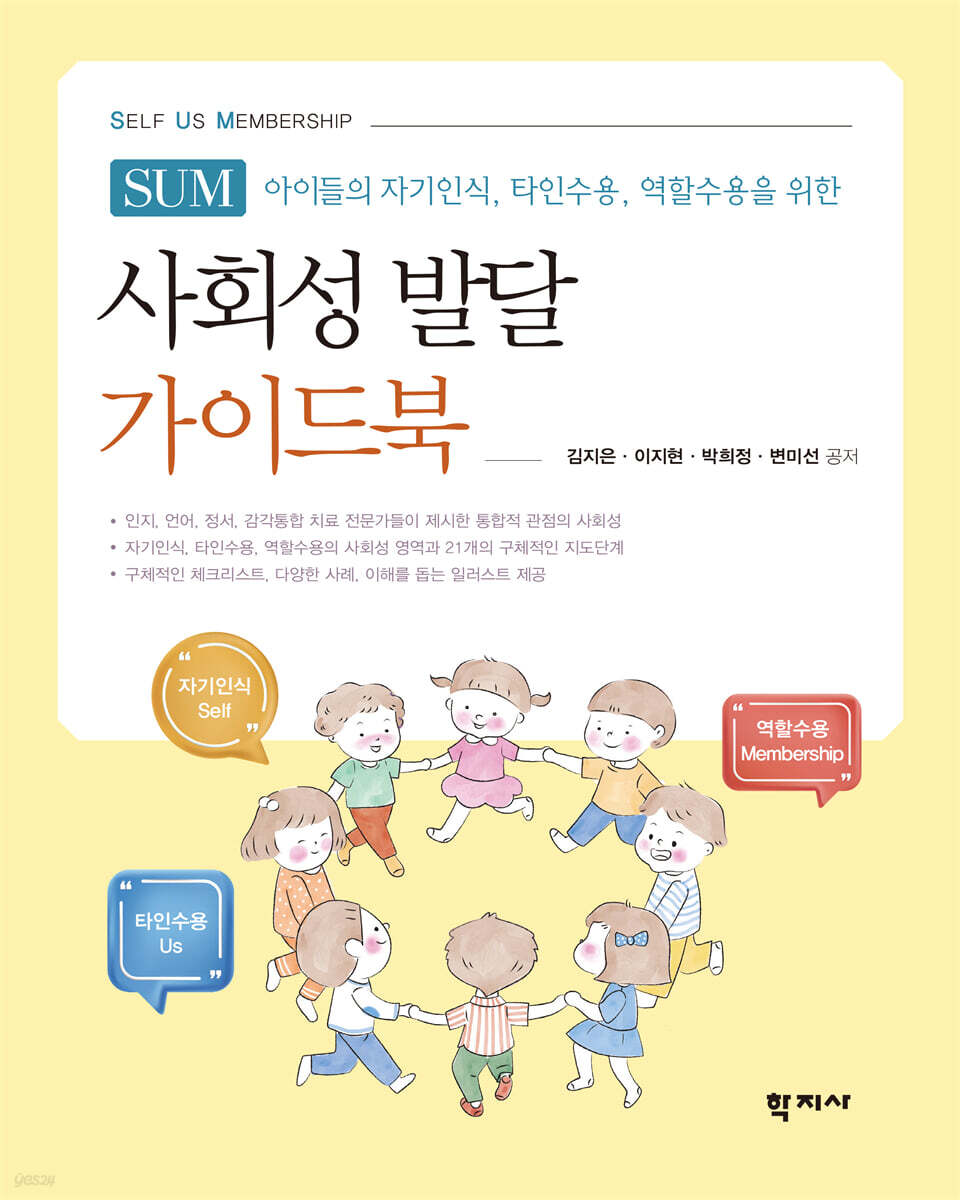
In 『Social Development Guidebook SUM』, experts from various treatment fields such as sensory integration, play therapy, speech therapy, cognitive therapy, and learning therapy gathered together to create social goals that are integrated across treatment areas. They systematically organized and presented integrated social therapy support necessary for the holistic development of children, including the therapist's attitude, goals, preparation, guidance areas, methods, and inspection.
It also contains stories about the therapist's role in the social domain and the guidance process through specific cases.
It also contains stories about the therapist's role in the social domain and the guidance process through specific cases.
index
preface
How to Use the SUM Guidebook
SUM table
SUM Stages of Social Development
Sociality area on the vertical axis of the SUM table
Horizontal axis map step of SUM table
SUM therapist attitude
SUM Step-by-Step Goals
Part 1: Self-Awareness
SUM Stage 1: Attachment-Exploration
SUM Stage 2: Attachment-Experience
SUM Level 3: Autonomy-Experience
SUM Stage 4: Autonomy-Imitation
SUM Step 5: Autonomy-Intentionality Emergence
SUM Step 6: Self-Concept-Experience
SUM Stage 7: Self-Concept - Imitation
SUM Step 8: Self-Concept - Intentional Development
SUM Step 9: Self-Emotions-Experiences
SUM 10 Steps: Self-Emotion-Imitation
SUM Step 11: Self-Emotion-Intentional Expression
Part 2 Acceptance of Others
SUM Step 12: Demonstrating Initiative and Intentionality
SUM Level 13: Initiative-Communication
SUM Step 14: Self-Regulation - Intentionality
SUM Step 15: Self-Regulation-Communication
SUM Level 16: Social Emotions - Communication
SUM Level 17: Social Emotions - Empathy
Part 3: Role Acceptance
SUM Step 18: Collaboration, Communication, and Empathy
SUM Step 19: Cooperation - Situation Resolution
SUM Level 20: Social Attitudes - Communication, Empathy
SUM Step 21: Social Self-Management - Situation Resolution
Appendix SUM Step-by-Step Treatment Area Goals
How to Use the SUM Guidebook
SUM table
SUM Stages of Social Development
Sociality area on the vertical axis of the SUM table
Horizontal axis map step of SUM table
SUM therapist attitude
SUM Step-by-Step Goals
Part 1: Self-Awareness
SUM Stage 1: Attachment-Exploration
SUM Stage 2: Attachment-Experience
SUM Level 3: Autonomy-Experience
SUM Stage 4: Autonomy-Imitation
SUM Step 5: Autonomy-Intentionality Emergence
SUM Step 6: Self-Concept-Experience
SUM Stage 7: Self-Concept - Imitation
SUM Step 8: Self-Concept - Intentional Development
SUM Step 9: Self-Emotions-Experiences
SUM 10 Steps: Self-Emotion-Imitation
SUM Step 11: Self-Emotion-Intentional Expression
Part 2 Acceptance of Others
SUM Step 12: Demonstrating Initiative and Intentionality
SUM Level 13: Initiative-Communication
SUM Step 14: Self-Regulation - Intentionality
SUM Step 15: Self-Regulation-Communication
SUM Level 16: Social Emotions - Communication
SUM Level 17: Social Emotions - Empathy
Part 3: Role Acceptance
SUM Step 18: Collaboration, Communication, and Empathy
SUM Step 19: Cooperation - Situation Resolution
SUM Level 20: Social Attitudes - Communication, Empathy
SUM Step 21: Social Self-Management - Situation Resolution
Appendix SUM Step-by-Step Treatment Area Goals
Publisher's Review
In SUM, the social domain is divided into self-awareness, acceptance of others, and role acceptance, and the subdomains corresponding to each domain are attachment, autonomy, self-concept, self-emotion, initiative, self-regulation, social emotion, cooperation, social attitude, and social self-management.
These social areas were organized in consideration of Erik Erikson's (1902-1994) psychosocial development stages and the 2019 revised 'Children-Play-Centered Nuri Education Curriculum', which 'respects the health and happiness of children and the value of learning through play to the greatest extent possible and pursues a child-led play-centered approach.'
The guidance stages for each social area, such as exploration, experience, imitation, expression of intention, communication, empathy, and situation resolution, are based on the revised Nuri Curriculum, which focuses on ‘activities in which young children freely participate and lead according to their own interests and concerns,’ and Vygotsky’s zone of proximal development. The support categories are set in stages so that environmental/instructional support can be provided according to the children’s developmental process.
SUM, a program led by experts in sensory integration, play therapy, speech therapy, and cognitive therapy, offers a long-term, integrative perspective on social development. It combines the social dimensions of children's development with appropriate instructional methods. At SUM, children learn about their preferences, bodies, abilities, and emotions through a process of self-awareness, allowing them to feel and express diverse thoughts and emotions, building self-understanding.
Based on this self-understanding, children communicate and empathize with their peers, and go through the process of accepting others by controlling their emotions and behavior according to the situation.
Furthermore, children can learn and perform various roles given to them in relationships with their peers and grow as members of a group.
In this book, experts from various therapeutic fields, including sensory integration, play therapy, speech therapy, cognitive therapy, and learning therapy, have come together to create integrated social goals across therapeutic areas. They have systematically organized and presented integrated social therapy support necessary for the holistic development of children, including the therapist's attitude, goals, preparations, guidance areas, methods, and inspections.
It also contains stories about the therapist's role in the social domain and the guidance process through specific cases.
These social areas were organized in consideration of Erik Erikson's (1902-1994) psychosocial development stages and the 2019 revised 'Children-Play-Centered Nuri Education Curriculum', which 'respects the health and happiness of children and the value of learning through play to the greatest extent possible and pursues a child-led play-centered approach.'
The guidance stages for each social area, such as exploration, experience, imitation, expression of intention, communication, empathy, and situation resolution, are based on the revised Nuri Curriculum, which focuses on ‘activities in which young children freely participate and lead according to their own interests and concerns,’ and Vygotsky’s zone of proximal development. The support categories are set in stages so that environmental/instructional support can be provided according to the children’s developmental process.
SUM, a program led by experts in sensory integration, play therapy, speech therapy, and cognitive therapy, offers a long-term, integrative perspective on social development. It combines the social dimensions of children's development with appropriate instructional methods. At SUM, children learn about their preferences, bodies, abilities, and emotions through a process of self-awareness, allowing them to feel and express diverse thoughts and emotions, building self-understanding.
Based on this self-understanding, children communicate and empathize with their peers, and go through the process of accepting others by controlling their emotions and behavior according to the situation.
Furthermore, children can learn and perform various roles given to them in relationships with their peers and grow as members of a group.
In this book, experts from various therapeutic fields, including sensory integration, play therapy, speech therapy, cognitive therapy, and learning therapy, have come together to create integrated social goals across therapeutic areas. They have systematically organized and presented integrated social therapy support necessary for the holistic development of children, including the therapist's attitude, goals, preparations, guidance areas, methods, and inspections.
It also contains stories about the therapist's role in the social domain and the guidance process through specific cases.
GOODS SPECIFICS
- Date of issue: August 30, 2024
- Format: Paperback book binding method guide
- Page count, weight, size: 296 pages | 188*235*14mm
- ISBN13: 9788999731556
You may also like
카테고리
korean


korean

![GQ KOREA Mark (Monthly): December [2025]](http://librairie.coreenne.fr/cdn/shop/files/8ef265dbbfbf186523ed75ba7319009d.jpg?v=1765340328&width=3840)


