

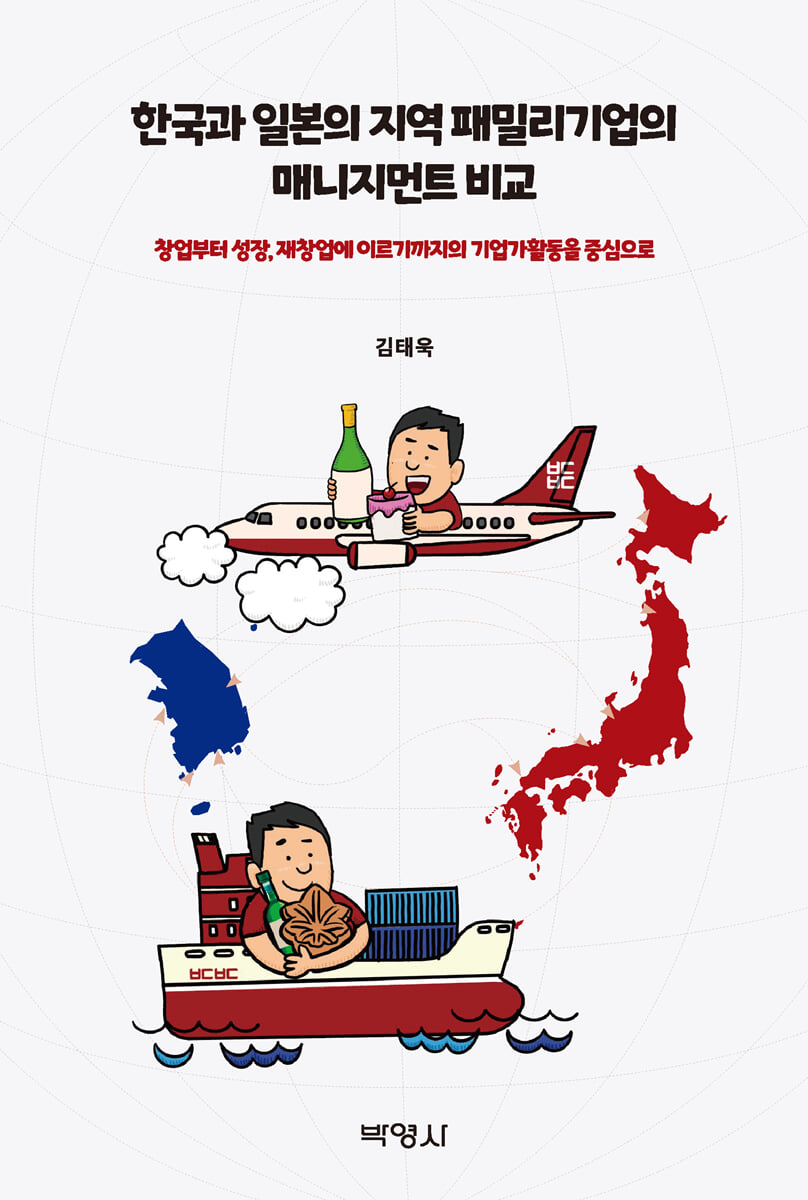
Comparing the Management of Regional Family Businesses in Korea and Japan
 |
Description
index
CHAPTER 01 - Review of Previous Research
CHAPTER 02 - About Research Analysis
CHAPTER 03 - Corporate Succession in Japan and Korea
CHAPTER 04 - Case Analysis of Japan
CHAPTER 05 - Case Analysis of Korea
CHAPTER 06 - Comparative Case Analysis and Summary
CHAPTER 02 - About Research Analysis
CHAPTER 03 - Corporate Succession in Japan and Korea
CHAPTER 04 - Case Analysis of Japan
CHAPTER 05 - Case Analysis of Korea
CHAPTER 06 - Comparative Case Analysis and Summary
Publisher's Review
Recently, Korea-Japan relations are facing a major turning point.
Amidst the South Korean government's proactive stance toward improving Korea-Japan relations, exchanges and cooperation between the government, businesses, and the private sector are becoming more active.
Korea inherited assets from Japanese companies before and after the war, learning not only their technology but also their management know-how. However, in recent decades, its economic growth and corporate competitiveness have been remarkable, and in some fields, it has developed to a level that surpasses that of Japan.
Although it started out as an imitation, once individuals and companies are able to develop their own original ideas and technologies, they tend to lose their original intentions.
Also, as the saying goes, “A small needle is as big as a stick,” it is not desirable to be overconfident or to distort facts and ignore reality.
Accepting reality seriously and humbly and thinking about what to do about it and how to do it becomes an opportunity for development for both individuals and companies.
Looking at Japan, which supports society broadly from basic science to applied fields, and Korea, which is world-class in some fields but faces a completely different situation with just a slight change in field, I have long wondered where and when this difference arose.
The number of Nobel Prize winners doesn't tell the whole story, nor does the number of world-renowned prizewinners in mathematics and architecture tell the whole story of a country's quality.
However, I think it can be an important criterion for judgment.
Almost every year, Japanese scholars win awards or are nominated for prizes in fields such as medicine, chemistry, and physics.
Even though there are some unavoidable aspects to the history of modernization that lagged behind Japan from the beginning, the gap has not narrowed even after 80 years since the start of modern education.
There are various theories as to why this is the case, but I believe it stems from problems with the systems and consciousness of society as a whole, including home education, education during childhood, and later advancement to university, as well as companies and the nation.
In Japan and Korea, huge investments are made starting from kindergarten to prepare children for admission to prestigious universities.
There is a constant effort to gain an advantage over others through advanced learning in languages such as English, Korean, and math.
First of all, the crucial difference between Japan and Korea is the wage gap between high school graduates and college graduates and the difference in social perception.
In Korea, the wage and treatment differences between large corporations and small and medium-sized enterprises, as well as the income and social perception of college and high school graduates, are quite different from those of Japan.
In terms of college advancement rate, Korea is much higher than Japan.
The reason, of course, stems from differences in perceptions of college graduates in employment and society.
There are many different types of people in the world, so while there are those who are good at studying, there are also those who excel at crafts, cooking, sports, art, and many other fields.
There's an old joke that the best students in America start businesses and become billionaires without graduating from college, while the next best students get jobs at big companies.
And it was said that those who become bureaucrats are the next group, but in Japan, there is a theory that it is the opposite.
That is, it is only recently that entrepreneurs have begun to be evaluated in Japanese and Korean society.
However, the social perception of scholars, farmers, artisans, and merchants remains deeply ingrained, and the situation in Korea, which has historically rejected commerce and industry more than Japan, is more serious than in Japan.
Because modernization occurred without a culture that valued technology and commerce developing, there was a general admiration for bureaucrats throughout society.
As a result, it is no exaggeration to say that the civil service-centered ruling structure has continued since the Joseon Dynasty.
Just as sundials and water clocks were being made in Korea at a time when Western mechanical clocks were being made in Japan, the gap that exists today is based on when the country opened its doors to science and Western culture, and how the people and the national system that accepted it changed.
Fundamentally, a country cannot develop without a culture that recognizes differences and respects individuality and others rather than uniformity.
The same can be said about the founding or succession of a business.
I have been conducting corporate management analysis in Japan and Korea for many years.
What are the major differences between the business environments of Japan and Korea?
First of all, compared to Japan, the history of Korean companies is short.
It is not uncommon for conglomerates to inherit facilities and employees left behind by Japanese who were called colonial-era employees or enemy property.
In addition, since there are many cases where various small and medium-sized enterprises are involved in the conglomerate through subcontracting, the number of small and medium-sized enterprises that have maintained their own technology for a long time is overwhelmingly small compared to Japan.
Additionally, the history and tradition of local companies responsible for each region's traditional industries are shorter than in Japan, so there are many small businesses.
Unlike Japan, where each region had a sufficient market for local businesses to survive, in Korea, companies must expand into the metropolitan area or other large cities to grow to a certain size.
Even large corporations cannot expect significant growth if they fail to conquer the global market.
The above structure has become a direct cause of the differences in management between local companies, small and medium-sized enterprises, and large corporations in Japan and Korea.
As mentioned above, we can see differences in the direct management environment surrounding the company, along with the social and cultural environment.
Furthermore, differences in national systems for inheriting and continuously operating businesses make business succession difficult in Korea.
When a conglomerate CEO's descendants inherit stocks and other assets, they have to pay astronomical inheritance taxes.
Ultimately, companies that cannot pay in cash all at once are paying installments and inheritance tax on the sale of stocks.
In the meantime, there are many cases where vulnerabilities in corporate defenses are exposed and corporate management rights are transferred to others.
I am not speaking for the conglomerates or corporate executives.
However, if the management cannot maintain motivation in carrying out corporate management, the business will lose its appeal.
In this way, the systems and national policies surrounding a company have a great influence on corporate management.
As the economic and security landscape surrounding East Asia rapidly changes, the governments and businesses of Japan and South Korea need to continuously grow and develop by learning from each other through collaborative efforts.
For reference, in 2022, the year this book was published, a new government was formed in Korea, and Japan will not have any major elections for the time being after the House of Councilors election in July.
I hope that we can make good use of this opportunity, as it will provide a good opportunity for stable interaction between us.
This book is a translation of the first and second volumes of "A Comparison of Management of Regional Family Businesses in Japan and Korea," published in Japan in 2021 and 2022.
In the first volume, we analyzed the founding, growth, and second founding of Japanese regional companies. In the second volume, we selected representative regional companies in Korea and analyzed the relationship between entrepreneurship and innovation in regional companies.
Specifically, in the upper section, we conducted case analyses of Yamadaya and Asahi Shuzo Co., Ltd., and in the lower section, we conducted case analyses of Muhak Co., Ltd. and SPC Group.
In Japan, we tried to identify the growth and development stories of local confectionery and sake companies, and in Korea, we tried to identify the similarities and differences in the growth and development processes of local companies in both countries by drawing the growth stories of local shochu companies, confectionery, and bakery companies.
In addition, this book is a significantly revised version of the book 『Renovation Strategy of Local Enterprises - Evolution of Business Models of Long-established Family Enterprises』 (2015, Park Young-sa (Korea)).
Although the theoretical background is the same, it is a completely separate research paper that changes the subject of analysis and conducts additional research.
In particular, it is noteworthy that the analysis is divided into upper and lower tiers and the scope is expanded to include Korean companies, attempting research from a completely different perspective.
This study was made possible by the support of numerous people and published in this form.
I would like to thank you for writing this here.
Professor Kazuyori Kanai (President of Aomori University) has been my mentor and has always provided me with warm guidance since my days as a graduate student at Hokkaido University.
I am always impressed by the professor's extensive knowledge of small and medium-sized enterprises and regional enterprises, and his insightful perspective that transcends the limitations of existing research.
I would like to express my sincere gratitude to the teacher who always gives me constructive advice.
I am greatly indebted to Professor Satoshi Iwata of the Graduate School of Economics at Hokkaido University for his guidance during my graduate school days and for ongoing joint research.
Additionally, Professor Junichi Uchida of Otaru University of Commerce provided me with much constructive advice in reviewing previous research and building the framework.
Likewise, Professor Tomoyuki Nishimura of Otaru University of Commerce occasionally gave me advice and discussions about research concerns and management strategies via email or phone.
Thank you to the teachers.
Professor Keiko Yokoyama of Kansai University was greatly indebted to me for helping me with projects for undergraduate seminars, which gave me the opportunity to think about what it means for local businesses to create social value.
I would like to express my gratitude.
I have been indebted to Professor Jinichiro Yamada of the Graduate School of Management at Kyoto University, Professor Shuichi Ishida of Tohoku University, Professor Futoshi Akiba of Ryukoku University, and Professor Haruomi Shindo of Chuo University for their support, both public and private, since my graduate school days, and I am always grateful.
In addition, I would like to express my gratitude to Sangjin Han, a graduate of the doctoral program at the Graduate School of Commerce, Kinki University, and a member of Sungkwang Logistics Co., Ltd., for his consistent support and assistance in the publication of this book from the initial conception stage of this study to the final organization stage.
He helped me for a long time, from my undergraduate days to my post-doctoral studies.
This time, too, it was no easy task to understand the theory and analytical framework of prior research, then accompany business managers to their sites, conduct multiple interviews, and then compile the results into a book.
I would like to express my gratitude to the Korean army for their persistent support to the end.
I would also like to express my deepest gratitude to Director Moon Jun of Neulbom Hospital, who took the time to provide illustrations despite his busy schedule, and to CEO Ahn Sang-jun of Park Young-sa, who readily accepted the publishing contract.
Finally, I wish the success of this study and would like to conclude my remarks by expressing my gratitude to my family for their dedicated support and encouragement throughout my research.
Amidst the South Korean government's proactive stance toward improving Korea-Japan relations, exchanges and cooperation between the government, businesses, and the private sector are becoming more active.
Korea inherited assets from Japanese companies before and after the war, learning not only their technology but also their management know-how. However, in recent decades, its economic growth and corporate competitiveness have been remarkable, and in some fields, it has developed to a level that surpasses that of Japan.
Although it started out as an imitation, once individuals and companies are able to develop their own original ideas and technologies, they tend to lose their original intentions.
Also, as the saying goes, “A small needle is as big as a stick,” it is not desirable to be overconfident or to distort facts and ignore reality.
Accepting reality seriously and humbly and thinking about what to do about it and how to do it becomes an opportunity for development for both individuals and companies.
Looking at Japan, which supports society broadly from basic science to applied fields, and Korea, which is world-class in some fields but faces a completely different situation with just a slight change in field, I have long wondered where and when this difference arose.
The number of Nobel Prize winners doesn't tell the whole story, nor does the number of world-renowned prizewinners in mathematics and architecture tell the whole story of a country's quality.
However, I think it can be an important criterion for judgment.
Almost every year, Japanese scholars win awards or are nominated for prizes in fields such as medicine, chemistry, and physics.
Even though there are some unavoidable aspects to the history of modernization that lagged behind Japan from the beginning, the gap has not narrowed even after 80 years since the start of modern education.
There are various theories as to why this is the case, but I believe it stems from problems with the systems and consciousness of society as a whole, including home education, education during childhood, and later advancement to university, as well as companies and the nation.
In Japan and Korea, huge investments are made starting from kindergarten to prepare children for admission to prestigious universities.
There is a constant effort to gain an advantage over others through advanced learning in languages such as English, Korean, and math.
First of all, the crucial difference between Japan and Korea is the wage gap between high school graduates and college graduates and the difference in social perception.
In Korea, the wage and treatment differences between large corporations and small and medium-sized enterprises, as well as the income and social perception of college and high school graduates, are quite different from those of Japan.
In terms of college advancement rate, Korea is much higher than Japan.
The reason, of course, stems from differences in perceptions of college graduates in employment and society.
There are many different types of people in the world, so while there are those who are good at studying, there are also those who excel at crafts, cooking, sports, art, and many other fields.
There's an old joke that the best students in America start businesses and become billionaires without graduating from college, while the next best students get jobs at big companies.
And it was said that those who become bureaucrats are the next group, but in Japan, there is a theory that it is the opposite.
That is, it is only recently that entrepreneurs have begun to be evaluated in Japanese and Korean society.
However, the social perception of scholars, farmers, artisans, and merchants remains deeply ingrained, and the situation in Korea, which has historically rejected commerce and industry more than Japan, is more serious than in Japan.
Because modernization occurred without a culture that valued technology and commerce developing, there was a general admiration for bureaucrats throughout society.
As a result, it is no exaggeration to say that the civil service-centered ruling structure has continued since the Joseon Dynasty.
Just as sundials and water clocks were being made in Korea at a time when Western mechanical clocks were being made in Japan, the gap that exists today is based on when the country opened its doors to science and Western culture, and how the people and the national system that accepted it changed.
Fundamentally, a country cannot develop without a culture that recognizes differences and respects individuality and others rather than uniformity.
The same can be said about the founding or succession of a business.
I have been conducting corporate management analysis in Japan and Korea for many years.
What are the major differences between the business environments of Japan and Korea?
First of all, compared to Japan, the history of Korean companies is short.
It is not uncommon for conglomerates to inherit facilities and employees left behind by Japanese who were called colonial-era employees or enemy property.
In addition, since there are many cases where various small and medium-sized enterprises are involved in the conglomerate through subcontracting, the number of small and medium-sized enterprises that have maintained their own technology for a long time is overwhelmingly small compared to Japan.
Additionally, the history and tradition of local companies responsible for each region's traditional industries are shorter than in Japan, so there are many small businesses.
Unlike Japan, where each region had a sufficient market for local businesses to survive, in Korea, companies must expand into the metropolitan area or other large cities to grow to a certain size.
Even large corporations cannot expect significant growth if they fail to conquer the global market.
The above structure has become a direct cause of the differences in management between local companies, small and medium-sized enterprises, and large corporations in Japan and Korea.
As mentioned above, we can see differences in the direct management environment surrounding the company, along with the social and cultural environment.
Furthermore, differences in national systems for inheriting and continuously operating businesses make business succession difficult in Korea.
When a conglomerate CEO's descendants inherit stocks and other assets, they have to pay astronomical inheritance taxes.
Ultimately, companies that cannot pay in cash all at once are paying installments and inheritance tax on the sale of stocks.
In the meantime, there are many cases where vulnerabilities in corporate defenses are exposed and corporate management rights are transferred to others.
I am not speaking for the conglomerates or corporate executives.
However, if the management cannot maintain motivation in carrying out corporate management, the business will lose its appeal.
In this way, the systems and national policies surrounding a company have a great influence on corporate management.
As the economic and security landscape surrounding East Asia rapidly changes, the governments and businesses of Japan and South Korea need to continuously grow and develop by learning from each other through collaborative efforts.
For reference, in 2022, the year this book was published, a new government was formed in Korea, and Japan will not have any major elections for the time being after the House of Councilors election in July.
I hope that we can make good use of this opportunity, as it will provide a good opportunity for stable interaction between us.
This book is a translation of the first and second volumes of "A Comparison of Management of Regional Family Businesses in Japan and Korea," published in Japan in 2021 and 2022.
In the first volume, we analyzed the founding, growth, and second founding of Japanese regional companies. In the second volume, we selected representative regional companies in Korea and analyzed the relationship between entrepreneurship and innovation in regional companies.
Specifically, in the upper section, we conducted case analyses of Yamadaya and Asahi Shuzo Co., Ltd., and in the lower section, we conducted case analyses of Muhak Co., Ltd. and SPC Group.
In Japan, we tried to identify the growth and development stories of local confectionery and sake companies, and in Korea, we tried to identify the similarities and differences in the growth and development processes of local companies in both countries by drawing the growth stories of local shochu companies, confectionery, and bakery companies.
In addition, this book is a significantly revised version of the book 『Renovation Strategy of Local Enterprises - Evolution of Business Models of Long-established Family Enterprises』 (2015, Park Young-sa (Korea)).
Although the theoretical background is the same, it is a completely separate research paper that changes the subject of analysis and conducts additional research.
In particular, it is noteworthy that the analysis is divided into upper and lower tiers and the scope is expanded to include Korean companies, attempting research from a completely different perspective.
This study was made possible by the support of numerous people and published in this form.
I would like to thank you for writing this here.
Professor Kazuyori Kanai (President of Aomori University) has been my mentor and has always provided me with warm guidance since my days as a graduate student at Hokkaido University.
I am always impressed by the professor's extensive knowledge of small and medium-sized enterprises and regional enterprises, and his insightful perspective that transcends the limitations of existing research.
I would like to express my sincere gratitude to the teacher who always gives me constructive advice.
I am greatly indebted to Professor Satoshi Iwata of the Graduate School of Economics at Hokkaido University for his guidance during my graduate school days and for ongoing joint research.
Additionally, Professor Junichi Uchida of Otaru University of Commerce provided me with much constructive advice in reviewing previous research and building the framework.
Likewise, Professor Tomoyuki Nishimura of Otaru University of Commerce occasionally gave me advice and discussions about research concerns and management strategies via email or phone.
Thank you to the teachers.
Professor Keiko Yokoyama of Kansai University was greatly indebted to me for helping me with projects for undergraduate seminars, which gave me the opportunity to think about what it means for local businesses to create social value.
I would like to express my gratitude.
I have been indebted to Professor Jinichiro Yamada of the Graduate School of Management at Kyoto University, Professor Shuichi Ishida of Tohoku University, Professor Futoshi Akiba of Ryukoku University, and Professor Haruomi Shindo of Chuo University for their support, both public and private, since my graduate school days, and I am always grateful.
In addition, I would like to express my gratitude to Sangjin Han, a graduate of the doctoral program at the Graduate School of Commerce, Kinki University, and a member of Sungkwang Logistics Co., Ltd., for his consistent support and assistance in the publication of this book from the initial conception stage of this study to the final organization stage.
He helped me for a long time, from my undergraduate days to my post-doctoral studies.
This time, too, it was no easy task to understand the theory and analytical framework of prior research, then accompany business managers to their sites, conduct multiple interviews, and then compile the results into a book.
I would like to express my gratitude to the Korean army for their persistent support to the end.
I would also like to express my deepest gratitude to Director Moon Jun of Neulbom Hospital, who took the time to provide illustrations despite his busy schedule, and to CEO Ahn Sang-jun of Park Young-sa, who readily accepted the publishing contract.
Finally, I wish the success of this study and would like to conclude my remarks by expressing my gratitude to my family for their dedicated support and encouragement throughout my research.
GOODS SPECIFICS
- Date of issue: July 25, 2023
- Page count, weight, size: 352 pages | Checking size
- ISBN13: 9791130317502
- ISBN10: 1130317501
You may also like
카테고리
korean


korean

![GQ KOREA Mark (Monthly): December [2025]](http://librairie.coreenne.fr/cdn/shop/files/8ef265dbbfbf186523ed75ba7319009d.jpg?v=1765340328&width=3840)


