

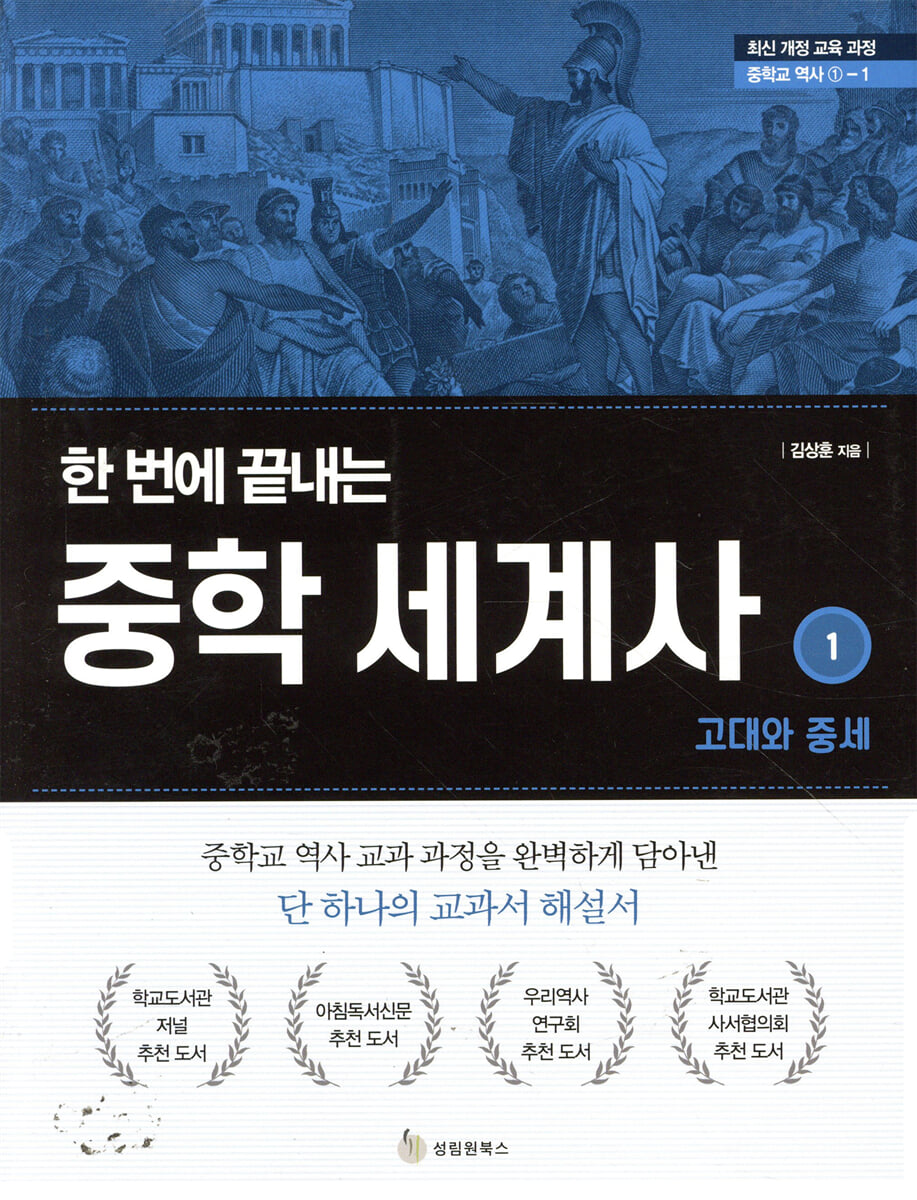
Middle School World History 1: Ancient and Medieval Times
 |
Description
Book Introduction
《Middle School World History in One Go》explains the curriculum and content of 'Middle School History ①' in detail.
Above all, it is of great help in grasping the context of history because it kindly explains the causal relationships of history at each point in time to see how what happened now was influenced by certain events.
History is a subject that requires memorization, but the depth of your achievements depends on your understanding of the context and terminology of history.
This is the point that this book considers most important.
We have lowered the level of understanding so that even readers with limited historical knowledge and weak literacy and reading skills can fully understand it, and we have also paid careful attention to the definitions of terms and words.
The storytelling skills of a bestselling historical author are added to make it even more entertaining.
At the end of each unit, a corner is provided to summarize the previous content, thereby enhancing the learning effect for young readers.
As the author says, reading the relevant section 2-3 times during exam period will be of great help.
Above all, it is of great help in grasping the context of history because it kindly explains the causal relationships of history at each point in time to see how what happened now was influenced by certain events.
History is a subject that requires memorization, but the depth of your achievements depends on your understanding of the context and terminology of history.
This is the point that this book considers most important.
We have lowered the level of understanding so that even readers with limited historical knowledge and weak literacy and reading skills can fully understand it, and we have also paid careful attention to the definitions of terms and words.
The storytelling skills of a bestselling historical author are added to make it even more entertaining.
At the end of each unit, a corner is provided to summarize the previous content, thereby enhancing the learning effect for young readers.
As the author says, reading the relevant section 2-3 times during exam period will be of great help.
- You can preview some of the book's contents.
Preview
index
We'll help you solve your problems with history textbooks by starting this book.
I recommend this book, as it suggests a new direction for studying history.
Ⅰ The Rise of Civilization and the Formation of the Ancient World
: The first empires emerge around the world.
1. The meaning of history and the purpose of studying history
: A constant dialogue with the past
Did the Jujiryukrim and the Trojan Horse actually happen? - History as a fact and history as a record Why historical materials are important in the study of history - How to study history The best discipline to learn life wisdom - The purpose of studying history
Unit Summary Notes
1.
Two branches of history 2.
Type 3 of historical materials used to study history.
The purpose of studying history
2 Prehistoric Cultures and Ancient Civilizations of the World
: Humanity Opens the Door to History
Evolution begins with hands becoming free - The emergence and evolution of mankind The first tool was a broken stone - Characteristics of the Paleolithic Age The world changed by agriculture - The significance and characteristics of the Neolithic Revolution Civilization begins around large rivers - The birth and commonalities of the world's four major civilizations There was the first code of law before the Code of Hammurabi - The development of Mesopotamian civilization Why were pyramids and mummies built - The development of Egyptian civilization Why did the Indian caste system come into being? - The development and decline of Indian civilization How is the Chinese feudal system different from the European feudal system? - The birth and development of Chinese civilization
Unit Summary Notes
1.
The process of human evolution 2.
Stone Age Tools 3.
Changes brought about by the agricultural revolution 4.
The process of the birth of civilization 5.
6 Commonalities of the Four Great Civilizations
Characteristics of the four major civilizations
3 Characteristics of ancient empires and the growth of the surrounding world
: Entering the Age of Empire
Why did Persia pursue a policy of tolerance? - Achaemenid Dynasty The Persian unification of Western Asia The biggest difference between Parthia and the Sassanid Dynasty - Sassanid Dynasty The rise and fall of Persia The origin of modern religion comes from Persia - Cultural development of Persia The background of the birth of the Chinese character idiom "Wasindamjang" - The Spring and Autumn Period and the Warring States Period and the Hundred Schools of Thought Why did Qin Shi Huang burn books? - The Qin unification of China The origin of the situation of being surrounded on all sides - The establishment and development of the Han Dynasty Where did the word "Chinese character" come from? - Characteristics of Han Dynasty culture What is the difference between the Acropolis and the Agora? - The development of Athens and Sparta Who won the confrontation between Athens and Sparta? - The Greco-Persian Wars and the Greek Civil War What exactly is midwifery? - Characteristics of Greek culture Why did Alexander marry a Persian woman? - The birth of the Hellenistic world Why did the Gracchus brothers advocate land reform? - The establishment and development of the Roman Republic The origin of the word "emperor" comes from Rome - The birth and fall of the Roman Empire Why did Nero persecute Christianity? - The history of Roman culture Characteristics and Christian Recognition
Unit Summary Notes
1.
Characteristics and History of the Ancient Persian Empire 2.
Genealogy of the Ancient Chinese States 3.
Characteristics and representative thoughts of the Hundred Schools of Thought 4.
A summary of ancient Greek history
Ⅱ The Spread of World Religions and the Formation of Regional Cultures
: Religion changes the world
4 Formation and spread of Buddhist and Hindu cultures
: Why did India become a country of religion?
Why did Buddha give up becoming a king? - The birth of Buddhism. Why did King Ashoka give up war? - The unification and development of India under the Mauryan Dynasty. Why do Indian Buddhist statues resemble Westerners? - The Kushan Dynasty and Gandhara art. There are 1.2 billion gods in India. - The establishment of the Gupta Dynasty and the development of Hinduism. The origin of Arabic numerals is India. - The development of classical Indian culture and its spread to Southeast Asia.
Unit Summary Notes
1.
The process of creating a dynasty in India 2.
3. Dynasty formed in northern India.
Gandhara Art and Hinduism
5. Formation and Spread of East Asian Culture
: Growing up in East Asia, embracing Chinese culture
Why did the story of Romance of the Three Kingdoms unfold with Liu Bei at the center? - The confrontation between Wei, Shu, and Wu and the development of the Wei, Jin, and Northern and Southern Dynasties The face of the Northern Buddhist statue was modeled after the face of the emperor - Culture of the Wei, Jin, and Northern and Southern Dynasties Why did the Sui build the Grand Canal? - The unification of Sui and the reunification of Tang Why did Emperor Taizong of Tang swallow a locust? - The development and fall of Tang Why did the Tang Sancai resemble Western merchants and camels? - The development of Tang aristocratic culture and the expansion of trade The 'origin' of Japan's Asuka culture came from the Korean Peninsula - The establishment and development of ancient Japanese states What do Korea, China, and Japan have in common? - The formation of the East Asian cultural sphere
Unit Summary Notes
1.
2. States of China after the Han Dynasty.
A summary of ancient Japanese history
6 Formation and Spread of Islamic Culture
: A new religion shakes West Asia
Why did Mecca suddenly come to mind? - The establishment of Islam and the construction of an Islamic community. Why Islam split into Sunni and Shia. - The era of the orthodox caliphs and the emergence of Shia. The fall of the Umayyad dynasty after 100 years. - The rise and fall of the Umayyad dynasty and the doctrines of Islam. Why did Islamic countries not destroy the Abbasid dynasty? - The Abbasid dynasty and the division of Islam. Why the Arabian Nights are called 'A Thousand and One Nights'. - The expansion of trade between the East and the West and the formation of the Islamic cultural sphere.
Unit Summary Notes
1.
History of the Early Islamic World 2.
The meaning of the Islamic world
7 Formation and Spread of Christian Culture
: A continent dominated by feudalism and Christianity
Why did the Roman Church support the Frankish Kingdom? - The migration of the Germanic tribes and the founding of the Frankish Kingdom. Why did the Frankish Kingdom split? - The division of the Frankish Kingdom and the revival of the Roman Empire. Why were the peasants of medieval Europe called serfs? - Characteristics of the feudal system in medieval Europe. Why did Christianity split? - The rise and fall of the Byzantine Empire and the establishment of the Eastern European cultural sphere. Why did the emperor ask the Pope for forgiveness? - The development of medieval Christian culture. Why did the Crusades attack the Byzantine Empire, which was on the same side? - The Crusades and the decline of the manorial economy. Why did the knights fall in the Hundred Years' War? - The emergence of a centralized state. Why did Europe try to revive Greek and Roman culture? - The beginning and spread of the Renaissance. Why did Henry VIII abandon Roman Catholicism? - The Reformation fever.
Unit Summary Notes
1.
Roman Empire and Frankish Kingdom 2.
The impact of the Crusades on history 3.
The Impact of the Hundred Years' War and the Wars of the Roses 4.
The Origin and Cultural Characteristics of the Renaissance 5.
Background and influence of the Reformation
Ⅲ Exchange and Change in the Regional World
: The world, into the whirlpool of change!
8 Cultural Exchange with the Mongol Empire
: Mongolia, Conquering the World
What would happen if only literati were favored? - The rise and fall of the Song Dynasty and the growth of northern peoples What is the oldest banknote in the world? - The development of the Song Dynasty's economy and culture Why Genghis Khan did not conquer China? - The construction of the Mongol world empire and the establishment of the Yuan Dynasty Why did the Yuan Dynasty fall after just 100 years? - The expansion of East-West exchanges and the open culture of the Yuan Dynasty
Unit Summary Notes
1.
Chinese dynasties after the Tang 2.
Characteristics of Song Dynasty culture
9 Changes in the East Asian Regional Order
: A nomadic people who took over China again
The reason why the Ming Dynasty stopped overseas exploration - The Southern Sea Expedition and the rise and fall of the Ming Dynasty The reason why officials' salaries were paid in silver - The Ming Dynasty's foreign exchanges and economy and culture When was the territory of today's China established? - The founding and development of the Qing Dynasty The reason why the Qing Dynasty introduced the public service system - The Qing Dynasty's foreign exchanges and economy and culture The reason why Japan caused the Imjin War - The establishment of the samurai regime in Japan The reason why Japan opened its ports only to the Netherlands - The establishment and development of the Edo shogunate
Unit Summary Notes
1.
Ming's expedition to the South Sea and the ban on maritime affairs 2.
The fall of the Ming Dynasty and the Qing's rule over China 3.
Changes in China's ruling class since the Song Dynasty 4.
Summary of Japanese history since the Heian period
10 Changes in the regional order in West Asia and North Africa
: The rise of a new power in the Islamic world
The name of the country of Turkey is derived from the name of the people - Changes in the Islamic world Why did Ottoman soldiers cross the mountains with their fleets on their backs? - The establishment and development of the Ottoman Empire Why was coffee popular in the Ottoman Empire? - The economic and cultural development of the Ottoman Empire Why did the Marathas fight with the Mughal Empire? - The establishment and development of the Mughal Empire The Taj Mahal is a symbol of religious fusion - The cultural and economic development of the Mughal Empire
Unit Summary Notes
1.
Who are the Turks 2.
The history of the founding of the Turkic people 3.
Islamic countries in India
11. The development of new sea routes and the transformation of the European regional order
: Europe begins to lead the world
Why did Portuguese ships go around Africa to India? - The beginning of the era of new maritime routes Why did the price revolution and the commercial revolution occur? - World history changed by the opening of new maritime routes Why were bureaucracy and standing armies introduced? - The establishment of absolute monarchies Why were the citizen classes weak in Germany and Russia? - Absolute monarchies in Western and Eastern Europe The discovery of universal gravitation led to the scientific revolution - Science and culture in 17th and 18th century Europe
Unit Summary Notes
1.
Key figures who led the development of new routes 2.
The world's topography changed by the Age of Exploration and the development of new sea routes 3.
The expanding world, the ever-growing sea
I recommend this book, as it suggests a new direction for studying history.
Ⅰ The Rise of Civilization and the Formation of the Ancient World
: The first empires emerge around the world.
1. The meaning of history and the purpose of studying history
: A constant dialogue with the past
Did the Jujiryukrim and the Trojan Horse actually happen? - History as a fact and history as a record Why historical materials are important in the study of history - How to study history The best discipline to learn life wisdom - The purpose of studying history
Unit Summary Notes
1.
Two branches of history 2.
Type 3 of historical materials used to study history.
The purpose of studying history
2 Prehistoric Cultures and Ancient Civilizations of the World
: Humanity Opens the Door to History
Evolution begins with hands becoming free - The emergence and evolution of mankind The first tool was a broken stone - Characteristics of the Paleolithic Age The world changed by agriculture - The significance and characteristics of the Neolithic Revolution Civilization begins around large rivers - The birth and commonalities of the world's four major civilizations There was the first code of law before the Code of Hammurabi - The development of Mesopotamian civilization Why were pyramids and mummies built - The development of Egyptian civilization Why did the Indian caste system come into being? - The development and decline of Indian civilization How is the Chinese feudal system different from the European feudal system? - The birth and development of Chinese civilization
Unit Summary Notes
1.
The process of human evolution 2.
Stone Age Tools 3.
Changes brought about by the agricultural revolution 4.
The process of the birth of civilization 5.
6 Commonalities of the Four Great Civilizations
Characteristics of the four major civilizations
3 Characteristics of ancient empires and the growth of the surrounding world
: Entering the Age of Empire
Why did Persia pursue a policy of tolerance? - Achaemenid Dynasty The Persian unification of Western Asia The biggest difference between Parthia and the Sassanid Dynasty - Sassanid Dynasty The rise and fall of Persia The origin of modern religion comes from Persia - Cultural development of Persia The background of the birth of the Chinese character idiom "Wasindamjang" - The Spring and Autumn Period and the Warring States Period and the Hundred Schools of Thought Why did Qin Shi Huang burn books? - The Qin unification of China The origin of the situation of being surrounded on all sides - The establishment and development of the Han Dynasty Where did the word "Chinese character" come from? - Characteristics of Han Dynasty culture What is the difference between the Acropolis and the Agora? - The development of Athens and Sparta Who won the confrontation between Athens and Sparta? - The Greco-Persian Wars and the Greek Civil War What exactly is midwifery? - Characteristics of Greek culture Why did Alexander marry a Persian woman? - The birth of the Hellenistic world Why did the Gracchus brothers advocate land reform? - The establishment and development of the Roman Republic The origin of the word "emperor" comes from Rome - The birth and fall of the Roman Empire Why did Nero persecute Christianity? - The history of Roman culture Characteristics and Christian Recognition
Unit Summary Notes
1.
Characteristics and History of the Ancient Persian Empire 2.
Genealogy of the Ancient Chinese States 3.
Characteristics and representative thoughts of the Hundred Schools of Thought 4.
A summary of ancient Greek history
Ⅱ The Spread of World Religions and the Formation of Regional Cultures
: Religion changes the world
4 Formation and spread of Buddhist and Hindu cultures
: Why did India become a country of religion?
Why did Buddha give up becoming a king? - The birth of Buddhism. Why did King Ashoka give up war? - The unification and development of India under the Mauryan Dynasty. Why do Indian Buddhist statues resemble Westerners? - The Kushan Dynasty and Gandhara art. There are 1.2 billion gods in India. - The establishment of the Gupta Dynasty and the development of Hinduism. The origin of Arabic numerals is India. - The development of classical Indian culture and its spread to Southeast Asia.
Unit Summary Notes
1.
The process of creating a dynasty in India 2.
3. Dynasty formed in northern India.
Gandhara Art and Hinduism
5. Formation and Spread of East Asian Culture
: Growing up in East Asia, embracing Chinese culture
Why did the story of Romance of the Three Kingdoms unfold with Liu Bei at the center? - The confrontation between Wei, Shu, and Wu and the development of the Wei, Jin, and Northern and Southern Dynasties The face of the Northern Buddhist statue was modeled after the face of the emperor - Culture of the Wei, Jin, and Northern and Southern Dynasties Why did the Sui build the Grand Canal? - The unification of Sui and the reunification of Tang Why did Emperor Taizong of Tang swallow a locust? - The development and fall of Tang Why did the Tang Sancai resemble Western merchants and camels? - The development of Tang aristocratic culture and the expansion of trade The 'origin' of Japan's Asuka culture came from the Korean Peninsula - The establishment and development of ancient Japanese states What do Korea, China, and Japan have in common? - The formation of the East Asian cultural sphere
Unit Summary Notes
1.
2. States of China after the Han Dynasty.
A summary of ancient Japanese history
6 Formation and Spread of Islamic Culture
: A new religion shakes West Asia
Why did Mecca suddenly come to mind? - The establishment of Islam and the construction of an Islamic community. Why Islam split into Sunni and Shia. - The era of the orthodox caliphs and the emergence of Shia. The fall of the Umayyad dynasty after 100 years. - The rise and fall of the Umayyad dynasty and the doctrines of Islam. Why did Islamic countries not destroy the Abbasid dynasty? - The Abbasid dynasty and the division of Islam. Why the Arabian Nights are called 'A Thousand and One Nights'. - The expansion of trade between the East and the West and the formation of the Islamic cultural sphere.
Unit Summary Notes
1.
History of the Early Islamic World 2.
The meaning of the Islamic world
7 Formation and Spread of Christian Culture
: A continent dominated by feudalism and Christianity
Why did the Roman Church support the Frankish Kingdom? - The migration of the Germanic tribes and the founding of the Frankish Kingdom. Why did the Frankish Kingdom split? - The division of the Frankish Kingdom and the revival of the Roman Empire. Why were the peasants of medieval Europe called serfs? - Characteristics of the feudal system in medieval Europe. Why did Christianity split? - The rise and fall of the Byzantine Empire and the establishment of the Eastern European cultural sphere. Why did the emperor ask the Pope for forgiveness? - The development of medieval Christian culture. Why did the Crusades attack the Byzantine Empire, which was on the same side? - The Crusades and the decline of the manorial economy. Why did the knights fall in the Hundred Years' War? - The emergence of a centralized state. Why did Europe try to revive Greek and Roman culture? - The beginning and spread of the Renaissance. Why did Henry VIII abandon Roman Catholicism? - The Reformation fever.
Unit Summary Notes
1.
Roman Empire and Frankish Kingdom 2.
The impact of the Crusades on history 3.
The Impact of the Hundred Years' War and the Wars of the Roses 4.
The Origin and Cultural Characteristics of the Renaissance 5.
Background and influence of the Reformation
Ⅲ Exchange and Change in the Regional World
: The world, into the whirlpool of change!
8 Cultural Exchange with the Mongol Empire
: Mongolia, Conquering the World
What would happen if only literati were favored? - The rise and fall of the Song Dynasty and the growth of northern peoples What is the oldest banknote in the world? - The development of the Song Dynasty's economy and culture Why Genghis Khan did not conquer China? - The construction of the Mongol world empire and the establishment of the Yuan Dynasty Why did the Yuan Dynasty fall after just 100 years? - The expansion of East-West exchanges and the open culture of the Yuan Dynasty
Unit Summary Notes
1.
Chinese dynasties after the Tang 2.
Characteristics of Song Dynasty culture
9 Changes in the East Asian Regional Order
: A nomadic people who took over China again
The reason why the Ming Dynasty stopped overseas exploration - The Southern Sea Expedition and the rise and fall of the Ming Dynasty The reason why officials' salaries were paid in silver - The Ming Dynasty's foreign exchanges and economy and culture When was the territory of today's China established? - The founding and development of the Qing Dynasty The reason why the Qing Dynasty introduced the public service system - The Qing Dynasty's foreign exchanges and economy and culture The reason why Japan caused the Imjin War - The establishment of the samurai regime in Japan The reason why Japan opened its ports only to the Netherlands - The establishment and development of the Edo shogunate
Unit Summary Notes
1.
Ming's expedition to the South Sea and the ban on maritime affairs 2.
The fall of the Ming Dynasty and the Qing's rule over China 3.
Changes in China's ruling class since the Song Dynasty 4.
Summary of Japanese history since the Heian period
10 Changes in the regional order in West Asia and North Africa
: The rise of a new power in the Islamic world
The name of the country of Turkey is derived from the name of the people - Changes in the Islamic world Why did Ottoman soldiers cross the mountains with their fleets on their backs? - The establishment and development of the Ottoman Empire Why was coffee popular in the Ottoman Empire? - The economic and cultural development of the Ottoman Empire Why did the Marathas fight with the Mughal Empire? - The establishment and development of the Mughal Empire The Taj Mahal is a symbol of religious fusion - The cultural and economic development of the Mughal Empire
Unit Summary Notes
1.
Who are the Turks 2.
The history of the founding of the Turkic people 3.
Islamic countries in India
11. The development of new sea routes and the transformation of the European regional order
: Europe begins to lead the world
Why did Portuguese ships go around Africa to India? - The beginning of the era of new maritime routes Why did the price revolution and the commercial revolution occur? - World history changed by the opening of new maritime routes Why were bureaucracy and standing armies introduced? - The establishment of absolute monarchies Why were the citizen classes weak in Germany and Russia? - Absolute monarchies in Western and Eastern Europe The discovery of universal gravitation led to the scientific revolution - Science and culture in 17th and 18th century Europe
Unit Summary Notes
1.
Key figures who led the development of new routes 2.
The world's topography changed by the Age of Exploration and the development of new sea routes 3.
The expanding world, the ever-growing sea
Detailed image

Into the book
History is a subject that is important to memorize.
However, your interest in history, your understanding of it, and your test scores will vary depending on whether you understand and memorize the flow and context of history, whether you properly understand and memorize difficult terms, or whether you memorize everything you come across.
I hope this book will serve as a small catalyst for Korean youth to become interested in history.
I also hope that this book will help young people improve their history test scores.
History is a subject that becomes more interesting the more you get into it.
You guys, feel it too.
---From "Starting This Book"
This book was written through a process of communication between teachers and students from the beginning.
So, it clearly shows the efforts made to reflect the positions of the teacher and the student as much as possible.
I hope that through this book, you can shake off the negative thoughts about history, such as “difficult,” “boring,” and “one-sided.”
This book will undoubtedly be of great help to middle school students in their study of history and development of their critical thinking skills.
---From "Recommending this book"
The question of which is more important, history as facts or history as records, has been a hot topic of debate since the modern era.
German historian Ranke said, “The duty of historians is to reveal the past as it was.”
It is about excluding the subjectivity and values of historians, so history as facts is considered important.
On the other hand, British historian Carr said, “The facts of the past in themselves are meaningless.
“History is an unending dialogue between the present and the past.”
I believe that it is the historian's responsibility to give meaning to past facts and to organize their relationship to the present.
It seems like Carr placed a little more importance on history as a record?
--- p.26~27
By studying history, we can learn about the footsteps of our neighboring countries, Japan and China, as well as about countries in Europe, America, and Africa.
You can learn about the process through which each nation and country reached where they are today.
In our case, our people, who originated in the Korean Peninsula and Manchuria, interacted primarily with various countries in East Asia before the modern era, and after the modern era, we grew in line with the flow of world history.
Studying Korean history also allows us to understand our people's identity.
--- p.33
Food was obtained through foraging, which involved picking and eating fruits, and hunting, which involved hunting wild animals.
It takes several people to share information about food and hunt big game.
It's impossible to do it alone.
That's why Paleolithic people lived in groups.
This group moved to find a new place when food ran out around where they lived.
--- p.41~42
The Mesopotamian people were open and proactive.
Also, because wars broke out frequently, people wanted a stable life right away.
They valued the present life, this life, more than the afterlife, the life after death.
This can also be seen in the Sumerian Epic of Gilgamesh, which is considered to be the first epic poem in human history.
This epic tells the story of the adventures of King Gilgamesh.
Gilgamesh sets out to find the herb of immortality and realizes that humans cannot escape death.
It teaches us the lesson that if we are not going to live forever, we should enjoy each day we are alive.
As we will see shortly, this is where it differs most from Egyptian civilization.
Egyptian civilization placed great importance on the afterlife.
--- p.52
There are some people who think that Persia is only a country with strong military power.
This is because the Achaemenid Persian Empire reunited the entire Orient, and the Sassanid Persian Empire overthrew the Parthians and the Kushan Dynasty in India, among other military achievements.
But Persia was also a cultural powerhouse.
Persia's achievements, especially in the field of religion, are quite significant.
Persia was the first country in the world to open its eyes to advanced religion.
This religion is Zoroastrianism, which later had a great influence on Christianity and Islam.
If we exclude Buddhism, Zoroastrianism can be considered the 'mother of modern religions'.
--- p.
78
The most significant characteristic of the Spring and Autumn Period and the Warring States Period was the development of thought and philosophy.
Philosophers and thinkers searched the world to find ways to resolve the chaos, and feudal lords seeking to conquer the world sought to recruit them to find ways to achieve victory.
As a result, the flowers of philosophy and thought blossomed.
However, your interest in history, your understanding of it, and your test scores will vary depending on whether you understand and memorize the flow and context of history, whether you properly understand and memorize difficult terms, or whether you memorize everything you come across.
I hope this book will serve as a small catalyst for Korean youth to become interested in history.
I also hope that this book will help young people improve their history test scores.
History is a subject that becomes more interesting the more you get into it.
You guys, feel it too.
---From "Starting This Book"
This book was written through a process of communication between teachers and students from the beginning.
So, it clearly shows the efforts made to reflect the positions of the teacher and the student as much as possible.
I hope that through this book, you can shake off the negative thoughts about history, such as “difficult,” “boring,” and “one-sided.”
This book will undoubtedly be of great help to middle school students in their study of history and development of their critical thinking skills.
---From "Recommending this book"
The question of which is more important, history as facts or history as records, has been a hot topic of debate since the modern era.
German historian Ranke said, “The duty of historians is to reveal the past as it was.”
It is about excluding the subjectivity and values of historians, so history as facts is considered important.
On the other hand, British historian Carr said, “The facts of the past in themselves are meaningless.
“History is an unending dialogue between the present and the past.”
I believe that it is the historian's responsibility to give meaning to past facts and to organize their relationship to the present.
It seems like Carr placed a little more importance on history as a record?
--- p.26~27
By studying history, we can learn about the footsteps of our neighboring countries, Japan and China, as well as about countries in Europe, America, and Africa.
You can learn about the process through which each nation and country reached where they are today.
In our case, our people, who originated in the Korean Peninsula and Manchuria, interacted primarily with various countries in East Asia before the modern era, and after the modern era, we grew in line with the flow of world history.
Studying Korean history also allows us to understand our people's identity.
--- p.33
Food was obtained through foraging, which involved picking and eating fruits, and hunting, which involved hunting wild animals.
It takes several people to share information about food and hunt big game.
It's impossible to do it alone.
That's why Paleolithic people lived in groups.
This group moved to find a new place when food ran out around where they lived.
--- p.41~42
The Mesopotamian people were open and proactive.
Also, because wars broke out frequently, people wanted a stable life right away.
They valued the present life, this life, more than the afterlife, the life after death.
This can also be seen in the Sumerian Epic of Gilgamesh, which is considered to be the first epic poem in human history.
This epic tells the story of the adventures of King Gilgamesh.
Gilgamesh sets out to find the herb of immortality and realizes that humans cannot escape death.
It teaches us the lesson that if we are not going to live forever, we should enjoy each day we are alive.
As we will see shortly, this is where it differs most from Egyptian civilization.
Egyptian civilization placed great importance on the afterlife.
--- p.52
There are some people who think that Persia is only a country with strong military power.
This is because the Achaemenid Persian Empire reunited the entire Orient, and the Sassanid Persian Empire overthrew the Parthians and the Kushan Dynasty in India, among other military achievements.
But Persia was also a cultural powerhouse.
Persia's achievements, especially in the field of religion, are quite significant.
Persia was the first country in the world to open its eyes to advanced religion.
This religion is Zoroastrianism, which later had a great influence on Christianity and Islam.
If we exclude Buddhism, Zoroastrianism can be considered the 'mother of modern religions'.
--- p.
78
The most significant characteristic of the Spring and Autumn Period and the Warring States Period was the development of thought and philosophy.
Philosophers and thinkers searched the world to find ways to resolve the chaos, and feudal lords seeking to conquer the world sought to recruit them to find ways to achieve victory.
As a result, the flowers of philosophy and thought blossomed.
--- p.83
Publisher's Review
Middle School History ① A textbook commentary that perfectly captures the curriculum
The world's kindest and most entertaining youth history book, written by the author of "A Complete History of the World," which sold 250,000 copies!
As the middle school history curriculum was reorganized, the previous method of studying world history and Korean history together was changed to a method of separating world history (2nd grade) and Korean history (3rd grade).
It appears to be a choice made based on the judgment that studying history, which crosses world history and Korean history, could be burdensome for middle school students.
In any case, ‘history’ is an unpleasant subject for the younger generation.
Because a vast amount of information is included in a single textbook, it is written superficially, making it difficult to understand the content even if you study the textbook diligently.
Even current teachers cannot delve into the subject in depth due to the severe lack of class time.
History is a clear causal relationship in which subsequent events arise from the influence and consequences of previous events. However, if you take your eyes off the flow of history and lose sight of it, it will be difficult to understand the context of the historical events you are currently encountering.
Even if you try to get help from a textbook or reference book, it is difficult to understand because it compresses long stories into just a few sentences, just like a textbook.
In one way or another, young people who lack basic knowledge of history are bound to become increasingly distant from history.
《Middle School World History in One Go》explains the curriculum and content of 'Middle School History ①' in detail.
Above all, it is of great help in grasping the context of history because it kindly explains the causal relationships of history at each point in time to see how what happened now was influenced by certain events.
History is a subject that requires memorization, but the depth of your achievements depends on your understanding of the context and terminology of history.
This is the point that this book considers most important.
We have lowered the level of understanding so that even readers with limited historical knowledge and weak literacy and reading skills can fully understand it, and we have also paid careful attention to the definitions of terms and words.
The storytelling skills of a bestselling historical author are added to make it even more entertaining.
At the end of each unit, a corner is provided to summarize the previous content, thereby enhancing the learning effect for young readers.
As the author says, reading the relevant section 2-3 times during exam period will be of great help.
A new history book tailored to young readers' eye level
The biggest challenge for students and parents in learning history is the lack of textbooks that are appropriate for the knowledge level of young readers.
History is a subject that conveys and accepts vast stories that have accumulated over thousands of years.
Inevitably, from a teaching perspective, the ability to convey information must be guaranteed.
However, our country's education and publishing environment is not responding to the reality faced by young readers.
There is a void between children's educational comics and adult history books.
Moreover, textbooks and other learning materials tend to summarize vast amounts of information in just a few lines, and current teachers are unable to provide in-depth instruction due to the severe lack of class time.
For most young readers who lack a basic understanding of history, the barrier to entry to accessing history is too high.
What should be done to solve these problems?
*****
First, the content of history must be conveyed at a level that is accessible to young people.
Second, unfamiliar and difficult historical terms and words must be sufficiently explained.
Third, the storytelling must be excellent to capture the interest of young readers.
Fourth, above all, the learning effect must be high enough to help with exams and school grades.
*****
《Middle School World History in One Go》 sufficiently satisfies these four requirements.
From the writing stage, we took into account the needs of young readers and the wishes of current teachers, and during the editing process, we went through multiple reviews to ensure that the opinions of students and teachers were sufficiently reflected.
The storytelling skills of the bestselling author who received the love of 250,000 readers with “A Complete History of the World” have been added, making it even more fun.
We've even added [Unit Summary Notes] to help you organize what you've read here in a clear manner.
Young readers can also verify the skills they have accumulated through the "Middle School World History 'Workbook'" published in conjunction with this book.
A textbook commentary perfectly aligned with the order and content of middle school history classes.
The thing I paid the most attention to while creating this book was its connection to school curriculum.
So, this book follows the order and content of the [Middle School History ①] textbook.
The greatest strength of this book is that it provides a rich explanation of the causal relationships in history that textbooks and school classes cannot provide, through friendly commentary.
They say history is a subject that requires memorization, but if you don't understand the flow of history, not only will you not remember what you've memorized for long, you won't be able to answer descriptive questions properly.
The core of studying history is understanding how previous events and phenomena influenced what happened later and what results they produced.
But as I mentioned earlier, it's almost impossible to know these facts from a text summarized in just a few sentences.
《World History for Middle School Students in One Go》 presents history in a way that is appropriate for the historical knowledge and intellectual level of young readers, while also enhancing readers' understanding by placing appropriate illustrations and maps at the appropriate time.
If you read this book while looking at your textbook, you will achieve groundbreaking achievements you have never experienced before.
Unique features and advantages of "World History for Middle School Students in One Go"
This book has the following features and advantages, having been written through a process that faithfully reflects the wishes of history teachers and middle school readers.
*****
First, it was organized perfectly to match the order of middle school history textbooks.
Second, all middle school history textbooks were analyzed in detail to ensure that only the essential content was included.
Third, difficult terms are explained in an easy-to-understand manner, and condensed content is accompanied by helpful explanations and stories.
Fourth, learning objectives were set for each unit to provide direction for reading.
Fifth, [Unit Summary Notes] were placed for each unit so that the previously read content could be visualized at a glance.
Sixth, it organically linked relevant events in world history and Korean history.
*****
《Middle School World History in One Go》 does not stop at ‘middle school.’
We've added essential information to help you prepare for the high school history curriculum.
Let's finish 'World History', a difficult subject with a low score and a lot of content, perfectly with this book in middle school.
Middle school students who find studying history difficult and challenging will have the opportunity to become closer to history through this book, while also achieving satisfactory results in school.
The world's kindest and most entertaining youth history book, written by the author of "A Complete History of the World," which sold 250,000 copies!
As the middle school history curriculum was reorganized, the previous method of studying world history and Korean history together was changed to a method of separating world history (2nd grade) and Korean history (3rd grade).
It appears to be a choice made based on the judgment that studying history, which crosses world history and Korean history, could be burdensome for middle school students.
In any case, ‘history’ is an unpleasant subject for the younger generation.
Because a vast amount of information is included in a single textbook, it is written superficially, making it difficult to understand the content even if you study the textbook diligently.
Even current teachers cannot delve into the subject in depth due to the severe lack of class time.
History is a clear causal relationship in which subsequent events arise from the influence and consequences of previous events. However, if you take your eyes off the flow of history and lose sight of it, it will be difficult to understand the context of the historical events you are currently encountering.
Even if you try to get help from a textbook or reference book, it is difficult to understand because it compresses long stories into just a few sentences, just like a textbook.
In one way or another, young people who lack basic knowledge of history are bound to become increasingly distant from history.
《Middle School World History in One Go》explains the curriculum and content of 'Middle School History ①' in detail.
Above all, it is of great help in grasping the context of history because it kindly explains the causal relationships of history at each point in time to see how what happened now was influenced by certain events.
History is a subject that requires memorization, but the depth of your achievements depends on your understanding of the context and terminology of history.
This is the point that this book considers most important.
We have lowered the level of understanding so that even readers with limited historical knowledge and weak literacy and reading skills can fully understand it, and we have also paid careful attention to the definitions of terms and words.
The storytelling skills of a bestselling historical author are added to make it even more entertaining.
At the end of each unit, a corner is provided to summarize the previous content, thereby enhancing the learning effect for young readers.
As the author says, reading the relevant section 2-3 times during exam period will be of great help.
A new history book tailored to young readers' eye level
The biggest challenge for students and parents in learning history is the lack of textbooks that are appropriate for the knowledge level of young readers.
History is a subject that conveys and accepts vast stories that have accumulated over thousands of years.
Inevitably, from a teaching perspective, the ability to convey information must be guaranteed.
However, our country's education and publishing environment is not responding to the reality faced by young readers.
There is a void between children's educational comics and adult history books.
Moreover, textbooks and other learning materials tend to summarize vast amounts of information in just a few lines, and current teachers are unable to provide in-depth instruction due to the severe lack of class time.
For most young readers who lack a basic understanding of history, the barrier to entry to accessing history is too high.
What should be done to solve these problems?
*****
First, the content of history must be conveyed at a level that is accessible to young people.
Second, unfamiliar and difficult historical terms and words must be sufficiently explained.
Third, the storytelling must be excellent to capture the interest of young readers.
Fourth, above all, the learning effect must be high enough to help with exams and school grades.
*****
《Middle School World History in One Go》 sufficiently satisfies these four requirements.
From the writing stage, we took into account the needs of young readers and the wishes of current teachers, and during the editing process, we went through multiple reviews to ensure that the opinions of students and teachers were sufficiently reflected.
The storytelling skills of the bestselling author who received the love of 250,000 readers with “A Complete History of the World” have been added, making it even more fun.
We've even added [Unit Summary Notes] to help you organize what you've read here in a clear manner.
Young readers can also verify the skills they have accumulated through the "Middle School World History 'Workbook'" published in conjunction with this book.
A textbook commentary perfectly aligned with the order and content of middle school history classes.
The thing I paid the most attention to while creating this book was its connection to school curriculum.
So, this book follows the order and content of the [Middle School History ①] textbook.
The greatest strength of this book is that it provides a rich explanation of the causal relationships in history that textbooks and school classes cannot provide, through friendly commentary.
They say history is a subject that requires memorization, but if you don't understand the flow of history, not only will you not remember what you've memorized for long, you won't be able to answer descriptive questions properly.
The core of studying history is understanding how previous events and phenomena influenced what happened later and what results they produced.
But as I mentioned earlier, it's almost impossible to know these facts from a text summarized in just a few sentences.
《World History for Middle School Students in One Go》 presents history in a way that is appropriate for the historical knowledge and intellectual level of young readers, while also enhancing readers' understanding by placing appropriate illustrations and maps at the appropriate time.
If you read this book while looking at your textbook, you will achieve groundbreaking achievements you have never experienced before.
Unique features and advantages of "World History for Middle School Students in One Go"
This book has the following features and advantages, having been written through a process that faithfully reflects the wishes of history teachers and middle school readers.
*****
First, it was organized perfectly to match the order of middle school history textbooks.
Second, all middle school history textbooks were analyzed in detail to ensure that only the essential content was included.
Third, difficult terms are explained in an easy-to-understand manner, and condensed content is accompanied by helpful explanations and stories.
Fourth, learning objectives were set for each unit to provide direction for reading.
Fifth, [Unit Summary Notes] were placed for each unit so that the previously read content could be visualized at a glance.
Sixth, it organically linked relevant events in world history and Korean history.
*****
《Middle School World History in One Go》 does not stop at ‘middle school.’
We've added essential information to help you prepare for the high school history curriculum.
Let's finish 'World History', a difficult subject with a low score and a lot of content, perfectly with this book in middle school.
Middle school students who find studying history difficult and challenging will have the opportunity to become closer to history through this book, while also achieving satisfactory results in school.
GOODS SPECIFICS
- Publication date: September 27, 2021
- Page count, weight, size: 332 pages | 568g | 173*220*20mm
- ISBN13: 9791188762255
- ISBN10: 1188762257
You may also like
카테고리
korean


korean

![GQ KOREA Mark (Monthly): December [2025]](http://librairie.coreenne.fr/cdn/shop/files/8ef265dbbfbf186523ed75ba7319009d.jpg?v=1765340328&width=3840)


