

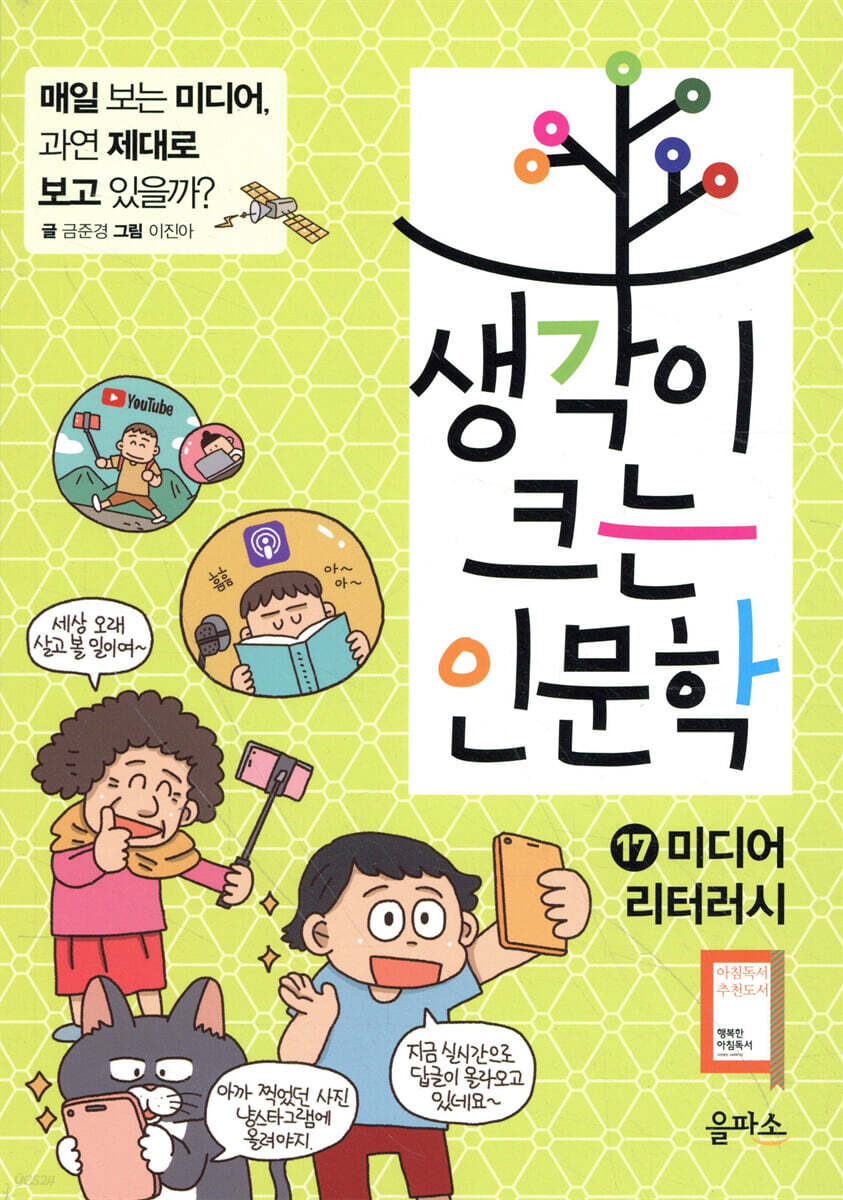
Humanities 17: Media Literacy
 |
Description
Book Introduction
For teenagers who are learning new common sense in a changing era
How should media literacy education be conducted?
How to read the media, taught by a media expert!
Today's teenagers are different from the generation that used to sit in front of the TV every Sunday morning and watch "Disneyland."
As we enter an era where we can access any content we want, such as YouTube videos, webtoons, and live broadcasts on social media, at any time, teenagers are being exposed to a wider variety of media than ever before.
Concerns about this have led to the creation of separate kid-friendly content on media channels and the creation of apps that limit youth media viewing. But is blocking content from being viewed in sections truly the solution?
The importance of 'media literacy', which involves viewing media properly and using it effectively, has been repeatedly emphasized.
However, even adults find it difficult to explain what wise media use is.
With the urgent need for proper media education for the new generation, who should we look to for guidance?
Geum Jun-kyung, a writer who has specialized in media changes and literacy education for [Media Today], discusses the digital citizenship qualities that young people need to possess in the new media era based on her extensive field experience.
Through the eyes of a professional media journalist who examines and interprets the complex world of media, teenage readers will also be able to learn what it means to properly view media.
Together, we will learn how to consume and produce healthy media content, and move forward together to become active members of the media world.
How should media literacy education be conducted?
How to read the media, taught by a media expert!
Today's teenagers are different from the generation that used to sit in front of the TV every Sunday morning and watch "Disneyland."
As we enter an era where we can access any content we want, such as YouTube videos, webtoons, and live broadcasts on social media, at any time, teenagers are being exposed to a wider variety of media than ever before.
Concerns about this have led to the creation of separate kid-friendly content on media channels and the creation of apps that limit youth media viewing. But is blocking content from being viewed in sections truly the solution?
The importance of 'media literacy', which involves viewing media properly and using it effectively, has been repeatedly emphasized.
However, even adults find it difficult to explain what wise media use is.
With the urgent need for proper media education for the new generation, who should we look to for guidance?
Geum Jun-kyung, a writer who has specialized in media changes and literacy education for [Media Today], discusses the digital citizenship qualities that young people need to possess in the new media era based on her extensive field experience.
Through the eyes of a professional media journalist who examines and interprets the complex world of media, teenage readers will also be able to learn what it means to properly view media.
Together, we will learn how to consume and produce healthy media content, and move forward together to become active members of the media world.
- You can preview some of the book's contents.
Preview
index
Chapter 1.
Media, what you see isn't everything!
- There was media even in the Joseon Dynasty!
- “Every citizen is a journalist.”
- A hundred media, a hundred frames
- There are gatekeepers in the media?
* [New York Times], The first apology in 161 years
Chapter 2.
How far can the media go?
- The power of media to change the world
- Give strength to those who have no strength
- Media that both promotes and destroys prejudice
- Media that underlines important things
* Slowly and steadily like a cauldron
Chapter 3.
Who wants to touch the media!
- There is a separate owner of the media?
- Revealed in 60 seconds!
Media above media, a powerful platform
- AI recommends content that I really like?
* Reject corporate interference!
Chapter 4.
Light and Shadow in the New Media Age
- Is content that hits your taste always good?
A world where everything becomes content
- What if anyone could make news?
- My traces that cannot be erased even if erased
* Catch false information with media literacy!
Chapter 5.
How to look at the media with the right perspective?
- Checklist for Active Media Use
· When watching the news
· When looking for something to enjoy
· When creating media
*How to write a good article as told by a reporter
Media, what you see isn't everything!
- There was media even in the Joseon Dynasty!
- “Every citizen is a journalist.”
- A hundred media, a hundred frames
- There are gatekeepers in the media?
* [New York Times], The first apology in 161 years
Chapter 2.
How far can the media go?
- The power of media to change the world
- Give strength to those who have no strength
- Media that both promotes and destroys prejudice
- Media that underlines important things
* Slowly and steadily like a cauldron
Chapter 3.
Who wants to touch the media!
- There is a separate owner of the media?
- Revealed in 60 seconds!
Media above media, a powerful platform
- AI recommends content that I really like?
* Reject corporate interference!
Chapter 4.
Light and Shadow in the New Media Age
- Is content that hits your taste always good?
A world where everything becomes content
- What if anyone could make news?
- My traces that cannot be erased even if erased
* Catch false information with media literacy!
Chapter 5.
How to look at the media with the right perspective?
- Checklist for Active Media Use
· When watching the news
· When looking for something to enjoy
· When creating media
*How to write a good article as told by a reporter
Detailed image

Into the book
Now anyone can tell their story to people all over the world through the Internet.
There are many open spaces, such as Twitter, Facebook, YouTube, and various communities.
You can report on social issues or share the little things about your daily life.
It's not necessary for a company to be a large company to become a media outlet.
We already live in an age where everyone is media.
Sometimes, I hear news of my favorite singer's comeback through a live broadcast on social media, and sometimes, a choreography video I filmed myself spreads around the world through YouTube.
In a world where anyone can become media, what kind of voice do you want to have?
--- p.20
In our society, diverse people live together.
In a democratic country, everyone pursues a free and equal society.
But in reality, each person's voice does not have the same volume.
What does this mean? Powerful people can easily convey their message to a large audience by holding press conferences or running advertisements when they have something to say.
But ordinary, powerless people have no way to express what they want to say.
The powerful people hold the microphone and speak, but the ordinary and powerless people have to shout loudly.
So, it can be said that the role of the media is to balance this sound through 'buyak'.
--- p.49
We are no longer just recipients of media content.
You can become a media outlet yourself and speak out, and if there's a bad media outlet out there, you can take proactive action to call out the problem.
And above all, it can play a role in encouraging and supporting the creation of more good media.
Whenever our society develops in a positive direction, good media has always been there.
It's good to remember that media is not a given; it can change depending on how we cultivate it.
There are many open spaces, such as Twitter, Facebook, YouTube, and various communities.
You can report on social issues or share the little things about your daily life.
It's not necessary for a company to be a large company to become a media outlet.
We already live in an age where everyone is media.
Sometimes, I hear news of my favorite singer's comeback through a live broadcast on social media, and sometimes, a choreography video I filmed myself spreads around the world through YouTube.
In a world where anyone can become media, what kind of voice do you want to have?
--- p.20
In our society, diverse people live together.
In a democratic country, everyone pursues a free and equal society.
But in reality, each person's voice does not have the same volume.
What does this mean? Powerful people can easily convey their message to a large audience by holding press conferences or running advertisements when they have something to say.
But ordinary, powerless people have no way to express what they want to say.
The powerful people hold the microphone and speak, but the ordinary and powerless people have to shout loudly.
So, it can be said that the role of the media is to balance this sound through 'buyak'.
--- p.49
We are no longer just recipients of media content.
You can become a media outlet yourself and speak out, and if there's a bad media outlet out there, you can take proactive action to call out the problem.
And above all, it can play a role in encouraging and supporting the creation of more good media.
Whenever our society develops in a positive direction, good media has always been there.
It's good to remember that media is not a given; it can change depending on how we cultivate it.
--- p.157
Publisher's Review
The media I'm watching now, I didn't choose it?
Let's find out the hidden truth about the media!
This book discusses the past, present, and future of media.
The concept of media is explained in detail through examples that make it easy to understand what kind of media connected people in the distant past and why the Joseon Dynasty's government publication, "Jobo," is called a half-baked media.
Concepts like 'gatekeeping' and 'frame', which can be difficult to grasp, are explained in a way that is accessible to young people, with expressions such as the idea that there are gatekeepers guarding the entrance to the media, and explanations that everyone has a different window through which to view the world.
By examining the characteristics of media that span both old and new media, we can understand the process that a piece of media content goes through before it reaches us, and develop the ability to anticipate even the invisible parts.
It also explains in detail the principles that drive the media world in the new media era.
We examine the influence of platform power and advertising on media by examining common situations, such as why there are so many advertisements next to Internet articles and why titles are created by forcing real-time search terms into them.
By examining the factors that influence media, we will understand the media ecosystem and learn how to become a digital citizen who reads intelligently rather than passively.
Media with the power to change the world
Who should we hand the reins to?
The media sometimes ousts dictators, and sometimes is used by dictatorial regimes.
This book examines the influence and ripple effect of media through historical examples, emphasizing that ultimately, what matters is us who use the media.
So, in this new media age, where everyone is not only a consumer but also a producer of media, what kind of media should we choose and create? For readers who are pondering what exactly they should watch, listen to, and create, the author recommends first examining the kind of content they should create.
It provides specific guidance on what to show to whom and what media is suitable for that, and above all, it guides you to not forget media ethics.
In addition, the final chapter explores why it is important to cultivate a healthy media world and what specific actions can be taken to help you navigate the world of media freely and healthily.
Even as new and unfamiliar media continue to emerge, this book on media literacy will serve as a compass to guide you through the vast sea of content.
Books selected for various recommendations and recommended by relevant organizations!
A humanities series for teens that starts with a question
It develops the power to think for yourself!
This book is the seventeenth in the "Humanities that Make You Think Big" series.
The "Humanities for Big Thinking" series was designed to help teenagers, who are beginning to develop their own perspectives on the world, develop a humanistic literacy rather than just humanistic knowledge.
Since the first book was published in 2013, the series has consistently focused on topics that can foster the thinking of teenagers, including study, beauty, wealth, morality, the mind, history, emotions, justice, freedom, life, psychology, gender equality, the constitution and human rights, food, big data, space development, and even media literacy.
The questions presented in the book will make you think about situations you've never thought about before and give you time to reflect.
Some readers will find their own answers in the process, while others will still be left with only question marks. However, the time to think for themselves will help young readers develop their thinking skills.
This series was selected as an excellent liberal arts book by the Ministry of Culture, Sports and Tourism, a liberal arts book by Sejong Books, a youth liberal arts book of the year by the Korea Publishers Association, a youth recommended book by the Korea Publication Industry Promotion Agency, a morning reading youth recommended book, and an excellent science book.
Let's find out the hidden truth about the media!
This book discusses the past, present, and future of media.
The concept of media is explained in detail through examples that make it easy to understand what kind of media connected people in the distant past and why the Joseon Dynasty's government publication, "Jobo," is called a half-baked media.
Concepts like 'gatekeeping' and 'frame', which can be difficult to grasp, are explained in a way that is accessible to young people, with expressions such as the idea that there are gatekeepers guarding the entrance to the media, and explanations that everyone has a different window through which to view the world.
By examining the characteristics of media that span both old and new media, we can understand the process that a piece of media content goes through before it reaches us, and develop the ability to anticipate even the invisible parts.
It also explains in detail the principles that drive the media world in the new media era.
We examine the influence of platform power and advertising on media by examining common situations, such as why there are so many advertisements next to Internet articles and why titles are created by forcing real-time search terms into them.
By examining the factors that influence media, we will understand the media ecosystem and learn how to become a digital citizen who reads intelligently rather than passively.
Media with the power to change the world
Who should we hand the reins to?
The media sometimes ousts dictators, and sometimes is used by dictatorial regimes.
This book examines the influence and ripple effect of media through historical examples, emphasizing that ultimately, what matters is us who use the media.
So, in this new media age, where everyone is not only a consumer but also a producer of media, what kind of media should we choose and create? For readers who are pondering what exactly they should watch, listen to, and create, the author recommends first examining the kind of content they should create.
It provides specific guidance on what to show to whom and what media is suitable for that, and above all, it guides you to not forget media ethics.
In addition, the final chapter explores why it is important to cultivate a healthy media world and what specific actions can be taken to help you navigate the world of media freely and healthily.
Even as new and unfamiliar media continue to emerge, this book on media literacy will serve as a compass to guide you through the vast sea of content.
Books selected for various recommendations and recommended by relevant organizations!
A humanities series for teens that starts with a question
It develops the power to think for yourself!
This book is the seventeenth in the "Humanities that Make You Think Big" series.
The "Humanities for Big Thinking" series was designed to help teenagers, who are beginning to develop their own perspectives on the world, develop a humanistic literacy rather than just humanistic knowledge.
Since the first book was published in 2013, the series has consistently focused on topics that can foster the thinking of teenagers, including study, beauty, wealth, morality, the mind, history, emotions, justice, freedom, life, psychology, gender equality, the constitution and human rights, food, big data, space development, and even media literacy.
The questions presented in the book will make you think about situations you've never thought about before and give you time to reflect.
Some readers will find their own answers in the process, while others will still be left with only question marks. However, the time to think for themselves will help young readers develop their thinking skills.
This series was selected as an excellent liberal arts book by the Ministry of Culture, Sports and Tourism, a liberal arts book by Sejong Books, a youth liberal arts book of the year by the Korea Publishers Association, a youth recommended book by the Korea Publication Industry Promotion Agency, a morning reading youth recommended book, and an excellent science book.
GOODS SPECIFICS
- Date of publication: October 25, 2019
- Page count, weight, size: 164 pages | 292g | 148*210*20mm
- ISBN13: 9788950983970
- ISBN10: 8950983974
- KC Certification: Certification Type: Conformity Confirmation
You may also like
카테고리
korean


korean

![GQ KOREA Mark (Monthly): December [2025]](http://librairie.coreenne.fr/cdn/shop/files/8ef265dbbfbf186523ed75ba7319009d.jpg?v=1765340328&width=3840)


