

Anatomy stories that are so fun you'll read them all night
 |
Description
Book Introduction
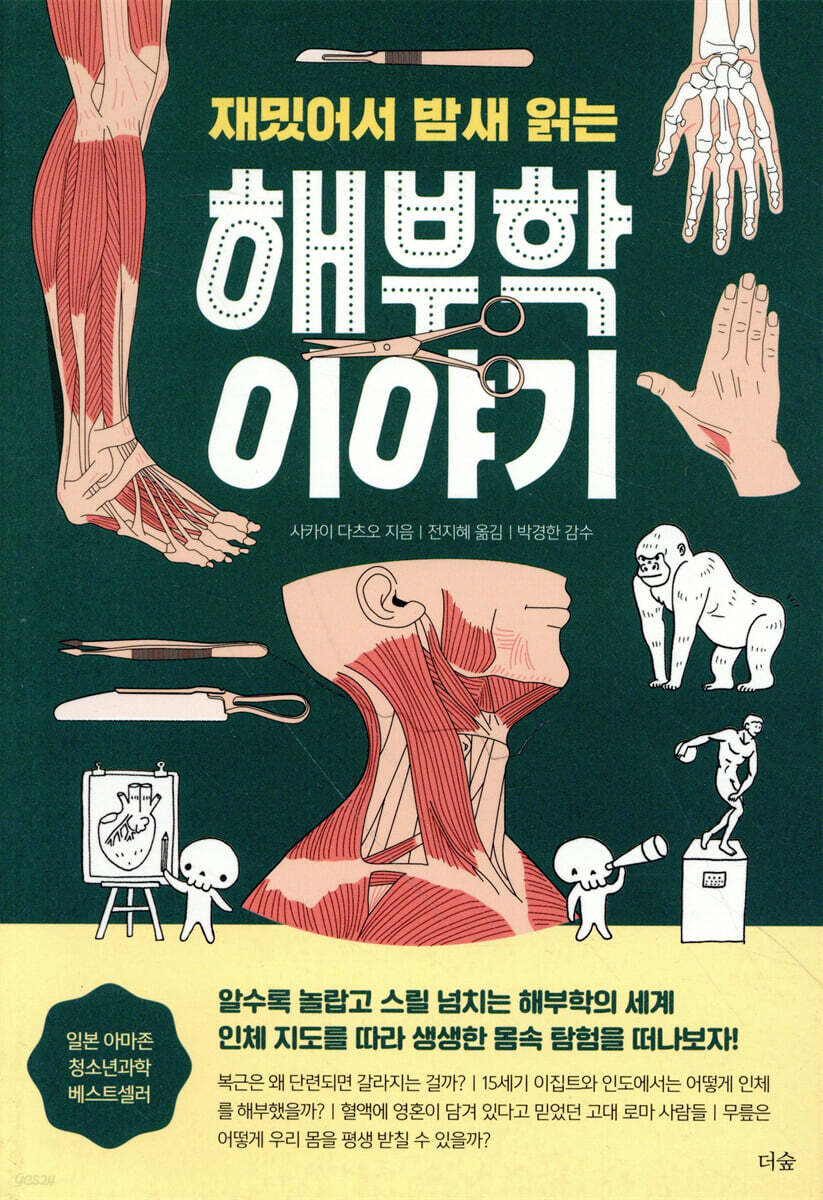
The "Anatomy" edition of the Japanese youth science bestseller series "So fun you'll read it all night" has been published!
The more you learn, the more surprising and thrilling the world of anatomy becomes.
Let's go on a vivid exploration of the inside of the body along the human body map!
The "Anatomy" edition of the "Fun to Read All Night" series, which is a bestseller in the Japanese youth science field and has been selected as a recommended book and excellent science book in Korea, and is loved by youth, teachers, and parents, has been published.
From the basics of science to in-depth stories, the charm of this series, which melts science, which was once perceived as difficult, into interesting stories, can be found in this 'Anatomy' edition.
It guides us into the exciting and thrilling world of anatomy, freeing us from the preconceived notions that 'anatomy is scary and cruel', 'medical science is rigid and boring', or 'anatomy is a specialized field', and teaching us about our bodies that we never knew existed.
It will also provide an opportunity to learn about medicine and anatomy, which have only been seen through distorted perspectives in dramas and movies.
The author, who has been a medical school professor for over 30 years and has written a wide range of books, from medical textbooks to popular books, vividly describes the specific process of dissection as if he were observing an actual dissection.
It satisfies the curiosity and interest you have had about human anatomy by providing an engaging explanation of the names and origins of the human body, the process of uncovering the secrets within the body, and the history of anatomy, which were once difficult to understand due to their long and unfamiliar names.
As an anatomist, the author says that anatomy is a map of the human body that shows the way to reach the destination of organs and tissues while traveling through the universe called the human body, and that it informs us of the role and properties of each.
This book explains in easy-to-understand pictures the major bones that make up the body, along with the shape and role of the organs and muscles contained within them, following the human body map.
In the process, the book unfolds rich and interesting content, including stories that allow you to discover the mysteries of the human body in everyday life, such as why the abdominal muscles split when trained, the exact location of the armpits, and the so-called 'beer glass muscles' used when holding a beer glass.
The actual process of dissection, the body's interior, which is revealed by cutting the skin and spreading the muscles, is a vast and mysterious world comparable to a small universe full of mysteries, or a museum that explores everything on Earth.
The more you learn, the more surprising and thrilling the world of anatomy becomes.
Let's go on a vivid exploration of the inside of the body along the human body map!
The "Anatomy" edition of the "Fun to Read All Night" series, which is a bestseller in the Japanese youth science field and has been selected as a recommended book and excellent science book in Korea, and is loved by youth, teachers, and parents, has been published.
From the basics of science to in-depth stories, the charm of this series, which melts science, which was once perceived as difficult, into interesting stories, can be found in this 'Anatomy' edition.
It guides us into the exciting and thrilling world of anatomy, freeing us from the preconceived notions that 'anatomy is scary and cruel', 'medical science is rigid and boring', or 'anatomy is a specialized field', and teaching us about our bodies that we never knew existed.
It will also provide an opportunity to learn about medicine and anatomy, which have only been seen through distorted perspectives in dramas and movies.
The author, who has been a medical school professor for over 30 years and has written a wide range of books, from medical textbooks to popular books, vividly describes the specific process of dissection as if he were observing an actual dissection.
It satisfies the curiosity and interest you have had about human anatomy by providing an engaging explanation of the names and origins of the human body, the process of uncovering the secrets within the body, and the history of anatomy, which were once difficult to understand due to their long and unfamiliar names.
As an anatomist, the author says that anatomy is a map of the human body that shows the way to reach the destination of organs and tissues while traveling through the universe called the human body, and that it informs us of the role and properties of each.
This book explains in easy-to-understand pictures the major bones that make up the body, along with the shape and role of the organs and muscles contained within them, following the human body map.
In the process, the book unfolds rich and interesting content, including stories that allow you to discover the mysteries of the human body in everyday life, such as why the abdominal muscles split when trained, the exact location of the armpits, and the so-called 'beer glass muscles' used when holding a beer glass.
The actual process of dissection, the body's interior, which is revealed by cutting the skin and spreading the muscles, is a vast and mysterious world comparable to a small universe full of mysteries, or a museum that explores everything on Earth.
- You can preview some of the book's contents.
Preview
index
preface
Part Ⅰ: Anatomy Stories That Will Make You Read All Night
Anatomy is a well-intentioned science.
Preparatory work for dissection practice
Entering full-scale dissection practice
From a dissected object to a single human being
Anatomy developed through body donation
Part II How Anatomy Developed
Medicine of ancient civilizations
Anatomy that changed Western medicine in the 19th century
ancient Roman anatomist
The Renaissance Era of Advancing Science
Leonardo da Vinci and Anatomy
17th-century British 'blood circulation theory'
How Printing Changed Anatomy
What was dissection like in the Edo period?
The curtain opens on Western medicine
The History and Meaning of Body Donation
Part Ⅲ Body Shape from an Anatomical Perspective
Our bodies are different from what we think
The Birth of Anatomical Terminology
Where exactly is the armpit?!
You have 'beer glass muscles'?
Why do abs split?
What color are your lungs?
The heart has a skeleton
There is an apron inside the boat
Height difference between left and right sides
Abdominal and femoral tunnels
Why humans have developed hips
Why do feet have heels?
The Amazing Structure of the Knee
pelvis and genitals
How does a man cut his hair in one go?
Observing the senses
Things to know when dissecting a jaw
Eyes surrounded by fat
The inside of the ear is a complex maze
Conclusion
References
Part Ⅰ: Anatomy Stories That Will Make You Read All Night
Anatomy is a well-intentioned science.
Preparatory work for dissection practice
Entering full-scale dissection practice
From a dissected object to a single human being
Anatomy developed through body donation
Part II How Anatomy Developed
Medicine of ancient civilizations
Anatomy that changed Western medicine in the 19th century
ancient Roman anatomist
The Renaissance Era of Advancing Science
Leonardo da Vinci and Anatomy
17th-century British 'blood circulation theory'
How Printing Changed Anatomy
What was dissection like in the Edo period?
The curtain opens on Western medicine
The History and Meaning of Body Donation
Part Ⅲ Body Shape from an Anatomical Perspective
Our bodies are different from what we think
The Birth of Anatomical Terminology
Where exactly is the armpit?!
You have 'beer glass muscles'?
Why do abs split?
What color are your lungs?
The heart has a skeleton
There is an apron inside the boat
Height difference between left and right sides
Abdominal and femoral tunnels
Why humans have developed hips
Why do feet have heels?
The Amazing Structure of the Knee
pelvis and genitals
How does a man cut his hair in one go?
Observing the senses
Things to know when dissecting a jaw
Eyes surrounded by fat
The inside of the ear is a complex maze
Conclusion
References
Into the book
Looking into the human body can feel like stepping into unknown territory and discovering treasure.
The work of cutting the skin and spreading the muscles to find the internal organs is similar to that of a museum.
Museum science is the study of nature as a whole, observing its interior in detail to build up knowledge.
Anatomy, like museum history, has the appeal of being able to observe the human body to uncover the mysteries of nature and explore unexplored territories.
Students will also be able to feel intellectual excitement during the process.
Since you can't dissect a human body right now, why not take a look inside your own body through this book, even if it's a little scary? I'll guide you through the ins and outs of human dissection, as if you were embarking on an expedition.
It will undoubtedly be a valuable exploration that will allow us to experience not only the mystery of the human body but also the dignity of life.
So, let's go on a treasure hunt along the human body map.
---From the "Preface"
Brain death medically means the death of a human being.
However, people generally cannot accept the reality that their family member is dead, even if he or she is brain dead, as long as the heart is beating and body temperature is felt.
This may be because they cannot accept the fact that the heart's only role is to pump blood throughout the body.
That means we do not view the human body objectively.
However, when you practice dissection and remove a heart, you realize that the heart is just a muscular sac that pumps blood.
Without directly confirming the existence of this organ, it is difficult to accept that the movement of the heart is merely a function of pumping blood.
Therefore, by practicing dissection, you develop an eye to view the human body objectively.
---From "Entering Full-scale Dissection Practice"
During the dissection, it feels like you are fighting with every part of the human body.
But things change when the practice gets to the second half and we start dissecting the head.
I am struck by the fact that the object I have been dissecting until now is actually a human being.
This fact becomes especially evident when dissecting the face.
The corpse's face is kept covered with a mask during practice and is removed for the first time when the head is dissected.
Then, suddenly, you come face to face with the deceased's expression.
If you cover the already dissected lower part of the neck with a flannel cloth, leaving only the face visible, the object you have been dissecting will suddenly change into the appearance of a human being.
When I lift the flannel cloth and look at the lower part of the neck and face, I feel uneasy, as if I have seen something I should not have seen.
But as I started to focus on the facial anatomy, my mind slowly calmed down.
When you peel off the skin, you are once again immersed in the world of the human body for dissection.
At this time, it is very important to always be aware that the deceased's body is not simply an object for dissection, but a human being.
---From "From anatomy to human"
We, living in modern times, know that blood circulates through the body.
But Galen, despite seeing the same heart and blood vessels as us, thought very differently.
When performing an anatomy, you can see arteries, veins, and nerves, but Galen thought that they were not tubes that carried blood and circulated it throughout the body, but rather tubes that carried different types of fluids.
Just as objects that are attached to each other transmit vibrations and wires conduct electricity, it was believed that the soul was transmitted through bodily fluids if the tubes were connected within the body.
But why did Galen believe that arterial blood contained a soul? He believed that palpating an artery would reveal a pulsating pulse, which he considered evidence of a soul.
And it was believed that a part of the arterial blood was connected to the lower part of the brain, and that from the lower part of the brain, external spirits entering through the nose produced a neural fluid that performed intellectual functions.
And it was thought that the neural fluid stayed in the empty space inside the brain, preparing the brain to function, and at the same time, it was transmitted to the whole body through the peripheral nerves, allowing for free movement and sensation.
The human body system conceived by Galen is a system so excellent that it can be believed without thinking, as it incorporates anatomical findings in general.
---From "Ancient Roman Anatomists"
The human neck is thin and has to support a heavy head, so it easily becomes tired and can cause shoulder stiffness.
So, what if the neck were encased in a thick, rigid skeletal container, capable of supporting the heavy head? If the neck were fixed in place like the three skeletal containers mentioned above, unable to move, it would be impossible to turn around when called from behind.
Of course, you can turn your whole body to look behind you, but not being able to move your neck is more uncomfortable than you might think.
The more serious part is the stomach.
If the skeletal vessel surrounds the stomach, not only can the intestines not move, but the body cannot turn over while sleeping.
This is because tossing and turning while sleeping requires turning the upper and lower body to change the direction of the body.
Also, if you can't move your stomach, you won't be able to get out of bed after sleeping.
You cannot lie on your back and get up without bending over.
In this way, our body has a functional form that allows us to lead a comfortable daily life.
The work of cutting the skin and spreading the muscles to find the internal organs is similar to that of a museum.
Museum science is the study of nature as a whole, observing its interior in detail to build up knowledge.
Anatomy, like museum history, has the appeal of being able to observe the human body to uncover the mysteries of nature and explore unexplored territories.
Students will also be able to feel intellectual excitement during the process.
Since you can't dissect a human body right now, why not take a look inside your own body through this book, even if it's a little scary? I'll guide you through the ins and outs of human dissection, as if you were embarking on an expedition.
It will undoubtedly be a valuable exploration that will allow us to experience not only the mystery of the human body but also the dignity of life.
So, let's go on a treasure hunt along the human body map.
---From the "Preface"
Brain death medically means the death of a human being.
However, people generally cannot accept the reality that their family member is dead, even if he or she is brain dead, as long as the heart is beating and body temperature is felt.
This may be because they cannot accept the fact that the heart's only role is to pump blood throughout the body.
That means we do not view the human body objectively.
However, when you practice dissection and remove a heart, you realize that the heart is just a muscular sac that pumps blood.
Without directly confirming the existence of this organ, it is difficult to accept that the movement of the heart is merely a function of pumping blood.
Therefore, by practicing dissection, you develop an eye to view the human body objectively.
---From "Entering Full-scale Dissection Practice"
During the dissection, it feels like you are fighting with every part of the human body.
But things change when the practice gets to the second half and we start dissecting the head.
I am struck by the fact that the object I have been dissecting until now is actually a human being.
This fact becomes especially evident when dissecting the face.
The corpse's face is kept covered with a mask during practice and is removed for the first time when the head is dissected.
Then, suddenly, you come face to face with the deceased's expression.
If you cover the already dissected lower part of the neck with a flannel cloth, leaving only the face visible, the object you have been dissecting will suddenly change into the appearance of a human being.
When I lift the flannel cloth and look at the lower part of the neck and face, I feel uneasy, as if I have seen something I should not have seen.
But as I started to focus on the facial anatomy, my mind slowly calmed down.
When you peel off the skin, you are once again immersed in the world of the human body for dissection.
At this time, it is very important to always be aware that the deceased's body is not simply an object for dissection, but a human being.
---From "From anatomy to human"
We, living in modern times, know that blood circulates through the body.
But Galen, despite seeing the same heart and blood vessels as us, thought very differently.
When performing an anatomy, you can see arteries, veins, and nerves, but Galen thought that they were not tubes that carried blood and circulated it throughout the body, but rather tubes that carried different types of fluids.
Just as objects that are attached to each other transmit vibrations and wires conduct electricity, it was believed that the soul was transmitted through bodily fluids if the tubes were connected within the body.
But why did Galen believe that arterial blood contained a soul? He believed that palpating an artery would reveal a pulsating pulse, which he considered evidence of a soul.
And it was believed that a part of the arterial blood was connected to the lower part of the brain, and that from the lower part of the brain, external spirits entering through the nose produced a neural fluid that performed intellectual functions.
And it was thought that the neural fluid stayed in the empty space inside the brain, preparing the brain to function, and at the same time, it was transmitted to the whole body through the peripheral nerves, allowing for free movement and sensation.
The human body system conceived by Galen is a system so excellent that it can be believed without thinking, as it incorporates anatomical findings in general.
---From "Ancient Roman Anatomists"
The human neck is thin and has to support a heavy head, so it easily becomes tired and can cause shoulder stiffness.
So, what if the neck were encased in a thick, rigid skeletal container, capable of supporting the heavy head? If the neck were fixed in place like the three skeletal containers mentioned above, unable to move, it would be impossible to turn around when called from behind.
Of course, you can turn your whole body to look behind you, but not being able to move your neck is more uncomfortable than you might think.
The more serious part is the stomach.
If the skeletal vessel surrounds the stomach, not only can the intestines not move, but the body cannot turn over while sleeping.
This is because tossing and turning while sleeping requires turning the upper and lower body to change the direction of the body.
Also, if you can't move your stomach, you won't be able to get out of bed after sleeping.
You cannot lie on your back and get up without bending over.
In this way, our body has a functional form that allows us to lead a comfortable daily life.
---From "Our bodies are different from what we think"
Publisher's Review
How do our knees support our bodies throughout our lives? Is there a labyrinth inside our ears?
An exciting anatomy story that reveals something about my body I never knew about.
Our body is a diligent machine that runs without rest for a single second from the moment we are born until we die.
This book says that it is an amazing machine that has both precision and delicacy, and that it operates without any problems despite its complex structure.
It seems natural to see our eyes and kidneys surrounded by fat rather than solid bone, and our knees sticking out when we walk or run, but there's a reason for each structure.
For example, the neck plays a major role in supporting the head, one of the most important parts of the body, but it is relatively thin and fragile.
Wouldn't it be more stable if the neck were surrounded by a thick, strong skeletal framework to support the heavy head? However, if the neck were made of bone, it would be fixed, unable to move, and even turning the head would be difficult.
The eyes are surrounded by fat, and the stomach protects the organs.
Because it is made of flesh and muscle, it can move freely, see all around, and bend its body.
The knees are one of the parts that reveal the mysteries of the human body.
When you peel off the skin of the knee and remove the joint for dissection, you can see that it is a sturdy structure made up of large and small joints, tendons, and muscles.
Thanks to this, they can walk, run, and bend freely while supporting a weight that is five times their body weight.
Also, the inner ear is called the bony labyrinth because the inner ear is filled with small, delicate organs like a labyrinth.
These small ears not only help us hear sounds, but also help us maintain balance and regulate air pressure.
From the ancient Romans who believed that the soul was contained in the blood
From the Renaissance to 18th-century England and Japan's Edo period, stories of dissection are told.
If you follow anatomy, you can see the development of civilization!
As people live, they constantly get hurt and get sick.
When you get sick or injured, a doctor will diagnose and treat you, and prescribe medication if necessary.
Although it is now a given, this process was possible thanks to the continuous exploration of the human body by scholars of previous eras.
This book tells the story of how the mysteries of the human body were gradually revealed over a long period of time, along with the development of civilization.
In ancient Rome, when interest in the human body began to grow, the theory was proposed that blood contained the soul and carried it throughout the body.
This hypothesis, which sounds absurd now, actually had its own scientific logic, and surprisingly, most scholars at the time actually believed it.
Then, starting with the bodies of animals, they began to dissect actual human bodies in earnest, and during the Renaissance, anatomy began to develop rapidly.
Compared to the long history of exploring the human body, the history of the technology and knowledge we use today is actually not that long.
The stethoscope, anesthetics, and disinfection methods were developed in the 19th century, so it has been less than 200 years.
But it was because of the extensive research that we were able to achieve the knowledge and technology we have today.
The author says that anatomy is a 'science of good intentions'.
It was possible to develop because there were people who donated their bodies and people who valued and studied the meaning of donating their bodies.
It provides an opportunity to reflect on the rich knowledge about our bodies and the meaning contained in the study of anatomy, and to think about the preciousness of our own bodies and lives.
An exciting anatomy story that reveals something about my body I never knew about.
Our body is a diligent machine that runs without rest for a single second from the moment we are born until we die.
This book says that it is an amazing machine that has both precision and delicacy, and that it operates without any problems despite its complex structure.
It seems natural to see our eyes and kidneys surrounded by fat rather than solid bone, and our knees sticking out when we walk or run, but there's a reason for each structure.
For example, the neck plays a major role in supporting the head, one of the most important parts of the body, but it is relatively thin and fragile.
Wouldn't it be more stable if the neck were surrounded by a thick, strong skeletal framework to support the heavy head? However, if the neck were made of bone, it would be fixed, unable to move, and even turning the head would be difficult.
The eyes are surrounded by fat, and the stomach protects the organs.
Because it is made of flesh and muscle, it can move freely, see all around, and bend its body.
The knees are one of the parts that reveal the mysteries of the human body.
When you peel off the skin of the knee and remove the joint for dissection, you can see that it is a sturdy structure made up of large and small joints, tendons, and muscles.
Thanks to this, they can walk, run, and bend freely while supporting a weight that is five times their body weight.
Also, the inner ear is called the bony labyrinth because the inner ear is filled with small, delicate organs like a labyrinth.
These small ears not only help us hear sounds, but also help us maintain balance and regulate air pressure.
From the ancient Romans who believed that the soul was contained in the blood
From the Renaissance to 18th-century England and Japan's Edo period, stories of dissection are told.
If you follow anatomy, you can see the development of civilization!
As people live, they constantly get hurt and get sick.
When you get sick or injured, a doctor will diagnose and treat you, and prescribe medication if necessary.
Although it is now a given, this process was possible thanks to the continuous exploration of the human body by scholars of previous eras.
This book tells the story of how the mysteries of the human body were gradually revealed over a long period of time, along with the development of civilization.
In ancient Rome, when interest in the human body began to grow, the theory was proposed that blood contained the soul and carried it throughout the body.
This hypothesis, which sounds absurd now, actually had its own scientific logic, and surprisingly, most scholars at the time actually believed it.
Then, starting with the bodies of animals, they began to dissect actual human bodies in earnest, and during the Renaissance, anatomy began to develop rapidly.
Compared to the long history of exploring the human body, the history of the technology and knowledge we use today is actually not that long.
The stethoscope, anesthetics, and disinfection methods were developed in the 19th century, so it has been less than 200 years.
But it was because of the extensive research that we were able to achieve the knowledge and technology we have today.
The author says that anatomy is a 'science of good intentions'.
It was possible to develop because there were people who donated their bodies and people who valued and studied the meaning of donating their bodies.
It provides an opportunity to reflect on the rich knowledge about our bodies and the meaning contained in the study of anatomy, and to think about the preciousness of our own bodies and lives.
GOODS SPECIFICS
- Date of publication: May 20, 2019
- Page count, weight, size: 244 pages | 388g | 146*210*16mm
- ISBN13: 9791186900864
- ISBN10: 1186900865
You may also like
카테고리
korean


korean

![GQ KOREA Mark (Monthly): December [2025]](http://librairie.coreenne.fr/cdn/shop/files/8ef265dbbfbf186523ed75ba7319009d.jpg?v=1765340328&width=3840)


