

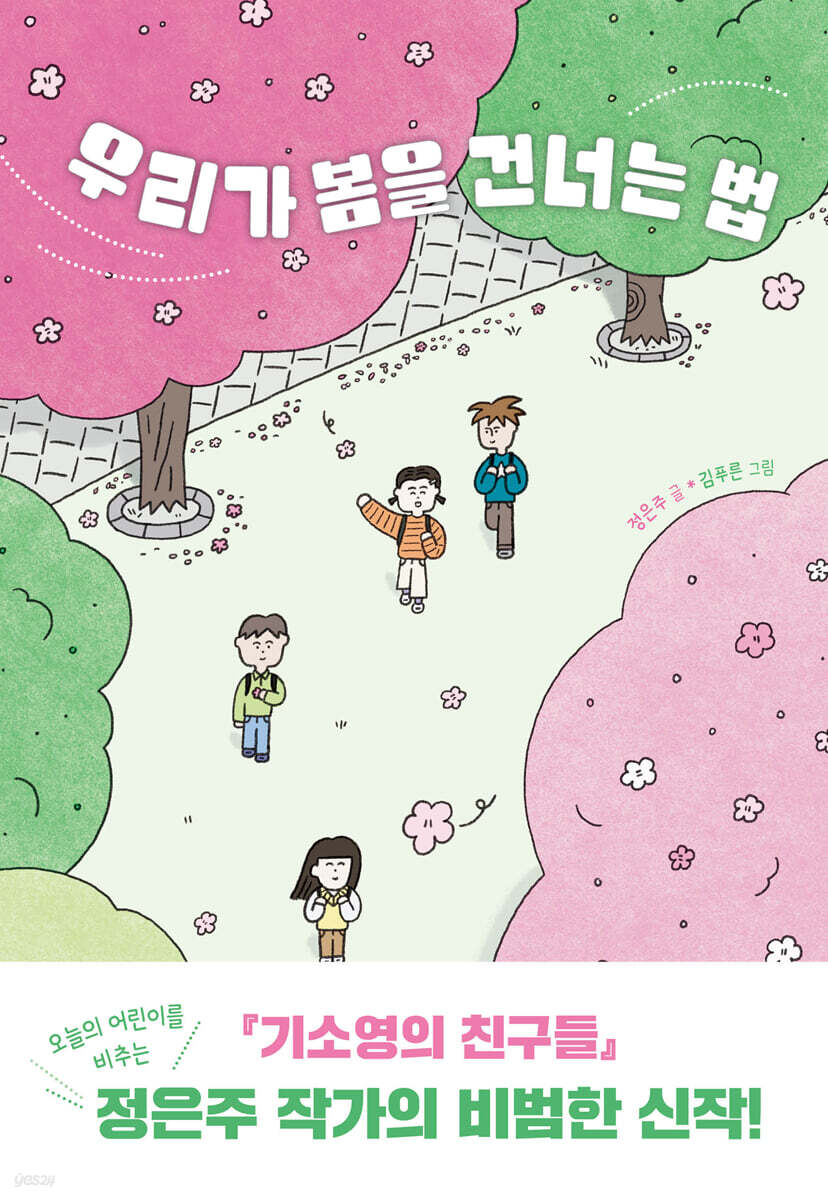
How we cross spring
 |
Description
Book Introduction
Between disability and non-disability, between prejudice and understanding
Can we really be friends?
Seon-ah, a timid and anxious person who has difficulty making friends; San-ae, Seon-ah's childhood best friend who grew apart after being diagnosed with a disability at the hospital and who transfers to Seon-ah's class after 5 years; Min-jun, who has no friends but is always confident wherever and whenever; and Haetsal, who acts as she pleases and is called a "child with small pockets of thought."
In the spring of the fifth grade, four different children meet each other in Class 3.
Your children are struggling to survive the new spring of their twelve years, as much as the vitality of spring.
Author Eun-ju Jeong, who depicted children's grief and solidarity in "Kisoyoung's Friends," once again sharply depicts children's friendship and solidarity between the disabled and the non-disabled, between prejudice and understanding, through "How We Cross Spring."
Through the eyes of Seon-ah, who is completely focused on making friends in the new semester, the author honestly portrays the budding hope that blooms in sensitive and vulnerable places such as disability and school violence.
Can we really be friends?
Seon-ah, a timid and anxious person who has difficulty making friends; San-ae, Seon-ah's childhood best friend who grew apart after being diagnosed with a disability at the hospital and who transfers to Seon-ah's class after 5 years; Min-jun, who has no friends but is always confident wherever and whenever; and Haetsal, who acts as she pleases and is called a "child with small pockets of thought."
In the spring of the fifth grade, four different children meet each other in Class 3.
Your children are struggling to survive the new spring of their twelve years, as much as the vitality of spring.
Author Eun-ju Jeong, who depicted children's grief and solidarity in "Kisoyoung's Friends," once again sharply depicts children's friendship and solidarity between the disabled and the non-disabled, between prejudice and understanding, through "How We Cross Spring."
Through the eyes of Seon-ah, who is completely focused on making friends in the new semester, the author honestly portrays the budding hope that blooms in sensitive and vulnerable places such as disability and school violence.
- You can preview some of the book's contents.
Preview
index
A familiar transfer student
Scene from Class 3, Grade 5
Invitation from the Tuhyun Group
Children of the Carbonara
Even if we're not friends
Ask the mountain
Group name: Sunshine
Buldak Bokkeum Myeon incident
Perpetrator? Victim?
A handful of courage
Minjun returns
Invitation to the Mountain
Rumors fly at the speed of light
How to Cross Spring
Author's Note
Scene from Class 3, Grade 5
Invitation from the Tuhyun Group
Children of the Carbonara
Even if we're not friends
Ask the mountain
Group name: Sunshine
Buldak Bokkeum Myeon incident
Perpetrator? Victim?
A handful of courage
Minjun returns
Invitation to the Mountain
Rumors fly at the speed of light
How to Cross Spring
Author's Note
Detailed image

Into the book
Sanae and I grew up together like twins, attending the same daycare and kindergarten until we were seven.
Our mothers were so close that there were no secrets between us.
When I was little, my biggest secret was that I wore diapers at night, and the mountain knew that and would ask about it from time to time.
“Seo, Seo, Seon-ah.
pee?"
I was a child who had trouble urinating during the day and had trouble urinating at night.
My grandmother, who took care of me instead of my mother, scolded me every day for not being able to control my urine even though I was a grown man.
--- p.12
The sunlight that disrupts classes on fictional days may be a bit harsh, but even that sunlight has a best friend now.
It's Park Min-jun.
The first time I heard Park Min-jun's name was when I was in the 4th grade.
A report of school violence was filed because a bad boy beat up a smaller friend.
It was the first time I heard about school violence at my school, something I had only heard about on the news, so I was very curious about what kind of person the person was.
However, contrary to the loud rumors, Minjun did not transfer schools, received no special punishment, and continued to attend school well after that.
Like Sunshine, Park Min-jun and I were in the same class for the first time in the 5th grade.
As for Park Min-jun, who I've watched so far, he wasn't exactly a bully, and he was just a kid who played well on his own, not someone who was bullied.
If someone were to ask me what kind of kid Minjun is, I would say that his true identity is still hidden behind a hazy fog.
--- p.24
There are only ten days left in April.
I still haven't really gotten to know anyone in my class.
At least in early March, I was able to get along well with Na-Hyeon.
I thought Nahyun would form a group with me, but looking at her behavior these days, it doesn't seem like that's the case.
The problem is that once groups are formed like this, they stay that way pretty much until the end of the school year.
Girls with girls, boys with boys.
If you don't have a best friend, you have to belong to some group to avoid being a loner.
--- p.32
Suddenly, this thought occurred to me.
Whatever it was, I wanted to introduce it without using words like ‘special school’ or ‘disabled person’… When I made up my mind to do that, I felt embarrassed.
I know quite a bit about Sanae. When I was young, I would tell my mom and dad over ten reasons why I should marry Sanae. But now, I can't think of a word to describe Sanae without mentioning special school and disability.
That's not it... There are so many things to say about Sanae, but I don't know why not a single one comes to mind.
--- p.42
The children who had been touched by the thief and collapsed called out to Haetsal in a desperate manner, saying, “Doctor, doctor!”
Sunshine approached with a bright smile and carefully helped the children up.
At that moment, Haetsal's expression was like that of a real doctor whose only thought was to save the patient.
Some children stand up and say, “Thank you.
He also said loudly, “Doctor.”
--- p.60
In the mountain, a bright smile appeared next to me, Haetsal only looked at Minjun, and next to him, Park Minjun was doodling on the desk.
Looking at these group members, my heart felt heavy.
Me in charge of all the assignments! Me in charge of all the presentations! I thought there wouldn't be any need for a maid.
--- p.76
That was when.
Minjun spoke in a small voice that only I could hear.
“Because Haetsal spoke to me first and asked me to play…
“It was just the sunlight.”
Those words made me feel like crying.
--- p.84
“You said you forced Haetsal to buy it for you?”
“No, Seon-ah.
“Uh… Minjun said, ‘Oh, I want to eat Buldak Bokkeum Myeon Carbonara.’ Then Haetsal said, ‘Me too, me too.’”
Before I knew it, I was next to the mountain.
“Gangsan, I did that once when you were here last time.
Other times, Haetsal would drag me along to buy something first.”
“No, Minjun.
“Uh… When you were with me, twice? Three times? ‘Oh, I want to eat it.’ You said that.”
“I said no! I didn’t do it three times!”
The two continued to bicker over how many times they had done that.
Park Min-jun, who used to look incredibly smart, is now more stupid than San-e.
It looked like a bow.
He didn't even know how much danger he was in right now, and he just sat there counting the number of times.
I sighed deeply
After resting, I came to the classroom first.
Even while sitting down, the mountain continued to talk about the matter.
“Seon-ah.
I bought it once too.
Haetsal suggested we go to the convenience store, but I didn't have any money, so I bought it.
I bought this for Minjun too
uh.
Minjun never bought it.”
Minjun didn't respond at all, just hung his head and doodled.
Suddenly, our Sunshine group became the center of a school bullying incident, with two perpetrators and one victim sitting together.
Haetsal was still bright-eyed, unaware that her mother had reported her only two classmates for school bullying.
--- pp.93~94
As they rushed to the cafeteria during lunchtime, the children continued to chatter about that story.
I, who had been following behind alone, turned back and went back to the classroom.
The situation that would happen in the cafeteria was clearly pictured in my mind.
I kept thinking about San-e, who would be eating alone without Min-jun.
I thought that today, at least, that sight would look so pitiful.
But I don't have the courage to sit with you.
It's better not to see it.
I skipped lunch.
--- p.99
This is probably the first time Minjun has been invited to a boys' soccer game.
Minjun looked up from his phone and saw the boys waving.
He looked like he was thinking a lot.
Of course so.
If I were to play soccer, I would feel bad for San-ae, who would be left alone, and if I were to turn down Ji-hoo's offer, it would be a shame...
“I’ll go to the mountain with you too!”
Minjun stood up from the stands and shouted toward the field.
Even I felt my heart swell with emotion at the sight.
Minjun and Sane finally got to hang out with the other boys! And they were playing soccer together! My heart erupted with fireworks of congratulations and cheers.
--- p.130
As I was walking slowly along the forest path, San-e suddenly placed a small box in my hand.
He said this while looking at me wondering what it was.
"gift."
“It’s my birthday….”
“New, not a birthday present, but a gift from the heart.
“I’m giving you this gift because I like you, Seon-ah.”
“….”
“Hey, you don’t have to answer now.
later.
“Just take this gift because I love you so much.”
Since it didn't fit in my pants pocket, I walked to the apartment entrance with the gift in my hand.
He refused to let me take him home, saying that he could go home on his own.
Although it was close enough that our noses would touch if we fell, I was worried about sending him out alone in the mountains in the middle of the night, so I watched his back for a long time before going home.
--- pp.145~146
Sane and I sat on a wooden chair on one side of the square.
I was once again troubled about what to say first.
When the mountain bike followed me around at school, I would turn around and yell at him without a care, but today I can't do that.
I need to gradually clear up any misunderstandings and convey my true feelings.
So that the mountain can fully understand.
--- p.166
Sanaewa and I were so excited that we felt like we could be friends with every twelve-year-old in the world if we wanted to.
Our mothers were so close that there were no secrets between us.
When I was little, my biggest secret was that I wore diapers at night, and the mountain knew that and would ask about it from time to time.
“Seo, Seo, Seon-ah.
pee?"
I was a child who had trouble urinating during the day and had trouble urinating at night.
My grandmother, who took care of me instead of my mother, scolded me every day for not being able to control my urine even though I was a grown man.
--- p.12
The sunlight that disrupts classes on fictional days may be a bit harsh, but even that sunlight has a best friend now.
It's Park Min-jun.
The first time I heard Park Min-jun's name was when I was in the 4th grade.
A report of school violence was filed because a bad boy beat up a smaller friend.
It was the first time I heard about school violence at my school, something I had only heard about on the news, so I was very curious about what kind of person the person was.
However, contrary to the loud rumors, Minjun did not transfer schools, received no special punishment, and continued to attend school well after that.
Like Sunshine, Park Min-jun and I were in the same class for the first time in the 5th grade.
As for Park Min-jun, who I've watched so far, he wasn't exactly a bully, and he was just a kid who played well on his own, not someone who was bullied.
If someone were to ask me what kind of kid Minjun is, I would say that his true identity is still hidden behind a hazy fog.
--- p.24
There are only ten days left in April.
I still haven't really gotten to know anyone in my class.
At least in early March, I was able to get along well with Na-Hyeon.
I thought Nahyun would form a group with me, but looking at her behavior these days, it doesn't seem like that's the case.
The problem is that once groups are formed like this, they stay that way pretty much until the end of the school year.
Girls with girls, boys with boys.
If you don't have a best friend, you have to belong to some group to avoid being a loner.
--- p.32
Suddenly, this thought occurred to me.
Whatever it was, I wanted to introduce it without using words like ‘special school’ or ‘disabled person’… When I made up my mind to do that, I felt embarrassed.
I know quite a bit about Sanae. When I was young, I would tell my mom and dad over ten reasons why I should marry Sanae. But now, I can't think of a word to describe Sanae without mentioning special school and disability.
That's not it... There are so many things to say about Sanae, but I don't know why not a single one comes to mind.
--- p.42
The children who had been touched by the thief and collapsed called out to Haetsal in a desperate manner, saying, “Doctor, doctor!”
Sunshine approached with a bright smile and carefully helped the children up.
At that moment, Haetsal's expression was like that of a real doctor whose only thought was to save the patient.
Some children stand up and say, “Thank you.
He also said loudly, “Doctor.”
--- p.60
In the mountain, a bright smile appeared next to me, Haetsal only looked at Minjun, and next to him, Park Minjun was doodling on the desk.
Looking at these group members, my heart felt heavy.
Me in charge of all the assignments! Me in charge of all the presentations! I thought there wouldn't be any need for a maid.
--- p.76
That was when.
Minjun spoke in a small voice that only I could hear.
“Because Haetsal spoke to me first and asked me to play…
“It was just the sunlight.”
Those words made me feel like crying.
--- p.84
“You said you forced Haetsal to buy it for you?”
“No, Seon-ah.
“Uh… Minjun said, ‘Oh, I want to eat Buldak Bokkeum Myeon Carbonara.’ Then Haetsal said, ‘Me too, me too.’”
Before I knew it, I was next to the mountain.
“Gangsan, I did that once when you were here last time.
Other times, Haetsal would drag me along to buy something first.”
“No, Minjun.
“Uh… When you were with me, twice? Three times? ‘Oh, I want to eat it.’ You said that.”
“I said no! I didn’t do it three times!”
The two continued to bicker over how many times they had done that.
Park Min-jun, who used to look incredibly smart, is now more stupid than San-e.
It looked like a bow.
He didn't even know how much danger he was in right now, and he just sat there counting the number of times.
I sighed deeply
After resting, I came to the classroom first.
Even while sitting down, the mountain continued to talk about the matter.
“Seon-ah.
I bought it once too.
Haetsal suggested we go to the convenience store, but I didn't have any money, so I bought it.
I bought this for Minjun too
uh.
Minjun never bought it.”
Minjun didn't respond at all, just hung his head and doodled.
Suddenly, our Sunshine group became the center of a school bullying incident, with two perpetrators and one victim sitting together.
Haetsal was still bright-eyed, unaware that her mother had reported her only two classmates for school bullying.
--- pp.93~94
As they rushed to the cafeteria during lunchtime, the children continued to chatter about that story.
I, who had been following behind alone, turned back and went back to the classroom.
The situation that would happen in the cafeteria was clearly pictured in my mind.
I kept thinking about San-e, who would be eating alone without Min-jun.
I thought that today, at least, that sight would look so pitiful.
But I don't have the courage to sit with you.
It's better not to see it.
I skipped lunch.
--- p.99
This is probably the first time Minjun has been invited to a boys' soccer game.
Minjun looked up from his phone and saw the boys waving.
He looked like he was thinking a lot.
Of course so.
If I were to play soccer, I would feel bad for San-ae, who would be left alone, and if I were to turn down Ji-hoo's offer, it would be a shame...
“I’ll go to the mountain with you too!”
Minjun stood up from the stands and shouted toward the field.
Even I felt my heart swell with emotion at the sight.
Minjun and Sane finally got to hang out with the other boys! And they were playing soccer together! My heart erupted with fireworks of congratulations and cheers.
--- p.130
As I was walking slowly along the forest path, San-e suddenly placed a small box in my hand.
He said this while looking at me wondering what it was.
"gift."
“It’s my birthday….”
“New, not a birthday present, but a gift from the heart.
“I’m giving you this gift because I like you, Seon-ah.”
“….”
“Hey, you don’t have to answer now.
later.
“Just take this gift because I love you so much.”
Since it didn't fit in my pants pocket, I walked to the apartment entrance with the gift in my hand.
He refused to let me take him home, saying that he could go home on his own.
Although it was close enough that our noses would touch if we fell, I was worried about sending him out alone in the mountains in the middle of the night, so I watched his back for a long time before going home.
--- pp.145~146
Sane and I sat on a wooden chair on one side of the square.
I was once again troubled about what to say first.
When the mountain bike followed me around at school, I would turn around and yell at him without a care, but today I can't do that.
I need to gradually clear up any misunderstandings and convey my true feelings.
So that the mountain can fully understand.
--- p.166
Sanaewa and I were so excited that we felt like we could be friends with every twelve-year-old in the world if we wanted to.
--- p.171
Publisher's Review
Children who are awkward in relationships
What I learned from going through spring
Seon-ah, a timid and anxious person who has difficulty making friends; San-ae, Seon-ah's childhood best friend who appears in front of Seon-ah after 5 years of being diagnosed with a disability; Min-jun, who has no friends but is always confident wherever and whenever; and Haetsal, who acts however she pleases.
In the spring of the fifth grade, four different children meet each other in Class 3.
Seon-ah, who suffered from bedwetting due to her parents' divorce and her grandmother's strict discipline as a child, is worried that she will not be able to fit in with the girls' group in the new semester.
In front of Seon-ah, San-ae, who was her childhood friend but grew distant after being diagnosed with Williams syndrome, appears after five years.
San is happy to see Seon-ah, but Seon-ah is worried about San-ah because she is afraid that she will not be able to get along with other girls her age and will be alone all year round, so she keeps her distance from San-ah.
In the affectionate mountain, Minjun and Haetsal hang out together, who are hesitant to deal with Seon-ah's distance but are still accepting of her.
Meanwhile, Seon-ah, San-ae, Min-jun, and Haetsal become a group.
Through group activities, Seon-ah learns about Min-jun's true feelings, which had been shrouded in rumors and misunderstandings, and her feelings for San-ae gradually become more at ease.
As time passes, Seon-ah also starts hanging out with girls in her class, and one day, when it seems like the kids in class 5-3 are all going through the new semester without any problems, San-ae and Min-jun get caught up in a school violence incident.
Through this confusing situation, Seon-ah experiences the prejudiced perspectives of adults on children's relationships and the complexities that are difficult to resolve in an instant.
Author Eun-ju Jeong, who depicted children's grief and solidarity in "Kisoyoung's Friends," once again sharply depicts children's friendship and solidarity between the disabled and the non-disabled, between prejudice and understanding, through "How We Cross Spring."
Through the eyes of Seon-ah, who is completely focused on making friends in the new semester, the author honestly portrays the hope that blooms like a ray of hope in sensitive and vulnerable places such as disability and school violence.
The colors of friendship are as colorful as each unique being.
Imagine
Starting a new semester with new teachers, new friends, and a new environment is tough for everyone.
For children who struggle with making friends or are easily anxious, the spring of the new school year can be the most difficult time of the year.
Especially for children with disabilities who are in regular classes, it is not easy to make classmates with different characteristics from their own.
While there may be children who are kind and helpful and considerate, it is rare to find a relationship where you can make mistakes, apologize to each other, and play comfortably.
The opposite is also true.
For children without disabilities, it is often difficult to know how to relate to the disabled children they meet in the same class.
How can we find a way to move beyond a one-sided, reciprocal relationship to one where we enjoy each other's company and grow together?
"How We Cross Spring" calmly illuminates how each person's weaknesses are respected and strengthened within relationships, transcending the distinction between disabled and non-disabled through the relationships of four children.
Children with different upbringings, personalities, and characteristics pass through the spring of their twelve years, intersecting with each other in their own places, like the unstable energy of spring when all things come to life.
The encounter between your children does not end with mutual reciprocity, which is difficult for them to get along with other children in their class, but rather develops into a relationship of mutual care and mutual growth, where each person's weakness awakens the other's courage.
Just as trees maintain their positions and form a silent solidarity, the four children, each in their own place, demonstrate that friendship and solidarity can have diverse colors, just as each individual has their own unique existence.
A story that illuminates the courage of a single step
"How We Cross Spring" follows the slow and clumsy movements of the hearts of four children, and does not immediately offer comfort for the small wounds they experience as they learn about relationships.
Instead, he calmly illuminates the children's cautious half-steps and courageous steps taken amidst the spring turmoil, and consistently believes in their growth.
In her author's note, author Eun-ju Jeong mentions her nephew, who has Williams syndrome, and conveys how difficult and complex making friends can be, especially for children with developmental disabilities.
Through the author's sincere words, we will be able to think about what determines a person's charm and likability.
Friendships are a realm where individual likes and attractions operate more delicately than in any other relationship.
In order for children growing up in countless relationships to respect their uniqueness and build healthy relationships that foster mutual growth, we, who live with children, should also consider whether we need to expand our perspectives on the world and people to be more detailed and diverse than we currently are.
Through the story of four children going through a new semester in the spring of their twelfth year, young readers will find empathy and comfort as they laugh and worry alongside Seon-ah, San-ae, Min-jun, and Haetsal.
We will all naturally begin to ponder what tomorrow will be like, one where children are respected for their uniqueness and can form healthy relationships.
What I learned from going through spring
Seon-ah, a timid and anxious person who has difficulty making friends; San-ae, Seon-ah's childhood best friend who appears in front of Seon-ah after 5 years of being diagnosed with a disability; Min-jun, who has no friends but is always confident wherever and whenever; and Haetsal, who acts however she pleases.
In the spring of the fifth grade, four different children meet each other in Class 3.
Seon-ah, who suffered from bedwetting due to her parents' divorce and her grandmother's strict discipline as a child, is worried that she will not be able to fit in with the girls' group in the new semester.
In front of Seon-ah, San-ae, who was her childhood friend but grew distant after being diagnosed with Williams syndrome, appears after five years.
San is happy to see Seon-ah, but Seon-ah is worried about San-ah because she is afraid that she will not be able to get along with other girls her age and will be alone all year round, so she keeps her distance from San-ah.
In the affectionate mountain, Minjun and Haetsal hang out together, who are hesitant to deal with Seon-ah's distance but are still accepting of her.
Meanwhile, Seon-ah, San-ae, Min-jun, and Haetsal become a group.
Through group activities, Seon-ah learns about Min-jun's true feelings, which had been shrouded in rumors and misunderstandings, and her feelings for San-ae gradually become more at ease.
As time passes, Seon-ah also starts hanging out with girls in her class, and one day, when it seems like the kids in class 5-3 are all going through the new semester without any problems, San-ae and Min-jun get caught up in a school violence incident.
Through this confusing situation, Seon-ah experiences the prejudiced perspectives of adults on children's relationships and the complexities that are difficult to resolve in an instant.
Author Eun-ju Jeong, who depicted children's grief and solidarity in "Kisoyoung's Friends," once again sharply depicts children's friendship and solidarity between the disabled and the non-disabled, between prejudice and understanding, through "How We Cross Spring."
Through the eyes of Seon-ah, who is completely focused on making friends in the new semester, the author honestly portrays the hope that blooms like a ray of hope in sensitive and vulnerable places such as disability and school violence.
The colors of friendship are as colorful as each unique being.
Imagine
Starting a new semester with new teachers, new friends, and a new environment is tough for everyone.
For children who struggle with making friends or are easily anxious, the spring of the new school year can be the most difficult time of the year.
Especially for children with disabilities who are in regular classes, it is not easy to make classmates with different characteristics from their own.
While there may be children who are kind and helpful and considerate, it is rare to find a relationship where you can make mistakes, apologize to each other, and play comfortably.
The opposite is also true.
For children without disabilities, it is often difficult to know how to relate to the disabled children they meet in the same class.
How can we find a way to move beyond a one-sided, reciprocal relationship to one where we enjoy each other's company and grow together?
"How We Cross Spring" calmly illuminates how each person's weaknesses are respected and strengthened within relationships, transcending the distinction between disabled and non-disabled through the relationships of four children.
Children with different upbringings, personalities, and characteristics pass through the spring of their twelve years, intersecting with each other in their own places, like the unstable energy of spring when all things come to life.
The encounter between your children does not end with mutual reciprocity, which is difficult for them to get along with other children in their class, but rather develops into a relationship of mutual care and mutual growth, where each person's weakness awakens the other's courage.
Just as trees maintain their positions and form a silent solidarity, the four children, each in their own place, demonstrate that friendship and solidarity can have diverse colors, just as each individual has their own unique existence.
A story that illuminates the courage of a single step
"How We Cross Spring" follows the slow and clumsy movements of the hearts of four children, and does not immediately offer comfort for the small wounds they experience as they learn about relationships.
Instead, he calmly illuminates the children's cautious half-steps and courageous steps taken amidst the spring turmoil, and consistently believes in their growth.
In her author's note, author Eun-ju Jeong mentions her nephew, who has Williams syndrome, and conveys how difficult and complex making friends can be, especially for children with developmental disabilities.
Through the author's sincere words, we will be able to think about what determines a person's charm and likability.
Friendships are a realm where individual likes and attractions operate more delicately than in any other relationship.
In order for children growing up in countless relationships to respect their uniqueness and build healthy relationships that foster mutual growth, we, who live with children, should also consider whether we need to expand our perspectives on the world and people to be more detailed and diverse than we currently are.
Through the story of four children going through a new semester in the spring of their twelfth year, young readers will find empathy and comfort as they laugh and worry alongside Seon-ah, San-ae, Min-jun, and Haetsal.
We will all naturally begin to ponder what tomorrow will be like, one where children are respected for their uniqueness and can form healthy relationships.
GOODS SPECIFICS
- Date of issue: November 18, 2025
- Page count, weight, size: 180 pages | 312g | 145*210*10mm
- ISBN13: 9791167553584
- ISBN10: 1167553586
- KC Certification: Certification Type: Conformity Confirmation
You may also like
카테고리
korean


korean

![GQ KOREA Mark (Monthly): December [2025]](http://librairie.coreenne.fr/cdn/shop/files/8ef265dbbfbf186523ed75ba7319009d.jpg?v=1765340328&width=3840)


