

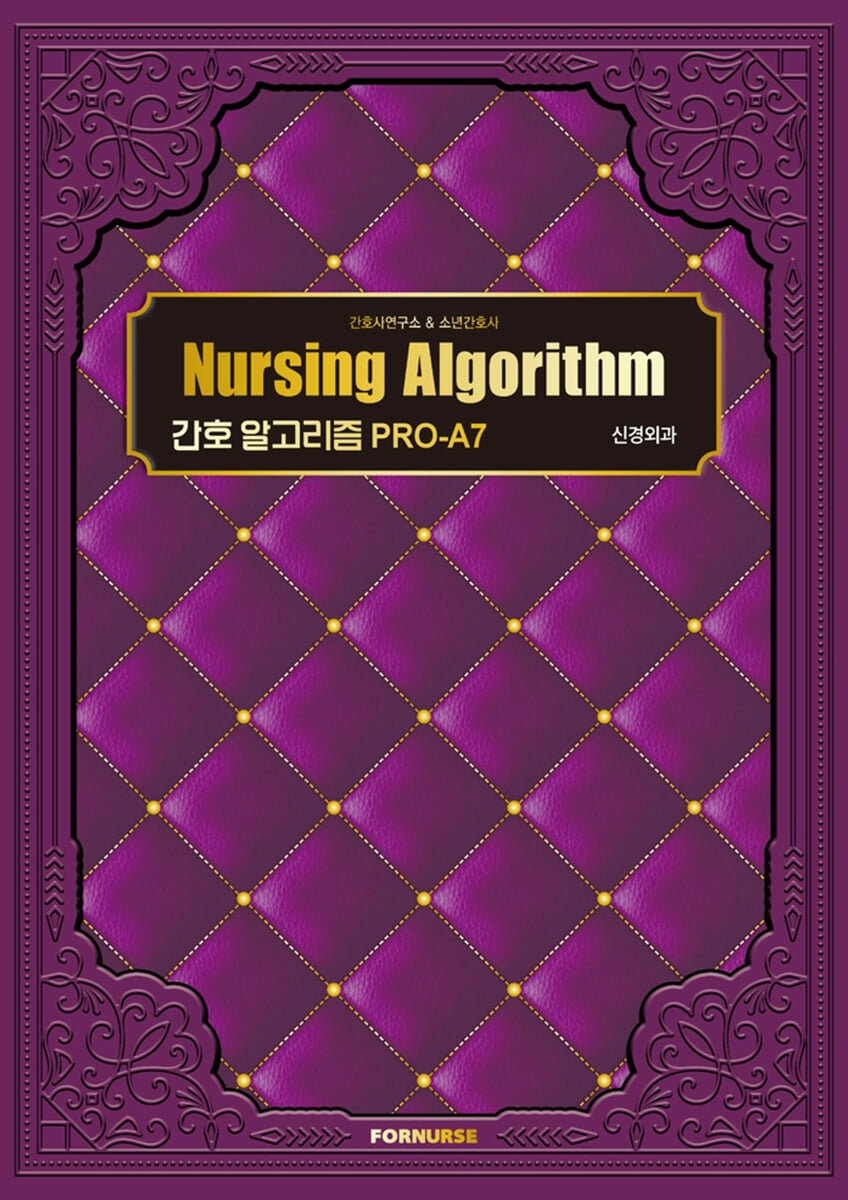
Nursing Algorithm PRO-A7: Neurosurgery
 |
Description
Book Introduction
『Nursing Algorithm PRO-A7.
The composition of ‘Neurosurgery’ is as follows.
· Greetings ·1.
Neurosurgery (Cerebral Hemorrhage & Cerebral Infarction), Vertebral Disease ·2.
Vital signs (blood pressure, heart rate, body temperature, respiratory rate) ·3.
Common nursing care (intravenous infusion therapy, blood tests, microbiological tests and antibiotics, blood transfusions, analgesia & sedation & Acting Out, oxygen therapy, fluid therapy, blood pressure raising drugs: vasopressors, management of organ transplant patients)
The composition of ‘Neurosurgery’ is as follows.
· Greetings ·1.
Neurosurgery (Cerebral Hemorrhage & Cerebral Infarction), Vertebral Disease ·2.
Vital signs (blood pressure, heart rate, body temperature, respiratory rate) ·3.
Common nursing care (intravenous infusion therapy, blood tests, microbiological tests and antibiotics, blood transfusions, analgesia & sedation & Acting Out, oxygen therapy, fluid therapy, blood pressure raising drugs: vasopressors, management of organ transplant patients)
index
Neurology 11
Cerebral Hemorrhage & Cerebral Infarction 13
Cerebral Hemorrhage & Cerebral Infarction - Why Algorithm: Developing Algorithmic Thinking Skills 14
Brain Tumors - Why Algorithm: Developing Algorithmic Thinking Skills 18
Common Nursing Assessment & Performance 22
1.
Neurological Assessment 22
2.
Blood Pressure Control: Intracerebral Hemorrhage (ICH) 24
3.
Blood Pressure Control: Ischemic Stroke 26
4.
Controlling Nausea & Vomiting 27
5.
Headache Control 29
6.
Increased intracranial pressure (IICP) 30
7.
Surgical Site Assessment & Drainage Management 33
8.
Seizure 37
Stroke Nursing Assessment & Practice 40
1.
Symptom onset detection 40
2.
Diagnostic Tests & Neurologist Consultation 40
3.
Treatment decisions based on test results 41
4.
Nursing care according to treatment 42
Neurosurgical Disease Surgical Treatment & Nursing 44
Neurological Disease Treatment & Nursing 54
1.
Surgical Treatment (Surgery) 54
Neurological medication 56
1.
Fluid 56
2.
Antibiotics 57
3.
Anticonvulsants & Antiepileptic drugs 58
4.
Anticoagulant 59
5.
Nausea & Vomiting 60
6.
60 intracranial pressure reducing drugs
7.
Other drugs 61
Neurological examination 62
1.
Brain CT 62
2.
Brain MRI 64
3.
Cerebral Angiography
: Transfemoral cerebral angiography (TFCA) 66
4.
Transcranial Doppler Ultrasound (TCD) 68
5.
Holter Monitor 69
6.
Carotid Doppler 69
7.
Lumbar puncture (Spinal tapping, Lumbar puncture, CSF tapping) 70
8.
Electroencephalogram (EEG) 72
9.
Blood test: infection 74
10.
Culture test 75
11.
Blood tests for bleeding 78
Vertebral Disease 81
Spinal Disease - Why Algorithm: Developing Algorithmic Thinking Skills 82
Common Nursing Assessment & Performance 86
1.
Radiation Pain & Numbness/Tingling 86
2.
Neurological Symptoms
: Paralysis, sensory disturbance, rigidity, spasticity 89
Situational Nursing Assessment & Practice 90
1.
Preoperative Nursing 91
2.
Intraoperative Nursing 97
3.
Postoperative Care 98
Post-Spine Surgery Care 100
Spinal Disease Test 104
1.
X-ray & CT & MRI 104
2.
Neurophysiological Test 105
3.
Other Tests 105
* Neurosurgical Nurse's Know-How 106
* 107 Questions for Neurosurgical Candidates
Vital Signs 109
Blood pressure 111
Hypertension - Why Algorithm: Developing Algorithmic Thinking Skills 112
Low Blood Pressure - Why Algorithm Developing Algorithmic Thinking Skills 114
Blood Pressure (BP) 116
Heart rate 123
Tachycardia - Why Algorithm: Developing Algorithmic Thinking Skills 124
Why Algorithm: Developing Algorithmic Thinking Skills 126
Heart Rate (HR) 128
Body temperature 139
High Temperature - Why Algorithm Developing Algorithmic Thinking Skills 140
Hypothermia - Why Algorithm: Developing Algorithmic Thinking Skills 142
Body Temperature (BT) 144
Respiration rate 153
Tachypnea - Why Algorithm: Developing Algorithmic Thinking Skills 154
Respiratory Depression - Why Algorithm Developing Algorithmic Thinking Skills 156
Respiratory Rate (RR) 158
Common Nursing 175
Intravenous therapy 177
1.
Main Dosage Methods of Drugs 178
2.
Major vein 179
3.
Types and characteristics of venous vessels 180
Blood test 185
1.
Major Blood Test Types and Specimens 186
2.
Specimens & Characteristics & Blood Collection Order by Blood Test Type 187
3.
Other important tests 188
Microbiological Testing and Antimicrobials 191
1.
Classification of microorganisms based on Gram (+) (-) results 193
2.
Multi-drug resistant organism (MDRO) 197
3.
Antibacterial 200
Blood transfusion 205
1.
Collection of transfusion products 206
2.
General transfusion tip 208
Pain Relief & Sedation & Acting Out 211
1.
Non-narcotic analgesics: used for mild pain 213
2.
Narcotic analgesics: used for moderate to severe pain 214
3.
Sedatives: administered in cases of delirium, agitation, or excitement 215
Acting Out (Risk of Self-Harm or Harm to Others) - Why Algorithm Developing Algorithmic Thinking Skills 216
Oxygen Therapy 219
1.
Oxygen delivery systems 220
2.
Is the patient receiving adequate oxygen? Oxygenation Indicators 221
Fluid Therapy 223
1.
Types of sap 224
2.
TIP 225: Choosing IV Fluids Based on Your Symptoms
Blood Pressure Raising Drugs: Vasopressors 227
Organ Transplant Patient Management 231
Cerebral Hemorrhage & Cerebral Infarction 13
Cerebral Hemorrhage & Cerebral Infarction - Why Algorithm: Developing Algorithmic Thinking Skills 14
Brain Tumors - Why Algorithm: Developing Algorithmic Thinking Skills 18
Common Nursing Assessment & Performance 22
1.
Neurological Assessment 22
2.
Blood Pressure Control: Intracerebral Hemorrhage (ICH) 24
3.
Blood Pressure Control: Ischemic Stroke 26
4.
Controlling Nausea & Vomiting 27
5.
Headache Control 29
6.
Increased intracranial pressure (IICP) 30
7.
Surgical Site Assessment & Drainage Management 33
8.
Seizure 37
Stroke Nursing Assessment & Practice 40
1.
Symptom onset detection 40
2.
Diagnostic Tests & Neurologist Consultation 40
3.
Treatment decisions based on test results 41
4.
Nursing care according to treatment 42
Neurosurgical Disease Surgical Treatment & Nursing 44
Neurological Disease Treatment & Nursing 54
1.
Surgical Treatment (Surgery) 54
Neurological medication 56
1.
Fluid 56
2.
Antibiotics 57
3.
Anticonvulsants & Antiepileptic drugs 58
4.
Anticoagulant 59
5.
Nausea & Vomiting 60
6.
60 intracranial pressure reducing drugs
7.
Other drugs 61
Neurological examination 62
1.
Brain CT 62
2.
Brain MRI 64
3.
Cerebral Angiography
: Transfemoral cerebral angiography (TFCA) 66
4.
Transcranial Doppler Ultrasound (TCD) 68
5.
Holter Monitor 69
6.
Carotid Doppler 69
7.
Lumbar puncture (Spinal tapping, Lumbar puncture, CSF tapping) 70
8.
Electroencephalogram (EEG) 72
9.
Blood test: infection 74
10.
Culture test 75
11.
Blood tests for bleeding 78
Vertebral Disease 81
Spinal Disease - Why Algorithm: Developing Algorithmic Thinking Skills 82
Common Nursing Assessment & Performance 86
1.
Radiation Pain & Numbness/Tingling 86
2.
Neurological Symptoms
: Paralysis, sensory disturbance, rigidity, spasticity 89
Situational Nursing Assessment & Practice 90
1.
Preoperative Nursing 91
2.
Intraoperative Nursing 97
3.
Postoperative Care 98
Post-Spine Surgery Care 100
Spinal Disease Test 104
1.
X-ray & CT & MRI 104
2.
Neurophysiological Test 105
3.
Other Tests 105
* Neurosurgical Nurse's Know-How 106
* 107 Questions for Neurosurgical Candidates
Vital Signs 109
Blood pressure 111
Hypertension - Why Algorithm: Developing Algorithmic Thinking Skills 112
Low Blood Pressure - Why Algorithm Developing Algorithmic Thinking Skills 114
Blood Pressure (BP) 116
Heart rate 123
Tachycardia - Why Algorithm: Developing Algorithmic Thinking Skills 124
Why Algorithm: Developing Algorithmic Thinking Skills 126
Heart Rate (HR) 128
Body temperature 139
High Temperature - Why Algorithm Developing Algorithmic Thinking Skills 140
Hypothermia - Why Algorithm: Developing Algorithmic Thinking Skills 142
Body Temperature (BT) 144
Respiration rate 153
Tachypnea - Why Algorithm: Developing Algorithmic Thinking Skills 154
Respiratory Depression - Why Algorithm Developing Algorithmic Thinking Skills 156
Respiratory Rate (RR) 158
Common Nursing 175
Intravenous therapy 177
1.
Main Dosage Methods of Drugs 178
2.
Major vein 179
3.
Types and characteristics of venous vessels 180
Blood test 185
1.
Major Blood Test Types and Specimens 186
2.
Specimens & Characteristics & Blood Collection Order by Blood Test Type 187
3.
Other important tests 188
Microbiological Testing and Antimicrobials 191
1.
Classification of microorganisms based on Gram (+) (-) results 193
2.
Multi-drug resistant organism (MDRO) 197
3.
Antibacterial 200
Blood transfusion 205
1.
Collection of transfusion products 206
2.
General transfusion tip 208
Pain Relief & Sedation & Acting Out 211
1.
Non-narcotic analgesics: used for mild pain 213
2.
Narcotic analgesics: used for moderate to severe pain 214
3.
Sedatives: administered in cases of delirium, agitation, or excitement 215
Acting Out (Risk of Self-Harm or Harm to Others) - Why Algorithm Developing Algorithmic Thinking Skills 216
Oxygen Therapy 219
1.
Oxygen delivery systems 220
2.
Is the patient receiving adequate oxygen? Oxygenation Indicators 221
Fluid Therapy 223
1.
Types of sap 224
2.
TIP 225: Choosing IV Fluids Based on Your Symptoms
Blood Pressure Raising Drugs: Vasopressors 227
Organ Transplant Patient Management 231
Detailed image

Publisher's Review
“Achieving perfection through two revisions!”
The best-selling book 『Nursing Algorithm』 by Ponals, which has sold over 10,000 copies and received much love from readers, has been reborn as 『Nursing Algorithm PRO-Series』 by the author, the Nurses' Research Institute, Boy Nurse, RN. Nogari, RNZY TV, and Yong, the photo-taking nurse.
The 『Nursing Algorithm PRO-Series』 began by analyzing the shortcomings of the existing 『Nursing Algorithm』, and then went through a process of finding solutions and restructuring to produce a sample book.
This is a nursing clinical practice book that was published after several revisions, including feedback from a nursing student opinion survey group through sample books and manuscript review by 21 experts, to make it more perfect.
The first feature of the book is that it adds a basis for why the nursing practice should be performed next to the algorithms in the existing 『Nursing Algorithm』.
The problem with the existing ‘Nursing Algorithm’ is that new nurses understand ‘how’ to perform nursing care after reading the algorithm, but they do not understand ‘why’ they should perform nursing care in that manner.
'Young Nurse', which best explains the basis of nursing practice, has worked hard to enable a fundamental understanding rather than a rushed clinical study by presenting the 'basis' of nursing practice next to the algorithm.
The second feature of the book is that it is divided into seven categories under a specialized classification system for each department, allowing you to study the content of the department that applies to you more professionally.
Each decentralized book is divided into three levels: a 'specialty part' where you can study theories centered on each clinical department, 'vital signs' where you can identify patients through abnormal findings, and 'common nursing' centered on each clinical department, enabling clinical reasoning from nurse readers.
The third feature of this book is that it was reviewed by 21 trustworthy, current experts to ensure that not only new nurses but also professional and dedicated nurses can fully utilize it.
The review team consists of current and former Big 5 nurses, nurses pursuing master's or doctoral degrees, and current nurses with more than 10 years of experience.
With the recent enactment of the Nursing Act, the burden on dedicated nurses and specialist nurses has increased.
For those who are anxious about being put into practice without proper training and those who are anxious even after receiving training, a nursing performance book similar to the doctor's clinical performance evaluation algorithm but more advanced was created.
Lastly, the book was boldly produced in A4, Big Size from a handbook-sized book, allowing readers to see the nursing algorithms of each department at a glance through the open pages of the book, and it has the advantage of allowing readers to study and take notes in a large size book.
The e-book 『Nursing Algorithm PRO-MAX』, which integrates all seven subjects, is scheduled to be published on November 20, 2024, and the paperback version is scheduled to be published on January 5, 2025.
The best-selling book 『Nursing Algorithm』 by Ponals, which has sold over 10,000 copies and received much love from readers, has been reborn as 『Nursing Algorithm PRO-Series』 by the author, the Nurses' Research Institute, Boy Nurse, RN. Nogari, RNZY TV, and Yong, the photo-taking nurse.
The 『Nursing Algorithm PRO-Series』 began by analyzing the shortcomings of the existing 『Nursing Algorithm』, and then went through a process of finding solutions and restructuring to produce a sample book.
This is a nursing clinical practice book that was published after several revisions, including feedback from a nursing student opinion survey group through sample books and manuscript review by 21 experts, to make it more perfect.
The first feature of the book is that it adds a basis for why the nursing practice should be performed next to the algorithms in the existing 『Nursing Algorithm』.
The problem with the existing ‘Nursing Algorithm’ is that new nurses understand ‘how’ to perform nursing care after reading the algorithm, but they do not understand ‘why’ they should perform nursing care in that manner.
'Young Nurse', which best explains the basis of nursing practice, has worked hard to enable a fundamental understanding rather than a rushed clinical study by presenting the 'basis' of nursing practice next to the algorithm.
The second feature of the book is that it is divided into seven categories under a specialized classification system for each department, allowing you to study the content of the department that applies to you more professionally.
Each decentralized book is divided into three levels: a 'specialty part' where you can study theories centered on each clinical department, 'vital signs' where you can identify patients through abnormal findings, and 'common nursing' centered on each clinical department, enabling clinical reasoning from nurse readers.
The third feature of this book is that it was reviewed by 21 trustworthy, current experts to ensure that not only new nurses but also professional and dedicated nurses can fully utilize it.
The review team consists of current and former Big 5 nurses, nurses pursuing master's or doctoral degrees, and current nurses with more than 10 years of experience.
With the recent enactment of the Nursing Act, the burden on dedicated nurses and specialist nurses has increased.
For those who are anxious about being put into practice without proper training and those who are anxious even after receiving training, a nursing performance book similar to the doctor's clinical performance evaluation algorithm but more advanced was created.
Lastly, the book was boldly produced in A4, Big Size from a handbook-sized book, allowing readers to see the nursing algorithms of each department at a glance through the open pages of the book, and it has the advantage of allowing readers to study and take notes in a large size book.
The e-book 『Nursing Algorithm PRO-MAX』, which integrates all seven subjects, is scheduled to be published on November 20, 2024, and the paperback version is scheduled to be published on January 5, 2025.
GOODS SPECIFICS
- Date of issue: December 31, 2024
- Page count, weight, size: 236 pages | 210*297*20mm
- ISBN13: 9791166275784
- ISBN10: 1166275787
You may also like
카테고리
korean


korean

![GQ KOREA Mark (Monthly): December [2025]](http://librairie.coreenne.fr/cdn/shop/files/8ef265dbbfbf186523ed75ba7319009d.jpg?v=1765340328&width=3840)


