

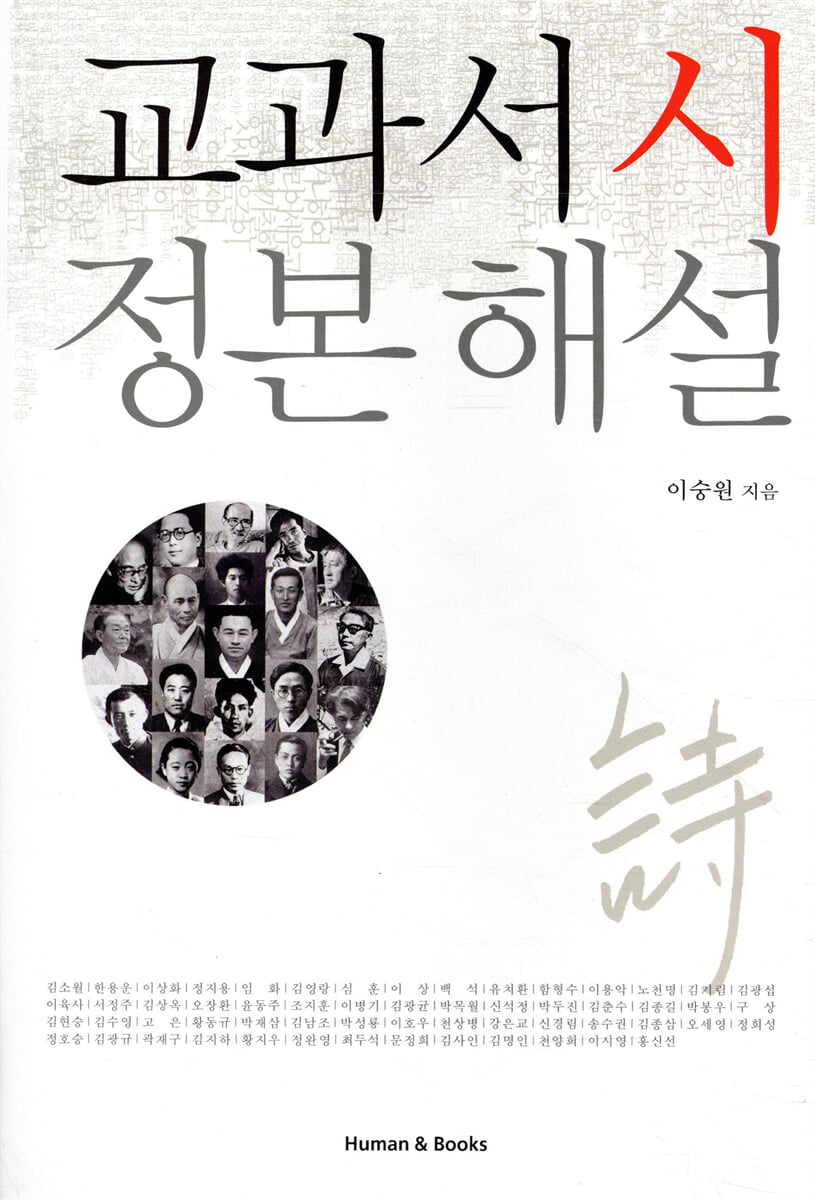
Textbook Poem Commentary
 |
Description
Book Introduction
This book collects 99 works that have been or will be included in textbooks, and explains their meaning and significance in a way that is easy for the general public to understand.
This book is designed for those who study poetry.
The main target audience is students learning poetry, teachers teaching poetry, and general readers interested in poetry.
The author aimed to correct errors in previously published commentaries on modern poetry and to suggest a method for correctly understanding modern poetry.
It contains an effort to convey the original story of the poem without damaging the original poem, without distorting the story.
This book will help the general public, as well as teachers and students, who wish to appreciate modern poetry, completely resolve the confusion and frustration they may feel when interpreting poetry.
This book is designed for those who study poetry.
The main target audience is students learning poetry, teachers teaching poetry, and general readers interested in poetry.
The author aimed to correct errors in previously published commentaries on modern poetry and to suggest a method for correctly understanding modern poetry.
It contains an effort to convey the original story of the poem without damaging the original poem, without distorting the story.
This book will help the general public, as well as teachers and students, who wish to appreciate modern poetry, completely resolve the confusion and frustration they may feel when interpreting poetry.
- You can preview some of the book's contents.
Preview
index
Lee Byeong-gi - Old Book
Kim Gwang-gyun - Chuil Seo-jeong
Park Mok-wol - The prayers of the wanderer, the deer, the lower body, and the man's father
Shin Seok-jeong - Flower Bush
Park Du-jin - The Sea, Cheongsando
Kim Chun-soo - Flowers, Poem for Flowers, Snow Falling in Chagall's Village
Kim Jong-gil - Christmas
Park Bong-woo - Military Demarcation Line
Concept - Poem of the Scorched Earth - In front of the enemy's graveyard
Kim Hyun-seung - Tears
Kim Soo-young - Snow, Grass
Go Eun - Eyes
Hwang Dong-gyu - A Happy Letter, A Little Love Song
Park Jae-sam - Autumn River with Tears, from Memories
Kim Nam-jo - Winter Sea
Park Sung-ryong - Suburbs
Lee Ho-woo - Hak
Heavenly Soldiers - Noble and Common
Kang Eun-kyo - We become water
Shin Kyeong-rim - Agricultural and Mokgye Market
Song Su-kwon - Leaning on Prose
Kim Jong-sam - Civilian, Someone Asked Me
Oh Se-young - Jewel
Jeong Hee-seong - Washing a shovel in the river at sunset
Jeong Ho-seung - Blind couple singers
Kim Gwang-gyu - The Old Shadow of Faint Love
Kwak Jae-gu - At Sapyeong Station
Kim Ji-ha - With a burning thirst
Hwang Ji-woo - Even birds leave this world
Jeong Wan-yeong - Eulsukdo
Choi Du-seok - Old House
Moon Jeong-hee - Thorn
Kim Sa-in - A Room on Earth
Kim Myung-in - You and a House
Cheon Yang-hee - The Sorghum Field of the Heart
Lee Si-young - Dawn
Open food for thought
Kim Gwang-gyun - Chuil Seo-jeong
Park Mok-wol - The prayers of the wanderer, the deer, the lower body, and the man's father
Shin Seok-jeong - Flower Bush
Park Du-jin - The Sea, Cheongsando
Kim Chun-soo - Flowers, Poem for Flowers, Snow Falling in Chagall's Village
Kim Jong-gil - Christmas
Park Bong-woo - Military Demarcation Line
Concept - Poem of the Scorched Earth - In front of the enemy's graveyard
Kim Hyun-seung - Tears
Kim Soo-young - Snow, Grass
Go Eun - Eyes
Hwang Dong-gyu - A Happy Letter, A Little Love Song
Park Jae-sam - Autumn River with Tears, from Memories
Kim Nam-jo - Winter Sea
Park Sung-ryong - Suburbs
Lee Ho-woo - Hak
Heavenly Soldiers - Noble and Common
Kang Eun-kyo - We become water
Shin Kyeong-rim - Agricultural and Mokgye Market
Song Su-kwon - Leaning on Prose
Kim Jong-sam - Civilian, Someone Asked Me
Oh Se-young - Jewel
Jeong Hee-seong - Washing a shovel in the river at sunset
Jeong Ho-seung - Blind couple singers
Kim Gwang-gyu - The Old Shadow of Faint Love
Kwak Jae-gu - At Sapyeong Station
Kim Ji-ha - With a burning thirst
Hwang Ji-woo - Even birds leave this world
Jeong Wan-yeong - Eulsukdo
Choi Du-seok - Old House
Moon Jeong-hee - Thorn
Kim Sa-in - A Room on Earth
Kim Myung-in - You and a House
Cheon Yang-hee - The Sorghum Field of the Heart
Lee Si-young - Dawn
Open food for thought
Into the book
It's been 30 years since I started teaching poetry at school.
I have taught many students over the years, and most of them unanimously said that after learning poetry from the teacher, poetry, which used to be difficult, became very interesting and endearing.
(Omitted) Listening to a lecture and reading a book may not be the same, but if readers who read this book feel familiar with poetry and become interested in reading poetry, I could not ask for more.
We hope you will join us on our journey to discover the true essence of poetry.
I have taught many students over the years, and most of them unanimously said that after learning poetry from the teacher, poetry, which used to be difficult, became very interesting and endearing.
(Omitted) Listening to a lecture and reading a book may not be the same, but if readers who read this book feel familiar with poetry and become interested in reading poetry, I could not ask for more.
We hope you will join us on our journey to discover the true essence of poetry.
---From the author's preface
Publisher's Review
A friendly guide for teachers of poetry!
A must-read for students studying poetry!
| Editor's Letter |
As my job is my job, I have carefully looked at my son's Korean language textbook while he is in high school.
The poem part.
Whether it was my son's sloppy handwriting or the teacher's faulty teaching, there were many interpretations of the poems that were schematic, mechanical, and simply unacceptable.
Looking at the reference book, it was the same.
Even if you study poetry to prepare for the exam, you will never be able to solve the problems if you study like that.
Especially these days, many of the college entrance exam questions are complex and require in-depth understanding (which is a good thing), so you can't aim for a high score without understanding the poem as a whole.
No, but more than that, I felt frustrated because the poem seemed to be fragmented.
It would not be an exaggeration to say that learning poetry from textbooks is the alpha and omega of learning poetry for almost all people, but learning poetry that way will lead you further away from poetry.
So, I thought that learning textbook poetry properly and enjoyably is very important for popularizing and expanding the base of Korean poetry, and furthermore, I thought that it is not the attitude of a critic to ignore that fun aspect.
When I gave such a passionate speech at a gathering, Professor Lee Soong-won, who was sitting next to me, said that he thought the same thing, so I suggested to Professor Lee Soong-won that he write a commentary on the textbook poem. People around him also encouraged Professor Lee Soong-won, saying that he was the right person for the job, and finally, Professor Lee Soong-won agreed, and that is how this book was started.
And it took exactly two years.
It was possible because Professor Lee Soong-won was on sabbatical at the time.
Although it may seem simple, selecting the poem, confirming the original text, and adding commentary to each one was a time-consuming, arduous, and tedious task.
As the title suggests, "The Original Commentary," I was extra careful to be thorough so as not to confuse students or teachers.
I would like to take this opportunity to express my sincere gratitude to Professor Lee Soong-won for his hard work.
And to give readers of this book some space to think, I've also included some food for thought that highlights key points.
That's how this book came into the world.
If there are any errors, we will correct them in the future and continue to expand it by adding good poems.
I hope this book will be of some help in serving as a guide to poetry and making poetry more enjoyable.
Ha Eung-baek (CEO of Human & Books, literary critic)
▷Reading poetry in its entirety for fun
The poetry commentaries in reference books and literature commentaries that students read are often extremely schematic and conventional.
Additionally, the notation and sources of the works are different.
For this reason, poetry remains a strange and ambiguous language structure full of metaphors and symbols, even in middle and high school and after entering university.
That's because I can't read the poem in its entirety.
So poetry is difficult and looks like some kind of monster.
『Textbook Poetry Commentary』 is a commentary on the 'original' modern poetry that addresses the above problems.
We have collected 99 works that have been or will be included in textbooks, and explained their meaning and significance in a way that is easy for the general public to understand.
This book is designed for those who study poetry.
The main target audience is students learning poetry, teachers teaching poetry, and general readers interested in poetry.
In the preface, the author says, "If readers who read this book feel more familiar with poetry and become interested in reading poetry, I could ask for nothing more."
▷ The complete version of textbook poetry review, the 'original' commentary!
Textbooks, reference books, and literature commentaries each offer different explanations, confusing students.
Teachers who teach poetry also find it difficult to choose from the many different textbooks available.
Indiscriminate commentary on modern poetry has made poetry difficult and hard to understand.
Literary critic Lee Soong-won, the author, revealed the problems with commentaries on modern poetry currently available in the market through the ‘Author’s Preface’ as follows.
“The ‘water-soaked star’ in Jeong Ji-yong’s ‘Glass Window’ has nothing to do with the ideal world, and I have seen a book that interpreted it that way, and the ‘meteorite’ in Yun Dong-ju’s ‘Confession’ is a poetic word with a very gloomy image, and there was also an article that interpreted it with the meaning of ‘shooting star’ and the aesthetics of astronomy.
There were even cases where the phrase “Where should I kneel” in Lee Yuk-sa’s “Climax” was interpreted as meaning “to surrender.”
If you're going to give in, why were you driven to the 'frosty blades of Jin' plateau to dream of a 'rainbow of steel'? Moreover, with different books offering different interpretations of the same verses and lines, it's bound to be confusing for students and teachers alike."
“The problem doesn’t end here.
The notation and sources of the works are not unified and vary.
The notation can be broadly divided into three categories: those that are written as they were at the time of publication, those that maintain the notation at the time of publication but modify only some of the pronunciation to fit modern language, and those that modify all notation to fit modern spelling.
When revealing the source of a work, for example, a work from the 1960s is presented, but a collection of poems published in the 1980s is cited as the source. For example, the source of Kim So-wol's "Azaleas" is stated as "1922, 『Gaebyeok』," but the actual citation of the work is in the form included in the poetry collection 『Azaleas』 (1925).
This means that multiple editions of the same work are distributed on the market, and students who have no choice in books end up learning works with different spellings depending on the book they are given.”
The author, literary critic Lee Soong-won, published “Textbook Poetry Commentary” to correct the errors in commentary on modern poetry and to suggest a way to correctly understand modern poetry.
The dictionary definition of 'original text' is a book that is judged to be the closest to the original through review and correction among books that have the same basic content but have some differences, such as literary works, and that can serve as a standard.
This book, as the name suggests, is a genuine text, as it conveys the original story of the poem without damaging it or distorting the story.
It will completely resolve the confusion and frustration felt by teachers and students about poetry commentary.
▷ A friendly and entertaining commentary on modern poetry by literary critic Lee Soong-won!
Students often study poetry as if they were memorizing formulas.
This is a metaphor, this is a simile, this is a symbol, and so on.
So, we don't see the whole picture and misunderstand the poem.
So how can we understand poetry?
The author says in the preface:
“When students encounter poetry, they tend to look for metaphors and symbols first, and they show impatience to find the theme before savoring the work.
These days, the poetry of young poets tends to cast aside everyday meaning and instead engage in light wordplay or unfold the shades of ambiguous images. Students who encounter such works are at a loss and are at a loss.
“We become so fixated on what a few lines imply that we fail to grasp the context and the overall outline of the poem.”
As the author says, to understand a poem, it is most important to understand the context and the overall outline of the poem.
To do this, we need to listen to the story of the poem.
The author provides accessible and entertaining commentary on modern poetry to help students understand it more easily.
It carefully and logically explains how the social situation at the time and the poet's personal experiences are reflected in the poem, and how this can be applied to universal humanity.
The author's commentary is completely different from other poetry commentaries that are extremely stiff.
As you recite the poems one stanza at a time, line by line, following the author's explanations, you will soon find yourself understanding the poems and accepting them with your heart.
▷ Food for thought!
One of the reasons why students only explore the theme and meaning of poetry is because the poetry exam questions have become standardized.
It can't be helped since each question only asks questions like, "What does this poem mean?" or "What is the theme of this poem?"
Since the primary readers of this book are students studying poetry and teachers teaching poetry, the author has included food for thought that can be reflected on after a deeper understanding of poetry.
That thought is at the very heart of the poem.
In other words, understanding poetry is completed through food for thought.
A must-read for students studying poetry!
| Editor's Letter |
As my job is my job, I have carefully looked at my son's Korean language textbook while he is in high school.
The poem part.
Whether it was my son's sloppy handwriting or the teacher's faulty teaching, there were many interpretations of the poems that were schematic, mechanical, and simply unacceptable.
Looking at the reference book, it was the same.
Even if you study poetry to prepare for the exam, you will never be able to solve the problems if you study like that.
Especially these days, many of the college entrance exam questions are complex and require in-depth understanding (which is a good thing), so you can't aim for a high score without understanding the poem as a whole.
No, but more than that, I felt frustrated because the poem seemed to be fragmented.
It would not be an exaggeration to say that learning poetry from textbooks is the alpha and omega of learning poetry for almost all people, but learning poetry that way will lead you further away from poetry.
So, I thought that learning textbook poetry properly and enjoyably is very important for popularizing and expanding the base of Korean poetry, and furthermore, I thought that it is not the attitude of a critic to ignore that fun aspect.
When I gave such a passionate speech at a gathering, Professor Lee Soong-won, who was sitting next to me, said that he thought the same thing, so I suggested to Professor Lee Soong-won that he write a commentary on the textbook poem. People around him also encouraged Professor Lee Soong-won, saying that he was the right person for the job, and finally, Professor Lee Soong-won agreed, and that is how this book was started.
And it took exactly two years.
It was possible because Professor Lee Soong-won was on sabbatical at the time.
Although it may seem simple, selecting the poem, confirming the original text, and adding commentary to each one was a time-consuming, arduous, and tedious task.
As the title suggests, "The Original Commentary," I was extra careful to be thorough so as not to confuse students or teachers.
I would like to take this opportunity to express my sincere gratitude to Professor Lee Soong-won for his hard work.
And to give readers of this book some space to think, I've also included some food for thought that highlights key points.
That's how this book came into the world.
If there are any errors, we will correct them in the future and continue to expand it by adding good poems.
I hope this book will be of some help in serving as a guide to poetry and making poetry more enjoyable.
Ha Eung-baek (CEO of Human & Books, literary critic)
▷Reading poetry in its entirety for fun
The poetry commentaries in reference books and literature commentaries that students read are often extremely schematic and conventional.
Additionally, the notation and sources of the works are different.
For this reason, poetry remains a strange and ambiguous language structure full of metaphors and symbols, even in middle and high school and after entering university.
That's because I can't read the poem in its entirety.
So poetry is difficult and looks like some kind of monster.
『Textbook Poetry Commentary』 is a commentary on the 'original' modern poetry that addresses the above problems.
We have collected 99 works that have been or will be included in textbooks, and explained their meaning and significance in a way that is easy for the general public to understand.
This book is designed for those who study poetry.
The main target audience is students learning poetry, teachers teaching poetry, and general readers interested in poetry.
In the preface, the author says, "If readers who read this book feel more familiar with poetry and become interested in reading poetry, I could ask for nothing more."
▷ The complete version of textbook poetry review, the 'original' commentary!
Textbooks, reference books, and literature commentaries each offer different explanations, confusing students.
Teachers who teach poetry also find it difficult to choose from the many different textbooks available.
Indiscriminate commentary on modern poetry has made poetry difficult and hard to understand.
Literary critic Lee Soong-won, the author, revealed the problems with commentaries on modern poetry currently available in the market through the ‘Author’s Preface’ as follows.
“The ‘water-soaked star’ in Jeong Ji-yong’s ‘Glass Window’ has nothing to do with the ideal world, and I have seen a book that interpreted it that way, and the ‘meteorite’ in Yun Dong-ju’s ‘Confession’ is a poetic word with a very gloomy image, and there was also an article that interpreted it with the meaning of ‘shooting star’ and the aesthetics of astronomy.
There were even cases where the phrase “Where should I kneel” in Lee Yuk-sa’s “Climax” was interpreted as meaning “to surrender.”
If you're going to give in, why were you driven to the 'frosty blades of Jin' plateau to dream of a 'rainbow of steel'? Moreover, with different books offering different interpretations of the same verses and lines, it's bound to be confusing for students and teachers alike."
“The problem doesn’t end here.
The notation and sources of the works are not unified and vary.
The notation can be broadly divided into three categories: those that are written as they were at the time of publication, those that maintain the notation at the time of publication but modify only some of the pronunciation to fit modern language, and those that modify all notation to fit modern spelling.
When revealing the source of a work, for example, a work from the 1960s is presented, but a collection of poems published in the 1980s is cited as the source. For example, the source of Kim So-wol's "Azaleas" is stated as "1922, 『Gaebyeok』," but the actual citation of the work is in the form included in the poetry collection 『Azaleas』 (1925).
This means that multiple editions of the same work are distributed on the market, and students who have no choice in books end up learning works with different spellings depending on the book they are given.”
The author, literary critic Lee Soong-won, published “Textbook Poetry Commentary” to correct the errors in commentary on modern poetry and to suggest a way to correctly understand modern poetry.
The dictionary definition of 'original text' is a book that is judged to be the closest to the original through review and correction among books that have the same basic content but have some differences, such as literary works, and that can serve as a standard.
This book, as the name suggests, is a genuine text, as it conveys the original story of the poem without damaging it or distorting the story.
It will completely resolve the confusion and frustration felt by teachers and students about poetry commentary.
▷ A friendly and entertaining commentary on modern poetry by literary critic Lee Soong-won!
Students often study poetry as if they were memorizing formulas.
This is a metaphor, this is a simile, this is a symbol, and so on.
So, we don't see the whole picture and misunderstand the poem.
So how can we understand poetry?
The author says in the preface:
“When students encounter poetry, they tend to look for metaphors and symbols first, and they show impatience to find the theme before savoring the work.
These days, the poetry of young poets tends to cast aside everyday meaning and instead engage in light wordplay or unfold the shades of ambiguous images. Students who encounter such works are at a loss and are at a loss.
“We become so fixated on what a few lines imply that we fail to grasp the context and the overall outline of the poem.”
As the author says, to understand a poem, it is most important to understand the context and the overall outline of the poem.
To do this, we need to listen to the story of the poem.
The author provides accessible and entertaining commentary on modern poetry to help students understand it more easily.
It carefully and logically explains how the social situation at the time and the poet's personal experiences are reflected in the poem, and how this can be applied to universal humanity.
The author's commentary is completely different from other poetry commentaries that are extremely stiff.
As you recite the poems one stanza at a time, line by line, following the author's explanations, you will soon find yourself understanding the poems and accepting them with your heart.
▷ Food for thought!
One of the reasons why students only explore the theme and meaning of poetry is because the poetry exam questions have become standardized.
It can't be helped since each question only asks questions like, "What does this poem mean?" or "What is the theme of this poem?"
Since the primary readers of this book are students studying poetry and teachers teaching poetry, the author has included food for thought that can be reflected on after a deeper understanding of poetry.
That thought is at the very heart of the poem.
In other words, understanding poetry is completed through food for thought.
GOODS SPECIFICS
- Date of issue: July 28, 2008
- Page count, weight, size: 568 pages | 849g | 152*223*35mm
- ISBN13: 9788960780439
- ISBN10: 896078043X
You may also like
카테고리
korean


korean

![GQ KOREA Mark (Monthly): December [2025]](http://librairie.coreenne.fr/cdn/shop/files/8ef265dbbfbf186523ed75ba7319009d.jpg?v=1765340328&width=3840)


