

Aesthetic thought of our people
 |
Description
Book Introduction
As the Korean Wave is gaining global attention, this book makes us look back at the roots of our art.
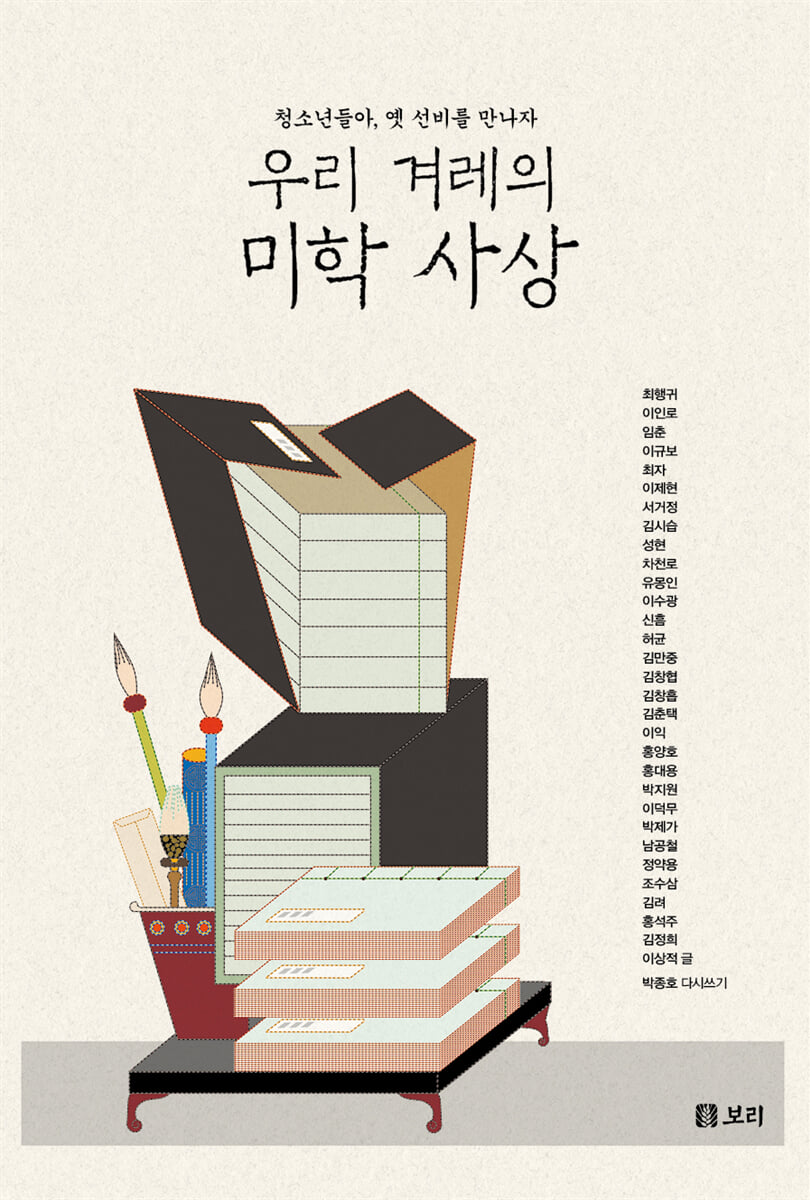
《The Aesthetic Thought of Our People - Young People, Let's Meet the Scholars of Old》 collects the writings of thirty-one scholars who have illuminated our literary history, from Yi Gyu-bo of Goryeo to Park Ji-won, Jeong Yak-yong, and Kim Jeong-hui of Joseon.
It retells the thoughts on literature and art left by people of old in today's language.
Centered around the questions, “What is good writing? What is beauty?”, author Jong-ho Park, who has taught Korean for 35 years, has refined the book to suit the level of young readers and added friendly commentary.
We can examine our people's aesthetic sense and philosophy through the writings of ancient scholars.
《The Aesthetic Thought of Our People - Young People, Let's Meet the Scholars of Old》 collects the writings of thirty-one scholars who have illuminated our literary history, from Yi Gyu-bo of Goryeo to Park Ji-won, Jeong Yak-yong, and Kim Jeong-hui of Joseon.
It retells the thoughts on literature and art left by people of old in today's language.
Centered around the questions, “What is good writing? What is beauty?”, author Jong-ho Park, who has taught Korean for 35 years, has refined the book to suit the level of young readers and added friendly commentary.
We can examine our people's aesthetic sense and philosophy through the writings of ancient scholars.
- You can preview some of the book's contents.
Preview
index
Part 1: The poem comes from the sky
Korean and Chinese Poetry | Choi Haeng-Gwi 14
Flowing from the spring of the heart | Lee In-ro 15
The Most Important Thing in Writing | Lim Chun, 18
Is Sentence Rhyme That Important? | Lim Chun, 19
Recording the Song of King Dongmyeong | Lee Gyu-bo 20
Nine Inappropriate Writing Styles | Lee Gyu-bo 23
Putting New Meanings into New Words|Lee Gyu-bo 26
The Divine Power of the Poet | Lee Gyu-bo 28
A Poetry Essay on Exorcising Ghosts | Lee Gyu-bo 30
The meaning of poetry comes from heaven | Lee Gyu-bo 36
Burning Poetry | Lee Gyu-bo 39
Sending it back to Son Deuk-ji | Lee Gyu-bo 40
I Sing a Song of Two White Herons | Lee Gyu-bo, 45
To You Who Failed the Exam | Lee Gyu-bo 47
Poetry should express feelings | Lee Gyu-bo 49
What a Poet Must Have | Choi Ja 51
Lee Ji-sim's Poetry | Choi Ja 55
People Learning Poetry Now | Choi Ja 57
The Quality and Content of Poetry, Poetic Language and Rhyme|Choi Ja 59
Understanding Poetry is Difficult | Choi Ja 61
Preface to the first volume of "The Story of the Reverse Ongpaeseol" | Lee Je-hyeon 65
Preface to the second part of the "Reverse Ongpaeseol" | Lee Je-hyeon 67
Poets' Poems Are All Different | Lee Je-Hyeon 69
Jeong Ji-sang's Poetry | Lee Je-hyeon 71
Techniques of Poetry | Lee Je-hyeon 73
Appreciating Difficult Poetry | Lee Je-hyeon 76
Poetry by Im Chun and Choi Ja | Lee Je-hyeon 77
Expressing the meaning in words | Lee Je-Hyeon 79
Part 2: To write anything
Poetry Must Lead with Spirit | Seo Geo-jeong 82
Describe it as if you were seeing it right before your eyes | Seo Geo-jeong 85
It's Difficult to Understand Poetry | Seo Geo-jeong 87
There is a hierarchy of works | Seo Geo-jeong 88
The Function of Poetry | Seo Geo-jeong 89
Long Poems by Lee Gyu-bo and Lee Saek | Seo Geo-jeong 91
The Relationship Between Literature and Martial Arts | Seo Geo-jeong 92
Sentences Must Be Learned from Travel and Reality | Seo Geo-jeong 94
Reading books and traveling|Seo Geo-jeong 96
Why Are Literati So Unfortunate? | Seo Geo-jeong 97
Poetry is a spring of cold water | Kim Si-seup 98
As I Feel | Kim Si-seup 99
To write anything|Kim Si-seup 100
Song of Qu Yuan | Kim Si-seup 102
Korean Literati|Sunghyeon 104
Korean Painters | Seonghyeon 107
Korean Musicians | Seonghyeon 109
Part 3: The Woodcutter and the Woman's Song
Poets are the clearest people | Chacheon-ro 114
Poetry is a grand event forever | Chacheon-ro 115
Poetry is an expression of thought and emotion | Yu Mong-in 116
What Does Poetry Do? | Yumong-in 117
Poetry Reflects Life | Yumong-in 118
Kim Si-seup's satirical poem | Yu Mong-in 120
The difficult part is the conception. Yumong-in 122
Similarities Between the Picture and the Sentence | Yumong-in 124
An Gyeon's Bamboo Painting | Yu Mong-in 126
What's Important in a Sentence | Lee Su-gwang 128
The Mysterious Realm of Painting | Shin Heum 134
Written in Kim Saeng's "Gwandongdo" | Shin Heum 135
Baek Gwang-hoon's Poetry | Shin Heum 136
Jeong Cheol's Poetry | Shin Heum 137
Staying Still | Heo Gyun 138
Two Poems | Heo Gyun 139
The Woodcutter's Boy and the Water-Fetching Woman's Words | Kim Man-jung 141
Why I Write Novels | Kim Man-jung 142
Studying Song, Ming, and Tang Poetry | Kim Chang-hyeop 143
Kim Man-jung's Sentences | Kim Chang-heup 145
Communication between Nature and the Mind | Kim Chang-heup 146
Prose and Poetry, Poetry and Music | Kim Chang-heup 147
There's a special talent for knowing poetry | Kim Chang-heup 148
Over-polishing sentences | Kim Chang-heup 149
Understanding Jo's Sentence | Kim Chang-heup 150
Choi Hyo-geon's Poetry: Escape from the Poetry Illnesses of Poetry | Kim Chang-heup 151
Songs and Novels Written in Korean | Kim Chun-taek 152
The world is mired in a pit of profit and desire|Profit 156
Part 4: True Poetry Speaks Its Own Voice
All songs come from folk songs | Hong Yang-ho 160
A sentence is like a lake | Hong Yang-ho 161
A sentence is not something that decorates a phrase. | Hong Yang-ho 162
Past and Present | Hong Yang-ho 163
Poetry is a bursting sound | Hong Yang-ho 164
Poems from the Heart | Hong Dae-yong 165
A Letter to the Sixth Patriarch | Hong Dae-yong 168
A Letter to Son Yu-ui | Hong Dae-yong 170
A Letter to Ban Jeong-gyun | Hong Dae-yong 171
Writing should be done with sincerity only | Park Ji-won 172
Lost etiquette: Go to the countryside to find it | Park Ji-won 175
A Writing Containing Poetic Thoughts|Park Ji-won 179
Lee Deok-mu's Poetry is a Joseon Song | Park Ji-won 182
Forget everything, even if it's just a little trick | Park Ji-won 186
I haven't looked into the old stuff enough | Park Ji-won 188
The vulgarity of everyday life is all reality | Park Ji-won 191
A Writing that Won Hundreds of Battles | Park Ji-won 194
You must not hide your name|Park Ji-won 198
Close Your Eyes on the Road | Park Ji-won 200
He who does not know painting does not know poetry | Park Ji-won 202
At Songgang Jeongcheol's Grave | Lee Deokmu 204
Lee Je-hyeon's Poetry | Lee Deok-mu 205
Friendship and Friendship|Lee Deok-mu 206
Lee Eun-jin's Poetry | Lee Deok-mu 208
Standard Poetry | Lee Deok-mu 210
Outstanding Description | Lee Deok-mu 211
Poem by Park Jae-ga | Lee Deok-mu 212
Yeonam Park Ji-won | Lee Deok-mu 214
All true poetry speaks for itself. | Park Je-ga 216
Sing the 5th Era
Imitation is not a sentence | Nam Gong-cheol 220
The Tile Technique in Sentences|Nam Gong-cheol 221
All Torture Is a Lie | Nam Gong-cheol 223
The Geomungo is Closest to Poetry | Nam Gong-cheol 224
A beautifully written and logical piece | Nam Gong-cheol 225
The Order of Learning Sentences | Nam Gong-cheol 226
Even literary styles change with the times | Jeong Yak-yong 227
What is a True Sentence? | Jeong Yak-yong 229
The Purpose of Music | Jeong Yak-yong 232
The Effects of Music | Jeong Yak-yong 234
Art is not achieved overnight. | Jeong Yak-yong 236
A Great Sentence, a True Sentence | Jeong Yak-yong 238
Poetry is the expression of meaning | Jeong Yak-yong 239
The Mindset of Writing Poetry | Jeong Yak-yong 240
To Write | Jeong Yak-yong 242
Honam's Talented Yoo Yun-oh | Jo Su-sam 244
Writing Habits of My Youth | Jo Su-sam 247
"I am a human now" | Kim Ryeo 249
On criticizing Lee Ok|Kim Ryeo 250
Seeing a sentence is like seeing a flower | Kim Ryeo 251
The Virtuous One's Sentences Are Beautiful | Hong Seok-ju 252
Old Words and New Words | Hong Seok-ju 254
Poetry should move people | Hong Seok-ju 257
The Mysterious Taste of Sentences | Kim Jeong-hee 261
Don't Deceive Yourself | Kim Jeong-hee 262
Song of the Times | Kim Jeong-hee 263
Writing and Emotions | Ideal 267
Poetry is a painting, and a painting is a poem|Ideal 268
Reading our classics in depth
* Art and Aesthetics of Our People 272
* The Writing Spirit of Scholars 275
* Why You Should Read the Classics Today 284
Search 286
Korean and Chinese Poetry | Choi Haeng-Gwi 14
Flowing from the spring of the heart | Lee In-ro 15
The Most Important Thing in Writing | Lim Chun, 18
Is Sentence Rhyme That Important? | Lim Chun, 19
Recording the Song of King Dongmyeong | Lee Gyu-bo 20
Nine Inappropriate Writing Styles | Lee Gyu-bo 23
Putting New Meanings into New Words|Lee Gyu-bo 26
The Divine Power of the Poet | Lee Gyu-bo 28
A Poetry Essay on Exorcising Ghosts | Lee Gyu-bo 30
The meaning of poetry comes from heaven | Lee Gyu-bo 36
Burning Poetry | Lee Gyu-bo 39
Sending it back to Son Deuk-ji | Lee Gyu-bo 40
I Sing a Song of Two White Herons | Lee Gyu-bo, 45
To You Who Failed the Exam | Lee Gyu-bo 47
Poetry should express feelings | Lee Gyu-bo 49
What a Poet Must Have | Choi Ja 51
Lee Ji-sim's Poetry | Choi Ja 55
People Learning Poetry Now | Choi Ja 57
The Quality and Content of Poetry, Poetic Language and Rhyme|Choi Ja 59
Understanding Poetry is Difficult | Choi Ja 61
Preface to the first volume of "The Story of the Reverse Ongpaeseol" | Lee Je-hyeon 65
Preface to the second part of the "Reverse Ongpaeseol" | Lee Je-hyeon 67
Poets' Poems Are All Different | Lee Je-Hyeon 69
Jeong Ji-sang's Poetry | Lee Je-hyeon 71
Techniques of Poetry | Lee Je-hyeon 73
Appreciating Difficult Poetry | Lee Je-hyeon 76
Poetry by Im Chun and Choi Ja | Lee Je-hyeon 77
Expressing the meaning in words | Lee Je-Hyeon 79
Part 2: To write anything
Poetry Must Lead with Spirit | Seo Geo-jeong 82
Describe it as if you were seeing it right before your eyes | Seo Geo-jeong 85
It's Difficult to Understand Poetry | Seo Geo-jeong 87
There is a hierarchy of works | Seo Geo-jeong 88
The Function of Poetry | Seo Geo-jeong 89
Long Poems by Lee Gyu-bo and Lee Saek | Seo Geo-jeong 91
The Relationship Between Literature and Martial Arts | Seo Geo-jeong 92
Sentences Must Be Learned from Travel and Reality | Seo Geo-jeong 94
Reading books and traveling|Seo Geo-jeong 96
Why Are Literati So Unfortunate? | Seo Geo-jeong 97
Poetry is a spring of cold water | Kim Si-seup 98
As I Feel | Kim Si-seup 99
To write anything|Kim Si-seup 100
Song of Qu Yuan | Kim Si-seup 102
Korean Literati|Sunghyeon 104
Korean Painters | Seonghyeon 107
Korean Musicians | Seonghyeon 109
Part 3: The Woodcutter and the Woman's Song
Poets are the clearest people | Chacheon-ro 114
Poetry is a grand event forever | Chacheon-ro 115
Poetry is an expression of thought and emotion | Yu Mong-in 116
What Does Poetry Do? | Yumong-in 117
Poetry Reflects Life | Yumong-in 118
Kim Si-seup's satirical poem | Yu Mong-in 120
The difficult part is the conception. Yumong-in 122
Similarities Between the Picture and the Sentence | Yumong-in 124
An Gyeon's Bamboo Painting | Yu Mong-in 126
What's Important in a Sentence | Lee Su-gwang 128
The Mysterious Realm of Painting | Shin Heum 134
Written in Kim Saeng's "Gwandongdo" | Shin Heum 135
Baek Gwang-hoon's Poetry | Shin Heum 136
Jeong Cheol's Poetry | Shin Heum 137
Staying Still | Heo Gyun 138
Two Poems | Heo Gyun 139
The Woodcutter's Boy and the Water-Fetching Woman's Words | Kim Man-jung 141
Why I Write Novels | Kim Man-jung 142
Studying Song, Ming, and Tang Poetry | Kim Chang-hyeop 143
Kim Man-jung's Sentences | Kim Chang-heup 145
Communication between Nature and the Mind | Kim Chang-heup 146
Prose and Poetry, Poetry and Music | Kim Chang-heup 147
There's a special talent for knowing poetry | Kim Chang-heup 148
Over-polishing sentences | Kim Chang-heup 149
Understanding Jo's Sentence | Kim Chang-heup 150
Choi Hyo-geon's Poetry: Escape from the Poetry Illnesses of Poetry | Kim Chang-heup 151
Songs and Novels Written in Korean | Kim Chun-taek 152
The world is mired in a pit of profit and desire|Profit 156
Part 4: True Poetry Speaks Its Own Voice
All songs come from folk songs | Hong Yang-ho 160
A sentence is like a lake | Hong Yang-ho 161
A sentence is not something that decorates a phrase. | Hong Yang-ho 162
Past and Present | Hong Yang-ho 163
Poetry is a bursting sound | Hong Yang-ho 164
Poems from the Heart | Hong Dae-yong 165
A Letter to the Sixth Patriarch | Hong Dae-yong 168
A Letter to Son Yu-ui | Hong Dae-yong 170
A Letter to Ban Jeong-gyun | Hong Dae-yong 171
Writing should be done with sincerity only | Park Ji-won 172
Lost etiquette: Go to the countryside to find it | Park Ji-won 175
A Writing Containing Poetic Thoughts|Park Ji-won 179
Lee Deok-mu's Poetry is a Joseon Song | Park Ji-won 182
Forget everything, even if it's just a little trick | Park Ji-won 186
I haven't looked into the old stuff enough | Park Ji-won 188
The vulgarity of everyday life is all reality | Park Ji-won 191
A Writing that Won Hundreds of Battles | Park Ji-won 194
You must not hide your name|Park Ji-won 198
Close Your Eyes on the Road | Park Ji-won 200
He who does not know painting does not know poetry | Park Ji-won 202
At Songgang Jeongcheol's Grave | Lee Deokmu 204
Lee Je-hyeon's Poetry | Lee Deok-mu 205
Friendship and Friendship|Lee Deok-mu 206
Lee Eun-jin's Poetry | Lee Deok-mu 208
Standard Poetry | Lee Deok-mu 210
Outstanding Description | Lee Deok-mu 211
Poem by Park Jae-ga | Lee Deok-mu 212
Yeonam Park Ji-won | Lee Deok-mu 214
All true poetry speaks for itself. | Park Je-ga 216
Sing the 5th Era
Imitation is not a sentence | Nam Gong-cheol 220
The Tile Technique in Sentences|Nam Gong-cheol 221
All Torture Is a Lie | Nam Gong-cheol 223
The Geomungo is Closest to Poetry | Nam Gong-cheol 224
A beautifully written and logical piece | Nam Gong-cheol 225
The Order of Learning Sentences | Nam Gong-cheol 226
Even literary styles change with the times | Jeong Yak-yong 227
What is a True Sentence? | Jeong Yak-yong 229
The Purpose of Music | Jeong Yak-yong 232
The Effects of Music | Jeong Yak-yong 234
Art is not achieved overnight. | Jeong Yak-yong 236
A Great Sentence, a True Sentence | Jeong Yak-yong 238
Poetry is the expression of meaning | Jeong Yak-yong 239
The Mindset of Writing Poetry | Jeong Yak-yong 240
To Write | Jeong Yak-yong 242
Honam's Talented Yoo Yun-oh | Jo Su-sam 244
Writing Habits of My Youth | Jo Su-sam 247
"I am a human now" | Kim Ryeo 249
On criticizing Lee Ok|Kim Ryeo 250
Seeing a sentence is like seeing a flower | Kim Ryeo 251
The Virtuous One's Sentences Are Beautiful | Hong Seok-ju 252
Old Words and New Words | Hong Seok-ju 254
Poetry should move people | Hong Seok-ju 257
The Mysterious Taste of Sentences | Kim Jeong-hee 261
Don't Deceive Yourself | Kim Jeong-hee 262
Song of the Times | Kim Jeong-hee 263
Writing and Emotions | Ideal 267
Poetry is a painting, and a painting is a poem|Ideal 268
Reading our classics in depth
* Art and Aesthetics of Our People 272
* The Writing Spirit of Scholars 275
* Why You Should Read the Classics Today 284
Search 286
Into the book
What is poetry?
Poetry is a spring of cold water
When I hit a rock, I cry and sob
When you put it on the nail, it is quiet and not noisy.
It looks like an ordinary class
It is difficult to explain the strange truth.
--- p.98, from the text “Poetry is a spring of cold water_ Kim Si-seup”
There was also an old painting known as a masterpiece, which depicted an old grandfather holding his grandchild in his arms and feeding him rice with a spoon.
The brushwork was vibrant and seemed alive.
King Seongjong evaluated this painting as follows:
“This picture is good, but when people feed a child, their mouths naturally open, but this picture has its mouths closed, so it doesn’t fit the class.”
So this picture was also abandoned.
What's the difference between a picture and a sentence?
If it deviates from the truth even slightly, no matter how many false words are used, a person who knows the sentence will not accept it.
A discerning person knows this.
--- p.124, from the text “Similarities between pictures and sentences_ Yu Mong-in”
Nowadays, our country's poets are abandoning their own language and learning foreign languages, and no matter how similar they may be, they are nothing more than parrots imitating people.
The humming of the village woodcutter and the water-drawing women, though vulgar, cannot be compared to the poems of the nobles if one is to judge between truth and falsehood.
--- p.141, from the text “The Woodcutter Boy and the Water-Fetching Woman’s Words_ Kim Man-jung”
Writing is enough to express meaning.
Some people, after thinking about a title and taking up a brush, suddenly think of old sayings and force themselves to find stories from classics, decorate the meaning with solemnity and make each letter solemn.
It's like calling a painter to paint a portrait and then changing your appearance.
The pupils do not roll and the clothes do not wrinkle, so it is different from the usual appearance, so even the best painter would have difficulty portraying the true appearance.
What's different about people who write?
--- p.172, from the text “Only truth is required in writing_ Park Ji-won”
I'm imitating others and shouting loudly
The spirit of poetry is already dead
It smells good.
Forcibly maintaining the spirit of old poetry
I tried to build up my reputation by force,
Poor thing, it's rotting away
The most sacred thing to be held in high esteem
It will not become a song of the times.
Poetry is a spring of cold water
When I hit a rock, I cry and sob
When you put it on the nail, it is quiet and not noisy.
It looks like an ordinary class
It is difficult to explain the strange truth.
--- p.98, from the text “Poetry is a spring of cold water_ Kim Si-seup”
There was also an old painting known as a masterpiece, which depicted an old grandfather holding his grandchild in his arms and feeding him rice with a spoon.
The brushwork was vibrant and seemed alive.
King Seongjong evaluated this painting as follows:
“This picture is good, but when people feed a child, their mouths naturally open, but this picture has its mouths closed, so it doesn’t fit the class.”
So this picture was also abandoned.
What's the difference between a picture and a sentence?
If it deviates from the truth even slightly, no matter how many false words are used, a person who knows the sentence will not accept it.
A discerning person knows this.
--- p.124, from the text “Similarities between pictures and sentences_ Yu Mong-in”
Nowadays, our country's poets are abandoning their own language and learning foreign languages, and no matter how similar they may be, they are nothing more than parrots imitating people.
The humming of the village woodcutter and the water-drawing women, though vulgar, cannot be compared to the poems of the nobles if one is to judge between truth and falsehood.
--- p.141, from the text “The Woodcutter Boy and the Water-Fetching Woman’s Words_ Kim Man-jung”
Writing is enough to express meaning.
Some people, after thinking about a title and taking up a brush, suddenly think of old sayings and force themselves to find stories from classics, decorate the meaning with solemnity and make each letter solemn.
It's like calling a painter to paint a portrait and then changing your appearance.
The pupils do not roll and the clothes do not wrinkle, so it is different from the usual appearance, so even the best painter would have difficulty portraying the true appearance.
What's different about people who write?
--- p.172, from the text “Only truth is required in writing_ Park Ji-won”
I'm imitating others and shouting loudly
The spirit of poetry is already dead
It smells good.
Forcibly maintaining the spirit of old poetry
I tried to build up my reputation by force,
Poor thing, it's rotting away
The most sacred thing to be held in high esteem
It will not become a song of the times.
--- p.265, from the text “Song of the Times_ Kim Jeong-hee”
Publisher's Review
The Essence of Literature and Art Found in the Writings of Scholars
For our scholars, poetry, writing, painting, and music are not mere hobbies, but ‘the work of revealing the truth.’
"The Aesthetic Thought of Our People - Young People, Let's Meet the Scholars of Old" compiles writings on literature and art left behind by scholars, addressing the questions, "What is true writing?" and "Where does beauty come from?"
This book is filled with sentences that resonate across time, such as “Poetry is a spring of cold water” (Kim Si-seup), “Only truth must be used in writing” (Park Ji-won), and “The song of the village woodcutter boy and the water-drawing woman is better than the poetry of the nobleman” (Kim Man-jung).
The words passed down by scholars hundreds of years ago are still vivid today.
It makes young people who want to create something new think about what they should include in their creations and what is truly beautiful.
The writings of 31 scholars who have illuminated our literary history in one place
From Choi Haeng-gwi, who introduced the Korean language song Hyangga, to Lee Gyu-bo, who left behind the Dongmyeongwangpyeon, to Kim Si-seup, who wrote the Geumosinhwa, to Yu Mong-in, a master of folktale literature, to Park Ji-won and Jeong Yak-yong, thinkers ahead of their time, to Kim Jeong-hui, who brought various arts to fruition, we have gathered together the writings of thirty-one scholars representing a thousand years of Korean literary history.
Their writings include writers from the Silla period, such as Choi Chi-won and Seol Chong, as well as scholars from the late Joseon period, such as Lee Ok, who used a new literary style.
The writings of scholars contain a common spirit that transcends time.
He tried to look straight at the lives of the people and to set the world right by revealing the absurdity and contradictions of the times.
They sought to capture truth in their writings, and they cherished the value of art, which is imbued with the lives of the people, and literature written in our own language and script.
And we tried to protect the individuality and pride of our people.
The writing spirit of our scholars poses the question to our youth today: "How should we write? For what purpose should we write?"
Deep works, easy-to-read classics
The essays in this book contain profound content about literature and art, but they are by no means dry or difficult.
Mr. Jong-ho Park, who has been teaching Korean for 35 years, has reorganized the texts written in the form of poems, interesting stories, letters, and book introductions so that even young people can easily read them.
You can encounter major texts from 《Dongguk Yisanggukjip》, 《Pahanjip》, 《Maewoldangjip》, 《Eouyadam》, and 《Yeonamjip》, which you only saw the names of in textbooks, as well as works such as 'Writing to Drive Out the Ghosts of Poetry' (Lee Gyu-bo), 'Preface to Yeokongpaeseol' (Lee Je-hyeon), 'Words of the Woodcutter Boy and the Water-Drawing Woman' (Kim Man-jung), and 'Close Your Eyes Again' (Park Ji-won).
By following the flow of our literature, we can examine the different ideas about "beauty" that have existed in each era and feel the depth of our aesthetics contained in the classics.
For our scholars, poetry, writing, painting, and music are not mere hobbies, but ‘the work of revealing the truth.’
"The Aesthetic Thought of Our People - Young People, Let's Meet the Scholars of Old" compiles writings on literature and art left behind by scholars, addressing the questions, "What is true writing?" and "Where does beauty come from?"
This book is filled with sentences that resonate across time, such as “Poetry is a spring of cold water” (Kim Si-seup), “Only truth must be used in writing” (Park Ji-won), and “The song of the village woodcutter boy and the water-drawing woman is better than the poetry of the nobleman” (Kim Man-jung).
The words passed down by scholars hundreds of years ago are still vivid today.
It makes young people who want to create something new think about what they should include in their creations and what is truly beautiful.
The writings of 31 scholars who have illuminated our literary history in one place
From Choi Haeng-gwi, who introduced the Korean language song Hyangga, to Lee Gyu-bo, who left behind the Dongmyeongwangpyeon, to Kim Si-seup, who wrote the Geumosinhwa, to Yu Mong-in, a master of folktale literature, to Park Ji-won and Jeong Yak-yong, thinkers ahead of their time, to Kim Jeong-hui, who brought various arts to fruition, we have gathered together the writings of thirty-one scholars representing a thousand years of Korean literary history.
Their writings include writers from the Silla period, such as Choi Chi-won and Seol Chong, as well as scholars from the late Joseon period, such as Lee Ok, who used a new literary style.
The writings of scholars contain a common spirit that transcends time.
He tried to look straight at the lives of the people and to set the world right by revealing the absurdity and contradictions of the times.
They sought to capture truth in their writings, and they cherished the value of art, which is imbued with the lives of the people, and literature written in our own language and script.
And we tried to protect the individuality and pride of our people.
The writing spirit of our scholars poses the question to our youth today: "How should we write? For what purpose should we write?"
Deep works, easy-to-read classics
The essays in this book contain profound content about literature and art, but they are by no means dry or difficult.
Mr. Jong-ho Park, who has been teaching Korean for 35 years, has reorganized the texts written in the form of poems, interesting stories, letters, and book introductions so that even young people can easily read them.
You can encounter major texts from 《Dongguk Yisanggukjip》, 《Pahanjip》, 《Maewoldangjip》, 《Eouyadam》, and 《Yeonamjip》, which you only saw the names of in textbooks, as well as works such as 'Writing to Drive Out the Ghosts of Poetry' (Lee Gyu-bo), 'Preface to Yeokongpaeseol' (Lee Je-hyeon), 'Words of the Woodcutter Boy and the Water-Drawing Woman' (Kim Man-jung), and 'Close Your Eyes Again' (Park Ji-won).
By following the flow of our literature, we can examine the different ideas about "beauty" that have existed in each era and feel the depth of our aesthetics contained in the classics.
GOODS SPECIFICS
- Date of issue: November 17, 2025
- Page count, weight, size: 296 pages | 152*225*20mm
- ISBN13: 9791163144366
You may also like
카테고리
korean


korean

![GQ KOREA Mark (Monthly): December [2025]](http://librairie.coreenne.fr/cdn/shop/files/8ef265dbbfbf186523ed75ba7319009d.jpg?v=1765340328&width=3840)


