

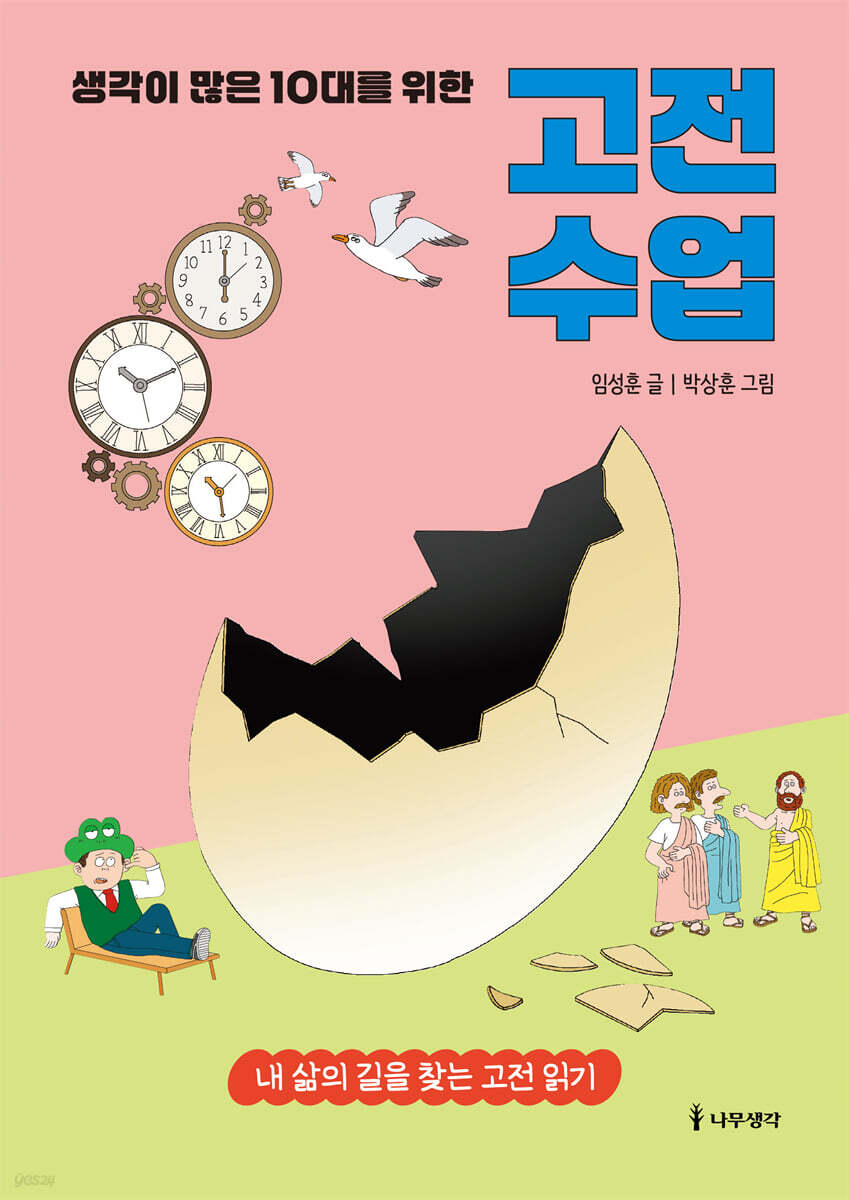
Classical classes for thoughtful teenagers
 |
Description
Book Introduction
“What we need now is not more information,
“Deeper thinking”
The secret to not getting lost in the sea of information that even mobilizes AI
A classic that will clearly illuminate the direction of life
Reading the classics: Learn to train your thinking muscles
In an age where everything changes rapidly, not only adults but also teenagers are losing the 'power of thought.'
This is because we have become more trained to 'search' rather than think, to quickly find the 'right answer' rather than questioning, and to get used to short comments and short messages, making it difficult to have long conversations or write.
Excessive academic burden also robs young people of the freedom to think.
In an age where immediate answers are preferred and enforced, classics are a tool that helps us regain the roots of our thinking.
Because it is the oldest answer to a question that humans have repeatedly asked.
The process of reading classics, asking questions and finding answers in old sentences, can be a training exercise for young people to strengthen their 'thinking muscles' again.
Even though times change, humanity's questions of "How should we live?" and "What is right?" remain unchanged.
The classics don't give the answers directly, but they do provide a path for readers to find the answers themselves.
“Deeper thinking”
The secret to not getting lost in the sea of information that even mobilizes AI
A classic that will clearly illuminate the direction of life
Reading the classics: Learn to train your thinking muscles
In an age where everything changes rapidly, not only adults but also teenagers are losing the 'power of thought.'
This is because we have become more trained to 'search' rather than think, to quickly find the 'right answer' rather than questioning, and to get used to short comments and short messages, making it difficult to have long conversations or write.
Excessive academic burden also robs young people of the freedom to think.
In an age where immediate answers are preferred and enforced, classics are a tool that helps us regain the roots of our thinking.
Because it is the oldest answer to a question that humans have repeatedly asked.
The process of reading classics, asking questions and finding answers in old sentences, can be a training exercise for young people to strengthen their 'thinking muscles' again.
Even though times change, humanity's questions of "How should we live?" and "What is right?" remain unchanged.
The classics don't give the answers directly, but they do provide a path for readers to find the answers themselves.
- You can preview some of the book's contents.
Preview
index
prolog
Chapter 1_ Do I really have to study?
Life is a continuation of learning * Analects
If you set your mind to something big and learn, you will become a great person. * Gyeokmongyo-gyeol
Chapter 2_ The world before your eyes may not be real?
To escape from the frog in the well * Zhuangzi
When you question the obvious, you see something new * Gulliver's Travels
Chapter 3: Creating My Own Life
Let's find our own reason to live * Seagull's Dream
A Life of Constant Growth * Damian
Chapter 4: Is human nature good?
The nature of human beings, given by heaven, is all good * Mencius
Is a dark nature part of humanity? * Lord of the Flies
Chapter 5: How should we live?
It is harder to avoid injustice than to die * Apology of Socrates
What was I born into this world to do? * The Old Man and the Sea
Chapter 6: Why should we know history?
Learn from history so you don't repeat mistakes * Jingbirok
Human problems do not change * The Chronicles of Fraud
References
Chapter 1_ Do I really have to study?
Life is a continuation of learning * Analects
If you set your mind to something big and learn, you will become a great person. * Gyeokmongyo-gyeol
Chapter 2_ The world before your eyes may not be real?
To escape from the frog in the well * Zhuangzi
When you question the obvious, you see something new * Gulliver's Travels
Chapter 3: Creating My Own Life
Let's find our own reason to live * Seagull's Dream
A Life of Constant Growth * Damian
Chapter 4: Is human nature good?
The nature of human beings, given by heaven, is all good * Mencius
Is a dark nature part of humanity? * Lord of the Flies
Chapter 5: How should we live?
It is harder to avoid injustice than to die * Apology of Socrates
What was I born into this world to do? * The Old Man and the Sea
Chapter 6: Why should we know history?
Learn from history so you don't repeat mistakes * Jingbirok
Human problems do not change * The Chronicles of Fraud
References
Detailed image
Into the book
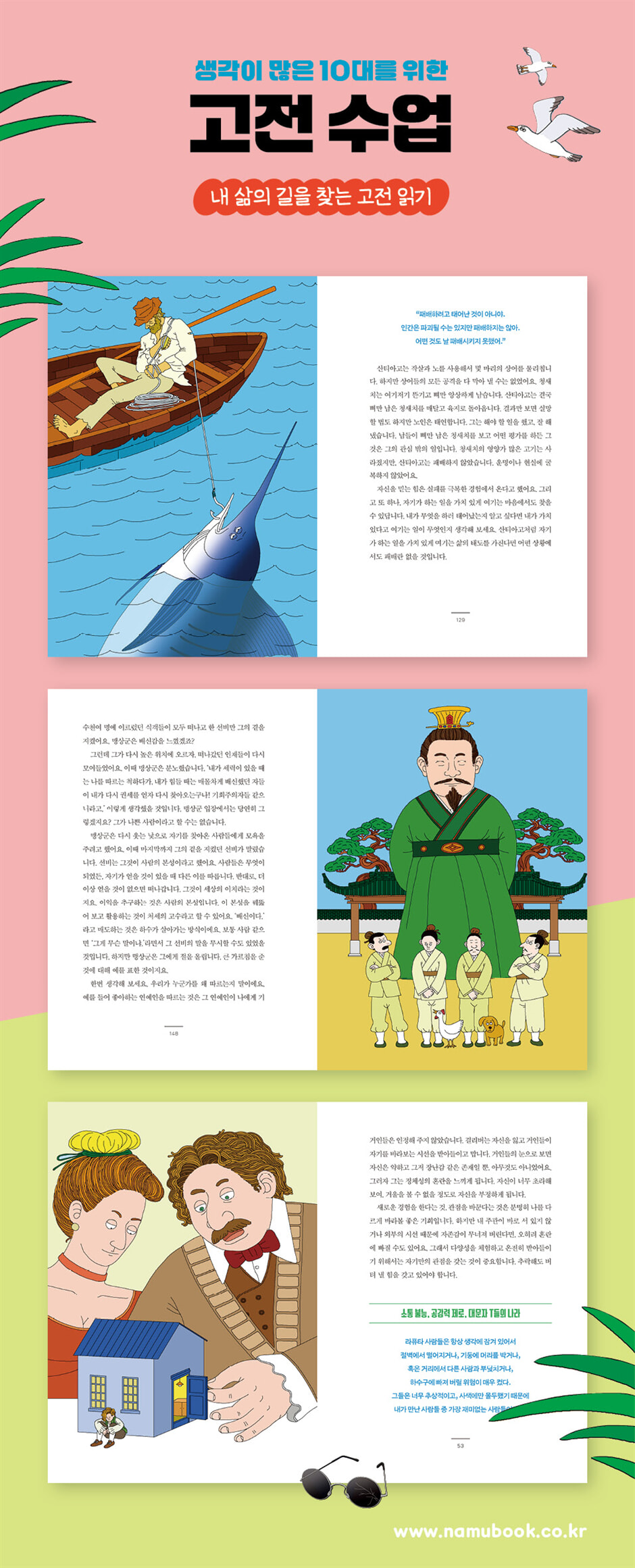
‘習’ is a character that represents a bird flying in the sky.
Young birds learn how to fly from their parents to take to the sky, but they must practice flying on their own.
Likewise, you must repeat and practice what you have learned to achieve your goal and make it your own.
Learning isn't just about putting knowledge in your head and memorizing it.
It is the process of learning and practicing the knowledge and skills essential to our lives to make them our own.
--- p.14
Studying is never something you do because someone else tells you to.
I have to make up my mind first.
We learn English and math in school, but not many people are willing to do it.
But what if I wanted to work for an international organization that helps refugees struggling to survive somewhere around the world? To work for an international organization, improving your English skills is essential.
English is the means I need to achieve my goals.
Then you will be willing to study English.
--- p.25
There is a seagull that has left a flock of a thousand seagulls.
This seagull named Jonathan practices his flight while others fight for food.
It's a flying skill that seagulls don't necessarily need.
Jonathan discovers the various principles of flight and finds a reason to live.
If a being's only reason to live is to 'eat', then its life is miserable.
You must find your own calling that goes beyond food.
--- p.62
What does it mean to "break the egg"? It means to shatter the world around you, your common sense, and the authority you hold.
It's opening your eyes to a new, unknown world.
Even birds must break out of their eggs to survive in the world, and snakes must shed their skin to grow.
In this way, growth goes hand in hand with destruction.
So what happens when a bird comes out into the world? It's said to fly to Abraxas.
Abraxas is a god with both a bright and dark side.
--- p.81
Is our dark nature part of humanity? Is it always with us, as the Lord of the Flies suggests in the novel? What is good, and what is evil? Aren't "good and evil" ultimately choices we make at every moment? Had Jack listened to Ralph and Piggy and joined forces, he might not have gone to the extreme of hunting humans.
Because humans are always beings who can choose.
The curse of the Lord of the Flies, who is always with humans, will have no power in the face of human free will.
--- p.105
They say that the power to believe in yourself comes from the experience of overcoming failure.
And another thing you can find is in the heart that values what you do.
If you want to know what you were born to do, think about what you find valuable.
If you have a life attitude like Santiago's, where you value what you do, you will never be defeated in any situation.
--- p.129
Sima Qian included various aspects of human life in his Records of the Grand Historian.
And he pointed out human nature sharply.
You can become a great person only when you understand and embrace human nature, not ignore it.
And history praises those who do not lose their humanity.
History shows us that if we become so intoxicated with our own abilities and achievements that we lose our humanity and live on the edge of beasts, we will be punished in some way.
Young birds learn how to fly from their parents to take to the sky, but they must practice flying on their own.
Likewise, you must repeat and practice what you have learned to achieve your goal and make it your own.
Learning isn't just about putting knowledge in your head and memorizing it.
It is the process of learning and practicing the knowledge and skills essential to our lives to make them our own.
--- p.14
Studying is never something you do because someone else tells you to.
I have to make up my mind first.
We learn English and math in school, but not many people are willing to do it.
But what if I wanted to work for an international organization that helps refugees struggling to survive somewhere around the world? To work for an international organization, improving your English skills is essential.
English is the means I need to achieve my goals.
Then you will be willing to study English.
--- p.25
There is a seagull that has left a flock of a thousand seagulls.
This seagull named Jonathan practices his flight while others fight for food.
It's a flying skill that seagulls don't necessarily need.
Jonathan discovers the various principles of flight and finds a reason to live.
If a being's only reason to live is to 'eat', then its life is miserable.
You must find your own calling that goes beyond food.
--- p.62
What does it mean to "break the egg"? It means to shatter the world around you, your common sense, and the authority you hold.
It's opening your eyes to a new, unknown world.
Even birds must break out of their eggs to survive in the world, and snakes must shed their skin to grow.
In this way, growth goes hand in hand with destruction.
So what happens when a bird comes out into the world? It's said to fly to Abraxas.
Abraxas is a god with both a bright and dark side.
--- p.81
Is our dark nature part of humanity? Is it always with us, as the Lord of the Flies suggests in the novel? What is good, and what is evil? Aren't "good and evil" ultimately choices we make at every moment? Had Jack listened to Ralph and Piggy and joined forces, he might not have gone to the extreme of hunting humans.
Because humans are always beings who can choose.
The curse of the Lord of the Flies, who is always with humans, will have no power in the face of human free will.
--- p.105
They say that the power to believe in yourself comes from the experience of overcoming failure.
And another thing you can find is in the heart that values what you do.
If you want to know what you were born to do, think about what you find valuable.
If you have a life attitude like Santiago's, where you value what you do, you will never be defeated in any situation.
--- p.129
Sima Qian included various aspects of human life in his Records of the Grand Historian.
And he pointed out human nature sharply.
You can become a great person only when you understand and embrace human nature, not ignore it.
And history praises those who do not lose their humanity.
History shows us that if we become so intoxicated with our own abilities and achievements that we lose our humanity and live on the edge of beasts, we will be punished in some way.
--- p.154
Publisher's Review
I hope you will wander less on the path of life that lies ahead.
"Classical Studies for Thinking Teenagers" is a "private reading textbook" that interprets the core ideas of classics in today's language, tailored to the level of teenagers.
By selecting 12 classic books from the East and the West, including “Analects of Confucius,” “Jingbirok,” “Records of the Grand Historian,” “Apology of Socrates,” and “Gulliver’s Travels,” it covers topics that teenagers worry about, such as study, change, growing life, values, and history.
For example, in Chapter 1, “Do I really have to study?”, the starting point of a human life is found within “myself” through Confucius’s “Analects of Confucius” and Yi Yi’s “Gyeokmongyogyeol”, and the message is that self-cultivation, humility, and respect for others are the foundation of life, and it makes us reflect on “what kind of person I will grow into.”
Chapter 4, “Is human nature good?” introduces Mencius’s “Mencius” and William Golding’s “Lord of the Flies,” and teaches that good and evil are ultimately choices we make at every moment, and encourages us to live by listening to the stories of those who have lived while preserving their good nature.
I hope that readers will find clues to their own path in life as they read this book.
In doing so, I believe that by reading the classics and diligently studying certain topics, I will be able to find a clearer path.
《Classical Studies for Thinking Teenagers》 is not just a book about learning about the past, but also a book about preparing for the future.
What young people need today is not more information, but deeper thinking.
Although classics are old texts, they contain the most up-to-date wisdom for understanding humanity.
The author, who has been teaching humanities classes to students and parents for a long time, says, “The classics do not provide the right answers.
Instead, he asked the question, “Why?” and said that question helps young people grow,” adding that he hopes young people will regain the power to ask questions, think, and think for themselves.
"Classical Studies for Thinking Teenagers" is a "private reading textbook" that interprets the core ideas of classics in today's language, tailored to the level of teenagers.
By selecting 12 classic books from the East and the West, including “Analects of Confucius,” “Jingbirok,” “Records of the Grand Historian,” “Apology of Socrates,” and “Gulliver’s Travels,” it covers topics that teenagers worry about, such as study, change, growing life, values, and history.
For example, in Chapter 1, “Do I really have to study?”, the starting point of a human life is found within “myself” through Confucius’s “Analects of Confucius” and Yi Yi’s “Gyeokmongyogyeol”, and the message is that self-cultivation, humility, and respect for others are the foundation of life, and it makes us reflect on “what kind of person I will grow into.”
Chapter 4, “Is human nature good?” introduces Mencius’s “Mencius” and William Golding’s “Lord of the Flies,” and teaches that good and evil are ultimately choices we make at every moment, and encourages us to live by listening to the stories of those who have lived while preserving their good nature.
I hope that readers will find clues to their own path in life as they read this book.
In doing so, I believe that by reading the classics and diligently studying certain topics, I will be able to find a clearer path.
《Classical Studies for Thinking Teenagers》 is not just a book about learning about the past, but also a book about preparing for the future.
What young people need today is not more information, but deeper thinking.
Although classics are old texts, they contain the most up-to-date wisdom for understanding humanity.
The author, who has been teaching humanities classes to students and parents for a long time, says, “The classics do not provide the right answers.
Instead, he asked the question, “Why?” and said that question helps young people grow,” adding that he hopes young people will regain the power to ask questions, think, and think for themselves.
GOODS SPECIFICS
- Date of issue: November 24, 2025
- Page count, weight, size: 156 pages | 145*205*12mm
- ISBN13: 9791162183694
You may also like
카테고리
korean


korean

![GQ KOREA Mark (Monthly): December [2025]](http://librairie.coreenne.fr/cdn/shop/files/8ef265dbbfbf186523ed75ba7319009d.jpg?v=1765340328&width=3840)


