

I'm not good at crying
 |
Description
Book Introduction
“I am braver than I am in this collection of poems.”
A collection of confessional poems, a reflection on those clumsy days when I struggled to understand the incomprehensible.
This book is the first poetry collection published after the revamp of the 'Changbi Youth Poetry Series' and is the fifty-first volume in the series.
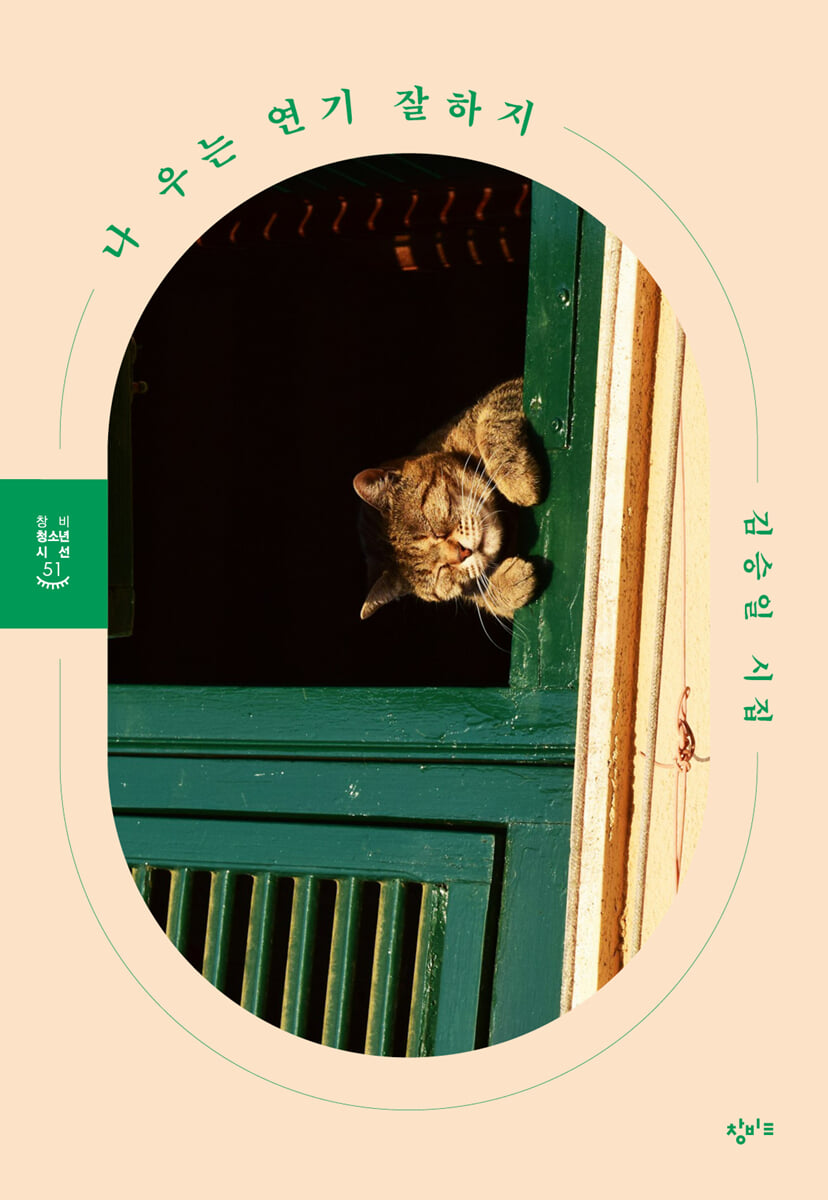
In particular, this cover was selected with the full support of Changbi Education's youth reader group, 'Han Kwon Dan', and we expect that 'Youth Poetry' will become even closer to readers.
Additionally, we will be creating a new section called 'The Heart of Writing Poetry', where we will publish various types of writings written by poets themselves. This will become a meeting place where creators and readers can communicate through the medium of 'poetry'.
The first of these, 『I'm Not Good at Crying Acting』, is a poetry collection for young people that expresses the complex and subtle waves of emotions in a whimsical yet honest way, using the language and voice of young people.
This is also the first poetry collection for young adults by poet Seung-il Kim, who began his career in 2009 through the "New Writer Recommendation" section of "Modern Literature" and has been gaining attention for his experimental poetry that explores the incomprehensible world by crossing the boundaries between reality and unreality.
This collection of poems deals with situations and emotions that anyone who is going through or has gone through adolescence will likely have experienced. The poems, which contain familiar and close daily life and emotions, unfold with unpredictable emotional endings, sometimes cheerful, sometimes leaving a lingering impression.
The poet does not imitate the speech or trends of young people, but rather, he deeply understands their way of thinking and sensibilities and conveys them with new expressions and a unique sensibility, bringing sincerity, empathy, and fun, which suggests new possibilities for youth poetry.
As readers read this collection of poems, they will come to realize the true meaning of life, that "honesty is the greatest courage," through the speaker and those around him.
For young people, it will be an eccentric yet warm friend who will represent their voices, and for adults who are new to poetry, it will be a welcoming gift to step into the world of poetry.
A collection of confessional poems, a reflection on those clumsy days when I struggled to understand the incomprehensible.
This book is the first poetry collection published after the revamp of the 'Changbi Youth Poetry Series' and is the fifty-first volume in the series.
In particular, this cover was selected with the full support of Changbi Education's youth reader group, 'Han Kwon Dan', and we expect that 'Youth Poetry' will become even closer to readers.
Additionally, we will be creating a new section called 'The Heart of Writing Poetry', where we will publish various types of writings written by poets themselves. This will become a meeting place where creators and readers can communicate through the medium of 'poetry'.
The first of these, 『I'm Not Good at Crying Acting』, is a poetry collection for young people that expresses the complex and subtle waves of emotions in a whimsical yet honest way, using the language and voice of young people.
This is also the first poetry collection for young adults by poet Seung-il Kim, who began his career in 2009 through the "New Writer Recommendation" section of "Modern Literature" and has been gaining attention for his experimental poetry that explores the incomprehensible world by crossing the boundaries between reality and unreality.
This collection of poems deals with situations and emotions that anyone who is going through or has gone through adolescence will likely have experienced. The poems, which contain familiar and close daily life and emotions, unfold with unpredictable emotional endings, sometimes cheerful, sometimes leaving a lingering impression.
The poet does not imitate the speech or trends of young people, but rather, he deeply understands their way of thinking and sensibilities and conveys them with new expressions and a unique sensibility, bringing sincerity, empathy, and fun, which suggests new possibilities for youth poetry.
As readers read this collection of poems, they will come to realize the true meaning of life, that "honesty is the greatest courage," through the speaker and those around him.
For young people, it will be an eccentric yet warm friend who will represent their voices, and for adults who are new to poetry, it will be a welcoming gift to step into the world of poetry.
- You can preview some of the book's contents.
Preview
index
Poet's words
Part 1 A little bit far away
wrinkle
other class
Han Yu-ri's power
transfer student
Short marathon
Second father
Tears of an elegant woman
perception
betrayal
My younger sibling goes to a different school
jealousy
weird kids
quarrel
Admissions Report
dinosaur egg fossils
A kid who runs around wearing only socks
Part 2: I Want to Be Loved Even Without Knowing Anything
Saju Cafe
A friend I met after a few days
I don't know what I want
Bremen Town Musicians
Marine Boy Scouts
Internet friends
Heart Cello
first love
Reasons for sleeping at school
Painful speed reading
At a friend's house
Can't help it
moment
A letter to a friend who transferred schools
Final exam
The kid who likes me
Part 3: Meet Here
Teacher Plato
warning
First life
diary
I need to know
Meet here
Danggogae
A friend with a film camera
Poor grandmother
Reason for living
I am good
heliocentrism
dawn
basketball
sandals
The Heart of Writing Poetry_Essay
Part 1 A little bit far away
wrinkle
other class
Han Yu-ri's power
transfer student
Short marathon
Second father
Tears of an elegant woman
perception
betrayal
My younger sibling goes to a different school
jealousy
weird kids
quarrel
Admissions Report
dinosaur egg fossils
A kid who runs around wearing only socks
Part 2: I Want to Be Loved Even Without Knowing Anything
Saju Cafe
A friend I met after a few days
I don't know what I want
Bremen Town Musicians
Marine Boy Scouts
Internet friends
Heart Cello
first love
Reasons for sleeping at school
Painful speed reading
At a friend's house
Can't help it
moment
A letter to a friend who transferred schools
Final exam
The kid who likes me
Part 3: Meet Here
Teacher Plato
warning
First life
diary
I need to know
Meet here
Danggogae
A friend with a film camera
Poor grandmother
Reason for living
I am good
heliocentrism
dawn
basketball
sandals
The Heart of Writing Poetry_Essay
Detailed image
Into the book
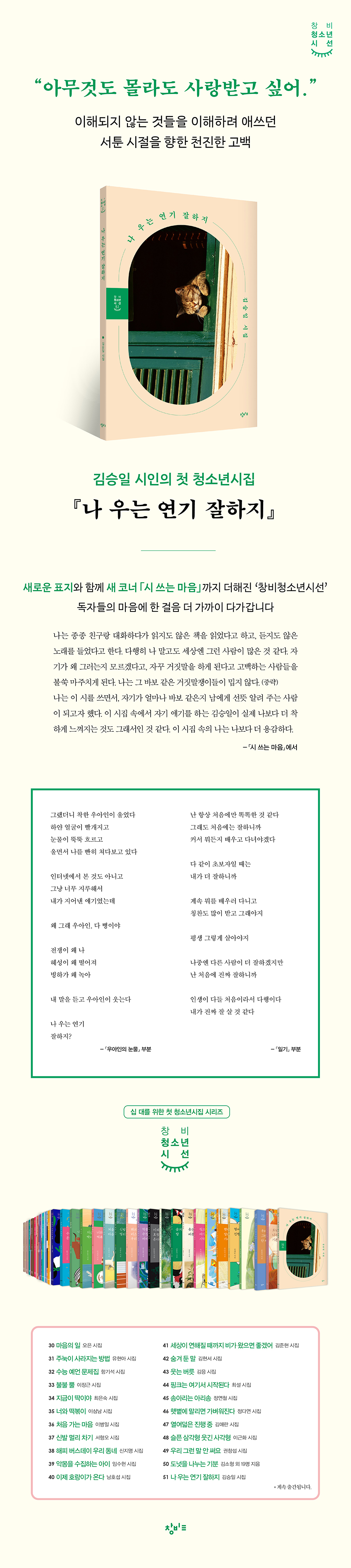
I often find myself talking to friends and saying that I've read a book I haven't read and listened to a song I haven't heard.
Fortunately, it seems like there are many people like that in the world, other than me.
I often come across people who confess that they don't know why they do it and that they keep lying.
I don't hate those stupid liars.
(syncopation)
I just wanted to write about a time when there were so many things I didn't understand.
I tried to think back to the time when I had the most things I wanted to confess.
I hope that this collection of poems will bring a smile to the faces of those who read it.
Then I found out.
The fact that there is no difference between then and now.
I think that's why Kim Seung-il, who talks about himself in "I'm Good at Crying," feels kinder than I actually am.
The me in this collection of poems is braver than I am.
Fortunately, it seems like there are many people like that in the world, other than me.
I often come across people who confess that they don't know why they do it and that they keep lying.
I don't hate those stupid liars.
(syncopation)
I just wanted to write about a time when there were so many things I didn't understand.
I tried to think back to the time when I had the most things I wanted to confess.
I hope that this collection of poems will bring a smile to the faces of those who read it.
Then I found out.
The fact that there is no difference between then and now.
I think that's why Kim Seung-il, who talks about himself in "I'm Good at Crying," feels kinder than I actually am.
The me in this collection of poems is braver than I am.
--- From the text “The Heart of Writing Poetry”
Publisher's Review
“I like my story too.”
The brilliant emotions found in the box called 'familiarity'
Poet Seung-il Kim, who has been building a unique world of poetry, has published his first poetry collection for young people.
This poetry collection is the fifty-first in the 'Changbi Youth Poetry Series', and contains a story of a quirky and honest youth's self-exploration.
The poet says that he still doesn't know what 'youth poetry' is, but he just tried to listen to "the times when I had the most things I wanted to confess" and "the times when there were so many things I didn't understand" ("The Heart of Writing Poetry").
He then confesses that he realized that there is not much difference between his youth and his present self, which allows readers to naturally empathize with the speaker and those around him, no matter what stage of life they are in.
This collection of poems primarily deals with familiar themes from youth poetry, such as school and home, but the poet's unique individuality is displayed in a unique way.
By focusing on the small moments in life that occur in familiar spaces, it vividly and delicately captures the various emotions and psychology that teenagers experience in their daily lives.
For example, the loneliness of going to see your best friend who has grown “very, very slightly distant” after being split into two classes (“Another Class”), the day of the class president election when you went because your seatmate said “you’re the only one who can do it” and “I voted for you” (“Han Yu-ri’s Power”), the classroom scene where people wait for a transfer student who is rumored to be handsome with “bright eyes” and “heart pounding” (“Transfer Student”), etc. Stories that any teenager could experience unfold like a panorama.
The scenes that unfold as if nothing happened and without a care in the world bring a smile to your face as you experience them, and this is the magic that makes you look forward to the next poem.
During class, the teacher
Go to the teachers' office for a moment
Everyone is quiet and waiting
I am elegant
The world might end soon
He said he heard it on the internet
Then the kind elegant woman cried
The white face turns red
Tears are falling
He's staring at me while crying.
I didn't see it on the internet
I'm just so bored
I made that up
Why are you like that, elegant? It's all a lie.
Why is there war?
Why did the comet fall?
Why are glaciers melting?
Listen to me
The elegant woman smiles
I'm crying
Are you doing well?
- Full text of "Tears of Grace" (pp. 24-25)
“You must never throw it away.
“I have to wait.”
Things you only realize when you face brave faces
Young people are always curious and want to know something.
However, there is more that we do not know than what we do know, and although we are ashamed of the fact that we do not know, we try hard to pretend to know and sometimes even lie because we want to be acknowledged by others.
But I'm worried about getting caught, and I blame myself, thinking, "Why am I like this?" and I tell myself, "I don't want to lie again."
“I want to be loved even if I don’t know anything,” but “I hate not knowing anything” (“Painful Speed Reading”), this contradictory feeling accurately depicts the complex psychology of adolescence.
At the same time, I feel sad because I feel like “I wonder if I’m the only one who’s this sensitive/I hate myself so much” and “I feel like I’m the only one having a hard time” (“Can’t I Help It”), and I also feel like “my life is ruined somehow” (“Sandals”).
Nevertheless, he encourages himself by saying, “It’s fortunate that everyone has a first life/I think I’ll really live well” (“Living Life for the First Time”) and writes positive thoughts such as “I’ll soon be happy” (“Diary”).
Through the speaker's hesitant, half-confident self-doubt, half-curious about himself but not quite knowing himself, the reader can project himself onto the story, and the poet cautiously takes a step closer to the youth who are growing up, bumping into things here and there.
I asked if you had read that book.
Lied and said I read it
I bought it at the bookstore on my way home
I don't think I'll be able to read it all by tomorrow.
How to pretend to read well
I guess I should study for the test.
(…)
I asked if you knew that idol group.
I said I knew
But I don't know the members' names well
I'm going crazy
Why am I like this?
I've never even heard the song
I want to be loved even though I don't know anything
Of course I hate not knowing anything
I always don't have time
Why isn't it there?
You know a lot
It's cool that you don't even pretend to read it
I want to be you
- The "Painful Speed Reading" section (pp. 69-71)
“Teacher, I really don’t know, so I asked.”
A confession of a heart that tries to understand
The confusing emotions of adolescence aren't just directed at oneself.
The poet talks about trivial incidents that occur in everyday life, but deep within them are fundamental questions about life.
Rather than simply depicting the lives of teenagers, it poses weighty questions such as “Why do we live?” and “What is death?” through the young narrator.
“I just don’t like something/I don’t know what I want either,” he complains, and when he hears that his mother is sick, he worries about “how I should live from now on” (“I Don’t Know What I Want”), but he doesn’t know the answer.
When I hear my friend say, “My grandfather died,” I imagine my grandmother’s death and worry, “I’m afraid I’ll be sad/I’ll be a weird kid” (“A Friend I Met After a Few Days”).
This is not just a question that concerns adolescents; it is a question that all generations can relate to.
The young speakers in the poem feel confused because “life suddenly feels strange” and “I don’t know why I live/I have too many thoughts,” but they console themselves with the words “I feel a little better now that I think about living to find out” (“Reason for Living”) and come up with their own answers.
Life suddenly feels strange
It was strange to begin with
I was curious originally too
(syncopation)
My Korean language teacher said so
You look happy today?
It was hard because I didn't know why I was living.
I think I live to know that
I suddenly feel a little better
The teacher said I was great.
Teacher, by the way
I'm still very sad
If you live long enough and still don't find out
I think that would be difficult
You'll find out, right?
- "Reason for Living" section (pages 111-113)
"Am I a little smart? I'm not good at studying."
The courage to show my awkward and embarrassed self as it is
In addition to a complete renewal of the cover, 'Changbi Youth Poetry' has established a corner called "The Heart of Writing Poetry" starting with the poetry collection "I'm Not Good at Crying Acting", thereby establishing a bridge between the poet and the reader.
We hope that this corner will continue to serve as a "meeting place" where poets can present diverse writings, allowing creators to approach readers more sincerely and readers to gain a deeper understanding of the creator's world of work.
In this collection of poems, poet Seung-il Kim writes essays that are both calm and honest, and he states, “While writing the poems in this collection, I wanted to become someone who readily lets others know how foolish I am.”
Next, “I confess to teach you how to confess.
“I confess to learn how to confess,” he says.
In light of these words, this collection of poems can ultimately be called a 'collection of confessions.'
Here, ‘confession’ is not simply the act of revealing a secret kept deep in one’s heart, but the ‘courage’ to reveal one’s ‘shameful self’ as it is, without hiding anything, as “the most foolish person in the world” (“Sandals”).
It is 'honesty' that willingly reveals that everything is still awkward, immature, and lacking.
And it is the ‘realization’ that “no one can judge arbitrarily and no one can easily ridicule.”
After gaining insight into their own attitudes and mindsets toward themselves and life, teenagers will feel more courageous about revealing their serious, quirky, awkward, and honest selves.
In an empty lot on a rainy day
At a time when all the lights in the world have gone out
Don't care about anyone
Don't worry about yourself either
Without music
Everyone gather at the same time on the same day
I wish I could dance
Then we will fall in love with each other
It's dark so I don't know who I'm in love with
That we are in love
It's so certain I won't doubt it
Take off your shoes and dance
I think it would be okay if we fell like dominoes
The ground we fell on was soft and fluffy
I'm about to burst out laughing
My friend wrote a poem so
I also write poems about my friends.
I don't know where my friend is
I'm just writing a poem to be here
Poetry is sad
I like writing poetry
- "Meet Here" section (pages 101-103)
The brilliant emotions found in the box called 'familiarity'
Poet Seung-il Kim, who has been building a unique world of poetry, has published his first poetry collection for young people.
This poetry collection is the fifty-first in the 'Changbi Youth Poetry Series', and contains a story of a quirky and honest youth's self-exploration.
The poet says that he still doesn't know what 'youth poetry' is, but he just tried to listen to "the times when I had the most things I wanted to confess" and "the times when there were so many things I didn't understand" ("The Heart of Writing Poetry").
He then confesses that he realized that there is not much difference between his youth and his present self, which allows readers to naturally empathize with the speaker and those around him, no matter what stage of life they are in.
This collection of poems primarily deals with familiar themes from youth poetry, such as school and home, but the poet's unique individuality is displayed in a unique way.
By focusing on the small moments in life that occur in familiar spaces, it vividly and delicately captures the various emotions and psychology that teenagers experience in their daily lives.
For example, the loneliness of going to see your best friend who has grown “very, very slightly distant” after being split into two classes (“Another Class”), the day of the class president election when you went because your seatmate said “you’re the only one who can do it” and “I voted for you” (“Han Yu-ri’s Power”), the classroom scene where people wait for a transfer student who is rumored to be handsome with “bright eyes” and “heart pounding” (“Transfer Student”), etc. Stories that any teenager could experience unfold like a panorama.
The scenes that unfold as if nothing happened and without a care in the world bring a smile to your face as you experience them, and this is the magic that makes you look forward to the next poem.
During class, the teacher
Go to the teachers' office for a moment
Everyone is quiet and waiting
I am elegant
The world might end soon
He said he heard it on the internet
Then the kind elegant woman cried
The white face turns red
Tears are falling
He's staring at me while crying.
I didn't see it on the internet
I'm just so bored
I made that up
Why are you like that, elegant? It's all a lie.
Why is there war?
Why did the comet fall?
Why are glaciers melting?
Listen to me
The elegant woman smiles
I'm crying
Are you doing well?
- Full text of "Tears of Grace" (pp. 24-25)
“You must never throw it away.
“I have to wait.”
Things you only realize when you face brave faces
Young people are always curious and want to know something.
However, there is more that we do not know than what we do know, and although we are ashamed of the fact that we do not know, we try hard to pretend to know and sometimes even lie because we want to be acknowledged by others.
But I'm worried about getting caught, and I blame myself, thinking, "Why am I like this?" and I tell myself, "I don't want to lie again."
“I want to be loved even if I don’t know anything,” but “I hate not knowing anything” (“Painful Speed Reading”), this contradictory feeling accurately depicts the complex psychology of adolescence.
At the same time, I feel sad because I feel like “I wonder if I’m the only one who’s this sensitive/I hate myself so much” and “I feel like I’m the only one having a hard time” (“Can’t I Help It”), and I also feel like “my life is ruined somehow” (“Sandals”).
Nevertheless, he encourages himself by saying, “It’s fortunate that everyone has a first life/I think I’ll really live well” (“Living Life for the First Time”) and writes positive thoughts such as “I’ll soon be happy” (“Diary”).
Through the speaker's hesitant, half-confident self-doubt, half-curious about himself but not quite knowing himself, the reader can project himself onto the story, and the poet cautiously takes a step closer to the youth who are growing up, bumping into things here and there.
I asked if you had read that book.
Lied and said I read it
I bought it at the bookstore on my way home
I don't think I'll be able to read it all by tomorrow.
How to pretend to read well
I guess I should study for the test.
(…)
I asked if you knew that idol group.
I said I knew
But I don't know the members' names well
I'm going crazy
Why am I like this?
I've never even heard the song
I want to be loved even though I don't know anything
Of course I hate not knowing anything
I always don't have time
Why isn't it there?
You know a lot
It's cool that you don't even pretend to read it
I want to be you
- The "Painful Speed Reading" section (pp. 69-71)
“Teacher, I really don’t know, so I asked.”
A confession of a heart that tries to understand
The confusing emotions of adolescence aren't just directed at oneself.
The poet talks about trivial incidents that occur in everyday life, but deep within them are fundamental questions about life.
Rather than simply depicting the lives of teenagers, it poses weighty questions such as “Why do we live?” and “What is death?” through the young narrator.
“I just don’t like something/I don’t know what I want either,” he complains, and when he hears that his mother is sick, he worries about “how I should live from now on” (“I Don’t Know What I Want”), but he doesn’t know the answer.
When I hear my friend say, “My grandfather died,” I imagine my grandmother’s death and worry, “I’m afraid I’ll be sad/I’ll be a weird kid” (“A Friend I Met After a Few Days”).
This is not just a question that concerns adolescents; it is a question that all generations can relate to.
The young speakers in the poem feel confused because “life suddenly feels strange” and “I don’t know why I live/I have too many thoughts,” but they console themselves with the words “I feel a little better now that I think about living to find out” (“Reason for Living”) and come up with their own answers.
Life suddenly feels strange
It was strange to begin with
I was curious originally too
(syncopation)
My Korean language teacher said so
You look happy today?
It was hard because I didn't know why I was living.
I think I live to know that
I suddenly feel a little better
The teacher said I was great.
Teacher, by the way
I'm still very sad
If you live long enough and still don't find out
I think that would be difficult
You'll find out, right?
- "Reason for Living" section (pages 111-113)
"Am I a little smart? I'm not good at studying."
The courage to show my awkward and embarrassed self as it is
In addition to a complete renewal of the cover, 'Changbi Youth Poetry' has established a corner called "The Heart of Writing Poetry" starting with the poetry collection "I'm Not Good at Crying Acting", thereby establishing a bridge between the poet and the reader.
We hope that this corner will continue to serve as a "meeting place" where poets can present diverse writings, allowing creators to approach readers more sincerely and readers to gain a deeper understanding of the creator's world of work.
In this collection of poems, poet Seung-il Kim writes essays that are both calm and honest, and he states, “While writing the poems in this collection, I wanted to become someone who readily lets others know how foolish I am.”
Next, “I confess to teach you how to confess.
“I confess to learn how to confess,” he says.
In light of these words, this collection of poems can ultimately be called a 'collection of confessions.'
Here, ‘confession’ is not simply the act of revealing a secret kept deep in one’s heart, but the ‘courage’ to reveal one’s ‘shameful self’ as it is, without hiding anything, as “the most foolish person in the world” (“Sandals”).
It is 'honesty' that willingly reveals that everything is still awkward, immature, and lacking.
And it is the ‘realization’ that “no one can judge arbitrarily and no one can easily ridicule.”
After gaining insight into their own attitudes and mindsets toward themselves and life, teenagers will feel more courageous about revealing their serious, quirky, awkward, and honest selves.
In an empty lot on a rainy day
At a time when all the lights in the world have gone out
Don't care about anyone
Don't worry about yourself either
Without music
Everyone gather at the same time on the same day
I wish I could dance
Then we will fall in love with each other
It's dark so I don't know who I'm in love with
That we are in love
It's so certain I won't doubt it
Take off your shoes and dance
I think it would be okay if we fell like dominoes
The ground we fell on was soft and fluffy
I'm about to burst out laughing
My friend wrote a poem so
I also write poems about my friends.
I don't know where my friend is
I'm just writing a poem to be here
Poetry is sad
I like writing poetry
- "Meet Here" section (pages 101-103)
'Changbi Youth Poetry Series' is a full-fledged youth poetry series that discovers and selects youth poetry written by professional poets.
We plan to consistently produce slightly dangerous and slightly eccentric songs that will stay with young people, while assessing the diverse breadth and depth of youth poetry.
'Changbi Youth Poetry Series' is a full-fledged youth poetry series that discovers and selects youth poetry written by professional poets.
We plan to consistently produce slightly dangerous and slightly eccentric songs that will stay with young people, while assessing the diverse breadth and depth of youth poetry.
We plan to consistently produce slightly dangerous and slightly eccentric songs that will stay with young people, while assessing the diverse breadth and depth of youth poetry.
'Changbi Youth Poetry Series' is a full-fledged youth poetry series that discovers and selects youth poetry written by professional poets.
We plan to consistently produce slightly dangerous and slightly eccentric songs that will stay with young people, while assessing the diverse breadth and depth of youth poetry.
GOODS SPECIFICS
- Date of issue: August 28, 2025
- Page count, weight, size: 132 pages | 145*210mm
- ISBN13: 9791165703608
- ISBN10: 1165703602
You may also like
카테고리
korean


korean

![GQ KOREA Mark (Monthly): December [2025]](http://librairie.coreenne.fr/cdn/shop/files/8ef265dbbfbf186523ed75ba7319009d.jpg?v=1765340328&width=3840)


