

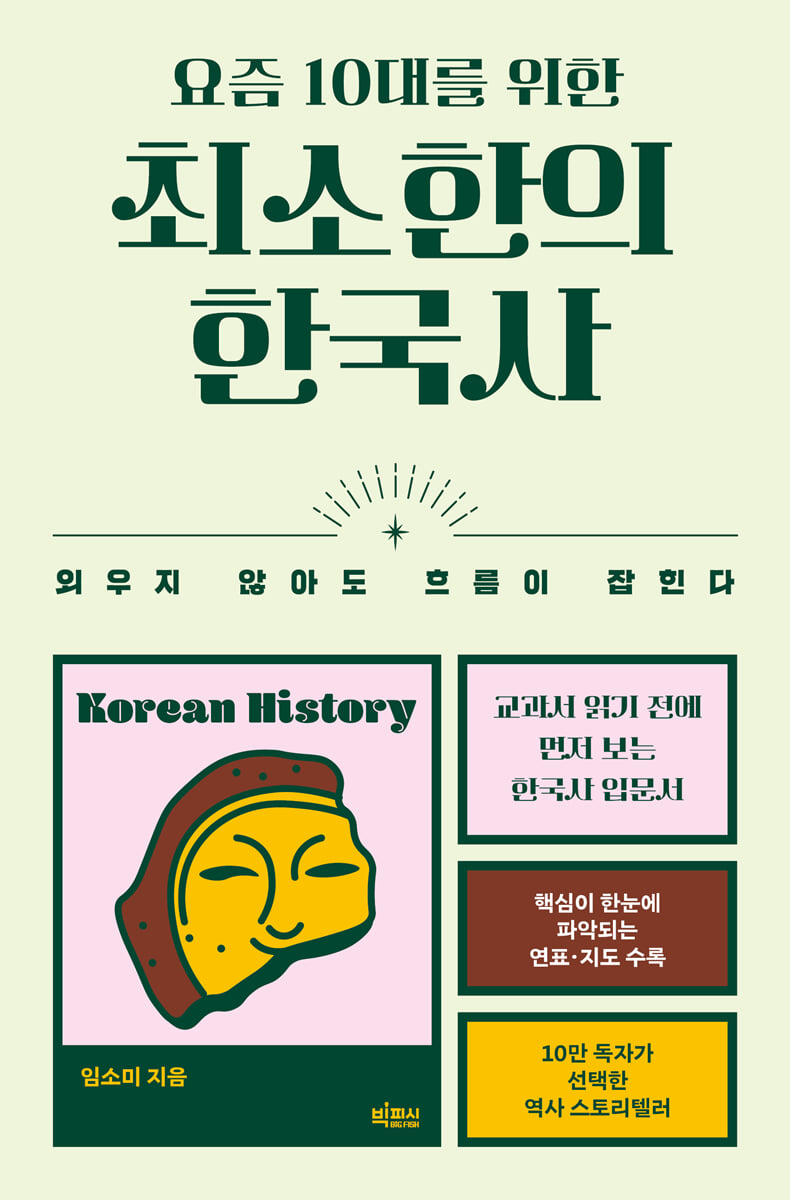
Minimum Korean History for Today's Teenagers
 |
Description
Book Introduction
The vast history of Korea is inputted into your head.
A must-read for teenagers: fun, educational, and academically rewarding.
'Taejeongtaesemundanse'.
Korean history is such a difficult subject for teenagers to memorize that they even make songs to memorize it.
If you memorize a lot of information without thinking, as time passes, you may only remember the year and forget the event, or you may remember the person but not the achievement.
For teenagers who have not been able to properly grasp the flow of history, “Minimum Korean History for Today’s Teenagers” was published.
This book carefully selects only the most representative figures and decisive events in Korean history and unfolds them through witty storytelling, capturing the flow of history from Gojoseon to the Korean Empire in one glance.
In addition, a timeline and maps that show the key points of each era at a glance, as well as abundant photos that vividly convey the era, are added to help organize the five thousand years of history that young people must know in their minds.
At the end of each article, there are post-reading questions to help you organize what you've read and expand your thoughts.
For teenagers who want to understand the main storyline of history before diving into textbooks, and for students who want to have fun and learn at the same time, this book will be the best introduction to Korean history.
A must-read for teenagers: fun, educational, and academically rewarding.
'Taejeongtaesemundanse'.
Korean history is such a difficult subject for teenagers to memorize that they even make songs to memorize it.
If you memorize a lot of information without thinking, as time passes, you may only remember the year and forget the event, or you may remember the person but not the achievement.
For teenagers who have not been able to properly grasp the flow of history, “Minimum Korean History for Today’s Teenagers” was published.
This book carefully selects only the most representative figures and decisive events in Korean history and unfolds them through witty storytelling, capturing the flow of history from Gojoseon to the Korean Empire in one glance.
In addition, a timeline and maps that show the key points of each era at a glance, as well as abundant photos that vividly convey the era, are added to help organize the five thousand years of history that young people must know in their minds.
At the end of each article, there are post-reading questions to help you organize what you've read and expand your thoughts.
For teenagers who want to understand the main storyline of history before diving into textbooks, and for students who want to have fun and learn at the same time, this book will be the best introduction to Korean history.
- You can preview some of the book's contents.
Preview
index
[Prologue] A Korean History Class: From Gojoseon to the Korean Empire
Part 01.
The beginning of Korean Peninsula history: Gojoseon and the Three Kingdoms period
[Gojoseon] The first nation to open the door to Korean history
[Early States] States with Unique Customs that Diversified the Korean Peninsula
[Goguryeo] A brave nation that shook the world
Baekje: A Brilliant Culture Blossomed Through Active Exchange
Part 02.
Silla, which achieved the great feat of unifying the three kingdoms
[Silla] The last to reach its peak, but the ultimate victor
[Unified Silla] Achieving the first unification of the Korean Peninsula
[Gaya] The Essence of Iron Age Culture That Never Disappears
[Balhae] A powerful East Asian nation on par with the Tang Dynasty
Part 03.
Goryeo, which opened the Middle Ages of Korean history
[Later Three Kingdoms Period] Three Figures' Battle for Unification
[Taejo Wang Geon] The Beginning of the 500-Year Goryeo Dynasty
[Musin Jeong Coup] A fierce power struggle amidst the ongoing Khitan invasions
[The Retreat of Wihwado] The Yuan Empire's Interference and the End of Goryeo
Part 04.
The early Joseon Dynasty, founded on Neo-Confucianism
[Taejo Yi Seong-gye] The first king of Joseon to ascend to the throne at the oldest age
[King Sejong] The Rise of a Passionate Genius King, Skilled in Literature and the Military
[Gye-Yu Jeongnan] The True Face of King Sejo, Who Had Two Faces
[Growth of the Sarim] King Yejong and King Seongjong, who achieved the revival and development of Joseon
[The Rebellion of Muo] A Time When Anger and Madness Swept the Court
[Imjin War] The war that completely changed the fate of Joseon
Part 05.
From Joseon to the Korean Empire through turbulent times
[Byeongjahoran] King Injo's humiliation after surrendering to the Qing Dynasty
[Yesong Debate] A Chaotic Period of Regime Transition
[Tangpyeong Policy] King Yeongjo, the longest-reigning king, and King Jeongjo, who overcame sorrow and moved forward.
[Factional Politics] The Era of the Andong Kim Clan Begins
[The Korean Empire] The Joseon Dynasty's decline amidst the wave of modernization
Goryeo royal genealogy
Joseon royal genealogy
References
Part 01.
The beginning of Korean Peninsula history: Gojoseon and the Three Kingdoms period
[Gojoseon] The first nation to open the door to Korean history
[Early States] States with Unique Customs that Diversified the Korean Peninsula
[Goguryeo] A brave nation that shook the world
Baekje: A Brilliant Culture Blossomed Through Active Exchange
Part 02.
Silla, which achieved the great feat of unifying the three kingdoms
[Silla] The last to reach its peak, but the ultimate victor
[Unified Silla] Achieving the first unification of the Korean Peninsula
[Gaya] The Essence of Iron Age Culture That Never Disappears
[Balhae] A powerful East Asian nation on par with the Tang Dynasty
Part 03.
Goryeo, which opened the Middle Ages of Korean history
[Later Three Kingdoms Period] Three Figures' Battle for Unification
[Taejo Wang Geon] The Beginning of the 500-Year Goryeo Dynasty
[Musin Jeong Coup] A fierce power struggle amidst the ongoing Khitan invasions
[The Retreat of Wihwado] The Yuan Empire's Interference and the End of Goryeo
Part 04.
The early Joseon Dynasty, founded on Neo-Confucianism
[Taejo Yi Seong-gye] The first king of Joseon to ascend to the throne at the oldest age
[King Sejong] The Rise of a Passionate Genius King, Skilled in Literature and the Military
[Gye-Yu Jeongnan] The True Face of King Sejo, Who Had Two Faces
[Growth of the Sarim] King Yejong and King Seongjong, who achieved the revival and development of Joseon
[The Rebellion of Muo] A Time When Anger and Madness Swept the Court
[Imjin War] The war that completely changed the fate of Joseon
Part 05.
From Joseon to the Korean Empire through turbulent times
[Byeongjahoran] King Injo's humiliation after surrendering to the Qing Dynasty
[Yesong Debate] A Chaotic Period of Regime Transition
[Tangpyeong Policy] King Yeongjo, the longest-reigning king, and King Jeongjo, who overcame sorrow and moved forward.
[Factional Politics] The Era of the Andong Kim Clan Begins
[The Korean Empire] The Joseon Dynasty's decline amidst the wave of modernization
Goryeo royal genealogy
Joseon royal genealogy
References
Detailed image
.jpg)
Into the book
Surprising, sometimes frightening, ordinary yet decisive moments, and heart-warming stories pile up to form today's Korean history.
Because all that time is our roots, Korean history is even more special.
(…) I hope that your first encounter with history will be filled with excitement and curiosity.
If, as you look back on a past you didn't know about, new questions like "Why did this happen?" and "What choices would I have made?" arise, you've already begun a wonderful journey through Korean history.
I created this book with the hope of helping you get off to a great start.
--- p.5 [Prologue | A Korean History Class to Understand from Gojoseon to the Korean Empire]
'The sword is blue and the fire is undefeated'.
Simple but not shabby, flashy but not extravagant.
This is a sentence in which Kim Bu-sik, the author of Samguk Sagi, evaluates the aesthetics of Baekje.
Baekje has disappeared into history, but its beautiful breath remains not only on the Korean Peninsula but also in Japan.
(…) Asuka-dera, which is said to be the first full-fledged temple in Japan, was built under the guidance of Baekje craftsmen.
Until then, when building houses or palaces, Wa covered the roofs with tree bark, but Baekje's cutting-edge construction technology was transplanted.
Under the influence of Baekje, the splendid Asuka culture flourished in Japan in the 6th and 7th centuries.
Baekje's architectural technology was by far the best among the three kingdoms.
--- p.59 [Baekje | Blossoming a Splendid Culture through Active Exchange]
In the midst of the chaos, Silla's famous general Kim Yu-sin was active, moving around the battlefield.
In 647, when Bidam, who was a subordinate, started a rebellion by striking the back of Queen Seondeok's head, Kim Yu-sin contributed greatly to suppressing the rebellion and solidified his position.
Meanwhile, Queen Seondeok dies, and her cousin ascends to the throne as the 28th Queen Jindeok.
Silla, which was in disarray due to the relentless attacks of Baekje and Goguryeo, somehow found a way to survive.
Finally, in 648, Silla formed an alliance with the Tang Dynasty.
The 'Natang Alliance' was formed.
--- p.69 [Silla | The last to reach its peak, but the ultimate victor]
The greatest task that King Taejo Wang Geon prioritized was recovering the old territory of Goguryeo.
In 926, when Balhae, the kingdom of the East Sea, was attacked by the Khitan and destroyed, King Taejo actively accepted the refugees of Balhae who had lost their country.
And he openly drew a line against the Khitans who destroyed Balhae, calling them a nation of beasts.
Additionally, houses and land were distributed to the ancient Silla people and the Later Baekje people.
In this way, Taejo embraced the northern Balhae refugees, the Later Baekje people, and the Silla people, and achieved unification without any external influence.
This is what distinguishes it from Silla's unification of the three kingdoms.
--- p.113 [Taejo Wang Geon | The Beginning of the 500-Year Goryeo Dynasty]
How on earth could he defeat 133 enemy ships with just 13 ships? Yi Sun-sin's strategy was to stand at the entrance to a narrow alley and fight 17 to 1.
If we had just guarded the narrow entrance to the Myeongnyang Strait, so many enemy ships would not have been able to enter at once and surround the fleet.
The fire spreads among the enemy ships that were struggling in the whirlpool, and the Japanese navy finally begins to withdraw.
(…) Yi Sun-sin prepared for the final battle in the waters off Noryang.
During the Battle of Noryang, which began with a surprise attack by the Joseon navy, Admiral Yi Sun-sin was hit by enemy bullets and died a heroic death.
Before closing his eyes, Admiral Yi Sun-sin gave his last order.
--- p.210-212 [Imjin War | The war that completely changed the fate of Joseon]
In the 18th century, during the reign of King Jeongjo, the Industrial Revolution that would change the world began in the distant island nation of England in Western Europe.
(…) Amidst these changes, new technologies and new ideas such as Catholicism began to flow into Joseon.
In the field, Confucian scholars opened their eyes to a new world and discussed reforming Joseon.
Scholars including Jeong Yak-yong participated in the construction of Hwaseong Fortress in Suwon during the reign of King Jeongjo, and various tools, including cranes, were used.
Suwon Hwaseong Fortress is a fortress built by King Jeongjo when he moved the tomb of his father, Crown Prince Sado, to a place of great auspiciousness.
Above all, this was a planned city designed by King Jeongjo with the hope that it would become the starting point of Joseon's reform.
Because all that time is our roots, Korean history is even more special.
(…) I hope that your first encounter with history will be filled with excitement and curiosity.
If, as you look back on a past you didn't know about, new questions like "Why did this happen?" and "What choices would I have made?" arise, you've already begun a wonderful journey through Korean history.
I created this book with the hope of helping you get off to a great start.
--- p.5 [Prologue | A Korean History Class to Understand from Gojoseon to the Korean Empire]
'The sword is blue and the fire is undefeated'.
Simple but not shabby, flashy but not extravagant.
This is a sentence in which Kim Bu-sik, the author of Samguk Sagi, evaluates the aesthetics of Baekje.
Baekje has disappeared into history, but its beautiful breath remains not only on the Korean Peninsula but also in Japan.
(…) Asuka-dera, which is said to be the first full-fledged temple in Japan, was built under the guidance of Baekje craftsmen.
Until then, when building houses or palaces, Wa covered the roofs with tree bark, but Baekje's cutting-edge construction technology was transplanted.
Under the influence of Baekje, the splendid Asuka culture flourished in Japan in the 6th and 7th centuries.
Baekje's architectural technology was by far the best among the three kingdoms.
--- p.59 [Baekje | Blossoming a Splendid Culture through Active Exchange]
In the midst of the chaos, Silla's famous general Kim Yu-sin was active, moving around the battlefield.
In 647, when Bidam, who was a subordinate, started a rebellion by striking the back of Queen Seondeok's head, Kim Yu-sin contributed greatly to suppressing the rebellion and solidified his position.
Meanwhile, Queen Seondeok dies, and her cousin ascends to the throne as the 28th Queen Jindeok.
Silla, which was in disarray due to the relentless attacks of Baekje and Goguryeo, somehow found a way to survive.
Finally, in 648, Silla formed an alliance with the Tang Dynasty.
The 'Natang Alliance' was formed.
--- p.69 [Silla | The last to reach its peak, but the ultimate victor]
The greatest task that King Taejo Wang Geon prioritized was recovering the old territory of Goguryeo.
In 926, when Balhae, the kingdom of the East Sea, was attacked by the Khitan and destroyed, King Taejo actively accepted the refugees of Balhae who had lost their country.
And he openly drew a line against the Khitans who destroyed Balhae, calling them a nation of beasts.
Additionally, houses and land were distributed to the ancient Silla people and the Later Baekje people.
In this way, Taejo embraced the northern Balhae refugees, the Later Baekje people, and the Silla people, and achieved unification without any external influence.
This is what distinguishes it from Silla's unification of the three kingdoms.
--- p.113 [Taejo Wang Geon | The Beginning of the 500-Year Goryeo Dynasty]
How on earth could he defeat 133 enemy ships with just 13 ships? Yi Sun-sin's strategy was to stand at the entrance to a narrow alley and fight 17 to 1.
If we had just guarded the narrow entrance to the Myeongnyang Strait, so many enemy ships would not have been able to enter at once and surround the fleet.
The fire spreads among the enemy ships that were struggling in the whirlpool, and the Japanese navy finally begins to withdraw.
(…) Yi Sun-sin prepared for the final battle in the waters off Noryang.
During the Battle of Noryang, which began with a surprise attack by the Joseon navy, Admiral Yi Sun-sin was hit by enemy bullets and died a heroic death.
Before closing his eyes, Admiral Yi Sun-sin gave his last order.
--- p.210-212 [Imjin War | The war that completely changed the fate of Joseon]
In the 18th century, during the reign of King Jeongjo, the Industrial Revolution that would change the world began in the distant island nation of England in Western Europe.
(…) Amidst these changes, new technologies and new ideas such as Catholicism began to flow into Joseon.
In the field, Confucian scholars opened their eyes to a new world and discussed reforming Joseon.
Scholars including Jeong Yak-yong participated in the construction of Hwaseong Fortress in Suwon during the reign of King Jeongjo, and various tools, including cranes, were used.
Suwon Hwaseong Fortress is a fortress built by King Jeongjo when he moved the tomb of his father, Crown Prince Sado, to a place of great auspiciousness.
Above all, this was a planned city designed by King Jeongjo with the hope that it would become the starting point of Joseon's reform.
--- p.257 [Tangpyeong Policy | Yeongjo, who reigned the longest, and Jeongjo, who overcame sorrow and moved forward]
Publisher's Review
★An introductory book on Korean history to read before reading textbooks★
Korean history, if you start with something easy and fun, you will remember it for a long time!
A historical story that flows naturally without having to memorize it.
For teenagers, Korean history can be difficult to learn because there is a lot to memorize and it even includes unfamiliar Chinese characters.
However, Korean history is not only a required subject for the college entrance exam, but it also serves as a standard for judging the level of general knowledge in employment and is a basic skill for intellectual conversation in social life.
Although it is a subject that must be learned from adolescence, the more you think of it as a test subject, the less likely it is to stick in your head.
So, before studying textbooks, it is very helpful to first approach Korean history through easy and fun general books.
This is because you can naturally accept it as a ‘history story’ rather than a ‘test subject’ without the burden of having to memorize it.
Above all, once you grasp the flow of Korean history, it is much easier to understand the details later.
《Minimum Korean History for Today's Teenagers》 condenses the essential flow of our history to help teenagers easily and enjoyably learn Korean history.
While following the flow of the textbook, it also covers the main storyline and behind-the-scenes stories that cannot be found in textbooks, revealing the true fun of Korean history.
This book, which carefully selects and interestingly explains only the key figures and decisive events that became turning points in Korean history, will help you learn without having to memorize them, and your historical knowledge will follow naturally.
★Chronology? Map? Royal Genealogy Complete Compilation★
Five thousand years of Korean history from Gojoseon to the Korean Empire at a glance
A glance at the politics, economy, and culture that make up today's Republic of Korea
《Minimum Korean History for Today's Teenagers》 is comprised of five chapters, covering Gojoseon, the beginning of Korean history, the Three Kingdoms period, Silla, which achieved the great feat of unifying the three kingdoms, Goryeo, which ushered in the medieval period of Korean history, the early Joseon Dynasty, which laid the foundation for Neo-Confucianism, and the Korean Empire, which was born after a turbulent era.
By following the major events and figures such as the fierce unification process of Goguryeo, Baekje, and Silla, the changes in Goryeo's ruling class from aristocrats to the new aristocrats, the Imjin War that became a turning point in Joseon, and the Yesong Controversy that shook the government, you will naturally connect the flow of 5,000 years of Korean history as well as the politics, economy, society, and culture that created the Republic of Korea today.
This book introduces history in chronological order, providing a broad context while also providing a variety of visual aids to help you grasp key points at a glance.
The introduction of the book includes a chronological table of the entire history of Korea, and each chapter includes a key chronological table of each era to help explain the flow of history. The abundant maps and photographs vividly illustrate the situation at the time.
At the end of the book, a genealogy of the kings of Goryeo and Joseon is organized so that readers can organize the complex succession of the throne and the major achievements of the kings themselves.
Thanks to this, by the time you close this book, Korean history will unfold vividly in your mind like a story.
★History Storyteller Chosen by 100,000 Readers★
It's easy to read, like listening to a lecture.
From background knowledge to thinking skills, everything builds up!
Author So-mi Lim, who received praise for her #1 bestselling history books, “A Minimum World History for Adults Today” and “A Minimum Korean History for Adults Today,” which were described as “easy and fun to read even if you know nothing about history,” now presents a Korean history book for teenagers.
Based on dozens of books and papers, this book accurately researches and cleverly conveys only the key points, transforming even difficult history into an engaging story that will have you turning the last page before you know it.
This book is the youth edition of “Minimum Korean History for Adults Today,” which has sold a total of 100,000 copies, and contains a selection of essential information for teenagers.
At the end of each article, there are 'minimal questions to deepen your thinking' so you can answer them yourself and reorganize the content.
Thanks to this, core concepts become solid, and the thinking skills necessary for writing and debating are naturally developed.
For today's teenagers living in the heyday of K-culture, Korean history is not just a subject to be memorized; it is an essential liberal arts subject.
This is because by indirectly experiencing the past, we can understand various perspectives and thoughts, and we can broaden our view of the world through the figures who shaped the Republic of Korea today.
By following the rise and fall of our history with this book, you will gain background knowledge and the wisdom to resolve the various conflicts we face in life and grow through cooperation.
Korean history, if you start with something easy and fun, you will remember it for a long time!
A historical story that flows naturally without having to memorize it.
For teenagers, Korean history can be difficult to learn because there is a lot to memorize and it even includes unfamiliar Chinese characters.
However, Korean history is not only a required subject for the college entrance exam, but it also serves as a standard for judging the level of general knowledge in employment and is a basic skill for intellectual conversation in social life.
Although it is a subject that must be learned from adolescence, the more you think of it as a test subject, the less likely it is to stick in your head.
So, before studying textbooks, it is very helpful to first approach Korean history through easy and fun general books.
This is because you can naturally accept it as a ‘history story’ rather than a ‘test subject’ without the burden of having to memorize it.
Above all, once you grasp the flow of Korean history, it is much easier to understand the details later.
《Minimum Korean History for Today's Teenagers》 condenses the essential flow of our history to help teenagers easily and enjoyably learn Korean history.
While following the flow of the textbook, it also covers the main storyline and behind-the-scenes stories that cannot be found in textbooks, revealing the true fun of Korean history.
This book, which carefully selects and interestingly explains only the key figures and decisive events that became turning points in Korean history, will help you learn without having to memorize them, and your historical knowledge will follow naturally.
★Chronology? Map? Royal Genealogy Complete Compilation★
Five thousand years of Korean history from Gojoseon to the Korean Empire at a glance
A glance at the politics, economy, and culture that make up today's Republic of Korea
《Minimum Korean History for Today's Teenagers》 is comprised of five chapters, covering Gojoseon, the beginning of Korean history, the Three Kingdoms period, Silla, which achieved the great feat of unifying the three kingdoms, Goryeo, which ushered in the medieval period of Korean history, the early Joseon Dynasty, which laid the foundation for Neo-Confucianism, and the Korean Empire, which was born after a turbulent era.
By following the major events and figures such as the fierce unification process of Goguryeo, Baekje, and Silla, the changes in Goryeo's ruling class from aristocrats to the new aristocrats, the Imjin War that became a turning point in Joseon, and the Yesong Controversy that shook the government, you will naturally connect the flow of 5,000 years of Korean history as well as the politics, economy, society, and culture that created the Republic of Korea today.
This book introduces history in chronological order, providing a broad context while also providing a variety of visual aids to help you grasp key points at a glance.
The introduction of the book includes a chronological table of the entire history of Korea, and each chapter includes a key chronological table of each era to help explain the flow of history. The abundant maps and photographs vividly illustrate the situation at the time.
At the end of the book, a genealogy of the kings of Goryeo and Joseon is organized so that readers can organize the complex succession of the throne and the major achievements of the kings themselves.
Thanks to this, by the time you close this book, Korean history will unfold vividly in your mind like a story.
★History Storyteller Chosen by 100,000 Readers★
It's easy to read, like listening to a lecture.
From background knowledge to thinking skills, everything builds up!
Author So-mi Lim, who received praise for her #1 bestselling history books, “A Minimum World History for Adults Today” and “A Minimum Korean History for Adults Today,” which were described as “easy and fun to read even if you know nothing about history,” now presents a Korean history book for teenagers.
Based on dozens of books and papers, this book accurately researches and cleverly conveys only the key points, transforming even difficult history into an engaging story that will have you turning the last page before you know it.
This book is the youth edition of “Minimum Korean History for Adults Today,” which has sold a total of 100,000 copies, and contains a selection of essential information for teenagers.
At the end of each article, there are 'minimal questions to deepen your thinking' so you can answer them yourself and reorganize the content.
Thanks to this, core concepts become solid, and the thinking skills necessary for writing and debating are naturally developed.
For today's teenagers living in the heyday of K-culture, Korean history is not just a subject to be memorized; it is an essential liberal arts subject.
This is because by indirectly experiencing the past, we can understand various perspectives and thoughts, and we can broaden our view of the world through the figures who shaped the Republic of Korea today.
By following the rise and fall of our history with this book, you will gain background knowledge and the wisdom to resolve the various conflicts we face in life and grow through cooperation.
GOODS SPECIFICS
- Date of issue: August 6, 2025
- Page count, weight, size: 276 pages | 479g | 145*220*16mm
- ISBN13: 9791194033967
- ISBN10: 1194033962
You may also like
카테고리
korean


korean

![GQ KOREA Mark (Monthly): December [2025]](http://librairie.coreenne.fr/cdn/shop/files/8ef265dbbfbf186523ed75ba7319009d.jpg?v=1765340328&width=3840)


