

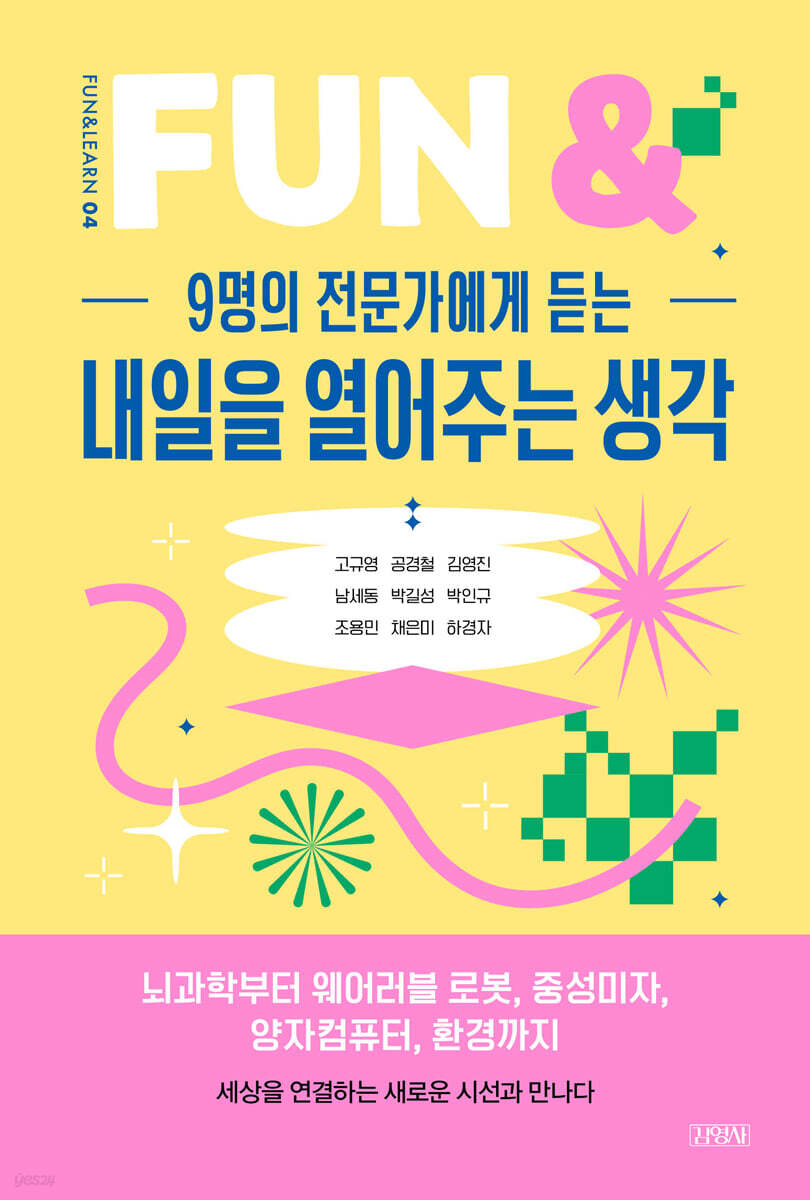
Ideas that open up tomorrow from 9 experts
 |
Description
Book Introduction
We create the future with our imagination.
From brain science to wearable robots, data science, neutrinos, quantum computers, and the environment…
Stories about science, society, technology, and the environment for a better tomorrow
What should we imagine and envision for our future, for our tomorrow? This book features experts from nine fields that shape our society, including life sciences, engineering, physics, and atmospheric environmental science, discussing the current state of their respective fields and future challenges. They also share diverse perspectives on the world with young people.
In this infinitely connected world, discover profound knowledge, insights, and warm advice that will help you design your own "future self."
From brain science to wearable robots, data science, neutrinos, quantum computers, and the environment…
Stories about science, society, technology, and the environment for a better tomorrow
What should we imagine and envision for our future, for our tomorrow? This book features experts from nine fields that shape our society, including life sciences, engineering, physics, and atmospheric environmental science, discussing the current state of their respective fields and future challenges. They also share diverse perspectives on the world with young people.
In this infinitely connected world, discover profound knowledge, insights, and warm advice that will help you design your own "future self."
- You can preview some of the book's contents.
Preview
index
Preface
Exploring Brain Protection and Cleansing / Go Gyu-young
Wearable Robot / Gong Gyeong-cheol
▶ Data Science: A Magnifying Glass for the World / Kim Young-jin
How far can artificial intelligence take us? / Nam Se-dong
Let's sail the Pacific Ocean together, full of dreams / Park Gil-seong
In Search of the Missing Neutrino / Park In-gyu
▶ Cheat Keys for Success in the Game of Life / Yongmin Jo
▶ When Computers Meet Quantum / Chae Eun-mi
▶ The Secret of Abnormal Climate and Future Extreme Climate / Ha Kyung-ja
Exploring Brain Protection and Cleansing / Go Gyu-young
Wearable Robot / Gong Gyeong-cheol
▶ Data Science: A Magnifying Glass for the World / Kim Young-jin
How far can artificial intelligence take us? / Nam Se-dong
Let's sail the Pacific Ocean together, full of dreams / Park Gil-seong
In Search of the Missing Neutrino / Park In-gyu
▶ Cheat Keys for Success in the Game of Life / Yongmin Jo
▶ When Computers Meet Quantum / Chae Eun-mi
▶ The Secret of Abnormal Climate and Future Extreme Climate / Ha Kyung-ja
Into the book
Finally, this is what I find most interesting.
Why does cerebral fluid drain through such a complex pathway? Why does it drain through the same areas where we breathe and swallow? Finding a fundamental answer to this question would likely earn a Nobel Prize.
I haven't found any clues so far.
I can only guess that perhaps the physiological activities of talking, breathing, laughing, eating, and talking might help drain brain fluid in some way.
I believe that you will research and uncover this in the future.
---p.30~31
Artificial intelligence is a technology that we will undoubtedly need to continue to receive assistance from in the future.
The more that happens, the more the technology will develop.
However, artificial intelligence clearly has limitations.
So how should we use AI? AI learns from massive amounts of data and quickly analyzes specialized information.
Developing artificial intelligence directly is something that large companies can do with the ability to train such massive amounts of data.
We can use this artificial intelligence to analyze data.
Even with small data, you can find value and direction in it depending on your perspective and content.
---p.76
Neutrinos are ghost particles.
There is no response.
There is no presence.
Even though it exists, it doesn't seem to exist.
But this room is full, and at this very moment, 100 trillion of them are passing through our bodies.
Neutrinos are chameleons.
Only about a third of the electron neutrinos produced in the sun reach Earth, and the rest escape by changing into other neutrinos.
What's even more interesting is that, unlike other particles, neutrinos are halved.
I don't have a partner.
We are born with only one spin and we don't know if there are neutrinos with the opposite spin or not.
It's a mystery of modern physics.
---p.178~179
I think the cheat key to life is authenticity.
Of course, you've probably heard a lot about being authentic to others and to yourself.
But why aren't many people using this cheat properly? It's because it's too difficult.
An authentic person may sometimes seem slower than others, or even stupid.
In this cutthroat, competitive world, authenticity can feel like a burden, a burden to carry.
But in the end, authenticity will save each and every one of us.
I hope you all spend today thinking deeply about authenticity.
---p.208~209
Quantum superposition and quantum entanglement form the core technologies of quantum computers.
In particular, how well quantum entanglement is created, maintained, and controlled will determine the performance of a quantum computer.
It is no exaggeration to say that that is all.
How do quantum superposition and quantum entanglement serve as core technologies for quantum computers? First, quantum superposition, simply put, allows for the simultaneous calculation of multiple scenarios.
Why does cerebral fluid drain through such a complex pathway? Why does it drain through the same areas where we breathe and swallow? Finding a fundamental answer to this question would likely earn a Nobel Prize.
I haven't found any clues so far.
I can only guess that perhaps the physiological activities of talking, breathing, laughing, eating, and talking might help drain brain fluid in some way.
I believe that you will research and uncover this in the future.
---p.30~31
Artificial intelligence is a technology that we will undoubtedly need to continue to receive assistance from in the future.
The more that happens, the more the technology will develop.
However, artificial intelligence clearly has limitations.
So how should we use AI? AI learns from massive amounts of data and quickly analyzes specialized information.
Developing artificial intelligence directly is something that large companies can do with the ability to train such massive amounts of data.
We can use this artificial intelligence to analyze data.
Even with small data, you can find value and direction in it depending on your perspective and content.
---p.76
Neutrinos are ghost particles.
There is no response.
There is no presence.
Even though it exists, it doesn't seem to exist.
But this room is full, and at this very moment, 100 trillion of them are passing through our bodies.
Neutrinos are chameleons.
Only about a third of the electron neutrinos produced in the sun reach Earth, and the rest escape by changing into other neutrinos.
What's even more interesting is that, unlike other particles, neutrinos are halved.
I don't have a partner.
We are born with only one spin and we don't know if there are neutrinos with the opposite spin or not.
It's a mystery of modern physics.
---p.178~179
I think the cheat key to life is authenticity.
Of course, you've probably heard a lot about being authentic to others and to yourself.
But why aren't many people using this cheat properly? It's because it's too difficult.
An authentic person may sometimes seem slower than others, or even stupid.
In this cutthroat, competitive world, authenticity can feel like a burden, a burden to carry.
But in the end, authenticity will save each and every one of us.
I hope you all spend today thinking deeply about authenticity.
---p.208~209
Quantum superposition and quantum entanglement form the core technologies of quantum computers.
In particular, how well quantum entanglement is created, maintained, and controlled will determine the performance of a quantum computer.
It is no exaggeration to say that that is all.
How do quantum superposition and quantum entanglement serve as core technologies for quantum computers? First, quantum superposition, simply put, allows for the simultaneous calculation of multiple scenarios.
---p.226
Publisher's Review
Developing the ability to think by broadening the scope of the field
The fourth book in the FUN & LEARN series
The 《FUN & LEARN》 series has been published again this year with 《Thoughts on Opening Tomorrow from 9 Experts》.
In this book, you can meet many of the leading experts of our time, whom you have met in the previous "FUN & LEARN" series, and through their stories, you can take time to think about what to prepare for tomorrow and how to think.
We are already living in a completely different world than before.
We use the power of artificial intelligence to write, draw, diagnose cancer, and develop new drugs.
In this way, artificial intelligence is making our lives more convenient and improving our quality of life, and cutting-edge science and technology, which change every day, are rewriting the history of humanity.
In this increasingly fast-changing world, we are always exposed to new technologies and knowledge.
This book covers not only artificial intelligence but also wearable robots, data science, neutrinos, quantum computers, and the climate crisis, topics not previously covered in the FUN & LEARN series.
Nine experts expand the range of fields covered in the series, guiding us into diverse worlds to help future generations develop the power of thinking.
If you want answers to the questions, “What do you want to learn?”, “How should you look at it?”, and “How should you think?”, listen to their stories now.
You will find the answer through the stories they tell about today for tomorrow.
- Brain science that awakens the interest and challenge of life sciences, in search of the meningeal lymphatic vessels…
The first story is about 'how to protect and clean the brain'.
The brain is a central organ that controls various organs in our body.
Accordingly, the skull protects the brain from external physical impact, the meninges prevent pathogens from infiltrating the brain, which has no immune cells, and waste products accumulated in the brain are cleaned by cerebrospinal fluid.
This book explains the tissues and structures of our body that protect the brain, how cerebral fluid containing accumulated waste is discharged through the meningeal lymphatic vessels, and how far research has progressed on the meningeal lymphatic vessels and brain clearance rate.
Go Kyu-young, a life scientist who is considered a world authority in the field of blood vessels and lymphatic vessels, tells the story of how he discovered the collecting lymphatic vessel connected to the nasopharyngeal lymphatic network while exploring the lower lateral side of the brain and how he discovered that cerebral fluid flows out through the lymphatic vessel in the ethmoid plate of the nose. He arouses interest in the field of life sciences and arouses a sense of challenge by introducing tasks that have not yet been discovered in the field of life sciences.
- Engineering that restores, maintains, enhances, and transcends human capabilities: wearable robots
When people think of 'wearable robots', many still think of it as something that only appears in science fiction, like the movie 'Iron Man'.
The second is about wearable robots, an engineering that restores, maintains, enhances, and transcends human capabilities.
Engineer Gong Kyung-chul begins with the problem statement, "We recreate human capabilities with technology." He then explains how wearable robots, which help people with impaired physical abilities, were created through the "methods of scientific inquiry," the first approach introduced in middle school science textbooks.
Every discipline we explore begins by observing a technology or social phenomenon, then defining a problem and formulating a hypothesis.
Then, based on the hypothesis, a method is designed, implemented, and verified.
If the hypothesis is wrong, it is revised again.
If you repeat this process several times, you will eventually reach a conclusion.
However, the educational environment that today's youth are exposed to only teaches them what the conclusion is.
Engineer Gong Gyeong-cheol talks about the process by which his problem definitions are gradually realized through specific technologies, and encourages young people to design their future by setting their own problem definitions and hypotheses and proving them.
- Discover a new perspective that reveals a world that AI cannot see.
With the development of artificial intelligence, many jobs will disappear and new ones will be created.
The third story is told by a data scientist, who has emerged as a promising career for the future thanks to the development of artificial intelligence.
Data scientist Kim Young-jin argues that unlike artificial intelligence, which learns from vast amounts of data to quickly analyze specialized information, humans can find diverse value even from small amounts of data.
This case study introduces Professor Kim Gyu-ho's research process for creating an automatic heating controller by analyzing data, Benford's Law used to analyze financial statements, a word cloud created by collecting titles from petition bulletin boards, and the correlation between food and diabetes.
Through each case, we learn that even seemingly trivial data can yield useful information that benefits our lives depending on the perspective and content, and we can delve deeper into the role of data scientists, something we've long been curious about.
Let's dream of an artificial intelligence filled with our imagination.
Artificial intelligence appears before us every time as an amazing technology.
The fourth is about how artificial intelligence works and how far it can develop.
Computers of the past, which could only calculate in binary, could not distinguish between dogs and cats, and could not read numbers or letters written by people.
However, current artificial intelligence is even performing artistic creation tasks that were once considered uniquely human, such as composing songs and drawing pictures.
The reason this technology is possible is because, while computers in the past were mostly created through programming, artificial intelligence was created through deep learning.
Deep learning is a fundamental technology of artificial intelligence that allows computers to learn on their own and repeat mindlessly until they achieve the desired result.
Nam Se-dong, CEO of VoyagerX, explains the principles of deep learning by comparing computers of the past with artificial intelligence of today, and explains 'generative AI' that creates images, music, and text on its own, and 'multimodal' that processes various types of data such as voice, images, and text, and tells the story of how our imaginations have become reality.
- Let's go out into the world with our maritime imagination.
The fifth is a story told by sociologist Professor Park Gil-seong based on his experience sailing the Pacific Ocean for a month with students from the Naval Academy.
He boarded a ship in Sydney, Australia, sailed through Auckland, New Zealand, and Fiji, and anchored in Pearl Harbor, Hawaii, a journey of approximately 10,000 kilometers, and wanted to share the deep emotions and enlightenment he gained through nature, especially the sea.
He talks.
The Pacific Ocean is infinitely wide and infinitely deep.
If it is wide, it makes people follow, and if it is deep, it makes people feel moved.
If you want people to follow you, you must be broad-minded, and if you want to impress people, your words and actions must be profound.
Let us live as people who resemble the wisdom and embrace of the sea.
And let us go out into the world through the sea.
His story offers us a chance to reimagine our future in the ocean, a world of boundless possibilities and interconnectedness.
- Neutrinos, the invisible rulers of the universe
Unlike other particles, it has no pair and is called a 'ghost particle', meaning it has no reaction or existence.
However, the 'neutrino' that changes like a chameleon and rules the universe.
The sixth story is about these neutrinos.
Neutrinos have been around us since the beginning of the universe.
The existence of neutrinos, the smallest particles that make up the universe, was questioned in 1930, and it was not until 1950 that it was proven.
Physicist Park In-gyu explains what neutrinos are and how they were discovered, from the moment when the possibility of their existence was first questioned to the moment when their existence was proven and the historical moments when their quantity was measured.
In addition, it raises questions about the connection with dark matter, the greatest mystery of modern physics, and leads us into a heated scientific debate.
- Ultimately, sincerity will save each and every one of us.
There are things that should not change even as times change.
It is the attitude towards life.
The seventh is a story about the 'authenticity' that we must have in the future society.
Even when dealing with generative AI, rather than humans, the AI produces different answers depending on the question. If we ask questions while providing AI with a bit of specialized knowledge or richer information to make it easier for it to understand, the AI will provide us with better answers than if we had not done so.
Unbound Lab's Chief Investment Officer, Yongmin Cho, uses examples of generative AI to compare several images and discusses the importance of user-friendly thinking.
He also tells the story of Google's Loon project and the development of Google Glass, which started with user-friendly ideas but ended in failure, and says that in order to move forward, we must not be afraid of failure and continue to challenge ourselves.
And he emphasizes that in order to act like this, you must put 'sincerity' into your work.
His story gives us a chance to deeply reflect on the importance of authenticity, something we often forget in our busy daily lives.
- A new computing paradigm, quantum computers.
Quantum computers will revolutionize future industries.
The eighth story is about quantum computers, which add quantum properties to computers.
Physicist Professor Chae Eun-mi introduces the performance and strengths of quantum computers, their progress to date, and the challenges ahead.
Quantum superposition and quantum entanglement, which are important features of quantum mechanics, play a crucial role in operating quantum computers.
The quantum superposition phenomenon allows the existence of values that are both 0 and 1 in addition to 0 and 1 as the basic units of information, and the quantum entanglement phenomenon allows multiple qubits to become entangled with each other, causing each qubit to influence the other.
These two features allow quantum computers to perform multiple calculations simultaneously, making their computational speeds so fast that comparisons with classical computers become meaningless.
Physicist Eunmi Chae explains the performance and strengths of quantum computers, along with the process of creating them, and guides readers through the fields in which quantum computers are currently being actively researched.
Through this story, we are led to consider how the new field of quantum science and technology will transform our future and what role we will play in it.
The climate crisis threatens humanity. From beginning to end, humanity holds the answer.
The last story is about the climate crisis we are currently facing.
Climate scientist Ha Kyung-ja begins her talk by introducing recent record-breaking heat waves and daily rainfall in Korea, hoping to raise awareness of the severity of abnormal climate that has become a daily occurrence and find solutions.
Currently, extreme precipitation events are occurring more frequently in our country, and the rate of temperature rise is exceeding the global average.
This book examines not only Korea's abnormal climate phenomena through various data and materials, but also the world's abnormal climate phenomena, and provides insight into the various problems caused by global warming and future climate predictions.
Due to the amplification of Arctic warming caused by global warming, the Arctic is often hot while the mid-latitudes remain cold, and depending on regional characteristics, various parts of the world are exposed to dangerous environments such as dry heat waves and wet heat waves.
Climate scientist Ha Kyung-ja presents a graph predicting future climate if carbon dioxide emissions continue at the current rate, and discusses the dangers of a climate crisis that will become more severe in the future, saying that we need to gather more wisdom on climate issues in the future.
※ The 《FUN & LEARN》 series is a collection of lectures from the Ho-Am Foundation's knowledge-sharing festival for youth.
You can meet lectures by experts in each field through a book composed of lectures held each summer and winter.
The fourth book in the FUN & LEARN series
The 《FUN & LEARN》 series has been published again this year with 《Thoughts on Opening Tomorrow from 9 Experts》.
In this book, you can meet many of the leading experts of our time, whom you have met in the previous "FUN & LEARN" series, and through their stories, you can take time to think about what to prepare for tomorrow and how to think.
We are already living in a completely different world than before.
We use the power of artificial intelligence to write, draw, diagnose cancer, and develop new drugs.
In this way, artificial intelligence is making our lives more convenient and improving our quality of life, and cutting-edge science and technology, which change every day, are rewriting the history of humanity.
In this increasingly fast-changing world, we are always exposed to new technologies and knowledge.
This book covers not only artificial intelligence but also wearable robots, data science, neutrinos, quantum computers, and the climate crisis, topics not previously covered in the FUN & LEARN series.
Nine experts expand the range of fields covered in the series, guiding us into diverse worlds to help future generations develop the power of thinking.
If you want answers to the questions, “What do you want to learn?”, “How should you look at it?”, and “How should you think?”, listen to their stories now.
You will find the answer through the stories they tell about today for tomorrow.
- Brain science that awakens the interest and challenge of life sciences, in search of the meningeal lymphatic vessels…
The first story is about 'how to protect and clean the brain'.
The brain is a central organ that controls various organs in our body.
Accordingly, the skull protects the brain from external physical impact, the meninges prevent pathogens from infiltrating the brain, which has no immune cells, and waste products accumulated in the brain are cleaned by cerebrospinal fluid.
This book explains the tissues and structures of our body that protect the brain, how cerebral fluid containing accumulated waste is discharged through the meningeal lymphatic vessels, and how far research has progressed on the meningeal lymphatic vessels and brain clearance rate.
Go Kyu-young, a life scientist who is considered a world authority in the field of blood vessels and lymphatic vessels, tells the story of how he discovered the collecting lymphatic vessel connected to the nasopharyngeal lymphatic network while exploring the lower lateral side of the brain and how he discovered that cerebral fluid flows out through the lymphatic vessel in the ethmoid plate of the nose. He arouses interest in the field of life sciences and arouses a sense of challenge by introducing tasks that have not yet been discovered in the field of life sciences.
- Engineering that restores, maintains, enhances, and transcends human capabilities: wearable robots
When people think of 'wearable robots', many still think of it as something that only appears in science fiction, like the movie 'Iron Man'.
The second is about wearable robots, an engineering that restores, maintains, enhances, and transcends human capabilities.
Engineer Gong Kyung-chul begins with the problem statement, "We recreate human capabilities with technology." He then explains how wearable robots, which help people with impaired physical abilities, were created through the "methods of scientific inquiry," the first approach introduced in middle school science textbooks.
Every discipline we explore begins by observing a technology or social phenomenon, then defining a problem and formulating a hypothesis.
Then, based on the hypothesis, a method is designed, implemented, and verified.
If the hypothesis is wrong, it is revised again.
If you repeat this process several times, you will eventually reach a conclusion.
However, the educational environment that today's youth are exposed to only teaches them what the conclusion is.
Engineer Gong Gyeong-cheol talks about the process by which his problem definitions are gradually realized through specific technologies, and encourages young people to design their future by setting their own problem definitions and hypotheses and proving them.
- Discover a new perspective that reveals a world that AI cannot see.
With the development of artificial intelligence, many jobs will disappear and new ones will be created.
The third story is told by a data scientist, who has emerged as a promising career for the future thanks to the development of artificial intelligence.
Data scientist Kim Young-jin argues that unlike artificial intelligence, which learns from vast amounts of data to quickly analyze specialized information, humans can find diverse value even from small amounts of data.
This case study introduces Professor Kim Gyu-ho's research process for creating an automatic heating controller by analyzing data, Benford's Law used to analyze financial statements, a word cloud created by collecting titles from petition bulletin boards, and the correlation between food and diabetes.
Through each case, we learn that even seemingly trivial data can yield useful information that benefits our lives depending on the perspective and content, and we can delve deeper into the role of data scientists, something we've long been curious about.
Let's dream of an artificial intelligence filled with our imagination.
Artificial intelligence appears before us every time as an amazing technology.
The fourth is about how artificial intelligence works and how far it can develop.
Computers of the past, which could only calculate in binary, could not distinguish between dogs and cats, and could not read numbers or letters written by people.
However, current artificial intelligence is even performing artistic creation tasks that were once considered uniquely human, such as composing songs and drawing pictures.
The reason this technology is possible is because, while computers in the past were mostly created through programming, artificial intelligence was created through deep learning.
Deep learning is a fundamental technology of artificial intelligence that allows computers to learn on their own and repeat mindlessly until they achieve the desired result.
Nam Se-dong, CEO of VoyagerX, explains the principles of deep learning by comparing computers of the past with artificial intelligence of today, and explains 'generative AI' that creates images, music, and text on its own, and 'multimodal' that processes various types of data such as voice, images, and text, and tells the story of how our imaginations have become reality.
- Let's go out into the world with our maritime imagination.
The fifth is a story told by sociologist Professor Park Gil-seong based on his experience sailing the Pacific Ocean for a month with students from the Naval Academy.
He boarded a ship in Sydney, Australia, sailed through Auckland, New Zealand, and Fiji, and anchored in Pearl Harbor, Hawaii, a journey of approximately 10,000 kilometers, and wanted to share the deep emotions and enlightenment he gained through nature, especially the sea.
He talks.
The Pacific Ocean is infinitely wide and infinitely deep.
If it is wide, it makes people follow, and if it is deep, it makes people feel moved.
If you want people to follow you, you must be broad-minded, and if you want to impress people, your words and actions must be profound.
Let us live as people who resemble the wisdom and embrace of the sea.
And let us go out into the world through the sea.
His story offers us a chance to reimagine our future in the ocean, a world of boundless possibilities and interconnectedness.
- Neutrinos, the invisible rulers of the universe
Unlike other particles, it has no pair and is called a 'ghost particle', meaning it has no reaction or existence.
However, the 'neutrino' that changes like a chameleon and rules the universe.
The sixth story is about these neutrinos.
Neutrinos have been around us since the beginning of the universe.
The existence of neutrinos, the smallest particles that make up the universe, was questioned in 1930, and it was not until 1950 that it was proven.
Physicist Park In-gyu explains what neutrinos are and how they were discovered, from the moment when the possibility of their existence was first questioned to the moment when their existence was proven and the historical moments when their quantity was measured.
In addition, it raises questions about the connection with dark matter, the greatest mystery of modern physics, and leads us into a heated scientific debate.
- Ultimately, sincerity will save each and every one of us.
There are things that should not change even as times change.
It is the attitude towards life.
The seventh is a story about the 'authenticity' that we must have in the future society.
Even when dealing with generative AI, rather than humans, the AI produces different answers depending on the question. If we ask questions while providing AI with a bit of specialized knowledge or richer information to make it easier for it to understand, the AI will provide us with better answers than if we had not done so.
Unbound Lab's Chief Investment Officer, Yongmin Cho, uses examples of generative AI to compare several images and discusses the importance of user-friendly thinking.
He also tells the story of Google's Loon project and the development of Google Glass, which started with user-friendly ideas but ended in failure, and says that in order to move forward, we must not be afraid of failure and continue to challenge ourselves.
And he emphasizes that in order to act like this, you must put 'sincerity' into your work.
His story gives us a chance to deeply reflect on the importance of authenticity, something we often forget in our busy daily lives.
- A new computing paradigm, quantum computers.
Quantum computers will revolutionize future industries.
The eighth story is about quantum computers, which add quantum properties to computers.
Physicist Professor Chae Eun-mi introduces the performance and strengths of quantum computers, their progress to date, and the challenges ahead.
Quantum superposition and quantum entanglement, which are important features of quantum mechanics, play a crucial role in operating quantum computers.
The quantum superposition phenomenon allows the existence of values that are both 0 and 1 in addition to 0 and 1 as the basic units of information, and the quantum entanglement phenomenon allows multiple qubits to become entangled with each other, causing each qubit to influence the other.
These two features allow quantum computers to perform multiple calculations simultaneously, making their computational speeds so fast that comparisons with classical computers become meaningless.
Physicist Eunmi Chae explains the performance and strengths of quantum computers, along with the process of creating them, and guides readers through the fields in which quantum computers are currently being actively researched.
Through this story, we are led to consider how the new field of quantum science and technology will transform our future and what role we will play in it.
The climate crisis threatens humanity. From beginning to end, humanity holds the answer.
The last story is about the climate crisis we are currently facing.
Climate scientist Ha Kyung-ja begins her talk by introducing recent record-breaking heat waves and daily rainfall in Korea, hoping to raise awareness of the severity of abnormal climate that has become a daily occurrence and find solutions.
Currently, extreme precipitation events are occurring more frequently in our country, and the rate of temperature rise is exceeding the global average.
This book examines not only Korea's abnormal climate phenomena through various data and materials, but also the world's abnormal climate phenomena, and provides insight into the various problems caused by global warming and future climate predictions.
Due to the amplification of Arctic warming caused by global warming, the Arctic is often hot while the mid-latitudes remain cold, and depending on regional characteristics, various parts of the world are exposed to dangerous environments such as dry heat waves and wet heat waves.
Climate scientist Ha Kyung-ja presents a graph predicting future climate if carbon dioxide emissions continue at the current rate, and discusses the dangers of a climate crisis that will become more severe in the future, saying that we need to gather more wisdom on climate issues in the future.
※ The 《FUN & LEARN》 series is a collection of lectures from the Ho-Am Foundation's knowledge-sharing festival for youth.
You can meet lectures by experts in each field through a book composed of lectures held each summer and winter.
GOODS SPECIFICS
- Date of issue: June 30, 2025
- Page count, weight, size: 268 pages | 152*225*20mm
- ISBN13: 9791173322396
- ISBN10: 1173322396
You may also like
카테고리
korean


korean

![GQ KOREA Mark (Monthly): December [2025]](http://librairie.coreenne.fr/cdn/shop/files/8ef265dbbfbf186523ed75ba7319009d.jpg?v=1765340328&width=3840)


