

You said Malaya was pretty?
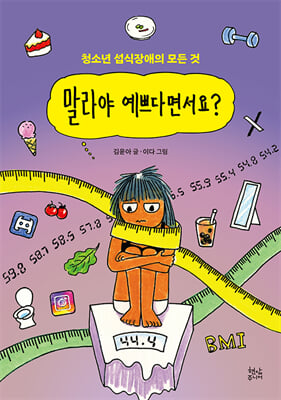 |
Description
Book Introduction
“If you don’t dry out, you’re better off dead.”
Weight loss, but anxiety not.
Eating becomes a guilt trip, and gaining weight feels like a failure.
This isn't just a story about dieting, it's a story about a mind where eating becomes painful.
Let's delve into the complex and nuanced world of adolescent eating disorders, which cannot be defined by flat words like "eat-to-die," "pro-ana," or "bone-dry."
Weight loss, but anxiety not.
Eating becomes a guilt trip, and gaining weight feels like a failure.
This isn't just a story about dieting, it's a story about a mind where eating becomes painful.
Let's delve into the complex and nuanced world of adolescent eating disorders, which cannot be defined by flat words like "eat-to-die," "pro-ana," or "bone-dry."
- You can preview some of the book's contents.
Preview
index
Chapter 1: I Have an Eating Disorder?
01 I was just on a diet
02 Is it an eating disorder even if I'm not thin?
03 I didn't know I had an eating disorder
Chapter 2 I keep hating my body
01 I feel like people are only looking at my legs.
02 The only thing I can control is my weight.
03 I wish I had skinny legs like my friend.
Chapter 3 I was praised for being thin
01 They say it's great if you lose weight.
02 Idols are 'bone-dry', so why can't we?
03 They say that if you just take medicine, you can lose 10kg in no time.
04 My parents say I'm embarrassed
Chapter 4: I want to recover, but I'm afraid of gaining weight.
01 I think I have an eating disorder. What should I do?
02 I think I'll gain weight if I eat it regularly.
03 My mom and I always fight over what to eat.
Appendix Eating Disorder Self-Assessment Test
Author's Note: Even with an eating disorder, life must go on.
References
01 I was just on a diet
02 Is it an eating disorder even if I'm not thin?
03 I didn't know I had an eating disorder
Chapter 2 I keep hating my body
01 I feel like people are only looking at my legs.
02 The only thing I can control is my weight.
03 I wish I had skinny legs like my friend.
Chapter 3 I was praised for being thin
01 They say it's great if you lose weight.
02 Idols are 'bone-dry', so why can't we?
03 They say that if you just take medicine, you can lose 10kg in no time.
04 My parents say I'm embarrassed
Chapter 4: I want to recover, but I'm afraid of gaining weight.
01 I think I have an eating disorder. What should I do?
02 I think I'll gain weight if I eat it regularly.
03 My mom and I always fight over what to eat.
Appendix Eating Disorder Self-Assessment Test
Author's Note: Even with an eating disorder, life must go on.
References
Detailed image

Into the book
The sad truth is that because of this misunderstanding, people with eating disorders miss the opportunity to seek treatment because they are censoring themselves about how much of an eating disorder they really are.
In fact, when I asked people who visited the counseling center, many of them said that they had no intention of getting treatment even though their weight was increasing and decreasing like a rubber band due to repeated fasting and binge eating, and that they simply thought that their dieting method was wrong or that they were experiencing a yo-yo effect.
Even if you think, 'Could it be an eating disorder?', you end up putting off treatment because you are stuck in a pit of self-blame thinking that you are too special.
---p.20
The perception that 'a fat body is a funny body' is passed on to teenagers.
Children who are slightly overweight or large grow up hearing ridicule like “An-yeo-dwae (pig with glasses)” and “The broth is flowing.”
Some people lose weight because they want to look better, while others feel pressured to change their appearance to avoid being ridiculed or to survive.
---p.69
Rather than putting off life with resolutions like, “I’ll buy clothes once I lose 5 more kilos,” or “I’ll definitely lose weight and travel next year,” I hope you live in the present moment.
Because life continues not just in that 'then' when the body changed, but also in 'this place now'.
In fact, when I asked people who visited the counseling center, many of them said that they had no intention of getting treatment even though their weight was increasing and decreasing like a rubber band due to repeated fasting and binge eating, and that they simply thought that their dieting method was wrong or that they were experiencing a yo-yo effect.
Even if you think, 'Could it be an eating disorder?', you end up putting off treatment because you are stuck in a pit of self-blame thinking that you are too special.
---p.20
The perception that 'a fat body is a funny body' is passed on to teenagers.
Children who are slightly overweight or large grow up hearing ridicule like “An-yeo-dwae (pig with glasses)” and “The broth is flowing.”
Some people lose weight because they want to look better, while others feel pressured to change their appearance to avoid being ridiculed or to survive.
---p.69
Rather than putting off life with resolutions like, “I’ll buy clothes once I lose 5 more kilos,” or “I’ll definitely lose weight and travel next year,” I hope you live in the present moment.
Because life continues not just in that 'then' when the body changed, but also in 'this place now'.
---p.133
Publisher's Review
A story about 'pain', not dieting
A Closer Look at Adolescent Eating Disorders
In recent years, there has been a flood of articles about 'teenage eating disorders'.
The content is that teenagers are not only not eating to lose weight, but are also repeatedly engaging in behaviors such as eating and then vomiting (mukto) and chewing and spitting out food (chew spit).
The confession that appears on internet communities, “If you don’t lose weight, you’re better off dead,” is no longer unfamiliar.
The first question that comes to mind when faced with this phenomenon is simple.
"Why?" Why do teenagers endure the pain of holding onto the toilet for hours and vomiting food in an attempt to lose weight? "You're supposed to be skinny to be pretty, right?" answers this question, stating that the reason cannot be simply explained as "wanting to be pretty."
The author, who suffered from an eating disorder in her youth and became a counselor specializing in eating disorders, points out that adolescent eating disorders are a problem that can never be explained by the single cause of 'dieting', based on vivid counseling cases she encountered while counseling adolescents.
In a college entrance exam system that stifles autonomy, a social atmosphere that takes competition for granted, and a media environment that constantly instills unrealistic body standards, the emergence of adolescent eating disorders is perhaps a completely natural progression.
And within it, the youth of South Korea are still quietly sickening.
“You said Malaya was pretty?”
How to protect myself from distorted body standards
Our society constantly evaluates and controls our bodies.
When the target is a youth, the impact is deeper and more widespread.
The beauty industry has consistently bombarded us with the message, "You need to be better than you are now," and has successfully popularized various diet products.
From plastic surgery ads to diet supplement ads to dermatological procedures.
Teenagers are exposed to distorted body images every day.
"You're Pretty When You're Skinny" analyzes how this obsession with thinness is reinforced within the psychological and social structure, and argues that explaining eating disorders simply as a matter of personal will or self-esteem overlooks the circumstances faced by adolescents.
Before we judge adolescents with eating disorders with flat terms like "eat-to-die," "pro-ana," and "bone-dry," we need to ask:
Why did those kids want to be so skinny? Who asked if being skinny was the right thing to do?
From realistic cartoons to actionable checklists,
Empathy 100x Yuna's Counseling Center
"You said Malaya was pretty?" is structured so that teenagers can immerse themselves in the story without emotional distance, through scenes of counseling between a teenager suffering from an eating disorder and Teacher Yuna.
From a conversational format reminiscent of familiar messaging apps to checklists for self-diagnosis and practical tips for everyday life, it helps readers actively monitor their own health.
It also provides an opportunity to explore treatment options for those who have been delaying treatment because they are censoring how much of an eating disorder they have, by presenting realistic cases such as binge eating, fasting, and weight obsession.
Furthermore, we are helping adults, including parents, teachers, and counselors, to accurately understand the pain of adolescents and begin recovery together.
Here, cartoon cuts drawn by Ida, an illustrator with over 100,000 SNS followers, are added, further increasing the immersion and emotional density of the book.
Author Ida's unique raw sensibility and realistic humor delicately portray the anxieties and instability of teenagers that cannot be fully expressed in words.
'Even if you have an eating disorder, life must go on.'
A message of comfort is more accurate than a perfect solution.
Eating disorders in adolescents are different from those in adults.
Adults voluntarily seek medical attention when eating problems significantly interfere with their daily lives, but teenagers find it difficult to easily make the decision to give up on dieting, no matter how difficult it may be.
This is because schools are now ranking students based on their appearance and making fun of fat friends.
In such a situation, telling teenagers to “stop dieting” sounds like an unreasonable demand.
So what advice do teens with eating disorders, or those just beginning to develop them, have? The author of this book offers this advice.
Even if you can't give up on your diet right now, don't give up on your daily routine.
Even if you don't feel like eating, try to keep your promise to eat tteokbokki with friends, and don't skip school because you're binge eating.
The small choices we make to continue our daily lives can ultimately become resources for recovery.
Rather than offering a perfect solution, "Isn't Malaya Pretty?" offers precise comfort so that teenagers suffering from eating disorders don't have to suffer alone anymore.
“Even if you have an eating disorder, life must go on.” I hope this book reaches someone who needs that message.
A Closer Look at Adolescent Eating Disorders
In recent years, there has been a flood of articles about 'teenage eating disorders'.
The content is that teenagers are not only not eating to lose weight, but are also repeatedly engaging in behaviors such as eating and then vomiting (mukto) and chewing and spitting out food (chew spit).
The confession that appears on internet communities, “If you don’t lose weight, you’re better off dead,” is no longer unfamiliar.
The first question that comes to mind when faced with this phenomenon is simple.
"Why?" Why do teenagers endure the pain of holding onto the toilet for hours and vomiting food in an attempt to lose weight? "You're supposed to be skinny to be pretty, right?" answers this question, stating that the reason cannot be simply explained as "wanting to be pretty."
The author, who suffered from an eating disorder in her youth and became a counselor specializing in eating disorders, points out that adolescent eating disorders are a problem that can never be explained by the single cause of 'dieting', based on vivid counseling cases she encountered while counseling adolescents.
In a college entrance exam system that stifles autonomy, a social atmosphere that takes competition for granted, and a media environment that constantly instills unrealistic body standards, the emergence of adolescent eating disorders is perhaps a completely natural progression.
And within it, the youth of South Korea are still quietly sickening.
“You said Malaya was pretty?”
How to protect myself from distorted body standards
Our society constantly evaluates and controls our bodies.
When the target is a youth, the impact is deeper and more widespread.
The beauty industry has consistently bombarded us with the message, "You need to be better than you are now," and has successfully popularized various diet products.
From plastic surgery ads to diet supplement ads to dermatological procedures.
Teenagers are exposed to distorted body images every day.
"You're Pretty When You're Skinny" analyzes how this obsession with thinness is reinforced within the psychological and social structure, and argues that explaining eating disorders simply as a matter of personal will or self-esteem overlooks the circumstances faced by adolescents.
Before we judge adolescents with eating disorders with flat terms like "eat-to-die," "pro-ana," and "bone-dry," we need to ask:
Why did those kids want to be so skinny? Who asked if being skinny was the right thing to do?
From realistic cartoons to actionable checklists,
Empathy 100x Yuna's Counseling Center
"You said Malaya was pretty?" is structured so that teenagers can immerse themselves in the story without emotional distance, through scenes of counseling between a teenager suffering from an eating disorder and Teacher Yuna.
From a conversational format reminiscent of familiar messaging apps to checklists for self-diagnosis and practical tips for everyday life, it helps readers actively monitor their own health.
It also provides an opportunity to explore treatment options for those who have been delaying treatment because they are censoring how much of an eating disorder they have, by presenting realistic cases such as binge eating, fasting, and weight obsession.
Furthermore, we are helping adults, including parents, teachers, and counselors, to accurately understand the pain of adolescents and begin recovery together.
Here, cartoon cuts drawn by Ida, an illustrator with over 100,000 SNS followers, are added, further increasing the immersion and emotional density of the book.
Author Ida's unique raw sensibility and realistic humor delicately portray the anxieties and instability of teenagers that cannot be fully expressed in words.
'Even if you have an eating disorder, life must go on.'
A message of comfort is more accurate than a perfect solution.
Eating disorders in adolescents are different from those in adults.
Adults voluntarily seek medical attention when eating problems significantly interfere with their daily lives, but teenagers find it difficult to easily make the decision to give up on dieting, no matter how difficult it may be.
This is because schools are now ranking students based on their appearance and making fun of fat friends.
In such a situation, telling teenagers to “stop dieting” sounds like an unreasonable demand.
So what advice do teens with eating disorders, or those just beginning to develop them, have? The author of this book offers this advice.
Even if you can't give up on your diet right now, don't give up on your daily routine.
Even if you don't feel like eating, try to keep your promise to eat tteokbokki with friends, and don't skip school because you're binge eating.
The small choices we make to continue our daily lives can ultimately become resources for recovery.
Rather than offering a perfect solution, "Isn't Malaya Pretty?" offers precise comfort so that teenagers suffering from eating disorders don't have to suffer alone anymore.
“Even if you have an eating disorder, life must go on.” I hope this book reaches someone who needs that message.
GOODS SPECIFICS
- Date of issue: June 5, 2025
- Page count, weight, size: 136 pages | 148*210*8mm
- ISBN13: 9788932376547
You may also like
카테고리
korean


korean

![GQ KOREA Mark (Monthly): December [2025]](http://librairie.coreenne.fr/cdn/shop/files/8ef265dbbfbf186523ed75ba7319009d.jpg?v=1765340328&width=3840)


