

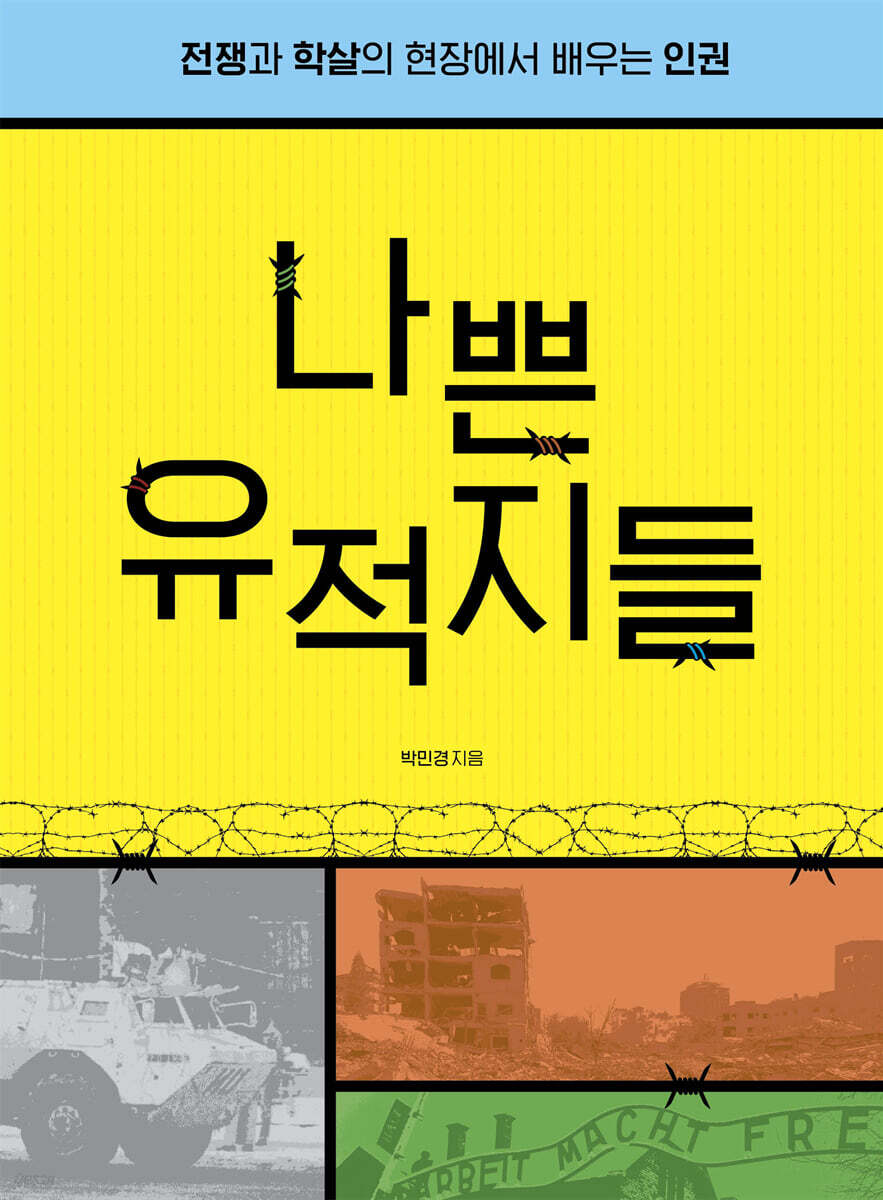
Bad historical sites
 |
Description
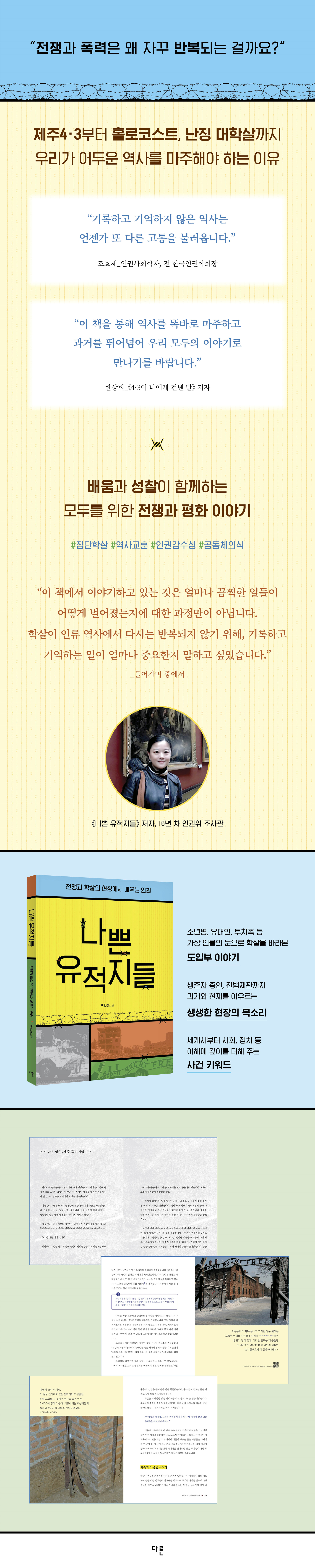
Book Introduction
'Bad' Sites Created by War and Massacre
From the Jeju April 3 Incident to the Holocaust and the Nanjing Massacre
Why We Must Face Our Dark History
The Holocaust occurred during World War II.
As many as 6 million people lost their lives in this massacre.
Around the same time, in Nanjing, China, Japanese troops brutally murdered 300,000 people in just six weeks.
The history of massacre was neither the beginning nor the end.
Before the Holocaust, there was the Armenian genocide, which Hitler used as an example, and after World War II, there was the Rwandan genocide, where families and neighbors killed each other.
“Who on earth is talking about the Armenian genocide now?”
This is what Hitler said in his autobiography.
Only when we face the back of history can we know what to watch out for and how to act.
The 'bad relics' left behind by war and massacre, which should not have existed, are historical sites that we must remember today to avoid repeating the same tragedies.
From the Jeju April 3 Incident to the Holocaust and the Nanjing Massacre
Why We Must Face Our Dark History
The Holocaust occurred during World War II.
As many as 6 million people lost their lives in this massacre.
Around the same time, in Nanjing, China, Japanese troops brutally murdered 300,000 people in just six weeks.
The history of massacre was neither the beginning nor the end.
Before the Holocaust, there was the Armenian genocide, which Hitler used as an example, and after World War II, there was the Rwandan genocide, where families and neighbors killed each other.
“Who on earth is talking about the Armenian genocide now?”
This is what Hitler said in his autobiography.
Only when we face the back of history can we know what to watch out for and how to act.
The 'bad relics' left behind by war and massacre, which should not have existed, are historical sites that we must remember today to avoid repeating the same tragedies.
- You can preview some of the book's contents.
Preview
index
Introduction_The Power of Memory to Illuminate Dark History
Chapter 1.
China, Nanjing Massacre
: We were not human
#Japanese_Military_Comfort_Women #Safe_Zone #Cold_War
My name is Hakuto, I am a Japanese soldier.
A land steeped in a glorious history | Abandoned cities and people | Turning the rivers red | A race to kill faster and more | A safe haven for the just | The lives of the survivors | A record for a better future
Chapter 2.
Germany, Holocaust
: The Shadow of Nazi
#Jews #Eugenics #Universal_Declaration_of_Human_Rights
My name is Jan, I am Jewish.
A man-made catastrophe | Why did the Germans fall to the Nazis? | The red letter Jew | People forced into ghettos | The last train station to death | Victims of eugenics | Schindler's people | The birth of the Universal Declaration of Human Rights | The sad repetition of history
Chapter 3.
South Korea, Jeju April 3
: When a country abandons its people
#USMilitaryGovernment #MartialLaw #StateViolence
My name is Manseok, and I am a native of Jeju.
Long live Korean independence! | Jeju Island, the island of chaos | Those who do not come down die! | Losing family and village | Living in caves to survive | Those who could not return | Another face of the devil, the Northwest Youth Corps | A history that should not be remembered | Because the people are the masters of the nation
Chapter 4.
Rwanda, the tear of Africa
: At the crossroads of revenge and forgiveness
#imperialism #third world #discrimination
My name is Monique, I am Tutsi.
Land grabbing around Africa | Rule by division | The end of irreversible hatred | Kill your family and neighbors | The hotel manager who saved people | Deaths the world turned a blind eye to | Good discrimination, bad discrimination | Gachacha who rebuilt Rwanda
Chapter 5.
Cambodia, Killing Fields
: A land that has become a graveyard
#mass_grave #child_soldier #land_mine
My name is Bopha, I am a child soldier of the Khmer Rouge.
A Land of Beautiful Temples | Cambodia Under Communism | Pol Pot, the Worst Leader | Forbidden Difference | No War for the Weak | Tuol Sleng, a School Turned into a Torture Chamber | What Remains After the Sword | The Unpunished
Chapter 6.
Siege of Sarajevo, Bosnia and Herzegovina
: 1,425 days in city jail
#European_powder_deposit #Sniper's_street
My name is Sarah, I am a citizen trapped in Sarajevo.
A small, mysterious, and complex country | The Balkans, Europe's powder keg | Three nations under one roof | Sarajevo, a city that became a prison | Sniper Street | A tunnel of hope through hunger | Another massacre, Srebrenica | What's over and what's not over | What global citizens should know
Chapter 7.
Armenia, Mez Yegern
: Unfinished death
#The_first_genocide_of_the_20th_century
My name is Sona, I am Armenian
Armenia and the Ottoman Empire | From the Hamid Massacre to the Adana Massacre | A Homeland Forced to Survive | A Victim of Imperialism | An Unapologetic Game of Wits | A Reason to Remember
References
Chapter 1.
China, Nanjing Massacre
: We were not human
#Japanese_Military_Comfort_Women #Safe_Zone #Cold_War
My name is Hakuto, I am a Japanese soldier.
A land steeped in a glorious history | Abandoned cities and people | Turning the rivers red | A race to kill faster and more | A safe haven for the just | The lives of the survivors | A record for a better future
Chapter 2.
Germany, Holocaust
: The Shadow of Nazi
#Jews #Eugenics #Universal_Declaration_of_Human_Rights
My name is Jan, I am Jewish.
A man-made catastrophe | Why did the Germans fall to the Nazis? | The red letter Jew | People forced into ghettos | The last train station to death | Victims of eugenics | Schindler's people | The birth of the Universal Declaration of Human Rights | The sad repetition of history
Chapter 3.
South Korea, Jeju April 3
: When a country abandons its people
#USMilitaryGovernment #MartialLaw #StateViolence
My name is Manseok, and I am a native of Jeju.
Long live Korean independence! | Jeju Island, the island of chaos | Those who do not come down die! | Losing family and village | Living in caves to survive | Those who could not return | Another face of the devil, the Northwest Youth Corps | A history that should not be remembered | Because the people are the masters of the nation
Chapter 4.
Rwanda, the tear of Africa
: At the crossroads of revenge and forgiveness
#imperialism #third world #discrimination
My name is Monique, I am Tutsi.
Land grabbing around Africa | Rule by division | The end of irreversible hatred | Kill your family and neighbors | The hotel manager who saved people | Deaths the world turned a blind eye to | Good discrimination, bad discrimination | Gachacha who rebuilt Rwanda
Chapter 5.
Cambodia, Killing Fields
: A land that has become a graveyard
#mass_grave #child_soldier #land_mine
My name is Bopha, I am a child soldier of the Khmer Rouge.
A Land of Beautiful Temples | Cambodia Under Communism | Pol Pot, the Worst Leader | Forbidden Difference | No War for the Weak | Tuol Sleng, a School Turned into a Torture Chamber | What Remains After the Sword | The Unpunished
Chapter 6.
Siege of Sarajevo, Bosnia and Herzegovina
: 1,425 days in city jail
#European_powder_deposit #Sniper's_street
My name is Sarah, I am a citizen trapped in Sarajevo.
A small, mysterious, and complex country | The Balkans, Europe's powder keg | Three nations under one roof | Sarajevo, a city that became a prison | Sniper Street | A tunnel of hope through hunger | Another massacre, Srebrenica | What's over and what's not over | What global citizens should know
Chapter 7.
Armenia, Mez Yegern
: Unfinished death
#The_first_genocide_of_the_20th_century
My name is Sona, I am Armenian
Armenia and the Ottoman Empire | From the Hamid Massacre to the Adana Massacre | A Homeland Forced to Survive | A Victim of Imperialism | An Unapologetic Game of Wits | A Reason to Remember
References
Detailed image
Into the book
The Nanjing Massacre refers to the indiscriminate killing of Chinese prisoners of war and civilians by Japanese troops from 1937 to 1938.
The most infamous of these is the 100-man neck-cutting contest.
Two Japanese officers competed to see who could be the fastest to behead 100 Chinese prisoners.
Surprisingly, the match was covered in Japanese newspapers with headlines like “Unbelievable Record” and “106 to 105, Two Lieutenants Go into Overtime.”
--- p.19 From “Chapter 1_China, Nanjing Massacre”
Their thinking was this:
They said that the problem would be solved if they brought in women from various countries that were then Japanese colonies and operated 'comfort women'.
They thought it would prevent soldiers from contracting sexually transmitted diseases and help Japan avoid being criticized by other countries.
Thus, comfort stations were created all over China.
It is said that there were more than 40 comfort stations in Nanjing alone.
Many women were brought here by force or by deception with promises of money.
Among them were women from our country.
--- p.21 From “Chapter 1_China, Nanjing Massacre”
René Cassin was a French lawyer and Jew who participated in drafting the Universal Declaration of Human Rights.
Having lost 29 relatives in Nazi concentration camps, he wrote a draft of what would happen if human rights were trampled.
And we must all speak together so that everyone can speak freely, practice their religion, and be free from fear and want.
Later, in the Universal Declaration of Human Rights, this content was slightly changed. The Holocaust was the impetus for the creation of the Universal Declaration of Human Rights, but the lesson was to be made into a principle that all of humanity must follow, regardless of race or religion, not just a specific country or ethnicity.
--- p.56-58 From “Chapter 2_Germany, the Holocaust”
Darangshi Cave was also a place where people gathered to live.
The punitive force, realizing that people were hiding, fired into the Darangshi Cave.
Those who were afraid would have gone deeper into the cave.
Then, the punitive force set fire to the cave and blocked the entrance with a stone as it gradually filled with smoke.
When the place was discovered later, it is said that the people inside the cave had died with their noses buried in the ground or digging the ground with their hands.
--- p.78 From “Chapter 3_Korea, Jeju 4.3”
The bodies of those who were arrested as a precautionary measure and died at Seottal Oreum were not returned to their families until six years later.
However, the bodies were entangled with each other and rotting together with leaves, clothes, etc., making it difficult to even tell who was who.
Eventually, people had to gather the bodies together, hold a funeral, and bury them in the ground.
And they erected a monument inscribed with the names of the victims.
The name of the tombstone was Baekjo Ilsonji Myo (百祖一孫之墓).
It means that more than 100 ancestors died on the same day and in the same place and became one, so their descendants are now one lineage.
--- p.84 From “Chapter 3_Korea, Jeju 4.3”
What fueled the massacre was a broadcast coming through the radio.
The Hutu-controlled radio station broadcasted broadcasts vilifying the Tutsi all day long.
The voice was low and heavy.
“Kill the Tutsi.
They are cockroaches.
“Find the Tutsi living in my neighborhood right now and kill them.”
--- p.101 From “Chapter 4_Rwanda, Tears of Africa”
Rwandans who barely survived the genocide were in the absurd position of having to repay the money they borrowed to buy machetes.
He cried out to the world that it was unfair to demand repayment of the money used to kill his family and friends, but was ignored.
France, which had lent the money, also remained silent.
In the end, the Rwandan people had to suffer from hunger for a long time to repay the money they borrowed from France.
--- p.106 From “Chapter 4_Rwanda, Tears of Africa”
What if the Ottoman Empire had been the first to acknowledge and apologize for the Armenian Genocide? Just as the great powers came together after World War I to ensure such a war would never happen again?
So, what if humanity had recognized that genocide was a clear crime and atrocity? Perhaps the Nazi Holocaust against the Jews might never have happened.
Isn't this why we should remember history?
The most infamous of these is the 100-man neck-cutting contest.
Two Japanese officers competed to see who could be the fastest to behead 100 Chinese prisoners.
Surprisingly, the match was covered in Japanese newspapers with headlines like “Unbelievable Record” and “106 to 105, Two Lieutenants Go into Overtime.”
--- p.19 From “Chapter 1_China, Nanjing Massacre”
Their thinking was this:
They said that the problem would be solved if they brought in women from various countries that were then Japanese colonies and operated 'comfort women'.
They thought it would prevent soldiers from contracting sexually transmitted diseases and help Japan avoid being criticized by other countries.
Thus, comfort stations were created all over China.
It is said that there were more than 40 comfort stations in Nanjing alone.
Many women were brought here by force or by deception with promises of money.
Among them were women from our country.
--- p.21 From “Chapter 1_China, Nanjing Massacre”
René Cassin was a French lawyer and Jew who participated in drafting the Universal Declaration of Human Rights.
Having lost 29 relatives in Nazi concentration camps, he wrote a draft of what would happen if human rights were trampled.
And we must all speak together so that everyone can speak freely, practice their religion, and be free from fear and want.
Later, in the Universal Declaration of Human Rights, this content was slightly changed. The Holocaust was the impetus for the creation of the Universal Declaration of Human Rights, but the lesson was to be made into a principle that all of humanity must follow, regardless of race or religion, not just a specific country or ethnicity.
--- p.56-58 From “Chapter 2_Germany, the Holocaust”
Darangshi Cave was also a place where people gathered to live.
The punitive force, realizing that people were hiding, fired into the Darangshi Cave.
Those who were afraid would have gone deeper into the cave.
Then, the punitive force set fire to the cave and blocked the entrance with a stone as it gradually filled with smoke.
When the place was discovered later, it is said that the people inside the cave had died with their noses buried in the ground or digging the ground with their hands.
--- p.78 From “Chapter 3_Korea, Jeju 4.3”
The bodies of those who were arrested as a precautionary measure and died at Seottal Oreum were not returned to their families until six years later.
However, the bodies were entangled with each other and rotting together with leaves, clothes, etc., making it difficult to even tell who was who.
Eventually, people had to gather the bodies together, hold a funeral, and bury them in the ground.
And they erected a monument inscribed with the names of the victims.
The name of the tombstone was Baekjo Ilsonji Myo (百祖一孫之墓).
It means that more than 100 ancestors died on the same day and in the same place and became one, so their descendants are now one lineage.
--- p.84 From “Chapter 3_Korea, Jeju 4.3”
What fueled the massacre was a broadcast coming through the radio.
The Hutu-controlled radio station broadcasted broadcasts vilifying the Tutsi all day long.
The voice was low and heavy.
“Kill the Tutsi.
They are cockroaches.
“Find the Tutsi living in my neighborhood right now and kill them.”
--- p.101 From “Chapter 4_Rwanda, Tears of Africa”
Rwandans who barely survived the genocide were in the absurd position of having to repay the money they borrowed to buy machetes.
He cried out to the world that it was unfair to demand repayment of the money used to kill his family and friends, but was ignored.
France, which had lent the money, also remained silent.
In the end, the Rwandan people had to suffer from hunger for a long time to repay the money they borrowed from France.
--- p.106 From “Chapter 4_Rwanda, Tears of Africa”
What if the Ottoman Empire had been the first to acknowledge and apologize for the Armenian Genocide? Just as the great powers came together after World War I to ensure such a war would never happen again?
So, what if humanity had recognized that genocide was a clear crime and atrocity? Perhaps the Nazi Holocaust against the Jews might never have happened.
Isn't this why we should remember history?
--- p.186-188 From “Chapter 7_Armenia, Mez Yegern”
Publisher's Review
★ Recommended by human rights sociologist Cho Hyo-je
★ Recommended by Han Sang-hee, author of "What the April 3rd Incident Told Me"
★ A must-read for global citizens, recommended for human rights classes
★ Provides follow-up activity sheets for critical peace education.
'If I were a boy soldier, a Jew, or a Jeju person…'
Through the eyes of a 16-year veteran investigator at the Human Rights Commission
A story of war and peace for everyone
This book explores genocide that has occurred around the world.
There are a total of seven incidents, from the Nanjing Massacre in China to the Holocaust, the Jeju April 3 Incident, the Rwandan Genocide, the Cambodian Killing Fields, the Siege of Sarajevo in Bosnia and Herzegovina, and the Armenian Genocide.
The story moves between the past and present, asking why such a terrible thing happened, who did it, and what has become of the place now.
Event keywords that organize complex world history, such as the Cold War, eugenics, and the oil crisis, help us clearly understand the causes and background of the massacre.
The author, who has worked as an investigator for the National Human Rights Commission for 16 years, goes further and talks about humanity, such as the safety zone for righteous people and the Gachacha spirit that prioritizes reconciliation and cooperation.
Additionally, the introductory story, written based on remaining records, vividly conveys the situation at the time through the eyes of children, the greatest victims of the war.
It leads the reader into questions and reflections such as, 'What if it were me?' and 'What if that happened to me?'
Those who committed the massacre were from another country and another people, but they were also the same people and the government that was supposed to protect the people.
Only by writing it down can we remember, and only by remembering can we ensure that such terrible things never happen again.
The dark history told in this book is ultimately a story for all of us.
Editor's Note
Even deaths that were not 'recognized' as genocide
A story of unending suffering
'Genocide' refers to the act of killing members of a specific group with the purpose of eradicating that group.
In Korean, it is usually called genocide or genocide.
Genocide requires the intent and action of destruction directed against a specific national, ethnic, racial, or religious group.
That is why, on the contrary, the name genocide cannot be applied to massacres that occur within a country or a people, or acts of coercion carried out for political purposes.
Examples include the Nanjing Massacre, in which the Japanese army massacred the citizens of the city of Nanjing during the Second Sino-Japanese War; the Killing Fields inflicted by the Cambodian leader on his own people; and the Siege of Sarajevo, in which civilians were indiscriminately attacked in an attempt to quickly end the war.
The Jeju 4.5 Incident is one of them, where our country's soldiers and police pointed their guns at the people of Jeju.
Today, there are growing calls to broaden the scope of genocide.
To raise awareness of the gravity and blatant nature of genocide as an international crime, and to draw attention to the countless acts of violence and oppression taking place behind the scenes.
However, it is still an unfamiliar term to many people, and discussions on this topic are lacking.
That is why this book covers both events recognized as genocide, such as the Holocaust and the Rwandan genocide, and those that are not.
Whether the event was called genocide or not, I wanted to talk about where there was mass death and what is still going on there.
Wars and massacres are still happening all over the world.
I hope this story will help, even if only a little, to prevent similar tragedies and to ease the sorrow of those who suffered massacres.
★ Recommended by Han Sang-hee, author of "What the April 3rd Incident Told Me"
★ A must-read for global citizens, recommended for human rights classes
★ Provides follow-up activity sheets for critical peace education.
'If I were a boy soldier, a Jew, or a Jeju person…'
Through the eyes of a 16-year veteran investigator at the Human Rights Commission
A story of war and peace for everyone
This book explores genocide that has occurred around the world.
There are a total of seven incidents, from the Nanjing Massacre in China to the Holocaust, the Jeju April 3 Incident, the Rwandan Genocide, the Cambodian Killing Fields, the Siege of Sarajevo in Bosnia and Herzegovina, and the Armenian Genocide.
The story moves between the past and present, asking why such a terrible thing happened, who did it, and what has become of the place now.
Event keywords that organize complex world history, such as the Cold War, eugenics, and the oil crisis, help us clearly understand the causes and background of the massacre.
The author, who has worked as an investigator for the National Human Rights Commission for 16 years, goes further and talks about humanity, such as the safety zone for righteous people and the Gachacha spirit that prioritizes reconciliation and cooperation.
Additionally, the introductory story, written based on remaining records, vividly conveys the situation at the time through the eyes of children, the greatest victims of the war.
It leads the reader into questions and reflections such as, 'What if it were me?' and 'What if that happened to me?'
Those who committed the massacre were from another country and another people, but they were also the same people and the government that was supposed to protect the people.
Only by writing it down can we remember, and only by remembering can we ensure that such terrible things never happen again.
The dark history told in this book is ultimately a story for all of us.
Editor's Note
Even deaths that were not 'recognized' as genocide
A story of unending suffering
'Genocide' refers to the act of killing members of a specific group with the purpose of eradicating that group.
In Korean, it is usually called genocide or genocide.
Genocide requires the intent and action of destruction directed against a specific national, ethnic, racial, or religious group.
That is why, on the contrary, the name genocide cannot be applied to massacres that occur within a country or a people, or acts of coercion carried out for political purposes.
Examples include the Nanjing Massacre, in which the Japanese army massacred the citizens of the city of Nanjing during the Second Sino-Japanese War; the Killing Fields inflicted by the Cambodian leader on his own people; and the Siege of Sarajevo, in which civilians were indiscriminately attacked in an attempt to quickly end the war.
The Jeju 4.5 Incident is one of them, where our country's soldiers and police pointed their guns at the people of Jeju.
Today, there are growing calls to broaden the scope of genocide.
To raise awareness of the gravity and blatant nature of genocide as an international crime, and to draw attention to the countless acts of violence and oppression taking place behind the scenes.
However, it is still an unfamiliar term to many people, and discussions on this topic are lacking.
That is why this book covers both events recognized as genocide, such as the Holocaust and the Rwandan genocide, and those that are not.
Whether the event was called genocide or not, I wanted to talk about where there was mass death and what is still going on there.
Wars and massacres are still happening all over the world.
I hope this story will help, even if only a little, to prevent similar tragedies and to ease the sorrow of those who suffered massacres.
GOODS SPECIFICS
- Date of issue: May 2, 2025
- Page count, weight, size: 192 pages | 370g | 165*224*11mm
- ISBN13: 9791156336884
You may also like
카테고리
korean


korean

![GQ KOREA Mark (Monthly): December [2025]](http://librairie.coreenne.fr/cdn/shop/files/8ef265dbbfbf186523ed75ba7319009d.jpg?v=1765340328&width=3840)


