

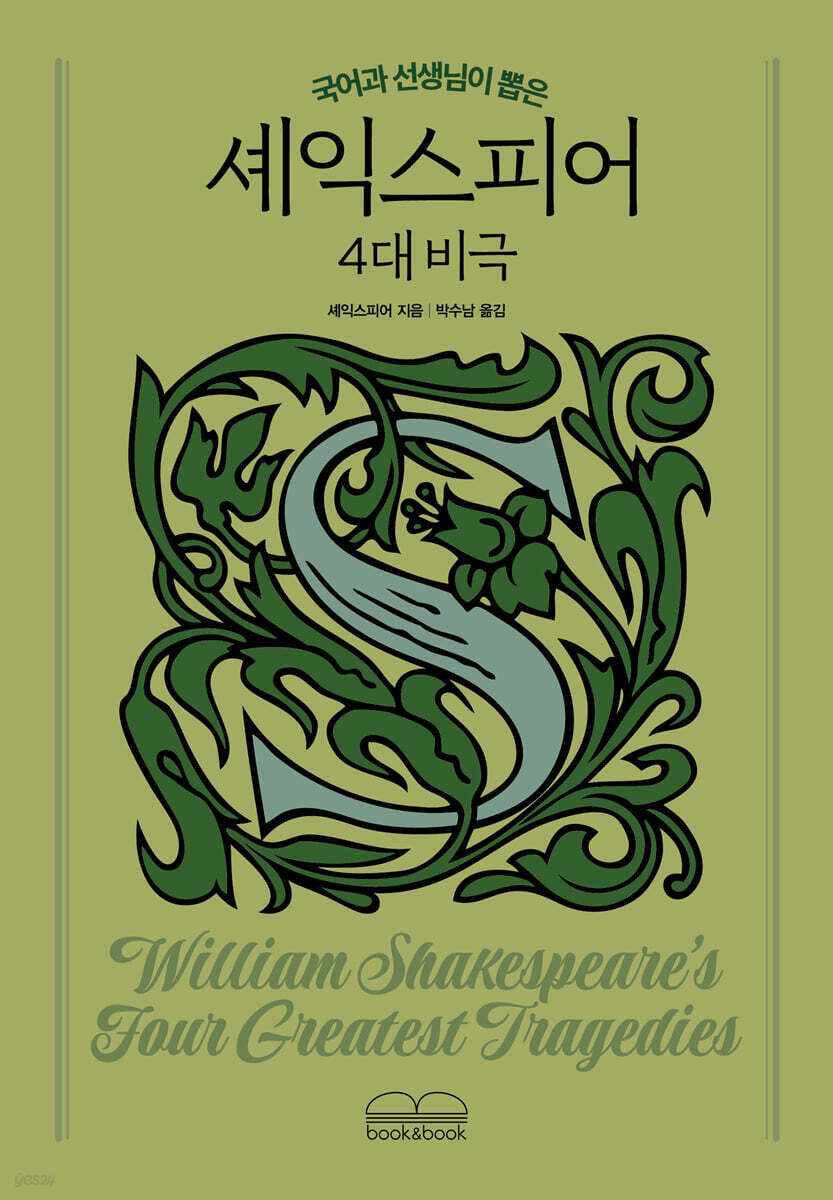
Shakespeare's Four Great Tragedies Chosen by a Korean Language Teacher
 |
Description
Book Introduction
A must-read for students majoring in English education and English literature, as well as students studying acting and directing in middle and high school!
Shakespeare, the pride of British culture who had a great influence on English literature, theater, and world culture, and is revered as the greatest writer in the history of world literature, has deeply depicted the joyful and malicious aspects of human suffering that transcends race, language, time, and space.
The outstanding expressive power and imagination of the four major tragedies, "Hamlet," "Othello," "King Lear," and "Macbeth," which deeply deal with the problems of human suffering and the joyful and malicious aspects of human society, are widespread throughout the world and continue to grow without cooling down over time.
Just like Hamlet's famous soliloquy, "To be, or not to be, that is the question," which explores the realm of life and exquisitely depicts the various tragic and comical elements hidden within the human psyche, his unique language and descriptions, as well as his thoughts and beauty, are like a brush trembling with excitement and ecstasy, and he is encountered and intimately connected with us wherever we go.
Shakespeare, the pride of British culture who had a great influence on English literature, theater, and world culture, and is revered as the greatest writer in the history of world literature, has deeply depicted the joyful and malicious aspects of human suffering that transcends race, language, time, and space.
The outstanding expressive power and imagination of the four major tragedies, "Hamlet," "Othello," "King Lear," and "Macbeth," which deeply deal with the problems of human suffering and the joyful and malicious aspects of human society, are widespread throughout the world and continue to grow without cooling down over time.
Just like Hamlet's famous soliloquy, "To be, or not to be, that is the question," which explores the realm of life and exquisitely depicts the various tragic and comical elements hidden within the human psyche, his unique language and descriptions, as well as his thoughts and beauty, are like a brush trembling with excitement and ecstasy, and he is encountered and intimately connected with us wherever we go.
- You can preview some of the book's contents.
Preview
index
Header
About Shakespeare
Hamlet
Act 1
Act 2
Act 3
Act 4
Act 5
Othello
Act 1
Act 2
Act 3
Act 4
Act 5
King Lear
Act 1
Act 2
Act 3
Act 4
Act 5
Macbeth
Act 1
Act 2
Act 3
Act 4
Act 5
commentary
annual report
About Shakespeare
Hamlet
Act 1
Act 2
Act 3
Act 4
Act 5
Othello
Act 1
Act 2
Act 3
Act 4
Act 5
King Lear
Act 1
Act 2
Act 3
Act 4
Act 5
Macbeth
Act 1
Act 2
Act 3
Act 4
Act 5
commentary
annual report
Detailed image
Into the book
A fool thinks he is wise,
A wise man knows that he is foolish.
William Shakespeare, born in England, had a profound influence on writers and artists around the world and is considered the greatest writer in the history of English literature.
He is one of the greatest playwrights in the history of world literature, leaving behind masterpieces of skill and expression that offer insight into life and the universe. His works are praised as the best works written in the English language.
He is the pride of the British people and a great poet with a universal heart for all times, not just one, but a philosopher. His works contain elements that allow us to explore all areas of life that transcend time and space.
Shakespeare's four immortal tragedies, "Hamlet," "Othello," "King Lear," and "Macbeth," which have had a great influence on English literature, theater, and world culture and contain serious reflections on human nature, exquisitely depict various tragic and comic elements, such as greed, conspiracy, and frustration hidden within the human psyche.
His works are considered to be stories that transcend race and language, relatable to everyone, and to be works that express the English language more beautifully than anyone else.
Hamlet's famous soliloquy, "To be or not to be, that is the question," from "The Tragedy of Hamlet, Prince of Denmark," excites and ecstasies with his inimitable language and method.
Shakespeare's fame and influence, revered as a brilliant legacy of humanity and a great writer who had insight into the human mind, explains why he is still so revered four hundred years after his death.
British novelist Jane Austen said, 'You know Shakespeare without knowing it.
It is a part of the British Constitution, and its thoughts and beauty are spread all over the world, so that wherever you go you feel it and are instinctively close to it.'
And Carlyle said, 'India will one day be lost, but Shakespeare will never disappear and will be with us forever.' And Elizabeth I said, 'I would give up my whole country but not Shakespeare.'
Even now, hundreds of years later, Shakespeare's forty-odd plays, translated into every language worldwide and still performed and enjoying immense popularity, have inspired countless works of art and are essential reading for students majoring in English education and English literature, as well as those studying acting or directing with dreams of becoming actors.
--- From the "Header"
Hamlet is the earliest of Shakespeare's four major tragedies, written between 1599 and 1601, and is considered one of his most famous and popular works.
"Hamlet" is a work written when Shakespeare had insight into life and the universe and when his technique and expression were mature. It was first published in 1603 as a plagiarized version made with the audience's shorthand.
And the first performance of this play was also around this time.
"Hamlet" is set in the Danish royal family in the early 13th century. It is about Prince Hamlet, who was robbed of his throne and mother by his uncle who poisoned his father, and who seeks revenge on the orders of the ghost of his father. It was also adapted in England as "The Original Hamlet."
It is said to have been attributed to Thomas Kyd, author of "The Spanish Tragedy," but no copy survives.
Shakespeare seems to have made reference to this when creating the play "Hamlet."
"Hamlet" is a revenge tragedy, and the human nature of the protagonist, the prince, is presented as an eternal enigma, a character trying to transcend life in the interstices of thought and action, truth and falsehood, conscience and determination, belief and skepticism.
Hamlet must avenge his father and restore order to the country.
However, due to his indecisive personality, he is unable to make a decision and misses the right time.
Also, the soliloquy, 'To be or not to be, that is the question', well reveals Hamlet's personality.
This play, considered one of Shakespeare's most humane works, has raised many questions and controversies regarding the interpretation of the protagonist's personality.
The first recorded performance of "Othello" is said to have been performed by the "King's Company" on November 1, 1604.
The production date is also estimated to be 1604.
The original title of Othello is "The Tragedy of Othello, the Moor of Venice."
The first printed edition of the work, which consists of five acts, was published in 1623, after Shakespeare's death.
Othello, a black professional soldier, is a general employed by the Duchy of Venice.
Othello is a simple-minded, romantic idealist.
The heroine, Desdemona, was a naive and beautiful woman, but also strong-willed enough to abandon her father for the man she loved.
This play is a tragedy that depicts the process in which Othello's love for his wife is cruelly destroyed by the schemes of the villain Iago. It is a work that highlights human distrust and trust rather than psychological conflict.
In this work, Shakespeare lets the devilish evil of Ago fully unfold, making Othello a foolish and vulnerable character and destroying him.
Iago's pursuit of evil, called 'unmotivated evil', vividly portrays human evil.
This work is not based on any historical facts, but can be seen as a kind of domestic tragedy.
Yet, among Shakespeare's four major tragedies, it is the most realistic and tragically colored work, and its depiction of human love and jealousy and the consequences they bring about fully highlights Shakespeare's genius.
"King Lear" was written in 1606 and first published in 1608.
The earliest recorded performance of the play is at court on December 26, 1606.
"King Lear" is composed of five acts and is based on the legendary English King Lear.
It is a work based on the motif of the test of love between the old King Lear and his three daughters, and depicts the figures of the subjects who are loyal to the king in their respective positions.
While Shakespeare's other tragedies deal with the conflicts and downfalls that arise from human relationships, "King Lear" is a tragedy that depicts the process by which the destruction of ties between kin expands into the collapse of the cosmic order from a very political and social perspective.
King Lear's tragic story is about how, despite the need for clear wisdom, if one lacks discernment, one ends up bringing about one's own tragedy.
Only after everything is taken away from him does King Lear realize that he is just a human being, a mere naked animal.
Also, along with the tragedy of King Lear, the tragedy of the Earl of Gloucester expresses the misery of people who have abandoned grace.
It is rare to find a work that addresses the question of good and evil in humanity at such a fundamental level, and it is also rare to find examples that highlight the inherent tragedy of life.
"King Lear" is considered to be the largest and most emotionally intense of Shakespeare's tragedies.
The date of writing of "Macbeth" is estimated to be 1606.
The first performance is also estimated to be around 1606.
In this story, Macbeth, a general, kills King Duncan and takes the crown, but is brutally killed by the rebellion of the barons and the rebellion of his own conscience.
This shows that when humans become excessively greedy beyond their means, it becomes the cause of destruction, blood begets blood, and retaliation for murder ends in more murder.
Shakespeare describes the personalities of his characters in very unique ways.
Macbeth is usually ambitious, but he lacks the ability to carry it out and is weak-hearted.
He is overcome with human anguish when he realizes that usurping the throne is treason.
However, his wife is a person with no conscience and great ambition.
When Macbeth succeeds to the throne through his wife's scheme, he still has a conscience and feels anxious about the future, so he kills the dangerous people predicted by the witches.
After that, Macbeth's wife suffers from guilt and ends up sleepwalking, and Macbeth, driven by power, usurps the throne and suffers the tragic consequences it brings.
"Macbeth" is a tragedy that teaches the lesson of karma and retribution, dealing with the proposition that while being a villain, the human conscience and the collapse of the soul are all the same.
It deeply penetrates the universal phenomenon of human society, where evil excludes good and disorder destroys order, and arouses both fear and empathy in us.
A wise man knows that he is foolish.
William Shakespeare, born in England, had a profound influence on writers and artists around the world and is considered the greatest writer in the history of English literature.
He is one of the greatest playwrights in the history of world literature, leaving behind masterpieces of skill and expression that offer insight into life and the universe. His works are praised as the best works written in the English language.
He is the pride of the British people and a great poet with a universal heart for all times, not just one, but a philosopher. His works contain elements that allow us to explore all areas of life that transcend time and space.
Shakespeare's four immortal tragedies, "Hamlet," "Othello," "King Lear," and "Macbeth," which have had a great influence on English literature, theater, and world culture and contain serious reflections on human nature, exquisitely depict various tragic and comic elements, such as greed, conspiracy, and frustration hidden within the human psyche.
His works are considered to be stories that transcend race and language, relatable to everyone, and to be works that express the English language more beautifully than anyone else.
Hamlet's famous soliloquy, "To be or not to be, that is the question," from "The Tragedy of Hamlet, Prince of Denmark," excites and ecstasies with his inimitable language and method.
Shakespeare's fame and influence, revered as a brilliant legacy of humanity and a great writer who had insight into the human mind, explains why he is still so revered four hundred years after his death.
British novelist Jane Austen said, 'You know Shakespeare without knowing it.
It is a part of the British Constitution, and its thoughts and beauty are spread all over the world, so that wherever you go you feel it and are instinctively close to it.'
And Carlyle said, 'India will one day be lost, but Shakespeare will never disappear and will be with us forever.' And Elizabeth I said, 'I would give up my whole country but not Shakespeare.'
Even now, hundreds of years later, Shakespeare's forty-odd plays, translated into every language worldwide and still performed and enjoying immense popularity, have inspired countless works of art and are essential reading for students majoring in English education and English literature, as well as those studying acting or directing with dreams of becoming actors.
--- From the "Header"
Hamlet is the earliest of Shakespeare's four major tragedies, written between 1599 and 1601, and is considered one of his most famous and popular works.
"Hamlet" is a work written when Shakespeare had insight into life and the universe and when his technique and expression were mature. It was first published in 1603 as a plagiarized version made with the audience's shorthand.
And the first performance of this play was also around this time.
"Hamlet" is set in the Danish royal family in the early 13th century. It is about Prince Hamlet, who was robbed of his throne and mother by his uncle who poisoned his father, and who seeks revenge on the orders of the ghost of his father. It was also adapted in England as "The Original Hamlet."
It is said to have been attributed to Thomas Kyd, author of "The Spanish Tragedy," but no copy survives.
Shakespeare seems to have made reference to this when creating the play "Hamlet."
"Hamlet" is a revenge tragedy, and the human nature of the protagonist, the prince, is presented as an eternal enigma, a character trying to transcend life in the interstices of thought and action, truth and falsehood, conscience and determination, belief and skepticism.
Hamlet must avenge his father and restore order to the country.
However, due to his indecisive personality, he is unable to make a decision and misses the right time.
Also, the soliloquy, 'To be or not to be, that is the question', well reveals Hamlet's personality.
This play, considered one of Shakespeare's most humane works, has raised many questions and controversies regarding the interpretation of the protagonist's personality.
The first recorded performance of "Othello" is said to have been performed by the "King's Company" on November 1, 1604.
The production date is also estimated to be 1604.
The original title of Othello is "The Tragedy of Othello, the Moor of Venice."
The first printed edition of the work, which consists of five acts, was published in 1623, after Shakespeare's death.
Othello, a black professional soldier, is a general employed by the Duchy of Venice.
Othello is a simple-minded, romantic idealist.
The heroine, Desdemona, was a naive and beautiful woman, but also strong-willed enough to abandon her father for the man she loved.
This play is a tragedy that depicts the process in which Othello's love for his wife is cruelly destroyed by the schemes of the villain Iago. It is a work that highlights human distrust and trust rather than psychological conflict.
In this work, Shakespeare lets the devilish evil of Ago fully unfold, making Othello a foolish and vulnerable character and destroying him.
Iago's pursuit of evil, called 'unmotivated evil', vividly portrays human evil.
This work is not based on any historical facts, but can be seen as a kind of domestic tragedy.
Yet, among Shakespeare's four major tragedies, it is the most realistic and tragically colored work, and its depiction of human love and jealousy and the consequences they bring about fully highlights Shakespeare's genius.
"King Lear" was written in 1606 and first published in 1608.
The earliest recorded performance of the play is at court on December 26, 1606.
"King Lear" is composed of five acts and is based on the legendary English King Lear.
It is a work based on the motif of the test of love between the old King Lear and his three daughters, and depicts the figures of the subjects who are loyal to the king in their respective positions.
While Shakespeare's other tragedies deal with the conflicts and downfalls that arise from human relationships, "King Lear" is a tragedy that depicts the process by which the destruction of ties between kin expands into the collapse of the cosmic order from a very political and social perspective.
King Lear's tragic story is about how, despite the need for clear wisdom, if one lacks discernment, one ends up bringing about one's own tragedy.
Only after everything is taken away from him does King Lear realize that he is just a human being, a mere naked animal.
Also, along with the tragedy of King Lear, the tragedy of the Earl of Gloucester expresses the misery of people who have abandoned grace.
It is rare to find a work that addresses the question of good and evil in humanity at such a fundamental level, and it is also rare to find examples that highlight the inherent tragedy of life.
"King Lear" is considered to be the largest and most emotionally intense of Shakespeare's tragedies.
The date of writing of "Macbeth" is estimated to be 1606.
The first performance is also estimated to be around 1606.
In this story, Macbeth, a general, kills King Duncan and takes the crown, but is brutally killed by the rebellion of the barons and the rebellion of his own conscience.
This shows that when humans become excessively greedy beyond their means, it becomes the cause of destruction, blood begets blood, and retaliation for murder ends in more murder.
Shakespeare describes the personalities of his characters in very unique ways.
Macbeth is usually ambitious, but he lacks the ability to carry it out and is weak-hearted.
He is overcome with human anguish when he realizes that usurping the throne is treason.
However, his wife is a person with no conscience and great ambition.
When Macbeth succeeds to the throne through his wife's scheme, he still has a conscience and feels anxious about the future, so he kills the dangerous people predicted by the witches.
After that, Macbeth's wife suffers from guilt and ends up sleepwalking, and Macbeth, driven by power, usurps the throne and suffers the tragic consequences it brings.
"Macbeth" is a tragedy that teaches the lesson of karma and retribution, dealing with the proposition that while being a villain, the human conscience and the collapse of the soul are all the same.
It deeply penetrates the universal phenomenon of human society, where evil excludes good and disorder destroys order, and arouses both fear and empathy in us.
--- From the "Commentary"
Publisher's Review
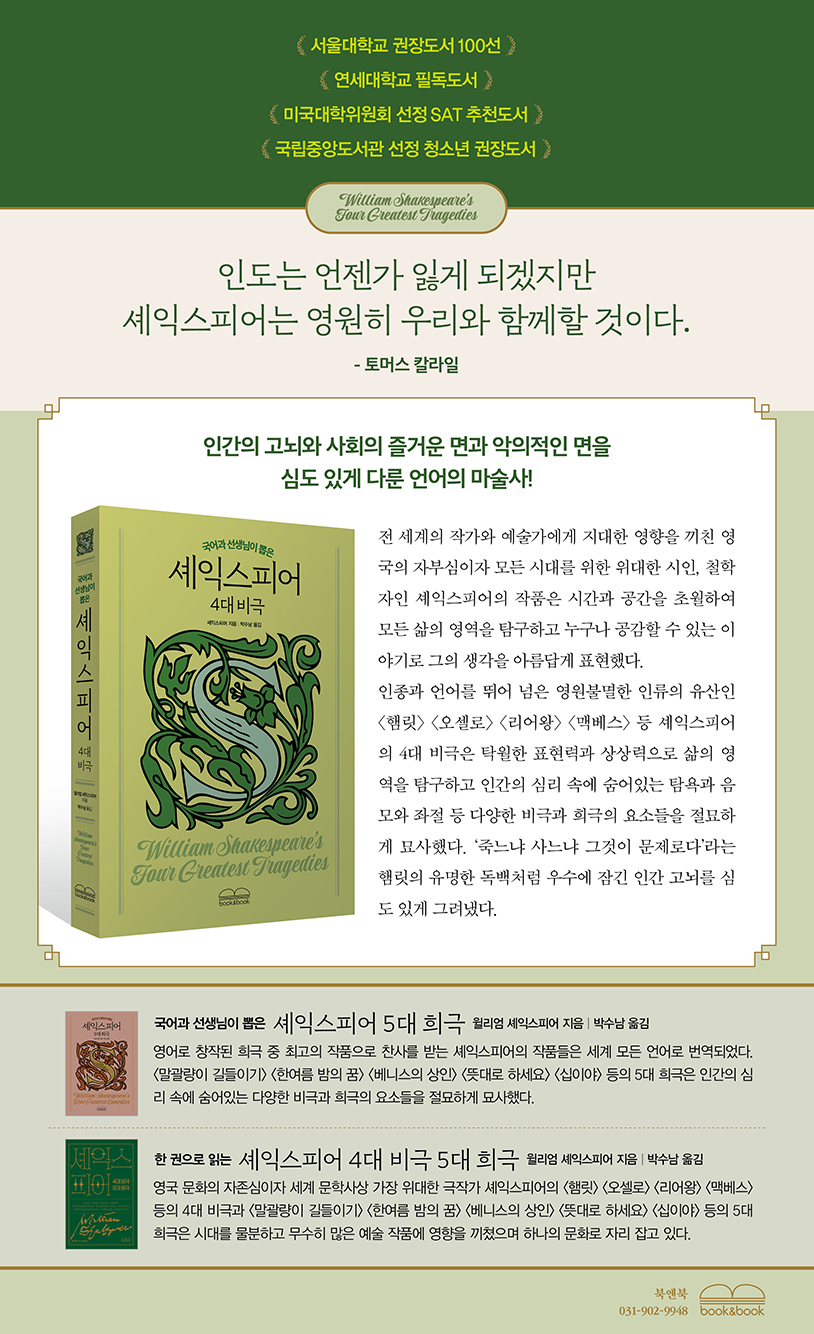
Nobel Institute's 100 World Literature
Seoul National University's 100 Recommended Books
Seoul National University's 200 East-West Classics
Yonsei University must-read books
SAT Recommended Reading Lists Selected by the College Board
Recommended books for youth selected by the National Library of Korea
An immortal classic that transcends time and space, written by Shakespeare, the great poet and philosopher who possesses the hearts of all people!
India may be lost someday, but Shakespeare will be with us forever.
-Thomas Carlyle
Seoul National University's 100 Recommended Books
Seoul National University's 200 East-West Classics
Yonsei University must-read books
SAT Recommended Reading Lists Selected by the College Board
Recommended books for youth selected by the National Library of Korea
An immortal classic that transcends time and space, written by Shakespeare, the great poet and philosopher who possesses the hearts of all people!
India may be lost someday, but Shakespeare will be with us forever.
-Thomas Carlyle
GOODS SPECIFICS
- Date of issue: April 15, 2025
- Page count, weight, size: 496 pages | 670g | 148*213*20mm
- ISBN13: 9791186649879
- ISBN10: 1186649879
You may also like
카테고리
korean


korean

![GQ KOREA Mark (Monthly): December [2025]](http://librairie.coreenne.fr/cdn/shop/files/8ef265dbbfbf186523ed75ba7319009d.jpg?v=1765340328&width=3840)


