

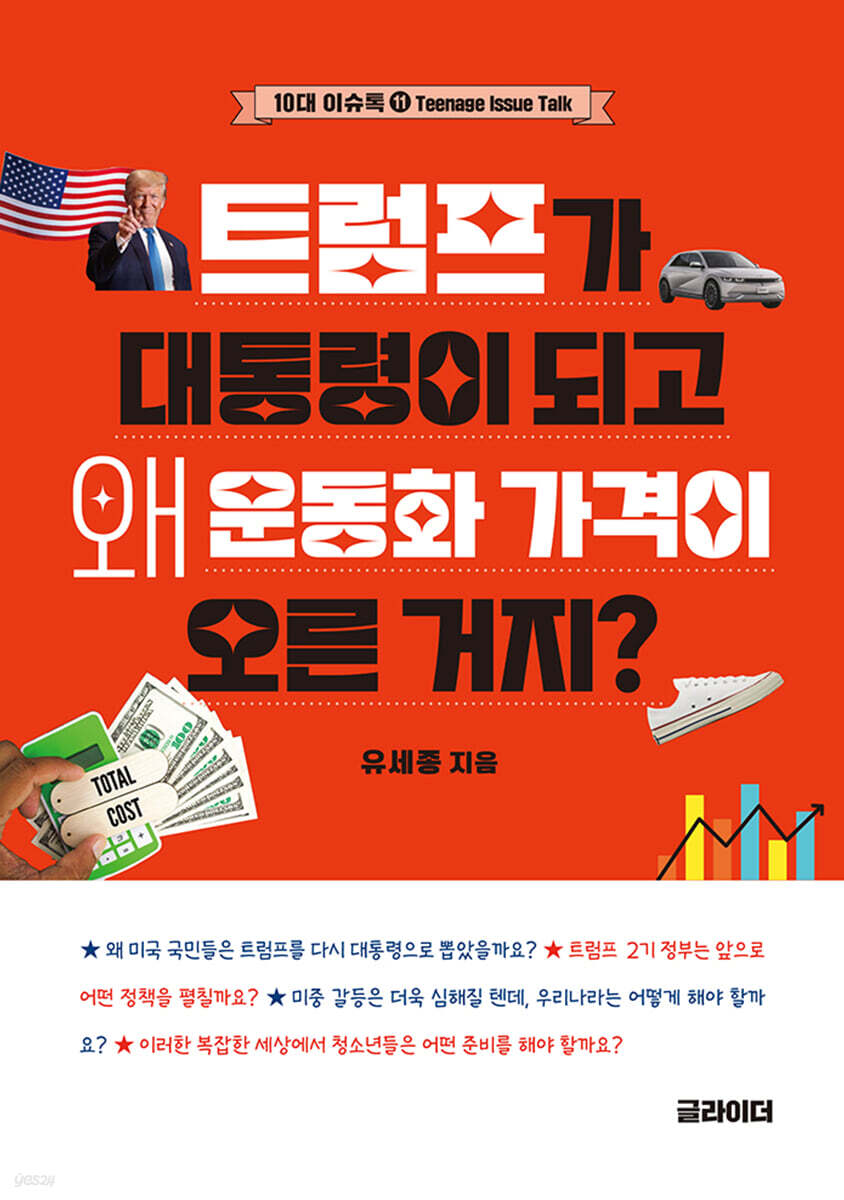
Why did sneaker prices go up when Trump became president?
 |
Description
Book Introduction
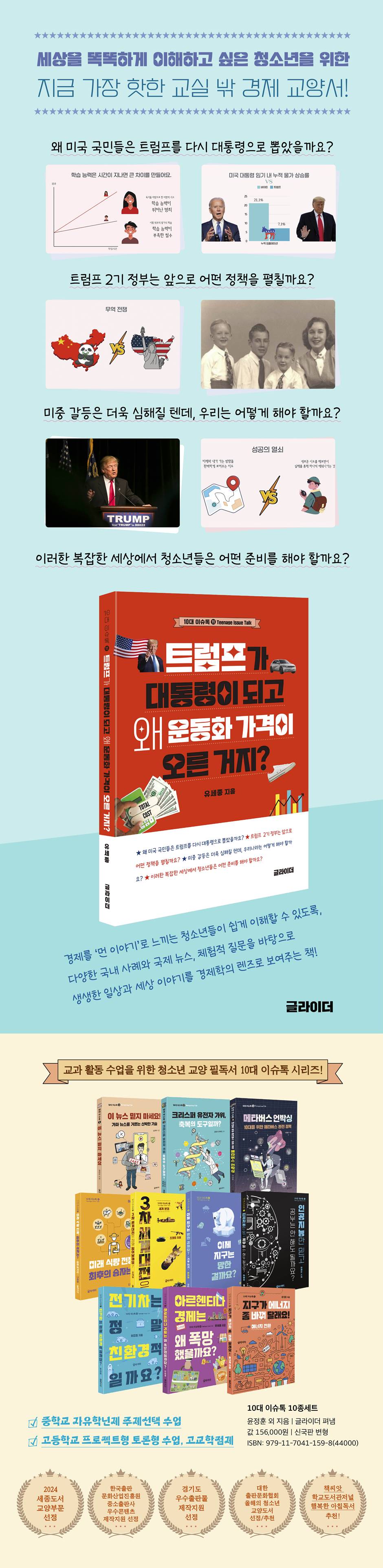
For young people who want to understand the world smartly
The hottest economics textbook for teenagers!
What ripples has Donald Trump's rise caused in the global economy, and what impact has it had on our lives? This book goes beyond simply discussing Trump and American politics and economics, examining how his policy changes have impacted everyday consumption, from the prices of sneakers to game consoles, Pokémon buns, and vegetables.
To help young people who often find economics a distant topic easily understand it, this book presents vivid stories of everyday life and the world through the lens of economics, drawing on a variety of domestic cases, international news, and experiential questions.
Trump's trade policies have accelerated the relocation of Korean companies overseas, leading to a decline in regular domestic jobs and a youth unemployment crisis.
In particular, the report points out that the global protectionist trend is behind the record-high youth unemployment rate and the number of economically inactive youth who responded that they are "just resting." It also examines the widening gap between regular and non-regular workers and the economic deprivation of the younger generation through specific statistics.
Looking at the key policies of the Trump administration, which gained popularity with its economic nationalism and "America First" slogan - trade, foreign affairs, tax cuts, immigration, energy - he introduced high tariffs on China, triggering the US-China trade war, which led to a reorganization of the global supply chain.
In the process, American consumers also experienced direct price increases.
Trump's policy stance, including prioritizing industry over the environment, attempting to withdraw from the WHO and NATO, and taking a hard-line stance against illegal immigration and favoring the influx of skilled workers, reveals a strong American-centrism.
The resulting conflict between the US and China has expanded beyond a simple trade dispute into a competition for hegemony, disrupting global supply chains and significantly impacting Korean companies.
In addition, diplomatic relations with the United States will be shaken by demands for an increase in defense cost sharing from Korea.
Trump has actively used “fake news” as a political weapon, manipulating public opinion through numerous false statements.
This chapter introduces the psychological concept of "confirmation bias," warning that people's tendency to accept only the information they want to hear contributes to the spread of fake news.
It also explains cases where conspiracy theories like "Pizzagate" led to actual crimes, persuasively conveying that the ability to verify information is an essential skill for survival in the 21st century.
The future society demands critical thinking, creativity, and problem-solving skills rather than memorization.
Global companies like Tesla and Apple value originality over test scores, and in this global era, cultural understanding and foreign language skills are also emerging as important competitive advantages.
As Warren Buffett advises, it convinces us through various examples that 'investing in yourself is the best investment.'
This book explains how the global economy and politics impact our lives in an accessible and engaging way, using concrete, connected examples. Through the lens of Trump, we gain insight into global economic trends, ultimately fostering the ability to think and question for ourselves.
The hottest economics textbook for teenagers!
What ripples has Donald Trump's rise caused in the global economy, and what impact has it had on our lives? This book goes beyond simply discussing Trump and American politics and economics, examining how his policy changes have impacted everyday consumption, from the prices of sneakers to game consoles, Pokémon buns, and vegetables.
To help young people who often find economics a distant topic easily understand it, this book presents vivid stories of everyday life and the world through the lens of economics, drawing on a variety of domestic cases, international news, and experiential questions.
Trump's trade policies have accelerated the relocation of Korean companies overseas, leading to a decline in regular domestic jobs and a youth unemployment crisis.
In particular, the report points out that the global protectionist trend is behind the record-high youth unemployment rate and the number of economically inactive youth who responded that they are "just resting." It also examines the widening gap between regular and non-regular workers and the economic deprivation of the younger generation through specific statistics.
Looking at the key policies of the Trump administration, which gained popularity with its economic nationalism and "America First" slogan - trade, foreign affairs, tax cuts, immigration, energy - he introduced high tariffs on China, triggering the US-China trade war, which led to a reorganization of the global supply chain.
In the process, American consumers also experienced direct price increases.
Trump's policy stance, including prioritizing industry over the environment, attempting to withdraw from the WHO and NATO, and taking a hard-line stance against illegal immigration and favoring the influx of skilled workers, reveals a strong American-centrism.
The resulting conflict between the US and China has expanded beyond a simple trade dispute into a competition for hegemony, disrupting global supply chains and significantly impacting Korean companies.
In addition, diplomatic relations with the United States will be shaken by demands for an increase in defense cost sharing from Korea.
Trump has actively used “fake news” as a political weapon, manipulating public opinion through numerous false statements.
This chapter introduces the psychological concept of "confirmation bias," warning that people's tendency to accept only the information they want to hear contributes to the spread of fake news.
It also explains cases where conspiracy theories like "Pizzagate" led to actual crimes, persuasively conveying that the ability to verify information is an essential skill for survival in the 21st century.
The future society demands critical thinking, creativity, and problem-solving skills rather than memorization.
Global companies like Tesla and Apple value originality over test scores, and in this global era, cultural understanding and foreign language skills are also emerging as important competitive advantages.
As Warren Buffett advises, it convinces us through various examples that 'investing in yourself is the best investment.'
This book explains how the global economy and politics impact our lives in an accessible and engaging way, using concrete, connected examples. Through the lens of Trump, we gain insight into global economic trends, ultimately fostering the ability to think and question for ourselves.
- You can preview some of the book's contents.
Preview
index
prolog
Chapter 1.
The Economy and Youth in the Trump Era
The Korean Economy: The Current State of the Korean Economy in the Trump Era
The Growing National Debt | Why Is the Growing National Debt a Problem for All of Us? | Brothers and Sisters Who Are Unemployed and Resting | Why Are Full-Time Jobs Declining?
Korean Education: The Current State of Korean Education in the Trump Era
White Space | Is Korea Still in a Competitive Educational System?
Future_ What preparations should youth make?
What skills will be needed in the Trump era? | How should young people prepare for the Trump era?
Future_ What do you think about failure?
Is the "secret to success" people believe really true? | Success begins with seizing opportunities | Not being afraid to make mistakes is the key to success.
Finding the Truth_ Fake News and Critical Thinking
Trump's Political Strategy and Fake News | Trump's Leading Lies | Confirmation Bias and the Spread of Fake News | The Importance of Critical Thinking and Information Verification | A Three-Step Strategy for Critical Thinking | "Don't Just Kick the Ball, Kick the Opponent Too" Strategy | Tips for Practical Debate
Chapter 2.
The Foundation for Understanding the Trump Era
Trump's Rise: From "Problem Child" to "Master of the White House"
A Strict Father and Competitive Family Environment | The Lesson of "Image Matters More Than Reality" and Leadership | At the Center of Scandal and Controversy: Trump's Unique Strategy for Success | A Bad Blood with President Obama
Background: Anti-elitism, economic nationalism, and anti-globalization movements
Anti-elitism and popular sympathy | Hispanic voters' shifting sentiments based on economic interests | Economic nationalism and border protection policies
Populism: The politics of hate and discrimination
The Politics of Hate | Populism Appeals to Popular Emotions | From the Golden Age of Liberal Democracy to Skepticism | The Crisis Emerging Even in Liberal Democracies | Winners and Losers in Neoliberal Global Trade | Trump and Populism
What MAGA_America First Says
The Historical Background of America First | Tony Michael and the Symbolism of America First | Social Media and Trump's Election Strategy | Trump and the 2016 Presidential Election | A President for American Workers
Smart Item 1
The National Economy: The U.S. Budget and Fiscal Deficit
The Role of Government | Government Revenue | Government Expenditure | Government Budget and Fiscal Deficit
Economic Crisis_Why Did No One Notice It?
The Great Depression of the 1930s | The Asian Financial Crisis of the 1980s and 1990s | The IMF Financial Crisis in Korea in 1997 | The Dot-Com Bubble of the 2000s: The Dreams and Frustration of Internet Companies | The 2008 Financial Crisis: The Economic Collapse That Shook the World | The 2020 COVID-19 Crisis: Unexpected Economic Shocks and Rapid Debt Burdens | Lessons from History on Economic Crises
Chapter 3.
Trump administration's major policies
Trump's Policy: America First, Protectionism, and the Era of the Three Nos
Trump's Favorite Word: Tariffs | He Prefers Bilateral Negotiations Over Multilateral
Smart Item 2
Smart Item 3
Will Trump's strategy to attract manufacturing succeed?
Foreign Policy: America First and Isolationism
No more world police! | The return of imperialism? Greenland will belong to the US! | Trump's eyes on Canada? | Will the Panama Canal belong to the US?
Tax Cut Policy: Will cutting corporate taxes revitalize the economy?
Tax Cuts and Jobs Act | The Economic Impact of Corporate Tax Cuts
Immigration Policy_ We will thoroughly screen and accept applicants!
We will thoroughly block and deport illegal immigrants! | We will automatically grant permanent residency to foreigners who graduate from American universities!
Energy and Environmental Policy_Renewable Energy? No, Coal? Yes!
Drill, Baby, Drill | Is Renewable Energy Support the Biggest Scam in History?
Chapter 4.
Global economic conflicts and changes in the international order
The Rise of China: China's Ambition Can No Longer Be Hidden
China's Historical Background | Restoring Great Power Status and the Chinese Dream | US Containment and Regulation | China's Response to Trump's Tariffs
Smart Item 4
Strategic Choices for the UK and the EU | The Belt and Road Initiative: China's Global Expansion Strategy | From Economic Power to Military Power | Expanding Influence through Finance
Thucydides' Trap: Is Global Economic Conflict Inevitable?
Prophecies of an Ancient Greek Historian | The Rise of China and the US-China Conflict | Self-Fulfilling Prophecies: Beliefs Can Become Reality! | He Who Rules the Sea Rules the World
Global Supply Chains: What Impact Will the War for Hegemony Have on Us?
Protectionism and the Challenges of the Korean Economy | Survival Strategies for the Korean Economy and Businesses | Trump's Second Term: What Attitude Should We Have?
International Order: Why is America Dissatisfied?
Why did Trump try to withdraw from NATO? | Will NATO lose its power in the future? | Why would Trump want to withdraw from an international organization?
Smart Item 5
Epilogue
Trump Economic Glossary
References
Chapter 1.
The Economy and Youth in the Trump Era
The Korean Economy: The Current State of the Korean Economy in the Trump Era
The Growing National Debt | Why Is the Growing National Debt a Problem for All of Us? | Brothers and Sisters Who Are Unemployed and Resting | Why Are Full-Time Jobs Declining?
Korean Education: The Current State of Korean Education in the Trump Era
White Space | Is Korea Still in a Competitive Educational System?
Future_ What preparations should youth make?
What skills will be needed in the Trump era? | How should young people prepare for the Trump era?
Future_ What do you think about failure?
Is the "secret to success" people believe really true? | Success begins with seizing opportunities | Not being afraid to make mistakes is the key to success.
Finding the Truth_ Fake News and Critical Thinking
Trump's Political Strategy and Fake News | Trump's Leading Lies | Confirmation Bias and the Spread of Fake News | The Importance of Critical Thinking and Information Verification | A Three-Step Strategy for Critical Thinking | "Don't Just Kick the Ball, Kick the Opponent Too" Strategy | Tips for Practical Debate
Chapter 2.
The Foundation for Understanding the Trump Era
Trump's Rise: From "Problem Child" to "Master of the White House"
A Strict Father and Competitive Family Environment | The Lesson of "Image Matters More Than Reality" and Leadership | At the Center of Scandal and Controversy: Trump's Unique Strategy for Success | A Bad Blood with President Obama
Background: Anti-elitism, economic nationalism, and anti-globalization movements
Anti-elitism and popular sympathy | Hispanic voters' shifting sentiments based on economic interests | Economic nationalism and border protection policies
Populism: The politics of hate and discrimination
The Politics of Hate | Populism Appeals to Popular Emotions | From the Golden Age of Liberal Democracy to Skepticism | The Crisis Emerging Even in Liberal Democracies | Winners and Losers in Neoliberal Global Trade | Trump and Populism
What MAGA_America First Says
The Historical Background of America First | Tony Michael and the Symbolism of America First | Social Media and Trump's Election Strategy | Trump and the 2016 Presidential Election | A President for American Workers
Smart Item 1
The National Economy: The U.S. Budget and Fiscal Deficit
The Role of Government | Government Revenue | Government Expenditure | Government Budget and Fiscal Deficit
Economic Crisis_Why Did No One Notice It?
The Great Depression of the 1930s | The Asian Financial Crisis of the 1980s and 1990s | The IMF Financial Crisis in Korea in 1997 | The Dot-Com Bubble of the 2000s: The Dreams and Frustration of Internet Companies | The 2008 Financial Crisis: The Economic Collapse That Shook the World | The 2020 COVID-19 Crisis: Unexpected Economic Shocks and Rapid Debt Burdens | Lessons from History on Economic Crises
Chapter 3.
Trump administration's major policies
Trump's Policy: America First, Protectionism, and the Era of the Three Nos
Trump's Favorite Word: Tariffs | He Prefers Bilateral Negotiations Over Multilateral
Smart Item 2
Smart Item 3
Will Trump's strategy to attract manufacturing succeed?
Foreign Policy: America First and Isolationism
No more world police! | The return of imperialism? Greenland will belong to the US! | Trump's eyes on Canada? | Will the Panama Canal belong to the US?
Tax Cut Policy: Will cutting corporate taxes revitalize the economy?
Tax Cuts and Jobs Act | The Economic Impact of Corporate Tax Cuts
Immigration Policy_ We will thoroughly screen and accept applicants!
We will thoroughly block and deport illegal immigrants! | We will automatically grant permanent residency to foreigners who graduate from American universities!
Energy and Environmental Policy_Renewable Energy? No, Coal? Yes!
Drill, Baby, Drill | Is Renewable Energy Support the Biggest Scam in History?
Chapter 4.
Global economic conflicts and changes in the international order
The Rise of China: China's Ambition Can No Longer Be Hidden
China's Historical Background | Restoring Great Power Status and the Chinese Dream | US Containment and Regulation | China's Response to Trump's Tariffs
Smart Item 4
Strategic Choices for the UK and the EU | The Belt and Road Initiative: China's Global Expansion Strategy | From Economic Power to Military Power | Expanding Influence through Finance
Thucydides' Trap: Is Global Economic Conflict Inevitable?
Prophecies of an Ancient Greek Historian | The Rise of China and the US-China Conflict | Self-Fulfilling Prophecies: Beliefs Can Become Reality! | He Who Rules the Sea Rules the World
Global Supply Chains: What Impact Will the War for Hegemony Have on Us?
Protectionism and the Challenges of the Korean Economy | Survival Strategies for the Korean Economy and Businesses | Trump's Second Term: What Attitude Should We Have?
International Order: Why is America Dissatisfied?
Why did Trump try to withdraw from NATO? | Will NATO lose its power in the future? | Why would Trump want to withdraw from an international organization?
Smart Item 5
Epilogue
Trump Economic Glossary
References
Detailed image
Into the book
In 2023, South Korea's national debt exceeded 50% of GDP for the first time.
Currently, in Korea, debt is increasing faster than money is being earned.
Some say, “About 50% of GDP is fine.”
But if a country takes on too much debt, the burden will ultimately fall on future generations, the youth of today.
--- p.15
Korea achieved rapid growth without critical thinking by following advanced countries through reverse engineering.
But the growth strategies of the past no longer work.
With technological advancements and changes in the global market, it is difficult to solve new problems through simple memorization and thinking within a given framework.
Therefore, in future societies, it is essential to go beyond simple knowledge acquisition to develop critical thinking and creative problem-solving skills.
--- p.28
The reason Trump's lies were effective is because of "confirmation bias," the tendency for people to believe only what they want to believe.
Confirmation bias refers to the psychological phenomenon of easily accepting news that matches what you already believe and ignoring information that contradicts it.
--- p.45
Populism tends to simplify complex problems or propose extreme solutions, using public sentiment to gain support.
Populism often operates on an “us versus them” tactic.
Here, “we” refers to ordinary citizens, and “they” is defined as political elites, minorities, or foreigners.
Populist leaders claim to solve problems by taking the side of “us” and defining “them” as the enemy.
--- p.74
By looking at where the government spends its money, we can get a more specific idea of what role the government plays.
The government pays the salaries of civil servants with the taxes it collects, and also purchases goods and services produced by private companies.
Additionally, the government pays interest on government bonds issued and supports households and businesses through health insurance, employment insurance, and social assistance. This expenditure is called “current expenditure.”
Additionally, the government purchases land, buildings, machinery, and equipment, which are called “capital expenditures.”
--- p.95
During his term in 2017, President Trump introduced the Tax Cuts and Jobs Act (TCJA).
The law was one of the largest corporate tax cuts in U.S. history, lowering the top corporate tax rate from 35% to 21%.
Additionally, when a company purchases equipment, the cost is recognized, significantly reducing the company's tax burden.
By changing the way income earned abroad is taxed, we encouraged American companies to bring their overseas profits back home.
--- p.129
If the U.S. imposes a 25% tariff on Hyundai cars, American consumers will have to pay higher prices, and exports are likely to decrease as Korean products become less competitive.
Moreover, America's high tariff policy could also affect trade with China and Europe.
South Korea's semiconductors and batteries are widely used in electronics and automobiles in China and Europe, and if the U.S. restricts trade with China and Europe, South Korea's exports of intermediate goods (parts, not finished products) could also decline.
Currently, in Korea, debt is increasing faster than money is being earned.
Some say, “About 50% of GDP is fine.”
But if a country takes on too much debt, the burden will ultimately fall on future generations, the youth of today.
--- p.15
Korea achieved rapid growth without critical thinking by following advanced countries through reverse engineering.
But the growth strategies of the past no longer work.
With technological advancements and changes in the global market, it is difficult to solve new problems through simple memorization and thinking within a given framework.
Therefore, in future societies, it is essential to go beyond simple knowledge acquisition to develop critical thinking and creative problem-solving skills.
--- p.28
The reason Trump's lies were effective is because of "confirmation bias," the tendency for people to believe only what they want to believe.
Confirmation bias refers to the psychological phenomenon of easily accepting news that matches what you already believe and ignoring information that contradicts it.
--- p.45
Populism tends to simplify complex problems or propose extreme solutions, using public sentiment to gain support.
Populism often operates on an “us versus them” tactic.
Here, “we” refers to ordinary citizens, and “they” is defined as political elites, minorities, or foreigners.
Populist leaders claim to solve problems by taking the side of “us” and defining “them” as the enemy.
--- p.74
By looking at where the government spends its money, we can get a more specific idea of what role the government plays.
The government pays the salaries of civil servants with the taxes it collects, and also purchases goods and services produced by private companies.
Additionally, the government pays interest on government bonds issued and supports households and businesses through health insurance, employment insurance, and social assistance. This expenditure is called “current expenditure.”
Additionally, the government purchases land, buildings, machinery, and equipment, which are called “capital expenditures.”
--- p.95
During his term in 2017, President Trump introduced the Tax Cuts and Jobs Act (TCJA).
The law was one of the largest corporate tax cuts in U.S. history, lowering the top corporate tax rate from 35% to 21%.
Additionally, when a company purchases equipment, the cost is recognized, significantly reducing the company's tax burden.
By changing the way income earned abroad is taxed, we encouraged American companies to bring their overseas profits back home.
--- p.129
If the U.S. imposes a 25% tariff on Hyundai cars, American consumers will have to pay higher prices, and exports are likely to decrease as Korean products become less competitive.
Moreover, America's high tariff policy could also affect trade with China and Europe.
South Korea's semiconductors and batteries are widely used in electronics and automobiles in China and Europe, and if the U.S. restricts trade with China and Europe, South Korea's exports of intermediate goods (parts, not finished products) could also decline.
--- p.173
Publisher's Review
Starting with the simple question, “Why have sneaker prices risen?”, it carefully explains the complex global economic structure behind it.
At the heart of this are former US President Donald Trump's protectionist trade policies and "America First" policies.
Trump imposed high tariffs on Chinese products, claiming that the United States was losing money on trade with China.
This increased the manufacturing costs for American companies that imported parts from China to produce their products, which resulted in higher prices for consumers.
In today's world of interconnected global supply chains, one country's economic policies can have a significant impact on the daily lives of others.
This book explains these economic trends in an easy-to-understand way through concepts such as comparative advantage, free trade, and zero-sum thinking.
It also introduces the theories of economists such as Adam Smith and David Ricardo, emphasizing the positive role of cooperation and trade between countries.
In particular, it emphasizes that trade is not a "zero-sum game" where one side wins and the other side loses, explaining why Trump's economic views have been controversial.
The book also focuses on Trump's political rhetoric, which often attacks the media by calling them "fake news," but which actually spread distorted information.
Through this case, the book reminds us of the importance of critical thinking and information discernment.
The message is that the ability to verify sources and make rational, rather than emotional, judgments is essential for today's youth, who are overflowing with digital information.
To survive in our rapidly changing society, our youth need more than just knowledge: creativity, a spirit of challenge, a global perspective, and the courage to face failure.
Through this book, let's cultivate the strength to stay grounded and move forward even in an unpredictable world like the Trump era.
Author's Note
The Trump-era Economy, Told from a Young Adult Perspective
In 1776, economist Adam Smith argued in The Wealth of Nations that if a country exploits other countries to become rich, everyone will eventually become poor.
The point is that methods of oppressing other countries, such as slavery or tariffs, ultimately harm the exploiting party as well.
David Ricardo, an economist of the same era, mathematically proved an important concept about trade between countries.
It is the 'theory of comparative advantage'.
The principle is that if each country focuses on what it does best, everyone benefits more.
Even if we assume that the United States makes all products better and faster than Korea, if Korea focuses on semiconductor production and the United States focuses on IT services, both the United States and Korea will be better off.
President Trump has ignored these basic economic principles, re-established tariff barriers on the free trade system that has lasted for over 30 years, and has strongly pushed forward economic nationalism and protectionism under the guise of "America First."
As a result, weaker countries suffered great losses and the international order became unstable.
President Trump has pursued policies that seem to treat trade as a "zero-sum game" (the idea that if one country gains, another necessarily loses).
His policies were inconsistent and unpredictable, which caused great economic turmoil.
And yet, in November 2024, American citizens again elected Trump as president.
Why is this? What policies will a second Trump administration pursue? The US-China conflict is likely to intensify. What strategy should Korea adopt? And how should we, as young people, prepare for this complex society?
This book is an economics textbook for young people designed to answer these questions.
Starting with the simple question, "Why are sneaker prices rising?", this book explains in an accessible and engaging way how the economic policies of the Trump era have affected our daily lives.
This book has three goals:
First, it shows that the economy is not someone else's business.
Economic issues in the news, like Trump's tax cuts, protectionism, and the US-China trade war, are actually connected to the things we use every day, like game consoles, sneakers, and smartphones.
By examining why companies relocate factories and why prices rise, you'll understand that economics isn't just "theory for testing," but a reality directly connected to your life.
Second, it is about developing critical thinking skills.
We now live in an age overflowing with fake news and exaggerated information.
President Trump has criticized the media, using the term "fake news," but he himself has distorted many facts.
This book explains why it's important to check sources, review data, and make rational, non-emotional judgments, helping young people develop the power to think and make decisions for themselves.
Third, it is about developing the power to prepare for the future.
The world is changing too quickly, and it's difficult to survive with just memorized knowledge.
We provide guidance to help young people grow into individuals with creativity, a spirit of challenge, and a global perspective.
Even in a world as chaotic as the Trump era, those who are unafraid of failure and think critically can move forward unwaveringly.
At the heart of this are former US President Donald Trump's protectionist trade policies and "America First" policies.
Trump imposed high tariffs on Chinese products, claiming that the United States was losing money on trade with China.
This increased the manufacturing costs for American companies that imported parts from China to produce their products, which resulted in higher prices for consumers.
In today's world of interconnected global supply chains, one country's economic policies can have a significant impact on the daily lives of others.
This book explains these economic trends in an easy-to-understand way through concepts such as comparative advantage, free trade, and zero-sum thinking.
It also introduces the theories of economists such as Adam Smith and David Ricardo, emphasizing the positive role of cooperation and trade between countries.
In particular, it emphasizes that trade is not a "zero-sum game" where one side wins and the other side loses, explaining why Trump's economic views have been controversial.
The book also focuses on Trump's political rhetoric, which often attacks the media by calling them "fake news," but which actually spread distorted information.
Through this case, the book reminds us of the importance of critical thinking and information discernment.
The message is that the ability to verify sources and make rational, rather than emotional, judgments is essential for today's youth, who are overflowing with digital information.
To survive in our rapidly changing society, our youth need more than just knowledge: creativity, a spirit of challenge, a global perspective, and the courage to face failure.
Through this book, let's cultivate the strength to stay grounded and move forward even in an unpredictable world like the Trump era.
Author's Note
The Trump-era Economy, Told from a Young Adult Perspective
In 1776, economist Adam Smith argued in The Wealth of Nations that if a country exploits other countries to become rich, everyone will eventually become poor.
The point is that methods of oppressing other countries, such as slavery or tariffs, ultimately harm the exploiting party as well.
David Ricardo, an economist of the same era, mathematically proved an important concept about trade between countries.
It is the 'theory of comparative advantage'.
The principle is that if each country focuses on what it does best, everyone benefits more.
Even if we assume that the United States makes all products better and faster than Korea, if Korea focuses on semiconductor production and the United States focuses on IT services, both the United States and Korea will be better off.
President Trump has ignored these basic economic principles, re-established tariff barriers on the free trade system that has lasted for over 30 years, and has strongly pushed forward economic nationalism and protectionism under the guise of "America First."
As a result, weaker countries suffered great losses and the international order became unstable.
President Trump has pursued policies that seem to treat trade as a "zero-sum game" (the idea that if one country gains, another necessarily loses).
His policies were inconsistent and unpredictable, which caused great economic turmoil.
And yet, in November 2024, American citizens again elected Trump as president.
Why is this? What policies will a second Trump administration pursue? The US-China conflict is likely to intensify. What strategy should Korea adopt? And how should we, as young people, prepare for this complex society?
This book is an economics textbook for young people designed to answer these questions.
Starting with the simple question, "Why are sneaker prices rising?", this book explains in an accessible and engaging way how the economic policies of the Trump era have affected our daily lives.
This book has three goals:
First, it shows that the economy is not someone else's business.
Economic issues in the news, like Trump's tax cuts, protectionism, and the US-China trade war, are actually connected to the things we use every day, like game consoles, sneakers, and smartphones.
By examining why companies relocate factories and why prices rise, you'll understand that economics isn't just "theory for testing," but a reality directly connected to your life.
Second, it is about developing critical thinking skills.
We now live in an age overflowing with fake news and exaggerated information.
President Trump has criticized the media, using the term "fake news," but he himself has distorted many facts.
This book explains why it's important to check sources, review data, and make rational, non-emotional judgments, helping young people develop the power to think and make decisions for themselves.
Third, it is about developing the power to prepare for the future.
The world is changing too quickly, and it's difficult to survive with just memorized knowledge.
We provide guidance to help young people grow into individuals with creativity, a spirit of challenge, and a global perspective.
Even in a world as chaotic as the Trump era, those who are unafraid of failure and think critically can move forward unwaveringly.
GOODS SPECIFICS
- Date of issue: April 15, 2025
- Page count, weight, size: 204 pages | 150*210*20mm
- ISBN13: 9791170411628
- ISBN10: 1170411622
You may also like
카테고리
korean


korean

![GQ KOREA Mark (Monthly): December [2025]](http://librairie.coreenne.fr/cdn/shop/files/8ef265dbbfbf186523ed75ba7319009d.jpg?v=1765340328&width=3840)


