

Food for survival
 |
Description
Book Introduction
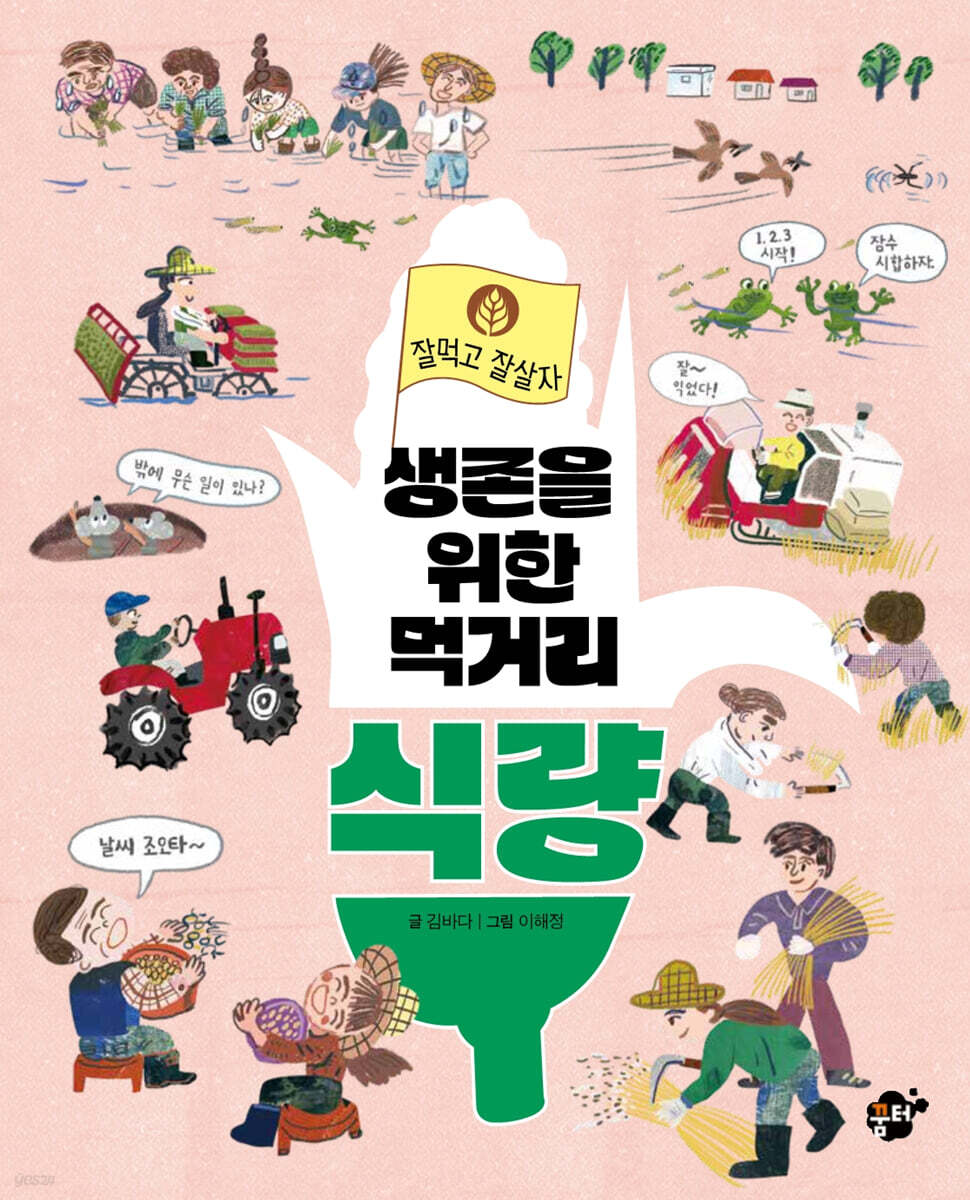
In the 'Eat Well, Live Well' series, we will learn about the importance of food for our survival and about the foods people eat, such as grains, vegetables, fruits, meat, and fish.
We often see these foods on our dinner tables every day, but we don't know what process they go through before they end up on our tables.
We live without thinking about the fact that there is a different production process from the bread, ramen, and snacks that can be easily purchased at large supermarkets.
We need to know that the rice, barley, beans, vegetables, fruits, eggs, meat, and fish we eat most of can never be made in a factory.
With greenhouse cultivation, watermelon and strawberries can be eaten all year round, regardless of the season, so the meaning of seasonal fruit is disappearing.
Through this series, “Eat Well and Live Well,” children will learn about the past, present, and future of food.
We often see these foods on our dinner tables every day, but we don't know what process they go through before they end up on our tables.
We live without thinking about the fact that there is a different production process from the bread, ramen, and snacks that can be easily purchased at large supermarkets.
We need to know that the rice, barley, beans, vegetables, fruits, eggs, meat, and fish we eat most of can never be made in a factory.
With greenhouse cultivation, watermelon and strawberries can be eaten all year round, regardless of the season, so the meaning of seasonal fruit is disappearing.
Through this series, “Eat Well and Live Well,” children will learn about the past, present, and future of food.
- You can preview some of the book's contents.
Preview
index
Food and provisions necessary for survival
What kind of food do friends from other countries eat?
All five major grains gathered together!
rice
wheat
corner
barley
bean
Changes in food production methods
Old farm tools
Composting and fertilizing
Farming order
food crisis
genetically modified organisms
The Inconvenient Truth About GMOs
Seed problem
The looming food crisis
Crop damage caused by climate change
Food of the Future
Have you heard of artificial meat?
Author's Note
Quiz
What kind of food do friends from other countries eat?
All five major grains gathered together!
rice
wheat
corner
barley
bean
Changes in food production methods
Old farm tools
Composting and fertilizing
Farming order
food crisis
genetically modified organisms
The Inconvenient Truth About GMOs
Seed problem
The looming food crisis
Crop damage caused by climate change
Food of the Future
Have you heard of artificial meat?
Author's Note
Quiz
Detailed image
Into the book
Most people eat three meals a day: breakfast, lunch, and dinner.
Some people eat two meals a day, some only one, and many people starve because there is no food.
--- From "Food and Rations Necessary for Survival"
The world's five major grains are rice, wheat, corn, barley, and soybeans.
The three most widely eaten grains in the world are rice, wheat, and corn.
Among them, rice is the staple food of one-third of the world's population and is the most important grain produced worldwide.
Because wheat is difficult to eat with the husk on, we grind it and make flour into bread, cookies, and noodles.
Corn is easy to grow and boasts the highest production among grains.
Barley is a staple grain, but it is also used to make beer.
Soybeans are rich in protein and other nutrients, so they are called “meat from the field.”
--- From "All the Five Major Grains Gathered"
Just sowing seeds in the ground and waiting doesn't produce food. Farmers used to have to work tirelessly, plowing the land, sowing seeds, weeding, and harvesting. However, farming tools have improved over the years, and now large tractors travel across the fields, plowing the soil, and drones spray pesticides.
--- From "Changes in Food Production Methods"
If 100 percent of the food produced worldwide is used as livestock feed, 40 to 50 percent is used as livestock feed.
It is also used as automobile fuel.
As meat-eating culture increased, the need for livestock feed increased.
25,000 people starve to death every day due to food shortages.
What is Korea's food self-sufficiency rate? Excluding rice, the self-sufficiency rate for grains is only 3.4%, putting food security at risk.
Climate change caused by global warming is reducing crop production and converting agricultural land in rural areas to other uses, worsening the food crisis.
Most of the ingredients in the food we eat come from the ground.
In order to pass on good food to our future descendants, we must protect and preserve the Earth's environment.
--- From "Food Crisis"
Edible insects are receiving the most attention as a future food source, and artificial meat includes meat made from plant ingredients and meat cultured from animal cells.
Raising meat consumes a lot of grain and causes environmental pollution, but insects do not cause any environmental pollution.
Recently, our country's research team succeeded in creating meat rice.
Some people eat two meals a day, some only one, and many people starve because there is no food.
--- From "Food and Rations Necessary for Survival"
The world's five major grains are rice, wheat, corn, barley, and soybeans.
The three most widely eaten grains in the world are rice, wheat, and corn.
Among them, rice is the staple food of one-third of the world's population and is the most important grain produced worldwide.
Because wheat is difficult to eat with the husk on, we grind it and make flour into bread, cookies, and noodles.
Corn is easy to grow and boasts the highest production among grains.
Barley is a staple grain, but it is also used to make beer.
Soybeans are rich in protein and other nutrients, so they are called “meat from the field.”
--- From "All the Five Major Grains Gathered"
Just sowing seeds in the ground and waiting doesn't produce food. Farmers used to have to work tirelessly, plowing the land, sowing seeds, weeding, and harvesting. However, farming tools have improved over the years, and now large tractors travel across the fields, plowing the soil, and drones spray pesticides.
--- From "Changes in Food Production Methods"
If 100 percent of the food produced worldwide is used as livestock feed, 40 to 50 percent is used as livestock feed.
It is also used as automobile fuel.
As meat-eating culture increased, the need for livestock feed increased.
25,000 people starve to death every day due to food shortages.
What is Korea's food self-sufficiency rate? Excluding rice, the self-sufficiency rate for grains is only 3.4%, putting food security at risk.
Climate change caused by global warming is reducing crop production and converting agricultural land in rural areas to other uses, worsening the food crisis.
Most of the ingredients in the food we eat come from the ground.
In order to pass on good food to our future descendants, we must protect and preserve the Earth's environment.
--- From "Food Crisis"
Edible insects are receiving the most attention as a future food source, and artificial meat includes meat made from plant ingredients and meat cultured from animal cells.
Raising meat consumes a lot of grain and causes environmental pollution, but insects do not cause any environmental pollution.
Recently, our country's research team succeeded in creating meat rice.
--- From "Future Food"
Publisher's Review
An interesting look at food stories that aren't covered in social studies textbooks!
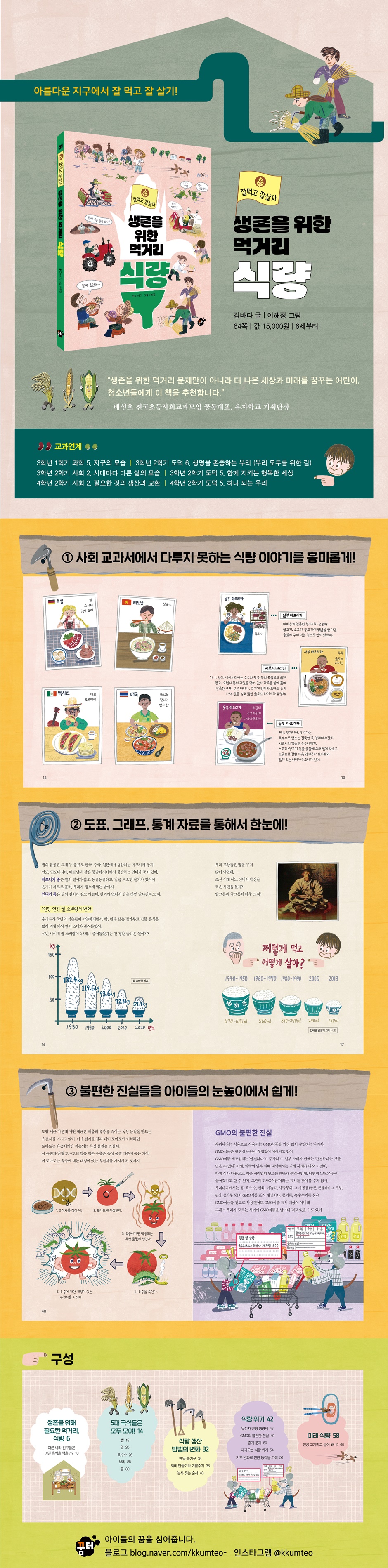
Through the 24 solar terms, grain proverbs like "The riper the rice, the lower it bows its head," and farming-related proverbs like "Children are like farming," the book introduces traditional farming culture in an engaging way, tailored to the level of third and fourth graders.
Why do we eat noodles on special occasions? Learn about the origins of this traditional food.
Shows at a glance through diagrams, graphs, and statistics
Through photos of the sizes of rice bowls from the Joseon Dynasty and comparisons of rice bowl sizes by era, we can see that our country's eating habits are becoming westernized.
A bar graph of the world's wheat production rankings, a chart of changes in the size of the global and domestic seed markets, and other appropriately placed elements allow for easy understanding at a glance without having to read the text in detail.
The process of making soybean paste (making meju - > making soy sauce - > making doenjang - > making gochujang), farming, making compost, and making rice noodles and kalguksu are also well illustrated.
Inconvenient truths explained easily at children's eye level!
It presents serious issues such as the process of creating genetically modified foods, side effects, the increasing amount of seed imports each year, and the looming food crisis, all in a way that elementary school students can understand.
Why do food problems arise? We explain the connection between food problems and the environment, and also provide actionable guidance for children.
■ Author's Note
Eat well and live well on this beautiful planet
Welcome, friends, to Earth, a solar system located at the edge of our galaxy!
Since we came to this beautiful Earth, we should live well, right?
If you want to live well, you have to eat well.
But you see, eating well and living well is not that easy.
Since children are growing, they need to eat food that contains a balanced amount of nutrients.
To do that, you need to pay attention to what your friends eat.
Is it healthy food?
Where and how was it produced? How was it cooked?
The food that feeds humanity is grain grown with the sweat and care of farmers.
Production is also possible only by investing in energy such as oil and various agricultural materials.
Farmers grow crops every year to feed the world's 8 billion people.
If you think about the hard work of farmers, you should cherish every grain of grain.
You should be grateful for that effort.
I hope my friends eat only as much food as they can eat and don't waste food carelessly.
This is how we reduce environmental pollution and protect the planet we live on.
It is also a way to provide food to friends who are starving anywhere in the world.
Friends, eat well and live well!
- Kim Ba-da from the beautiful Earth, Republic of Korea
Through the 24 solar terms, grain proverbs like "The riper the rice, the lower it bows its head," and farming-related proverbs like "Children are like farming," the book introduces traditional farming culture in an engaging way, tailored to the level of third and fourth graders.
Why do we eat noodles on special occasions? Learn about the origins of this traditional food.
Shows at a glance through diagrams, graphs, and statistics
Through photos of the sizes of rice bowls from the Joseon Dynasty and comparisons of rice bowl sizes by era, we can see that our country's eating habits are becoming westernized.
A bar graph of the world's wheat production rankings, a chart of changes in the size of the global and domestic seed markets, and other appropriately placed elements allow for easy understanding at a glance without having to read the text in detail.
The process of making soybean paste (making meju - > making soy sauce - > making doenjang - > making gochujang), farming, making compost, and making rice noodles and kalguksu are also well illustrated.
Inconvenient truths explained easily at children's eye level!
It presents serious issues such as the process of creating genetically modified foods, side effects, the increasing amount of seed imports each year, and the looming food crisis, all in a way that elementary school students can understand.
Why do food problems arise? We explain the connection between food problems and the environment, and also provide actionable guidance for children.
■ Author's Note
Eat well and live well on this beautiful planet
Welcome, friends, to Earth, a solar system located at the edge of our galaxy!
Since we came to this beautiful Earth, we should live well, right?
If you want to live well, you have to eat well.
But you see, eating well and living well is not that easy.
Since children are growing, they need to eat food that contains a balanced amount of nutrients.
To do that, you need to pay attention to what your friends eat.
Is it healthy food?
Where and how was it produced? How was it cooked?
The food that feeds humanity is grain grown with the sweat and care of farmers.
Production is also possible only by investing in energy such as oil and various agricultural materials.
Farmers grow crops every year to feed the world's 8 billion people.
If you think about the hard work of farmers, you should cherish every grain of grain.
You should be grateful for that effort.
I hope my friends eat only as much food as they can eat and don't waste food carelessly.
This is how we reduce environmental pollution and protect the planet we live on.
It is also a way to provide food to friends who are starving anywhere in the world.
Friends, eat well and live well!
- Kim Ba-da from the beautiful Earth, Republic of Korea
GOODS SPECIFICS
- Date of issue: March 11, 2024
- Page count, weight, size: 64 pages | 398g | 195*242*11mm
- ISBN13: 9791167391063
- ISBN10: 1167391063
You may also like
카테고리
korean


korean

![GQ KOREA Mark (Monthly): December [2025]](http://librairie.coreenne.fr/cdn/shop/files/8ef265dbbfbf186523ed75ba7319009d.jpg?v=1765340328&width=3840)


