

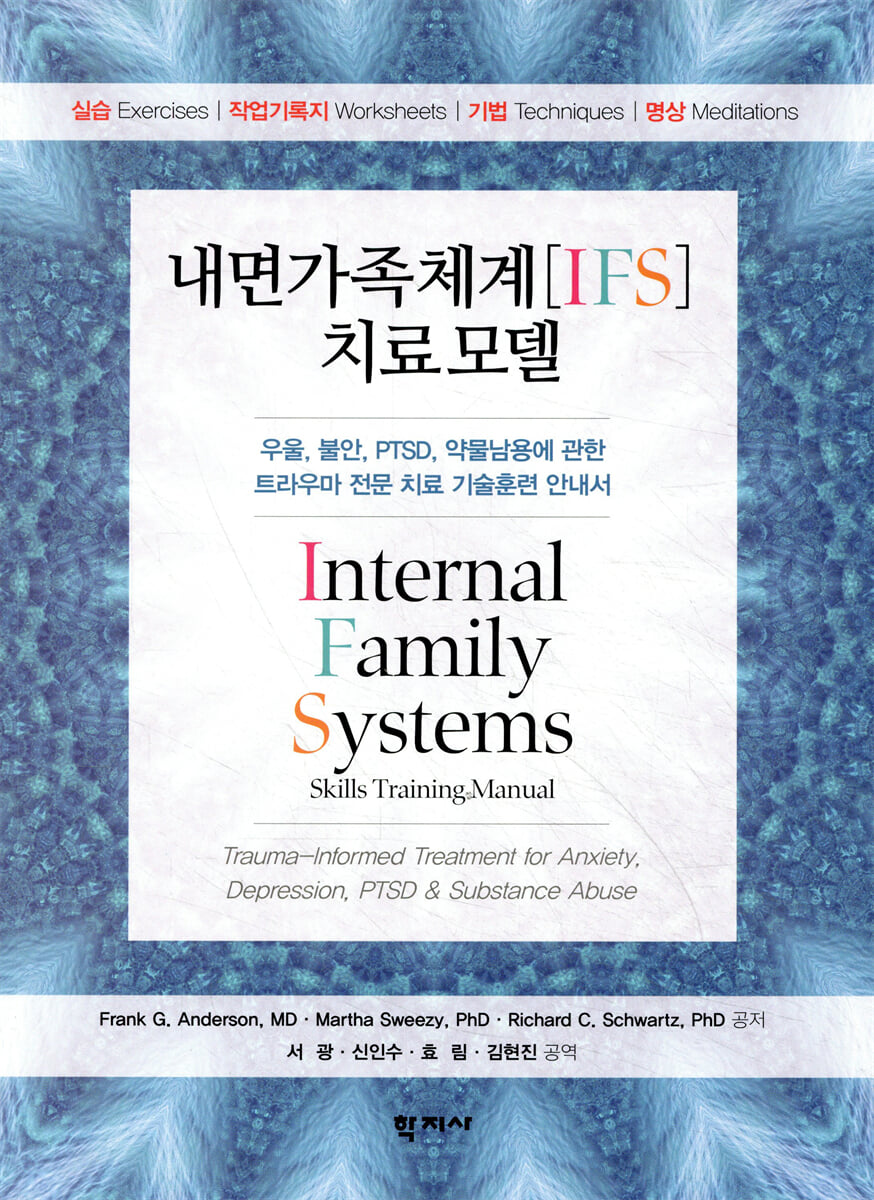
Internal Family Systems (IFS) Treatment Model
 |
Description
index
Translator's Preface
Note
Chapter 1: Overview of the Internal Family System (IFS)
Embodiment of the true self, listen to the parts
How to use this book
IFS Glossary of Terms
IFS's Goals
Precautions for Precautionary Caregivers
The vulnerable parts that were banished
The definition of true self
Log in to Chamna
Chapter 2 Evaluation and Diagnosis
Evaluation: Partial vs.
Pathology
Running an Initial Assessment of IFS
Medical Model vs.
Mind model
A different approach to trauma
Prioritize process over content in the early stages.
Assessment and Diagnosis at IFS
Psychology and Biology
Benefits of IFS for the therapist
Chapter 3 Treatment and Practice
Client selection
Starting IFS Therapy with a New Client
The role of language
Trauma specialist treatment
Parents determine the speed
First, get familiar with your system.
All parts are welcome
Getting to Know Your Client's Caregivers: Using Inner Communication or Direct Connection
Dismantle 6F
Helping to Demix Parts: Externalizing Techniques
Remember last week's goals
Keeping Parents Up-to-Date During the De-Blending Process
After Discovering, Focusing, and Embodying: The Crossroads
Introduction to neuroscience
Science: The Mind-Brain Connection
The Science of Discovery: Understanding the Parts
The Science of Focus: Going Inward and Meditating
The Science of Embodying: Clarifying the Part
Step Four: Evaluate the True Energy by Feeling Its Part
Note: Parts similar to the true self in the fourth step (feeling toward the part)
Science: Connecting with the Self through Feeling for the Part
Science: The Neurobiology of Trauma and Dissociation
The final two steps of 6F: Becoming Intimate and Exploring the Caregiver's Fears
Step Five: Getting to Know You
Ask your parents about their motivation
Getting closer leads to more de-mixing
Listen to your inner self
The Science of Becoming Intimate: Empathy vs.
remorse
Step Six: Assessing the Caregiver's Fears
Exploring Fear
Fear #1: The Outcast's Overwhelm
Science: Expressing Fears and Working with Extremes
Handling activation
Handling withdrawal
Direct access
Invite a guardian
What we tell the protection sector
6F's goal
Chapter 4: Common Challenges in Alliances with Guardians
When a parent's fears fuel a break in continuity
Polarized parts
Dealing with the Bipolarity of Extreme Caregivers
Two cases of bipolarity
Chapter 5: Healing: The Process of Letting Go
Putting down the burden after witnessing
Stepwise but not always linear
Letting Go: The Moment of Transformation
The next step for the exiles is
Follow-up with guardians
Next steps for caregivers
After the Load: Future Sessions
When the luggage comes back
The Science of Laying Down the Burden of Exile and Healing Wounds
Inherited burden
Origin of inherited burden
Loyalty and Legacy
epigenetics
How is inherited burden different from personal burden?
Chapter 6 Treatment Tips
Suggestions for concluding the session
Between sessions for clients
Between sessions for therapists
Troubleshooting: Common Problems and FAQs
Chapter 7 Application of IFS Treatment
Common concerns when applying IFS
Frequently Asked Questions About IFS Application
Various treatment models of IFS
IFS-related research
References
Note
Chapter 1: Overview of the Internal Family System (IFS)
Embodiment of the true self, listen to the parts
How to use this book
IFS Glossary of Terms
IFS's Goals
Precautions for Precautionary Caregivers
The vulnerable parts that were banished
The definition of true self
Log in to Chamna
Chapter 2 Evaluation and Diagnosis
Evaluation: Partial vs.
Pathology
Running an Initial Assessment of IFS
Medical Model vs.
Mind model
A different approach to trauma
Prioritize process over content in the early stages.
Assessment and Diagnosis at IFS
Psychology and Biology
Benefits of IFS for the therapist
Chapter 3 Treatment and Practice
Client selection
Starting IFS Therapy with a New Client
The role of language
Trauma specialist treatment
Parents determine the speed
First, get familiar with your system.
All parts are welcome
Getting to Know Your Client's Caregivers: Using Inner Communication or Direct Connection
Dismantle 6F
Helping to Demix Parts: Externalizing Techniques
Remember last week's goals
Keeping Parents Up-to-Date During the De-Blending Process
After Discovering, Focusing, and Embodying: The Crossroads
Introduction to neuroscience
Science: The Mind-Brain Connection
The Science of Discovery: Understanding the Parts
The Science of Focus: Going Inward and Meditating
The Science of Embodying: Clarifying the Part
Step Four: Evaluate the True Energy by Feeling Its Part
Note: Parts similar to the true self in the fourth step (feeling toward the part)
Science: Connecting with the Self through Feeling for the Part
Science: The Neurobiology of Trauma and Dissociation
The final two steps of 6F: Becoming Intimate and Exploring the Caregiver's Fears
Step Five: Getting to Know You
Ask your parents about their motivation
Getting closer leads to more de-mixing
Listen to your inner self
The Science of Becoming Intimate: Empathy vs.
remorse
Step Six: Assessing the Caregiver's Fears
Exploring Fear
Fear #1: The Outcast's Overwhelm
Science: Expressing Fears and Working with Extremes
Handling activation
Handling withdrawal
Direct access
Invite a guardian
What we tell the protection sector
6F's goal
Chapter 4: Common Challenges in Alliances with Guardians
When a parent's fears fuel a break in continuity
Polarized parts
Dealing with the Bipolarity of Extreme Caregivers
Two cases of bipolarity
Chapter 5: Healing: The Process of Letting Go
Putting down the burden after witnessing
Stepwise but not always linear
Letting Go: The Moment of Transformation
The next step for the exiles is
Follow-up with guardians
Next steps for caregivers
After the Load: Future Sessions
When the luggage comes back
The Science of Laying Down the Burden of Exile and Healing Wounds
Inherited burden
Origin of inherited burden
Loyalty and Legacy
epigenetics
How is inherited burden different from personal burden?
Chapter 6 Treatment Tips
Suggestions for concluding the session
Between sessions for clients
Between sessions for therapists
Troubleshooting: Common Problems and FAQs
Chapter 7 Application of IFS Treatment
Common concerns when applying IFS
Frequently Asked Questions About IFS Application
Various treatment models of IFS
IFS-related research
References
GOODS SPECIFICS
- Publication date: October 25, 2020
- Page count, weight, size: 212 pages | 568g | 188*255*14mm
- ISBN13: 9788999722158
- ISBN10: 8999722155
You may also like
카테고리
korean


korean

![GQ KOREA Mark (Monthly): December [2025]](http://librairie.coreenne.fr/cdn/shop/files/8ef265dbbfbf186523ed75ba7319009d.jpg?v=1765340328&width=3840)


