

The minimum note-taking required to achieve the desired grades
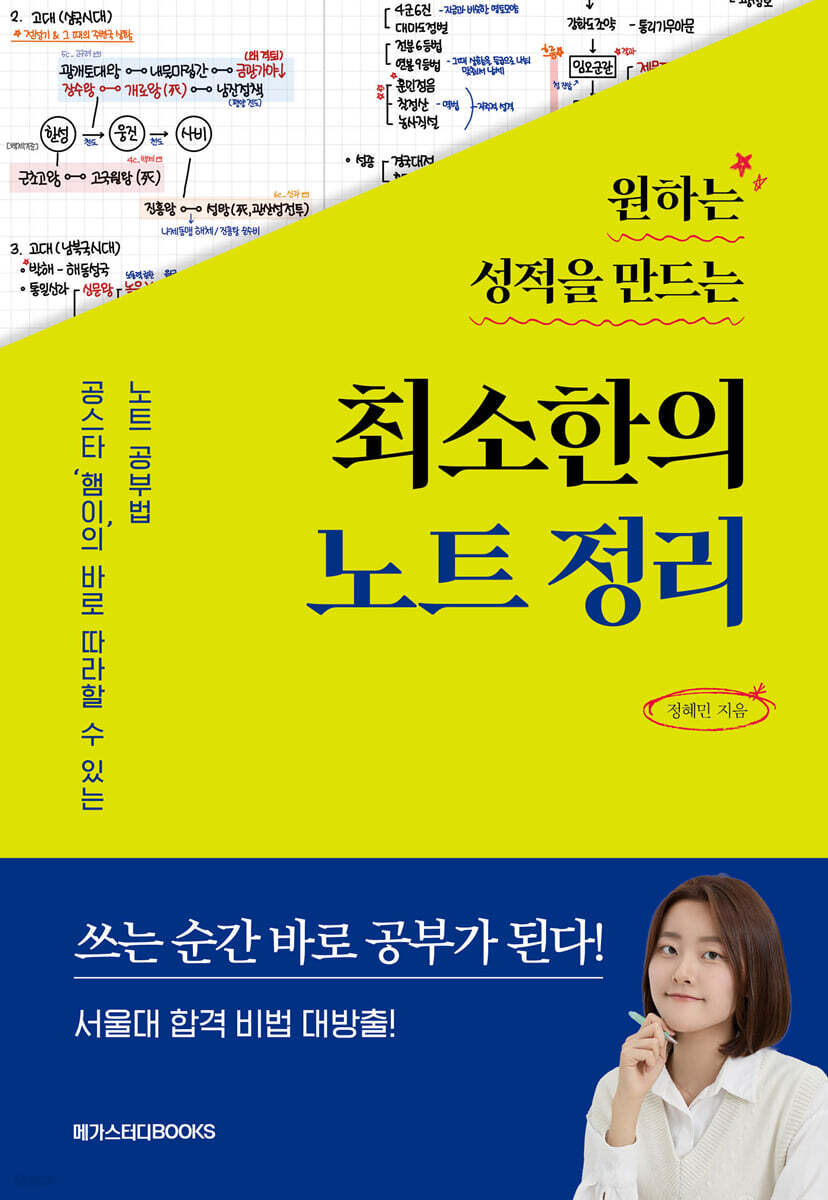 |
Description
Book Introduction
Note-Organizing Tips from Influencer Ham-i, With Over 47,000 Subscribers
Organizing Notes: Even a Beginner Can Improve Their Grades
Revealing the key note-taking tips that will surely improve your grades!
The special note-taking method of 'Hami', who has been sharing his note-taking know-how through social media since high school and has established himself as a study mentor for teenagers, is revealed.
The author's know-how for passing the Seoul National University entrance exam from a local high school is fully included through a solid note-taking study method that he has developed over many years.
We reveal everything about note-taking methods, from how to grasp the big picture of note-taking to the finer details.
This book is not just about neat and pretty note-taking tips, but also provides practical note-taking methods that will help you improve your grades. It contains everything about note-taking methods, such as how to select the content that must be written down in class and write it down in the textbook, the timing and content of transferring the notes to the notebook, how to structure the content in your head, and a 6-week plan for studying using notes.
If you follow the step-by-step instructions on how to study with notes from class time to exam day, even students who have had difficulty organizing notes or have worried about how to apply them to their studies will be able to follow along.
You can also find answers to the most frequently asked questions about note organization through SNS, such as solutions for when you can't actually look at your organized notes, recommended pens and notebooks, how to use a tablet, how to organize notes by subject, how to write mistake notes and concept notes, and how to make monthly, weekly, and daily plans.
Organizing Notes: Even a Beginner Can Improve Their Grades
Revealing the key note-taking tips that will surely improve your grades!
The special note-taking method of 'Hami', who has been sharing his note-taking know-how through social media since high school and has established himself as a study mentor for teenagers, is revealed.
The author's know-how for passing the Seoul National University entrance exam from a local high school is fully included through a solid note-taking study method that he has developed over many years.
We reveal everything about note-taking methods, from how to grasp the big picture of note-taking to the finer details.
This book is not just about neat and pretty note-taking tips, but also provides practical note-taking methods that will help you improve your grades. It contains everything about note-taking methods, such as how to select the content that must be written down in class and write it down in the textbook, the timing and content of transferring the notes to the notebook, how to structure the content in your head, and a 6-week plan for studying using notes.
If you follow the step-by-step instructions on how to study with notes from class time to exam day, even students who have had difficulty organizing notes or have worried about how to apply them to their studies will be able to follow along.
You can also find answers to the most frequently asked questions about note organization through SNS, such as solutions for when you can't actually look at your organized notes, recommended pens and notebooks, how to use a tablet, how to organize notes by subject, how to write mistake notes and concept notes, and how to make monthly, weekly, and daily plans.
- You can preview some of the book's contents.
Preview
index
Intro | A note-taking method for improving grades, developed through dozens of exams
Chapter 1.
Why Students Who Organize Their Notes Get Better Grades
The illusion that time spent organizing notes is a waste
The process of thinking 'Why?' / Studying for the exam begins when you organize your notes / Let's think 'How?' / If organizing notes takes too much time / Do you really know what you think you know? / The power of organizing notes to store learning content more firmly
I become the subject of my studies
Organizing notes is about creating your own materials.
The Difference Between Note Organizing and Mind Mapping
Chapter 2.
Preparation before starting to organize notes
Characteristics of Well-Organized Notes
Must be visible / Must be recognizable / Must be able to be brought out well
Preparation for note-taking
Pros and Cons of Each Notebook / Criteria for Choosing the Right Notebook for Me / Notebooks I've Used / Pens I've Used
Ham's Various Study Tips: How to Keep Ballpoint Pens from Smudging Under Highlighters
Establish your own rules for taking effective notes
Standards for determining font color / Note organization framework and structure / Frequently used expressions and symbols
Structure your thoughts in your head before opening your notes.
How to remember things in your head while organizing notes
Chapter 3, Note Organization Timeline
Note-taking during class
Listen attentively in class / Take notes in textbooks, not notebooks / Things you absolutely must take notes in class / Tips for taking notes in class / If your notes can't keep up with the class pace / Lecture notes: Listening vs. Taking notes
Stop and do it
Ham's various study tips_ If your arms or neck hurt when taking notes
Supplement notes immediately after class
Full note organization
Looking at the textbook and structuring it in your head / Organizing and summarizing the content / Writing while understanding vs.
Understand after writing / Tips for organizing notes so they are easy to read at a glance / What if the readability of diagrams is poor when transferred to a notebook / Why organize on paper instead of a tablet / Tips for using a tablet properly / Will organizing notes help you memorize them all at once? / Pretty organization like a workbook vs.
A messy but organized way to remember what you're studying
Ham's Various Study Tips: Why You Don't Look at Your Organized Notes
How to study with organized notes
Read the textbook and notes once before solving the problem / Upgrade your notes / Memorize the contents of your notes / Maximize your short-term memory right before the test
Chapter 4.
How to study notes for exams
Make a study plan for the exam
What you need to know before making a plan / Check the scope of the exam / Set a test preparation period / Make a plan by week / Determine daily study content / Adjust the detailed plan / Take time to review the plan
Example Exam Study Plan
High School Exam Period / Exam Feedback Summary
Why You Should Make a Study Plan
Why Study Plans Fail
Tips for Making a Well-Sticked Plan
How to Plan Your Year, Plan Your Vacation
Create a 6-week study plan for midterms and finals using notes.
6-4 weeks before the exam / 4-2 weeks before the exam / 2 weeks to 2 days before the exam / The day before the exam to the day of the exam
Ham's Various Study Tips_Test Question Solving Order
Benefits of Creating a Planner
How to Use Monthly, Weekly, and Daily Planners
Chapter 5.
How to organize notes by subject
Korean
Korean language for school grades / Korean language for college entrance exams / literature / non-literature
math
Wrong answer notebook / Mistake notebook right before the exam / Key concept notebook and thought process notebook / Why write the solution process on the workbook instead of a workbook
english
Social Studies
History / General Social Studies / Geography / Ethics / Korean History for the College Scholastic Ability Test
scientific exploration
Physics / Chemistry / Life Sciences / Earth Sciences
Ham's Note Organizing
Chapter 1.
Why Students Who Organize Their Notes Get Better Grades
The illusion that time spent organizing notes is a waste
The process of thinking 'Why?' / Studying for the exam begins when you organize your notes / Let's think 'How?' / If organizing notes takes too much time / Do you really know what you think you know? / The power of organizing notes to store learning content more firmly
I become the subject of my studies
Organizing notes is about creating your own materials.
The Difference Between Note Organizing and Mind Mapping
Chapter 2.
Preparation before starting to organize notes
Characteristics of Well-Organized Notes
Must be visible / Must be recognizable / Must be able to be brought out well
Preparation for note-taking
Pros and Cons of Each Notebook / Criteria for Choosing the Right Notebook for Me / Notebooks I've Used / Pens I've Used
Ham's Various Study Tips: How to Keep Ballpoint Pens from Smudging Under Highlighters
Establish your own rules for taking effective notes
Standards for determining font color / Note organization framework and structure / Frequently used expressions and symbols
Structure your thoughts in your head before opening your notes.
How to remember things in your head while organizing notes
Chapter 3, Note Organization Timeline
Note-taking during class
Listen attentively in class / Take notes in textbooks, not notebooks / Things you absolutely must take notes in class / Tips for taking notes in class / If your notes can't keep up with the class pace / Lecture notes: Listening vs. Taking notes
Stop and do it
Ham's various study tips_ If your arms or neck hurt when taking notes
Supplement notes immediately after class
Full note organization
Looking at the textbook and structuring it in your head / Organizing and summarizing the content / Writing while understanding vs.
Understand after writing / Tips for organizing notes so they are easy to read at a glance / What if the readability of diagrams is poor when transferred to a notebook / Why organize on paper instead of a tablet / Tips for using a tablet properly / Will organizing notes help you memorize them all at once? / Pretty organization like a workbook vs.
A messy but organized way to remember what you're studying
Ham's Various Study Tips: Why You Don't Look at Your Organized Notes
How to study with organized notes
Read the textbook and notes once before solving the problem / Upgrade your notes / Memorize the contents of your notes / Maximize your short-term memory right before the test
Chapter 4.
How to study notes for exams
Make a study plan for the exam
What you need to know before making a plan / Check the scope of the exam / Set a test preparation period / Make a plan by week / Determine daily study content / Adjust the detailed plan / Take time to review the plan
Example Exam Study Plan
High School Exam Period / Exam Feedback Summary
Why You Should Make a Study Plan
Why Study Plans Fail
Tips for Making a Well-Sticked Plan
How to Plan Your Year, Plan Your Vacation
Create a 6-week study plan for midterms and finals using notes.
6-4 weeks before the exam / 4-2 weeks before the exam / 2 weeks to 2 days before the exam / The day before the exam to the day of the exam
Ham's Various Study Tips_Test Question Solving Order
Benefits of Creating a Planner
How to Use Monthly, Weekly, and Daily Planners
Chapter 5.
How to organize notes by subject
Korean
Korean language for school grades / Korean language for college entrance exams / literature / non-literature
math
Wrong answer notebook / Mistake notebook right before the exam / Key concept notebook and thought process notebook / Why write the solution process on the workbook instead of a workbook
english
Social Studies
History / General Social Studies / Geography / Ethics / Korean History for the College Scholastic Ability Test
scientific exploration
Physics / Chemistry / Life Sciences / Earth Sciences
Ham's Note Organizing
Detailed image

Into the book
I consider thinking about what and how to organize it in my notes, and actually organizing it in my notes, as the beginning of studying for the exam.
Organizing my notes helps me understand how much I know now and how to study in the future.
--- From "Studying for the exam has already begun from the moment you start organizing your notes"
When you start studying by organizing your notes, that is, to remember the content in your head, the most important first step is to read, understand, and structure the study material. The second step is to write down the structured material in your notes and remember it.
Because you remember better when you write it down by hand than when you just read it.
--- From "How to remember things in your head while organizing notes"
Rather than just memorizing the details, it is important to study by firmly grasping the overall structure and flow, that is, the skeleton, in your head and then adding flesh to it.
That way, no matter what test question comes up, I can quickly find the framework I want from the many frameworks I've organized and find the answer.
--- From "Why I Organize on Paper Instead of Tablets"
In this way, I read the notes over and over again, memorizing the information I've arranged in a way that's easy for me to remember, like taking a picture.
It may be difficult to memorize every word written in the notes without missing a single word, but if you read it several times, you will be able to accurately remember the keywords that make up the main concepts and the order in which the content appears.
--- From "Reading Textbooks and Notes Before Solving Problems"
I wrote down the problem as simply as possible, and rather than listing the entire solution process below, I organized it by focusing on the concepts I missed.
I organized the types of problems to show which solution method to use when which type and conditions appear, so that it can be applied to other problems.
Organizing my notes helps me understand how much I know now and how to study in the future.
--- From "Studying for the exam has already begun from the moment you start organizing your notes"
When you start studying by organizing your notes, that is, to remember the content in your head, the most important first step is to read, understand, and structure the study material. The second step is to write down the structured material in your notes and remember it.
Because you remember better when you write it down by hand than when you just read it.
--- From "How to remember things in your head while organizing notes"
Rather than just memorizing the details, it is important to study by firmly grasping the overall structure and flow, that is, the skeleton, in your head and then adding flesh to it.
That way, no matter what test question comes up, I can quickly find the framework I want from the many frameworks I've organized and find the answer.
--- From "Why I Organize on Paper Instead of Tablets"
In this way, I read the notes over and over again, memorizing the information I've arranged in a way that's easy for me to remember, like taking a picture.
It may be difficult to memorize every word written in the notes without missing a single word, but if you read it several times, you will be able to accurately remember the keywords that make up the main concepts and the order in which the content appears.
--- From "Reading Textbooks and Notes Before Solving Problems"
I wrote down the problem as simply as possible, and rather than listing the entire solution process below, I organized it by focusing on the concepts I missed.
I organized the types of problems to show which solution method to use when which type and conditions appear, so that it can be applied to other problems.
--- From the "Incorrect Answer Note"
GOODS SPECIFICS
- Date of issue: December 2, 2024
- Page count, weight, size: 316 pages | 145*210*30mm
- ISBN13: 9791129713834
- ISBN10: 1129713830
You may also like
카테고리
korean


korean

![GQ KOREA Mark (Monthly): December [2025]](http://librairie.coreenne.fr/cdn/shop/files/8ef265dbbfbf186523ed75ba7319009d.jpg?v=1765340328&width=3840)


