

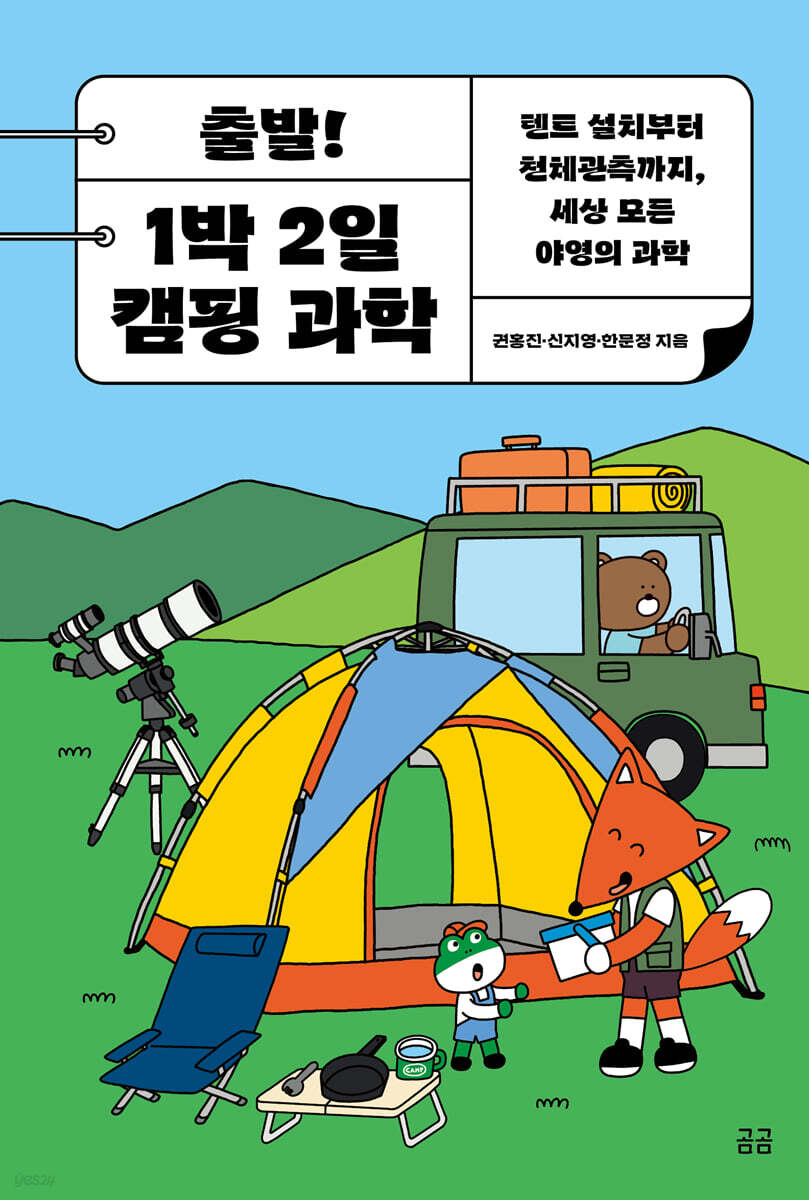
Let's go! 1 night 2 days camping science
 |
Description
Book Introduction
Nature observation, astronomy, meteorology, geology…
A day at a campsite where 24 hours is not enough
An exciting science story unfolding in a special space
A camping enthusiast and science expert will provide you with valuable information!
Camping is a way to escape the hustle and bustle of the city and enjoy some leisure time in nature.
As people tired of everyday life seek out campsites regardless of the season, the ways to enjoy camping are becoming more diverse, from urban camping for short periods of free time, to 'Jangbak' where you can pitch a tent and enjoy it like your own home all year round, to various themed camping filled with experiential learning programs.
Campgrounds, often sought for relaxation and leisure, are actually filled with rich scientific content, including astronomy, meteorology, and geology.
There's no time to be bored, with the ever-changing celestial bodies that decorate the night sky, the geographic features that bear the marks of time, meteorology that helps predict the weather, physics that makes tent setup easier, and the principles of sleeping bag insulation for a cozy night's sleep.
"Let's Go! 2 Days & 1 Night Camping Science" is a science textbook for young people that follows a day of 2 days & 1 night camping through the lens of science.
Science teachers and researchers who are members of the 'Science and Technology Network Dreaming of Change (ESC)' have joined forces to provide scientific knowledge in an easy-to-understand and friendly manner.
The authors, Hongjin Kwon, Jiyoung Shin, and Munjeong Han, are camping enthusiasts who travel around Korea and abroad to explore and enjoy various camping spots.
Based on my love of camping and my experience working with young people in school settings, I select and share essential scientific knowledge that is essential for campsites.
Discover exciting, insightful science from authors who are both camping enthusiasts and science experts.
By listening to the diverse stories contained within camping equipment and spaces, you will not only easily learn scientific knowledge that seemed difficult, but you will also experience the joy of discovering and directly exploring the scientific principles hidden around you.
A day at a campsite where 24 hours is not enough
An exciting science story unfolding in a special space
A camping enthusiast and science expert will provide you with valuable information!
Camping is a way to escape the hustle and bustle of the city and enjoy some leisure time in nature.
As people tired of everyday life seek out campsites regardless of the season, the ways to enjoy camping are becoming more diverse, from urban camping for short periods of free time, to 'Jangbak' where you can pitch a tent and enjoy it like your own home all year round, to various themed camping filled with experiential learning programs.
Campgrounds, often sought for relaxation and leisure, are actually filled with rich scientific content, including astronomy, meteorology, and geology.
There's no time to be bored, with the ever-changing celestial bodies that decorate the night sky, the geographic features that bear the marks of time, meteorology that helps predict the weather, physics that makes tent setup easier, and the principles of sleeping bag insulation for a cozy night's sleep.
"Let's Go! 2 Days & 1 Night Camping Science" is a science textbook for young people that follows a day of 2 days & 1 night camping through the lens of science.
Science teachers and researchers who are members of the 'Science and Technology Network Dreaming of Change (ESC)' have joined forces to provide scientific knowledge in an easy-to-understand and friendly manner.
The authors, Hongjin Kwon, Jiyoung Shin, and Munjeong Han, are camping enthusiasts who travel around Korea and abroad to explore and enjoy various camping spots.
Based on my love of camping and my experience working with young people in school settings, I select and share essential scientific knowledge that is essential for campsites.
Discover exciting, insightful science from authors who are both camping enthusiasts and science experts.
By listening to the diverse stories contained within camping equipment and spaces, you will not only easily learn scientific knowledge that seemed difficult, but you will also experience the joy of discovering and directly exploring the scientific principles hidden around you.
- You can preview some of the book's contents.
Preview
index
Preface: Where Starlight and Wind Stay: A Science Story Inside a Campground
1. Zero Waste | The First Step to Sustainable Camping
2 Weather Forecast | Check the weather before you leave!
3 Tents | If you want to build a sturdy tent
4 Sleeping Bags | Perfect Moisture and Cold Protection! The Secret to Floor Construction
5 Rocks | How can we know where a rock is from?
6 Plants | Photosynthetic factories temporarily closed?
7 Insects | Why Moths Are Drawn to Light
8 BBQ | The Fantastic Savory Flavor of Charcoal
9 Lanterns | Brighter, Brighter! Find the trendiest lanterns.
10 Campfires | Knowing Science Makes You a Fire Starter
11 Constellations | The ever-changing night sky that changes with the seasons
12 Hot Packs & Ice Packs | No problem, even in the middle of the night!
13 First Aid Kits | Essential for Outdoor Activities! Protect Your Body
14 Cameras | For the Best Sunrise Photos
References
Image source
1. Zero Waste | The First Step to Sustainable Camping
2 Weather Forecast | Check the weather before you leave!
3 Tents | If you want to build a sturdy tent
4 Sleeping Bags | Perfect Moisture and Cold Protection! The Secret to Floor Construction
5 Rocks | How can we know where a rock is from?
6 Plants | Photosynthetic factories temporarily closed?
7 Insects | Why Moths Are Drawn to Light
8 BBQ | The Fantastic Savory Flavor of Charcoal
9 Lanterns | Brighter, Brighter! Find the trendiest lanterns.
10 Campfires | Knowing Science Makes You a Fire Starter
11 Constellations | The ever-changing night sky that changes with the seasons
12 Hot Packs & Ice Packs | No problem, even in the middle of the night!
13 First Aid Kits | Essential for Outdoor Activities! Protect Your Body
14 Cameras | For the Best Sunrise Photos
References
Image source
Detailed image
.jpg)
Into the book
The pine tree rotates 144 degrees, which is 2/5 of 360 degrees, and the forget-me-not rotates 135 degrees, which is 3/8 of 360 degrees.
Just as people stand in between groups to avoid blocking others when taking a group photo, plants also stand in between groups to get enough sunlight.
The reason why each tree has a different angle of deviation is because it finds the best conditions to receive the most sunlight depending on the environment, such as the height of the tree and the height of the surrounding plants.
The tree's strategy is truly amazing.
But the numbers that appear here are not ordinary.
--- From "Plants"
If you spread out a mat after the sun sets and look up at the night sky, you may see stars moving among the twinkling stars.
Did a UFO appear in the night sky? If so, the observatory must have spotted it first.
These blinking, moving lights are actually not stars, but airplanes.
Airplanes have a variety of green, red, and white lights that they use during flight.
For example, collision avoidance lights blink 40 to 110 times per minute to notify other aircraft and people on the ground that the aircraft is in the air and to prevent collisions.
--- From "Constellations"
Mosquitoes, unwelcome summer visitors, are a constant presence even on camping nights.
There are people who are particularly prone to mosquito bites.
Have you ever wondered, "Why do I get bitten while everyone else gets bitten?" The most common response you'll hear at such times is probably, "It's because your blood is boiling!"
Is that really true? In fact, mosquitoes bite us so often because of our sweat and body odor.
Mosquitoes bite people by detecting carbon dioxide emissions and body heat, but the smell of sweat and skin secretions also plays an important role in mosquitoes detecting people.
Just as people stand in between groups to avoid blocking others when taking a group photo, plants also stand in between groups to get enough sunlight.
The reason why each tree has a different angle of deviation is because it finds the best conditions to receive the most sunlight depending on the environment, such as the height of the tree and the height of the surrounding plants.
The tree's strategy is truly amazing.
But the numbers that appear here are not ordinary.
--- From "Plants"
If you spread out a mat after the sun sets and look up at the night sky, you may see stars moving among the twinkling stars.
Did a UFO appear in the night sky? If so, the observatory must have spotted it first.
These blinking, moving lights are actually not stars, but airplanes.
Airplanes have a variety of green, red, and white lights that they use during flight.
For example, collision avoidance lights blink 40 to 110 times per minute to notify other aircraft and people on the ground that the aircraft is in the air and to prevent collisions.
--- From "Constellations"
Mosquitoes, unwelcome summer visitors, are a constant presence even on camping nights.
There are people who are particularly prone to mosquito bites.
Have you ever wondered, "Why do I get bitten while everyone else gets bitten?" The most common response you'll hear at such times is probably, "It's because your blood is boiling!"
Is that really true? In fact, mosquitoes bite us so often because of our sweat and body odor.
Mosquitoes bite people by detecting carbon dioxide emissions and body heat, but the smell of sweat and skin secretions also plays an important role in mosquitoes detecting people.
--- From "Standard Medicine"
Publisher's Review
A science feast all over the place
Into the vibrant camping scene
- The living, breathing world of science opened up by careful observation.
A book that will change your attitude toward science, both during and after camping.
The main axis of this book is ‘observation.’
The extraordinary space of a campsite gives us the opportunity to observe the surrounding phenomena that we would normally just pass by.
Careful observation leads to interest and questioning, which in turn leads to knowledge and enlightenment, broadening our perspective on the world.
This book focuses on such moments of observation.
For example, if you are taking a leisurely walk and your gaze lingers on the leaves of a summer plant, you will become interested in the deep green color and learn about photosynthesis and transpiration.
The question then extends to the arrangement of leaves and stems, and the Fibonacci sequence is discovered in the regularity of leaf arrangement.
In this way, we can see that the temperature of a high-altitude campsite is influenced by the troposphere, the rocks of a coastal cliff show traces of the Paleozoic era, the movement of insects gathered by light shows photodynamic reactions, and the principles of combustion and flame reactions are hidden in a colorful campfire.
The knowledge gained through experience will remain as an asset to readers even after returning to their daily lives, transforming their attitude toward science.
In addition, the boundless world of science welcomes campers both inside and outside the tent.
If camping is about building your own little home in nature, then building the home, and the things inside it, can also be objects of exploration.
"Let's Go! 2 Days & 1 Night Camping Science" explains the science behind various objects you might encounter during an overnight stay, from the elasticity of poles that build a sturdy tent, to the principles of electric current in lanterns that keep you warm during dark camping nights, to the structural characteristics of cameras that ensure the best sunrise photos.
These contents add vitality and realism to the scientific knowledge learned in textbooks.
Understanding that a tent is erected through the interplay of tensile and compressive forces between the poles and the fabric, and that the elasticity of the poles varies depending on the properties of the raw materials, can be helpful when purchasing and setting up camping gear.
In other words, you will experience that you can use the rigid scientific knowledge in a rewarding way in real life.
Exploring the natural world from my own perspective
- A thoughtful and delicate gaze toward nature
- Considering sustainable camping in the era of climate crisis
In this way, "Let's Go! 2 Days & 1 Night Camping Science" introduces vivid scientific stories contained within the space of a campsite in a single day, thoroughly demonstrating the charm of camping with science.
But what makes this book special is that it goes beyond simply telling a story, and leads young people to reflect on their own attitudes toward space and develop their own perspectives.
In particular, the suggestions for sustainable camping included throughout the book encourage young people to reconsider their attitude toward nature.
First, before we begin camping in earnest, we would like to inform you that the campsite is not a place to enjoy for a while and then leave, but a place where nature and humans interact and continuously influence each other.
Through this, readers can naturally understand the need to commune with nature by adopting carbon neutrality as a basic philosophy in the era of climate crisis.
Furthermore, specific ideas for enjoying camping without harming nature, such as zero waste and plogging, including using carbon-free land, serve as good examples for connecting knowledge to practice.
This perspective is always brought up when discussing science in camping.
For example, it explains how extreme heat events are linked to seasonal changes and the spread of malaria, introduces insulation materials that do not exploit animals and eco-friendly insulation materials that do not destroy the environment, and shows societal efforts to restore bee populations.
Especially considering that this book follows the entire camping process, including preparing camping supplies, setting up a tent, exploring the surrounding terrain, trails, and forest, and then having a barbecue and campfire, it is also a good reference to take to the campsite and enjoy various experiences and activities.
After camping, you will also have the pleasure of recalling your memories and reflecting on the scientific knowledge you have experienced firsthand.
Into the vibrant camping scene
- The living, breathing world of science opened up by careful observation.
A book that will change your attitude toward science, both during and after camping.
The main axis of this book is ‘observation.’
The extraordinary space of a campsite gives us the opportunity to observe the surrounding phenomena that we would normally just pass by.
Careful observation leads to interest and questioning, which in turn leads to knowledge and enlightenment, broadening our perspective on the world.
This book focuses on such moments of observation.
For example, if you are taking a leisurely walk and your gaze lingers on the leaves of a summer plant, you will become interested in the deep green color and learn about photosynthesis and transpiration.
The question then extends to the arrangement of leaves and stems, and the Fibonacci sequence is discovered in the regularity of leaf arrangement.
In this way, we can see that the temperature of a high-altitude campsite is influenced by the troposphere, the rocks of a coastal cliff show traces of the Paleozoic era, the movement of insects gathered by light shows photodynamic reactions, and the principles of combustion and flame reactions are hidden in a colorful campfire.
The knowledge gained through experience will remain as an asset to readers even after returning to their daily lives, transforming their attitude toward science.
In addition, the boundless world of science welcomes campers both inside and outside the tent.
If camping is about building your own little home in nature, then building the home, and the things inside it, can also be objects of exploration.
"Let's Go! 2 Days & 1 Night Camping Science" explains the science behind various objects you might encounter during an overnight stay, from the elasticity of poles that build a sturdy tent, to the principles of electric current in lanterns that keep you warm during dark camping nights, to the structural characteristics of cameras that ensure the best sunrise photos.
These contents add vitality and realism to the scientific knowledge learned in textbooks.
Understanding that a tent is erected through the interplay of tensile and compressive forces between the poles and the fabric, and that the elasticity of the poles varies depending on the properties of the raw materials, can be helpful when purchasing and setting up camping gear.
In other words, you will experience that you can use the rigid scientific knowledge in a rewarding way in real life.
Exploring the natural world from my own perspective
- A thoughtful and delicate gaze toward nature
- Considering sustainable camping in the era of climate crisis
In this way, "Let's Go! 2 Days & 1 Night Camping Science" introduces vivid scientific stories contained within the space of a campsite in a single day, thoroughly demonstrating the charm of camping with science.
But what makes this book special is that it goes beyond simply telling a story, and leads young people to reflect on their own attitudes toward space and develop their own perspectives.
In particular, the suggestions for sustainable camping included throughout the book encourage young people to reconsider their attitude toward nature.
First, before we begin camping in earnest, we would like to inform you that the campsite is not a place to enjoy for a while and then leave, but a place where nature and humans interact and continuously influence each other.
Through this, readers can naturally understand the need to commune with nature by adopting carbon neutrality as a basic philosophy in the era of climate crisis.
Furthermore, specific ideas for enjoying camping without harming nature, such as zero waste and plogging, including using carbon-free land, serve as good examples for connecting knowledge to practice.
This perspective is always brought up when discussing science in camping.
For example, it explains how extreme heat events are linked to seasonal changes and the spread of malaria, introduces insulation materials that do not exploit animals and eco-friendly insulation materials that do not destroy the environment, and shows societal efforts to restore bee populations.
Especially considering that this book follows the entire camping process, including preparing camping supplies, setting up a tent, exploring the surrounding terrain, trails, and forest, and then having a barbecue and campfire, it is also a good reference to take to the campsite and enjoy various experiences and activities.
After camping, you will also have the pleasure of recalling your memories and reflecting on the scientific knowledge you have experienced firsthand.
GOODS SPECIFICS
- Date of issue: September 30, 2024
- Page count, weight, size: 224 pages | 328g | 135*200*15mm
- ISBN13: 9791170872467
- ISBN10: 1170872468
You may also like
카테고리
korean


korean

![GQ KOREA Mark (Monthly): December [2025]](http://librairie.coreenne.fr/cdn/shop/files/8ef265dbbfbf186523ed75ba7319009d.jpg?v=1765340328&width=3840)


