

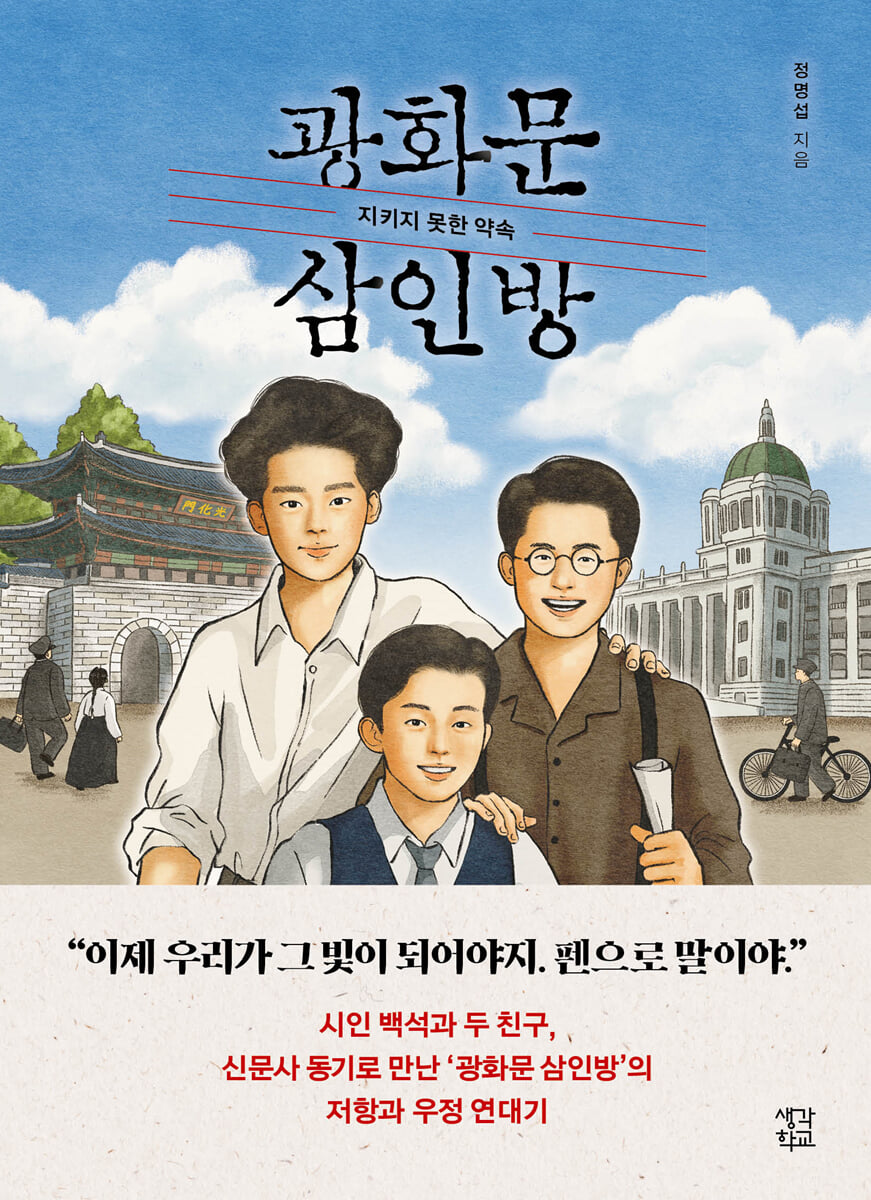
Gwanghwamun Three
 |
Description
Book Introduction
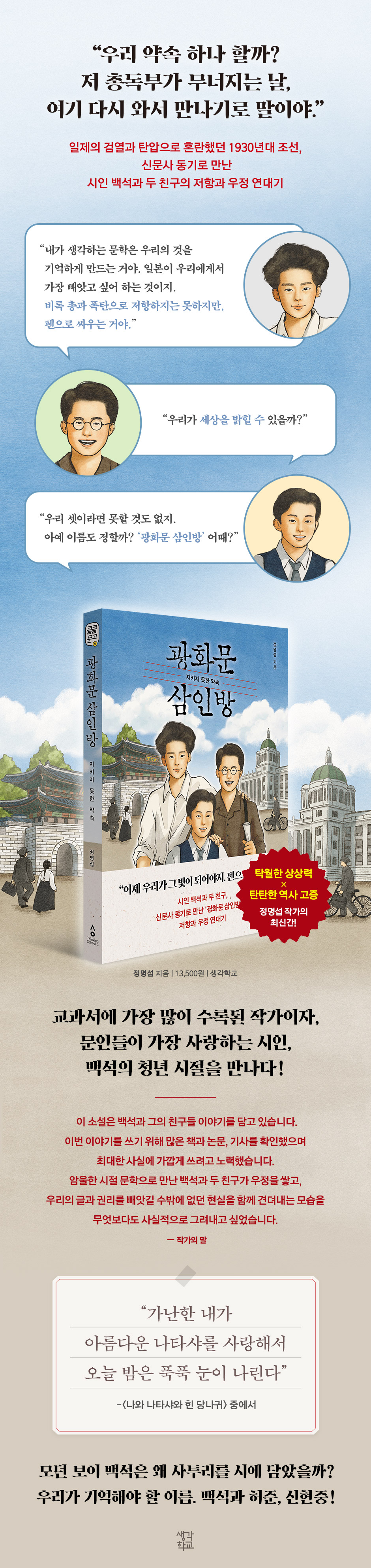
“Shall we make a promise?
“I said, ‘Come here and meet me again on the day that Government-General falls.’”
Joseon in the 1930s was in chaos due to Japanese censorship and oppression.
A chronicle of the resistance and friendship between poet Baek Seok and two friends who met as colleagues at a newspaper company.
A new historical novel by Jeong Myeong-seop, a writer beloved by teenagers.
Bestselling author Jeong Myeong-seop has consistently published novels based on historical events, including “Children of the Reservoir,” “1948, Two Friends,” and “Miss Sontag.”
This time he focused on the poet Baek Seok.
Baek Seok was once not properly recognized due to the stigma of being a writer who defected to North Korea, but now he shines as the 'writer most frequently included in textbooks.'
The fourteenth book in the Thinking School literature series, "Click Library," "The Gwanghwamun Trio," is a novel in which the author, noting that Baek Seok joined the Chosun Ilbo in 1934 and worked as a proofreading reporter, reconstructs his life through solid research and outstanding imagination.
In the 1930s, when Japan's brutal oppression and policy of ethnic annihilation were in full swing, Baek Seok, Heo Jun, and Shin Hyeon-jung, who met at a newspaper company, shared their sorrow over losing their country by reciting poetry and writing novels.
This book fully captures the depth of the agony and tragedy that intellectuals had to endure between resistance and collaboration at the time.
Modern Boy, Modern Girl: Gwanghwamun and Jongno, filled with the energy of youth; Baekseok's hometown Jeongju, where he pursued his dream of becoming a teacher; Tongyeong, where he had to overcome the pain of his first love; the author follows in Baekseok's footsteps, depicting the trio's daily lives in an extremely ordinary manner, while paradoxically painfully portraying the tragedy of the times that crushed their dreams and friendship.
Meanwhile, Baek Seok's beautiful poems scattered throughout the book are of great help in understanding his world of works, such as why he insisted on using the Korean language.
The depiction of a dark era of chaos and fear caused by Japan's war of aggression makes us reflect on the preciousness of the peace we enjoy today.
“I said, ‘Come here and meet me again on the day that Government-General falls.’”
Joseon in the 1930s was in chaos due to Japanese censorship and oppression.
A chronicle of the resistance and friendship between poet Baek Seok and two friends who met as colleagues at a newspaper company.
A new historical novel by Jeong Myeong-seop, a writer beloved by teenagers.
Bestselling author Jeong Myeong-seop has consistently published novels based on historical events, including “Children of the Reservoir,” “1948, Two Friends,” and “Miss Sontag.”
This time he focused on the poet Baek Seok.
Baek Seok was once not properly recognized due to the stigma of being a writer who defected to North Korea, but now he shines as the 'writer most frequently included in textbooks.'
The fourteenth book in the Thinking School literature series, "Click Library," "The Gwanghwamun Trio," is a novel in which the author, noting that Baek Seok joined the Chosun Ilbo in 1934 and worked as a proofreading reporter, reconstructs his life through solid research and outstanding imagination.
In the 1930s, when Japan's brutal oppression and policy of ethnic annihilation were in full swing, Baek Seok, Heo Jun, and Shin Hyeon-jung, who met at a newspaper company, shared their sorrow over losing their country by reciting poetry and writing novels.
This book fully captures the depth of the agony and tragedy that intellectuals had to endure between resistance and collaboration at the time.
Modern Boy, Modern Girl: Gwanghwamun and Jongno, filled with the energy of youth; Baekseok's hometown Jeongju, where he pursued his dream of becoming a teacher; Tongyeong, where he had to overcome the pain of his first love; the author follows in Baekseok's footsteps, depicting the trio's daily lives in an extremely ordinary manner, while paradoxically painfully portraying the tragedy of the times that crushed their dreams and friendship.
Meanwhile, Baek Seok's beautiful poems scattered throughout the book are of great help in understanding his world of works, such as why he insisted on using the Korean language.
The depiction of a dark era of chaos and fear caused by Japan's war of aggression makes us reflect on the preciousness of the peace we enjoy today.
- You can preview some of the book's contents.
Preview
index
meeting
Keijo Imperial University
The path of three people
Baekseok's deer
Poet of Hamheung
Back to Gyeongseong
People leaving
broken promises
Author's Note
Keijo Imperial University
The path of three people
Baekseok's deer
Poet of Hamheung
Back to Gyeongseong
People leaving
broken promises
Author's Note
Detailed image
Into the book
“Why James Joyce?”
“Because I’m Irish.
If you look at Ireland, it's in a similar situation to us.
And I like how James Joyce wrote in a rural setting while maintaining his Irish accent.”
“Do you want to be the James Joyce of Korea?”
Baek-seok shrugged his shoulders at Heo-jun's question, which was subtly playful.
“I don’t know about James Joyce, but I’m going to write literature in my hometown dialect.
Because what you have to remember must be remembered.
perhaps……."
Baek Seok added, frowning slightly.
“There may come a time when it will be difficult to even write literature that makes people remember their hometown and think of Joseon.”
--- p.36
“Damn, Jongno, where the Koreans live, doesn’t even have paved roads so it’s always dusty and there are no streetlights so it’s pitch black. This place is a whole other world.
“It’s a whole new world.”
Baek Seok also smiled bitterly.
Shin Hyun-joong, who was walking a little behind, put his hand on the shoulders of the two people.
“The writings of these two people can become the light that illuminates the darkness.”
Shin Hyun-joong, looking up at the streetlight, added.
“Not that fake light.”
--- p.58
“Shall we make a promise?”
“What promise?”
In response to Heo Jun's question, Baek Seok stared at the Governor-General's Office and spoke.
“I promised to come back here and meet you again on the day that the Government-General falls.”
At Baekseok's suggestion, both of them looked up at the dark Government-General building.
It didn't seem like it would ever fall apart, or disappear forever.
--- p.65
“Where is this? It’s my hideout.”
“What is this hideout for?”
Shin Hyun-joong answered Heo Jun's question as he touched the cold floor with his hand because there was no warmth at all.
“It’s a place where underground publications are made.”
--- p.92
Then one day, while I was sitting at my desk working, my servant Geumdongi approached me.
Geumdongi whispered cautiously to Baekseok, who had raised his head.
“The head of the correctional department wants to see the reporter.”
I thought to myself, 'Why that author?'
Geumdongi seemed to have noticed Baekseok's true feelings and came closer, speaking in a low voice.
“He said he would wait for me at Nakrangpara.”
“Because I’m Irish.
If you look at Ireland, it's in a similar situation to us.
And I like how James Joyce wrote in a rural setting while maintaining his Irish accent.”
“Do you want to be the James Joyce of Korea?”
Baek-seok shrugged his shoulders at Heo-jun's question, which was subtly playful.
“I don’t know about James Joyce, but I’m going to write literature in my hometown dialect.
Because what you have to remember must be remembered.
perhaps……."
Baek Seok added, frowning slightly.
“There may come a time when it will be difficult to even write literature that makes people remember their hometown and think of Joseon.”
--- p.36
“Damn, Jongno, where the Koreans live, doesn’t even have paved roads so it’s always dusty and there are no streetlights so it’s pitch black. This place is a whole other world.
“It’s a whole new world.”
Baek Seok also smiled bitterly.
Shin Hyun-joong, who was walking a little behind, put his hand on the shoulders of the two people.
“The writings of these two people can become the light that illuminates the darkness.”
Shin Hyun-joong, looking up at the streetlight, added.
“Not that fake light.”
--- p.58
“Shall we make a promise?”
“What promise?”
In response to Heo Jun's question, Baek Seok stared at the Governor-General's Office and spoke.
“I promised to come back here and meet you again on the day that the Government-General falls.”
At Baekseok's suggestion, both of them looked up at the dark Government-General building.
It didn't seem like it would ever fall apart, or disappear forever.
--- p.65
“Where is this? It’s my hideout.”
“What is this hideout for?”
Shin Hyun-joong answered Heo Jun's question as he touched the cold floor with his hand because there was no warmth at all.
“It’s a place where underground publications are made.”
--- p.92
Then one day, while I was sitting at my desk working, my servant Geumdongi approached me.
Geumdongi whispered cautiously to Baekseok, who had raised his head.
“The head of the correctional department wants to see the reporter.”
I thought to myself, 'Why that author?'
Geumdongi seemed to have noticed Baekseok's true feelings and came closer, speaking in a low voice.
“He said he would wait for me at Nakrangpara.”
--- p.120
Publisher's Review
“Shall we make a promise?
We agreed to come back here and meet again on the day the Government-General collapses.
A new historical novel by Jeong Myeong-seop, a writer beloved by teenagers.
Joseon in the 1930s was in chaos due to Japanese censorship and oppression.
A chronicle of the resistance and friendship between poet Baek Seok and two friends who met as colleagues at a newspaper company.
Bestselling author Jeong Myeong-seop has consistently written novels based on historical events, including “Children of the Reservoir,” “1948, Two Friends,” and “Miss Sontag.”
This time he focused on Baekseok.
Baek Seok was once not properly recognized due to the stigma of being a writer who defected to North Korea, but now he shines as the 'writer most frequently included in textbooks.'
The fourteenth book in the Thinking School literature series, "Click Library," "The Gwanghwamun Trio," is a novel in which the author, noting that Baek Seok worked as a newspaper reporter in Jongno in 1934, reconstructs his life through solid research and outstanding imagination.
Baek-seok, who is from Jeongju, North Pyongan Province, has a hard time adjusting to the fast-paced city of Gyeongseong, and Heo Jun and Shin Hyeon-jung appear like fate in front of him.
The three quickly become close while working together in the proofreading department of the Chosun Ilbo.
The three, who shared a love for writing and literature and a desire not to be swept up in the whirlpool of the pro-Japanese era, developed a friendship and called themselves the "Gwanghwamun Three."
With a promise to celebrate the day when the Government-General of Korea, which was built on the site of Gwanghwamun Square, collapses.
But as time goes by, the situation worsens rapidly without any time to do anything, and the trivial misunderstandings that arise between them become intertwined, and the Gwanghwamun Trio eventually breaks up.
Will the three be able to keep their promise from the past?
This book is based on the anecdotes of three people who made their living in the Gwanghwamun area.
This book stands out for its suspenseful events and detailed background descriptions, helping us understand the lives of Koreans at the time and the dark times.
In addition, it is a useful work for understanding Baek Seok's world of works, as it includes Baek Seok's poetry and writing background quoted here and there.
As the author said, “I checked many books, papers, and articles and tried to write as close to the facts as possible,” even though it is a novel, footnotes were provided to explain parts that differ from the facts.
Most of the small advertising phrases and supporting characters that appear in the background of the work are also based on facts.
Since this work is set against the backdrop of the actual streets of Jongno, one way to enjoy this book is to visit the streets and places that Baekseok and his friends walked along while reading the novel, such as Imun Seolleongtang, Bosingak Park, Hwanggungwoo, and Jeongdong First Church.
Baek-seok's new spiritual home in an unfamiliar city, Heo Jun and Shin Hyun-joong
The Birth of the Gwanghwamun Trio
“The three who shared a secret looked at each other with the same expression and felt warm comfort.
“Baek-seok, who had fallen into the unfamiliar city of Gyeongseong, felt the warmth he had felt in his hometown again.” - From the text
Baek Seok, known as the modern boy, is actually from Jeongju, Pyeongan Province.
For him, who had difficulty adjusting to the busy life in a foreign land, Heo Jun and Shin Hyun-joong became a home in his heart.
In fact, Baek Seok shared such a deep affection for Heo Jun, a novelist from the same northern province, that he described him as “a man from the land of clear and pure tears” in a poem named after him.
Their literary exchange was so active that Baek Seok showed almost all of his works to Heo Jun.
Baek Seok, who was a graduate of the national school founded by Lee Seung-hoon, was able to share a deep antipathy toward Japanese imperialism with Shin Hyeon-jung, the leader of the Anti-Imperialist Alliance Incident.
At a time when the writers he interacted with at the newspaper were changing their minds one by one and competing to produce works praising Japanese imperialism, Baek Seok, who insisted on writing works that sang national sentiments in the local language, was willing to share his heart and time with Heo Jun and Shin Hyeon-jung.
Just like the sentence that says that the Government-General of Korea, which still “looked tall and solid,” “became weak and low” when it was with these two friends, the friendship shared by Baek Seok, Heo Jun, and Shin Hyeon-joong in “The Gwanghwamun Three” was strong and solid.
Between love and friendship,
Another point of interest
Even their seemingly strong friendship begins to crack.
The reason was Park Gyeong-ryeon, the woman Baek Seok had feelings for.
This is because I heard that Shin Hyun-joong, who was already engaged to another woman, was meeting Park Kyung-ryun.
Baek Seok did not hide his feelings for Park Kyung-ryun from his friends, but the shock was even greater because it was Shin Hyun-joong who knew Baek Seok's true feelings toward Park Kyung-ryun better than anyone else.
The position of Heo Jun, who was married to Shin Hyun-joong's younger sister and was related to Shin Hyun-joong by marriage, was also difficult.
This is a famous anecdote that anyone who knows Baek Seok would already know, but what happened after this has not been properly covered.
Here, the author dramatizes how the friendship of three people, torn apart by love conflict, would have developed.
The episode of the Gwanghwamun Trio facing the dilemma of love and friendship adds to the fun of the novel.
“Go far away.
“If you want to survive as a poet.”
Survival is resistance,
People who chose to leave rather than defect
The period from 1934 to 1939, which is the setting of the book, was a time when Japan's ambitions for world conquest were at their peak.
In a time when resource exploitation, media censorship, a ban on the use of the Korean language, and forced conscription were all hindering Koreans, the pressure to convert was even more intense for literary figures and elite groups like the Gwanghwamun Three.
The Gwanghwamun Trio, looking at the Joseon Government-General Building that stood tall in the place where Gwanghwamun was once pushed aside, pledged to resist together and even prepared to distribute underground publications denouncing Japanese imperialism.
But as the situation worsens, Shin Hyun-joong suggests leaving rather than resisting immediately.
And Baek Seok and Heo Jun do not oppose the proposal.
The author ultimately says that the choices of the three people who left Gyeongseong and went their separate ways should not be criticized as the actions of weak intellectuals who gave up hopelessly in order to survive.
“Especially elites like Baek Seok” would have had to “choose between thoroughly accepting Japanese rule and walking the path of pro-Japanese collaborators, or risking their only life to resist,” and Baek Seok “resisted by fleeing far away.”
I suggest that we understand that even if we don't immediately write resistance poetry or arm ourselves with guns and swords and jump into the independence movement, going far away to maintain our identity as Koreans is also an act of courage and another form of struggle.
This is supported by the fact that most of the writers who interacted with Baek Seok, Shin Hyeon-jung, and Heo Jun (Ham Dae-hun, No Cheon-myeong, Mo Yun-suk, Choi Jeong-hui, etc.) who did not leave Gyeongseong at the time later betrayed their followers.
As Liberation Day approaches on August 15th, the story of Baek Seok and his friends, who, despite traveling far away, did not hesitate to write and share works that contained our emotions, and who kept everything about Korea close to their hearts, will resonate with us more than anything else.
“Poetry is your hometown.”
Understanding Baek Seok's World of Works
The novel “Gwanghwamun Three” is a work that shows the life of poet Baek Seok in many layers.
It depicts the human Baek Seok drawing his beloved woman or arguing with his close friend, and also wonderfully depicts the poet Baek Seok, a Joseon man who lost his country.
But more than anything, he delicately depicts the reason why he wrote his work in his hometown dialect and why he wrote about his hometown and its people rather than other subjects.
Through the question of why he printed only 100 copies of his poetry collection, “Deer,” and the question from Heo Jun and Shin Hyeon-jung as to why he only wrote about the story of an old man selling green pears in Jeongju Castle, famous for the Hong Gyeong-rae Rebellion, we can get a glimpse into Baek Seok’s attitude toward poetry and what he considered valuable.
If you are curious about the backstory of Baek Seok, who wrote uniquely lyrical and local poetry during the Japanese colonial period, a period that easily brings to mind independence and struggle, I recommend reading this.
It can be used as an interesting textbook reference material that broadly understands Baek Seok's life and works.
We agreed to come back here and meet again on the day the Government-General collapses.
A new historical novel by Jeong Myeong-seop, a writer beloved by teenagers.
Joseon in the 1930s was in chaos due to Japanese censorship and oppression.
A chronicle of the resistance and friendship between poet Baek Seok and two friends who met as colleagues at a newspaper company.
Bestselling author Jeong Myeong-seop has consistently written novels based on historical events, including “Children of the Reservoir,” “1948, Two Friends,” and “Miss Sontag.”
This time he focused on Baekseok.
Baek Seok was once not properly recognized due to the stigma of being a writer who defected to North Korea, but now he shines as the 'writer most frequently included in textbooks.'
The fourteenth book in the Thinking School literature series, "Click Library," "The Gwanghwamun Trio," is a novel in which the author, noting that Baek Seok worked as a newspaper reporter in Jongno in 1934, reconstructs his life through solid research and outstanding imagination.
Baek-seok, who is from Jeongju, North Pyongan Province, has a hard time adjusting to the fast-paced city of Gyeongseong, and Heo Jun and Shin Hyeon-jung appear like fate in front of him.
The three quickly become close while working together in the proofreading department of the Chosun Ilbo.
The three, who shared a love for writing and literature and a desire not to be swept up in the whirlpool of the pro-Japanese era, developed a friendship and called themselves the "Gwanghwamun Three."
With a promise to celebrate the day when the Government-General of Korea, which was built on the site of Gwanghwamun Square, collapses.
But as time goes by, the situation worsens rapidly without any time to do anything, and the trivial misunderstandings that arise between them become intertwined, and the Gwanghwamun Trio eventually breaks up.
Will the three be able to keep their promise from the past?
This book is based on the anecdotes of three people who made their living in the Gwanghwamun area.
This book stands out for its suspenseful events and detailed background descriptions, helping us understand the lives of Koreans at the time and the dark times.
In addition, it is a useful work for understanding Baek Seok's world of works, as it includes Baek Seok's poetry and writing background quoted here and there.
As the author said, “I checked many books, papers, and articles and tried to write as close to the facts as possible,” even though it is a novel, footnotes were provided to explain parts that differ from the facts.
Most of the small advertising phrases and supporting characters that appear in the background of the work are also based on facts.
Since this work is set against the backdrop of the actual streets of Jongno, one way to enjoy this book is to visit the streets and places that Baekseok and his friends walked along while reading the novel, such as Imun Seolleongtang, Bosingak Park, Hwanggungwoo, and Jeongdong First Church.
Baek-seok's new spiritual home in an unfamiliar city, Heo Jun and Shin Hyun-joong
The Birth of the Gwanghwamun Trio
“The three who shared a secret looked at each other with the same expression and felt warm comfort.
“Baek-seok, who had fallen into the unfamiliar city of Gyeongseong, felt the warmth he had felt in his hometown again.” - From the text
Baek Seok, known as the modern boy, is actually from Jeongju, Pyeongan Province.
For him, who had difficulty adjusting to the busy life in a foreign land, Heo Jun and Shin Hyun-joong became a home in his heart.
In fact, Baek Seok shared such a deep affection for Heo Jun, a novelist from the same northern province, that he described him as “a man from the land of clear and pure tears” in a poem named after him.
Their literary exchange was so active that Baek Seok showed almost all of his works to Heo Jun.
Baek Seok, who was a graduate of the national school founded by Lee Seung-hoon, was able to share a deep antipathy toward Japanese imperialism with Shin Hyeon-jung, the leader of the Anti-Imperialist Alliance Incident.
At a time when the writers he interacted with at the newspaper were changing their minds one by one and competing to produce works praising Japanese imperialism, Baek Seok, who insisted on writing works that sang national sentiments in the local language, was willing to share his heart and time with Heo Jun and Shin Hyeon-jung.
Just like the sentence that says that the Government-General of Korea, which still “looked tall and solid,” “became weak and low” when it was with these two friends, the friendship shared by Baek Seok, Heo Jun, and Shin Hyeon-joong in “The Gwanghwamun Three” was strong and solid.
Between love and friendship,
Another point of interest
Even their seemingly strong friendship begins to crack.
The reason was Park Gyeong-ryeon, the woman Baek Seok had feelings for.
This is because I heard that Shin Hyun-joong, who was already engaged to another woman, was meeting Park Kyung-ryun.
Baek Seok did not hide his feelings for Park Kyung-ryun from his friends, but the shock was even greater because it was Shin Hyun-joong who knew Baek Seok's true feelings toward Park Kyung-ryun better than anyone else.
The position of Heo Jun, who was married to Shin Hyun-joong's younger sister and was related to Shin Hyun-joong by marriage, was also difficult.
This is a famous anecdote that anyone who knows Baek Seok would already know, but what happened after this has not been properly covered.
Here, the author dramatizes how the friendship of three people, torn apart by love conflict, would have developed.
The episode of the Gwanghwamun Trio facing the dilemma of love and friendship adds to the fun of the novel.
“Go far away.
“If you want to survive as a poet.”
Survival is resistance,
People who chose to leave rather than defect
The period from 1934 to 1939, which is the setting of the book, was a time when Japan's ambitions for world conquest were at their peak.
In a time when resource exploitation, media censorship, a ban on the use of the Korean language, and forced conscription were all hindering Koreans, the pressure to convert was even more intense for literary figures and elite groups like the Gwanghwamun Three.
The Gwanghwamun Trio, looking at the Joseon Government-General Building that stood tall in the place where Gwanghwamun was once pushed aside, pledged to resist together and even prepared to distribute underground publications denouncing Japanese imperialism.
But as the situation worsens, Shin Hyun-joong suggests leaving rather than resisting immediately.
And Baek Seok and Heo Jun do not oppose the proposal.
The author ultimately says that the choices of the three people who left Gyeongseong and went their separate ways should not be criticized as the actions of weak intellectuals who gave up hopelessly in order to survive.
“Especially elites like Baek Seok” would have had to “choose between thoroughly accepting Japanese rule and walking the path of pro-Japanese collaborators, or risking their only life to resist,” and Baek Seok “resisted by fleeing far away.”
I suggest that we understand that even if we don't immediately write resistance poetry or arm ourselves with guns and swords and jump into the independence movement, going far away to maintain our identity as Koreans is also an act of courage and another form of struggle.
This is supported by the fact that most of the writers who interacted with Baek Seok, Shin Hyeon-jung, and Heo Jun (Ham Dae-hun, No Cheon-myeong, Mo Yun-suk, Choi Jeong-hui, etc.) who did not leave Gyeongseong at the time later betrayed their followers.
As Liberation Day approaches on August 15th, the story of Baek Seok and his friends, who, despite traveling far away, did not hesitate to write and share works that contained our emotions, and who kept everything about Korea close to their hearts, will resonate with us more than anything else.
“Poetry is your hometown.”
Understanding Baek Seok's World of Works
The novel “Gwanghwamun Three” is a work that shows the life of poet Baek Seok in many layers.
It depicts the human Baek Seok drawing his beloved woman or arguing with his close friend, and also wonderfully depicts the poet Baek Seok, a Joseon man who lost his country.
But more than anything, he delicately depicts the reason why he wrote his work in his hometown dialect and why he wrote about his hometown and its people rather than other subjects.
Through the question of why he printed only 100 copies of his poetry collection, “Deer,” and the question from Heo Jun and Shin Hyeon-jung as to why he only wrote about the story of an old man selling green pears in Jeongju Castle, famous for the Hong Gyeong-rae Rebellion, we can get a glimpse into Baek Seok’s attitude toward poetry and what he considered valuable.
If you are curious about the backstory of Baek Seok, who wrote uniquely lyrical and local poetry during the Japanese colonial period, a period that easily brings to mind independence and struggle, I recommend reading this.
It can be used as an interesting textbook reference material that broadly understands Baek Seok's life and works.
GOODS SPECIFICS
- Date of issue: July 29, 2024
- Page count, weight, size: 216 pages | 308g | 138*190*14mm
- ISBN13: 9791193811221
- ISBN10: 1193811228
You may also like
카테고리
korean


korean

![GQ KOREA Mark (Monthly): December [2025]](http://librairie.coreenne.fr/cdn/shop/files/8ef265dbbfbf186523ed75ba7319009d.jpg?v=1765340328&width=3840)


