

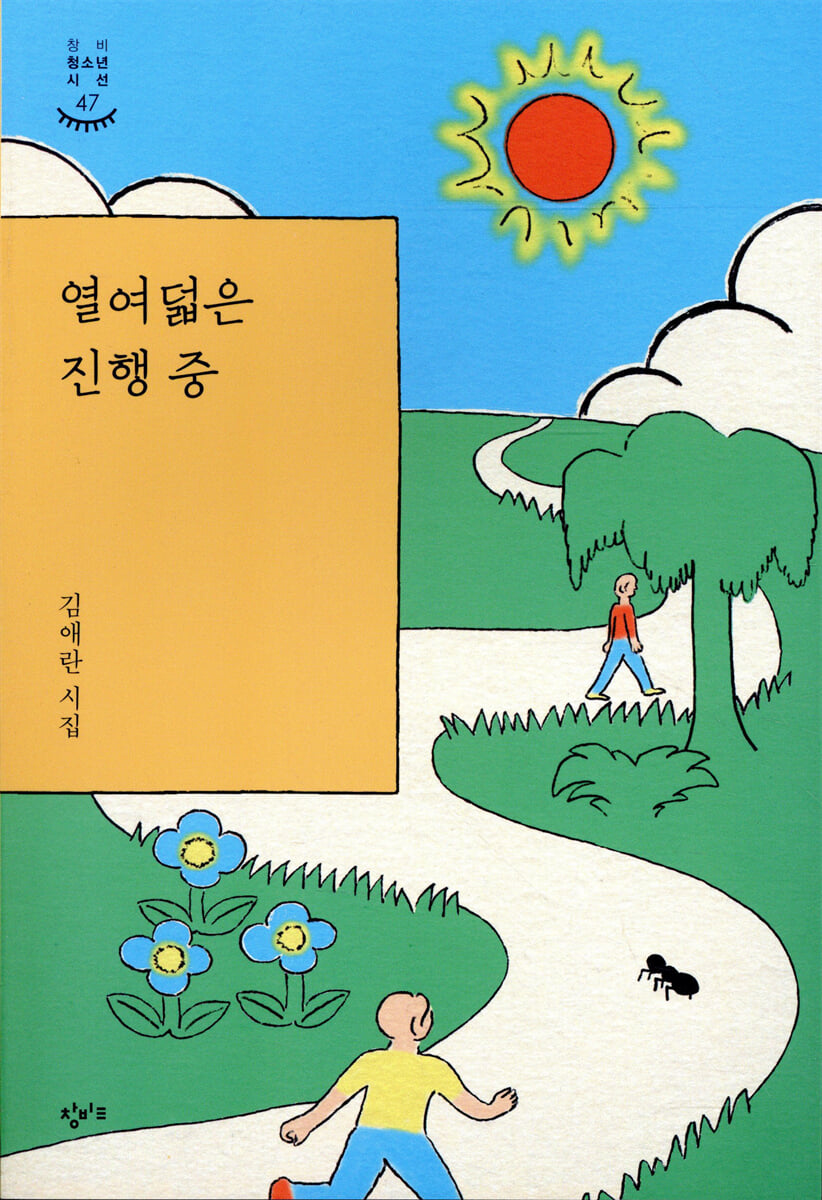
Eighteen is in progress
 |
Description
Book Introduction
You have to become an adult earlier than your peers
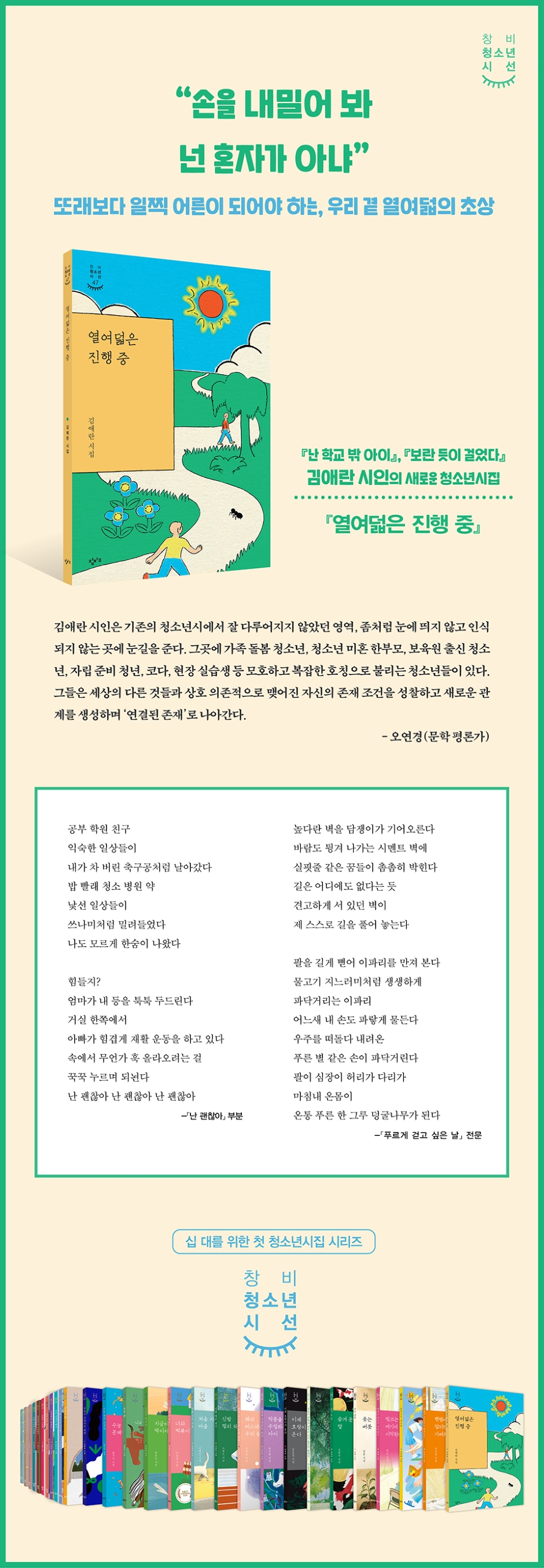
A poetry collection that illuminates the present of our youth.
This book is the 47th poetry collection in the Changbi Youth Poetry Series, and is a new work by poet Kim Ae-ran, who has further expanded the realm of youth poetry by warmly capturing the stories of “youth outside of school” through “I am a child outside of school” (2017) and “I walked proudly” (2019).
This collection of poems captures the lives and voices of eighteen-year-olds, who are called by ambiguous and complex terms such as youth in need of family care, single-parent youth, and youth preparing for independence, in a simple yet vivid manner.
The poet realistically describes the sense of isolation, loss, and anxiety felt by young people who are both objects of care and subjects of care who must care for others, and tells us that they are not the 'others' we only see on the news, but 'neighbors' we must look after.
Furthermore, through the speakers who struggle to survive in harsh realities while always understanding, comforting, and caring for others in the world, we explore the true meaning of growth and send them warm support and encouragement for their future.
Literary critic Oh Yeon-kyung said in this collection of poems, "In a reality where the ties to official care have been severed, we can discover the possibility of alternative forms of care, and even become the subjects of care themselves, discovering their own place and capabilities in this world."
Readers will have the opportunity to recognize those around us who need care while reading "Eighteen in Progress," and to reflect on what it means to grow as adults who care for themselves and those around them.
A poetry collection that illuminates the present of our youth.
This book is the 47th poetry collection in the Changbi Youth Poetry Series, and is a new work by poet Kim Ae-ran, who has further expanded the realm of youth poetry by warmly capturing the stories of “youth outside of school” through “I am a child outside of school” (2017) and “I walked proudly” (2019).
This collection of poems captures the lives and voices of eighteen-year-olds, who are called by ambiguous and complex terms such as youth in need of family care, single-parent youth, and youth preparing for independence, in a simple yet vivid manner.
The poet realistically describes the sense of isolation, loss, and anxiety felt by young people who are both objects of care and subjects of care who must care for others, and tells us that they are not the 'others' we only see on the news, but 'neighbors' we must look after.
Furthermore, through the speakers who struggle to survive in harsh realities while always understanding, comforting, and caring for others in the world, we explore the true meaning of growth and send them warm support and encouragement for their future.
Literary critic Oh Yeon-kyung said in this collection of poems, "In a reality where the ties to official care have been severed, we can discover the possibility of alternative forms of care, and even become the subjects of care themselves, discovering their own place and capabilities in this world."
Readers will have the opportunity to recognize those around us who need care while reading "Eighteen in Progress," and to reflect on what it means to grow as adults who care for themselves and those around them.
- You can preview some of the book's contents.
Preview
index
Part 1: I am a young caregiver
A father with dementia grows flowers.
This isn't it
I'm okay
present progressive tense
peppermint candy
On the way to school
cherry blossoms
How to care for your family
pal
I hate lies
Worry about food
Homeroom teacher
Flowerpot care
Fire lily
Part 2: The Very Pretty Age of Eighteen
thin ice
voice
Voluntary disclosure
warm hands
Baenatjeogori
sprout
Understanding the topic
High school dad
It was like this and that
Another morning
Brave Her
I want to play
I guess so
Thumbs up
Part 3: Eighteen Years Old's First Steps
nail artist
Reading a book
First steps
Talk to Geranium
weeds
Arrow extraction
We do it our way
Let's just walk
Swing ride
Nurungji
Beautiful solidarity
Part 4 I think you might need it too
Mom who gives orders
That woman
Spring Buck
It's nothing
Just pretend not to know
suddenly
aunt
It's not a pity
gossip
empty nest syndrome
See Seolgi
A day when I want to walk green
Sweet
Sending a smiling angel
family
Commentary | Oh Yeon-kyung
Poet's words
A father with dementia grows flowers.
This isn't it
I'm okay
present progressive tense
peppermint candy
On the way to school
cherry blossoms
How to care for your family
pal
I hate lies
Worry about food
Homeroom teacher
Flowerpot care
Fire lily
Part 2: The Very Pretty Age of Eighteen
thin ice
voice
Voluntary disclosure
warm hands
Baenatjeogori
sprout
Understanding the topic
High school dad
It was like this and that
Another morning
Brave Her
I want to play
I guess so
Thumbs up
Part 3: Eighteen Years Old's First Steps
nail artist
Reading a book
First steps
Talk to Geranium
weeds
Arrow extraction
We do it our way
Let's just walk
Swing ride
Nurungji
Beautiful solidarity
Part 4 I think you might need it too
Mom who gives orders
That woman
Spring Buck
It's nothing
Just pretend not to know
suddenly
aunt
It's not a pity
gossip
empty nest syndrome
See Seolgi
A day when I want to walk green
Sweet
Sending a smiling angel
family
Commentary | Oh Yeon-kyung
Poet's words
Detailed image
Publisher's Review
“I am a young caregiver.”
Enduring the harsh reality and bleak future with my whole body
Portraits of our youth
'Young carer' refers to a young person who takes care of family or relatives.
This collection of poems by Kim Ae-ran illuminates the lives and realities of young people living as "eighteen-year-old young caregivers," thrown into the midst of caregiving, where various roles and situations are intertwined.
It will never be easy to become someone's guardian and care for a sick family member at an age when they should still be protected.
Their lives are so harsh that “taking care of a mentally unstable grandmother/is as hard as getting the highest grade in every subject” (“How to Take Care of a Family”), cherry blossoms are likened to “pills that a grandmother has vomited out,” and spring rain is described as “rain like a spider’s web” (“Cherry Blossoms”).
But what is more difficult to bear is the fact that there is no end in sight to the suffering.
“Something is about to rise up inside me/ I’m suppressing it” and repeating “I’m okay, I’m okay, I’m okay” (“I’m okay”), but I feel anxious because “while I have to skip school to take care of my family/ my grades will be a mess/ my relationships with my friends will be a mess” and “ my future might be a mess too” (“On the Way to School”).
Cherry blossoms bloom like pills that my grandmother vomited out
Occasionally, spiderweb-like rain
Even on a spring day when the cherry blossoms fall diagonally
I'm always nervous, like a fly caught in a spider's web.
The sunlight is as faint as my grandmother's breathing
In the small room where the light shines and then quietly runs away
Nursing a grandmother lying on a three-tiered mat
I'm always nervous, like when I work part-time
My mother left, stepping on cherry blossom petals
Even if the cherry blossoms bloom again, I don't know if they will come back
I came back from the factory and lay down, stepping on cherry blossom petals.
Grandma doesn't wake up even when new cherry blossoms bloom
I came back from school stepping on cherry blossom petals
Even though the cherry blossoms were in full bloom, I couldn't go to school.
How many times must the cherry blossoms fall and bloom again?
Will grandma wake up?
Outside, there's a grandmother who says she wants me to die soon.
Cherry blossom petals, like a whimper, scatter in vain.
―Cherry Blossoms section (pages 22-23)
However, the poet does not miss the warm hand that helps them even in this precarious life.
The part-time job owner who “sometimes considers my circumstances” by giving them “a handful of peppermint candy” and saying “Okay, that’s enough, go ahead” (“Peppermint Candy”), the “lady on this floor” who says “Don’t worry, Grandma, just go to school” (“On the Way to School”), and the homeroom teacher (“Homeroom Teacher”) who asks for help from the community center, the Ministry of Welfare, and the Ministry of Education, saying “Students should be able to go to school with peace of mind” and pats them on the shoulder saying “Just a little more” become the hands of hope so that these children do not become isolated from the world.
“This and that, that and this and that.”
The complexities of becoming parents at an early age
The poet also pays close attention to teenagers who have become parents, taking in “one day, suddenly/a life form seventeen years younger than me” (“Sprout”).
Children who have become 'teenage parents' write about the 'real struggles of ups and downs' of 'studying, housework, and childcare' ('Wanting to Play') while feeling anxious and uncertain, thinking, "Are we doing well?" ('Thin Ice'). They pull themselves together and believe that they are 'adapting well to change' ('Voice').
When you go through “school, part-time job, and baby/day after day when you’re out of breath and barely able to breathe,” there are times when you want to give up, but whenever that happens, you imagine your baby growing like a sprout into a beautiful tree, and you gain strength, and you suddenly come to the realization, “Shouldn’t I grow up more/and become a tree or something?” (“Sprout”).
Whether it's a convenience store, a restaurant, or a gas station
If it's hard
On the topic of single mothers
If you say you're going to quit
Even though I didn't even graduate from high school
They scold me for not understanding the topic.
Understanding the topic
He used to bully me when I was in school too
Even now, when I don't go to school
It bothers me
―「Understanding the Topic」 (pp. 50-51)
“We decided to live our own way.”
A bold and powerful voice against prejudice and discrimination
Throughout the collection, we hear the voices of young people who live their lives in the shadow of prejudice and alienation, feeling “like they are in a deep hole” (“Another Morning”), yet live courageously and without fear.
To the boss who often brings up the fact that he is from an orphanage, he says frankly, “I’m not the kind of person who steals money/I quit to find a job that suits my aptitude” (“Weeds”), and to his girlfriend’s parents who ask, “What do your parents do?” he confidently says, “I am from an orphanage” (“Pull Out the Arrow”).
The voice that says, “We saved up our own savings and got a shabby room in the outskirts” and “We decided to just live our own way” (“We, Ourselves”) is trustworthy, and the voice that says, “I am Koda” (“Blurt”) without being ashamed of her hearing-impaired mother is filled with dignity.
Ivy climbs the high wall.
On a cement wall that even the wind bounces off of
Dreams are tightly woven like threads
It seems like there is no road anywhere
The wall that stood firm
I make my own way
Stretch out your arms and touch the leaves.
vivid as a fish fin
fluttering leaves
Before I knew it, my hands were turning blue too.
I came down from wandering through space
Blue star-like hands flap
Arms, heart, waist, legs
Finally my whole body
All of it becomes a single green vine
―Full text of "A Day I Want to Walk Green" (page 110)
“You are not alone”
A poetry collection to support the first steps of all eighteen-year-olds.
This collection of poems is particularly notable for its botanical imagination, which utilizes flowers, buds, trees, and flower pots.
As the saying goes, “Flowers need to be soaked in water to bloom beautifully” (from “A Dad with Dementia Grows Flowers”), caring for and cultivating plants is closely linked to the act of care.
The poet understands other beings in the world through the image of willow trees that “seem to grow apart/while maintaining an appropriate distance/but each has long roots/and are entangled” and discovers children who grow “together/with their intertwined roots/and share water” (“Beautiful Solidarity”).
The 'eighteen' youth, who is one year younger than the legal adult age of nineteen, is now at the starting point of "taking his first steps as an adult" ("Toddler").
To those who are entering adulthood, living a life of responsibility for someone at an age when it is difficult to take care of themselves, the poet encourages them by saying, “Don’t worry, everything will be okay/I’ll cast a spell” (“Mother Who Casts a Spell”), and hopes that they will grow up to be proud and healthy as the protagonists of the future generation.
The willow-leafed maples
On the hot sand of the desert
Grow up strong
Maintaining appropriate spacing
It seems like it's growing apart
Each one has long roots
Not tangled
If someone finds water
With intertwined roots
Sharing water with each other
Let's live together
Reach out your hand
You are not alone
―Excerpt from "Beautiful Solidarity" (page 86)
Enduring the harsh reality and bleak future with my whole body
Portraits of our youth
'Young carer' refers to a young person who takes care of family or relatives.
This collection of poems by Kim Ae-ran illuminates the lives and realities of young people living as "eighteen-year-old young caregivers," thrown into the midst of caregiving, where various roles and situations are intertwined.
It will never be easy to become someone's guardian and care for a sick family member at an age when they should still be protected.
Their lives are so harsh that “taking care of a mentally unstable grandmother/is as hard as getting the highest grade in every subject” (“How to Take Care of a Family”), cherry blossoms are likened to “pills that a grandmother has vomited out,” and spring rain is described as “rain like a spider’s web” (“Cherry Blossoms”).
But what is more difficult to bear is the fact that there is no end in sight to the suffering.
“Something is about to rise up inside me/ I’m suppressing it” and repeating “I’m okay, I’m okay, I’m okay” (“I’m okay”), but I feel anxious because “while I have to skip school to take care of my family/ my grades will be a mess/ my relationships with my friends will be a mess” and “ my future might be a mess too” (“On the Way to School”).
Cherry blossoms bloom like pills that my grandmother vomited out
Occasionally, spiderweb-like rain
Even on a spring day when the cherry blossoms fall diagonally
I'm always nervous, like a fly caught in a spider's web.
The sunlight is as faint as my grandmother's breathing
In the small room where the light shines and then quietly runs away
Nursing a grandmother lying on a three-tiered mat
I'm always nervous, like when I work part-time
My mother left, stepping on cherry blossom petals
Even if the cherry blossoms bloom again, I don't know if they will come back
I came back from the factory and lay down, stepping on cherry blossom petals.
Grandma doesn't wake up even when new cherry blossoms bloom
I came back from school stepping on cherry blossom petals
Even though the cherry blossoms were in full bloom, I couldn't go to school.
How many times must the cherry blossoms fall and bloom again?
Will grandma wake up?
Outside, there's a grandmother who says she wants me to die soon.
Cherry blossom petals, like a whimper, scatter in vain.
―Cherry Blossoms section (pages 22-23)
However, the poet does not miss the warm hand that helps them even in this precarious life.
The part-time job owner who “sometimes considers my circumstances” by giving them “a handful of peppermint candy” and saying “Okay, that’s enough, go ahead” (“Peppermint Candy”), the “lady on this floor” who says “Don’t worry, Grandma, just go to school” (“On the Way to School”), and the homeroom teacher (“Homeroom Teacher”) who asks for help from the community center, the Ministry of Welfare, and the Ministry of Education, saying “Students should be able to go to school with peace of mind” and pats them on the shoulder saying “Just a little more” become the hands of hope so that these children do not become isolated from the world.
“This and that, that and this and that.”
The complexities of becoming parents at an early age
The poet also pays close attention to teenagers who have become parents, taking in “one day, suddenly/a life form seventeen years younger than me” (“Sprout”).
Children who have become 'teenage parents' write about the 'real struggles of ups and downs' of 'studying, housework, and childcare' ('Wanting to Play') while feeling anxious and uncertain, thinking, "Are we doing well?" ('Thin Ice'). They pull themselves together and believe that they are 'adapting well to change' ('Voice').
When you go through “school, part-time job, and baby/day after day when you’re out of breath and barely able to breathe,” there are times when you want to give up, but whenever that happens, you imagine your baby growing like a sprout into a beautiful tree, and you gain strength, and you suddenly come to the realization, “Shouldn’t I grow up more/and become a tree or something?” (“Sprout”).
Whether it's a convenience store, a restaurant, or a gas station
If it's hard
On the topic of single mothers
If you say you're going to quit
Even though I didn't even graduate from high school
They scold me for not understanding the topic.
Understanding the topic
He used to bully me when I was in school too
Even now, when I don't go to school
It bothers me
―「Understanding the Topic」 (pp. 50-51)
“We decided to live our own way.”
A bold and powerful voice against prejudice and discrimination
Throughout the collection, we hear the voices of young people who live their lives in the shadow of prejudice and alienation, feeling “like they are in a deep hole” (“Another Morning”), yet live courageously and without fear.
To the boss who often brings up the fact that he is from an orphanage, he says frankly, “I’m not the kind of person who steals money/I quit to find a job that suits my aptitude” (“Weeds”), and to his girlfriend’s parents who ask, “What do your parents do?” he confidently says, “I am from an orphanage” (“Pull Out the Arrow”).
The voice that says, “We saved up our own savings and got a shabby room in the outskirts” and “We decided to just live our own way” (“We, Ourselves”) is trustworthy, and the voice that says, “I am Koda” (“Blurt”) without being ashamed of her hearing-impaired mother is filled with dignity.
Ivy climbs the high wall.
On a cement wall that even the wind bounces off of
Dreams are tightly woven like threads
It seems like there is no road anywhere
The wall that stood firm
I make my own way
Stretch out your arms and touch the leaves.
vivid as a fish fin
fluttering leaves
Before I knew it, my hands were turning blue too.
I came down from wandering through space
Blue star-like hands flap
Arms, heart, waist, legs
Finally my whole body
All of it becomes a single green vine
―Full text of "A Day I Want to Walk Green" (page 110)
“You are not alone”
A poetry collection to support the first steps of all eighteen-year-olds.
This collection of poems is particularly notable for its botanical imagination, which utilizes flowers, buds, trees, and flower pots.
As the saying goes, “Flowers need to be soaked in water to bloom beautifully” (from “A Dad with Dementia Grows Flowers”), caring for and cultivating plants is closely linked to the act of care.
The poet understands other beings in the world through the image of willow trees that “seem to grow apart/while maintaining an appropriate distance/but each has long roots/and are entangled” and discovers children who grow “together/with their intertwined roots/and share water” (“Beautiful Solidarity”).
The 'eighteen' youth, who is one year younger than the legal adult age of nineteen, is now at the starting point of "taking his first steps as an adult" ("Toddler").
To those who are entering adulthood, living a life of responsibility for someone at an age when it is difficult to take care of themselves, the poet encourages them by saying, “Don’t worry, everything will be okay/I’ll cast a spell” (“Mother Who Casts a Spell”), and hopes that they will grow up to be proud and healthy as the protagonists of the future generation.
The willow-leafed maples
On the hot sand of the desert
Grow up strong
Maintaining appropriate spacing
It seems like it's growing apart
Each one has long roots
Not tangled
If someone finds water
With intertwined roots
Sharing water with each other
Let's live together
Reach out your hand
You are not alone
―Excerpt from "Beautiful Solidarity" (page 86)
GOODS SPECIFICS
- Date of issue: May 27, 2024
- Page count, weight, size: 136 pages | 145*210*20mm
- ISBN13: 9791165702533
- ISBN10: 1165702533
You may also like
카테고리
korean


korean

![GQ KOREA Mark (Monthly): December [2025]](http://librairie.coreenne.fr/cdn/shop/files/8ef265dbbfbf186523ed75ba7319009d.jpg?v=1765340328&width=3840)


