

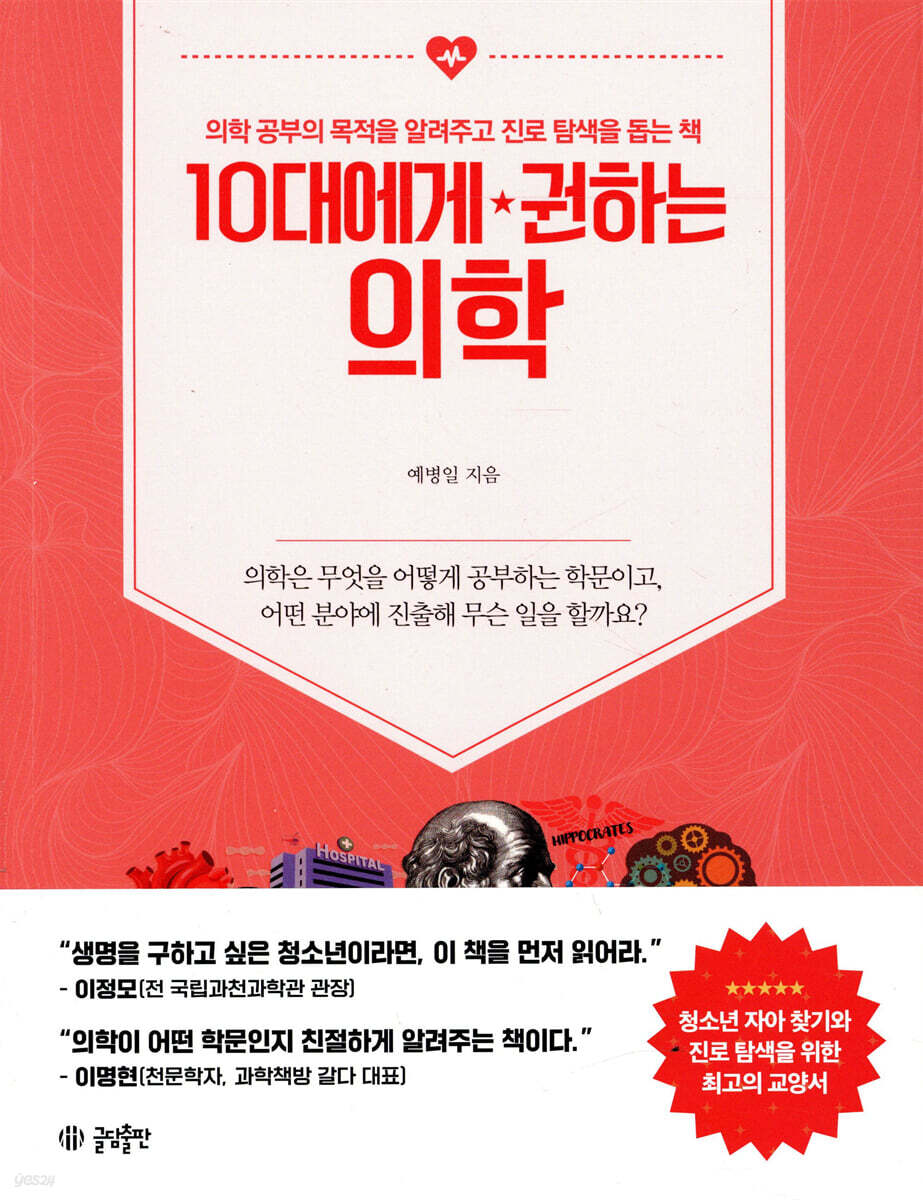
Medicine recommended for teenagers
 |
Description
Book Introduction
What and how can I learn and what can I do in the future if I major in medicine?
A must-read for young people who want to know if their academic interests are a good fit for them!
"If you're a young person who wants to save lives, read this book first." _Lee Jeong-mo (former director of the National Science Museum in Gwacheon)
"This book provides a friendly overview of what science is all about." _Lee Myeong-hyeon (astronomer, owner of Galda Science Bookstore)
"Medicine Recommended for Teenagers" is the tenth book in the "Medicine Recommended for Teenagers" series, which aims to help teenagers find themselves and explore their career paths.
Professor Ye Byeong-il, who has been working hard to cultivate talent as a professor of medical education at Yonsei University Wonju College of Medicine, has included all stories about medicine, including what medicine is, how medicine has developed and played a role in human history, how it will change society in the future, and what fields you can enter and what kind of work you can do if you study medicine.
Although medical school graduates can work in a variety of health care fields, many students pursue medical school primarily with the goal of becoming doctors who care for patients.
To enter medical school, one must first overcome fierce competition among top-tier universities, obtain a medical license, complete a six-year medical school curriculum and pass the national medical licensing exam, and become a specialist, complete another four years of residency training.
Because it requires such a long and arduous process, it is not an easy job to choose without a sense of mission.
This book will help young people who dream of becoming medical students decide on a career path by explaining the impact and value of medicine on society and what medicine can do. It will also guide young people who want to explore various academic fields to explore the boundless and exciting world of medicine.
A must-read for young people who want to know if their academic interests are a good fit for them!
"If you're a young person who wants to save lives, read this book first." _Lee Jeong-mo (former director of the National Science Museum in Gwacheon)
"This book provides a friendly overview of what science is all about." _Lee Myeong-hyeon (astronomer, owner of Galda Science Bookstore)
"Medicine Recommended for Teenagers" is the tenth book in the "Medicine Recommended for Teenagers" series, which aims to help teenagers find themselves and explore their career paths.
Professor Ye Byeong-il, who has been working hard to cultivate talent as a professor of medical education at Yonsei University Wonju College of Medicine, has included all stories about medicine, including what medicine is, how medicine has developed and played a role in human history, how it will change society in the future, and what fields you can enter and what kind of work you can do if you study medicine.
Although medical school graduates can work in a variety of health care fields, many students pursue medical school primarily with the goal of becoming doctors who care for patients.
To enter medical school, one must first overcome fierce competition among top-tier universities, obtain a medical license, complete a six-year medical school curriculum and pass the national medical licensing exam, and become a specialist, complete another four years of residency training.
Because it requires such a long and arduous process, it is not an easy job to choose without a sense of mission.
This book will help young people who dream of becoming medical students decide on a career path by explaining the impact and value of medicine on society and what medicine can do. It will also guide young people who want to explore various academic fields to explore the boundless and exciting world of medicine.
- You can preview some of the book's contents.
Preview
index
CHAPTER 01.
What is medicine?
01.
The birth of a doctor who cures diseases
02.
The emergence of concentration camps and hospitals
03.
The Birth of Science-Based Medical Education
04.
From Disease Treatment to Health Care: The Role of Doctors and Hospitals
05.
Why Humanities Are Emphasized in Medicine
Even in the primitive age, surgery was performed.
CHAPTER 02.
What people and events brought about groundbreaking medical advancements?
01.
People who led modern medicine in the 16th century
02.
The stethoscope, the first diagnostic device that enabled objective diagnosis
03.
The first chemotherapy drug developed to treat syphilis
04.
Enzyme-linked immunosorbent assay for diagnosing diseases with a single drop of blood
05.
Polymerase chain reaction, which finds genetic information from a single drop of blood
Think Plus+ Why aren't there any vaccines or specific medications for the common cold?
CHAPTER 03.
How can medicine be used in our lives?
01.
How did the drugs used to treat diseases evolve?
02.
How have doctors' surgical techniques evolved?
03.
Development of vaccines to prevent infectious diseases
04.
Finding the culprit using forensics
05.
Sports medicine that maximizes athletic performance
Can mental illness be cured with medicine?
CHAPTER 04.
How will medicine change in the future?
01.
3D printing could enable organ cloning
02.
Regenerative medicine to restore damaged body functions
03.
Ubiquitous healthcare using information and communication technology
04.
Medical AI to improve clinical capabilities
05.
Telemedicine and telemedicine that overcome the limitations of space and time
06.
Decoding the human genome and personalized medicine
Think Plus + Bionic Humans are Coming
CHAPTER 05.
What can I do if I study medicine?
01.
A clinician who directly cares for patients
02.
Basic medical researcher pursuing cutting-edge medical knowledge
03.
Civil servants and public corporations that formulate and implement medical policies
04.
The pharmaceutical industry is growing bigger and bigger
05.
Unconventional occupations that require medical knowledge
Think Plus+ Why doesn't our country have a family doctor system?
What is medicine?
01.
The birth of a doctor who cures diseases
02.
The emergence of concentration camps and hospitals
03.
The Birth of Science-Based Medical Education
04.
From Disease Treatment to Health Care: The Role of Doctors and Hospitals
05.
Why Humanities Are Emphasized in Medicine
Even in the primitive age, surgery was performed.
CHAPTER 02.
What people and events brought about groundbreaking medical advancements?
01.
People who led modern medicine in the 16th century
02.
The stethoscope, the first diagnostic device that enabled objective diagnosis
03.
The first chemotherapy drug developed to treat syphilis
04.
Enzyme-linked immunosorbent assay for diagnosing diseases with a single drop of blood
05.
Polymerase chain reaction, which finds genetic information from a single drop of blood
Think Plus+ Why aren't there any vaccines or specific medications for the common cold?
CHAPTER 03.
How can medicine be used in our lives?
01.
How did the drugs used to treat diseases evolve?
02.
How have doctors' surgical techniques evolved?
03.
Development of vaccines to prevent infectious diseases
04.
Finding the culprit using forensics
05.
Sports medicine that maximizes athletic performance
Can mental illness be cured with medicine?
CHAPTER 04.
How will medicine change in the future?
01.
3D printing could enable organ cloning
02.
Regenerative medicine to restore damaged body functions
03.
Ubiquitous healthcare using information and communication technology
04.
Medical AI to improve clinical capabilities
05.
Telemedicine and telemedicine that overcome the limitations of space and time
06.
Decoding the human genome and personalized medicine
Think Plus + Bionic Humans are Coming
CHAPTER 05.
What can I do if I study medicine?
01.
A clinician who directly cares for patients
02.
Basic medical researcher pursuing cutting-edge medical knowledge
03.
Civil servants and public corporations that formulate and implement medical policies
04.
The pharmaceutical industry is growing bigger and bigger
05.
Unconventional occupations that require medical knowledge
Think Plus+ Why doesn't our country have a family doctor system?
Detailed image

Into the book
“The reason Hippocrates is called the ‘father of medicine’ today is because he brought medicine from the realm of the gods to the realm of humans.
Before Hippocrates came to be known, there was little knowledge about disease, so people had no choice but to ask the gods for help.
Because they thought that illness was a punishment from God.
So, by building a temple and staying there, purifying one's body and mind, and concentrating one's mind in prayer, it must have had a real healing effect.”
--- p.17
“The French Revolution made health care available to all citizens.
This transformed the hospital, which had previously served only as a detention center for social outcasts, into a place where ordinary citizens could receive treatment.
“Thus, the French Revolution marked the transition from the era of ‘bedside medicine’ to the era of ‘hospital medicine.’”
--- p.30
“It is often said that ‘medicine is a science,’ but this is not a correct expression.
'Medicine is a discipline that has developed significantly through the use of scientific methods, and because it deals with people, it should be viewed as a discipline that requires a liberal arts background.'
Therefore, medicine requires scientific, sociological, and humanistic thinking.”
--- p.55
"In a time before stethoscopes, how did anyone first hear the sounds of the chest? In 1819, Laennec, the inventor of the stethoscope, published a book detailing the history of the stethoscope.
According to the book, on September 4, 1816, a plump female patient came to see him, and in a fit of spur-of-the-moment ingenuity, he rolled up a piece of paper, placed one end against the woman's chest, and held the other end to his ear.
However, the sound was better than expected, so efforts were made to create an instrument that could better hear the sounds coming from the chest, which led to the invention of the stethoscope.”
--- p.79
“The hospital where Semmelweis worked had delivery rooms in two wards.
However, we found that the maternal mortality rate was much lower in delivery rooms staffed by midwives than in delivery rooms staffed by doctors.
While looking for the reason, they noticed that doctors would touch dead bodies or patients with infectious diseases and then go into the delivery room without doing anything, but midwives would wash their hands thoroughly.
So when we made doctors wash their equipment and hands when they entered the delivery room, the mortality rate from puerperal fever dropped significantly.”
--- p.130
Advances in body transplant surgery in the 20th century confirmed the theory that body parts can produce new cells and grow.
From this point on, the field of tissue engineering began to develop, and naturally, regenerative medicine became an important element in tissue engineering.
Research on stem cells that can differentiate into various cell types is essential for regenerating cells, tissues, and organs.
Before Hippocrates came to be known, there was little knowledge about disease, so people had no choice but to ask the gods for help.
Because they thought that illness was a punishment from God.
So, by building a temple and staying there, purifying one's body and mind, and concentrating one's mind in prayer, it must have had a real healing effect.”
--- p.17
“The French Revolution made health care available to all citizens.
This transformed the hospital, which had previously served only as a detention center for social outcasts, into a place where ordinary citizens could receive treatment.
“Thus, the French Revolution marked the transition from the era of ‘bedside medicine’ to the era of ‘hospital medicine.’”
--- p.30
“It is often said that ‘medicine is a science,’ but this is not a correct expression.
'Medicine is a discipline that has developed significantly through the use of scientific methods, and because it deals with people, it should be viewed as a discipline that requires a liberal arts background.'
Therefore, medicine requires scientific, sociological, and humanistic thinking.”
--- p.55
"In a time before stethoscopes, how did anyone first hear the sounds of the chest? In 1819, Laennec, the inventor of the stethoscope, published a book detailing the history of the stethoscope.
According to the book, on September 4, 1816, a plump female patient came to see him, and in a fit of spur-of-the-moment ingenuity, he rolled up a piece of paper, placed one end against the woman's chest, and held the other end to his ear.
However, the sound was better than expected, so efforts were made to create an instrument that could better hear the sounds coming from the chest, which led to the invention of the stethoscope.”
--- p.79
“The hospital where Semmelweis worked had delivery rooms in two wards.
However, we found that the maternal mortality rate was much lower in delivery rooms staffed by midwives than in delivery rooms staffed by doctors.
While looking for the reason, they noticed that doctors would touch dead bodies or patients with infectious diseases and then go into the delivery room without doing anything, but midwives would wash their hands thoroughly.
So when we made doctors wash their equipment and hands when they entered the delivery room, the mortality rate from puerperal fever dropped significantly.”
--- p.130
Advances in body transplant surgery in the 20th century confirmed the theory that body parts can produce new cells and grow.
From this point on, the field of tissue engineering began to develop, and naturally, regenerative medicine became an important element in tissue engineering.
Research on stem cells that can differentiate into various cell types is essential for regenerating cells, tissues, and organs.
--- p.182
Publisher's Review
Medicine is a discipline that studies what and how,
What field and what kind of work can I do if I major in medicine?
One of the most competitive fields for admission to top universities in Korea is medical school.
This may be because the perception is that being a doctor is a stable and socially recognized profession.
However, even if you manage to get into medical school, it is not the end. You must train for a long time, gain experience, and pass a qualification exam to become a doctor. Even after becoming a doctor, you must continue to study and refine yourself.
Because it is such a long and arduous process, it is not an easy path to take on without a professional calling.
So, before choosing a career in medicine, wouldn't it be beneficial for young people to explore what medicine truly is, what it encompasses, and what contributions it can make to society? "Medicine for Teenagers" introduces the exciting world of medicine to young people who dream of becoming medical students or harbor a vague curiosity about it.
Professor Ye Byeong-il, who has been working hard to cultivate talent while serving as a professor of medical education at Yonsei University Wonju College of Medicine, will guide readers through various places inside and outside the medical school.
Professor Ye Byeong-il, who has been working hard to cultivate talent for a long time at Yonsei University Wonju College of Medicine,
To teach young people who dream of studying medicine the true value and utility of medicine.
This book comprehensively introduces medicine from ancient times, when the concepts of doctors and hospitals did not even exist, to the future of regenerative medicine and ubiquitous healthcare.
By doing so, we look back on the role and value of medicine by examining how humans have developed medicine and what impact medicine has had on human life.
In particular, the stories of medical technologies and people who have made great strides in the advancement of medicine, such as Vesalius, the father of anatomy introduced in Part 2; John Snow, the father of public health who emphasized the importance of drinking water; Semmelweis, who discovered the importance of hand washing for doctors; Jenner, who developed the smallpox vaccine; as well as the stethoscope, the first diagnostic device; the enzyme immunoassay method that diagnoses various diseases with a single drop of blood; and the polymerase chain reaction (PCR), known as the coronavirus test during the COVID-19 pandemic, will allow readers of this book to once again think about the importance, role, and sense of mission of the advancement of medicine.
Readers interested in medicine will also find the future medical technologies discussed in Part 4 fascinating.
We introduce organ cloning using 3D printing, regenerative medicine (stem cells) that restores damaged bodily functions, ubiquitous healthcare using information and communication technology, and medical artificial intelligence that helps improve clinical capabilities.
Cutting-edge technologies once only seen in novels and movies are already being used in various medical settings, confirming that medical advancements are reaching another level.
In line with the desire of modern people to live a healthy and youthful life beyond just living a long life,
The diverse and expanding roles of medicine are becoming increasingly important.
In 2022, the life expectancy of Koreans was recorded at 82.7 years.
In 1960, the average life expectancy was about 52 years, but it increased rapidly due to advancements in medical technology and economic development.
As a result, it is becoming more important to live longer, stay healthy, and stay younger without getting sick.
Accordingly, the role of medicine is expanding beyond treating the sick to preventing and managing illness before it occurs. To this end, people working in various fields, including clinical physicians who directly care for patients, basic medical researchers, pharmaceutical companies, and health care officials, are working together.
Professor Ye Byeong-il, the author, says, “Medicine is a discipline that studies how the human body is made and finds ways to maintain health.”
In doing so, he defined medicine as “a role that helps people by utilizing the knowledge gained through hard study by people who are curious about our bodies,” and in addition to directly treating patients, it can be used in forensic medicine, sports medicine, and new drug development, and people can also work as medical journalists, medical statisticians, and humanities and social medicine specialists, introducing fields that people with medical knowledge can advance into in the last chapter of this book.
This book will serve as a friendly and detailed career guide for young people interested in medicine, helping them decide on their own path and determine their direction by explaining how medicine can impact people's lives and change society, as well as the various fields and roles that medicine can play.
What field and what kind of work can I do if I major in medicine?
One of the most competitive fields for admission to top universities in Korea is medical school.
This may be because the perception is that being a doctor is a stable and socially recognized profession.
However, even if you manage to get into medical school, it is not the end. You must train for a long time, gain experience, and pass a qualification exam to become a doctor. Even after becoming a doctor, you must continue to study and refine yourself.
Because it is such a long and arduous process, it is not an easy path to take on without a professional calling.
So, before choosing a career in medicine, wouldn't it be beneficial for young people to explore what medicine truly is, what it encompasses, and what contributions it can make to society? "Medicine for Teenagers" introduces the exciting world of medicine to young people who dream of becoming medical students or harbor a vague curiosity about it.
Professor Ye Byeong-il, who has been working hard to cultivate talent while serving as a professor of medical education at Yonsei University Wonju College of Medicine, will guide readers through various places inside and outside the medical school.
Professor Ye Byeong-il, who has been working hard to cultivate talent for a long time at Yonsei University Wonju College of Medicine,
To teach young people who dream of studying medicine the true value and utility of medicine.
This book comprehensively introduces medicine from ancient times, when the concepts of doctors and hospitals did not even exist, to the future of regenerative medicine and ubiquitous healthcare.
By doing so, we look back on the role and value of medicine by examining how humans have developed medicine and what impact medicine has had on human life.
In particular, the stories of medical technologies and people who have made great strides in the advancement of medicine, such as Vesalius, the father of anatomy introduced in Part 2; John Snow, the father of public health who emphasized the importance of drinking water; Semmelweis, who discovered the importance of hand washing for doctors; Jenner, who developed the smallpox vaccine; as well as the stethoscope, the first diagnostic device; the enzyme immunoassay method that diagnoses various diseases with a single drop of blood; and the polymerase chain reaction (PCR), known as the coronavirus test during the COVID-19 pandemic, will allow readers of this book to once again think about the importance, role, and sense of mission of the advancement of medicine.
Readers interested in medicine will also find the future medical technologies discussed in Part 4 fascinating.
We introduce organ cloning using 3D printing, regenerative medicine (stem cells) that restores damaged bodily functions, ubiquitous healthcare using information and communication technology, and medical artificial intelligence that helps improve clinical capabilities.
Cutting-edge technologies once only seen in novels and movies are already being used in various medical settings, confirming that medical advancements are reaching another level.
In line with the desire of modern people to live a healthy and youthful life beyond just living a long life,
The diverse and expanding roles of medicine are becoming increasingly important.
In 2022, the life expectancy of Koreans was recorded at 82.7 years.
In 1960, the average life expectancy was about 52 years, but it increased rapidly due to advancements in medical technology and economic development.
As a result, it is becoming more important to live longer, stay healthy, and stay younger without getting sick.
Accordingly, the role of medicine is expanding beyond treating the sick to preventing and managing illness before it occurs. To this end, people working in various fields, including clinical physicians who directly care for patients, basic medical researchers, pharmaceutical companies, and health care officials, are working together.
Professor Ye Byeong-il, the author, says, “Medicine is a discipline that studies how the human body is made and finds ways to maintain health.”
In doing so, he defined medicine as “a role that helps people by utilizing the knowledge gained through hard study by people who are curious about our bodies,” and in addition to directly treating patients, it can be used in forensic medicine, sports medicine, and new drug development, and people can also work as medical journalists, medical statisticians, and humanities and social medicine specialists, introducing fields that people with medical knowledge can advance into in the last chapter of this book.
This book will serve as a friendly and detailed career guide for young people interested in medicine, helping them decide on their own path and determine their direction by explaining how medicine can impact people's lives and change society, as well as the various fields and roles that medicine can play.
GOODS SPECIFICS
- Date of issue: May 7, 2024
- Page count, weight, size: 252 pages | 494g | 170*220*16mm
- ISBN13: 9791191309638
- ISBN10: 1191309630
You may also like
카테고리
korean


korean

![GQ KOREA Mark (Monthly): December [2025]](http://librairie.coreenne.fr/cdn/shop/files/8ef265dbbfbf186523ed75ba7319009d.jpg?v=1765340328&width=3840)


