

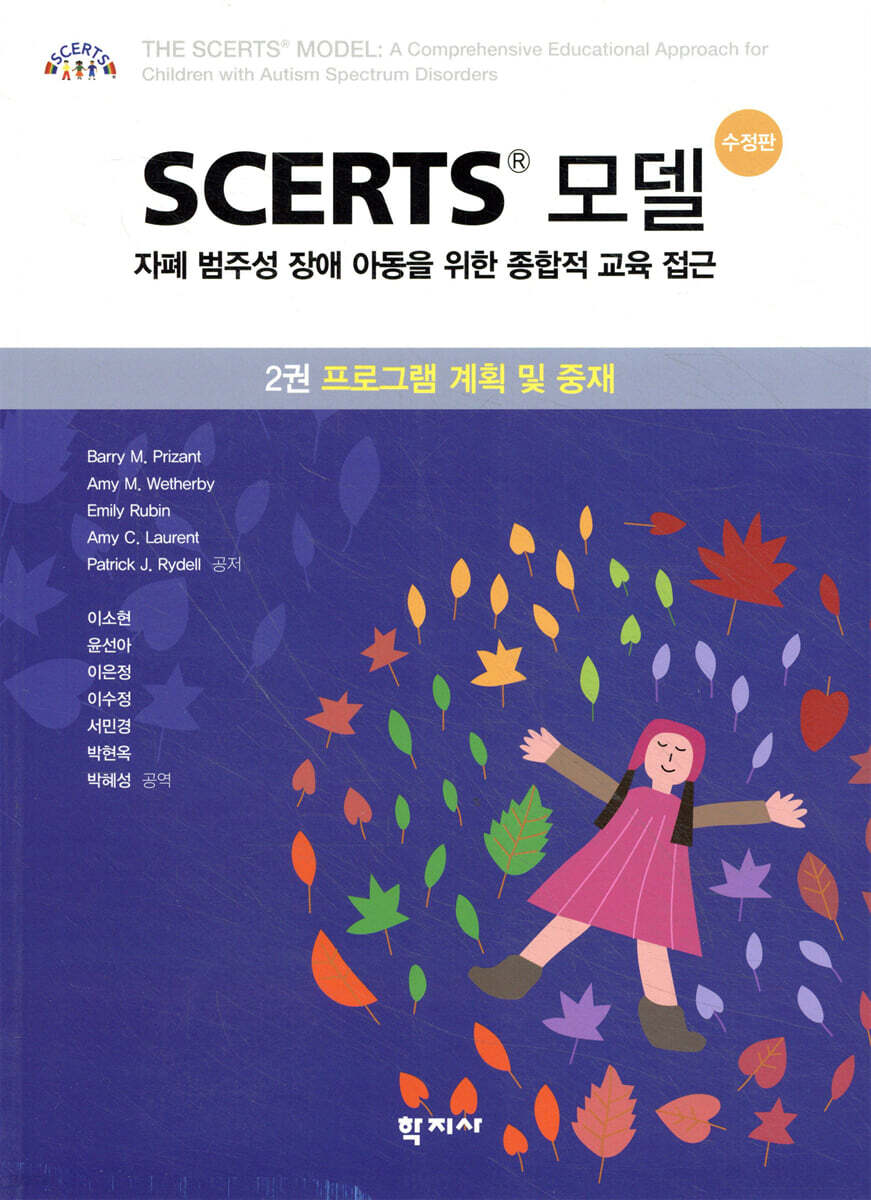
SCERTS Model Volume 2 Program Planning and Intervention
 |
Description
Book Introduction
The SCERTS model provides a framework for improving communication and social-emotional skills across the lifespan of children with autism spectrum disorders through a groundbreaking, comprehensive approach that is developmentally, relationship-centered, and skill-focused.
Developed through over 20 years of research by world-renowned experts, it supports developmental progress in three areas: Social Communication, Emotional Regulation, and Transactional Support.
The name 'SCERTS' is also derived from the initials of the English words presented above.
Developed through over 20 years of research by world-renowned experts, it supports developmental progress in three areas: Social Communication, Emotional Regulation, and Transactional Support.
The name 'SCERTS' is also derived from the initials of the English words presented above.
index
Chapter 1: SCERTS Model Education in Practice I: Core Values and Fundamentals, Application Guidelines, Goal Setting, and Exchange Support
1. What is the SCERTS model?
2.
Book Introduction
3. Core values and key principles of the SCERTS model
4. Seven Guidelines for Applying the SCERTS Model to Educating Children with ASD
5.
Determining Teaching Goals for Children
1) Supporting social communication, emotional regulation, and interaction: The basis for determining and prioritizing teaching objectives in the SCERTS model.
2) What is learning?
3) How are teaching objectives for children selected and determined?
4) In what situations should teaching objectives be addressed?
5) Multiple teaching objectives can be addressed during the activity.
6.
Exchange Support for Learning: Learning Context
1) General guidelines for activity design
2) MA & PA approaches for selecting and designing learning activities
3) Guidelines for carrying out activities
4) Criteria for defining MA & PA approaches
Chapter 2. Practice of SCERTS Model Education II.
Interaction support: interpersonal support, learning support, learning and play with peers
1.
Teaching Strategies
2.
The Role of Adult Partners
3.
Interpersonal Support: Interpersonal Support
1) The partner is responsive to the child.
2) The partner facilitates the initiating action.
3) Partners respect the child's independence.
4) Partners provide a platform for participation.
5) Partners support development.
6) Partners moderate their language use.
7) Partner models appropriate behavior.
8) 〈Summary〉 Exchange Support: Interpersonal Relationship Support
4.
Exchange Support: Learning Support
1) Partners structure activities to encourage active participation.
2) Partners use augmentative communication support to facilitate development.
3) Partners use visual and organizational support.
4) Partners modify goals, activities, and learning environments.
5) 〈Summary〉 Exchange Support: Learning Support
5.
Successful integration and learning and play with peers
1) Essential components of a program for successful integration
2) Implement activities that include learning and playing with peers.
6.
Summary _ 87
Chapter 3: Exchange Support: Family Support and Interprofessional Support
1.
Family support
1) Characteristics of the SCERTS Family Support Plan
2) Core difficulties requiring family support
3) Education and emotional support appropriate to the family's developmental stage
2. Principles of Family Support Implementation in the SCERTS Model
1) The practice of diagnosis for family support used in the SCERTS model
2) Working with families to support development
3.
Expert support
1) Challenges faced by professionals and other service providers
2) Education support
3) Emotional support
4.
summation
Chapter 4: Linking Goals: Linking Goals of Interaction Support with Social Communication and Emotional Regulation Goals
1.
The Importance of Addressing Child and Partner Goals
1) Transactional nature of developmental difficulties
2) Factors that determine a child's progress or lack of progress
2.
Identifying communication support goals and linking them to social communication and emotional regulation goals
3.
Determining the goals of support for exchange at each developmental stage
4.
Social Partner Stage
1) Social communication: common interest
2) Social communication: use of symbols
3) Emotional regulation: reciprocal regulation
4) Emotional regulation: self-regulation
5.
Language Partner Stage
1) Social communication: common interest
2) Social communication: use of symbols
3) Emotional regulation: reciprocal regulation
4) Emotional regulation: self-regulation
6.
Conversation Partner Stage
1) Social communication: common interest
2) Social communication: use of symbols
3) Emotional regulation: reciprocal regulation
4) Emotional regulation: self-regulation
Chapter 5: Strengthening Social Communication, Emotional Regulation, and Interaction Support at the Social Partner Stage: From Diagnosis to Program Implementation
1.
Prioritizing shared interest goals at the social partner level
2.
Prioritizing Symbolic Use Goals at the Social Partner Level
3.
Prioritizing mutual adjustment-related goals at the social partner level
4.
Prioritizing Self-Regulation Goals at the Social Partner Stage
5.
Prioritizing interpersonal support goals at the social partner level
6.
Prioritizing learning support goals at the social partner level
Chapter 6: Strengthening Social Communication, Emotional Regulation, and Interaction Support at the Language Partner Stage: From Diagnosis to Program Implementation
1.
Prioritizing shared interest goals at the language partner stage
2.
Prioritizing Symbol Use Goals at the Language Partner Stage
3.
Prioritizing Interregulation-Related Goals at the Language Partner Stage
4.
Prioritizing Self-Regulation Goals at the Language Partner Stage
5.
Prioritizing interpersonal support goals at the language partner stage
6.
Prioritizing Learning Support Goals at the Language Partner Stage
Chapter 7: Strengthening Social Communication, Emotional Regulation, and Interaction Support at the Conversation Partner Stage: From Diagnosis to Program Implementation
1.
Prioritizing shared interest goals at the conversation partner stage
2.
Prioritizing Symbol-Related Goals at the Conversation Partner Stage
3.
Prioritizing goals related to mutual adjustment at the conversation partner stage
4.
Prioritizing Self-Regulation Goals at the Conversation Partner Stage
5.
Prioritizing interpersonal support goals at the conversation partner stage
6.
Prioritizing Learning Support Goals at the Conversation Partner Stage
Appendix SCERT Diagnostics - Qualitative Indicators _ 589
1. What is the SCERTS model?
2.
Book Introduction
3. Core values and key principles of the SCERTS model
4. Seven Guidelines for Applying the SCERTS Model to Educating Children with ASD
5.
Determining Teaching Goals for Children
1) Supporting social communication, emotional regulation, and interaction: The basis for determining and prioritizing teaching objectives in the SCERTS model.
2) What is learning?
3) How are teaching objectives for children selected and determined?
4) In what situations should teaching objectives be addressed?
5) Multiple teaching objectives can be addressed during the activity.
6.
Exchange Support for Learning: Learning Context
1) General guidelines for activity design
2) MA & PA approaches for selecting and designing learning activities
3) Guidelines for carrying out activities
4) Criteria for defining MA & PA approaches
Chapter 2. Practice of SCERTS Model Education II.
Interaction support: interpersonal support, learning support, learning and play with peers
1.
Teaching Strategies
2.
The Role of Adult Partners
3.
Interpersonal Support: Interpersonal Support
1) The partner is responsive to the child.
2) The partner facilitates the initiating action.
3) Partners respect the child's independence.
4) Partners provide a platform for participation.
5) Partners support development.
6) Partners moderate their language use.
7) Partner models appropriate behavior.
8) 〈Summary〉 Exchange Support: Interpersonal Relationship Support
4.
Exchange Support: Learning Support
1) Partners structure activities to encourage active participation.
2) Partners use augmentative communication support to facilitate development.
3) Partners use visual and organizational support.
4) Partners modify goals, activities, and learning environments.
5) 〈Summary〉 Exchange Support: Learning Support
5.
Successful integration and learning and play with peers
1) Essential components of a program for successful integration
2) Implement activities that include learning and playing with peers.
6.
Summary _ 87
Chapter 3: Exchange Support: Family Support and Interprofessional Support
1.
Family support
1) Characteristics of the SCERTS Family Support Plan
2) Core difficulties requiring family support
3) Education and emotional support appropriate to the family's developmental stage
2. Principles of Family Support Implementation in the SCERTS Model
1) The practice of diagnosis for family support used in the SCERTS model
2) Working with families to support development
3.
Expert support
1) Challenges faced by professionals and other service providers
2) Education support
3) Emotional support
4.
summation
Chapter 4: Linking Goals: Linking Goals of Interaction Support with Social Communication and Emotional Regulation Goals
1.
The Importance of Addressing Child and Partner Goals
1) Transactional nature of developmental difficulties
2) Factors that determine a child's progress or lack of progress
2.
Identifying communication support goals and linking them to social communication and emotional regulation goals
3.
Determining the goals of support for exchange at each developmental stage
4.
Social Partner Stage
1) Social communication: common interest
2) Social communication: use of symbols
3) Emotional regulation: reciprocal regulation
4) Emotional regulation: self-regulation
5.
Language Partner Stage
1) Social communication: common interest
2) Social communication: use of symbols
3) Emotional regulation: reciprocal regulation
4) Emotional regulation: self-regulation
6.
Conversation Partner Stage
1) Social communication: common interest
2) Social communication: use of symbols
3) Emotional regulation: reciprocal regulation
4) Emotional regulation: self-regulation
Chapter 5: Strengthening Social Communication, Emotional Regulation, and Interaction Support at the Social Partner Stage: From Diagnosis to Program Implementation
1.
Prioritizing shared interest goals at the social partner level
2.
Prioritizing Symbolic Use Goals at the Social Partner Level
3.
Prioritizing mutual adjustment-related goals at the social partner level
4.
Prioritizing Self-Regulation Goals at the Social Partner Stage
5.
Prioritizing interpersonal support goals at the social partner level
6.
Prioritizing learning support goals at the social partner level
Chapter 6: Strengthening Social Communication, Emotional Regulation, and Interaction Support at the Language Partner Stage: From Diagnosis to Program Implementation
1.
Prioritizing shared interest goals at the language partner stage
2.
Prioritizing Symbol Use Goals at the Language Partner Stage
3.
Prioritizing Interregulation-Related Goals at the Language Partner Stage
4.
Prioritizing Self-Regulation Goals at the Language Partner Stage
5.
Prioritizing interpersonal support goals at the language partner stage
6.
Prioritizing Learning Support Goals at the Language Partner Stage
Chapter 7: Strengthening Social Communication, Emotional Regulation, and Interaction Support at the Conversation Partner Stage: From Diagnosis to Program Implementation
1.
Prioritizing shared interest goals at the conversation partner stage
2.
Prioritizing Symbol-Related Goals at the Conversation Partner Stage
3.
Prioritizing goals related to mutual adjustment at the conversation partner stage
4.
Prioritizing Self-Regulation Goals at the Conversation Partner Stage
5.
Prioritizing interpersonal support goals at the conversation partner stage
6.
Prioritizing Learning Support Goals at the Conversation Partner Stage
Appendix SCERT Diagnostics - Qualitative Indicators _ 589
Publisher's Review
The SCERTS model provides a framework for improving communication and social-emotional skills across the lifespan of children with autism spectrum disorders through a groundbreaking, comprehensive approach that is developmentally, relationship-centered, and skill-focused.
Developed through over 20 years of research by world-renowned experts, it supports developmental progress in three areas: Social Communication, Emotional Regulation, and Transactional Support.
The name 'SCERTS' is also derived from the initials of the English words presented above.
“Volume 2: Program Planning and Intervention” of the two-volume SCERTS Manual provides practical guidance to professionals on using SCERTS to plan and implement programs for infants and children with autism spectrum disorders.
Through this book, special education teachers, general education teachers, speech therapists, occupational therapists, psychologists, social workers, and other related professionals will learn how to set social communication and emotional regulation goals for children, select meaningful activities to help them reach each goal, link interaction support goals to social communication and emotional regulation goals, and use the SCERTS model to fit the three communication stages of social partner, language partner, and conversation partner.
When used in conjunction with Volume 1: Diagnosis, this book will provide professionals from a variety of disciplines with a comprehensive framework for enhancing the communication and social-emotional development of children with autism spectrum disorders.
As the number of people with autism is rapidly increasing worldwide, interest in supporting them is growing.
As part of this interest, a number of theories and methodologies have emerged in recent years to support children or people with autism.
As is the case in all areas of special education, the use of evidence-based practices supported by scientific research is encouraged, and teaching strategies recognized as appropriate for students with autism spectrum disorders are being introduced to this end.
Furthermore, a comprehensive educational approach that can implement these teaching strategies is being emphasized, and many programs are being developed and implemented, with their results being reported.
This book, "The SCERTS Model: A Comprehensive Educational Approach for Children with Autism Spectrum Disorders," is one of the programs developed in that context.
This model is based on a solid theoretical foundation, yet harmoniously links theory and practice through over 20 years of field application.
A compelling aspect of this book is that it does not advocate the exclusive use of the SCERTS model within educational programs.
That is, it emphasizes flexibility so that various educational approaches for children with autism spectrum disorders can be combined in various ways.
Additionally, it makes good use of the developmental perspective while covering the main behavioral characteristics of children with autism spectrum disorder, presenting the developmental stages and characteristics of behavior in great detail, and it also presents the methodology of diagnosis and intervention in detail, so it will be easy for teachers and other experts to apply in the field.
It will be particularly helpful for special education teachers who must develop and implement individualized education plans, as they will be able to conduct educational diagnosis and establish goals.
Above all, this book, consisting of two volumes, ‘Volume 1: Diagnosis’ and ‘Volume 2: Program Planning and Intervention,’ is remarkable in that it contains a wealth of academic knowledge on the core characteristics and diversity of autism spectrum disorders, as well as practical support methodologies.
The program is divided into three stages based on the child's function to ensure that all children in each category receive support as much as possible, and all areas necessary to address disabilities are naturally incorporated into the program.
In addition, in the area of social communication, it covers social interaction and communication behaviors, which are core deficits of autism spectrum disorder. In the area of emotional regulation, it shows how to deal with inappropriate behaviors due to difficulties in expressing or regulating emotions, both internally and externally. In the area of interaction support, it covers how supporters surrounding the child, including family, teachers, and peers, can interact with each other and give and receive support.
These three areas can be said to encompass the concerns and needs of those who raise or educate children with autism spectrum disorders.
Developed through over 20 years of research by world-renowned experts, it supports developmental progress in three areas: Social Communication, Emotional Regulation, and Transactional Support.
The name 'SCERTS' is also derived from the initials of the English words presented above.
“Volume 2: Program Planning and Intervention” of the two-volume SCERTS Manual provides practical guidance to professionals on using SCERTS to plan and implement programs for infants and children with autism spectrum disorders.
Through this book, special education teachers, general education teachers, speech therapists, occupational therapists, psychologists, social workers, and other related professionals will learn how to set social communication and emotional regulation goals for children, select meaningful activities to help them reach each goal, link interaction support goals to social communication and emotional regulation goals, and use the SCERTS model to fit the three communication stages of social partner, language partner, and conversation partner.
When used in conjunction with Volume 1: Diagnosis, this book will provide professionals from a variety of disciplines with a comprehensive framework for enhancing the communication and social-emotional development of children with autism spectrum disorders.
As the number of people with autism is rapidly increasing worldwide, interest in supporting them is growing.
As part of this interest, a number of theories and methodologies have emerged in recent years to support children or people with autism.
As is the case in all areas of special education, the use of evidence-based practices supported by scientific research is encouraged, and teaching strategies recognized as appropriate for students with autism spectrum disorders are being introduced to this end.
Furthermore, a comprehensive educational approach that can implement these teaching strategies is being emphasized, and many programs are being developed and implemented, with their results being reported.
This book, "The SCERTS Model: A Comprehensive Educational Approach for Children with Autism Spectrum Disorders," is one of the programs developed in that context.
This model is based on a solid theoretical foundation, yet harmoniously links theory and practice through over 20 years of field application.
A compelling aspect of this book is that it does not advocate the exclusive use of the SCERTS model within educational programs.
That is, it emphasizes flexibility so that various educational approaches for children with autism spectrum disorders can be combined in various ways.
Additionally, it makes good use of the developmental perspective while covering the main behavioral characteristics of children with autism spectrum disorder, presenting the developmental stages and characteristics of behavior in great detail, and it also presents the methodology of diagnosis and intervention in detail, so it will be easy for teachers and other experts to apply in the field.
It will be particularly helpful for special education teachers who must develop and implement individualized education plans, as they will be able to conduct educational diagnosis and establish goals.
Above all, this book, consisting of two volumes, ‘Volume 1: Diagnosis’ and ‘Volume 2: Program Planning and Intervention,’ is remarkable in that it contains a wealth of academic knowledge on the core characteristics and diversity of autism spectrum disorders, as well as practical support methodologies.
The program is divided into three stages based on the child's function to ensure that all children in each category receive support as much as possible, and all areas necessary to address disabilities are naturally incorporated into the program.
In addition, in the area of social communication, it covers social interaction and communication behaviors, which are core deficits of autism spectrum disorder. In the area of emotional regulation, it shows how to deal with inappropriate behaviors due to difficulties in expressing or regulating emotions, both internally and externally. In the area of interaction support, it covers how supporters surrounding the child, including family, teachers, and peers, can interact with each other and give and receive support.
These three areas can be said to encompass the concerns and needs of those who raise or educate children with autism spectrum disorders.
GOODS SPECIFICS
- Date of issue: May 25, 2016
- Format: Paperback book binding method guide
- Page count, weight, size: 608 pages | 1,366g | 188*254*18mm
- ISBN13: 9788999704871
- ISBN10: 8999704874
You may also like
카테고리
korean


korean

![GQ KOREA Mark (Monthly): December [2025]](http://librairie.coreenne.fr/cdn/shop/files/8ef265dbbfbf186523ed75ba7319009d.jpg?v=1765340328&width=3840)


