

Echoes
 |
Description
Book Introduction
Wassily Kandinsky's only poetry collection
The first complete Korean translation in 112 years has been published.
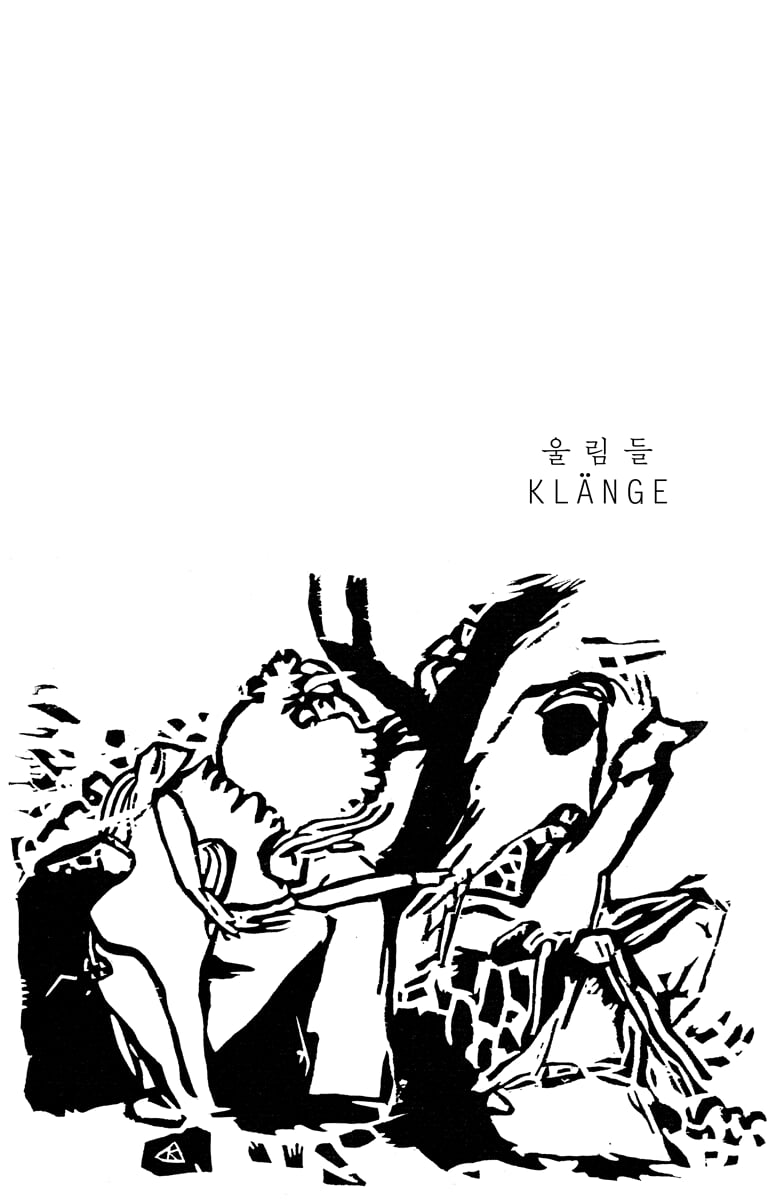
Wassily Kandinsky's only poetry collection, "Echoes," printed in only 345 copies in 1913, is now published in a complete Korean translation.
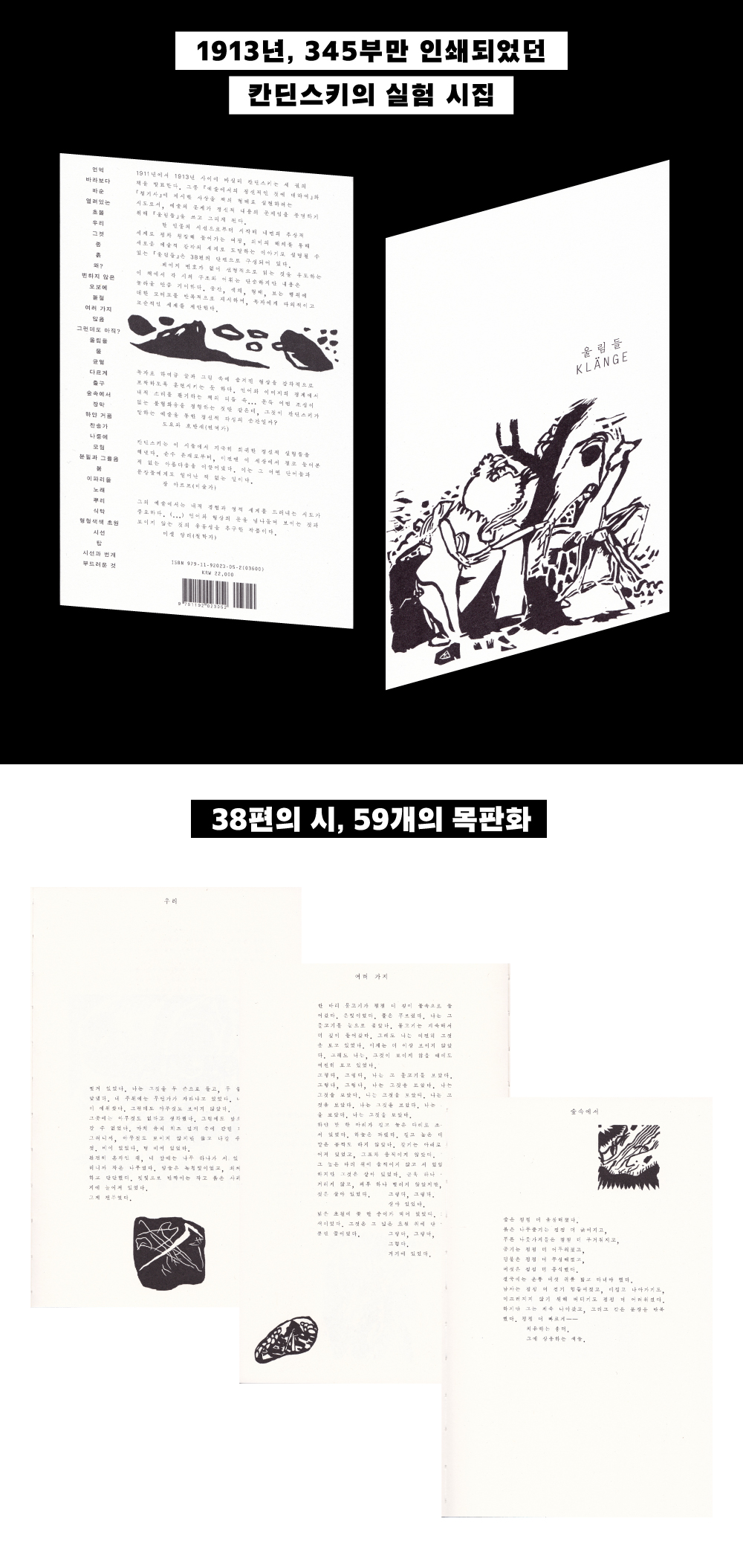
This work, which consists of 38 prose poems and 59 woodcuts, is an experimental poetry collection produced during Kandinsky's crucial period of transition from figuration to abstraction (1911-1913), and is considered a monumental document in the study of his painting and theory.
"Echoes" is a unique art book that creates a resonant relationship between poetry and image, color and sound, spirit and form within a single book.
It was published in small quantities by Reinhard Piper in Munich, Germany in 1913. At the time, the publisher was hesitant to publish the book due to its difficult content and unfamiliar format, and in fact, only 120 copies were sold in the two years following its publication.
As a result, it remained a relatively unknown work among Kandinsky's major works, but it was fully translated in the United States in the 1980s and became a key reference for researchers around the world.
The first complete Korean translation in 112 years has been published.
Wassily Kandinsky's only poetry collection, "Echoes," printed in only 345 copies in 1913, is now published in a complete Korean translation.
This work, which consists of 38 prose poems and 59 woodcuts, is an experimental poetry collection produced during Kandinsky's crucial period of transition from figuration to abstraction (1911-1913), and is considered a monumental document in the study of his painting and theory.
"Echoes" is a unique art book that creates a resonant relationship between poetry and image, color and sound, spirit and form within a single book.
It was published in small quantities by Reinhard Piper in Munich, Germany in 1913. At the time, the publisher was hesitant to publish the book due to its difficult content and unfamiliar format, and in fact, only 120 copies were sold in the two years following its publication.
As a result, it remained a relatively unknown work among Kandinsky's major works, but it was fully translated in the United States in the 1980s and became a key reference for researchers around the world.
- You can preview some of the book's contents.
Preview
index
Echoes
Editor's Note
Appendix 1: Notes on Configuration 4
Appendix 2: Notes on Configuration 6
Editor's Note
Appendix 1: Notes on Configuration 4
Appendix 2: Notes on Configuration 6
Detailed image
Into the book
The hills are clustered together.
A mound of hills made up of every color you can and want to imagine.
These are hills that anyone can think of if they put their mind to it.
Although the sizes vary, the shape is always the same.
Only one form.
Thick at the bottom, bulging at the sides, and flat and round at the top.
So, simple, familiar hills.
Those hills we always think about but never actually see.
--- p.7
You all know it.
I'm talking about that huge cloud.
It looks like cauliflower.
When you put it in your mouth, it crunches.
It's pure white and hard, so it has a chewy texture.
The tongue remains dry.
The clouds hung heavily across the deep blue sky.
--- p.28
My bench is blue, but it's not always there.
I just found it again the day before yesterday.
A cold lightning bolt was stuck next to the bench.
As always.
This time the grass around the lightning was slightly scorched.
Perhaps the lightning had suddenly burst forth, its tip buried in the ground.
Other than that, there was no change.
Everything was where it was before.
As always.
I was sitting on my bench.
On the right, a lightning bolt stuck with its tip sunk into the ground? Perhaps it was burning alone.
A wide plain stretched out before me.
To my right, about fifty paces from my seat, was a woman clutching a black cloth to her chest like a banana.
She was looking at the red mushroom.
On the left, as always, was a weathered phrase.
--- p.39
Yes, yes, I saw that fish.
Yes, yes, I saw it.
I saw it.
I saw it.
I saw it.
I saw it.
I saw it.
I saw it.
A mound of hills made up of every color you can and want to imagine.
These are hills that anyone can think of if they put their mind to it.
Although the sizes vary, the shape is always the same.
Only one form.
Thick at the bottom, bulging at the sides, and flat and round at the top.
So, simple, familiar hills.
Those hills we always think about but never actually see.
--- p.7
You all know it.
I'm talking about that huge cloud.
It looks like cauliflower.
When you put it in your mouth, it crunches.
It's pure white and hard, so it has a chewy texture.
The tongue remains dry.
The clouds hung heavily across the deep blue sky.
--- p.28
My bench is blue, but it's not always there.
I just found it again the day before yesterday.
A cold lightning bolt was stuck next to the bench.
As always.
This time the grass around the lightning was slightly scorched.
Perhaps the lightning had suddenly burst forth, its tip buried in the ground.
Other than that, there was no change.
Everything was where it was before.
As always.
I was sitting on my bench.
On the right, a lightning bolt stuck with its tip sunk into the ground? Perhaps it was burning alone.
A wide plain stretched out before me.
To my right, about fifty paces from my seat, was a woman clutching a black cloth to her chest like a banana.
She was looking at the red mushroom.
On the left, as always, was a weathered phrase.
--- p.39
Yes, yes, I saw that fish.
Yes, yes, I saw it.
I saw it.
I saw it.
I saw it.
I saw it.
I saw it.
I saw it.
--- p.44
Publisher's Review
I only wanted to make sound.
As Kandinsky said, "Echoes" is composed of 38 short prose poems, and is characterized by presenting fragments of non-narrative scenes such as internal emotions, memories, and fantasies rather than directly describing real-life events or people.
Each poem is structured around sensory elements such as color, sound, and rhythm rather than a clear plot or narrative structure, and the language itself functions as an abstract form.
Furthermore, 『Echoes』 is a controversial work that has given rise to various interpretations over the past 100 years since its publication.
Because of its experimental format, which combines painting and poetry, there has never been a clear consensus in academia, and researchers have interpreted the book as “the first case of Kandinsky’s abstract painting theory being experimented with in language” or “one of the textual experiments of the European avant-garde in the 1910s.”
Other researchers interpret it as the author's personal fantasy, emotional record, or a continuation of symbolic poetry, giving it different meanings.
The fact that it invites such diverse interpretations is a characteristic that directly reflects the experimental nature and ambiguity of 『Echoes』, as well as the complexity of the artistic transition period of that time.
Book structure
This Korean edition of 『Echoes』 is based on the original first edition published in Germany in 1913, and has been newly edited and designed by Text Press to suit the Korean language and modern reading environment.
While faithfully reflecting the rhythm of the original text as much as possible, the Korean version's unique visual structure was meticulously constructed to allow the poetry and images to breathe naturally within the medium of the book.
Additionally, to help understand the context of the work, Kandinsky's retrospective notes on the work written in 1911 and 1913 are included as an appendix.
This note is an important record showing how he moved beyond the limits of figurative painting to abstract painting, and what significance 『Echoes』 holds at the apex of that change.
Through the text and appendix, readers will be able to follow the process by which an artist constructed the sensory language of 'resonance.'
As Kandinsky said, "Echoes" is composed of 38 short prose poems, and is characterized by presenting fragments of non-narrative scenes such as internal emotions, memories, and fantasies rather than directly describing real-life events or people.
Each poem is structured around sensory elements such as color, sound, and rhythm rather than a clear plot or narrative structure, and the language itself functions as an abstract form.
Furthermore, 『Echoes』 is a controversial work that has given rise to various interpretations over the past 100 years since its publication.
Because of its experimental format, which combines painting and poetry, there has never been a clear consensus in academia, and researchers have interpreted the book as “the first case of Kandinsky’s abstract painting theory being experimented with in language” or “one of the textual experiments of the European avant-garde in the 1910s.”
Other researchers interpret it as the author's personal fantasy, emotional record, or a continuation of symbolic poetry, giving it different meanings.
The fact that it invites such diverse interpretations is a characteristic that directly reflects the experimental nature and ambiguity of 『Echoes』, as well as the complexity of the artistic transition period of that time.
Book structure
This Korean edition of 『Echoes』 is based on the original first edition published in Germany in 1913, and has been newly edited and designed by Text Press to suit the Korean language and modern reading environment.
While faithfully reflecting the rhythm of the original text as much as possible, the Korean version's unique visual structure was meticulously constructed to allow the poetry and images to breathe naturally within the medium of the book.
Additionally, to help understand the context of the work, Kandinsky's retrospective notes on the work written in 1911 and 1913 are included as an appendix.
This note is an important record showing how he moved beyond the limits of figurative painting to abstract painting, and what significance 『Echoes』 holds at the apex of that change.
Through the text and appendix, readers will be able to follow the process by which an artist constructed the sensory language of 'resonance.'
GOODS SPECIFICS
- Date of issue: November 19, 2025
- Page count, weight, size: 128 pages | 145*225*20mm
- ISBN13: 9791192023052
- ISBN10: 1192023056
You may also like
카테고리
korean


korean

![GQ KOREA Mark (Monthly): December [2025]](http://librairie.coreenne.fr/cdn/shop/files/8ef265dbbfbf186523ed75ba7319009d.jpg?v=1765340328&width=3840)


