

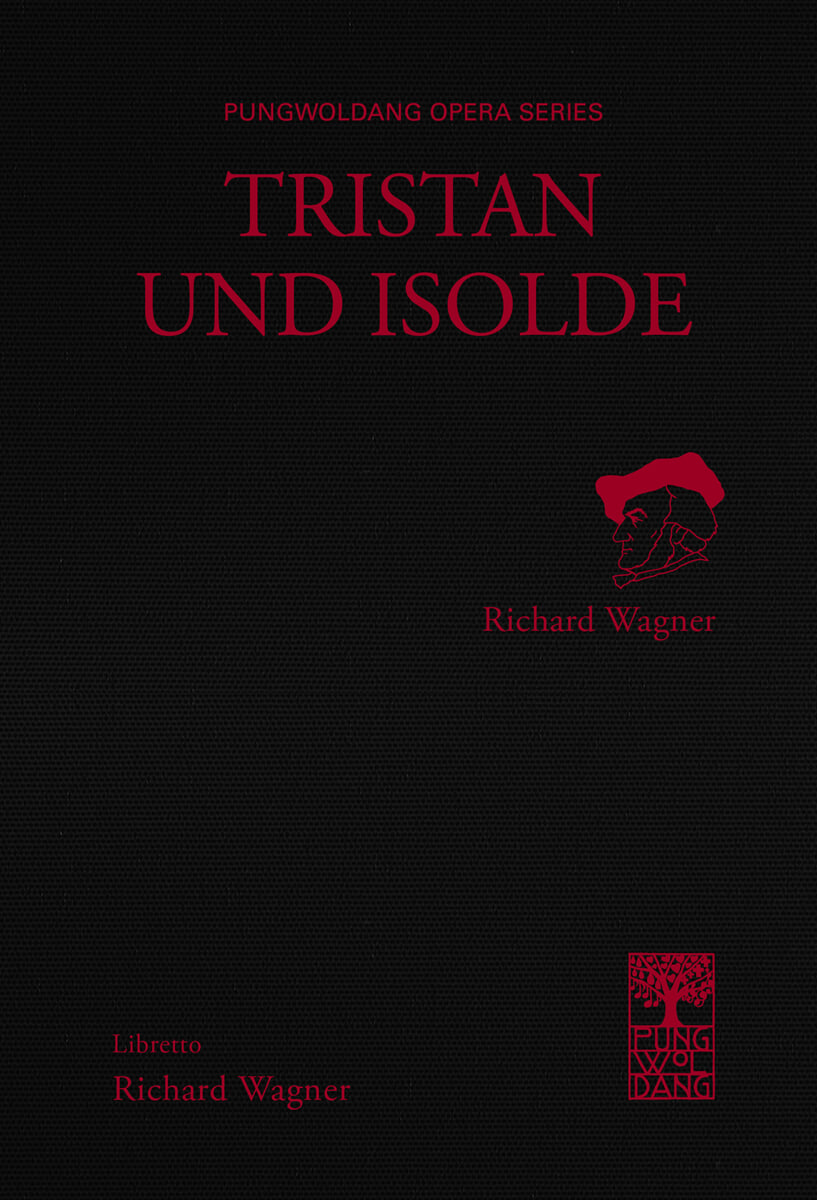
Tristan and Isolde
 |
Description
Book Introduction
Melody of Tokyo, a revolution in music
Tristan and Isolde
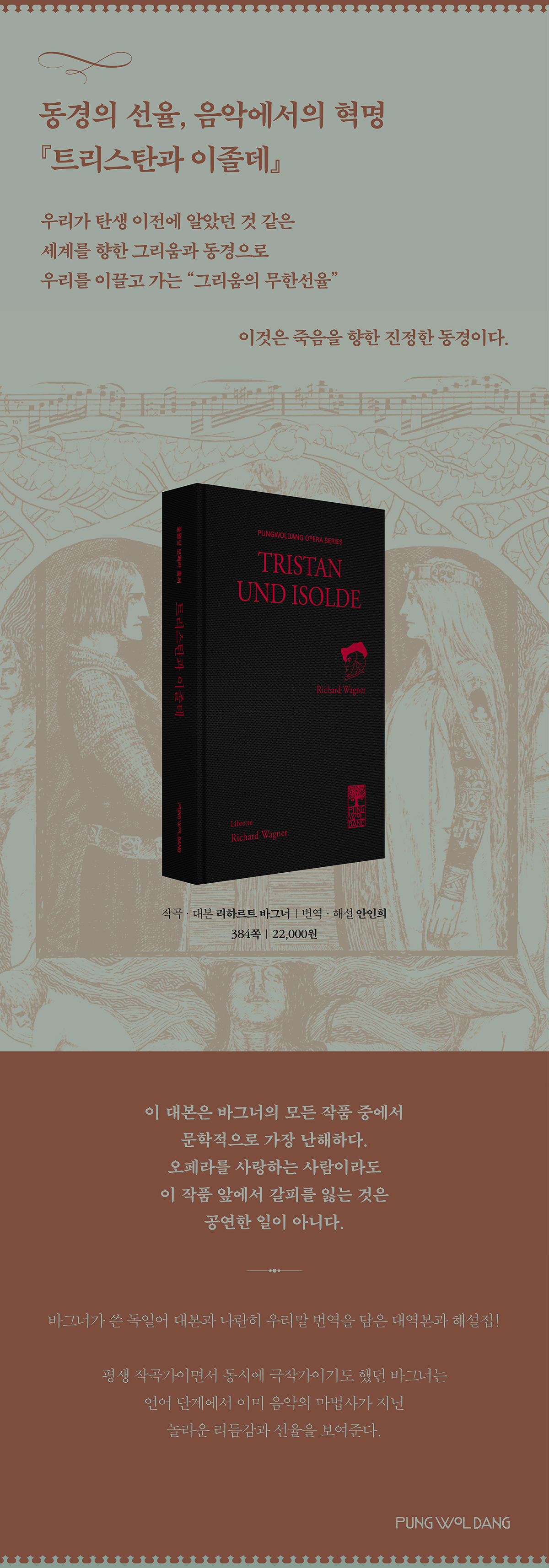
“The Infinite Melody of Longing” leads us to a longing and yearning for the world we knew before we were born. This is a true longing for death.
This libretto is the most literary difficult of all Wagner's works.
It is no surprise that even opera lovers are left speechless by this work.
A Korean translation of Wagner's German libretto alongside a commentary and commentary! Wagner, a lifelong composer and playwright, already demonstrated the remarkable rhythm and melody of a musical wizard at the linguistic level.
Tristan and Isolde
“The Infinite Melody of Longing” leads us to a longing and yearning for the world we knew before we were born. This is a true longing for death.
This libretto is the most literary difficult of all Wagner's works.
It is no surprise that even opera lovers are left speechless by this work.
A Korean translation of Wagner's German libretto alongside a commentary and commentary! Wagner, a lifelong composer and playwright, already demonstrated the remarkable rhythm and melody of a musical wizard at the linguistic level.
- You can preview some of the book's contents.
Preview
index
Full commentary
Detailed explanation
script
Act 1
Act 2
Act 3
Preface
Detailed explanation
script
Act 1
Act 2
Act 3
Preface
Detailed image
Into the book
This opera is a magical piece of music that is great to see performed on stage, but even better to listen to.
It melts the hearts of the listeners, leading us to a longing and yearning for a world we probably knew before we were born.
This yearning, this yearning for the source, is it the yearning our souls carry for the source? How can we capture it in words? Wagner captured this infinite yearning, difficult to express in words, with music of infinite melody.
What kind of magic and hypnotic effect is this music that once you fall into it, you can never forget it!?
--- p.7
In 1854, Wagner read Schopenhauer's The World as Will and Representation.
He, who suffered from a life of uncertainty and deep disappointment, deeply sympathized with this work.
Having tasted the bitter failure of the 1948 revolution, most young intellectuals at the time were enthusiastic about the reflections of this philosopher, who held a pessimistic worldview.
In a letter to Liszt, Wagner made the following remarks about Schopenhauer's philosophy:
'His central idea is the ultimate denial of the will to live, a terrifyingly serious but only salvation-giving thought.
This is a true longing for death.
Complete unconsciousness, complete non-existence, the disappearance of all dreams, the only final salvation!'
--- p.10
This particular work could not be brought to the stage as easily as Wagner had initially planned.
Even a high-level opera company like the Vienna Opera eventually gave up on putting on a stage after 77 rehearsals, and it was only after the intervention of the King of Bavaria that they were finally able to put it on stage, by force, with a huge expense of bringing in conductors and singers from all over the country.
The work was first staged at the Court Theatre in Munich in June 1865.
Those who heard this premiere and the subsequent performances felt their souls torn apart by extreme sentimentality.
These intense emotions were not only due to the passionate and spiritual abyss-inducing plot, but also came from the music.
Even today, those who can immerse themselves in musical impressions with an extremely honest and open sensibility, even without knowing the plot, often experience a new escape from the real world in this music, a level of experience that is difficult to find in any other music.
Moreover, this effect does not necessarily only occur through stage performances.
The hypnotic effect of this kind of music, which you have never heard before, does not change much when you listen to it through other media.
--- p.33
Wagner, who lived as a wanderer in Europe for over 50 years, caught up in economic hardship and political upheaval, was supported by all kinds of friends and achieved great fame throughout Europe, but he was still a man with a truly anxious sense of life. It is only natural that this anxiety of the times was vividly expressed in the music he wrote in his 40s.
In particular, the music of “Tristan,” which must show on stage the brutal clash between reality and dreamy ideals while carrying the pain of the soul, can only be persuasive if it maintains a state of continuous, intense tension.
If the music were calm, it would be nearly impossible for the audience to immerse themselves in the protagonists' truly manic state of mind.
It melts the hearts of the listeners, leading us to a longing and yearning for a world we probably knew before we were born.
This yearning, this yearning for the source, is it the yearning our souls carry for the source? How can we capture it in words? Wagner captured this infinite yearning, difficult to express in words, with music of infinite melody.
What kind of magic and hypnotic effect is this music that once you fall into it, you can never forget it!?
--- p.7
In 1854, Wagner read Schopenhauer's The World as Will and Representation.
He, who suffered from a life of uncertainty and deep disappointment, deeply sympathized with this work.
Having tasted the bitter failure of the 1948 revolution, most young intellectuals at the time were enthusiastic about the reflections of this philosopher, who held a pessimistic worldview.
In a letter to Liszt, Wagner made the following remarks about Schopenhauer's philosophy:
'His central idea is the ultimate denial of the will to live, a terrifyingly serious but only salvation-giving thought.
This is a true longing for death.
Complete unconsciousness, complete non-existence, the disappearance of all dreams, the only final salvation!'
--- p.10
This particular work could not be brought to the stage as easily as Wagner had initially planned.
Even a high-level opera company like the Vienna Opera eventually gave up on putting on a stage after 77 rehearsals, and it was only after the intervention of the King of Bavaria that they were finally able to put it on stage, by force, with a huge expense of bringing in conductors and singers from all over the country.
The work was first staged at the Court Theatre in Munich in June 1865.
Those who heard this premiere and the subsequent performances felt their souls torn apart by extreme sentimentality.
These intense emotions were not only due to the passionate and spiritual abyss-inducing plot, but also came from the music.
Even today, those who can immerse themselves in musical impressions with an extremely honest and open sensibility, even without knowing the plot, often experience a new escape from the real world in this music, a level of experience that is difficult to find in any other music.
Moreover, this effect does not necessarily only occur through stage performances.
The hypnotic effect of this kind of music, which you have never heard before, does not change much when you listen to it through other media.
--- p.33
Wagner, who lived as a wanderer in Europe for over 50 years, caught up in economic hardship and political upheaval, was supported by all kinds of friends and achieved great fame throughout Europe, but he was still a man with a truly anxious sense of life. It is only natural that this anxiety of the times was vividly expressed in the music he wrote in his 40s.
In particular, the music of “Tristan,” which must show on stage the brutal clash between reality and dreamy ideals while carrying the pain of the soul, can only be persuasive if it maintains a state of continuous, intense tension.
If the music were calm, it would be nearly impossible for the audience to immerse themselves in the protagonists' truly manic state of mind.
--- p.35
Publisher's Review
Pungwoldang Opera Collection
This year marks the 70th anniversary of opera performances in Korea.
The reality is that there is not a single proper Korean script.
Opera is the most important genre leading the world's performing arts scene.
Opera librettos are a great piece of literature in themselves and a genre of their own.
Other writers marginalized from world literature
A Guide for Serious Appreciators
A small group of people take on the task that no one else is doing.
It starts with the sense of mission that if you are a cultural nation, you should at least have opera librettos translated.
We are looking for a translator with both an interest and skill in opera to commission a manuscript and aim to produce a classy and easy-to-read book.
Although there will be difficulties, I will do my best to compile an excellent and proper script to the best of my ability.
I hope that this collection will contribute to the development of Korean opera and to the appreciation of opera by individuals.
Ultimately, we hope to become a country where more and more citizens around the world enjoy the true value of opera.
_Pungwoldang Park Jong-ho (from the publisher's note)
Infinite Melody of Longing
script and music
Schopenhauer's influence
Medieval literary work 『Tristan and Isolde』
Novalis's Hymns of the Night: A Poem of Transfiguration
German Romantic Literature and Wagner
personal experience
Music that transforms through pain
Transformation or Revolution in Music
Music Expressing Soul Pain: Dissonance and Chromaticity
Infinite Melody: The Language of the Orchestra
The Special Fate of the Opera "Tristan"
“This crystal was forged in a marvelous forge that mankind has never known before.
“The monstrous genius called Wagner created that language and music.”
This Korean translation, alongside the German libretto by Wagner, is intended to help Korean opera lovers fall in love with this special music and gain an intermediate understanding of its magic—a necessary step toward understanding the content that must be overcome before one can truly embrace the music.
The world of music cannot be expressed in words.
But the easiest way to approach Wagner's music is through the libretto.
That was also the order of Wagner's creation.
If we can understand the script well, we have a way to concretely approach his concepts, ideas, and emotions.
Then, when you listen to the music and think, “Ah, this word, this content, or this emotion is expressed in music like this,” and start to connect the content and the music, you feel as if a chink has opened before your eyes, allowing you to glimpse into the mysterious and creative world of the composer.
Unlike other composers, Wagner turned his words into music.
If we delve into and understand the rich emotions, countless adventures, and events hidden in Wagner's music, the listener's experience will become deeper and richer.
Tristan und Isolde, which deals with love and adultery, is a difficult work among Wagner's works because it contains the most delicate psychological (soul) observations and also has profound literary and philosophical aspects.
Even though it may be a bit cumbersome and difficult, if you understand the libretto and music of Tristan and Isolde, it is also a great step towards modern music after the Romantic era, so isn't it worth the effort?
This one volume alone gives one a grand sense of the German Middle Ages, Romanticism, opera, and fin de siècle.
Wagner's libretto itself is the most elaborate work he has ever produced, and the translator's fervor to not allow his beloved work to be tarnished is evident in every line.
Once you understand the longing for love that death has made eternal, you will realize that the distant aspirations carried by Wagner's infinitely extending melodies are ultimately a struggle of the spirit to reach out to something beyond music.
This year marks the 70th anniversary of opera performances in Korea.
The reality is that there is not a single proper Korean script.
Opera is the most important genre leading the world's performing arts scene.
Opera librettos are a great piece of literature in themselves and a genre of their own.
Other writers marginalized from world literature
A Guide for Serious Appreciators
A small group of people take on the task that no one else is doing.
It starts with the sense of mission that if you are a cultural nation, you should at least have opera librettos translated.
We are looking for a translator with both an interest and skill in opera to commission a manuscript and aim to produce a classy and easy-to-read book.
Although there will be difficulties, I will do my best to compile an excellent and proper script to the best of my ability.
I hope that this collection will contribute to the development of Korean opera and to the appreciation of opera by individuals.
Ultimately, we hope to become a country where more and more citizens around the world enjoy the true value of opera.
_Pungwoldang Park Jong-ho (from the publisher's note)
Infinite Melody of Longing
script and music
Schopenhauer's influence
Medieval literary work 『Tristan and Isolde』
Novalis's Hymns of the Night: A Poem of Transfiguration
German Romantic Literature and Wagner
personal experience
Music that transforms through pain
Transformation or Revolution in Music
Music Expressing Soul Pain: Dissonance and Chromaticity
Infinite Melody: The Language of the Orchestra
The Special Fate of the Opera "Tristan"
“This crystal was forged in a marvelous forge that mankind has never known before.
“The monstrous genius called Wagner created that language and music.”
This Korean translation, alongside the German libretto by Wagner, is intended to help Korean opera lovers fall in love with this special music and gain an intermediate understanding of its magic—a necessary step toward understanding the content that must be overcome before one can truly embrace the music.
The world of music cannot be expressed in words.
But the easiest way to approach Wagner's music is through the libretto.
That was also the order of Wagner's creation.
If we can understand the script well, we have a way to concretely approach his concepts, ideas, and emotions.
Then, when you listen to the music and think, “Ah, this word, this content, or this emotion is expressed in music like this,” and start to connect the content and the music, you feel as if a chink has opened before your eyes, allowing you to glimpse into the mysterious and creative world of the composer.
Unlike other composers, Wagner turned his words into music.
If we delve into and understand the rich emotions, countless adventures, and events hidden in Wagner's music, the listener's experience will become deeper and richer.
Tristan und Isolde, which deals with love and adultery, is a difficult work among Wagner's works because it contains the most delicate psychological (soul) observations and also has profound literary and philosophical aspects.
Even though it may be a bit cumbersome and difficult, if you understand the libretto and music of Tristan and Isolde, it is also a great step towards modern music after the Romantic era, so isn't it worth the effort?
This one volume alone gives one a grand sense of the German Middle Ages, Romanticism, opera, and fin de siècle.
Wagner's libretto itself is the most elaborate work he has ever produced, and the translator's fervor to not allow his beloved work to be tarnished is evident in every line.
Once you understand the longing for love that death has made eternal, you will realize that the distant aspirations carried by Wagner's infinitely extending melodies are ultimately a struggle of the spirit to reach out to something beyond music.
GOODS SPECIFICS
- Date of issue: October 1, 2021
- Format: Hardcover book binding method guide
- Page count, weight, size: 384 pages | 486g | 135*195*15mm
- ISBN13: 9791189346249
- ISBN10: 1189346249
You may also like
카테고리
korean


korean

![GQ KOREA Mark (Monthly): December [2025]](http://librairie.coreenne.fr/cdn/shop/files/8ef265dbbfbf186523ed75ba7319009d.jpg?v=1765340328&width=3840)


