

The Birth of the New Testament
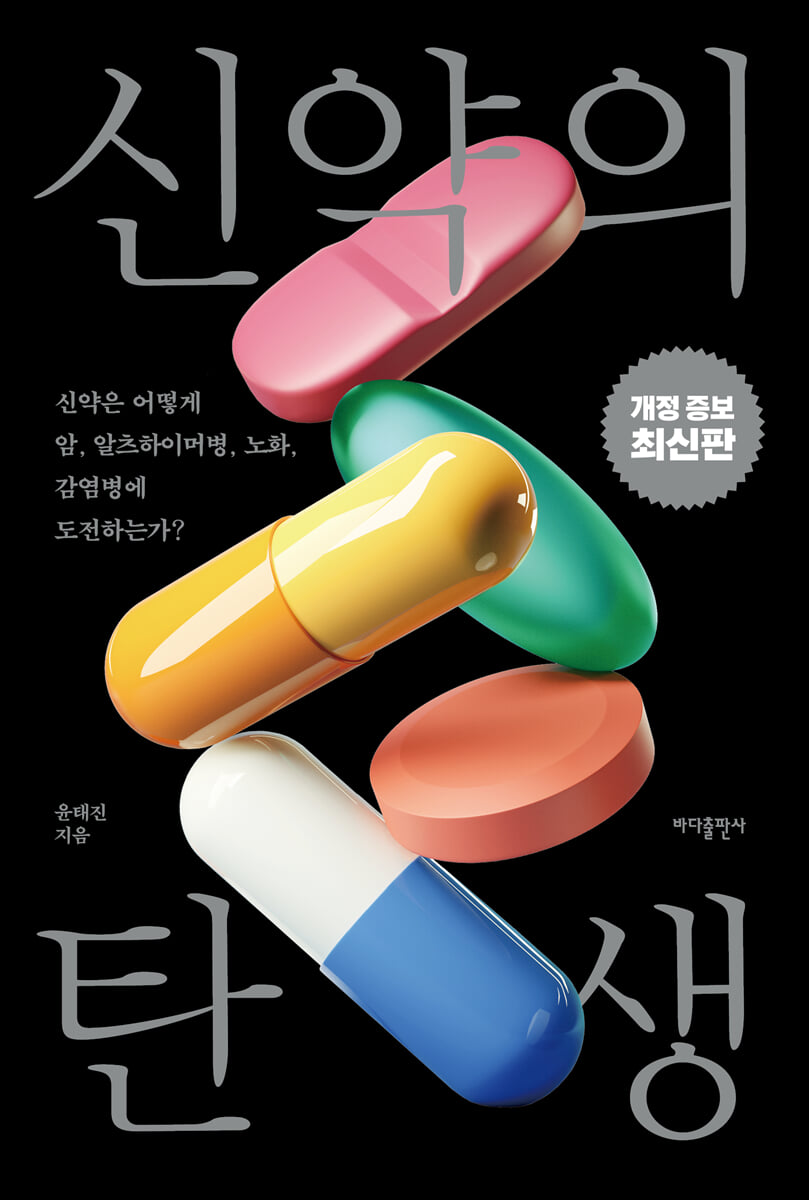 |
Description
Book Introduction
Dr. Taejin Yoon, Head of Strategy at Yuhan Corporation, guides you.
Innovations and Latest Trends in New Drug Development
Dr. Taejin Yoon, Head of Strategy at Yuhan Corporation, provides an overview of the latest trends in new drug development.
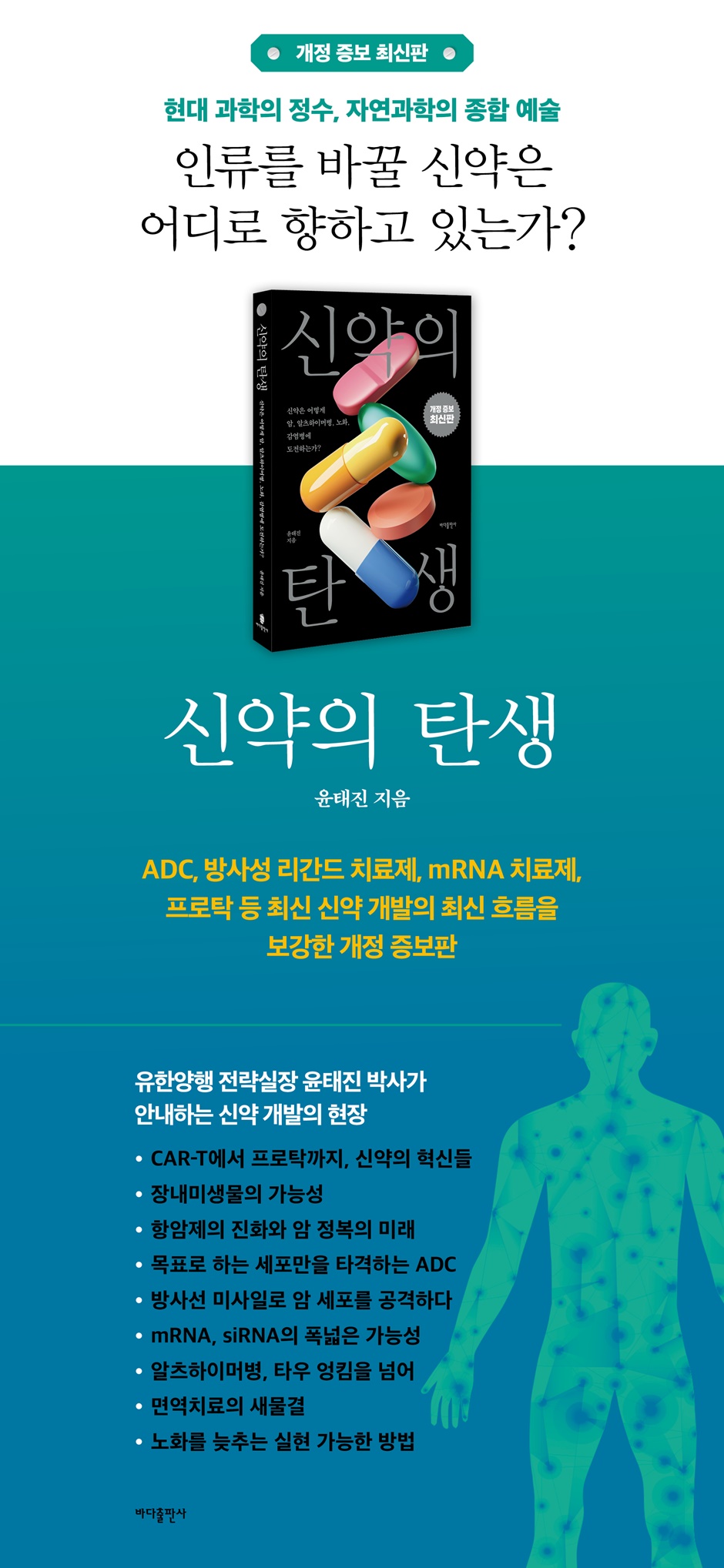
In addition to the previously introduced innovative new drug development trends such as CAR-T, Protac, and antibody new drugs, this revised edition adds the latest development trends such as magic bullet ADC that targets only target cells, radioligand therapy that destroys abnormal cells using radiation, and RNA therapeutics that have been rapidly developed due to COVID-19.
Many media outlets are competing to report that human life expectancy has increased to 100 years thanks to advancements in science and technology.
However, many diseases, including rare cancers, Alzheimer's disease, infectious diseases, and immune diseases, remain incurable and have no clear cure.
We also have the final challenge of humanity: aging.
How far has the development of new drugs, promising to revolutionize human life, progressed, and where is it headed? Dr. Taejin Yoon, who leads Yuhan Corporation's New Business Development Team and is at the forefront of new drug development, discusses new innovations that fundamentally alter the "method" of drug action from a macroscopic perspective.
Innovations and Latest Trends in New Drug Development
Dr. Taejin Yoon, Head of Strategy at Yuhan Corporation, provides an overview of the latest trends in new drug development.
In addition to the previously introduced innovative new drug development trends such as CAR-T, Protac, and antibody new drugs, this revised edition adds the latest development trends such as magic bullet ADC that targets only target cells, radioligand therapy that destroys abnormal cells using radiation, and RNA therapeutics that have been rapidly developed due to COVID-19.
Many media outlets are competing to report that human life expectancy has increased to 100 years thanks to advancements in science and technology.
However, many diseases, including rare cancers, Alzheimer's disease, infectious diseases, and immune diseases, remain incurable and have no clear cure.
We also have the final challenge of humanity: aging.
How far has the development of new drugs, promising to revolutionize human life, progressed, and where is it headed? Dr. Taejin Yoon, who leads Yuhan Corporation's New Business Development Team and is at the forefront of new drug development, discusses new innovations that fundamentally alter the "method" of drug action from a macroscopic perspective.
- You can preview some of the book's contents.
Preview
index
Entering
Editors Ask, Authors Answer: At the Forefront of Drug Development
Chapter 1: The Landscape of New Drug Development is Changing
1 People who make new medicine
2 Towards a new way of drug action
3 A new wave of immunotherapy
4 Potential of gut microbes
5 AI Research That Makes the Impossible Possible
6 'Magic Bullets' and Next-Generation ADCs
7 Radiation missiles, radioligand therapy
8 RNA-Based Therapeutics Promoted by COVID-19
Chapter 2: The Birth of the New Testament
1. The Evolution of Anticancer Drugs and the Future of Conquering Cancer
2 Alzheimer's Disease, Beyond Tau Tangles
3 Autoimmune Diseases (1): Controlling the Initiation of the Immune Response
4 Autoimmune Diseases (2): Suppressing Excessive Immune Responses
Chapter 3: Aging, the Final Task
1 Aging begins in DNA
2 Excessive cellular response and aging
3 Aging as seen through the body's comprehensive response
4 Feasible Ways to Slow Aging
Chapter 4 For a Healthier Life
1 Why Exercise Makes You Healthy
2 Smart Treatments to Slow Down Presbyopia
3. Personalized Precision Medicine and the Future of the Healthcare Industry
Going out
References
Search
Editors Ask, Authors Answer: At the Forefront of Drug Development
Chapter 1: The Landscape of New Drug Development is Changing
1 People who make new medicine
2 Towards a new way of drug action
3 A new wave of immunotherapy
4 Potential of gut microbes
5 AI Research That Makes the Impossible Possible
6 'Magic Bullets' and Next-Generation ADCs
7 Radiation missiles, radioligand therapy
8 RNA-Based Therapeutics Promoted by COVID-19
Chapter 2: The Birth of the New Testament
1. The Evolution of Anticancer Drugs and the Future of Conquering Cancer
2 Alzheimer's Disease, Beyond Tau Tangles
3 Autoimmune Diseases (1): Controlling the Initiation of the Immune Response
4 Autoimmune Diseases (2): Suppressing Excessive Immune Responses
Chapter 3: Aging, the Final Task
1 Aging begins in DNA
2 Excessive cellular response and aging
3 Aging as seen through the body's comprehensive response
4 Feasible Ways to Slow Aging
Chapter 4 For a Healthier Life
1 Why Exercise Makes You Healthy
2 Smart Treatments to Slow Down Presbyopia
3. Personalized Precision Medicine and the Future of the Healthcare Industry
Going out
References
Search
Detailed image
Publisher's Review
From CAR-T to radioligand therapy
The landscape of new drug development is changing.
Drug development, a comprehensive art form of natural science that embodies the essence of modern science, is expanding its reach and making new attempts to conquer disease. CAR-T therapy, Protac, TrimAway, ADC, radioligands, and RNA therapeutics are leading the paradigm of new drug development, reinvigorating previously stagnant research fields.
While existing drugs have had limited effects in treating diseases due to narrow indications and low utilization, drugs being developed now aim for near-infinite drug applicability and universality.
While existing drugs involved casting a fishing rod and waiting for the hook to land squarely in the fish's mouth, the current approach is to cast a net and catch the fish whole.
It's not just the drug approach that's changing.
Even research on gut microbiota, which seemed to be somewhat distant from medicine, and artificial intelligence research, which seemed to have nothing to do with medicine, are being introduced into new drug development.
This book analyzes emerging trends that are shedding new light on the study of diseases previously difficult to treat with conventional methods, and examines the potential impact these new trends will have on future drug development.
How New Drugs Tackle Cancer, Alzheimer's, and Immune Diseases
Looking back to the 1980s, cancer was a representative disease that caused people to fear death.
Since then, governments around the world have invested astronomical amounts of money into developing cancer treatments, but conquering cancer has not been easy, and voices of pessimism have begun to emerge.
Alzheimer's disease and immune disorders have also faced challenges beyond initial expectations and remain afflictions that still plague many people.
Although medicine has made remarkable progress over the past 100 years, there are some areas where it has lagged behind.
Even if a treatment is developed that only kills cancer cells, cancer cells quickly develop resistance and grow again.
Drugs targeting beta-amyloid and tau proteins, which were thought to be the cause of Alzheimer's disease, did not show much efficacy in treating the disease and repeatedly failed in clinical trials.
Regulatory T cells, which control immune function, sometimes disappoint researchers by behaving in ways that are quite different from what we expect.
Will these diseases, which currently plague us most, ultimately remain insurmountable? Dr. Taejin Yoon revisits the history of drug development for these conditions, examining the problems with past treatments, the approaches taken by emerging drugs, and the development trends to determine whether these new approaches hold promise for the future.
Just as cancer cells continue to develop drug resistance with their tenacious vitality, humans also challenge themselves to conquer incurable diseases with tenacious will.
The medicine that changes the world,
People who heal the world
As the COVID-19 pandemic afflicts the world, we realize the need for new treatments and vaccines more than ever.
Because we have had such easy access to medicines, we have forgotten how much these drugs have changed human lives.
Without medicine, human life expectancy would not have increased to this extent, and without vaccines, we would not be able to freely travel between countries due to the fear of infectious diseases.
Medicines, which have kept pace with the development of technological civilization in the 20th century, are still evolving today.
And on the front lines, countless people are pouring their wits and talents into saving lives.
How are new drugs developed, and what challenges remain? What efforts are being made to treat diseases that have yet to be conquered, such as cancer, Alzheimer's, and infectious diseases? Dr. Taejin Yoon, Head of Strategy at Yuhan Corporation, examines the latest innovations in drug development and discusses key changes that could shed light on the future of new drug development.
Aging, humanity's final challenge
Even if we conquer all diseases and attain eternal life, if we fail to maintain a young and healthy body, the blessing of eternity will inevitably become a curse.
With the tremendous advancements in medicine over the past 100 years, the average lifespan of humans has also increased, and aging is now recognized not as a natural phenomenon but as a disease we must overcome.
Why do humans age? How can we prevent it? Is it possible to cure it, or even reverse aging?
Aging is not a phenomenon caused by a single cause, but rather the final result of a combination of several phenomena.
Accordingly, Dr. Taejin Yoon divides the causes of aging into DNA level, cellular level, and individual level, and organizes nine causes of aging, including cellular aging, telomere reduction, and stem cell depletion.
We also examine whether familiar anti-aging substances such as resveratrol and rapamycin are truly effective in treating aging, and we also discuss some lifestyle tips we can implement in our daily lives to prevent aging.
Does wine really have anti-aging properties? Why does a lifestyle that disrupts our biological clock accelerate aging? By comprehensively examining the various characteristics of aging, we can gain a more in-depth understanding of its characteristics, causes, and treatments.
For a healthier life
Medicines not only treat illnesses, but also contribute to maintaining daily health.
I exercise to maintain a healthy weight, eat foods containing lutein to protect my eyesight, and check my health status with a smartwatch.
Researching ways to keep the body healthy and prevent disease before it actually occurs is also an important goal of 21st-century medicine.
From this perspective, we will discuss the various effects of exercise, the correlation between obesity and health, the causes of presbyopia and ways to overcome them, and finally, we will examine several concepts that will dominate the pharmaceutical and biotechnology industries in the near future, such as precision medicine, smart treatment, and biomarkers.
We often don't realize the value of medicine until we get sick.
However, as we navigate the COVID-19 outbreak, we are briefly reminded of a time without treatments or vaccines, and we are realizing once again how crucial medicine and the general health of citizens are to our society.
Making humanity healthy is a very important task for some people and a noble task that can change a person's life.
Researchers are also aware of this fact, which is why they work harder than anyone else on the medical front.
Let us all be grateful for their hard work and look forward to the future that Shinyak will create.
The landscape of new drug development is changing.
Drug development, a comprehensive art form of natural science that embodies the essence of modern science, is expanding its reach and making new attempts to conquer disease. CAR-T therapy, Protac, TrimAway, ADC, radioligands, and RNA therapeutics are leading the paradigm of new drug development, reinvigorating previously stagnant research fields.
While existing drugs have had limited effects in treating diseases due to narrow indications and low utilization, drugs being developed now aim for near-infinite drug applicability and universality.
While existing drugs involved casting a fishing rod and waiting for the hook to land squarely in the fish's mouth, the current approach is to cast a net and catch the fish whole.
It's not just the drug approach that's changing.
Even research on gut microbiota, which seemed to be somewhat distant from medicine, and artificial intelligence research, which seemed to have nothing to do with medicine, are being introduced into new drug development.
This book analyzes emerging trends that are shedding new light on the study of diseases previously difficult to treat with conventional methods, and examines the potential impact these new trends will have on future drug development.
How New Drugs Tackle Cancer, Alzheimer's, and Immune Diseases
Looking back to the 1980s, cancer was a representative disease that caused people to fear death.
Since then, governments around the world have invested astronomical amounts of money into developing cancer treatments, but conquering cancer has not been easy, and voices of pessimism have begun to emerge.
Alzheimer's disease and immune disorders have also faced challenges beyond initial expectations and remain afflictions that still plague many people.
Although medicine has made remarkable progress over the past 100 years, there are some areas where it has lagged behind.
Even if a treatment is developed that only kills cancer cells, cancer cells quickly develop resistance and grow again.
Drugs targeting beta-amyloid and tau proteins, which were thought to be the cause of Alzheimer's disease, did not show much efficacy in treating the disease and repeatedly failed in clinical trials.
Regulatory T cells, which control immune function, sometimes disappoint researchers by behaving in ways that are quite different from what we expect.
Will these diseases, which currently plague us most, ultimately remain insurmountable? Dr. Taejin Yoon revisits the history of drug development for these conditions, examining the problems with past treatments, the approaches taken by emerging drugs, and the development trends to determine whether these new approaches hold promise for the future.
Just as cancer cells continue to develop drug resistance with their tenacious vitality, humans also challenge themselves to conquer incurable diseases with tenacious will.
The medicine that changes the world,
People who heal the world
As the COVID-19 pandemic afflicts the world, we realize the need for new treatments and vaccines more than ever.
Because we have had such easy access to medicines, we have forgotten how much these drugs have changed human lives.
Without medicine, human life expectancy would not have increased to this extent, and without vaccines, we would not be able to freely travel between countries due to the fear of infectious diseases.
Medicines, which have kept pace with the development of technological civilization in the 20th century, are still evolving today.
And on the front lines, countless people are pouring their wits and talents into saving lives.
How are new drugs developed, and what challenges remain? What efforts are being made to treat diseases that have yet to be conquered, such as cancer, Alzheimer's, and infectious diseases? Dr. Taejin Yoon, Head of Strategy at Yuhan Corporation, examines the latest innovations in drug development and discusses key changes that could shed light on the future of new drug development.
Aging, humanity's final challenge
Even if we conquer all diseases and attain eternal life, if we fail to maintain a young and healthy body, the blessing of eternity will inevitably become a curse.
With the tremendous advancements in medicine over the past 100 years, the average lifespan of humans has also increased, and aging is now recognized not as a natural phenomenon but as a disease we must overcome.
Why do humans age? How can we prevent it? Is it possible to cure it, or even reverse aging?
Aging is not a phenomenon caused by a single cause, but rather the final result of a combination of several phenomena.
Accordingly, Dr. Taejin Yoon divides the causes of aging into DNA level, cellular level, and individual level, and organizes nine causes of aging, including cellular aging, telomere reduction, and stem cell depletion.
We also examine whether familiar anti-aging substances such as resveratrol and rapamycin are truly effective in treating aging, and we also discuss some lifestyle tips we can implement in our daily lives to prevent aging.
Does wine really have anti-aging properties? Why does a lifestyle that disrupts our biological clock accelerate aging? By comprehensively examining the various characteristics of aging, we can gain a more in-depth understanding of its characteristics, causes, and treatments.
For a healthier life
Medicines not only treat illnesses, but also contribute to maintaining daily health.
I exercise to maintain a healthy weight, eat foods containing lutein to protect my eyesight, and check my health status with a smartwatch.
Researching ways to keep the body healthy and prevent disease before it actually occurs is also an important goal of 21st-century medicine.
From this perspective, we will discuss the various effects of exercise, the correlation between obesity and health, the causes of presbyopia and ways to overcome them, and finally, we will examine several concepts that will dominate the pharmaceutical and biotechnology industries in the near future, such as precision medicine, smart treatment, and biomarkers.
We often don't realize the value of medicine until we get sick.
However, as we navigate the COVID-19 outbreak, we are briefly reminded of a time without treatments or vaccines, and we are realizing once again how crucial medicine and the general health of citizens are to our society.
Making humanity healthy is a very important task for some people and a noble task that can change a person's life.
Researchers are also aware of this fact, which is why they work harder than anyone else on the medical front.
Let us all be grateful for their hard work and look forward to the future that Shinyak will create.
GOODS SPECIFICS
- Date of issue: August 29, 2024
- Page count, weight, size: 272 pages | 145*215*20mm
- ISBN13: 9791166892844
- ISBN10: 1166892840
You may also like
카테고리
korean


korean

![GQ KOREA Mark (Monthly): December [2025]](http://librairie.coreenne.fr/cdn/shop/files/8ef265dbbfbf186523ed75ba7319009d.jpg?v=1765340328&width=3840)


