

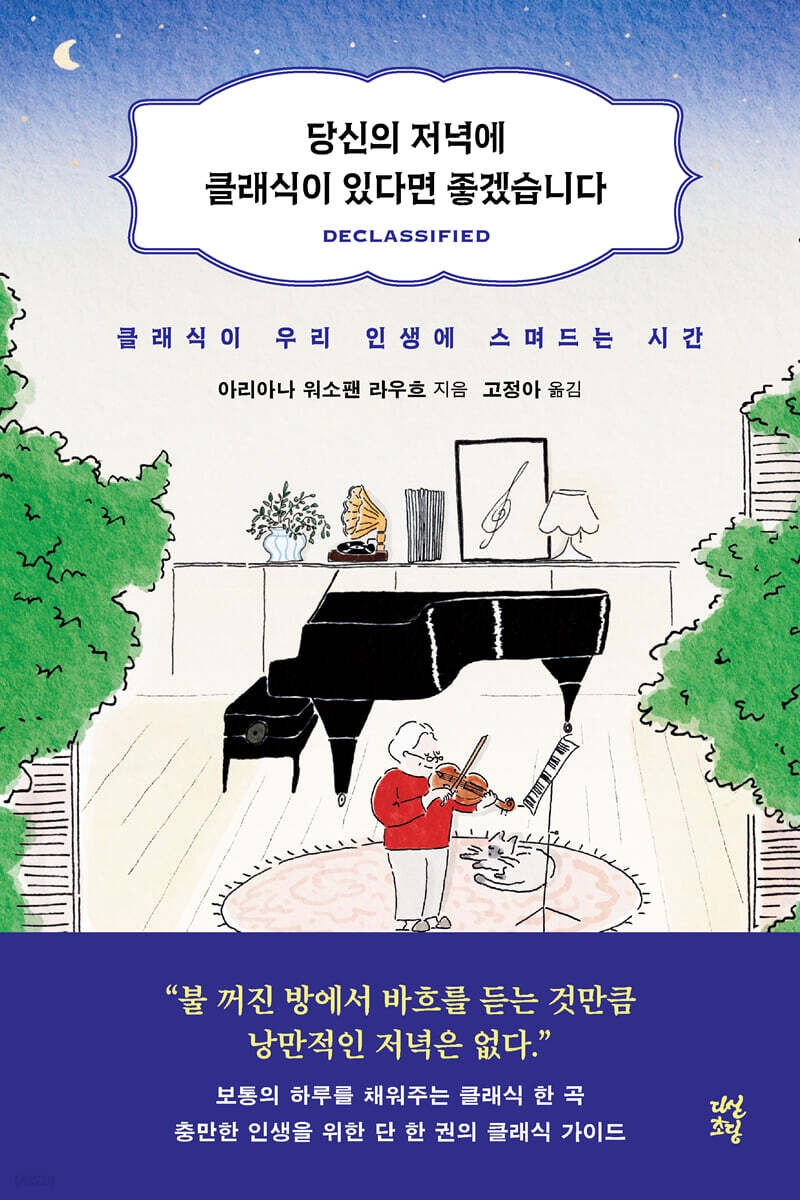
I wish you had some classics for your evening.
 |
Description
Book Introduction
“Tonight, no qualifications are required.
There is only one thing to remember,
“The fact that classical music is beautiful and enjoyable music!”
Overcoming the barricades set up by the classical music world's elite
How to Enter the World of Infinite Joy
This book is a classical lesson of courage and hospitality, offered to you by a world-class violinist who has been at the center of the most brilliant world.
After reading this book, which shatters the walls of elitism and privilege that have isolated and misunderstood classical music, you will be able to fully enjoy the inherent beauty of classical music.
We deserve to enjoy the classics.
And classical music is worth it.
Now that you've crossed the threshold of the art museum, it's time to swing open the grand, magnificent doors of the Seoul Arts Center! Readers are invited into a world of boundless joy.
There is only one thing to remember,
“The fact that classical music is beautiful and enjoyable music!”
Overcoming the barricades set up by the classical music world's elite
How to Enter the World of Infinite Joy
This book is a classical lesson of courage and hospitality, offered to you by a world-class violinist who has been at the center of the most brilliant world.
After reading this book, which shatters the walls of elitism and privilege that have isolated and misunderstood classical music, you will be able to fully enjoy the inherent beauty of classical music.
We deserve to enjoy the classics.
And classical music is worth it.
Now that you've crossed the threshold of the art museum, it's time to swing open the grand, magnificent doors of the Seoul Arts Center! Readers are invited into a world of boundless joy.
- You can preview some of the book's contents.
Preview
index
Introduction
Chapter 1: Classical Music? That's Nothing Special
1400 years of music organized in my own way
Chapter 2: Talent is nothing special either
To be honest, there is such a thing as talent.
But it's not as great as you think
Chapter 3 Beyond the Barricades of the Nobles
Now, classical music is music for us.
Chapter 4: The Conductors Are Sons of Motherfuckers
Looking at it with a biased gaze
Typical images of figures in the classical music world
Chapter 5 A House on Your Shoulders
The value and price of excellence
Chapter 6: Welcome to Juilliard Prison
Music students who don't care about the means or methods
Chapter 7: Why is this format so complicated?
Because you never know when a rondo-type song will end
Empty your bladder beforehand
Chapter 8: The Cursed Classic
Beethoven's hair, Mozart's Requiem, etc.
Superstitions of the Classical World
Chapter 9: Let's try the symphony first.
But if you only listen to symphonies
Not even half enjoying the classics
Chapter 10: The Love Story of the Century That Decorated the Music World
Or gossip surrounding forbidden love and love triangles.
Chapter 11: The Joy and Fury of the Wedding March Performer
How to Avoid Dissonance in Life's Precious Moments
Chapter 12 Okay, so shall we listen to some classic music now?
Everything you need to love classics your way
Acknowledgements
One more Viola joke
Glossary
References
Chapter 1: Classical Music? That's Nothing Special
1400 years of music organized in my own way
Chapter 2: Talent is nothing special either
To be honest, there is such a thing as talent.
But it's not as great as you think
Chapter 3 Beyond the Barricades of the Nobles
Now, classical music is music for us.
Chapter 4: The Conductors Are Sons of Motherfuckers
Looking at it with a biased gaze
Typical images of figures in the classical music world
Chapter 5 A House on Your Shoulders
The value and price of excellence
Chapter 6: Welcome to Juilliard Prison
Music students who don't care about the means or methods
Chapter 7: Why is this format so complicated?
Because you never know when a rondo-type song will end
Empty your bladder beforehand
Chapter 8: The Cursed Classic
Beethoven's hair, Mozart's Requiem, etc.
Superstitions of the Classical World
Chapter 9: Let's try the symphony first.
But if you only listen to symphonies
Not even half enjoying the classics
Chapter 10: The Love Story of the Century That Decorated the Music World
Or gossip surrounding forbidden love and love triangles.
Chapter 11: The Joy and Fury of the Wedding March Performer
How to Avoid Dissonance in Life's Precious Moments
Chapter 12 Okay, so shall we listen to some classic music now?
Everything you need to love classics your way
Acknowledgements
One more Viola joke
Glossary
References
Detailed image

Into the book
My dream is that after reading this book, you won't just say, "I like classical music," but rather, "I like Beethoven," or "I like Rachmaninoff," or "I like the perfect balance and poetic sensibility of Haydn and Mozart, but I like it better when those qualities unfold in sharper, more ingenious, and harmonic dissonances, like Prokofiev in his Neoclassical period."
But don't actually say this in front of anyone unless they already hate you.
---From "Chapter 1: Classical Music? That's Nothing Special"
It is only natural that spaces with a medieval concept would use music with a Renaissance feel.
If you use real medieval music, no one will come.
Anyway, at least I won't be revisiting.
Because he would have killed himself on the way home.
---From "Chapter 1: Classical Music? That's Nothing Special"
Whatever you've taken away from what you've read so far (whether you remember the Baroque era's chronology or the definition of counterpoint or not), I hope you've remembered that classical music contains a wide variety of sounds, and that it's not necessary—and even helpful—to treat them all equally.
I hate medieval music.
Beethoven hated [Für Elise].
As I will explain later, Tchaikovsky hated Brahms.
And one teacher at Juilliard School wouldn't teach music composed after 1900.
You also have the right to hate what you hate.
It's okay to dislike some of this music, as long as it doesn't get in the way of finding music you like.
But don't stop searching for songs you like.
(But if you hate Mozart, it's probably hard for us to be friends.)
---From "Chapter 1: Classical Music? That's Nothing Special"
One day, I was in a taxi and the driver saw my violin and said that I was born with a "talent" and that I was lucky to have a job that was "always fun."
He said that he once tried to learn the violin, but it was too painful and uncomfortable to hold the instrument, and he felt that the violin shouldn't feel that way.
I wanted to show him the peeling skin on my fingertips, the calluses on my index finger where I held the bow, and the scabs that were dripping and forming on my neck where my chin rested.
I wanted to talk about the pressure of performing, the absurd yet inescapable fear of vomiting on stage, the intense self-loathing that washed over me every time my fingers slipped 0.1 millimeter from the point I had practiced.
But that wasn't the case.
Instead, I gave him a 20 percent tip.
Because in some ways it is true that I am blessed.
(Anyone who can complain about things like job satisfaction can do that.) And many musicians who have never fallen into such a dark pit of self-pity would probably agree with him.
---From "Chapter 2: Talent is Nothing Special"
As I said before, Paganini was a bad guy.
Of course I've never met him, but I'm sure he was a bad guy.
The evidence is the twenty-four caprices and six violin concertos he composed for solo violin.
His sole purpose in composing these songs was to show off that he, and no one else, could do such things: twist, multiply, and dimensionally shift his fingers.
(Everyone should play these songs today.
Because violinists are all hyperactive, competitive people who see this as a challenge.)
---From "Chapter 2: Talent is Nothing Special"
In fact, old farts have been drawn to classical music since ancient times.
They have been an essential part of the economic structure of the classical music industry since the days of Bach and Mozart, when the wealthy upper echelons of society, including kings, princes, and archdukes, employed genius musicians as employees.
(This also applies to shoemakers, cooks, and tailors, who were often geniuses in their respective fields.)
---From "Chapter 3: Beyond the Barricades of the Nobles"
In fact, classical musicians are praying to be liberated from the old farts in the classical music world for as long as they have been in power.
Mozart's dislike of his employer, Archbishop Hieronymus Colloredo, is well documented in letters he sent to his father that do not center around the story of the intestinal movement.
He strongly condemned the archbishop's tyranny and stinginess, and in one letter he even wrote, "I hate the archbishop like crazy."
Bach may have felt similar feelings toward his patron, Duke Wilhelm Ernst of Saxe-Weimar.
When Bach tried to resign, the Duke imprisoned him for four weeks.
---From "Chapter 3: Beyond the Barricades of the Nobles"
So the point I'm making is, don't back down because of those old farts.
Even if the classical 'industry' is designed for them, classical music is not.
Many former veterans who have converted like me welcome you with open arms.
And those who haven't converted, those who long for the days when people were embarrassed in front of thousands because of the sound of their cell phones ringing, don't deserve the beauty that composers have given us.
Even the exciting creativity and innovation that my favorite artists are displaying right now.
It's for you.
Yes, you are right.
---From "Chapter 3: Beyond the Barricades of the Nobles"
Singers, like Australian flying squirrels, develop emotional and behavioral problems when they don't get enough attention.
My mentioning the singer now has already hurt their pride.
Compared to opera singers, violinists are like quiet meerkats, afraid of the spotlight ever since they saw their friend get electrocuted.
If violinists crave praise to confirm that their efforts are worthy of recognition, singers enjoy it like East German old men sunbathing naked.
They always seem to say, "Where are you?" no matter when they greet you or when they enter a place.
---From "Chapter 4: Conductors Are Sons of Bitches"
If the bassist is the laid-back kid who sits in the back of the classroom, the violinist is the studious kid who shows off his athletic skills on the playground and sits in the front row in the classroom.
They just want the teacher to call their names.
Because your own answer is always the best.
If a violinist were writing a cover letter for a typical job, he or she would likely list his or her strengths as sincerity, attention to detail, and a sense of purpose.
Their weaknesses might include competitiveness, egocentrism, and obsession, but they'll often express this in unfortunate phrases like, "Sometimes I'm too hard on myself."
Frankly, that statement is likely true.
---From "Chapter 4: Conductors Are Sons of Bitches"
According to countless internet posts, radio broadcasts, and newspaper articles, one of Juilliard's time-honored traditions involves hiding razor blades in the school's piano keys to break competitors' fingers and dreams.
For various reasons, Juilliard is often called the "Jailyard" of the music school world.
So, after I entered Juilliard, I used a flashlight to look at the gaps whenever I saw a piano.
---From "Chapter 6: Welcome to Juilliard Prison"
Another reason to know how to progress through the compositional format is our bladder.
If you don't know the 'type' of the song you're listening to, it's hard to predict whether you'll be able to endure it until the end.
---From "Chapter 7: What kind of format is this complicated?"
I think people who really like Ravel's [Bolero] are definitely emotionally unstable.
I don't know if these people (usually my sister's ex-boyfriends) were drawn to [Bolero] because of their inherently unstable personalities or if they listened to too much [Bolero], but if you happen to find yourself in a remote cabin one day and your companion suddenly puts this music on the record player, I suggest you tell them you're looking for firewood and run to the nearest bear den.
It's safer that way.
But don't actually say this in front of anyone unless they already hate you.
---From "Chapter 1: Classical Music? That's Nothing Special"
It is only natural that spaces with a medieval concept would use music with a Renaissance feel.
If you use real medieval music, no one will come.
Anyway, at least I won't be revisiting.
Because he would have killed himself on the way home.
---From "Chapter 1: Classical Music? That's Nothing Special"
Whatever you've taken away from what you've read so far (whether you remember the Baroque era's chronology or the definition of counterpoint or not), I hope you've remembered that classical music contains a wide variety of sounds, and that it's not necessary—and even helpful—to treat them all equally.
I hate medieval music.
Beethoven hated [Für Elise].
As I will explain later, Tchaikovsky hated Brahms.
And one teacher at Juilliard School wouldn't teach music composed after 1900.
You also have the right to hate what you hate.
It's okay to dislike some of this music, as long as it doesn't get in the way of finding music you like.
But don't stop searching for songs you like.
(But if you hate Mozart, it's probably hard for us to be friends.)
---From "Chapter 1: Classical Music? That's Nothing Special"
One day, I was in a taxi and the driver saw my violin and said that I was born with a "talent" and that I was lucky to have a job that was "always fun."
He said that he once tried to learn the violin, but it was too painful and uncomfortable to hold the instrument, and he felt that the violin shouldn't feel that way.
I wanted to show him the peeling skin on my fingertips, the calluses on my index finger where I held the bow, and the scabs that were dripping and forming on my neck where my chin rested.
I wanted to talk about the pressure of performing, the absurd yet inescapable fear of vomiting on stage, the intense self-loathing that washed over me every time my fingers slipped 0.1 millimeter from the point I had practiced.
But that wasn't the case.
Instead, I gave him a 20 percent tip.
Because in some ways it is true that I am blessed.
(Anyone who can complain about things like job satisfaction can do that.) And many musicians who have never fallen into such a dark pit of self-pity would probably agree with him.
---From "Chapter 2: Talent is Nothing Special"
As I said before, Paganini was a bad guy.
Of course I've never met him, but I'm sure he was a bad guy.
The evidence is the twenty-four caprices and six violin concertos he composed for solo violin.
His sole purpose in composing these songs was to show off that he, and no one else, could do such things: twist, multiply, and dimensionally shift his fingers.
(Everyone should play these songs today.
Because violinists are all hyperactive, competitive people who see this as a challenge.)
---From "Chapter 2: Talent is Nothing Special"
In fact, old farts have been drawn to classical music since ancient times.
They have been an essential part of the economic structure of the classical music industry since the days of Bach and Mozart, when the wealthy upper echelons of society, including kings, princes, and archdukes, employed genius musicians as employees.
(This also applies to shoemakers, cooks, and tailors, who were often geniuses in their respective fields.)
---From "Chapter 3: Beyond the Barricades of the Nobles"
In fact, classical musicians are praying to be liberated from the old farts in the classical music world for as long as they have been in power.
Mozart's dislike of his employer, Archbishop Hieronymus Colloredo, is well documented in letters he sent to his father that do not center around the story of the intestinal movement.
He strongly condemned the archbishop's tyranny and stinginess, and in one letter he even wrote, "I hate the archbishop like crazy."
Bach may have felt similar feelings toward his patron, Duke Wilhelm Ernst of Saxe-Weimar.
When Bach tried to resign, the Duke imprisoned him for four weeks.
---From "Chapter 3: Beyond the Barricades of the Nobles"
So the point I'm making is, don't back down because of those old farts.
Even if the classical 'industry' is designed for them, classical music is not.
Many former veterans who have converted like me welcome you with open arms.
And those who haven't converted, those who long for the days when people were embarrassed in front of thousands because of the sound of their cell phones ringing, don't deserve the beauty that composers have given us.
Even the exciting creativity and innovation that my favorite artists are displaying right now.
It's for you.
Yes, you are right.
---From "Chapter 3: Beyond the Barricades of the Nobles"
Singers, like Australian flying squirrels, develop emotional and behavioral problems when they don't get enough attention.
My mentioning the singer now has already hurt their pride.
Compared to opera singers, violinists are like quiet meerkats, afraid of the spotlight ever since they saw their friend get electrocuted.
If violinists crave praise to confirm that their efforts are worthy of recognition, singers enjoy it like East German old men sunbathing naked.
They always seem to say, "Where are you?" no matter when they greet you or when they enter a place.
---From "Chapter 4: Conductors Are Sons of Bitches"
If the bassist is the laid-back kid who sits in the back of the classroom, the violinist is the studious kid who shows off his athletic skills on the playground and sits in the front row in the classroom.
They just want the teacher to call their names.
Because your own answer is always the best.
If a violinist were writing a cover letter for a typical job, he or she would likely list his or her strengths as sincerity, attention to detail, and a sense of purpose.
Their weaknesses might include competitiveness, egocentrism, and obsession, but they'll often express this in unfortunate phrases like, "Sometimes I'm too hard on myself."
Frankly, that statement is likely true.
---From "Chapter 4: Conductors Are Sons of Bitches"
According to countless internet posts, radio broadcasts, and newspaper articles, one of Juilliard's time-honored traditions involves hiding razor blades in the school's piano keys to break competitors' fingers and dreams.
For various reasons, Juilliard is often called the "Jailyard" of the music school world.
So, after I entered Juilliard, I used a flashlight to look at the gaps whenever I saw a piano.
---From "Chapter 6: Welcome to Juilliard Prison"
Another reason to know how to progress through the compositional format is our bladder.
If you don't know the 'type' of the song you're listening to, it's hard to predict whether you'll be able to endure it until the end.
---From "Chapter 7: What kind of format is this complicated?"
I think people who really like Ravel's [Bolero] are definitely emotionally unstable.
I don't know if these people (usually my sister's ex-boyfriends) were drawn to [Bolero] because of their inherently unstable personalities or if they listened to too much [Bolero], but if you happen to find yourself in a remote cabin one day and your companion suddenly puts this music on the record player, I suggest you tell them you're looking for firewood and run to the nearest bear den.
It's safer that way.
---From "Chapter 8: Cursed Classics"
Publisher's Review
“Is your taste Beethoven or Rachmaninoff?”
I recommend it to you who cannot answer
The One Classic Guide to a Full Life
Anyone who enjoys a refined hobby has probably wandered around classical music at some point.
However, the barriers to classical music have been high since ancient times.
The ever-present challenge for beginners in classical music is that it's so vast that it's impossible to know where to start.
I always feel like I need to build up some basic knowledge before I can really enjoy classical music.
What if you go to a concert with a lot of determination and find yourself clapping alone at the wrong time? If the "old-timers" give you even a hint of a harsh glance, you'll want to run out immediately.
"I wish there was classical music in your evening" is a book that makes you want to meet the eyes of someone who glimpses classical music beyond the barrier and grab their hand and squeeze it tightly.
A world-class violinist who loves classical music more than anyone else and has been deeply involved in its world, will serve as a cheerful and warm guide.
The guide says he has something to say first.
“We deserve to enjoy classical music as much as the people who sat in the center of the front row at the premiere of Beethoven’s Fifth Symphony 200 years ago.” That’s right.
Classical music was the only music formally composed in the West for 1,500 years and was truly enjoyed by everyone.
Being qualified means that you don't really need any qualifications.
Classical music is open to everyone.
But whether by subtle hints or overt signals, someone or something has been standing between us and classical music.
The guide speaks firmly and clearly to us as we hesitate in front of the wall.
Don't even listen to what those old farts, or so-called nobles, say.
Our guide breaks down the walls of elitism and privilege and gives us something a hundred times better.
It's courage and hospitality.
"I wish there was classical music in your evening" is an excellent introductory book for those who know nothing about classical music but want to learn about it now, and for those who have loved classical music for a long time, it will be a joy to enjoy classical music in a new way.
The author's cheeky and caustic humor makes this book enjoyable even for those with only a passing interest in classical music and no prior knowledge of it.
Furthermore, if you know even a little about the classical world, you will be able to enjoy it even more deeply.
Humor, chit-chat, wit,
Everything you need to love classics your way!
The author began playing the violin at the age of three, graduated from the prestigious Juilliard School, and performed at Carnegie Hall.
She fell in love with classical music at first sight, but the more she entered that world, the more it became a suffocating competition and a professional achievement to be achieved.
Only after I got out of there was I able to rediscover classical music as something I could enjoy.
If she hadn't left the classical music industry, this book would never have come to light.
Maybe you had to pretend to be noble all the time, maybe you didn't even have time to joke around because you were climbing to the top of the competitive pyramid.
Drawing on his lifelong experience in the classical music world, the author exposes the classical music world's highbrows with a more sharp humor than anyone else.
From stereotypical images of classical music figures viewed through biased eyes to the somewhat unhealthy expression of the intense competitiveness I experienced at Juilliard School.
In the words of Grammy Award-winning trumpeter Chris Botti:
“I knew it was a good book, but I didn’t know it would be this funny.
“A must-read for anyone who regularly listens to classical music, or has tried and failed to do so.”
The guide invites readers to delve deeper into the classics so they can enjoy them more specifically.
After naturally absorbing the essential knowledge on each era, composer, and style, which is explained in detail through over 50 illustrations and 200 footnotes, this thought naturally comes to mind.
"Ready to enjoy!" Then, listen to over 200 recommended songs from 20 playlists carefully selected by the guide using the QR code.
You can find out your own taste in classical music.
Before I knew it, spending romantic evenings in a dark room listening to Bach had become my life.
What's more, this book is full of useless but incredibly interesting trivia, such as superstitions and curses floating around in the classical world and the price of the world's most expensive instruments.
Let me just introduce one thing: there is a superstition in the classical world that a composer's 9th symphony is his last symphony.
This theory became famous because of Mahler.
Mahler was reluctant to compose a ninth symphony because Beethoven, Schubert, and Dvořák all died after completing their ninth symphonies.
After composing his 8th symphony, he composed a symphony called [Das Lied von der Erde], which he believed had overcome the curse, and he then composed his 9th symphony.
And he died before completing his 10th symphony.
It is said that after Mahler, Sibelius and Vaughan Williams also fell victim to this curse.
As you read along, laughing along to the guide's wit, humor, and stories filled with his experiences in the world of classical music, walls that once seemed so solid will crumble as if they never existed.
For those who have bravely stepped into the world of classical music, this book will be the perfect introduction.
“There is no evening more romantic than listening to Bach in a dark room.”
A classic introduction course that will sink in as you read
Author Ariana Warsofan Rauch decided to become a violinist when she heard a Mendelssohn concerto at the age of seven.
Time flew by after he first picked up the violin at the age of three, passed the audition for the notoriously difficult Juilliard School, earned his bachelor's and master's degrees, and performed on world-class stages such as Carnegie Hall, Boston Symphony Hall, the Kennedy Center, and the Berlin Philharmonic.
Behind the dazzling and shining world, there was a time when we practiced and practiced in windowless rooms, slowly strangling our souls.
The fierce competition to reach the top, the suffocating perfectionism to achieve technical mastery.
For Rauch, classical music was no longer beautiful and enjoyable.
Only after she put down her violin was she able to rediscover the joy that had first brought her love of classical music when she heard the Mendelssohn concerto.
And she came back to us as a warm and cheerful guide.
Perhaps the most valuable thing readers can gain from this book is not the rich knowledge of classical music or the hilarious jokes that pour out with every page turn.
It's a declaration of liking something I like, a commitment to enjoying it the way I like it, and a sense of belonging that comes from gathering together with people who share the same interests and laughing and chatting.
If you follow our guide, who sometimes sounds like a professor giving an introductory lecture on classical music and sometimes like an overly excited 'geek,' you'll be well on your way to entering the world of classical music!
Let's listen to classical music when we're happy.
You will be able to shout with joy.
Let's listen to classical music when we're sad.
You might burst into heartbreaking tears.
When you're tired and worn out, listen to classical music.
You will feel a deep comfort that you have never felt before.
Classical music can sometimes be a passageway to a deeper connection with oneself, and at other times, it can be an experience that allows one to fully learn about the lives of composers who have lived before.
Well, the sun has set and it is evening.
Let's welcome the classics that come into your life.
I recommend it to you who cannot answer
The One Classic Guide to a Full Life
Anyone who enjoys a refined hobby has probably wandered around classical music at some point.
However, the barriers to classical music have been high since ancient times.
The ever-present challenge for beginners in classical music is that it's so vast that it's impossible to know where to start.
I always feel like I need to build up some basic knowledge before I can really enjoy classical music.
What if you go to a concert with a lot of determination and find yourself clapping alone at the wrong time? If the "old-timers" give you even a hint of a harsh glance, you'll want to run out immediately.
"I wish there was classical music in your evening" is a book that makes you want to meet the eyes of someone who glimpses classical music beyond the barrier and grab their hand and squeeze it tightly.
A world-class violinist who loves classical music more than anyone else and has been deeply involved in its world, will serve as a cheerful and warm guide.
The guide says he has something to say first.
“We deserve to enjoy classical music as much as the people who sat in the center of the front row at the premiere of Beethoven’s Fifth Symphony 200 years ago.” That’s right.
Classical music was the only music formally composed in the West for 1,500 years and was truly enjoyed by everyone.
Being qualified means that you don't really need any qualifications.
Classical music is open to everyone.
But whether by subtle hints or overt signals, someone or something has been standing between us and classical music.
The guide speaks firmly and clearly to us as we hesitate in front of the wall.
Don't even listen to what those old farts, or so-called nobles, say.
Our guide breaks down the walls of elitism and privilege and gives us something a hundred times better.
It's courage and hospitality.
"I wish there was classical music in your evening" is an excellent introductory book for those who know nothing about classical music but want to learn about it now, and for those who have loved classical music for a long time, it will be a joy to enjoy classical music in a new way.
The author's cheeky and caustic humor makes this book enjoyable even for those with only a passing interest in classical music and no prior knowledge of it.
Furthermore, if you know even a little about the classical world, you will be able to enjoy it even more deeply.
Humor, chit-chat, wit,
Everything you need to love classics your way!
The author began playing the violin at the age of three, graduated from the prestigious Juilliard School, and performed at Carnegie Hall.
She fell in love with classical music at first sight, but the more she entered that world, the more it became a suffocating competition and a professional achievement to be achieved.
Only after I got out of there was I able to rediscover classical music as something I could enjoy.
If she hadn't left the classical music industry, this book would never have come to light.
Maybe you had to pretend to be noble all the time, maybe you didn't even have time to joke around because you were climbing to the top of the competitive pyramid.
Drawing on his lifelong experience in the classical music world, the author exposes the classical music world's highbrows with a more sharp humor than anyone else.
From stereotypical images of classical music figures viewed through biased eyes to the somewhat unhealthy expression of the intense competitiveness I experienced at Juilliard School.
In the words of Grammy Award-winning trumpeter Chris Botti:
“I knew it was a good book, but I didn’t know it would be this funny.
“A must-read for anyone who regularly listens to classical music, or has tried and failed to do so.”
The guide invites readers to delve deeper into the classics so they can enjoy them more specifically.
After naturally absorbing the essential knowledge on each era, composer, and style, which is explained in detail through over 50 illustrations and 200 footnotes, this thought naturally comes to mind.
"Ready to enjoy!" Then, listen to over 200 recommended songs from 20 playlists carefully selected by the guide using the QR code.
You can find out your own taste in classical music.
Before I knew it, spending romantic evenings in a dark room listening to Bach had become my life.
What's more, this book is full of useless but incredibly interesting trivia, such as superstitions and curses floating around in the classical world and the price of the world's most expensive instruments.
Let me just introduce one thing: there is a superstition in the classical world that a composer's 9th symphony is his last symphony.
This theory became famous because of Mahler.
Mahler was reluctant to compose a ninth symphony because Beethoven, Schubert, and Dvořák all died after completing their ninth symphonies.
After composing his 8th symphony, he composed a symphony called [Das Lied von der Erde], which he believed had overcome the curse, and he then composed his 9th symphony.
And he died before completing his 10th symphony.
It is said that after Mahler, Sibelius and Vaughan Williams also fell victim to this curse.
As you read along, laughing along to the guide's wit, humor, and stories filled with his experiences in the world of classical music, walls that once seemed so solid will crumble as if they never existed.
For those who have bravely stepped into the world of classical music, this book will be the perfect introduction.
“There is no evening more romantic than listening to Bach in a dark room.”
A classic introduction course that will sink in as you read
Author Ariana Warsofan Rauch decided to become a violinist when she heard a Mendelssohn concerto at the age of seven.
Time flew by after he first picked up the violin at the age of three, passed the audition for the notoriously difficult Juilliard School, earned his bachelor's and master's degrees, and performed on world-class stages such as Carnegie Hall, Boston Symphony Hall, the Kennedy Center, and the Berlin Philharmonic.
Behind the dazzling and shining world, there was a time when we practiced and practiced in windowless rooms, slowly strangling our souls.
The fierce competition to reach the top, the suffocating perfectionism to achieve technical mastery.
For Rauch, classical music was no longer beautiful and enjoyable.
Only after she put down her violin was she able to rediscover the joy that had first brought her love of classical music when she heard the Mendelssohn concerto.
And she came back to us as a warm and cheerful guide.
Perhaps the most valuable thing readers can gain from this book is not the rich knowledge of classical music or the hilarious jokes that pour out with every page turn.
It's a declaration of liking something I like, a commitment to enjoying it the way I like it, and a sense of belonging that comes from gathering together with people who share the same interests and laughing and chatting.
If you follow our guide, who sometimes sounds like a professor giving an introductory lecture on classical music and sometimes like an overly excited 'geek,' you'll be well on your way to entering the world of classical music!
Let's listen to classical music when we're happy.
You will be able to shout with joy.
Let's listen to classical music when we're sad.
You might burst into heartbreaking tears.
When you're tired and worn out, listen to classical music.
You will feel a deep comfort that you have never felt before.
Classical music can sometimes be a passageway to a deeper connection with oneself, and at other times, it can be an experience that allows one to fully learn about the lives of composers who have lived before.
Well, the sun has set and it is evening.
Let's welcome the classics that come into your life.
GOODS SPECIFICS
- Date of issue: May 8, 2025
- Page count, weight, size: 384 pages | 610g | 142*210*24mm
- ISBN13: 9791130665887
- ISBN10: 1130665887
You may also like
카테고리
korean


korean

![GQ KOREA Mark (Monthly): December [2025]](http://librairie.coreenne.fr/cdn/shop/files/8ef265dbbfbf186523ed75ba7319009d.jpg?v=1765340328&width=3840)


