

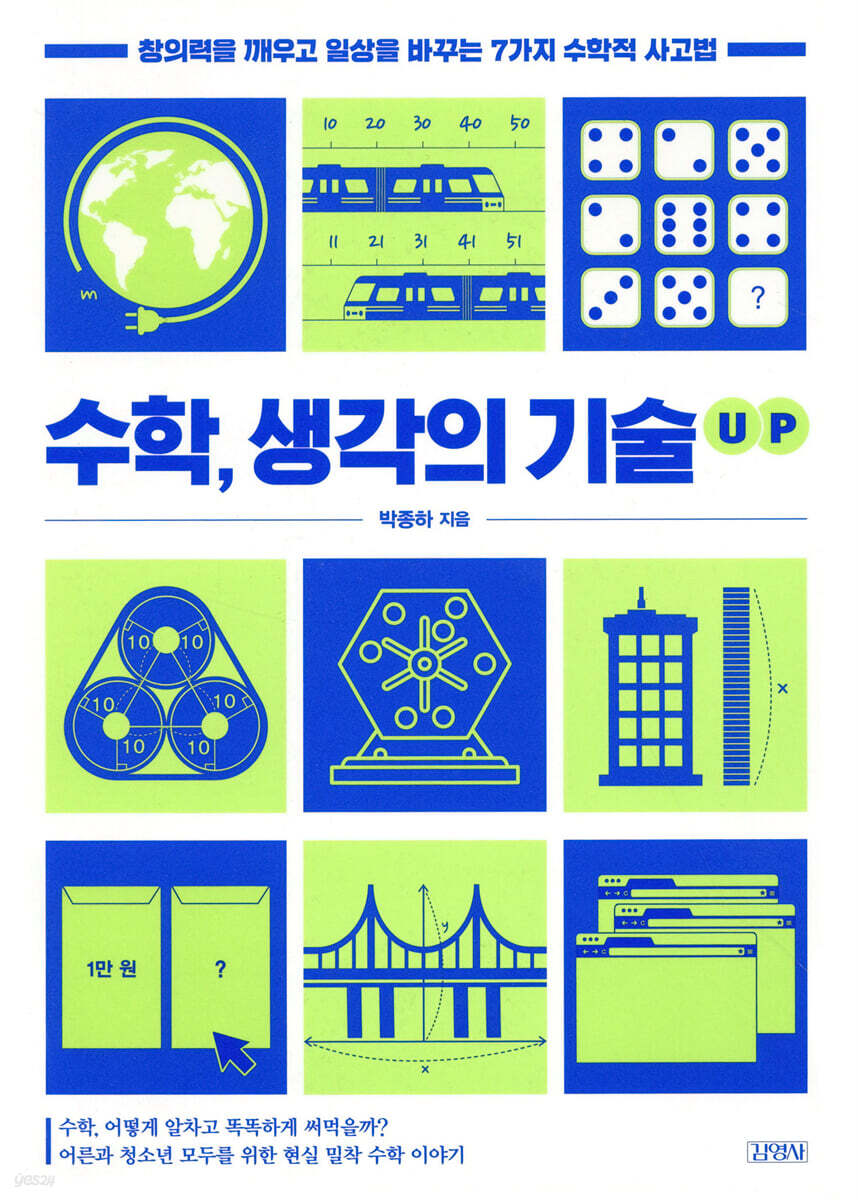
Math, Thinking Skills UP
 |
Description
Book Introduction
“A new discovery of a math book that is more useful than self-help books!”
A realistic math story for both adults and teenagers.
7 mathematical thinking techniques that will transform you into a more studious and more productive person!
From the college entrance exam and job interviews to artificial intelligence and TV entertainment, math is sought after in countless places.
But still, many people say that math is difficult and remain as dropouts.
What is the true nature of mathematics, hidden behind complex formulas and proofs? Park Jong-ha, a doctor of mathematics and a popular self-development lecturer, asserts that the essence of mathematics is "thinking."
This book teaches seven mathematical thinking methods that can become weapons in our lives, based on mathematical problems that anyone with even a middle school level of mathematical knowledge can understand and enjoy.
As you read through the various and extensive solution processes, you will discover the fun of mathematics and your ability to think for yourself will become stronger.
A realistic math story for both adults and teenagers.
7 mathematical thinking techniques that will transform you into a more studious and more productive person!
From the college entrance exam and job interviews to artificial intelligence and TV entertainment, math is sought after in countless places.
But still, many people say that math is difficult and remain as dropouts.
What is the true nature of mathematics, hidden behind complex formulas and proofs? Park Jong-ha, a doctor of mathematics and a popular self-development lecturer, asserts that the essence of mathematics is "thinking."
This book teaches seven mathematical thinking methods that can become weapons in our lives, based on mathematical problems that anyone with even a middle school level of mathematical knowledge can understand and enjoy.
As you read through the various and extensive solution processes, you will discover the fun of mathematics and your ability to think for yourself will become stronger.
- You can preview some of the book's contents.
Preview
index
Introduction: Thinking in Mathematics
Chapter 1: Critical Thinking: Asking "Why?" About the Obvious
[Creativity Museum] Can two parallel lines ever intersect? | Euclid's axioms | The man who predicted stock prices 10 times in a row | The magical Fibonacci sequence | A Jewish mother's questioning method | Pythagorean irrational numbers and Socrates' questions
Chapter 2: Conceptual Thinking: Discovering the Essence
[Creativity Museum] What is a picture? | The number of natural numbers and even numbers is equal: Galileo's argument |
0.99999… = 1, is it true? | Dozens of ways to quarter a square | Why soda cans are round: Appropriate technology | Creation is imitation of concepts | How to study math well
Chapter 3: Connective Thinking: Connecting Strange Things
[Creativity Museum] How is wise wisdom acquired? | Bridging language and mathematics | Connecting pictures and formulas | The Pythagorean theorem challenge | Greek and Babylonian thinking | Thinking with your eyes
Chapter 4: Transformational Thinking: Approaching from a Different Perspective
[Creativity Museum] I think I could do something like this, too. | Shifting Perspectives | Approaching Indirectly | Fermi Estimation | Seeing the Other Side | Seeing the Other, Not Myself
Chapter 5: Pattern Thinking: Simplify to Solve
[Creativity Museum] How can you tell it's his work at first glance? | How many squares are there on a Go board? | Discovering simple patterns in complex problems | Finding patterns through observation | Finding key points | Simplifying
Chapter 6: Dimensional Thinking: Thinking One Level Above
[Creativity Museum] Can You Imagine the Fourth Dimension? | Thinking Three-Dimensionally | Thinking Strategically | Metacognition: What Top Students Have in Common | Thinking Beyond Logic | Yang Ja-taek: Killing Two Birds at Once
Chapter 7: Contradictory Thinking: Acknowledging and Enjoying Paradoxes
[Creativity Museum] Can the Infinite Exist? | The Unanswerable: Paradox | Not a Paradox, Just Our Illusion | The Liar's Paradox | The Möbius Strip | Our Reality Is a Paradox
Chapter 1: Critical Thinking: Asking "Why?" About the Obvious
[Creativity Museum] Can two parallel lines ever intersect? | Euclid's axioms | The man who predicted stock prices 10 times in a row | The magical Fibonacci sequence | A Jewish mother's questioning method | Pythagorean irrational numbers and Socrates' questions
Chapter 2: Conceptual Thinking: Discovering the Essence
[Creativity Museum] What is a picture? | The number of natural numbers and even numbers is equal: Galileo's argument |
0.99999… = 1, is it true? | Dozens of ways to quarter a square | Why soda cans are round: Appropriate technology | Creation is imitation of concepts | How to study math well
Chapter 3: Connective Thinking: Connecting Strange Things
[Creativity Museum] How is wise wisdom acquired? | Bridging language and mathematics | Connecting pictures and formulas | The Pythagorean theorem challenge | Greek and Babylonian thinking | Thinking with your eyes
Chapter 4: Transformational Thinking: Approaching from a Different Perspective
[Creativity Museum] I think I could do something like this, too. | Shifting Perspectives | Approaching Indirectly | Fermi Estimation | Seeing the Other Side | Seeing the Other, Not Myself
Chapter 5: Pattern Thinking: Simplify to Solve
[Creativity Museum] How can you tell it's his work at first glance? | How many squares are there on a Go board? | Discovering simple patterns in complex problems | Finding patterns through observation | Finding key points | Simplifying
Chapter 6: Dimensional Thinking: Thinking One Level Above
[Creativity Museum] Can You Imagine the Fourth Dimension? | Thinking Three-Dimensionally | Thinking Strategically | Metacognition: What Top Students Have in Common | Thinking Beyond Logic | Yang Ja-taek: Killing Two Birds at Once
Chapter 7: Contradictory Thinking: Acknowledging and Enjoying Paradoxes
[Creativity Museum] Can the Infinite Exist? | The Unanswerable: Paradox | Not a Paradox, Just Our Illusion | The Liar's Paradox | The Möbius Strip | Our Reality Is a Paradox
Detailed image

Into the book
We are now facing a new civilization.
To adapt and advance in this new world, characterized by terms like the Fourth Industrial Revolution, artificial intelligence, and big data, mathematics is essential.
Mathematics demonstrates its power in a wide range of fields, and it is always hidden behind the amazing experiences of everyday life.
---From "Entering"
The first step in mathematical thinking is to validate your thoughts.
Mathematical thinking involves having a process of checking what other people say or what you think.
It's asking questions like "Why is that?" or "Does it really have to be that way?" about something so obvious.
Math is something that we learn more and more deeply through questions like these.
---From "Chapter 1: Critical Thinking"
My personal favorite way to study is to put down a large blank piece of paper, like the back of a calendar, and write down what I've studied on it without looking at the book.
I try to derive mathematical formulas and also give problems with the thought, 'If I were a teacher, I would give problems like this.'
The more you fill in blank pages without looking at the book, the more you will study.
---From "Chapter 2: Conceptual Thinking"
Visualization is the art of thinking with your eyes.
At first, it might seem strange to represent formulas graphically.
But after repeating it a few times, the solution will start to appear as if the eyes are thinking.
A visualized solution seems much clearer and wiser than a bunch of fancy formulas.
---From "Chapter 3 Connective Thinking"
Most math problems are best solved in a straightforward manner.
Because there is a set fastest way to solve the problem and the test time is limited.
But you shouldn't give up just because it doesn't work out in a direct way.
We need to quickly change our approach and use indirect methods.
It may be a headache and take a long time, but through that process, you will be able to think more flexibly.
---From "Chapter 4 Transformational Thinking"
As such, the key to problem solving is not simple calculations.
Being good at complex calculations is not a skill, but converting complex problems into simpler forms is the real skill.
Sometimes you can turn one complex problem into several simpler ones.
Since simple problems are easier to solve than complex problems, breaking a complex problem down into simpler forms is a good strategy.
---From "Chapter 5 Pattern Thinking"
If I can't properly distinguish between what I know and what I don't know, it will be difficult to learn proactively.
This is also true for adults.
People with high metacognitive abilities, such as knowing exactly who they are and developing their strengths or finding opportunities based on a sound understanding of their circumstances, lead proactive and successful lives.
---From "Chapter 6 Dimensional Thinking"
The reality is a tangled web of certainty and uncertainty, logic and illogicality.
Wouldn't it be boring if everything were rational and the world were filled only with things we could understand?
The world is ambiguous, and psychologist Robert Sternberg points out that “it is wise to tolerate ambiguity.”
Rather than turning away from ambiguity, it is the attitude of a wise person to find new wisdom in it.
To adapt and advance in this new world, characterized by terms like the Fourth Industrial Revolution, artificial intelligence, and big data, mathematics is essential.
Mathematics demonstrates its power in a wide range of fields, and it is always hidden behind the amazing experiences of everyday life.
---From "Entering"
The first step in mathematical thinking is to validate your thoughts.
Mathematical thinking involves having a process of checking what other people say or what you think.
It's asking questions like "Why is that?" or "Does it really have to be that way?" about something so obvious.
Math is something that we learn more and more deeply through questions like these.
---From "Chapter 1: Critical Thinking"
My personal favorite way to study is to put down a large blank piece of paper, like the back of a calendar, and write down what I've studied on it without looking at the book.
I try to derive mathematical formulas and also give problems with the thought, 'If I were a teacher, I would give problems like this.'
The more you fill in blank pages without looking at the book, the more you will study.
---From "Chapter 2: Conceptual Thinking"
Visualization is the art of thinking with your eyes.
At first, it might seem strange to represent formulas graphically.
But after repeating it a few times, the solution will start to appear as if the eyes are thinking.
A visualized solution seems much clearer and wiser than a bunch of fancy formulas.
---From "Chapter 3 Connective Thinking"
Most math problems are best solved in a straightforward manner.
Because there is a set fastest way to solve the problem and the test time is limited.
But you shouldn't give up just because it doesn't work out in a direct way.
We need to quickly change our approach and use indirect methods.
It may be a headache and take a long time, but through that process, you will be able to think more flexibly.
---From "Chapter 4 Transformational Thinking"
As such, the key to problem solving is not simple calculations.
Being good at complex calculations is not a skill, but converting complex problems into simpler forms is the real skill.
Sometimes you can turn one complex problem into several simpler ones.
Since simple problems are easier to solve than complex problems, breaking a complex problem down into simpler forms is a good strategy.
---From "Chapter 5 Pattern Thinking"
If I can't properly distinguish between what I know and what I don't know, it will be difficult to learn proactively.
This is also true for adults.
People with high metacognitive abilities, such as knowing exactly who they are and developing their strengths or finding opportunities based on a sound understanding of their circumstances, lead proactive and successful lives.
---From "Chapter 6 Dimensional Thinking"
The reality is a tangled web of certainty and uncertainty, logic and illogicality.
Wouldn't it be boring if everything were rational and the world were filled only with things we could understand?
The world is ambiguous, and psychologist Robert Sternberg points out that “it is wise to tolerate ambiguity.”
Rather than turning away from ambiguity, it is the attitude of a wise person to find new wisdom in it.
---From "Chapter 7 Contradictory Thinking"
Publisher's Review
“Why do you study math?” “Because it’s fun and useful!”
A realistic math book for adults and teenagers to read together
Study math and you'll discover new possibilities you've never known before.
Why do we learn mathematics? With the advent of the Fourth Industrial Revolution, the value of mathematics is rising by the day, but a clear answer to this question remains elusive.
Math is necessary for the college entrance exam to get into a good university and for the aptitude test to get a job at a good company.
But the ultimate reason we study mathematics is to solve everyday problems.
People who are good at math go beyond simply solving math problems with ease.
A person who knows how to express the real-world problems he or she faces in mathematical language such as numbers and shapes and solve them using mathematical methods is a person who is truly good at mathematics.
A book titled "Mathematics, Upgrading Your Thinking Skills," which contains seven mathematical thinking methods that awaken creativity and change your daily life, has been published.
In this book, author Jong-ha Park, a KAIST graduate with a PhD in mathematics and a self-development instructor, speaks to the countless math dropouts who shy away from complex calculations.
Mathematics is quite fun and a very practical subject.
Through engaging illustrations and quizzes, we help break down barriers to math and help students discover fun and value.
“When we think of mathematics, we often think of complex calculations.
Or maybe you think of it primarily as solving difficult equations using mathematical concepts.
But that is 'mathematics in the narrow sense'.
As we have seen above, the process of abstracting general problems, expressing them mathematically, solving them, and applying them to one's own problems can be called 'mathematics in a broad sense.' _ In the text
The essence of mathematics is not calculation, but 'thinking'!
7 Mathematical Thinking Techniques That Will Turn You into a Study-Oriented, Work-Oriented Person
When we think of mathematics, most people think of problems with complex formulas that are difficult to understand.
But mathematics is a subject that teaches the skill of thinking.
Calculation is just an occasional step in the process of thinking mathematically.
The phrase 'thinking mathematically' includes both the meaning of organizing thoughts systematically and establishing order, and the meaning of stimulating the brain to imagine freely.
This book, consisting of seven chapters, introduces seven mathematical thinking methods, one for each chapter, that systematically discover new possibilities through free imagination and intuition.
We open the door to the 'Creativity Museum' featuring famous paintings such as René Magritte's "Euclid's Walk" and Munch's "The Scream" and teach the skills of thinking that can become weapons in our lives.
· Critical thinking: Question what seems obvious.
Mathematical thinking is a process of checking whether my own thoughts, as well as those of others, are correct and finding errors and misconceptions.
· Conceptual thinking: Ask the question 'what' about an object or phenomenon and come up with your own definition.
To solve math problems, you need to know the core concepts.
· Connective thinking: Let's solve invisible problems by replacing them with visible formulas or shapes.
The core of mathematics is expressing everyday problems in mathematical language.
· Transformational thinking: When a problem doesn't work, try approaching it differently.
Sometimes, indirectly or from the opposite perspective, flexible thinking can help solve problems.
· Pattern thinking: To solve a problem, first identify the pattern.
All mathematics has patterns, and if you can identify the patterns, you can solve even difficult problems.
· Dimensional thinking: Go to a higher dimension and look at the whole picture.
The ability to look at the whole picture from one level and adjust it, called 'metacognitive ability,' is essential for successful people.
· Contradictory thinking: Embrace and enjoy paradoxes.
Mathematics is a discipline that demands rational answers rather than a single answer, and accepting contradictions opens up new possibilities.
Mathematics is a language that allows us to think more wisely and intelligently.
You can develop your thinking power by experiencing and learning mathematics.
In today's world of increasing uncertainty, mathematical thinking that can most wisely address unanswered questions is more important than ever.
The world's most creative organizations, Silicon Valley and Wall Street, value the ability to find approximate answers through logical reasoning, called "Fermi estimation."
In today's world, where it's more important to intelligently discover the meaning of data than simply collecting it, we need the skills to think mathematically.
“Solving math problems always requires a fresh perspective.
Open-mindedness and provocative challenges are the spirit of mathematics.
It is very difficult to break out of a mindset.
But please remember that it brings valuable results.” _ From the text
No difficult formulas! Even those who fail are OK!
Discover the amazing fun and usefulness of mathematics with just basic knowledge.
“How many taxis are there in Seoul?” is one of the most common questions asked in job interviews.
At this point, mathematics is needed to provide a logical and original answer.
In 『Mathematics, Thinking Skills UP』, we have compiled over 100 logic quizzes in the form of 'thought experiments', including common interview questions at major domestic companies and riddles passed down through the ages.
All of the math problems covered in this book fall under recreational math, so anyone with even very basic math knowledge can enjoy them.
Just watching the process of finding the correct answer to a 'thought experiment' that transcends time and borders can not only spark interest in mathematics but also greatly develop mathematical thinking skills.
How should I study mathematics? Contrary to the common misconception that mathematics is difficult, it's a subject anyone can master to a high level.
This book says that many students drop out because they are 'frustrated by the reality that they cannot solve difficult problems.'
But just as creation begins with imitation, following the problem-solving methods presented in this book will help you understand the content and sometimes even solve problems in a different way than existing solutions.
Since there isn't much to remember in math, let's study with the mindset of filling in a blank sheet of paper rather than memorizing it.
From students to teachers, from office workers to CEOs, you will soon become someone who is good at using math.
“When studying math, average students buy several easy workbooks and solve them as they come across them.
I feel relieved that there are so many problems that can be solved.
On the other hand, students who are good at math buy a difficult workbook and spend a long time solving problems.
“I would rather endure the uncomfortable time of getting wrong on questions I don’t know than feel relieved by getting many questions I already know right.” _ From the text
A realistic math book for adults and teenagers to read together
Study math and you'll discover new possibilities you've never known before.
Why do we learn mathematics? With the advent of the Fourth Industrial Revolution, the value of mathematics is rising by the day, but a clear answer to this question remains elusive.
Math is necessary for the college entrance exam to get into a good university and for the aptitude test to get a job at a good company.
But the ultimate reason we study mathematics is to solve everyday problems.
People who are good at math go beyond simply solving math problems with ease.
A person who knows how to express the real-world problems he or she faces in mathematical language such as numbers and shapes and solve them using mathematical methods is a person who is truly good at mathematics.
A book titled "Mathematics, Upgrading Your Thinking Skills," which contains seven mathematical thinking methods that awaken creativity and change your daily life, has been published.
In this book, author Jong-ha Park, a KAIST graduate with a PhD in mathematics and a self-development instructor, speaks to the countless math dropouts who shy away from complex calculations.
Mathematics is quite fun and a very practical subject.
Through engaging illustrations and quizzes, we help break down barriers to math and help students discover fun and value.
“When we think of mathematics, we often think of complex calculations.
Or maybe you think of it primarily as solving difficult equations using mathematical concepts.
But that is 'mathematics in the narrow sense'.
As we have seen above, the process of abstracting general problems, expressing them mathematically, solving them, and applying them to one's own problems can be called 'mathematics in a broad sense.' _ In the text
The essence of mathematics is not calculation, but 'thinking'!
7 Mathematical Thinking Techniques That Will Turn You into a Study-Oriented, Work-Oriented Person
When we think of mathematics, most people think of problems with complex formulas that are difficult to understand.
But mathematics is a subject that teaches the skill of thinking.
Calculation is just an occasional step in the process of thinking mathematically.
The phrase 'thinking mathematically' includes both the meaning of organizing thoughts systematically and establishing order, and the meaning of stimulating the brain to imagine freely.
This book, consisting of seven chapters, introduces seven mathematical thinking methods, one for each chapter, that systematically discover new possibilities through free imagination and intuition.
We open the door to the 'Creativity Museum' featuring famous paintings such as René Magritte's "Euclid's Walk" and Munch's "The Scream" and teach the skills of thinking that can become weapons in our lives.
· Critical thinking: Question what seems obvious.
Mathematical thinking is a process of checking whether my own thoughts, as well as those of others, are correct and finding errors and misconceptions.
· Conceptual thinking: Ask the question 'what' about an object or phenomenon and come up with your own definition.
To solve math problems, you need to know the core concepts.
· Connective thinking: Let's solve invisible problems by replacing them with visible formulas or shapes.
The core of mathematics is expressing everyday problems in mathematical language.
· Transformational thinking: When a problem doesn't work, try approaching it differently.
Sometimes, indirectly or from the opposite perspective, flexible thinking can help solve problems.
· Pattern thinking: To solve a problem, first identify the pattern.
All mathematics has patterns, and if you can identify the patterns, you can solve even difficult problems.
· Dimensional thinking: Go to a higher dimension and look at the whole picture.
The ability to look at the whole picture from one level and adjust it, called 'metacognitive ability,' is essential for successful people.
· Contradictory thinking: Embrace and enjoy paradoxes.
Mathematics is a discipline that demands rational answers rather than a single answer, and accepting contradictions opens up new possibilities.
Mathematics is a language that allows us to think more wisely and intelligently.
You can develop your thinking power by experiencing and learning mathematics.
In today's world of increasing uncertainty, mathematical thinking that can most wisely address unanswered questions is more important than ever.
The world's most creative organizations, Silicon Valley and Wall Street, value the ability to find approximate answers through logical reasoning, called "Fermi estimation."
In today's world, where it's more important to intelligently discover the meaning of data than simply collecting it, we need the skills to think mathematically.
“Solving math problems always requires a fresh perspective.
Open-mindedness and provocative challenges are the spirit of mathematics.
It is very difficult to break out of a mindset.
But please remember that it brings valuable results.” _ From the text
No difficult formulas! Even those who fail are OK!
Discover the amazing fun and usefulness of mathematics with just basic knowledge.
“How many taxis are there in Seoul?” is one of the most common questions asked in job interviews.
At this point, mathematics is needed to provide a logical and original answer.
In 『Mathematics, Thinking Skills UP』, we have compiled over 100 logic quizzes in the form of 'thought experiments', including common interview questions at major domestic companies and riddles passed down through the ages.
All of the math problems covered in this book fall under recreational math, so anyone with even very basic math knowledge can enjoy them.
Just watching the process of finding the correct answer to a 'thought experiment' that transcends time and borders can not only spark interest in mathematics but also greatly develop mathematical thinking skills.
How should I study mathematics? Contrary to the common misconception that mathematics is difficult, it's a subject anyone can master to a high level.
This book says that many students drop out because they are 'frustrated by the reality that they cannot solve difficult problems.'
But just as creation begins with imitation, following the problem-solving methods presented in this book will help you understand the content and sometimes even solve problems in a different way than existing solutions.
Since there isn't much to remember in math, let's study with the mindset of filling in a blank sheet of paper rather than memorizing it.
From students to teachers, from office workers to CEOs, you will soon become someone who is good at using math.
“When studying math, average students buy several easy workbooks and solve them as they come across them.
I feel relieved that there are so many problems that can be solved.
On the other hand, students who are good at math buy a difficult workbook and spend a long time solving problems.
“I would rather endure the uncomfortable time of getting wrong on questions I don’t know than feel relieved by getting many questions I already know right.” _ From the text
GOODS SPECIFICS
- Date of issue: January 10, 2023
- Page count, weight, size: 464 pages | 698g | 150*210*25mm
- ISBN13: 9788934966159
You may also like
카테고리
korean


korean

![GQ KOREA Mark (Monthly): December [2025]](http://librairie.coreenne.fr/cdn/shop/files/8ef265dbbfbf186523ed75ba7319009d.jpg?v=1765340328&width=3840)


