

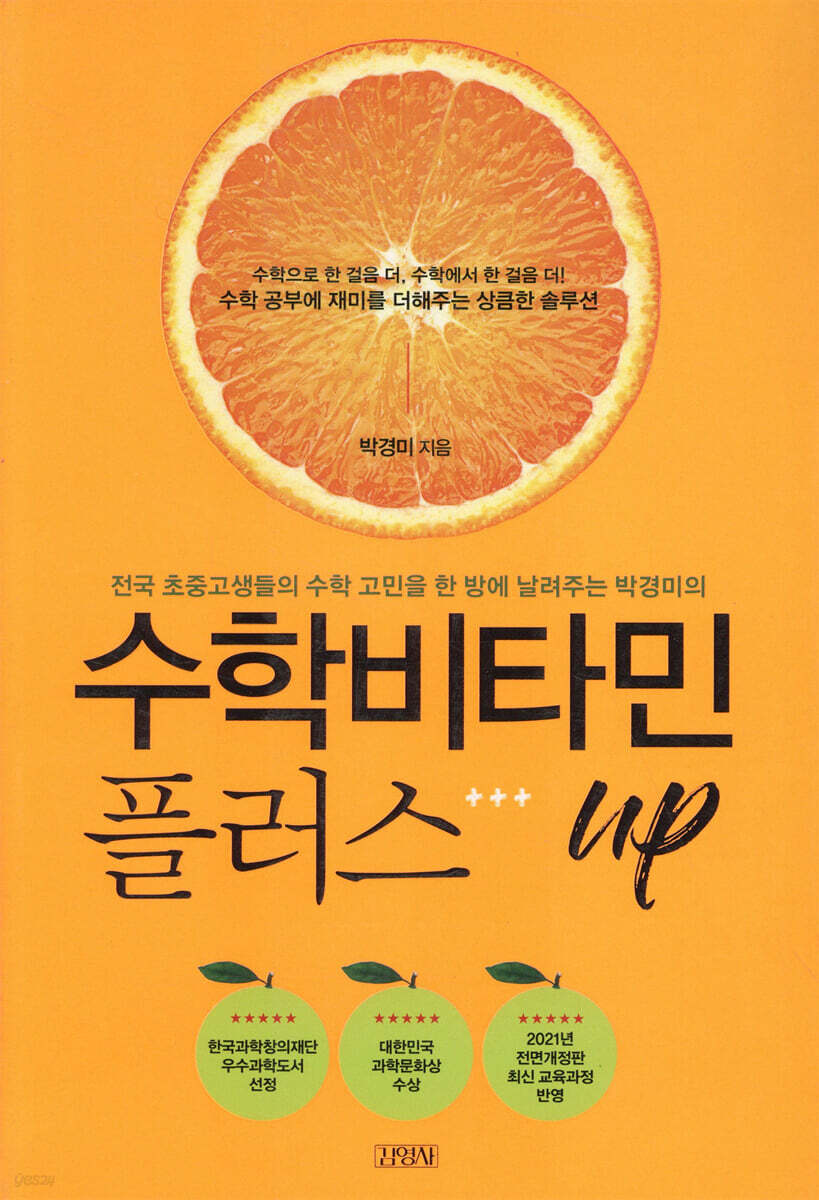
Math Vitamin Plus UP
 |
Description
Book Introduction
It has created a math syndrome in Korea, from elementary school students to the general public.
The Legendary Math Textbook: Math Vitamin Plus UP
More fun, easier, newer
Back to the revised and expanded edition!
Park Kyung-mi's "Math Vitamin Plus UP," which has solved the math problems of elementary, middle, and high school students across the country, is back with a revised and expanded edition.
Why are cold viruses shaped like icosahedrons? What do Son Heung-min, Park Ji-sung, Park Chan-ho, and Michael Jordan have in common? Can a genius mathematician win money at a casino? A mathematical story filled with mystery, infinity, romance, and emotion hidden in history, art, nature, science, and everyday life!
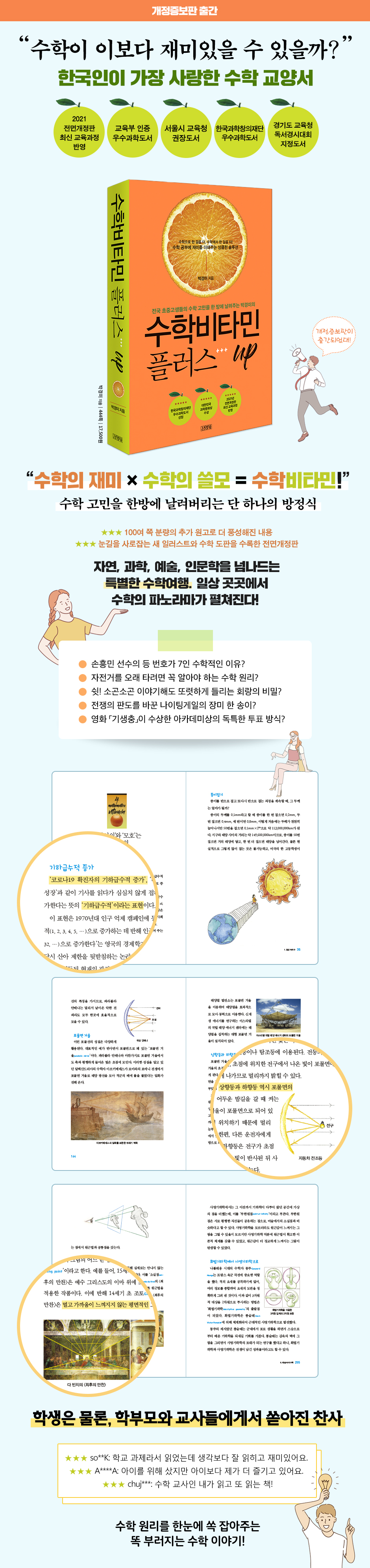
One step further into math, one step further in math! "Math Vitamin Plus UP" reflects the latest curriculum, completely updating the existing content and adding over 100 pages of manuscripts, making it even more enriching.
Math principles related to the subject are incorporated into fun math stories, so as you read, you will find yourself enjoying math class without even realizing it.
In addition, it includes warm illustrations and stylish photo plates, has a new cover, and the text is neatly organized.
It will be of great help to elementary, middle, and high school students, as well as general readers who want to fill in their mathematical knowledge, in understanding mathematics more easily and enjoyably.
This is a book that allows you to take a big step closer to mathematics, which still feels distant, and further helps you take a big step into the world of mathematics.
The Legendary Math Textbook: Math Vitamin Plus UP
More fun, easier, newer
Back to the revised and expanded edition!
Park Kyung-mi's "Math Vitamin Plus UP," which has solved the math problems of elementary, middle, and high school students across the country, is back with a revised and expanded edition.
Why are cold viruses shaped like icosahedrons? What do Son Heung-min, Park Ji-sung, Park Chan-ho, and Michael Jordan have in common? Can a genius mathematician win money at a casino? A mathematical story filled with mystery, infinity, romance, and emotion hidden in history, art, nature, science, and everyday life!
One step further into math, one step further in math! "Math Vitamin Plus UP" reflects the latest curriculum, completely updating the existing content and adding over 100 pages of manuscripts, making it even more enriching.
Math principles related to the subject are incorporated into fun math stories, so as you read, you will find yourself enjoying math class without even realizing it.
In addition, it includes warm illustrations and stylish photo plates, has a new cover, and the text is neatly organized.
It will be of great help to elementary, middle, and high school students, as well as general readers who want to fill in their mathematical knowledge, in understanding mathematics more easily and enjoyably.
This is a book that allows you to take a big step closer to mathematics, which still feels distant, and further helps you take a big step into the world of mathematics.
- You can preview some of the book's contents.
Preview
index
introduction
Chapter 1: Numbers in Everyday Life
1.
The three-legged octopus has three legs
2.
The genius behind Arabic numerals
3.
Gulliver's Travels and the Duplicate System
4.
'Mysterious' and 'ambiguous' are units of numbers
5.
The eerie coincidence of number 11
6.
13 Phobias and Defensiveness
7.
Same number whether you read it forward or backward
8.
Sports stars' jersey numbers
9.
Decrypt the password
Chapter 2: Algebra in Everyday Life
1.
The verification number in the barcode is a safety device
2.
The spirit of saving on A4 paper
3.
Go-Stop and equations
4.
Ladder climbing and biorhythms
5.
The Mathematics of Bicycles
6.
Unit expressed in logarithms
7.
Arecibo Message
Chapter 3: Geometry in Everyday Life
1.
Round table and manhole cover
2.
Pythagorean Winning Odds in Baseball
3.
Pentagram
4.
One-stroke calligraphy
5.
A small world connected in six steps
6.
Find the maze
7.
Parabolic and parabolic antennas
8.
Ellipse and Whispering Corridor
9.
The curves and soap film design of traditional roof tiles
10.
Fruit stacking and knotting
Chapter 4: Statistics in Everyday Life
1.
Know the percentage right away
2.
The magic of proportions
3.
The magic of graphs
4.
Paradox of the Average
5.
The Truth and Fiction of Opinion Polls
Chapter 5: Probability in Everyday Life
1.
Lotto odds
2.
Poker odds
3.
Probability of Yut Nori
4.
Murphy's Law and Sally's Law
5.
Sports odds
Chapter 6: Mathematics in Art
1.
Mathematics in Music
2.
Mathematics in Art
3.
Mathematics in Literature
4.
Mathematics in Architecture
5.
Mathematics in Film
Chapter 7: Mathematics in Nature
1.
The Mathematics of Bees
2.
The virus is an icosahedron
3.
Soccer ball and clathrin
4.
The number of petals is a Fibonacci number
Chapter 8: Mathematics in Eastern History
1.
A Revisit to the History of Eastern Mathematics
2.
Ingenious equation solutions
3.
The binary of the protagonist
4.
The magical power of the magic square
Chapter 9: Mathematics in Western History
1.
Mathematics in the Seven Wonders of the World
2.
Can Achilles overtake the tortoise?
3.
A history of mathematics centered on pi
4.
The mathematical tombstone of a mathematician
5.
Who was the first discoverer?
6.
Gambler's Ball
7.
Apple Computer's logo and mathematician Turing
Chapter 10: Seeing the World Through Mathematics
1.
The trap of absolute truth
2.
The Zeitgeist Seen Through Mathematics
3.
Mathematical terms appearing in the article
4.
Koreanization and Sino-Koreanization of mathematical terms
5.
Women are bad at math?
6.
The Nobel Prize in Mathematics is the Abel Prize
Epilogue: Getting to Know Math
Chapter 1: Numbers in Everyday Life
1.
The three-legged octopus has three legs
2.
The genius behind Arabic numerals
3.
Gulliver's Travels and the Duplicate System
4.
'Mysterious' and 'ambiguous' are units of numbers
5.
The eerie coincidence of number 11
6.
13 Phobias and Defensiveness
7.
Same number whether you read it forward or backward
8.
Sports stars' jersey numbers
9.
Decrypt the password
Chapter 2: Algebra in Everyday Life
1.
The verification number in the barcode is a safety device
2.
The spirit of saving on A4 paper
3.
Go-Stop and equations
4.
Ladder climbing and biorhythms
5.
The Mathematics of Bicycles
6.
Unit expressed in logarithms
7.
Arecibo Message
Chapter 3: Geometry in Everyday Life
1.
Round table and manhole cover
2.
Pythagorean Winning Odds in Baseball
3.
Pentagram
4.
One-stroke calligraphy
5.
A small world connected in six steps
6.
Find the maze
7.
Parabolic and parabolic antennas
8.
Ellipse and Whispering Corridor
9.
The curves and soap film design of traditional roof tiles
10.
Fruit stacking and knotting
Chapter 4: Statistics in Everyday Life
1.
Know the percentage right away
2.
The magic of proportions
3.
The magic of graphs
4.
Paradox of the Average
5.
The Truth and Fiction of Opinion Polls
Chapter 5: Probability in Everyday Life
1.
Lotto odds
2.
Poker odds
3.
Probability of Yut Nori
4.
Murphy's Law and Sally's Law
5.
Sports odds
Chapter 6: Mathematics in Art
1.
Mathematics in Music
2.
Mathematics in Art
3.
Mathematics in Literature
4.
Mathematics in Architecture
5.
Mathematics in Film
Chapter 7: Mathematics in Nature
1.
The Mathematics of Bees
2.
The virus is an icosahedron
3.
Soccer ball and clathrin
4.
The number of petals is a Fibonacci number
Chapter 8: Mathematics in Eastern History
1.
A Revisit to the History of Eastern Mathematics
2.
Ingenious equation solutions
3.
The binary of the protagonist
4.
The magical power of the magic square
Chapter 9: Mathematics in Western History
1.
Mathematics in the Seven Wonders of the World
2.
Can Achilles overtake the tortoise?
3.
A history of mathematics centered on pi
4.
The mathematical tombstone of a mathematician
5.
Who was the first discoverer?
6.
Gambler's Ball
7.
Apple Computer's logo and mathematician Turing
Chapter 10: Seeing the World Through Mathematics
1.
The trap of absolute truth
2.
The Zeitgeist Seen Through Mathematics
3.
Mathematical terms appearing in the article
4.
Koreanization and Sino-Koreanization of mathematical terms
5.
Women are bad at math?
6.
The Nobel Prize in Mathematics is the Abel Prize
Epilogue: Getting to Know Math
Detailed image
Into the book
Marcel Proust, author of the novel In Search of Lost Time, said, “The real voyage of discovery consists not in seeking new landscapes but in traveling with new eyes.”
I hope this book will serve as a guide to help you explore the world through the eyes of mathematics.
--- From "From the Preface"
In Gulliver's Travels, one foot in Lilliput is equivalent to one inch in Gulliver.
However, since 1 foot is 12 inches, Gulliver's height is 12 times the height of a dwarf, and since the body size is a three-dimensional volume, it is 1728 times the cube of 12, and as a result, Gulliver needs to eat for 1728 people.
Of course, this is not a scientifically convincing argument, as the lower your body weight, the more calories you need per unit of weight.
--- p.27 From “Chapter 1: Numbers in Everyday Life: Gulliver’s Travels and the Duplicate System”
The speed of walking at a comfortable pace is 5-6 km/h, and the speed of a car in the city is about 40-50 km/h, so the speed of a bicycle is somewhere in between the speed of a human walk and the speed of a car.
Walking allows you to fully savor the slowly changing scenery, while driving allows you to feel the sense of speed. Cycling, both in terms of speed and psychological aspects, is a hybrid that combines walking and driving.
--- p.115 From “Chapter 2 Algebra in Everyday Life: The Mathematics of Bicycles”
Let's analyze the 2018 professional baseball regular season records using the Pythagorean winning percentage formula.
In Doosan's case, the total points scored are 944, and the total points allowed are 756. If you put this into the winning percentage formula, Doosan's winning percentage becomes 0.6.
However, the actual winning percentage is 0.646, so there is some difference.
--- p.137 From “Chapter 3 Geometry in Everyday Life: Pythagorean Winning Odds in Baseball”
Big data, which has recently been attracting attention, is likened to the 'crude oil' of the 21st century.
Just as crude oil is extracted and processed into various products, analyzing big data can help us identify human thought and behavior patterns and create significant value by utilizing them in industries and services.
In the era of big data, statistical techniques for quickly processing massive and complex data are essential, so the importance of statistics is increasing day by day.
--- p.220 From “Chapter 4 Statistics in Everyday Life: The Truth and Falsehood of Opinion Polls”
There are 25 people on the soccer field: 22 players from each team, 1 referee, and 2 linesmen.
What's the probability that one of these people has the same birthday? It's a staggering 57%.
This is a hard-to-believe result, as it's easy to think that 366 people would have to gather to meet someone with the same birthday, considering that there are 365 days in a year.
--- p.236 From “Chapter 5 Probability in Everyday Life: Murphy’s Law and Sally’s Law”
Let's find out how the movie "Parasite" was chosen as the winner of the Oscar trophy.
The 2020 Academy Awards winners were decided by 8,469 Academy members, and the selection process was a two-step process.
In the first stage, five candidates are recommended for each category through preliminary voting, and in the second stage, voting is held on the five candidates to ultimately select one.
The second stage is simple because the winner is determined by which film receives the most votes among the nominees, but the first stage is a bit more complicated.
--- p.287 From “Chapter 6 Mathematics in Art: Mathematics in Film”
Many soccer fans stay up all night to watch Son Heung-min's spectacular dramatic goal in real time.
The soccer ball that moves dazzlingly and shakes the goal net in accordance with Son Heung-min's footwork is, in geometric terms, a 'truncated icosahedron'.
--- p.312 From “Chapter 7 Mathematics in Nature: Soccer Ball and Clathrin”
The magic square can be seen as a symbol of harmony and balance in that each number appears only once and the sum of the up, down, left, right, and diagonals is the same.
Since ancient times, people have longed for a society where all walks of life participate equally and achieve harmony and balance.
Perhaps the reason humanity has been fascinated by magic squares is because they resemble the kind of society we desire.
--- p.354 From “Chapter 8 Mathematics in Eastern History: The Magical Power of the Magic Square”
Graham Moore, who won an Academy Award for his role in The Imitation Game, said at the awards ceremony, “Stay weird, Stay different.”
This is similar to the famous line from Steve Jobs' Stanford University commencement speech: “Stay hungry, stay foolish.”
Turing reincarnated as the Apple Computer logo, and an homage to Steve Jobs's remarks, they're all cool.
--- p.
390 From “Chapter 9 Mathematics in Western History: Apple Computer’s Logo and Mathematician Turing”
Considering that women had limited opportunities to learn mathematics in the past, the existence of female mathematicians who achieved remarkable achievements is all the more significant.
Now that women no longer have to endure the arduous challenges of life to become mathematicians, and that mathematics is no longer a field exclusively for men, I hope to see more and more female mathematicians.
--- p.422 From “Chapter 10: Seeing the World Through Mathematics: Are Women Bad at Math?”
When we experience how close mathematics is to our daily lives, we can recognize the significance and value of why we should learn mathematics.
If you personally experience the value of mathematics like this, wouldn't your heart feel lighter as you embark on the long-distance race called 'studying mathematics'?
I hope this book will serve as a guide to help you explore the world through the eyes of mathematics.
--- From "From the Preface"
In Gulliver's Travels, one foot in Lilliput is equivalent to one inch in Gulliver.
However, since 1 foot is 12 inches, Gulliver's height is 12 times the height of a dwarf, and since the body size is a three-dimensional volume, it is 1728 times the cube of 12, and as a result, Gulliver needs to eat for 1728 people.
Of course, this is not a scientifically convincing argument, as the lower your body weight, the more calories you need per unit of weight.
--- p.27 From “Chapter 1: Numbers in Everyday Life: Gulliver’s Travels and the Duplicate System”
The speed of walking at a comfortable pace is 5-6 km/h, and the speed of a car in the city is about 40-50 km/h, so the speed of a bicycle is somewhere in between the speed of a human walk and the speed of a car.
Walking allows you to fully savor the slowly changing scenery, while driving allows you to feel the sense of speed. Cycling, both in terms of speed and psychological aspects, is a hybrid that combines walking and driving.
--- p.115 From “Chapter 2 Algebra in Everyday Life: The Mathematics of Bicycles”
Let's analyze the 2018 professional baseball regular season records using the Pythagorean winning percentage formula.
In Doosan's case, the total points scored are 944, and the total points allowed are 756. If you put this into the winning percentage formula, Doosan's winning percentage becomes 0.6.
However, the actual winning percentage is 0.646, so there is some difference.
--- p.137 From “Chapter 3 Geometry in Everyday Life: Pythagorean Winning Odds in Baseball”
Big data, which has recently been attracting attention, is likened to the 'crude oil' of the 21st century.
Just as crude oil is extracted and processed into various products, analyzing big data can help us identify human thought and behavior patterns and create significant value by utilizing them in industries and services.
In the era of big data, statistical techniques for quickly processing massive and complex data are essential, so the importance of statistics is increasing day by day.
--- p.220 From “Chapter 4 Statistics in Everyday Life: The Truth and Falsehood of Opinion Polls”
There are 25 people on the soccer field: 22 players from each team, 1 referee, and 2 linesmen.
What's the probability that one of these people has the same birthday? It's a staggering 57%.
This is a hard-to-believe result, as it's easy to think that 366 people would have to gather to meet someone with the same birthday, considering that there are 365 days in a year.
--- p.236 From “Chapter 5 Probability in Everyday Life: Murphy’s Law and Sally’s Law”
Let's find out how the movie "Parasite" was chosen as the winner of the Oscar trophy.
The 2020 Academy Awards winners were decided by 8,469 Academy members, and the selection process was a two-step process.
In the first stage, five candidates are recommended for each category through preliminary voting, and in the second stage, voting is held on the five candidates to ultimately select one.
The second stage is simple because the winner is determined by which film receives the most votes among the nominees, but the first stage is a bit more complicated.
--- p.287 From “Chapter 6 Mathematics in Art: Mathematics in Film”
Many soccer fans stay up all night to watch Son Heung-min's spectacular dramatic goal in real time.
The soccer ball that moves dazzlingly and shakes the goal net in accordance with Son Heung-min's footwork is, in geometric terms, a 'truncated icosahedron'.
--- p.312 From “Chapter 7 Mathematics in Nature: Soccer Ball and Clathrin”
The magic square can be seen as a symbol of harmony and balance in that each number appears only once and the sum of the up, down, left, right, and diagonals is the same.
Since ancient times, people have longed for a society where all walks of life participate equally and achieve harmony and balance.
Perhaps the reason humanity has been fascinated by magic squares is because they resemble the kind of society we desire.
--- p.354 From “Chapter 8 Mathematics in Eastern History: The Magical Power of the Magic Square”
Graham Moore, who won an Academy Award for his role in The Imitation Game, said at the awards ceremony, “Stay weird, Stay different.”
This is similar to the famous line from Steve Jobs' Stanford University commencement speech: “Stay hungry, stay foolish.”
Turing reincarnated as the Apple Computer logo, and an homage to Steve Jobs's remarks, they're all cool.
--- p.
390 From “Chapter 9 Mathematics in Western History: Apple Computer’s Logo and Mathematician Turing”
Considering that women had limited opportunities to learn mathematics in the past, the existence of female mathematicians who achieved remarkable achievements is all the more significant.
Now that women no longer have to endure the arduous challenges of life to become mathematicians, and that mathematics is no longer a field exclusively for men, I hope to see more and more female mathematicians.
--- p.422 From “Chapter 10: Seeing the World Through Mathematics: Are Women Bad at Math?”
When we experience how close mathematics is to our daily lives, we can recognize the significance and value of why we should learn mathematics.
If you personally experience the value of mathematics like this, wouldn't your heart feel lighter as you embark on the long-distance race called 'studying mathematics'?
--- p.443 From “Epilogue: Becoming Familiar with Mathematics”
Publisher's Review
“Can math be more fun than this?”
The legendary must-read that captivated millions of students nationwide.
The protagonist of 'Math Syndrome' returns in a revised and expanded edition!
★★★ Ministry of Education-certified excellent science book
★★★ Outstanding Science Book from the Korea Foundation for the Advancement of Science and Creativity
★★★ Seoul Metropolitan Office of Education Recommended Books
★★★ Kyobo Book Centre's Top 10 Most-Loved Science Books of the Past Decade
★★★ A completely revised edition reflecting the latest curriculum!
The fun of math × the usefulness of math = math vitamins.
A refreshing formula that has helped countless students overcome their math struggles!
A more fun, easier, and innovative way to learn math! "Math Vitamin Plus," the national math textbook that breathes life into math classes for millions of students nationwide, has been upgraded and reborn as "Math Vitamin Plus UP."
This is a completely revised edition that reflects the latest curriculum, with revised episodes, pictures, and diagrams, and approximately 100 pages of new manuscripts added, making the content much newer and richer.
"Math Vitamin Plus UP" is composed of exciting stories that will help even those who think math is difficult, boring, and useless experience the fun and usefulness of math.
Just as vitamins help with the digestion and absorption of important nutrients, 'Math Vitamin' helps you easily learn mathematical principles and knowledge.
The author, who has been at the forefront of mathematics education, working to popularize mathematics as a teacher, professor, educational researcher, and member of the 20th National Assembly Education Committee, says that in order to complete the “long-distance race” called mathematics, one must first understand the fun and usefulness of mathematics.
To this end, we have presented interesting mathematical stories with photos and illustrations at an eye level suitable for elementary, middle, and high school students.
It is composed of short episodes so that you can read it lightly and in your spare time.
As you follow the story of mathematics, which crosses nature, science, art, and humanities, you will find yourself immersed in the study of mathematics before you know it.
“Is there any way to keep a tight grip on my math studies?”
A math story that will help you grasp the principles of math while reading it with fun.
A vivid panorama of mathematics unfolding before your eyes
One step closer to mathematics, one step further from mathematics!
Why do cold viruses form an icosahedron? Why does Son Heung-min wear the number 7? Can a genius mathematician win at a casino? These are questions I've never considered before, but they spark my curiosity and naturally lead me to become familiar with mathematics.
"Math Vitamin Plus UP," a leading math book that has captivated students, parents, teachers, and adults alike, shows us just how abundant math is around us, without a single complex mathematical formula.
Full of excitement, full of skill! A math story unfolds that will awaken your eyes to mathematics like a refreshing vitamin.
Numbers in Everyday Life: Why is "Octopus" in English? Is there an easy way to memorize the difficult sexagenary cycle, from "Gapja" and "Eulchuk" to "Imsul" and "Gyehae"? Why is Son Heung-min's jersey number 7? We explore the secrets behind numbers, the starting point of mathematics.
Algebra in Everyday Life: By examining barcodes and QR codes, credit cards, the proportions of A4 paper, bicycle gears, and more through a mathematical lens, you can understand how the relationships between numbers add value to everyday life.
Geometry in Everyday Life: Mathematics is also the 'study of space.'
Why does the pentagram appear so frequently in mystery novels, national flags, and art? What are the mathematical principles behind an eagle's flight? Subtle shifts in space can make a huge difference.
Statistics in Everyday Life: Why did novelist Mark Twain call statistics lies? Because it's easy to be fooled by them if you don't know them well.
Let's discover the truth hidden in statistics through various examples from real life.
Probability in Everyday Life: "God does not play dice." Why did Einstein say that? What are the most effective combinations in Yut Nori? How much does one point increase the odds of winning in a sports game? We delve into the unbelievable magic of probability.
Mathematics in Art: What mathematical metaphors are embedded in the novel "The Little Ball Launched by a Dwarf"? Is the golden ratio found in architecture coincidental or inevitable? The secret that adds emotion to art lies in mathematics.
We explore the influence of mathematics on various fields such as music, painting, architecture, and literature.
Mathematics in Nature: As you learn about why honeycombs are hexagonal, why the number of flower petals is a Fibonacci number, and why viruses are icosahedron-shaped, you will naturally develop a sense of awe for nature.
Mathematics in Eastern History: There is a tendency to talk about the development of mathematics in a Western-centric way, but in fact, mathematics has been driven by both the East and the West.
Rediscover the history of Eastern mathematics, from the principles of binary systems in the Book of Changes and the 60-year cycle to the magical power of the magic square.
Mathematics in Western History: Why are the pyramids so mysterious? How can we explain why Zeno's Paradox is wrong? Why does the Apple logo resemble a bitten apple? We revisit the ongoing development of mathematics, from past to future.
Seeing the World Through Mathematics: Are women bad at math? Are the mathematical terms we use in everyday life appropriate? Is mathematical knowledge truly absolute? We examine the world's prejudices about mathematics one by one and examine their validity.
It is also fun to learn the principles of living in the world through mathematics.
The legendary must-read that captivated millions of students nationwide.
The protagonist of 'Math Syndrome' returns in a revised and expanded edition!
★★★ Ministry of Education-certified excellent science book
★★★ Outstanding Science Book from the Korea Foundation for the Advancement of Science and Creativity
★★★ Seoul Metropolitan Office of Education Recommended Books
★★★ Kyobo Book Centre's Top 10 Most-Loved Science Books of the Past Decade
★★★ A completely revised edition reflecting the latest curriculum!
The fun of math × the usefulness of math = math vitamins.
A refreshing formula that has helped countless students overcome their math struggles!
A more fun, easier, and innovative way to learn math! "Math Vitamin Plus," the national math textbook that breathes life into math classes for millions of students nationwide, has been upgraded and reborn as "Math Vitamin Plus UP."
This is a completely revised edition that reflects the latest curriculum, with revised episodes, pictures, and diagrams, and approximately 100 pages of new manuscripts added, making the content much newer and richer.
"Math Vitamin Plus UP" is composed of exciting stories that will help even those who think math is difficult, boring, and useless experience the fun and usefulness of math.
Just as vitamins help with the digestion and absorption of important nutrients, 'Math Vitamin' helps you easily learn mathematical principles and knowledge.
The author, who has been at the forefront of mathematics education, working to popularize mathematics as a teacher, professor, educational researcher, and member of the 20th National Assembly Education Committee, says that in order to complete the “long-distance race” called mathematics, one must first understand the fun and usefulness of mathematics.
To this end, we have presented interesting mathematical stories with photos and illustrations at an eye level suitable for elementary, middle, and high school students.
It is composed of short episodes so that you can read it lightly and in your spare time.
As you follow the story of mathematics, which crosses nature, science, art, and humanities, you will find yourself immersed in the study of mathematics before you know it.
“Is there any way to keep a tight grip on my math studies?”
A math story that will help you grasp the principles of math while reading it with fun.
A vivid panorama of mathematics unfolding before your eyes
One step closer to mathematics, one step further from mathematics!
Why do cold viruses form an icosahedron? Why does Son Heung-min wear the number 7? Can a genius mathematician win at a casino? These are questions I've never considered before, but they spark my curiosity and naturally lead me to become familiar with mathematics.
"Math Vitamin Plus UP," a leading math book that has captivated students, parents, teachers, and adults alike, shows us just how abundant math is around us, without a single complex mathematical formula.
Full of excitement, full of skill! A math story unfolds that will awaken your eyes to mathematics like a refreshing vitamin.
Numbers in Everyday Life: Why is "Octopus" in English? Is there an easy way to memorize the difficult sexagenary cycle, from "Gapja" and "Eulchuk" to "Imsul" and "Gyehae"? Why is Son Heung-min's jersey number 7? We explore the secrets behind numbers, the starting point of mathematics.
Algebra in Everyday Life: By examining barcodes and QR codes, credit cards, the proportions of A4 paper, bicycle gears, and more through a mathematical lens, you can understand how the relationships between numbers add value to everyday life.
Geometry in Everyday Life: Mathematics is also the 'study of space.'
Why does the pentagram appear so frequently in mystery novels, national flags, and art? What are the mathematical principles behind an eagle's flight? Subtle shifts in space can make a huge difference.
Statistics in Everyday Life: Why did novelist Mark Twain call statistics lies? Because it's easy to be fooled by them if you don't know them well.
Let's discover the truth hidden in statistics through various examples from real life.
Probability in Everyday Life: "God does not play dice." Why did Einstein say that? What are the most effective combinations in Yut Nori? How much does one point increase the odds of winning in a sports game? We delve into the unbelievable magic of probability.
Mathematics in Art: What mathematical metaphors are embedded in the novel "The Little Ball Launched by a Dwarf"? Is the golden ratio found in architecture coincidental or inevitable? The secret that adds emotion to art lies in mathematics.
We explore the influence of mathematics on various fields such as music, painting, architecture, and literature.
Mathematics in Nature: As you learn about why honeycombs are hexagonal, why the number of flower petals is a Fibonacci number, and why viruses are icosahedron-shaped, you will naturally develop a sense of awe for nature.
Mathematics in Eastern History: There is a tendency to talk about the development of mathematics in a Western-centric way, but in fact, mathematics has been driven by both the East and the West.
Rediscover the history of Eastern mathematics, from the principles of binary systems in the Book of Changes and the 60-year cycle to the magical power of the magic square.
Mathematics in Western History: Why are the pyramids so mysterious? How can we explain why Zeno's Paradox is wrong? Why does the Apple logo resemble a bitten apple? We revisit the ongoing development of mathematics, from past to future.
Seeing the World Through Mathematics: Are women bad at math? Are the mathematical terms we use in everyday life appropriate? Is mathematical knowledge truly absolute? We examine the world's prejudices about mathematics one by one and examine their validity.
It is also fun to learn the principles of living in the world through mathematics.
GOODS SPECIFICS
- Publication date: August 10, 2021
- Page count, weight, size: 444 pages | 742g | 150*220*25mm
- ISBN13: 9788934988397
- ISBN10: 8934988398
You may also like
카테고리
korean


korean

![GQ KOREA Mark (Monthly): December [2025]](http://librairie.coreenne.fr/cdn/shop/files/8ef265dbbfbf186523ed75ba7319009d.jpg?v=1765340328&width=3840)


