

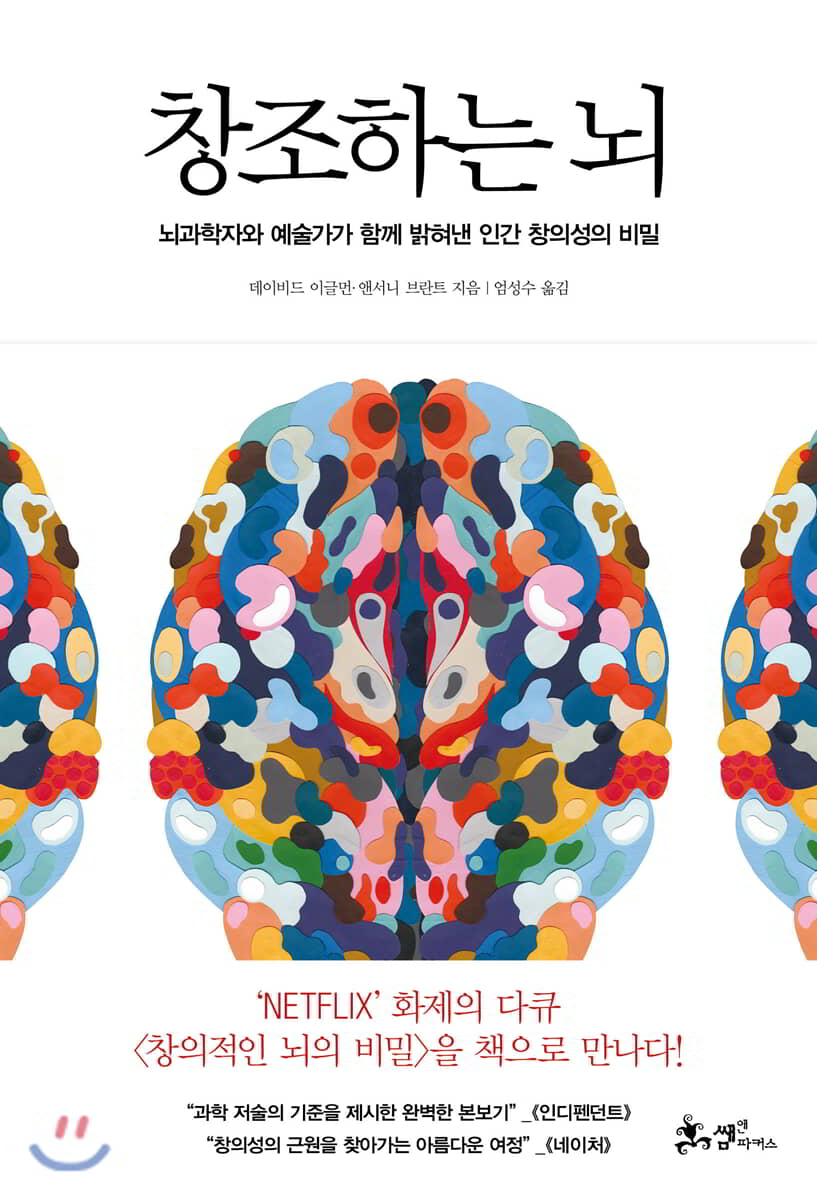
The creative brain
 |
Description
Book Introduction
This book contains an intellectual and exciting journey of world-renowned neuroscientist David Eagleman and composer Anthony Brandt, who has studied the human mind by combining art and science, to uncover the secrets of the brain and creativity. The two authors, focusing on their common research topic of "How the Brain Works," travel across five million years of human history, from robotics, computers, architecture, and artificial intelligence to literature, music, and art, analyzing great figures and innovative cases to get closer to the secrets of creativity. By examining creative and innovative art, science, and cutting-edge technological innovations, they uncover the threads of innovation that transcend each field. When people think of the words "creativity" or "innovation," they often think of a "lightning bolt from the blue" that sparks a brilliant idea. However, the author emphasizes that human beings' endless creation and innovation are in fact achieved by using past experiences and knowledge or something existing around them as raw materials. By analyzing numerous examples of creative works of art and innovative inventions recorded throughout history, the author summarized the "creative thinking methods displayed by the creative brain" into three strategies: "Bending," "Breaking," and "Blending." This book will invite readers with a keen interest in science to embark on a breathtaking and engaging intellectual journey, while offering entrepreneurs and businesspeople eager for innovation a glimpse into the boundless possibilities of creativity. |
- You can preview some of the book's contents.
Preview
index
Preface | An intellectual and daring adventure in search of the origins of deviant creativity
Part 1 | Something New Under the Sun
Chapter 1: Where Does Creativity Begin?
Chapter 2: The Roots of Creation and Innovation
Chapter 3_ Whiki: Transformation that Opens the Door to Possibility
Chapter 4: Splitting: Deconstructing the Materials of Creation
Chapter 5: Mixing: Infinite Combinations of Ideas
Chapter 6: A History of Failures in the Struggle for Creation
Part 2 | The Brain That Turns Imagination into Reality
Chapter 7: Is the Stradivarius a Perfect Instrument?
Chapter 8: A Novel with 47 Endings
Chapter 9_ Sometimes familiar, sometimes unfamiliar
Chapter 10: One Step Further Into the Fog
Part 3 | The Birth of Creativity
Chapter 11: What Makes Creative Companies Different and Why?
Chapter 12: Incubator for Future Innovators
Chapter 13: The Age of Creative Revolution
Acknowledgements
main
References
List of illustrations
Search
Part 1 | Something New Under the Sun
Chapter 1: Where Does Creativity Begin?
Chapter 2: The Roots of Creation and Innovation
Chapter 3_ Whiki: Transformation that Opens the Door to Possibility
Chapter 4: Splitting: Deconstructing the Materials of Creation
Chapter 5: Mixing: Infinite Combinations of Ideas
Chapter 6: A History of Failures in the Struggle for Creation
Part 2 | The Brain That Turns Imagination into Reality
Chapter 7: Is the Stradivarius a Perfect Instrument?
Chapter 8: A Novel with 47 Endings
Chapter 9_ Sometimes familiar, sometimes unfamiliar
Chapter 10: One Step Further Into the Fog
Part 3 | The Birth of Creativity
Chapter 11: What Makes Creative Companies Different and Why?
Chapter 12: Incubator for Future Innovators
Chapter 13: The Age of Creative Revolution
Acknowledgements
main
References
List of illustrations
Search
Detailed image

Into the book
There's something special about algorithms that work behind the scenes.
Humans are just one of many animal species, but why can't cows choreograph dances like humans? Why can't squirrels build elevators that take them to treetops? Why can't crocodiles invent speedboats? Thanks to evolutionary changes in the algorithms operating within our brains, humans absorb the world and create hypothetical versions of "what if?"
This book covers how that creative software works, why we have it, what we create, and where it's taking us.
In particular, it shows how the desire to shatter one's own expectations develops into humanity's 'deviant creativity'.
For example, by looking into the complex and rich world of art, science, and technology, we can discover clues to innovation that transcend each field.
--- p.15-16
Humans create endlessly.
When you put some kind of universal cooking utensil into the world, whether the raw material is linguistic, auditory, or visual, something new comes out of it.
Our innate cognitive abilities, multiplied by the efforts of countless Homo sapiens, have created a society that innovates at an ever-increasing pace, a society that thrives on the latest ideas.
It took a whopping 11,000 years from the Agricultural Revolution to the Industrial Revolution, but only 120 years from the Industrial Revolution to the invention of the light bulb.
It took only 90 years for humans to land on the moon.
From there, it took 22 years to get to the World Wide Web, and another 9 years to completely decode the human genome.
The picture presented by historical innovation is clear.
The time between significant innovations is rapidly shrinking! This is precisely what we expect from the human brain, which absorbs the planet's best ideas and improves them. --- pp. 62-63
Humanity always regenerates itself by destroying 'good things'.
Rotary phones gave way to push-button phones, brick-like cell phones morphed into flip phones and then into smartphones. TVs grew larger and thinner, and wireless TVs, curved TVs, and even 3D TVs emerged.
Despite all the innovations flowing into our cultural bloodstream, our thirst for the new remains unquenched.
But the human brain, which constantly pursues innovation, does not tolerate leaving something as is just because it is good enough.
--- p.176-177
Let us recall the fate of Beethoven's work, "Great Fugue."
When composing the piece, Beethoven ventured far from the hive, but when it turned out he had gone too far, he returned closer to the hive and replaced the last movement with a less ambitious one.
However, Beethoven insisted until the end of his life that the rejected “Great Fugue” was one of his greatest works.
The work, which went so far, was ignored for generations despite the composer's fame.
Even a century after Beethoven's death, critics still viewed the Great Fugue as "gloomy, vulgar, unimportant, unnatural, extravagant, intellectual, obscure, unplayable, foolish, mad, illogical, formless, and meaningless."
But Beethoven eventually cleared his name.
As the evaluation of his other music increased, even the previously neglected “Great Fugue” received a different evaluation.
Only later did critics realize that Beethoven had taken a similar leap a century earlier, just as Picasso had taken a risky leap with Les Demoiselles d'Avignon.
The innovations that were received with great shock by the audiences of Beethoven's time began to become mainstream.
Today, the Great Fugue is recognized as one of Beethoven's greatest masterpieces.
No matter how you look at it, it seems like people wouldn't like his work, but it ended up being loved a long time after his death.
--- p.205
The software called creativity is installed on our hard drives, allowing us to bend, split, and mix the world around us at any time.
Also, our brain is always generating new possibilities, and although most of them are not properly realized, some are realized.
Within the animal kingdom, no other animal has the energy and tenacity to dedicate itself to reshaping the world with such vigour and persistence as humans.
But simply running creative software isn't enough.
The most creative actions occur when we view the past not as sacred but as the foundation for new creation, when we seek to innovate what is imperfect and transform what is beloved.
Innovation takes off when the brain generates not just one new idea, but many, and when those ideas extend far beyond what is already known and accepted.
When you take risks and are not afraid of failure, your imagination becomes more powerful.
Humans are just one of many animal species, but why can't cows choreograph dances like humans? Why can't squirrels build elevators that take them to treetops? Why can't crocodiles invent speedboats? Thanks to evolutionary changes in the algorithms operating within our brains, humans absorb the world and create hypothetical versions of "what if?"
This book covers how that creative software works, why we have it, what we create, and where it's taking us.
In particular, it shows how the desire to shatter one's own expectations develops into humanity's 'deviant creativity'.
For example, by looking into the complex and rich world of art, science, and technology, we can discover clues to innovation that transcend each field.
--- p.15-16
Humans create endlessly.
When you put some kind of universal cooking utensil into the world, whether the raw material is linguistic, auditory, or visual, something new comes out of it.
Our innate cognitive abilities, multiplied by the efforts of countless Homo sapiens, have created a society that innovates at an ever-increasing pace, a society that thrives on the latest ideas.
It took a whopping 11,000 years from the Agricultural Revolution to the Industrial Revolution, but only 120 years from the Industrial Revolution to the invention of the light bulb.
It took only 90 years for humans to land on the moon.
From there, it took 22 years to get to the World Wide Web, and another 9 years to completely decode the human genome.
The picture presented by historical innovation is clear.
The time between significant innovations is rapidly shrinking! This is precisely what we expect from the human brain, which absorbs the planet's best ideas and improves them. --- pp. 62-63
Humanity always regenerates itself by destroying 'good things'.
Rotary phones gave way to push-button phones, brick-like cell phones morphed into flip phones and then into smartphones. TVs grew larger and thinner, and wireless TVs, curved TVs, and even 3D TVs emerged.
Despite all the innovations flowing into our cultural bloodstream, our thirst for the new remains unquenched.
But the human brain, which constantly pursues innovation, does not tolerate leaving something as is just because it is good enough.
--- p.176-177
Let us recall the fate of Beethoven's work, "Great Fugue."
When composing the piece, Beethoven ventured far from the hive, but when it turned out he had gone too far, he returned closer to the hive and replaced the last movement with a less ambitious one.
However, Beethoven insisted until the end of his life that the rejected “Great Fugue” was one of his greatest works.
The work, which went so far, was ignored for generations despite the composer's fame.
Even a century after Beethoven's death, critics still viewed the Great Fugue as "gloomy, vulgar, unimportant, unnatural, extravagant, intellectual, obscure, unplayable, foolish, mad, illogical, formless, and meaningless."
But Beethoven eventually cleared his name.
As the evaluation of his other music increased, even the previously neglected “Great Fugue” received a different evaluation.
Only later did critics realize that Beethoven had taken a similar leap a century earlier, just as Picasso had taken a risky leap with Les Demoiselles d'Avignon.
The innovations that were received with great shock by the audiences of Beethoven's time began to become mainstream.
Today, the Great Fugue is recognized as one of Beethoven's greatest masterpieces.
No matter how you look at it, it seems like people wouldn't like his work, but it ended up being loved a long time after his death.
--- p.205
The software called creativity is installed on our hard drives, allowing us to bend, split, and mix the world around us at any time.
Also, our brain is always generating new possibilities, and although most of them are not properly realized, some are realized.
Within the animal kingdom, no other animal has the energy and tenacity to dedicate itself to reshaping the world with such vigour and persistence as humans.
But simply running creative software isn't enough.
The most creative actions occur when we view the past not as sacred but as the foundation for new creation, when we seek to innovate what is imperfect and transform what is beloved.
Innovation takes off when the brain generates not just one new idea, but many, and when those ideas extend far beyond what is already known and accepted.
When you take risks and are not afraid of failure, your imagination becomes more powerful.
--- p.222-223
Publisher's Review
From da Vinci to Picasso, from Einstein to Jobs, from lunar exploration to space travel…
The Secrets of the Creative Brain Revealed in Creative Artworks and Innovative Inventions
The original book of Netflix's hit science documentary, "The Secret of the Creative Brain."
Highly recommended by Nature, The Wall Street Journal, and The Economist!
“The secrets of creation and innovation in history, and even a look into the future.
“Countless creative ideas shine like stars in this book!”
- Harvard Business Review
Why can't cows choreograph beautiful dances using their bodies like humans? Why can't squirrels create elevators to easily transport food to treetops? Why can't crocodiles invent even faster ways to travel, like speedboats? "The Creative Brain" suggests the answer lies in "deviant creativity," a development of the human desire to shatter expectations.
This book contains an intellectual and exciting journey of world-renowned neuroscientist David Eagleman and composer Anthony Brandt, who has studied the human mind by combining art and science, to uncover the secrets of the brain and creativity.
The two authors, who have established unrivaled positions in both science and art, center on their common research topic of "How the Brain Works," and travel across five million years of human history, from robotics, computers, architecture, and artificial intelligence to literature, music, and art. They analyze great figures and innovative cases, gradually approaching the secrets of creativity.
By examining creative and innovative art, science, and cutting-edge technological innovations, they uncover the threads of innovation that transcend each field.
David Eagleman, who the American media calls the "Carl Sagan of the neuroscience world," is a "science communicator" who has introduced the latest scientific issues to the public in an easy and interesting way through various media outlets such as the BBC, The New York Times, and New Scientist.
Another author, Anthony Brandt, is a composer and artist with a deep interest in the mysteries of art and science on the human mind.
Through the encounter between these two unique authors, this book comprehensively encompasses the latest advancements in brain science and the field of art, which lies at the peak of human creativity, and clearly and easily reveals the secrets of the "creative brain."
'Something new under the sun' is the exact opposite of 'creation'.
Three Strategies of the Creative Brain: Whirling, Splitting, and Mixing
When people think of the words "creativity" or "innovation," they often think of a "lightning bolt from the blue" that sparks a brilliant idea.
However, the author emphasizes that human beings' endless creation and innovation are in fact achieved by using past experiences and knowledge or something existing around them as raw materials.
The basis for this can be easily found in the flow of history.
It took a long time of 11,000 years from the agricultural revolution to the industrial revolution, but it took only 120 years from the industrial revolution to the invention of the light bulb.
It took 90 years to land on the moon, and 22 years to create the World Wide Web.
Just nine years later, in 2003, a monumental achievement in human history was achieved: the complete decoding of the human genome.
This phenomenon of the period between innovations rapidly shortening would have been impossible from the beginning if it had not been based on past achievements.
In other words, creativity and innovation are not ‘something new under the sun,’ but rather something newly ‘processed’ based on the intellectual foundation that humanity has built.
Behind this kind of fabrication lies a special way in which the human brain operates, namely the 'creative brain strategy'.
By analyzing numerous examples of creative works of art and innovative inventions recorded throughout history, the author summarized the "creative thinking patterns exhibited by the creative brain" into three strategies.
The first strategy is 'Bending'.
This refers to transforming or distorting the original form of something that already existed, thereby deviating from its original form.
Examples include the innovative choreography of choreographer Martha Graham, the curved architecture of architect Frank Gehry, and the alternating use of slow and fast motion in the film [300] to distort time.
This kind of bending strategy reveals hidden possibilities by changing the size, shape, material, speed, and time of the existing circle.
The second strategy is 'Breaking'.
Splitting a circle into several pieces is a strategy for creating new materials.
For example, we can cite the artist Picasso who broke down a flat surface to create a three-dimensional shape like a jigsaw puzzle.
This also includes the technology that divided communication areas into cells, forming the basis for modern cellphones, and LCD TV technology, which appears to be a single screen but is actually made up of millions of microscopic crystals.
The strategy of breaking down an object into manageable pieces provides a foundation for rebuilding or remodeling it.
The third strategy is ‘Blending’.
Mixing, combining two or more ingredients in new ways, has appeared throughout civilizations around the world, like the Sphinx, a combination of man and lion.
In language, it has given birth to words like rainbow and newspaper, and has appeared in various ways, such as genetic engineering, which involves putting different genetic tissues into a single organism, and hip-hop, which involves modifying and mixing lyrics and melodies from past music to create new music.
As cognitive scientist Mark Turner said, “The human mind finds connections and mixes everything together,” as the world becomes more connected through the development of information technology, more mixing strategies are taking place.
In this way, human creativity seeks to bend, split, and mix everything around it as raw materials, anytime, anywhere.
These three strategies, sometimes working together, generate new ideas and complete innovation.
The author explains why human creativity is special:
“Other animals show some creativity, but no animal shows creativity as much as humans.
Humans are exceptionally social, sowing mental seeds for one another by ‘interacting’ with one another and ‘sharing’ ideas.”
Hemingway wrote 47 endings, Dyson created 5,000 prototypes.
Creative ideas that evolve in ways that impact the world.
The human brain has created countless creative ideas by bending, splitting, and mixing various raw materials, but most of them have disappeared without being realized.
The ancestor of smartphones, the Blackberry, failed to keep up with the times and disappeared into history, and Kodak, which was practically the founder of the photography industry, hesitated to embrace the change despite knowing that digital photography technology was coming, and eventually went bankrupt.
Ford's 'Edsel' automobile, which was ahead of its time when it was released with seat belts and an innovative transmission, and Coca-Cola's 'New Coke', which was ambitiously launched with the slogan 'The best just got better', are also representative examples of failures that were ignored by the public.
So what characteristics does creativity exhibit as it evolves to impact the world?
If we look at people throughout history who have demonstrated creativity and achieved great innovation, we can find some commonalities.
First, they boldly broke away from the existing and were reborn.
Even as the Beatles reached the top of pop music in the late 1960s, they never stopped experimenting.
The Beatles demonstrated creative destruction by breaking not only the traditions of pop music but also their own traditions with the so-called 'White Album' released in 1968.
German geophysicist Wegener questioned the then-current knowledge about the creation of the seven continents and announced the 'Pangaea' theory, which included the theory of continental drift.
Wegener unfortunately died on a northern expedition to prove his theory, but it was soon proven that he was right.
Those who have achieved innovation have often come up with multiple options, not just one, to address problems.
Hemingway prepared 47 different endings for his novel A Farewell to Arms, and James Dyson, who first developed a bagless vacuum cleaner, created a whopping 5,127 prototypes over 15 years.
It should also be remembered that Edison's incandescent light bulb was created after experimenting with over 3,000 different materials for the filament.
In fact, it was Humphry Davy who first invented the light bulb, but it was Edison, who constantly challenged himself, who created a light bulb that could be mass-produced and changed human life.
As examples like this show, creative results are born after countless attempts.
Because it's difficult to predict which options will succeed, creative organizations and people are always on the lookout for diverse ideas to ensure success.
Their challenges were a series of countless failures, but as Dyson said, “With each failure, we got closer to solving the problem.” This is how the author evaluates those who achieved innovation.
“Because I didn’t avoid risky gambles, I was able to enjoy success and my imagination was fueled.”
"The Creative Brain" examines the amazing innovations that humanity has brought to fruition, from the agricultural revolution of ancient peoples to the 21st-century communications revolution, from the Renaissance genius da Vinci to Picasso, who opened a new chapter in modern art, from Einstein, who had a profound influence on the modern physics revolution, to Jobs, who completely changed the way modern people live, from the exploration of the moon, which was the first great step beyond Earth, to the era when everyone dreams of space travel.
Examples of creative works of art and innovative inventions that transcend time and space, including engineering, science, design, music, and art, provide a rich understanding of why humans choreograph beautiful dances, build elevators that reach high places, and invent transportation that travels farther and faster.
This book will invite readers with a keen interest in science to embark on a breathtaking and engaging intellectual journey, while offering entrepreneurs and businesspeople eager for innovation a glimpse into the boundless possibilities of creativity.
The Secrets of the Creative Brain Revealed in Creative Artworks and Innovative Inventions
The original book of Netflix's hit science documentary, "The Secret of the Creative Brain."
Highly recommended by Nature, The Wall Street Journal, and The Economist!
“The secrets of creation and innovation in history, and even a look into the future.
“Countless creative ideas shine like stars in this book!”
- Harvard Business Review
Why can't cows choreograph beautiful dances using their bodies like humans? Why can't squirrels create elevators to easily transport food to treetops? Why can't crocodiles invent even faster ways to travel, like speedboats? "The Creative Brain" suggests the answer lies in "deviant creativity," a development of the human desire to shatter expectations.
This book contains an intellectual and exciting journey of world-renowned neuroscientist David Eagleman and composer Anthony Brandt, who has studied the human mind by combining art and science, to uncover the secrets of the brain and creativity.
The two authors, who have established unrivaled positions in both science and art, center on their common research topic of "How the Brain Works," and travel across five million years of human history, from robotics, computers, architecture, and artificial intelligence to literature, music, and art. They analyze great figures and innovative cases, gradually approaching the secrets of creativity.
By examining creative and innovative art, science, and cutting-edge technological innovations, they uncover the threads of innovation that transcend each field.
David Eagleman, who the American media calls the "Carl Sagan of the neuroscience world," is a "science communicator" who has introduced the latest scientific issues to the public in an easy and interesting way through various media outlets such as the BBC, The New York Times, and New Scientist.
Another author, Anthony Brandt, is a composer and artist with a deep interest in the mysteries of art and science on the human mind.
Through the encounter between these two unique authors, this book comprehensively encompasses the latest advancements in brain science and the field of art, which lies at the peak of human creativity, and clearly and easily reveals the secrets of the "creative brain."
'Something new under the sun' is the exact opposite of 'creation'.
Three Strategies of the Creative Brain: Whirling, Splitting, and Mixing
When people think of the words "creativity" or "innovation," they often think of a "lightning bolt from the blue" that sparks a brilliant idea.
However, the author emphasizes that human beings' endless creation and innovation are in fact achieved by using past experiences and knowledge or something existing around them as raw materials.
The basis for this can be easily found in the flow of history.
It took a long time of 11,000 years from the agricultural revolution to the industrial revolution, but it took only 120 years from the industrial revolution to the invention of the light bulb.
It took 90 years to land on the moon, and 22 years to create the World Wide Web.
Just nine years later, in 2003, a monumental achievement in human history was achieved: the complete decoding of the human genome.
This phenomenon of the period between innovations rapidly shortening would have been impossible from the beginning if it had not been based on past achievements.
In other words, creativity and innovation are not ‘something new under the sun,’ but rather something newly ‘processed’ based on the intellectual foundation that humanity has built.
Behind this kind of fabrication lies a special way in which the human brain operates, namely the 'creative brain strategy'.
By analyzing numerous examples of creative works of art and innovative inventions recorded throughout history, the author summarized the "creative thinking patterns exhibited by the creative brain" into three strategies.
The first strategy is 'Bending'.
This refers to transforming or distorting the original form of something that already existed, thereby deviating from its original form.
Examples include the innovative choreography of choreographer Martha Graham, the curved architecture of architect Frank Gehry, and the alternating use of slow and fast motion in the film [300] to distort time.
This kind of bending strategy reveals hidden possibilities by changing the size, shape, material, speed, and time of the existing circle.
The second strategy is 'Breaking'.
Splitting a circle into several pieces is a strategy for creating new materials.
For example, we can cite the artist Picasso who broke down a flat surface to create a three-dimensional shape like a jigsaw puzzle.
This also includes the technology that divided communication areas into cells, forming the basis for modern cellphones, and LCD TV technology, which appears to be a single screen but is actually made up of millions of microscopic crystals.
The strategy of breaking down an object into manageable pieces provides a foundation for rebuilding or remodeling it.
The third strategy is ‘Blending’.
Mixing, combining two or more ingredients in new ways, has appeared throughout civilizations around the world, like the Sphinx, a combination of man and lion.
In language, it has given birth to words like rainbow and newspaper, and has appeared in various ways, such as genetic engineering, which involves putting different genetic tissues into a single organism, and hip-hop, which involves modifying and mixing lyrics and melodies from past music to create new music.
As cognitive scientist Mark Turner said, “The human mind finds connections and mixes everything together,” as the world becomes more connected through the development of information technology, more mixing strategies are taking place.
In this way, human creativity seeks to bend, split, and mix everything around it as raw materials, anytime, anywhere.
These three strategies, sometimes working together, generate new ideas and complete innovation.
The author explains why human creativity is special:
“Other animals show some creativity, but no animal shows creativity as much as humans.
Humans are exceptionally social, sowing mental seeds for one another by ‘interacting’ with one another and ‘sharing’ ideas.”
Hemingway wrote 47 endings, Dyson created 5,000 prototypes.
Creative ideas that evolve in ways that impact the world.
The human brain has created countless creative ideas by bending, splitting, and mixing various raw materials, but most of them have disappeared without being realized.
The ancestor of smartphones, the Blackberry, failed to keep up with the times and disappeared into history, and Kodak, which was practically the founder of the photography industry, hesitated to embrace the change despite knowing that digital photography technology was coming, and eventually went bankrupt.
Ford's 'Edsel' automobile, which was ahead of its time when it was released with seat belts and an innovative transmission, and Coca-Cola's 'New Coke', which was ambitiously launched with the slogan 'The best just got better', are also representative examples of failures that were ignored by the public.
So what characteristics does creativity exhibit as it evolves to impact the world?
If we look at people throughout history who have demonstrated creativity and achieved great innovation, we can find some commonalities.
First, they boldly broke away from the existing and were reborn.
Even as the Beatles reached the top of pop music in the late 1960s, they never stopped experimenting.
The Beatles demonstrated creative destruction by breaking not only the traditions of pop music but also their own traditions with the so-called 'White Album' released in 1968.
German geophysicist Wegener questioned the then-current knowledge about the creation of the seven continents and announced the 'Pangaea' theory, which included the theory of continental drift.
Wegener unfortunately died on a northern expedition to prove his theory, but it was soon proven that he was right.
Those who have achieved innovation have often come up with multiple options, not just one, to address problems.
Hemingway prepared 47 different endings for his novel A Farewell to Arms, and James Dyson, who first developed a bagless vacuum cleaner, created a whopping 5,127 prototypes over 15 years.
It should also be remembered that Edison's incandescent light bulb was created after experimenting with over 3,000 different materials for the filament.
In fact, it was Humphry Davy who first invented the light bulb, but it was Edison, who constantly challenged himself, who created a light bulb that could be mass-produced and changed human life.
As examples like this show, creative results are born after countless attempts.
Because it's difficult to predict which options will succeed, creative organizations and people are always on the lookout for diverse ideas to ensure success.
Their challenges were a series of countless failures, but as Dyson said, “With each failure, we got closer to solving the problem.” This is how the author evaluates those who achieved innovation.
“Because I didn’t avoid risky gambles, I was able to enjoy success and my imagination was fueled.”
"The Creative Brain" examines the amazing innovations that humanity has brought to fruition, from the agricultural revolution of ancient peoples to the 21st-century communications revolution, from the Renaissance genius da Vinci to Picasso, who opened a new chapter in modern art, from Einstein, who had a profound influence on the modern physics revolution, to Jobs, who completely changed the way modern people live, from the exploration of the moon, which was the first great step beyond Earth, to the era when everyone dreams of space travel.
Examples of creative works of art and innovative inventions that transcend time and space, including engineering, science, design, music, and art, provide a rich understanding of why humans choreograph beautiful dances, build elevators that reach high places, and invent transportation that travels farther and faster.
This book will invite readers with a keen interest in science to embark on a breathtaking and engaging intellectual journey, while offering entrepreneurs and businesspeople eager for innovation a glimpse into the boundless possibilities of creativity.
GOODS SPECIFICS
- Date of issue: July 17, 2019
- Page count, weight, size: 368 pages | 650g | 152*224*30mm
- ISBN13: 9788965708247
- ISBN10: 8965708249
You may also like
카테고리
korean


korean

![GQ KOREA Mark (Monthly): December [2025]](http://librairie.coreenne.fr/cdn/shop/files/8ef265dbbfbf186523ed75ba7319009d.jpg?v=1765340328&width=3840)


