

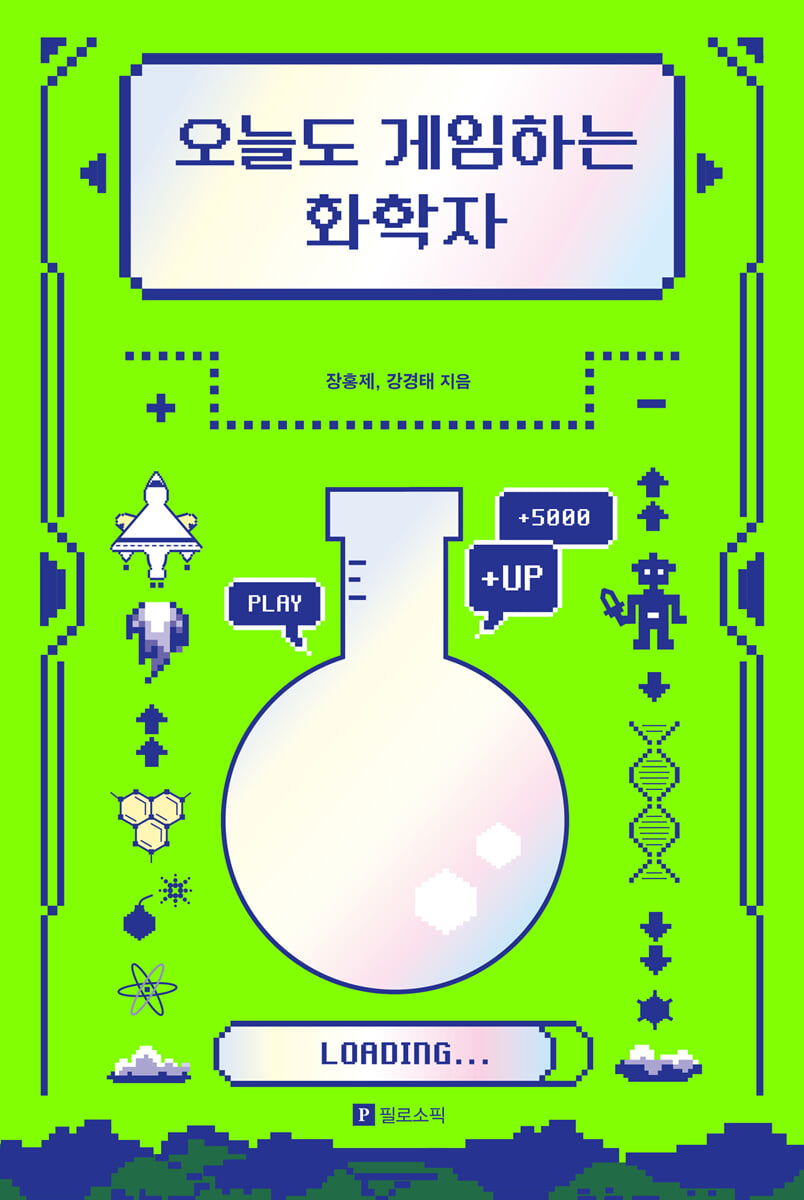
Chemist playing games today too
 |
Description
Book Introduction
There are no bad games in the world.
There is no boring chemistry in the world.
An exciting chemistry strategy from game-loving chemists.
So how do chemists play games? Professors Jang Hong-je and Kang Kyung-tae, both chemists and gamers, challenge the stereotype that games are merely about fun.
"The Chemist Who Plays Games Today" is a book that reveals that real-world chemistry knowledge is hidden even in the virtual world of games.
We explore biochemistry through [Spore], which deals with the birth and evolution of life, and the history of chemistry through [Elden Ring], which is based on the alchemy that gave birth to chemistry, and [Assassin's Creed], which deals with the chemical revolution.
In addition, we will look at games that everyone has likely heard of at least once, such as [Minecraft], [Pokemon], and [Starcraft], as well as the chemistry principles that are familiar to us today, and the chemistry of the future that is heading towards space.
When we realize that the world within a game is based on real-world scientific principles, a new joy of observation will come to us who play the game.
If you want to successfully kill two birds with one stone—games and knowledge—now is the time to start the chemistry of games, the game of chemistry, with 『The Chemist Who Plays Games Today』.
There is no boring chemistry in the world.
An exciting chemistry strategy from game-loving chemists.
So how do chemists play games? Professors Jang Hong-je and Kang Kyung-tae, both chemists and gamers, challenge the stereotype that games are merely about fun.
"The Chemist Who Plays Games Today" is a book that reveals that real-world chemistry knowledge is hidden even in the virtual world of games.
We explore biochemistry through [Spore], which deals with the birth and evolution of life, and the history of chemistry through [Elden Ring], which is based on the alchemy that gave birth to chemistry, and [Assassin's Creed], which deals with the chemical revolution.
In addition, we will look at games that everyone has likely heard of at least once, such as [Minecraft], [Pokemon], and [Starcraft], as well as the chemistry principles that are familiar to us today, and the chemistry of the future that is heading towards space.
When we realize that the world within a game is based on real-world scientific principles, a new joy of observation will come to us who play the game.
If you want to successfully kill two birds with one stone—games and knowledge—now is the time to start the chemistry of games, the game of chemistry, with 『The Chemist Who Plays Games Today』.
index
Entering
Chapter 1: Darwin's Simulation: Spore
How to Build a Better Being | Evolution Isn't Leveling Up | Chemists Search for the Origin of Life | Is RNA the Culprit? | We Don't Know 'Yet'
Chapter 2: A World Painted Through Alchemy (Elden Ring)
The Unbreakable Soul | Alchemy, Symbols, and Elden Ring | The Great Crucible of Alchemy | Alchemy and Chemistry
Chapter 3: Elements and Reactions (Opus Magnum)
Alchemy Simulator | Mechanical Elemental Combination | Elements and Atoms
Chapter 4: The Chemical Revolution (Assassin's Creed)
If there are no witnesses, it's an assassination | Lavoisier, Living and Dying in the Revolution | A System of Molecular Structure | The Intersection of Fact and Imagination
Chapter 5: A Game Like Reality, a Game Like Reality: The Legend of Zelda
The Legend of Zelda is a legend | Chemical engines and combustion | Games that respond to reality | The laws of conservation and equivalent exchange
Chapter 6: Civilization: A History Directed by Chemistry
Notorious Addiction | Is Our Country a Potassium Nitrate Powerhouse? | The Dream of Immortality Becomes Humanity's Worst Weapon of Destruction | Handwashing: A Civilization's Legacy | Science and the Future of Humanity
Chapter 7: Exploding Pixels, Exploding Worlds (Minecraft)
Sandbox in a Game Console | Exploding Creatures | Humans Pursue Power | Faster, Stronger
Chapter 8: The Secret Weapon: Poison (Brawl Stars and Dungeons & Dragons)
Chemicals that destroy the human body | Poison is defeated by poison | Manufactured poison
Chapter 9: How the Brain Enjoys Games: Tetris and Pokémon
Gaming and Immersion | Neuronal Chemistry | The Neuron-Brain Gap | Dopamine Rewards for Obsessive Compulsive Disorders | Immersion Mechanisms That Kill Three Birds
Chapter 10: Chemistry of Space and the Future (StarCraft)
Humans, Terrans, and Deceivers | Nuclear Reactions and Nuclear Weapons | Space and the Chemistry of the Future
A Side Story: Catching Up with K-Pro Gamers in StarCraft and League of Legends
Lim Yo-hwan, Hong Jin-ho, and Faker, let's go! | Snowballing | What does snowballing mean to chemistry? | Formose reaction | Soai reaction | Chemistry that South Korea excels at
Going out
Chapter 1: Darwin's Simulation: Spore
How to Build a Better Being | Evolution Isn't Leveling Up | Chemists Search for the Origin of Life | Is RNA the Culprit? | We Don't Know 'Yet'
Chapter 2: A World Painted Through Alchemy (Elden Ring)
The Unbreakable Soul | Alchemy, Symbols, and Elden Ring | The Great Crucible of Alchemy | Alchemy and Chemistry
Chapter 3: Elements and Reactions (Opus Magnum)
Alchemy Simulator | Mechanical Elemental Combination | Elements and Atoms
Chapter 4: The Chemical Revolution (Assassin's Creed)
If there are no witnesses, it's an assassination | Lavoisier, Living and Dying in the Revolution | A System of Molecular Structure | The Intersection of Fact and Imagination
Chapter 5: A Game Like Reality, a Game Like Reality: The Legend of Zelda
The Legend of Zelda is a legend | Chemical engines and combustion | Games that respond to reality | The laws of conservation and equivalent exchange
Chapter 6: Civilization: A History Directed by Chemistry
Notorious Addiction | Is Our Country a Potassium Nitrate Powerhouse? | The Dream of Immortality Becomes Humanity's Worst Weapon of Destruction | Handwashing: A Civilization's Legacy | Science and the Future of Humanity
Chapter 7: Exploding Pixels, Exploding Worlds (Minecraft)
Sandbox in a Game Console | Exploding Creatures | Humans Pursue Power | Faster, Stronger
Chapter 8: The Secret Weapon: Poison (Brawl Stars and Dungeons & Dragons)
Chemicals that destroy the human body | Poison is defeated by poison | Manufactured poison
Chapter 9: How the Brain Enjoys Games: Tetris and Pokémon
Gaming and Immersion | Neuronal Chemistry | The Neuron-Brain Gap | Dopamine Rewards for Obsessive Compulsive Disorders | Immersion Mechanisms That Kill Three Birds
Chapter 10: Chemistry of Space and the Future (StarCraft)
Humans, Terrans, and Deceivers | Nuclear Reactions and Nuclear Weapons | Space and the Chemistry of the Future
A Side Story: Catching Up with K-Pro Gamers in StarCraft and League of Legends
Lim Yo-hwan, Hong Jin-ho, and Faker, let's go! | Snowballing | What does snowballing mean to chemistry? | Formose reaction | Soai reaction | Chemistry that South Korea excels at
Going out
Into the book
This book introduces the world of digital games as seen by two chemists from the 'first generation of gamers.'
It is structured in a format where the authors freely discuss the chemical elements hidden within games they enjoyed playing.
For those who enjoy games while being mindful of others, I hope this book will provide an opportunity to reexamine the principles of the game world that might otherwise be overlooked.
And I hope that this will be an opportunity for those of us who grew up with games to reminisce about the fun times they had.
--- p.10 "Introduction"
Science fiction often revolves around unknown resources, technologies, and unique life forms, while fantasy often revolves around magic, ancient origins, and the hidden secrets that accompany them.
The most convenient reference at this time is alchemy, a discipline that has been around for thousands of years and is the foundation of chemistry, a delicate blend of mystery and science.
Alchemy is more useful in games than in movies or novels.
The experimental nature of science, which allows for a variety of attempts based on established principles or structures, can shine through in the way games are directly operated and played.
--- p.43 "Chapter 2: The World Painted Through Alchemy: Elden Ring"
If there's a physics engine that lets you grab, throw, push, and climb objects, what about a "chemical engine" that simulates chemical reactions like burning or transforming objects? While the term "chemical engine" may be unfamiliar to us, there's a reason why we chose "Breath of the Wild" as the starting point for this story.
This is because Breath of the Wild is the work that most seriously began to use and pursue the concept of a chemical engine.
Just because it's a chemical engine doesn't mean we have to obsess over grandiose tasks we couldn't imagine or implement alchemy that has nothing to do with the flow of the game.
--- p.106~107 "Chapter 5: A Game Like Reality, a Game Like Reality: The Legend of Zelda"
Meanwhile, the Pokémon series captures our brains in a completely different way than Tetris.
While Tetris stimulates the brain with fingertip reactions and immediate rewards, the Pokémon series induces immersion in a much more long-term and emotional way.
The journey of capturing your own Pokémon one by one, battling them together, evolving them, and completing the Pokédex is not simply a task, but a process of accumulating emotional attachment and growth experiences.
The core of the Pokémon series is ‘collecting’ and ‘evolution’.
--- p.204 "Chapter 9: How the Brain Enjoys Games: Tetris and Pokémon"
The ionic wind, a stream of microscopic particles such as protons and electrons emitted by stars burning with nuclear fusion, is mostly blocked by the Earth's magnetic field and atmosphere, but in space, where direct exposure to it is inevitable, it causes many adverse effects, including acute radiation syndrome, reproductive dysfunction, and brain nerve damage.
Recent space science research has shown that the environment in space is such that even microorganisms can easily mutate, so it will cause even greater problems for Terran Marines, whose activities are mostly outside.
Naturally, their combat uniforms are equipped with complete CBN (chemical, biological, radiological and nuclear) defense capabilities.
It is structured in a format where the authors freely discuss the chemical elements hidden within games they enjoyed playing.
For those who enjoy games while being mindful of others, I hope this book will provide an opportunity to reexamine the principles of the game world that might otherwise be overlooked.
And I hope that this will be an opportunity for those of us who grew up with games to reminisce about the fun times they had.
--- p.10 "Introduction"
Science fiction often revolves around unknown resources, technologies, and unique life forms, while fantasy often revolves around magic, ancient origins, and the hidden secrets that accompany them.
The most convenient reference at this time is alchemy, a discipline that has been around for thousands of years and is the foundation of chemistry, a delicate blend of mystery and science.
Alchemy is more useful in games than in movies or novels.
The experimental nature of science, which allows for a variety of attempts based on established principles or structures, can shine through in the way games are directly operated and played.
--- p.43 "Chapter 2: The World Painted Through Alchemy: Elden Ring"
If there's a physics engine that lets you grab, throw, push, and climb objects, what about a "chemical engine" that simulates chemical reactions like burning or transforming objects? While the term "chemical engine" may be unfamiliar to us, there's a reason why we chose "Breath of the Wild" as the starting point for this story.
This is because Breath of the Wild is the work that most seriously began to use and pursue the concept of a chemical engine.
Just because it's a chemical engine doesn't mean we have to obsess over grandiose tasks we couldn't imagine or implement alchemy that has nothing to do with the flow of the game.
--- p.106~107 "Chapter 5: A Game Like Reality, a Game Like Reality: The Legend of Zelda"
Meanwhile, the Pokémon series captures our brains in a completely different way than Tetris.
While Tetris stimulates the brain with fingertip reactions and immediate rewards, the Pokémon series induces immersion in a much more long-term and emotional way.
The journey of capturing your own Pokémon one by one, battling them together, evolving them, and completing the Pokédex is not simply a task, but a process of accumulating emotional attachment and growth experiences.
The core of the Pokémon series is ‘collecting’ and ‘evolution’.
--- p.204 "Chapter 9: How the Brain Enjoys Games: Tetris and Pokémon"
The ionic wind, a stream of microscopic particles such as protons and electrons emitted by stars burning with nuclear fusion, is mostly blocked by the Earth's magnetic field and atmosphere, but in space, where direct exposure to it is inevitable, it causes many adverse effects, including acute radiation syndrome, reproductive dysfunction, and brain nerve damage.
Recent space science research has shown that the environment in space is such that even microorganisms can easily mutate, so it will cause even greater problems for Terran Marines, whose activities are mostly outside.
Naturally, their combat uniforms are equipped with complete CBN (chemical, biological, radiological and nuclear) defense capabilities.
--- p.214~215 "Chapter 10: Chemistry of the Universe and the Future (Starcraft)"
Publisher's Review
For those who want to play games with culture
The Chemistry of Games, The Game of Chemistry
“This book introduces the world of digital games as seen by two chemists from the ‘first generation of gamers.’
It is structured in a format where the authors freely discuss the chemical elements hidden within games they enjoyed playing.
For those who enjoy games while being mindful of others, I hope this book will provide an opportunity to reexamine the principles of the game world that might otherwise be overlooked.
And I hope that this will be an opportunity for those of us who grew up with games to reminisce about the fun times they had.” - Introduction
Gaming has now become an inseparable hobby from our daily lives.
Playing mobile or computer games has become incredibly easy, and even without playing the games themselves, anyone can access them simply by watching game streamers broadcast on the internet.
But this book goes beyond simply enjoying the game; it discovers connections to knowledge within the pure fun.
It explores the roots of chemistry in alchemy, which appears as a background in many games, including Elden Ring, and explains the chemical reasons why games like Tetris and Pokémon are so addictive.
In this respect, "The Chemist Who Plays Games Today" is a book that attempts to overturn the existing prejudice that games only pursue fun.
Professors Jang Hong-je and Kang Kyung-tae successfully fulfilled the dual roles of gamer and chemist.
As a gamer who loves games, I have enjoyed various genres such as open-world RPGs, sandbox games, simulators, and RTS (real-time strategy games). However, as a chemist who loves chemistry, I have always maintained a scientific perspective.
From the worldview that dominates the entire game to the NPCs and items that make up part of the game, the two professors freely explore the principles of chemistry within the game.
Considering that games construct fictional stories based on our reality, it's only natural that chemistry, which explores the laws of matter, is embedded within them.
The authors demonstrate that if you have the will to know, you can gain knowledge from games, and that this can lead to even more immersive gaming experiences.
The moment you open "The Chemist Who Plays Games Today," games are now more than just a means of hobby.
This book examines the world through the fascinating medium of games, while also presenting the reasons why games can be enjoyable, giving readers/gamers an opportunity to exclaim, "Ah!"
I don't want to miss out on science or games!
How to Play Smarter, Chemistry Professors Teach You
When can we say that chemistry, the discipline discussed in this book, began? Before chemistry became a well-established discipline, we can trace its roots back to medieval alchemy.
This is because we got hints about the basic principles of matter from alchemy, which experimented with the reactions of various substances to create the noble metal of gold from the lowly metal of lead.
Alchemy, which involves studying real-world metals, is also used as a device to add a mysterious and magical atmosphere to the game, as it has a philosophical and symbolic basis.
This is why you can find these elements in everything from the various locations that serve as the backdrop for Elden Ring to the designs of the playable characters.
Since then, chemistry has begun to establish a system through an event that can be called the 'chemical revolution', and has become a solid branch of natural science today.
Chemistry, the discipline that explains the behavior of all substances in the real world, is now being applied to realizing the world of games beyond reality.
In The Legend of Zelda: Breath of the Wild, which uses a "chemical engine" to create chemical reactions similar to those in reality, fire burns down trees, rain extinguishes fires in fields, and lightning runs through metal and conducts electricity.
These operations, which may seem novel at first glance but are carried out under the strict laws of nature, have reached a point that far surpasses our imagination.
In explosive characters like Minecraft's Creepers, we read about the continued evolution of explosives, including TNT and dynamite, and in StarCraft's Terran Alliance weapons, we discover the destructive power of nuclear reactions and the endless exploration of future chemistry.
Beyond these dazzling graphics and vibrant sounds, we discover endless stories related to chemistry.
In this book, two chemists attempt to connect the past, present, and future of chemistry with games.
From the dawn of life to the future of chemistry stretching out into space, if we realize how closely games are intertwined with our reality, new horizons will open up on our monitors.
Today I play a game again
Today I am doing chemistry again!
We play games to keep up with the dopamine-fueled world and to pass the time in a thrilling and exciting way, or to briefly relax our bodies and minds from the hardships of everyday life.
And once you log into the game, time will fly by.
Why are games so fun? The defining characteristic of games is that they easily "immerse" us.
This is because the sensory stimulation provided by the game, along with the reward and exploration systems, creates a kind of addiction in our brains.
As this book explains with Tetris and Pokémon, dopamine, serotonin, and other neurotransmitters allow us to fully immerse ourselves in the game and create a new narrative separate from reality.
But do games really offer us nothing but a world of mindless addiction? It's time to reject the notion that knowledge and culture can only be cultivated through agonizing study, and that the more you play games, the more foolish they become.
The moment we realize that the countless realities that unfold within games are in fact intertwined with the chemical laws of reality, we will begin to see the world beyond games and be given the key to most accurately understanding reality.
If you're curious about the real and virtual worlds surrounding us, now is the time to play through the eyes of a chemist.
The game you jump into will have turned into a completely different chemistry lab than before.
The Chemistry of Games, The Game of Chemistry
“This book introduces the world of digital games as seen by two chemists from the ‘first generation of gamers.’
It is structured in a format where the authors freely discuss the chemical elements hidden within games they enjoyed playing.
For those who enjoy games while being mindful of others, I hope this book will provide an opportunity to reexamine the principles of the game world that might otherwise be overlooked.
And I hope that this will be an opportunity for those of us who grew up with games to reminisce about the fun times they had.” - Introduction
Gaming has now become an inseparable hobby from our daily lives.
Playing mobile or computer games has become incredibly easy, and even without playing the games themselves, anyone can access them simply by watching game streamers broadcast on the internet.
But this book goes beyond simply enjoying the game; it discovers connections to knowledge within the pure fun.
It explores the roots of chemistry in alchemy, which appears as a background in many games, including Elden Ring, and explains the chemical reasons why games like Tetris and Pokémon are so addictive.
In this respect, "The Chemist Who Plays Games Today" is a book that attempts to overturn the existing prejudice that games only pursue fun.
Professors Jang Hong-je and Kang Kyung-tae successfully fulfilled the dual roles of gamer and chemist.
As a gamer who loves games, I have enjoyed various genres such as open-world RPGs, sandbox games, simulators, and RTS (real-time strategy games). However, as a chemist who loves chemistry, I have always maintained a scientific perspective.
From the worldview that dominates the entire game to the NPCs and items that make up part of the game, the two professors freely explore the principles of chemistry within the game.
Considering that games construct fictional stories based on our reality, it's only natural that chemistry, which explores the laws of matter, is embedded within them.
The authors demonstrate that if you have the will to know, you can gain knowledge from games, and that this can lead to even more immersive gaming experiences.
The moment you open "The Chemist Who Plays Games Today," games are now more than just a means of hobby.
This book examines the world through the fascinating medium of games, while also presenting the reasons why games can be enjoyable, giving readers/gamers an opportunity to exclaim, "Ah!"
I don't want to miss out on science or games!
How to Play Smarter, Chemistry Professors Teach You
When can we say that chemistry, the discipline discussed in this book, began? Before chemistry became a well-established discipline, we can trace its roots back to medieval alchemy.
This is because we got hints about the basic principles of matter from alchemy, which experimented with the reactions of various substances to create the noble metal of gold from the lowly metal of lead.
Alchemy, which involves studying real-world metals, is also used as a device to add a mysterious and magical atmosphere to the game, as it has a philosophical and symbolic basis.
This is why you can find these elements in everything from the various locations that serve as the backdrop for Elden Ring to the designs of the playable characters.
Since then, chemistry has begun to establish a system through an event that can be called the 'chemical revolution', and has become a solid branch of natural science today.
Chemistry, the discipline that explains the behavior of all substances in the real world, is now being applied to realizing the world of games beyond reality.
In The Legend of Zelda: Breath of the Wild, which uses a "chemical engine" to create chemical reactions similar to those in reality, fire burns down trees, rain extinguishes fires in fields, and lightning runs through metal and conducts electricity.
These operations, which may seem novel at first glance but are carried out under the strict laws of nature, have reached a point that far surpasses our imagination.
In explosive characters like Minecraft's Creepers, we read about the continued evolution of explosives, including TNT and dynamite, and in StarCraft's Terran Alliance weapons, we discover the destructive power of nuclear reactions and the endless exploration of future chemistry.
Beyond these dazzling graphics and vibrant sounds, we discover endless stories related to chemistry.
In this book, two chemists attempt to connect the past, present, and future of chemistry with games.
From the dawn of life to the future of chemistry stretching out into space, if we realize how closely games are intertwined with our reality, new horizons will open up on our monitors.
Today I play a game again
Today I am doing chemistry again!
We play games to keep up with the dopamine-fueled world and to pass the time in a thrilling and exciting way, or to briefly relax our bodies and minds from the hardships of everyday life.
And once you log into the game, time will fly by.
Why are games so fun? The defining characteristic of games is that they easily "immerse" us.
This is because the sensory stimulation provided by the game, along with the reward and exploration systems, creates a kind of addiction in our brains.
As this book explains with Tetris and Pokémon, dopamine, serotonin, and other neurotransmitters allow us to fully immerse ourselves in the game and create a new narrative separate from reality.
But do games really offer us nothing but a world of mindless addiction? It's time to reject the notion that knowledge and culture can only be cultivated through agonizing study, and that the more you play games, the more foolish they become.
The moment we realize that the countless realities that unfold within games are in fact intertwined with the chemical laws of reality, we will begin to see the world beyond games and be given the key to most accurately understanding reality.
If you're curious about the real and virtual worlds surrounding us, now is the time to play through the eyes of a chemist.
The game you jump into will have turned into a completely different chemistry lab than before.
GOODS SPECIFICS
- Date of issue: December 10, 2025
- Page count, weight, size: 256 pages | 142*212*20mm
- ISBN13: 9791157833863
- ISBN10: 1157833861
You may also like
카테고리
korean


korean

![ELLE 엘르 스페셜 에디션 A형 : 12월 [2025]](http://librairie.coreenne.fr/cdn/shop/files/b8e27a3de6c9538896439686c6b0e8fb.jpg?v=1766436872&width=3840)


