

The first 3 minutes
 |
Description
Book Introduction
The Birth of the Universe: Just Three Minutes Decided Everything
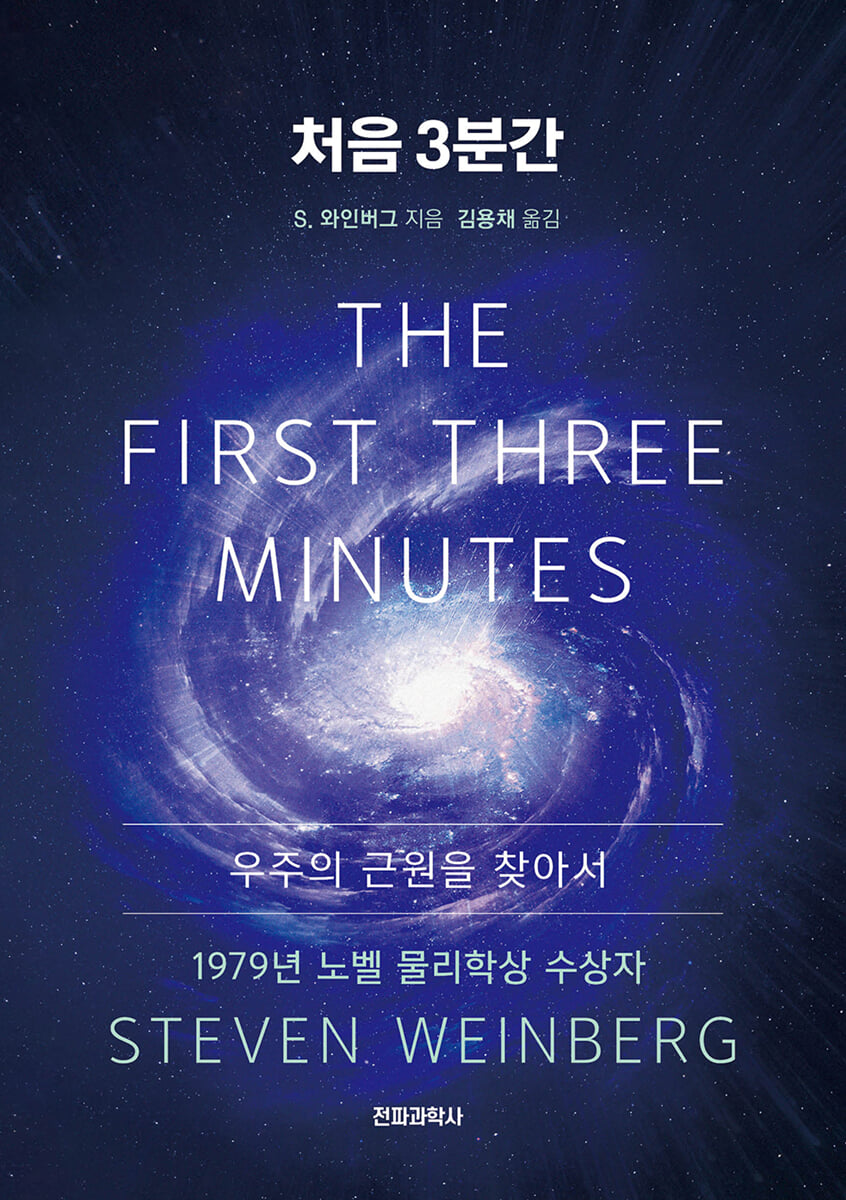
The First 3 Minutes
“How did the universe begin?” “The First Three Minutes” is a classic that contains scientific answers to this fundamental question that has plagued humanity.
It clearly and engagingly explains the dramatic events that occurred in the universe in the three minutes immediately following the Big Bang, revealing to readers a decisive achievement in modern cosmology.
Nobel Prize winner in physics Steven Weinberg translates complex physics theories into concise, accessible language, allowing even the average reader to experience the origins of the universe firsthand.
Since its publication, this book has been read by countless readers worldwide and has been praised as "the most influential popular book on cosmology." It vividly conveys the intellectual achievements and inspiration of 20th-century science.
It will be an engaging read for non-science majors, while also providing a contextual guide to cosmological research for those seeking a deeper exploration.
The First 3 Minutes
“How did the universe begin?” “The First Three Minutes” is a classic that contains scientific answers to this fundamental question that has plagued humanity.
It clearly and engagingly explains the dramatic events that occurred in the universe in the three minutes immediately following the Big Bang, revealing to readers a decisive achievement in modern cosmology.
Nobel Prize winner in physics Steven Weinberg translates complex physics theories into concise, accessible language, allowing even the average reader to experience the origins of the universe firsthand.
Since its publication, this book has been read by countless readers worldwide and has been praised as "the most influential popular book on cosmology." It vividly conveys the intellectual achievements and inspiration of 20th-century science.
It will be an engaging read for non-science majors, while also providing a contextual guide to cosmological research for those seeking a deeper exploration.
- You can preview some of the book's contents.
Preview
index
1.
Introduction: Giants and Cows
2.
expansion of the universe
3.
cosmic microwave background radiation
4.
Hot Space Recipe
5.
First 3 minutes
6.
historical transition
7.
The first hundredth of a second
8.
Review: Looking Ahead
Introduction: Giants and Cows
2.
expansion of the universe
3.
cosmic microwave background radiation
4.
Hot Space Recipe
5.
First 3 minutes
6.
historical transition
7.
The first hundredth of a second
8.
Review: Looking Ahead
Detailed image

Into the book
The clumps ultimately condensed to form the galaxies and stars of the present universe.
But the ingredients from which the stars began their lives were laid down in the first three minutes.
The standard model described above is not the most satisfactory theory imaginable for the origin of the universe.
Just as in the Shin Edda, there is a difficult ambiguity to explain about the beginning, the very first hundredth of a second or so.
There is also the unpleasant necessity of specifying initial conditions, in particular the initial billion-to-one ratio of photons to nuclei.
It would be better if there was a greater sense of logical consistency to this theory.
One alternative that seems philosophically much more attractive is, for example, the so-called steady-state model.
The theory proposed by Bondi, Gold, and (in slightly different forms) Hoyle in the 1940s holds that the universe has always been exactly as it is.
As the universe expands, new matter continues to be created to fill the gaps between galaxies.
--- p.20
The typical intergalactic spacing is shown as a function of time for two possible cosmological models.
In the case of an 'open universe', the universe is infinite, its density is less than the critical density, and the expansion will continue forever, albeit slowly.
In a 'closed universe', the universe is finite, its density is greater than the critical density, and expansion will eventually end and contraction will follow.
These curves were calculated for a matter-dominated universe using Einstein's field equations, which do not have a cosmological constant.
--- p.61
The radio noise observed by Serpenzias and Wilson is expressed as having an equivalent temperature of 3.5 K.
This temperature was much higher than expected, but in absolute terms it was very low.
So it's not surprising that Penzias and Wilson wrestled with their results for some time before publishing them.
It wasn't immediately apparent that this was the most important advance in cosmology since the discovery of redshift.
The meaning of this mysterious microwave noise soon began to be elucidated through the work of astrophysicists' "invisible university."
--- p.76
As soon as deuterium nuclei are created, they are shattered, leaving no room for heavier nuclei to be produced.
Neutrons are still being converted into protons, although much more slowly than before.
The composition of nuclear particles is now 17% neutrons and 83% protons.
Fifth screen.
The temperature of the universe is now 1 billion Kelvin, only about 70 times hotter than at the center of the Sun.
3 minutes and 2 seconds have passed since the first screen.
--- p.148~149
The universe will continue to expand and cool.
But nothing very interesting happens over the next 700,000 years.
At that time, the temperature would drop further so that electrons and nuclei could form stable atoms, but the lack of free electrons would make the contents of the universe transparent to radiation.
So, because of the elimination between matter and radiation, matter will begin to form galaxies and stars.
After another 10 billion years or so, organisms will begin to reconstruct this process.
But the ingredients from which the stars began their lives were laid down in the first three minutes.
The standard model described above is not the most satisfactory theory imaginable for the origin of the universe.
Just as in the Shin Edda, there is a difficult ambiguity to explain about the beginning, the very first hundredth of a second or so.
There is also the unpleasant necessity of specifying initial conditions, in particular the initial billion-to-one ratio of photons to nuclei.
It would be better if there was a greater sense of logical consistency to this theory.
One alternative that seems philosophically much more attractive is, for example, the so-called steady-state model.
The theory proposed by Bondi, Gold, and (in slightly different forms) Hoyle in the 1940s holds that the universe has always been exactly as it is.
As the universe expands, new matter continues to be created to fill the gaps between galaxies.
--- p.20
The typical intergalactic spacing is shown as a function of time for two possible cosmological models.
In the case of an 'open universe', the universe is infinite, its density is less than the critical density, and the expansion will continue forever, albeit slowly.
In a 'closed universe', the universe is finite, its density is greater than the critical density, and expansion will eventually end and contraction will follow.
These curves were calculated for a matter-dominated universe using Einstein's field equations, which do not have a cosmological constant.
--- p.61
The radio noise observed by Serpenzias and Wilson is expressed as having an equivalent temperature of 3.5 K.
This temperature was much higher than expected, but in absolute terms it was very low.
So it's not surprising that Penzias and Wilson wrestled with their results for some time before publishing them.
It wasn't immediately apparent that this was the most important advance in cosmology since the discovery of redshift.
The meaning of this mysterious microwave noise soon began to be elucidated through the work of astrophysicists' "invisible university."
--- p.76
As soon as deuterium nuclei are created, they are shattered, leaving no room for heavier nuclei to be produced.
Neutrons are still being converted into protons, although much more slowly than before.
The composition of nuclear particles is now 17% neutrons and 83% protons.
Fifth screen.
The temperature of the universe is now 1 billion Kelvin, only about 70 times hotter than at the center of the Sun.
3 minutes and 2 seconds have passed since the first screen.
--- p.148~149
The universe will continue to expand and cool.
But nothing very interesting happens over the next 700,000 years.
At that time, the temperature would drop further so that electrons and nuclei could form stable atoms, but the lack of free electrons would make the contents of the universe transparent to radiation.
So, because of the elimination between matter and radiation, matter will begin to form galaxies and stars.
After another 10 billion years or so, organisms will begin to reconstruct this process.
--- p.151~152
Publisher's Review
A classic of modern cosmology, a culmination of scientific insight and intellectual inspiration.
"The First Three Minutes" is more than just a science textbook; it is an intellectual achievement that holds a significant place in the history of modern science.
Weinberg combines his expertise as a theoretical physicist with his ability to tell a popular narrative, bringing the birth and early evolution of the universe to life as if he were there.
His explanations are both concise and elegant, allowing readers to understand scientific facts while gaining new perspectives on the universe.
Decades after its publication, this book still holds its luster as an introductory text and classic on cosmology.
Even in a world where countless science books are being published, the reason why "The First Three Minutes" remains special is because it goes beyond simply imparting knowledge and teaches readers "how to think about the world scientifically."
This book, filled with objective, cool-headed, yet humane insights, is an immortal classic that any science-loving reader must read.
"The First Three Minutes" is more than just a science textbook; it is an intellectual achievement that holds a significant place in the history of modern science.
Weinberg combines his expertise as a theoretical physicist with his ability to tell a popular narrative, bringing the birth and early evolution of the universe to life as if he were there.
His explanations are both concise and elegant, allowing readers to understand scientific facts while gaining new perspectives on the universe.
Decades after its publication, this book still holds its luster as an introductory text and classic on cosmology.
Even in a world where countless science books are being published, the reason why "The First Three Minutes" remains special is because it goes beyond simply imparting knowledge and teaches readers "how to think about the world scientifically."
This book, filled with objective, cool-headed, yet humane insights, is an immortal classic that any science-loving reader must read.
GOODS SPECIFICS
- Date of issue: November 25, 2025
- Page count, weight, size: 252 pages | 148*210*20mm
- ISBN13: 9791194832324
- ISBN10: 1194832326
You may also like
카테고리
korean


korean

![GQ KOREA Mark (Monthly): December [2025]](http://librairie.coreenne.fr/cdn/shop/files/8ef265dbbfbf186523ed75ba7319009d.jpg?v=1765340328&width=3840)


