

The forefront of science
 |
Description
Book Introduction
Supervised by IBS Director Noh Do-young, Korea's leading basic science research institute
Orbit · Dr. Jang Dong-seon highly recommended!
“A book for everyone preparing for the future!”
Whether alternative energy development can avert climate catastrophe, whether democracy can survive the age of artificial intelligence, and whether the healthcare challenges of an aging society can be addressed are fundamental concerns facing our society today.
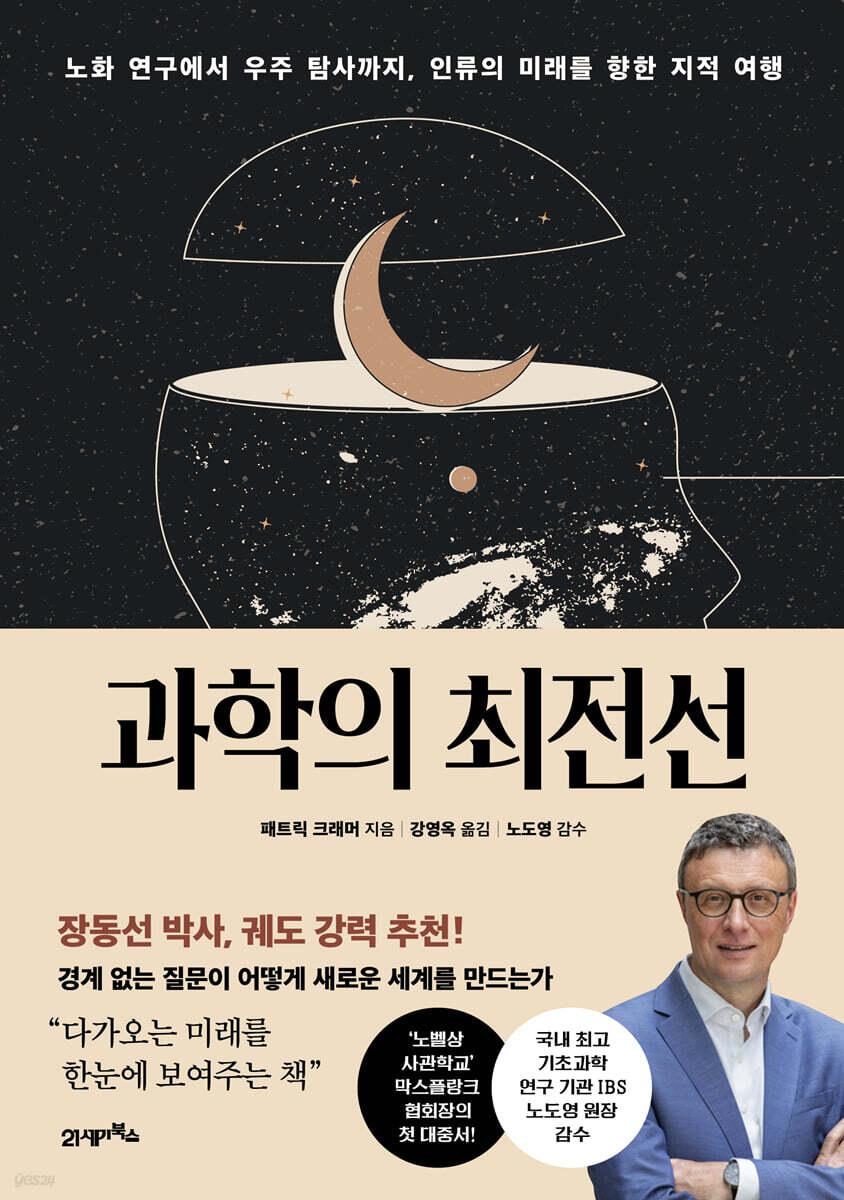
This book takes the form of a special scientific travelogue written by Patrick Kramer, president of the Max Planck Society, which has produced the world's largest number of Nobel Prize winners, as he personally visited 84 research institutes over the past year before taking office.
It vividly captures cutting-edge research currently underway, including observations of black holes in space, the secrets of cells, quantum computers, and nuclear fusion energy.
The author, Patrick Kramer, is considered a figure who strengthens active exchanges in the global scientific community as the president of the Max Planck Society.
He also raised expectations by announcing a plan for cooperation with Korea during his visit in 2024.
He dreams of communication not only across borders between academia and researchers, but also with the general public.
Through conversations with living Nobel laureates and scientists at the forefront of global science, and behind-the-scenes stories of groundbreaking research, the author illuminates how science seeks to solve humanity's greatest challenges.
Rather than explaining complex scientific theories, we break them down into accessible terms for the general public by sharing key questions and researchers' perspectives, and suggest concrete changes this cutting-edge research will bring to our lives and society.
The book's credibility and authority are further enhanced by the review by Director Noh Do-young of the Institute for Basic Science, the recommendation of science communicator Orbit, and the recommendation of neuroscientist Dr. Jang Dong-seon, who worked as a researcher at the Max Planck Institute.
This book covers 17 topics covering nearly every area of science, conveying key information that has recently attracted the attention of the global scientific community in a way that is accessible to the general public. This allows the general public to easily read and understand the topics they are interested in without fear of science.
It delivers scientific solutions and messages of hope for key issues facing our society, such as climate, artificial intelligence, and the aging population, while also cultivating readers' scientific thinking and problem-solving skills through vivid stories from actual research sites.
Filled with new inspiration through the passion, challenges, failures, and successes of world-class researchers, this book will inspire all those preparing for the future to dream of what's next, through the joy and profound resonance of discovering the unknown.
Orbit · Dr. Jang Dong-seon highly recommended!
“A book for everyone preparing for the future!”
Whether alternative energy development can avert climate catastrophe, whether democracy can survive the age of artificial intelligence, and whether the healthcare challenges of an aging society can be addressed are fundamental concerns facing our society today.
This book takes the form of a special scientific travelogue written by Patrick Kramer, president of the Max Planck Society, which has produced the world's largest number of Nobel Prize winners, as he personally visited 84 research institutes over the past year before taking office.
It vividly captures cutting-edge research currently underway, including observations of black holes in space, the secrets of cells, quantum computers, and nuclear fusion energy.
The author, Patrick Kramer, is considered a figure who strengthens active exchanges in the global scientific community as the president of the Max Planck Society.
He also raised expectations by announcing a plan for cooperation with Korea during his visit in 2024.
He dreams of communication not only across borders between academia and researchers, but also with the general public.
Through conversations with living Nobel laureates and scientists at the forefront of global science, and behind-the-scenes stories of groundbreaking research, the author illuminates how science seeks to solve humanity's greatest challenges.
Rather than explaining complex scientific theories, we break them down into accessible terms for the general public by sharing key questions and researchers' perspectives, and suggest concrete changes this cutting-edge research will bring to our lives and society.
The book's credibility and authority are further enhanced by the review by Director Noh Do-young of the Institute for Basic Science, the recommendation of science communicator Orbit, and the recommendation of neuroscientist Dr. Jang Dong-seon, who worked as a researcher at the Max Planck Institute.
This book covers 17 topics covering nearly every area of science, conveying key information that has recently attracted the attention of the global scientific community in a way that is accessible to the general public. This allows the general public to easily read and understand the topics they are interested in without fear of science.
It delivers scientific solutions and messages of hope for key issues facing our society, such as climate, artificial intelligence, and the aging population, while also cultivating readers' scientific thinking and problem-solving skills through vivid stories from actual research sites.
Filled with new inspiration through the passion, challenges, failures, and successes of world-class researchers, this book will inspire all those preparing for the future to dream of what's next, through the joy and profound resonance of discovering the unknown.
- You can preview some of the book's contents.
Preview
index
Recommendation
The Power of Questions to Bring the Future into the Present
Preface: The World's First Discovery, Its Wondrous Joy
Chapter 1 Our Place in the Universe: What Are We Looking for in the Vastness of Space?
Chapter 2: Earth's Complexity: A Vast System Where Everything Interacts
Chapter 3: Threatened Ecosystems: The Struggle to Conserve Biodiversity
Chapter 4: Humanity and Evolution: How We Became Human
Chapter 5 Cells and Life: The Mystery of the Cell, the Smallest Unit of Life
Chapter 6: Advances in Medicine: How Humans Fight Disease
Chapter 7: Aging and Regeneration: The Age of Eternal Youth
Chapter 8 Robots and Artificial Intelligence: At the Boundary Between Life and Machine
Chapter 9: Quantum and New Materials: Discovering New Possibilities at the Origin of Matter
Chapter 10: Green Chemistry and the Material Cycle: Designing a Sustainable Future from Scratch
Chapter 11: Hydrogen Energy: Holding the Key to the Energy Transition
Chapter 12 Nuclear Fusion and Superconductors: Harnessing the Energy of the Sun and Stars
Chapter 13: Society at the Center of Transformation: Science, Technology, and Social Change Happen Together
Chapter 14: The Law of Coexistence: New Rules for Coexistence Are Needed
Chapter 15: The Brain and Memory: Where Does Memory Lead Us?
Chapter 16: Words, Learning, and Action: The Condition of Humanity
Chapter 17: Time and Beauty: What Do We Leave Behind in the Flow of Time?
Postscript: The quest for truth has no borders.
Acknowledgments | Appendix | Index
The Power of Questions to Bring the Future into the Present
Preface: The World's First Discovery, Its Wondrous Joy
Chapter 1 Our Place in the Universe: What Are We Looking for in the Vastness of Space?
Chapter 2: Earth's Complexity: A Vast System Where Everything Interacts
Chapter 3: Threatened Ecosystems: The Struggle to Conserve Biodiversity
Chapter 4: Humanity and Evolution: How We Became Human
Chapter 5 Cells and Life: The Mystery of the Cell, the Smallest Unit of Life
Chapter 6: Advances in Medicine: How Humans Fight Disease
Chapter 7: Aging and Regeneration: The Age of Eternal Youth
Chapter 8 Robots and Artificial Intelligence: At the Boundary Between Life and Machine
Chapter 9: Quantum and New Materials: Discovering New Possibilities at the Origin of Matter
Chapter 10: Green Chemistry and the Material Cycle: Designing a Sustainable Future from Scratch
Chapter 11: Hydrogen Energy: Holding the Key to the Energy Transition
Chapter 12 Nuclear Fusion and Superconductors: Harnessing the Energy of the Sun and Stars
Chapter 13: Society at the Center of Transformation: Science, Technology, and Social Change Happen Together
Chapter 14: The Law of Coexistence: New Rules for Coexistence Are Needed
Chapter 15: The Brain and Memory: Where Does Memory Lead Us?
Chapter 16: Words, Learning, and Action: The Condition of Humanity
Chapter 17: Time and Beauty: What Do We Leave Behind in the Flow of Time?
Postscript: The quest for truth has no borders.
Acknowledgments | Appendix | Index
Detailed image

Into the book
Science has also given us a danger limit for the planet.
The world's population has grown so dramatically over the past 100 years because we have expended enormous amounts of energy to build technological power.
Much of our energy is still produced by burning fossil fuels like coal, oil and gas, releasing massive amounts of carbon dioxide into the atmosphere.
This promotes global warming and, in particular, changes the water cycle.
Our most urgent challenge is decarbonizing the technological sphere.
Unfortunately, humans are not only disrupting climate change on Earth.
We are also threatening other areas of the biosphere.
To understand this more precisely, we must first understand that the biosphere is made up of countless plants, animals, and microorganisms.
--- p.70 "Chapter 2 | Earth's Complexity: A Vast System Where Everything Interacts"
Medical diagnostic methods are evolving at a rapid pace.
In addition, the role of the genome is becoming increasingly important.
When analyzing the DNA sequences of people, there is a difference approximately every 1,000th position.
These small differences create our individuality and make us genetically unique.
Now, it is possible to sequence a person's genome from a single drop of blood in a short period of time and without spending a lot of money.
Using the genetic information obtained in this way, in many cases, the specific cause of the disease can be identified.
Doctors can use genetic information to more accurately predict whether a patient is at risk for developing a particular disease, and in some cases, genetic testing can even predict how likely a patient is to respond to or experience side effects from a particular medication.
--- p.151 Chapter 6 | The Advancement of Medicine: How Humans Fight Disease
Could an internet of quantum computers be possible in the future? In any case, researchers are already exploring how to connect individual quantum computers through large-scale connections.
Since qubits cannot be copied or duplicated, the advantage of such networks would be absolutely secure data transmission.
However, quantum information cannot be transmitted over arbitrarily long intervals because quantum signals are easily weakened.
So we need a junction, a quantum repeater, to 'refresh' the transmitted quantum information.
Research is already underway on how to build such a miraculous machine.
Scholars are waiting and preparing to run, waiting for a technological breakthrough.
--- p.215 Chapter 9 | Quantum and New Materials: Discovering New Possibilities at the Origin of Matter
Current solar cells convert sunlight directly into energy that is then fed into the power grid.
She added that this new material takes a completely different approach.
The material can directly store energy using incoming light, and the stored energy can be extracted from the material to produce electricity several hours later.
I was so surprised that I was dumbfounded.
Simply put, sunlight is being 'temporarily stored' here.
Researchers believe that in the future, these materials could be used to create new types of "solar cells" that charge first and then discharge later.
This way, in theory, you could produce and store energy during the day when the sun is at its brightest, and then use that energy to prepare meals in the evening.
--- p.287 Chapter 12 | Nuclear Fusion and Superconductors: Harnessing the Energy of the Sun and Stars
Photography can restore lost art.
Photographers are living witnesses of the scene, and their records still provide important hints to this day.
I passed through a small door and blinked for a moment in the dazzling Italian spring sun.
Behind a few lemon trees in large terracotta pots, the view opened up to reveal a landscape dominated by church bell towers and domed roofs.
Using old photographs, the interior of the church can be reconstructed on a computer.
A young scholar opened his laptop and excitedly showed off his research.
There was no structure for the space that no longer existed.
There was a single pillar in the middle of the church, and it was not supporting anything.
The pillar is said to have been created using numerous high-resolution images.
This is how a three-dimensional digital object is created, taking every detail into account.
The world's population has grown so dramatically over the past 100 years because we have expended enormous amounts of energy to build technological power.
Much of our energy is still produced by burning fossil fuels like coal, oil and gas, releasing massive amounts of carbon dioxide into the atmosphere.
This promotes global warming and, in particular, changes the water cycle.
Our most urgent challenge is decarbonizing the technological sphere.
Unfortunately, humans are not only disrupting climate change on Earth.
We are also threatening other areas of the biosphere.
To understand this more precisely, we must first understand that the biosphere is made up of countless plants, animals, and microorganisms.
--- p.70 "Chapter 2 | Earth's Complexity: A Vast System Where Everything Interacts"
Medical diagnostic methods are evolving at a rapid pace.
In addition, the role of the genome is becoming increasingly important.
When analyzing the DNA sequences of people, there is a difference approximately every 1,000th position.
These small differences create our individuality and make us genetically unique.
Now, it is possible to sequence a person's genome from a single drop of blood in a short period of time and without spending a lot of money.
Using the genetic information obtained in this way, in many cases, the specific cause of the disease can be identified.
Doctors can use genetic information to more accurately predict whether a patient is at risk for developing a particular disease, and in some cases, genetic testing can even predict how likely a patient is to respond to or experience side effects from a particular medication.
--- p.151 Chapter 6 | The Advancement of Medicine: How Humans Fight Disease
Could an internet of quantum computers be possible in the future? In any case, researchers are already exploring how to connect individual quantum computers through large-scale connections.
Since qubits cannot be copied or duplicated, the advantage of such networks would be absolutely secure data transmission.
However, quantum information cannot be transmitted over arbitrarily long intervals because quantum signals are easily weakened.
So we need a junction, a quantum repeater, to 'refresh' the transmitted quantum information.
Research is already underway on how to build such a miraculous machine.
Scholars are waiting and preparing to run, waiting for a technological breakthrough.
--- p.215 Chapter 9 | Quantum and New Materials: Discovering New Possibilities at the Origin of Matter
Current solar cells convert sunlight directly into energy that is then fed into the power grid.
She added that this new material takes a completely different approach.
The material can directly store energy using incoming light, and the stored energy can be extracted from the material to produce electricity several hours later.
I was so surprised that I was dumbfounded.
Simply put, sunlight is being 'temporarily stored' here.
Researchers believe that in the future, these materials could be used to create new types of "solar cells" that charge first and then discharge later.
This way, in theory, you could produce and store energy during the day when the sun is at its brightest, and then use that energy to prepare meals in the evening.
--- p.287 Chapter 12 | Nuclear Fusion and Superconductors: Harnessing the Energy of the Sun and Stars
Photography can restore lost art.
Photographers are living witnesses of the scene, and their records still provide important hints to this day.
I passed through a small door and blinked for a moment in the dazzling Italian spring sun.
Behind a few lemon trees in large terracotta pots, the view opened up to reveal a landscape dominated by church bell towers and domed roofs.
Using old photographs, the interior of the church can be reconstructed on a computer.
A young scholar opened his laptop and excitedly showed off his research.
There was no structure for the space that no longer existed.
There was a single pillar in the middle of the church, and it was not supporting anything.
The pillar is said to have been created using numerous high-resolution images.
This is how a three-dimensional digital object is created, taking every detail into account.
--- p.379 Chapter 17 | Time and Beauty: What Do We Leave Behind in the Flow of Time?
Publisher's Review
About 300 research institute directors, including living Nobel laureates,
A conversation with research team leaders and representatives leading 24,000 researchers from over 100 countries.
The future is told by the president of the Max Planck Society, reflecting the latest research from around the world.
“A small spark called a question
Showing how it can reach the front lines of the vast universe.
“A beautiful and wonderful journey”
-Orbit (science communicator, author of "The Time for Science")
The Max Planck Society, the organization with the most Nobel Prize winners (31)
Vivid scientific scenes and moments of discovery that will change the future
The Max Planck Society, of which the author is the president, is a research institute at the center of global science, having produced 31 Nobel Prize winners.
This book is the result of a year of on-the-ground documentation of over 90 Max Planck research institutes, conducted by molecular biologist Patrick Kramer before he took office as president, until June 2023.
The author meets scientists passionately engaged in research at each research institute and witnesses firsthand the budding futures emerging in their laboratories.
This book is a record of a journey to find answers to the fundamental questions science poses to us: who we are, where we came from, and where we are going.
The true value of this book lies not in its simple exploration of a research lab, but in its ability to directly convey to readers the groundbreaking discoveries that will transform the future of humanity.
From astrophysics uncovering the secrets of black holes, to life sciences unraveling the mysteries of cells, to cutting-edge research in quantum computing and nuclear fusion energy, it vividly captures the cutting edge of science unfolding around the world at this very moment.
The Max Planck Society is an organization that has driven scientific advancements not only in Germany but also around the world. For over 100 years, it has championed the motto, "Knowledge comes before application," and is a symbol of the spirit of scientific inquiry that demonstrates firsthand how the power of basic science can shape and transform the future of humanity.
Basic scientific research conducted at the Max Planck Society plays a vital role in understanding the essence of complex problems and finding innovative solutions.
Therefore, accompanying Patrick Kramer on his year-long journey through the lab is a time to confirm that science is not simply the accumulation of knowledge, but a key tool for addressing the complex challenges humanity faces, such as climate change, aging, and biodiversity loss, and for creating a sustainable future.
From astronomy and climate research to biomedicine and artificial intelligence, energy research and arts and culture, and law.
Nearly all of today's scientific research from 84 research institutes in one volume!
This book contains research sites from 84 Max Planck Institutes covering virtually every field of modern science, including astronomy, climate research, biomedicine, artificial intelligence, energy, culture and arts, and law.
It is systematically organized into 17 topics, including the universe and the Earth system, ecosystems, humans and evolution, cells and life, medicine, aging and regeneration, and quantum and new materials, vividly showing what the core research institutes in each field are actually researching and what scientific principles and achievements they have achieved.
The strength of this book is that it vividly depicts the field of research in the relevant field, while also explaining complex scientific theories in a way that the general public can easily understand.
Each chapter vividly portrays the lab's vibrant landscapes, complemented by intense conversations with researchers, capturing the passion and tension of the field.
The story of a research team led by 300 research directors and 24,000 researchers from over 100 countries naturally proves why the Max Planck Society is called the "Nobel Prize Academy."
The author has included in the book personal conversations and celebratory moments with living Nobel laureates, including Theodor Hensch, winner of the 2005 Nobel Prize in Physics, and Ferenc Kruus, winner of the 2023 Nobel Prize.
The author's conversations with Nobel laureates, the operating principles of cutting-edge research equipment, and the passionate spirit of researchers not only vividly portray the content, but also convey the joy of being the first in the world to discover something, and the passion that brings the future to the present through questions.
In particular, through interdisciplinary research that crosses academic boundaries, astrophysicists, engineers, biologists, and sociologists collaborate to capture the moments when the most innovative solutions are derived, and convey them to readers.
The author reflects not only research within the Max Planck Society but also the latest research trends from around the world, providing a three-dimensional view of how science today is shaping humanity's future.
All content is explained clearly and easily at a level that is accessible to the general public, so anyone with scientific curiosity can read it without difficulty.
Theoretical explanations appear only as much as necessary, and the vividness of actual research sites and the passion of researchers permeate the entire book.
“What is humanity asking science now?”
In an era of climate change and an aging population, it's time to discover the answers science can provide.
Can alternative energy avert climate catastrophe? Can our society survive the challenges AI poses to democracy? How can we provide healthcare services tailored to an aging society?
This book demonstrates in detail what science can do to answer the big questions facing humanity: climate change, the aging population, the rise of artificial intelligence, and the crisis of democracy.
Drawing on insights gleaned from his research across the institute, the author offers a comprehensive overview of what humanity and science are currently curious about. Beyond simply conveying scientific knowledge, he clearly reveals how ongoing research will impact our daily lives and the future.
The message the author seeks to convey throughout this course is an exploration of how modern science can address the significant challenges facing future society.
Patrick Kramer provides a scientist's perspective on future research directions in various scientific fields such as astronomy and space exploration, Earth system and climate studies, cell biology and life sciences, robotics and artificial intelligence, quantum physics and new materials, while also addressing issues that humanity must address, such as responding to climate change, developing alternative energy sources, the impact of artificial intelligence and new forms of communication on democracy, and solving the medical problems of an aging society.
Another unique aspect of this book is that it continuously provides food for thought by readers, asking them to think about how far science can advance in the future and how our future will change.
The author delves deeply into how modern science can address the critical challenges facing future society, sharing with readers insights gleaned from a yearlong journey like no other.
It also highlights the issues that scientists around the world are currently focusing on and the challenges that need to be addressed, offering important insights that can be of interest not only to German scientists but to everyone.
From the general reader curious about science to the professional preparing for the future, this book offers inspiration and insight for everyone.
A conversation with research team leaders and representatives leading 24,000 researchers from over 100 countries.
The future is told by the president of the Max Planck Society, reflecting the latest research from around the world.
“A small spark called a question
Showing how it can reach the front lines of the vast universe.
“A beautiful and wonderful journey”
-Orbit (science communicator, author of "The Time for Science")
The Max Planck Society, the organization with the most Nobel Prize winners (31)
Vivid scientific scenes and moments of discovery that will change the future
The Max Planck Society, of which the author is the president, is a research institute at the center of global science, having produced 31 Nobel Prize winners.
This book is the result of a year of on-the-ground documentation of over 90 Max Planck research institutes, conducted by molecular biologist Patrick Kramer before he took office as president, until June 2023.
The author meets scientists passionately engaged in research at each research institute and witnesses firsthand the budding futures emerging in their laboratories.
This book is a record of a journey to find answers to the fundamental questions science poses to us: who we are, where we came from, and where we are going.
The true value of this book lies not in its simple exploration of a research lab, but in its ability to directly convey to readers the groundbreaking discoveries that will transform the future of humanity.
From astrophysics uncovering the secrets of black holes, to life sciences unraveling the mysteries of cells, to cutting-edge research in quantum computing and nuclear fusion energy, it vividly captures the cutting edge of science unfolding around the world at this very moment.
The Max Planck Society is an organization that has driven scientific advancements not only in Germany but also around the world. For over 100 years, it has championed the motto, "Knowledge comes before application," and is a symbol of the spirit of scientific inquiry that demonstrates firsthand how the power of basic science can shape and transform the future of humanity.
Basic scientific research conducted at the Max Planck Society plays a vital role in understanding the essence of complex problems and finding innovative solutions.
Therefore, accompanying Patrick Kramer on his year-long journey through the lab is a time to confirm that science is not simply the accumulation of knowledge, but a key tool for addressing the complex challenges humanity faces, such as climate change, aging, and biodiversity loss, and for creating a sustainable future.
From astronomy and climate research to biomedicine and artificial intelligence, energy research and arts and culture, and law.
Nearly all of today's scientific research from 84 research institutes in one volume!
This book contains research sites from 84 Max Planck Institutes covering virtually every field of modern science, including astronomy, climate research, biomedicine, artificial intelligence, energy, culture and arts, and law.
It is systematically organized into 17 topics, including the universe and the Earth system, ecosystems, humans and evolution, cells and life, medicine, aging and regeneration, and quantum and new materials, vividly showing what the core research institutes in each field are actually researching and what scientific principles and achievements they have achieved.
The strength of this book is that it vividly depicts the field of research in the relevant field, while also explaining complex scientific theories in a way that the general public can easily understand.
Each chapter vividly portrays the lab's vibrant landscapes, complemented by intense conversations with researchers, capturing the passion and tension of the field.
The story of a research team led by 300 research directors and 24,000 researchers from over 100 countries naturally proves why the Max Planck Society is called the "Nobel Prize Academy."
The author has included in the book personal conversations and celebratory moments with living Nobel laureates, including Theodor Hensch, winner of the 2005 Nobel Prize in Physics, and Ferenc Kruus, winner of the 2023 Nobel Prize.
The author's conversations with Nobel laureates, the operating principles of cutting-edge research equipment, and the passionate spirit of researchers not only vividly portray the content, but also convey the joy of being the first in the world to discover something, and the passion that brings the future to the present through questions.
In particular, through interdisciplinary research that crosses academic boundaries, astrophysicists, engineers, biologists, and sociologists collaborate to capture the moments when the most innovative solutions are derived, and convey them to readers.
The author reflects not only research within the Max Planck Society but also the latest research trends from around the world, providing a three-dimensional view of how science today is shaping humanity's future.
All content is explained clearly and easily at a level that is accessible to the general public, so anyone with scientific curiosity can read it without difficulty.
Theoretical explanations appear only as much as necessary, and the vividness of actual research sites and the passion of researchers permeate the entire book.
“What is humanity asking science now?”
In an era of climate change and an aging population, it's time to discover the answers science can provide.
Can alternative energy avert climate catastrophe? Can our society survive the challenges AI poses to democracy? How can we provide healthcare services tailored to an aging society?
This book demonstrates in detail what science can do to answer the big questions facing humanity: climate change, the aging population, the rise of artificial intelligence, and the crisis of democracy.
Drawing on insights gleaned from his research across the institute, the author offers a comprehensive overview of what humanity and science are currently curious about. Beyond simply conveying scientific knowledge, he clearly reveals how ongoing research will impact our daily lives and the future.
The message the author seeks to convey throughout this course is an exploration of how modern science can address the significant challenges facing future society.
Patrick Kramer provides a scientist's perspective on future research directions in various scientific fields such as astronomy and space exploration, Earth system and climate studies, cell biology and life sciences, robotics and artificial intelligence, quantum physics and new materials, while also addressing issues that humanity must address, such as responding to climate change, developing alternative energy sources, the impact of artificial intelligence and new forms of communication on democracy, and solving the medical problems of an aging society.
Another unique aspect of this book is that it continuously provides food for thought by readers, asking them to think about how far science can advance in the future and how our future will change.
The author delves deeply into how modern science can address the critical challenges facing future society, sharing with readers insights gleaned from a yearlong journey like no other.
It also highlights the issues that scientists around the world are currently focusing on and the challenges that need to be addressed, offering important insights that can be of interest not only to German scientists but to everyone.
From the general reader curious about science to the professional preparing for the future, this book offers inspiration and insight for everyone.
GOODS SPECIFICS
- Date of issue: July 4, 2025
- Page count, weight, size: 412 pages | 572g | 145*210*26mm
- ISBN13: 9791173573491
- ISBN10: 1173573496
You may also like
카테고리
korean


korean

![GQ KOREA Mark (Monthly): December [2025]](http://librairie.coreenne.fr/cdn/shop/files/8ef265dbbfbf186523ed75ba7319009d.jpg?v=1765340328&width=3840)


