

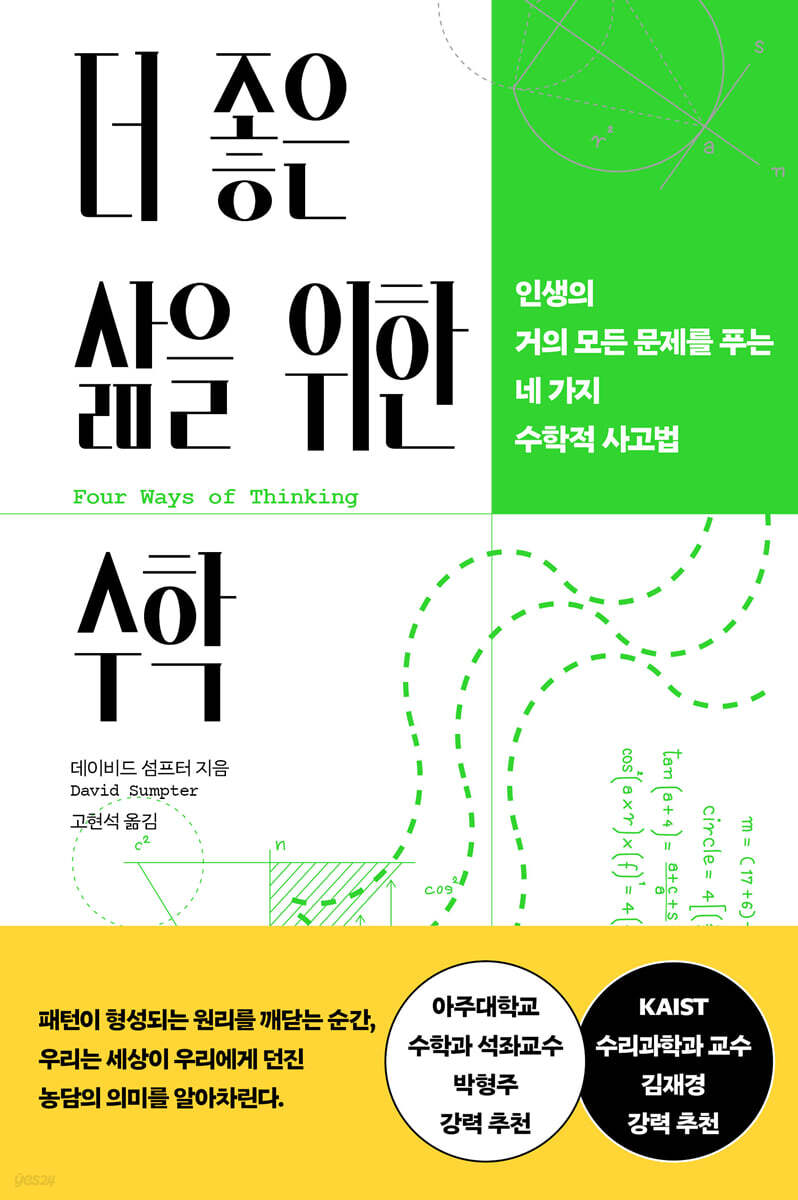
Mathematics for a Better Life
 |
Description
Book Introduction
Problems we face as we go through life
What if it could be solved as easily as a math problem?
Four mathematical thinking methods that will change your paradigm
Recommended by Park Hyung-joo (Professor Emeritus, Department of Mathematics, Ajou University) and Kim Jae-kyung (Professor, Department of Mathematical Sciences, KAIST)
Why should we study mathematics? The reason so many philosophers from ancient times, including Pythagoras, Plato, and Archimedes, were also mathematicians is because mathematics is a discipline that explores logical thinking.
Therefore, if you learn to think mathematically, you can create logic and evidence for your thoughts, and it is easier to find better answers to various problems in life.
In this book, David Sumpter, a professor of applied mathematics at Uppsala University in Sweden, introduces four mathematical thinking methods—statistical, interactional, chaotic, and complex systems—and explains how these concepts can be applied to everyday life.
In particular, it presents a method to simply solve the complex phenomena of the world we live in based on a mathematical model called cellular automata.
The author, who has given talks at Google, TEDx, Oxford, and other venues, and has contributed to various media outlets, is an active public mathematics communicator. In this book, which is based on his experience participating in a complexity summer school, he explains various mathematical concepts in an easy-to-understand way.
It also shows the stories of mathematicians for whom mathematics was their life, along with the story of the author, the main character.
In the book, you can look at the lives of great mathematicians such as Alfred Lotka, who explained the dynamics of nature as a prey-predator model in which things constantly cycle and influence each other; Margaret Hamilton, who contributed to the success of the Apollo 11 mission by drastically reducing errors in spacecraft launch and takeoff and landing programs with mathematical reasoning; and Andrei Nikolayevich Kolmogorov, a genius who cannot be left out in the history of modern mathematics who connected the complexity of mathematics with the value of life.
By seeing them solve everyday problems like work, career, friendship, and love with mathematical thinking, you can easily learn how to apply mathematical thinking to your own life.
What if it could be solved as easily as a math problem?
Four mathematical thinking methods that will change your paradigm
Recommended by Park Hyung-joo (Professor Emeritus, Department of Mathematics, Ajou University) and Kim Jae-kyung (Professor, Department of Mathematical Sciences, KAIST)
Why should we study mathematics? The reason so many philosophers from ancient times, including Pythagoras, Plato, and Archimedes, were also mathematicians is because mathematics is a discipline that explores logical thinking.
Therefore, if you learn to think mathematically, you can create logic and evidence for your thoughts, and it is easier to find better answers to various problems in life.
In this book, David Sumpter, a professor of applied mathematics at Uppsala University in Sweden, introduces four mathematical thinking methods—statistical, interactional, chaotic, and complex systems—and explains how these concepts can be applied to everyday life.
In particular, it presents a method to simply solve the complex phenomena of the world we live in based on a mathematical model called cellular automata.
The author, who has given talks at Google, TEDx, Oxford, and other venues, and has contributed to various media outlets, is an active public mathematics communicator. In this book, which is based on his experience participating in a complexity summer school, he explains various mathematical concepts in an easy-to-understand way.
It also shows the stories of mathematicians for whom mathematics was their life, along with the story of the author, the main character.
In the book, you can look at the lives of great mathematicians such as Alfred Lotka, who explained the dynamics of nature as a prey-predator model in which things constantly cycle and influence each other; Margaret Hamilton, who contributed to the success of the Apollo 11 mission by drastically reducing errors in spacecraft launch and takeoff and landing programs with mathematical reasoning; and Andrei Nikolayevich Kolmogorov, a genius who cannot be left out in the history of modern mathematics who connected the complexity of mathematics with the value of life.
By seeing them solve everyday problems like work, career, friendship, and love with mathematical thinking, you can easily learn how to apply mathematical thinking to your own life.
- You can preview some of the book's contents.
Preview
index
Recommendation
Introduction: Four Mathematical Thinking Methods
Beginning the journey to Seomun
Chapter 1 Statistical Thinking
Young geniuses met in Santa Fe | The trap of averages in statistics | Fisher's plausible answer | The power of statistics | How to live 12 years longer | How do you drink tea? | A happy world in numbers | What is my happiness score? | The dangers of statistics revealed by Fisher | Don't confuse the forest for the trees | Changing perspective
Chapter 2: Interactive Thinking
The Circle of Life | Why Steady State Never Reaches | Social Chemistry | The Secrets Behind Social Contagion and Recovery | The Whole Is Greater Than Its Parts | How to Get Friends to Exercise | Discovering the Third Law? | Cellular Automata | The Art of Desirable Argument | Bottom-Up vs. Bottom-Up
Top-down thinking
Chapter 3 Chaotic Thinking
Deducing the next step | From steady state to chaos | Chaos problem encountered at a bar | Catastrophe brought about by extreme determination | Mistake | Butterfly effect | Looking at the night sky: Part 1 | Looking at the night sky: Part 2 | The perfect wedding | Cellular chaos | Sending a message from B to C | Randomness is information | Twenty questions game | Good listeners always ask questions | Entropy never decreases | We live in a distribution | What word games teach us | How to make better choices | A sea of words
Chapter 4 Complex Systems Thinking
World Congress of Mathematicians | The essence of the matrix | Four people in a car | As complex as the simplest explanation | Numbers alone are not enough | The fourth category of thinking | Everything about life | A new lens for understanding social structure | We become human through other people | Here we are! | Complex problems | Almost always complex problems | Who am I? | A life made of short scenes | Explanations that cannot be expressed in words | The less you say, the more meaningful it becomes | Four ways | A life worth living
Acknowledgements
References
Introduction: Four Mathematical Thinking Methods
Beginning the journey to Seomun
Chapter 1 Statistical Thinking
Young geniuses met in Santa Fe | The trap of averages in statistics | Fisher's plausible answer | The power of statistics | How to live 12 years longer | How do you drink tea? | A happy world in numbers | What is my happiness score? | The dangers of statistics revealed by Fisher | Don't confuse the forest for the trees | Changing perspective
Chapter 2: Interactive Thinking
The Circle of Life | Why Steady State Never Reaches | Social Chemistry | The Secrets Behind Social Contagion and Recovery | The Whole Is Greater Than Its Parts | How to Get Friends to Exercise | Discovering the Third Law? | Cellular Automata | The Art of Desirable Argument | Bottom-Up vs. Bottom-Up
Top-down thinking
Chapter 3 Chaotic Thinking
Deducing the next step | From steady state to chaos | Chaos problem encountered at a bar | Catastrophe brought about by extreme determination | Mistake | Butterfly effect | Looking at the night sky: Part 1 | Looking at the night sky: Part 2 | The perfect wedding | Cellular chaos | Sending a message from B to C | Randomness is information | Twenty questions game | Good listeners always ask questions | Entropy never decreases | We live in a distribution | What word games teach us | How to make better choices | A sea of words
Chapter 4 Complex Systems Thinking
World Congress of Mathematicians | The essence of the matrix | Four people in a car | As complex as the simplest explanation | Numbers alone are not enough | The fourth category of thinking | Everything about life | A new lens for understanding social structure | We become human through other people | Here we are! | Complex problems | Almost always complex problems | Who am I? | A life made of short scenes | Explanations that cannot be expressed in words | The less you say, the more meaningful it becomes | Four ways | A life worth living
Acknowledgements
References
Detailed image

Into the book
The statistical relationships discovered in these data not only inform decision-making in governments, businesses, and other organizations, but also influence the decisions we make as individuals.
We also follow scientific research recommendations for everything from what to eat and how often to exercise to how to increase life satisfaction and study most effectively for exams.
But the challenge in applying statistical thinking to our lives lies not only in knowing what data can tell us, but also in being clear about what it cannot tell us.
Of all the scientific studies, which ones truly apply to individuals? Do the statistics we encounter represent causality, or are they simply correlations due to chance? To what extent should statistics and data influence our perception of the world? And when is it better to ignore the numbers and use other tools?
--- "The Trap of Averages in Statistics"
Before continuing our journey with other forms of thinking, let's take a closer look at this limitation.
Books, newspapers, social media, YouTube videos, and TED Talks give us access to a wide range of scientific research on our psychology, motivation, and personality.
All of these scientific studies offer suggestions on how we can become happier, more successful, and more satisfied with our lives.
So how do you find out which of these studies are applicable to you as an individual?
--- "Don't confuse the forest for the trees."
He drew a trajectory following the direction of the arrow with chalk.
The trajectory that started at the bottom right, that is, the point where the rabbit was further away than the fox, went up to the top right.
There were a lot of rabbits and foxes here.
But as the foxes began to prey on the rabbits and the rabbit population decreased, he reached the upper left quadrant, where the fox population also began to decline.
And finally, as we enter the lower left area of the board, the rabbit population increases again along with the decline of foxes.
As he moved back to the lower right quadrant, the cycle started over again.
Professor Parker said.
“This is why we will never reach a stable state.
Because the interactions between species lead us into an endless cycle.”
--- "Reasons for not reaching a stable state"
In this simulation, Aisha and Charlie started screaming at the same time and had difficulty stopping.
But in the new model, where Charlie tries not to respond to Aisha vocally, the frequency of arguments is noticeably reduced.
Ultimately, the only person we can change is ourselves.
But if we change the way we react to others—the basic rules of interaction—we can also change the outcomes of those interactions.
If Charlie screams less, Aisha will scream less too.
This is not because Aisha changed her rules, but because Charlie reacted less negatively to Aisha.
Charlie started the change, and it brought positive changes to both of them.
--- "The Art of Desirable Debate"
Another way to deal with chaos is to let go of your mind.
Whether you applied the double rule 30 times or blocked the holes on the billiard table and played 30 rounds, the details no longer matter.
Chaos means that it is no longer meaningful to try to figure out the initial conditions, to trace the dynamics step by step, or to know how many steps have been taken.
At this point, you should assume you don't know anything and simply start asking questions.
For example, “Is the ball on the left side of the pool table?” or “Is the ball on the top of the pool table?”
This principle applies to our lives as well.
A single automatic door we pass through on the subway, a meeting with a new person, a decision to drink coffee instead of going outside because it's raining, a single word we stumble over while speaking all make a subtle difference in our lives.
As time passes, entropy increases.
No matter how well we know ourselves today, we cannot know what will happen to us in the future.
--- "Entropy never decreases."
Chris said we all need to find life's jokes that say, "Here we go!"
We need to step outside the system to discover the larger truth and understand how complexity arises.
Chris added, “Wittgenstein’s ladder and the ‘Here you go!’ joke provide further insight.”
The insight is about how we understand how collective patterns emerge from individual interactions and then how we respond to them.
The moment we realize how patterns are formed, we move beyond our understanding of the phenomenon we are studying.
Only then do we realize the joke the world is playing on us.
At that moment, what was complicated becomes simple.
--- "It's here!"
No matter what the results of online tests say, or how others simplify or categorize Charlie, Charlie cannot be reduced to one or a few measures.
Likewise, it is dangerous to confine others to a certain framework.
It is wrong to label them as shy, confident, angry, cynical, smart, stupid, systematic, or confused.
Everyone's dimensions change depending on the context and the situation they are in.
So the answer to the question, “Who am I?” is that you cannot be defined by just one dimension.
Because you are a being with billions of dimensions.
We also follow scientific research recommendations for everything from what to eat and how often to exercise to how to increase life satisfaction and study most effectively for exams.
But the challenge in applying statistical thinking to our lives lies not only in knowing what data can tell us, but also in being clear about what it cannot tell us.
Of all the scientific studies, which ones truly apply to individuals? Do the statistics we encounter represent causality, or are they simply correlations due to chance? To what extent should statistics and data influence our perception of the world? And when is it better to ignore the numbers and use other tools?
--- "The Trap of Averages in Statistics"
Before continuing our journey with other forms of thinking, let's take a closer look at this limitation.
Books, newspapers, social media, YouTube videos, and TED Talks give us access to a wide range of scientific research on our psychology, motivation, and personality.
All of these scientific studies offer suggestions on how we can become happier, more successful, and more satisfied with our lives.
So how do you find out which of these studies are applicable to you as an individual?
--- "Don't confuse the forest for the trees."
He drew a trajectory following the direction of the arrow with chalk.
The trajectory that started at the bottom right, that is, the point where the rabbit was further away than the fox, went up to the top right.
There were a lot of rabbits and foxes here.
But as the foxes began to prey on the rabbits and the rabbit population decreased, he reached the upper left quadrant, where the fox population also began to decline.
And finally, as we enter the lower left area of the board, the rabbit population increases again along with the decline of foxes.
As he moved back to the lower right quadrant, the cycle started over again.
Professor Parker said.
“This is why we will never reach a stable state.
Because the interactions between species lead us into an endless cycle.”
--- "Reasons for not reaching a stable state"
In this simulation, Aisha and Charlie started screaming at the same time and had difficulty stopping.
But in the new model, where Charlie tries not to respond to Aisha vocally, the frequency of arguments is noticeably reduced.
Ultimately, the only person we can change is ourselves.
But if we change the way we react to others—the basic rules of interaction—we can also change the outcomes of those interactions.
If Charlie screams less, Aisha will scream less too.
This is not because Aisha changed her rules, but because Charlie reacted less negatively to Aisha.
Charlie started the change, and it brought positive changes to both of them.
--- "The Art of Desirable Debate"
Another way to deal with chaos is to let go of your mind.
Whether you applied the double rule 30 times or blocked the holes on the billiard table and played 30 rounds, the details no longer matter.
Chaos means that it is no longer meaningful to try to figure out the initial conditions, to trace the dynamics step by step, or to know how many steps have been taken.
At this point, you should assume you don't know anything and simply start asking questions.
For example, “Is the ball on the left side of the pool table?” or “Is the ball on the top of the pool table?”
This principle applies to our lives as well.
A single automatic door we pass through on the subway, a meeting with a new person, a decision to drink coffee instead of going outside because it's raining, a single word we stumble over while speaking all make a subtle difference in our lives.
As time passes, entropy increases.
No matter how well we know ourselves today, we cannot know what will happen to us in the future.
--- "Entropy never decreases."
Chris said we all need to find life's jokes that say, "Here we go!"
We need to step outside the system to discover the larger truth and understand how complexity arises.
Chris added, “Wittgenstein’s ladder and the ‘Here you go!’ joke provide further insight.”
The insight is about how we understand how collective patterns emerge from individual interactions and then how we respond to them.
The moment we realize how patterns are formed, we move beyond our understanding of the phenomenon we are studying.
Only then do we realize the joke the world is playing on us.
At that moment, what was complicated becomes simple.
--- "It's here!"
No matter what the results of online tests say, or how others simplify or categorize Charlie, Charlie cannot be reduced to one or a few measures.
Likewise, it is dangerous to confine others to a certain framework.
It is wrong to label them as shy, confident, angry, cynical, smart, stupid, systematic, or confused.
Everyone's dimensions change depending on the context and the situation they are in.
So the answer to the question, “Who am I?” is that you cannot be defined by just one dimension.
Because you are a being with billions of dimensions.
--- From "Who am I?"
Publisher's Review
Math has answers
Four Mathematical Thinking Methods for Solving Life's Uncertain Problems
When we struggle with problems in life that don't have easy answers, we often wish the answers were as clear and definitive as in mathematics.
Can't my life be solved as easily as a math problem?
David Sumpter, a professor of applied mathematics at Uppsala University in Sweden, proposes four mathematical methods of thinking centered around cellular automata models as a way to solve life's problems.
According to the author, "the core of science and mathematics is the search for better methods of reasoning." Cellular automata models are systems that generate unpredictably complex patterns from simple rules.
This shows the characteristic of mathematics that derives results through established rules.
Moreover, this model suggests that there are simple rules underlying the nature of seemingly complex phenomena.
Therefore, if we learn statistical, interactive, chaotic, and complex systems thinking derived from the patterns seen by cellular automata and apply them to our lives, life's problems that seemed complicated can be solved simply and we can obtain clear answers.
1) Statistical thinking
Statistical thinking is a way of judging situations based on numbers and data.
Repeated data is very helpful in predicting the future.
To properly utilize data, you need to properly understand the information represented in numbers.
It's about looking at how the data was collected and what pitfalls there are in the statistics that appear.
That is, probability and statistics are necessary to make rational decisions.
The book cites national happiness scores and the vast array of diet information available online as examples of statistical thinking.
The key to a healthy diet is eating fresh vegetables and avoiding processed foods that come in boxes or cans.
The average American supermarket carries over 40,000 products.
Most of them are processed foods, and many are marketed with health claims.
These marketing slogans exploit the lack of consensus on each diet's nutritional value to emphasize that their products are low-fat or low-carb.
But what it doesn't mention is that if the product is highly processed, there's no real benefit to being low-fat or low-carb.
―How to Live 12 Years Longer
In this age of information overload, you can now ask ChatGPT and receive all the information in the world within seconds.
However, as information overflows, the need for the ability to find the information we really need, the accurate information with basis, among the indiscriminate information becomes more evident.
2) Interactive thinking
-Interactional thinking refers to recognizing patterns that emerge as we interact with other people, society, and the world.
Contrary to the idea that the world will find a stable balance, it is actually constantly interacting and repeating infinite cycles.
Because the moment you grasp the pattern, you can simplify and easily solve life's seemingly complex problems.
This book shows how we can change our surroundings for the better by identifying various patterns that can emerge in groups, and how we can easily resolve conflicts with others.
Now the beauty of the tipping point is revealed.
Once a group crosses the threshold of five, a feedback effect maintains the group's status.
Peer pressure within the group now works towards maintaining health.
If Jennifer tries to revert to her previous unhealthy behaviors, her friends will remind her to go jogging or join an aerobics class.
Even the most passive members of the group start posting pictures in the group chat.
The important thing here is that the results are not proportional to the effort put in.
Initially, Jennifer had to work really hard to convince her friends, but once they got over the threshold, it took almost no effort to keep the group together.
―How to Get Your Friends Into Exercise
3) Chaotic thinking
-Chaotic thinking is a further development of interactional thinking, meaning that the patterns we observe are not always consistent.
Ironically, it is our attitude of trying to regulate ourselves within patterns that creates this chaos.
This explains the unpredictable nature of life.
The already well-known 'butterfly effect' is a good example of chaos.
The book introduces this by pointing out that it is actually the 'flapping of a seagull's wings'.
In 1972, when Lorenz couldn't come up with a title for his lecture, the organizers chose the question, "Can the flapping of a butterfly's wings in Brazil start a tornado in Texas?"
While this title is striking, it may give a slightly misleading impression about the concept of chaos.
This could be interpreted as meaning that a butterfly somewhere in the Amazon can cause a powerful tornado in Texas with a single flap of its wings.
To put the butterfly effect more precisely, we should say, “To accurately predict a storm that will occur in the North Atlantic two months from now, you need to know the atmospheric conditions all over the globe, including whether a butterfly in the Amazon has flapped its wings.”
What complicates matters isn't a particular butterfly, a piece of chocolate, or a single customer at the bar.
What makes life unpredictable is our inevitable limitations: not knowing about every butterfly, every chocolate, every strange thing.
―The Butterfly Effect
4) Complexity thinking
The most important complexity-based thinking approach in this book is understanding the statistical, interactional, and chaotic thinking approaches introduced earlier, and accepting that all of these can appear individually or at times all at once.
Understanding complex systems thinking means understanding that we can influence one another, that this can have irregular and unpredictable consequences, and that we cannot perfectly define one another.
When we accept the problem as it is and acknowledge that we and others are complex beings, we find simple solutions.
This lesson holds us all accountable.
Whether because of your role at work or your social standing, if you are influential or popular, think about how you can use your physical location to avoid excluding others.
You should not create closed friend groups that prevent others from joining.
When walking with other people, look back and make sure no one is walking alone.
Sometimes, sit next to someone you don't know in class and strike up a conversation.
The way we interact unintentionally and collectively creates rigid boundaries between us.
It is each individual's responsibility to recognize where these boundaries lie and to break them down.
―“A New Lens for Understanding Social Structure”
How did great mathematicians solve the problems of their lives?
Their stories of finding enlightenment through mathematics
This book introduces episodes of mathematicians who actually solved problems in their lives through four mathematical thinking methods.
Alfred Lotka, who explained the dynamics of nature as a prey-predator model in which things constantly cycle and influence each other; Margaret Hamilton, who contributed to the success of the Apollo 11 mission by drastically reducing errors in spacecraft launch and takeoff and landing programs using mathematical reasoning; and Andrei Nikolayevich Kolmogorov, a genius who cannot be left out in the history of modern mathematics who connected the complexity of mathematics with the value of life. They all clearly solved complex problems using mathematics as a tool.
The problems they tried to solve with mathematics are no different from the concerns we face in our daily lives, such as work and career, friendship and love, and human relationships.
Therefore, through this book, we can easily apply mathematical thinking to our lives, just as they did.
The moment you realize the principle of pattern formation
'We realize the meaning of the jokes the world throws at us'
Studying mathematics to understand the principles of the world and live a better life.
This book demonstrates, through various examples and the lives of several mathematicians, that mathematics can go beyond simple calculations and become a tool for philosophical thought.
David Sumpter's exceptional ability as a mathematical communicator stands out, particularly in his ability to explain what it means to think mathematically without complex formulas or difficult calculations.
The author, as well as the mathematicians featured in this book, ultimately hope to use mathematics to reduce unnecessary arguments, be considerate of others, better understand loved ones, and discover who they are.
These stories show us that mathematics, which has been perceived as rigid and cold, is actually a warm discipline that meticulously understands the world.
Four Mathematical Thinking Methods for Solving Life's Uncertain Problems
When we struggle with problems in life that don't have easy answers, we often wish the answers were as clear and definitive as in mathematics.
Can't my life be solved as easily as a math problem?
David Sumpter, a professor of applied mathematics at Uppsala University in Sweden, proposes four mathematical methods of thinking centered around cellular automata models as a way to solve life's problems.
According to the author, "the core of science and mathematics is the search for better methods of reasoning." Cellular automata models are systems that generate unpredictably complex patterns from simple rules.
This shows the characteristic of mathematics that derives results through established rules.
Moreover, this model suggests that there are simple rules underlying the nature of seemingly complex phenomena.
Therefore, if we learn statistical, interactive, chaotic, and complex systems thinking derived from the patterns seen by cellular automata and apply them to our lives, life's problems that seemed complicated can be solved simply and we can obtain clear answers.
1) Statistical thinking
Statistical thinking is a way of judging situations based on numbers and data.
Repeated data is very helpful in predicting the future.
To properly utilize data, you need to properly understand the information represented in numbers.
It's about looking at how the data was collected and what pitfalls there are in the statistics that appear.
That is, probability and statistics are necessary to make rational decisions.
The book cites national happiness scores and the vast array of diet information available online as examples of statistical thinking.
The key to a healthy diet is eating fresh vegetables and avoiding processed foods that come in boxes or cans.
The average American supermarket carries over 40,000 products.
Most of them are processed foods, and many are marketed with health claims.
These marketing slogans exploit the lack of consensus on each diet's nutritional value to emphasize that their products are low-fat or low-carb.
But what it doesn't mention is that if the product is highly processed, there's no real benefit to being low-fat or low-carb.
―How to Live 12 Years Longer
In this age of information overload, you can now ask ChatGPT and receive all the information in the world within seconds.
However, as information overflows, the need for the ability to find the information we really need, the accurate information with basis, among the indiscriminate information becomes more evident.
2) Interactive thinking
-Interactional thinking refers to recognizing patterns that emerge as we interact with other people, society, and the world.
Contrary to the idea that the world will find a stable balance, it is actually constantly interacting and repeating infinite cycles.
Because the moment you grasp the pattern, you can simplify and easily solve life's seemingly complex problems.
This book shows how we can change our surroundings for the better by identifying various patterns that can emerge in groups, and how we can easily resolve conflicts with others.
Now the beauty of the tipping point is revealed.
Once a group crosses the threshold of five, a feedback effect maintains the group's status.
Peer pressure within the group now works towards maintaining health.
If Jennifer tries to revert to her previous unhealthy behaviors, her friends will remind her to go jogging or join an aerobics class.
Even the most passive members of the group start posting pictures in the group chat.
The important thing here is that the results are not proportional to the effort put in.
Initially, Jennifer had to work really hard to convince her friends, but once they got over the threshold, it took almost no effort to keep the group together.
―How to Get Your Friends Into Exercise
3) Chaotic thinking
-Chaotic thinking is a further development of interactional thinking, meaning that the patterns we observe are not always consistent.
Ironically, it is our attitude of trying to regulate ourselves within patterns that creates this chaos.
This explains the unpredictable nature of life.
The already well-known 'butterfly effect' is a good example of chaos.
The book introduces this by pointing out that it is actually the 'flapping of a seagull's wings'.
In 1972, when Lorenz couldn't come up with a title for his lecture, the organizers chose the question, "Can the flapping of a butterfly's wings in Brazil start a tornado in Texas?"
While this title is striking, it may give a slightly misleading impression about the concept of chaos.
This could be interpreted as meaning that a butterfly somewhere in the Amazon can cause a powerful tornado in Texas with a single flap of its wings.
To put the butterfly effect more precisely, we should say, “To accurately predict a storm that will occur in the North Atlantic two months from now, you need to know the atmospheric conditions all over the globe, including whether a butterfly in the Amazon has flapped its wings.”
What complicates matters isn't a particular butterfly, a piece of chocolate, or a single customer at the bar.
What makes life unpredictable is our inevitable limitations: not knowing about every butterfly, every chocolate, every strange thing.
―The Butterfly Effect
4) Complexity thinking
The most important complexity-based thinking approach in this book is understanding the statistical, interactional, and chaotic thinking approaches introduced earlier, and accepting that all of these can appear individually or at times all at once.
Understanding complex systems thinking means understanding that we can influence one another, that this can have irregular and unpredictable consequences, and that we cannot perfectly define one another.
When we accept the problem as it is and acknowledge that we and others are complex beings, we find simple solutions.
This lesson holds us all accountable.
Whether because of your role at work or your social standing, if you are influential or popular, think about how you can use your physical location to avoid excluding others.
You should not create closed friend groups that prevent others from joining.
When walking with other people, look back and make sure no one is walking alone.
Sometimes, sit next to someone you don't know in class and strike up a conversation.
The way we interact unintentionally and collectively creates rigid boundaries between us.
It is each individual's responsibility to recognize where these boundaries lie and to break them down.
―“A New Lens for Understanding Social Structure”
How did great mathematicians solve the problems of their lives?
Their stories of finding enlightenment through mathematics
This book introduces episodes of mathematicians who actually solved problems in their lives through four mathematical thinking methods.
Alfred Lotka, who explained the dynamics of nature as a prey-predator model in which things constantly cycle and influence each other; Margaret Hamilton, who contributed to the success of the Apollo 11 mission by drastically reducing errors in spacecraft launch and takeoff and landing programs using mathematical reasoning; and Andrei Nikolayevich Kolmogorov, a genius who cannot be left out in the history of modern mathematics who connected the complexity of mathematics with the value of life. They all clearly solved complex problems using mathematics as a tool.
The problems they tried to solve with mathematics are no different from the concerns we face in our daily lives, such as work and career, friendship and love, and human relationships.
Therefore, through this book, we can easily apply mathematical thinking to our lives, just as they did.
The moment you realize the principle of pattern formation
'We realize the meaning of the jokes the world throws at us'
Studying mathematics to understand the principles of the world and live a better life.
This book demonstrates, through various examples and the lives of several mathematicians, that mathematics can go beyond simple calculations and become a tool for philosophical thought.
David Sumpter's exceptional ability as a mathematical communicator stands out, particularly in his ability to explain what it means to think mathematically without complex formulas or difficult calculations.
The author, as well as the mathematicians featured in this book, ultimately hope to use mathematics to reduce unnecessary arguments, be considerate of others, better understand loved ones, and discover who they are.
These stories show us that mathematics, which has been perceived as rigid and cold, is actually a warm discipline that meticulously understands the world.
GOODS SPECIFICS
- Date of issue: May 28, 2025
- Page count, weight, size: 388 pages | 522g | 146*214*20mm
- ISBN13: 9788965967194
- ISBN10: 8965967198
You may also like
카테고리
korean


korean

![GQ KOREA Mark (Monthly): December [2025]](http://librairie.coreenne.fr/cdn/shop/files/8ef265dbbfbf186523ed75ba7319009d.jpg?v=1765340328&width=3840)


